Running head: SEX DIFFERENCES IN SUBJECTIVE ESTIMATION OF TIME
Sex Differences in Subjective Estimation of Time During the Performance of Verbal and Spatial Tasks
Julio C. Penagos and Alejandra Ciria
Abstract
Differences between sexes in the subjective estimation of time when performing tasks of verbal fluency and mental rotation of 3-D images were studied in this research. 240 Mexican college students were divided in six groups; one male and one female group for each condition: Verbal, Spatial, and Control tasks. Subjects were asked to perform their corresponding task during two minutes which they had to estimate by themselves. No significant time estimation differences (p = .6913) between sexes were found when performing the verbal fluency task. However, significant time estimation differences (p = .0265) between the male and the female group were found with the mental rotation task. In addition, no significant time estimation differences between sexes were observed as for verbal fluency skills (p = .8265) and mental rotation (p = .4506). Results are discussed in terms of the evidence that shows that men have a higher activation in the right parietal region when performing mental rotation of 3-D images and estimating time prospectively. The way that different tasks affect the perceived length of psychological present depending on the cognitive processes used to perform each task is discussed as well.
Sex Differences in Subjective Estimation of Time During the Performance of Verbal and Spatial Tasks
The skill to estimate short time intervals has a routine but important role in everyday life. Time estimation is important at making decisions on a particular action that requires a response in a certain time interval (Taatgen, Anderson and Hedderik, 2007).
Psychological time is a relatively unexplored issue that involves time adaption processes and represents time properties to synchronize actions with external events (Block, Hancock and Zakay, 2000). In real life, this type of time interval estimation tasks is usually implicit, automatic, and strongly associated with other cognitive processes such as perception, learning, and decision-making (Taatgen, Anderson and Hedderik, 2007).
According to Block, Hancock and Zakay (2000), the study of psychologic time has direct implications on the understanding of sex differences regarding cognitive processes. Results from several authors show the existence of sex differences in time estimation (Rammsayer and Lustnauer, 1989) as well as other cognitive processes such as the performance of certain verbal and visual-spatial tasks (Halari, Hiles, Kimari, Mehrotra, Wheeler, Ng and Sharma, 2005). However, there is apparently not enough evidence to show the existence of sex differences in time estimation during the performance of verbal or visual-spatial tasks.
Time Perception
life and yet so poorly understood than psychological time. This implies subjective estimation of time. The lack of a physical correlation with time perception is a reason for this. Gibson (cited by Fraisse, 1984) concluded that events are perceptible whereas time is not.
Fraisse (1984) distinguished two basic pyshological time concepts: succession—the fact that two or more events can be perceived as different and organized in a
sequence—and duration—the interval between two successive events. Fraisse (1984) further explains that time perception is used to describe the constant feeling of
“psychological present”, which is delimited by durations of no longer than 4 seconds. As intervals shorter than 4 seconds are perceived as psychological present, when intervals are longer future and past arise. Then duration is commonly divided in categories spanning from less than one second, one to four seconds, four seconds to a few minutes, minutes to hours, days, months, and years, historical time and geological time. Fraisse (1984) According to Aschoff (1985), exact limits are hard to define, thus it can be assumed that different cognitive processes are used to estimate the duration of different categories.
In turn, sensorial memory is used in the perception of psychological present whereas short-time memory is needed to estimate intervals from seconds to a few minutes (Levin and Zakay, 1989). Long-term memory is probably used to estimate hours, days, years, and learning processees, past experiences, and attitudes are involved in this process. Therefore, the span from 4 seconds to 1-2 minutes are most convenient for the study of subjective time estimation processes (Levin and Zakay, 1989).
organized within a certain time interval influences on its perceived length. Moreover, Schiffman points out that organization and memory change the apparent lengths.
According to Schiffman (2002), an alternative view to Ornstein’s theory suggests that attention is divided into two processors: information and temporal. The less attention is given to information processing and the more attention to time passing, a longer time duration is experienced, whereas if attention is focused on an absorbing task, time seems to be shorter (Schiffman, 2002).
When properly considered, an irreducible connection between the seemingly innate perception of a certain time, the progressive present, and the conscious phenomenon of awareness is likely to exist (Lynds, 2003). Without the conception of the present moment in time, conscious cognition would not be possible (Lynds, 2003).
Every behavior—from the macro level of actions, perceptions, and thoughts to the micro level of brain functions, neuronal nets, and individual neuronal responses— happens in time (Brown, 2005). These processes have their own temporal dynamics, operate within their own time scales, and at the same time affect the timing of other processes and mechanisms (Brown, 2005).
The conscious awareness necessarily demands that mental content remains consciously for a time interval (Lynds, 2003). Without the conscious awareness,
construction also seems to be an important factor to create a conscious, unified, and coherent experience.
Factors that affect the subjective estimation of time.
Several factors affect time estimation. Block et al (2000) point out that some of the most important factors are the length of time to be estimated and the time duration paradigm. Another variable that may possibly influence time estimation is whether a person who will be required to estimate time duration knows in advance the length of time to be estimated (Block et al, 2000). In the prospective paradigm, the person knows this; in the retrospective paradigm, the person does not (Block et al, 2000). Magnitude and variability of the estimated time duration critically depend on this variable.
Prospective estimations are usually longer in magnitude and shorter in variability than retrospective estimations (Block et al, 2000).
In the retrospective paradigm, the magnitude of time estimation is directly related to the amount of attention paid to the temporal information processed during the length of the task to be estimated (Block et al, 2000). In brief, prospective time estimation is a task that requires division of attention. According to Block et al (2000), whether there is a sex difference in the ability to divide attention, sex interaction and processing
difficulty would be expected to be found. However, some works mentioned by Block et al (2000) provide poor evidence of small sex differences in the ability to divide
attention.
amount of attentional resources. When either of this occurs, less time units are processed and the person tends to say that the time interval is shorter. In another research cited by Schiff and Oldak (1990), it was found that tape recordings with attractive information were judged as shorter than others without interesting information. These tapes had sexual content that involved higher levels of arousal (Schiff and Oldak, 1990).
Sex Differences
There are well-documented sex differences in some cognitive abilities (Hausmann et al, 2000). In various research papers, it has been found that women tend to perform better in specific aspects of verbal ability, such as verbal fluency. On the other hand, it has been often documented that men have a better performance in spatial tasks such as those that imply mental rotation of objects (Hausmann et al, 2000). Likewise, sex differences regarding time perception have been found (Rammsayer and Lustnauer, 1989).
The term ‘vebal abilities’ does not imply one single item. It is applied to several components of language use: fluency to generate words, grammar, reading,
pronunciation, verbal analogies, vocabulary, and oral comprehension (Halpern, 1992). Verbal fluency differences between men and women have been found, with women outperforming men (Rahman, Abrahams and Wilson, 2003). Verbal fluency tests require participants to utter as many words starting with a particular letter or belonging to some category as possible during a certain period of time.
association between shapes and objects (Halpern, 1992). Visual-spatial abilities are seemingly comprised of the three following factors, beside the visualization and spatial analysis ability (Halpern, 1992):
1. Spatial perception: Requires the person to locate either vertical or horizontal shapes while ignoring distracting information.
2. Mental rotation: The ability to imagine how an object would look like when rotated or how thin when folded or how solid it would be when unfolded.
3. Spatial visualization: It refers to complexity and analysis of spatial information processing.
Results about sex differences in visual-spatial abilities seem to be more conclusive than results about other cognitive abilities (Halpern, 1992). However, several studies state that the magnitude of such a difference has diminished noticeably in recent years (Hausmann et al, 2000). In addition, Hausmann et al (2000) cite other research papers which state that sex differences in visual-spatial tasks can be eliminated through practice. Nonetheless, the 3-D mental rotation test seems to produce the greatest sex difference among all spatial tests (Hausmann et al, 2000).
In addition, sex differences in time perception with regard to auditory stimuli have been found. Rammsayer and Lustnauer (1989) conducted a research where men
achieved better results than women as for discrimination, duration, and time required for every session (Rammsayer and Lustnauer, 1989). In turn, Schiff and Oldak (1990) found in a literary review that women’s estimations are in general less accurate than men’s. This apparent difference in judgement accuracy may be a consequence of the fact that women’s estimations are more conservative than men’s (Schiff and Oldak, 1990). According to the literature reviewed by Schiff and Oldak (1990), this may be explained because either women use a larger “safety margin” than men or they have less spatial-temporal abilities.
Recent research papers reviewed by Block, Hancock, and Zakay (2000) corroborate that women underestimate time duration more than men. In addition, Block et al (2000) found after a literature review that there are sex differences in magnitude and variability of estimated time duration. These differences are attributed to spatial-temporal
perception abilities.
By taking into account that there are sex differences in subjective time estimation as well as in verbal and visual-spatial abilities, this work studies possible sex differences in subjective estimation of prospective time duration while verbal and visual-spatial tasks are performed.
Method
240 college students from Universidad de las Américas, Puebla, Mexico, 120 male and 120 female, within an age range of 18-30 years old from a medium-high socioeconomic status were randomly selected.
Participants were randomly assigned to six groups. 120 female participants were assigned to two experimental groups and one control group: A1, B1, C1, and 120 male participants were assigned to two experimental groups and one control group: A2, B2, C2. Groups A1 and A2 were composed of 20 subjects each, who were asked to
subjectively estimate the duration of 2 minutes while they performed a verbal task. Groups B1 and B2 were composed of 20 subjects each, who were asked to subjectively estimate the duration of 2 minutes while they performed a spatial task. Finally, Groups C1 and C2 were composed of 20 subjects each, and were asked to subjectively estimate the duration of 2 minutes while they manipulated a repetitive moving image.
Instruments
A software program written in Perl language version 5.006001 was used for manipulation of independent variables and measurement of studied variables in this research. This program generates HTML (Hyper text Markup Language) and javaScript codes in a server with Linux operating system and Debian distribution, version 2.4.18-bf2.4, which runs a web Apache server version 1.3. Three instruments were designed for the verbal, spatial, and control tasks.
letter, contain a second requested letter, and end with a third and different letter. The amount of given answers and correct guesses are automatically recorded when task ends.
Instrument 2 - spatial (mental rotation) task (adapted from Shepard and Metzler (1971) images): It starts with a series of detailed instructions with examples. The task consists of deciding whether two 3-D images are the same one but rotated or are completely different. The amount of given answers and correct guesses are automatically recorded when task ends.
Instrument 3 – control task: It consists of manipulating an image created by Foster (2002) with a mouse.
In order to measure time, JavaScript routines were used with the Client PC clock so that errors were not induced due to transmission and reception times to/from the Web Server. A precision of thousands of a second was handled. The following data was automatically registered: time used for the test, time difference in relation to the time set to be estimated, answered items and right answers (for the verbal and spatial tasks).
Task ability was evaluated by dividing the number of right answers to the task into the time estimated subjectively by each participant. The task ended when each
between the subjectively estimated two minutes and the objective time measured.
Instruments were applied in two Pentium 4 PC computers with processor at a 2 GHz speed and 512 Mb RAM, a 32-bit, 1024 x 786 pixel screen resolution. Computers were located in two separate rooms where subjects were isolated from stimuli that could somehow signal time passing. Each computer had Mozilla Firefox Version 2.0 for execution of the three instruments.
Procedure
This study has a 2x3 research design, where the sex variable has two conditions (male and female) and the task variable has three conditions (two cognitive and one control task). The control task was developed in order to know whether the verbal or spatial task triggered any difference in the way time was estimated.
The four Experimental groups: A1, A2, B1, and B2 were given the following instructions: “Before you start the test, please take off your watch and turn off your mobile telephone. Next, a series of detailed instructions will be shown to you, but in brief the task consists of estimating as best as possible the passing of two minutes while you answer as many exercises as possible. Whenever you consider that two minutes have passed, be sure to end the test.”
series of detailed instructions will be shown to you, but in brief the task consists of estimating as best as possible the passing of two minutes. Whenever you consider that two minutes have passed, be sure to end the test.”
As cited above, the 4 second-2 minute range is ideal for studying subjective time estimation processes (Levin and Zakay, 1989). Thus the time considered here is 2 minutes since time estimation during the execution of either a verbal (verbal fluency) task or a spatial (mental rotation) task is researched. Therefore, the 2 minute-period set as the task length meet the research needs and at the same time make subject
participation easier due to the test short duration. In addition, the decision on using the prospective paradigm in all three conditions was made. The tasks require division of attention, and no significant sex differences regarding ability to divide attention have been found (Herlitz et al.; Seth-Smith, Ashton and McFarland, cited by Block, Hancock and Zakay, 2000). Furthermore, the Prospective Paradigm is appropriate for
methodological needs because it makes the measurement of subjective time estimation (2 minutes) easier.
Results
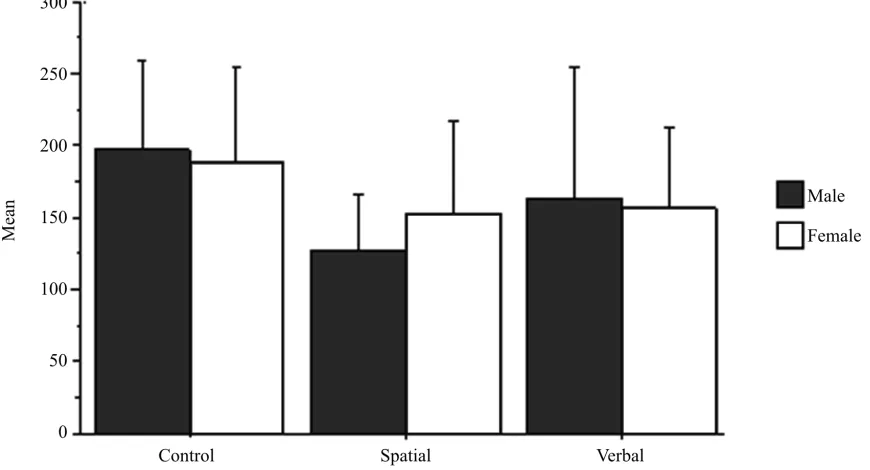
conducting Fisher’s PLSD test for subjectively estimated time between tests and sex difference in time estimation, a significant difference (p = .0001) in estimated time between the spatial task and the control task was observed. Moreover, there was a significant difference (p = .0014) in estimated time between the verbal task and the control task. However, no significant differences (p = .0736) in estimated time between the spatial and verbal tasks were observed. With regard to sex differences, no
significant differences (p = .6489) in subjective time estimation between men and women were found. Therefore, there were no significant sex differences in estimated time between the six groups. Figure 1 shows grouped data for each task: verbal, control, and spatial both for men and women. Results show that both female and male subjects overestimated time in the control task. In contrast, time estimation was more accurate for both sexes in both the spatial and the verbal tasks, although men in the spatial task obtained a media that was closer to the 120 seconds they were requested to estimate.
Results from men in all three conditions as well as from women in all three conditions were separated and analyzed as separate groups. For the male group,
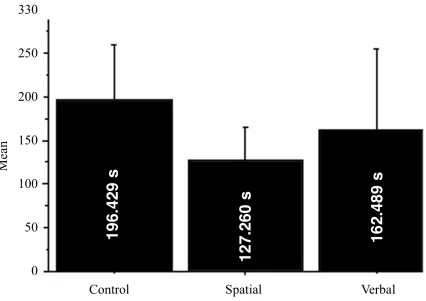
performance on subjective estimation of time in every test was analyzed by means of a one-way ANOVA aimed at knowing under what condition men performed better in the 120-second estimation. Significant differences (F = 10.224, p < .0001) in time
estimation by men were found between the verbal, spatial and control tasks. In Figure 2, it may be observed that men estimated the 120-second period quite more accurately in the spatial task, with a media of 127.26 seconds, in comparison to the estimated time medias obtained in the verbal and control tasks, where in general time was
Figure 2. Interaction bar plot for time – male
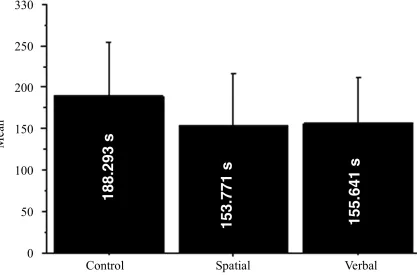
As for the female group, an identical analysis of performance on subjective time estimation in every condition by means of one-way ANOVA tests was conducted. A significant difference (F = 3.891, p = .0231) in time estimated by women was found in all three tasks. In Figure 3, it may be observed that women estimated time in a very similar fashion in the spatial and the verbal tasks. However, a considerable time
was found between the spatial and control tasks (p = .0146).
Figure 3. Interaction bar plot for time - female
No significant sex differences of performance on subjective time estimation in the verbal task (t = .399, p = .6913) were found. Likewise, no significant sex differences (t = .566, p = .5732) were found in the control task. On the other hand, there were
significant sex differences in the spatial task (t = -2.262, P = .0265).
Discussion
In the obtained results, no significant sex difference in subjective time estimation performance during the verbal task was observed. However, there was a significant sex difference in subjective time estimation performance in the spatial task. This partially corroborates the hypothesis that postulates that sex in interaction with verbal and visual-spatial tasks should influence on subjective time estimation performance.
Cognitive Psychology has generated various attentional models for time perception (Grondin, 2001). It has been found that when time is estimated under prospective paradigm conditions, the number of stimuli processed during a certain period of time inversely correlates with the estimated subjective length (Hicks, Millar, Gaes, and Bierman; Hicks et al; Zakay, cited by Grondin, 2000).
Likewise, perception depends on the presence of attention (Thomas and Cantor; Thomas and Weaver, cited by Grondin, 2001). It is commonly assumed that attention is a system with a limited capacity (Grondin, 2001). Therefore, if two tasks are processed simultaneously, available attention for each task is reduced (Grondin, 2001).
and Macar; Casini, Macar and Grondin; Grondin and Macar; Macar, Grondin and Casini; Zakay, cited by Brown and Boltz, 2002).
In this research, subjects were informed through instructions that the most important part of the task was the right calculation of two minutes. This was aimed at making subjects pay more attention to time calculation than number of right answers to the task. Thus subjects were prevented from underestimating time considerably if they had focused mainly on either the verbal or spatial task and paid little attention to time. In comparison with the control groups, the verbal and spatial task groups estimated the 2 minutes quite more accurately.
Then, when there is less attention capacity for time processing, the perceived period of time appears as shorter (Grondin, 2000). This could explain why both men and women overestimated time when making the control task. Likewise, the spatial and vebal tasks probably were more interesting stimuli than the control task. According to Schiff and Oldak (1990), positive stimuli cause an underestimation of time length.
By using prospective time along this research, sex differences in time estimation were eliminated. In various experiments that used the prospective paradigm for
manner, but when men and women interacted with a visual-spatial task, significant differences occurred.
In addition, it was found that the verbal task does not influence subjective time estimation in women. There were no differences in time estimation performance by women between the verbal and spatial tasks. This rejects the hypotheses stating that women have a better performance in subjective time estimation when performing a verbal task.
The capacity to register time order and structure of outer world events requires a coherent synchrony with visual perception (Battelli, Cavanagh, Martín and Barton; Nishida and Johnston; Walsh, cited by Alexander, Cowey and Walsh, 2005), time of motor behavior (Miall; Wing and Kristofferson, cited by Alexander, Cowey and Walsh, 2005), and estimation of time interval length (Wearden, cited by Alexander, Cowey and Walsh, 2005).
At the same time, relevant brain areas for time perception have been identified. However, several lines of research have shown that the lower right region of parietal cortex is indispensable for time perception (Alexander, Cowey and Walsh, 2005). As well, Rao et al (cited by Alexander, Cowey and Walsh, 2005) have observed a relevant activity in the lower right region of parietal cortex when time is estimated prospectively. It is likely that the right parietal cortex uses representation systems that are codified spatially (Walsh, cited by Alexander, Cowey and Walsh, 2005) and are common to time, space and quantity.
(Gaillard, Hertz-Pannier, Mott, Barnett, LeBihan and Theodore, 2000). It is possible that no relevant information regarding perceived time is provided when performing a verbal task. Then, during the performance of the verbal fluency task, no brain regions which use the same spatially codified representation system, common to time, are activated. Thus subjective time estimation is not influenced.
Also, Weiss, Siedentopf, Hofer, Deisenhammer, Hoptman, Kremser, Golaszewski, Felber, Fleischhacker, and Delazer (2003) studied sex differences in brain activation patterns during a verbal fluency task with subjects who presented no significant sex differences in the task performance. Both men and women had a significant brain activation in the left prefrontal cortex, right prefrontal cortex, cingulate gyrus, and right region of the cerebellum (Weiss et al, 2003). Then no significant sex differences in brain activation pattern during a verbal fluency task were found when there are no performance differences (Weiss et al, 2003). In this research, no significant sex differences in number of right answers for the verbal task (performance) in relation to subjectively estimated time. Therefore, as there are no sex differences in brain
activation pattern during a verbal fluency task (when there are no performance
differences), the fact that no sex differences in subjective estimation of time under this condition were observed can be explained.
In turn, the spatial task influenced men’s subjective estimation of time since there were a significant difference in estimated time performance between the spatial and verbal tasks. This provides confirmation that men have a better performance in subjective estimation of time while executing a 3-D visual-spatial task.
problems in relation to time (Battelli et al; Haaland and Knight, cited by Alexander, Cowey and Walsh, 2005). Critchley (cited by Alexander, Cowey and Walsh, 2005) noticed that the temporary deficit typically coincides with patients with parietal damage who display a wide array of errors as for temporary experience. These patients are unable to judge time passing during medical sessions, such as an interview. Time seems to pass very quickly; objects seem to move very rapidly, very slowly, or not smoothly.
When the right parietal cortex is used in representation systems that are spatially codified for time, space, and quantity, it shows the need for a common measure of time and space in order to assure a correct action that requires information about time
(Alexander, Cowey and Walsh, 2005). It is suggested that since brain activation sites are closely related while performing a mental rotation task and estimating time
prospectively, time calculation is easier due to the type of cognitive processes carried out in both tasks. Then it is likely that estimation of time while performing a mental rotation task —which implies visual-spatial abilities— causes a more accurate
calculation than while executing other kind of tasks which does not involve this type of abilities.
task. However, men showed a higher right parietal activation than women (Rilea et al, 2004). Likewise, in this current research, there were no significant sex differences in time estimation while performing the spatial task. Since the same parietal region is used for time perception and visual-spatial task performance, it may be inferred that
cognitive processes related with time perception and mental rotation tasks either are spatially codified or use the same code. This allows both time perception to contain visual-spatial information and visual-spatial information to contain data related to time perception. Therefore, it may be assumed that men estimate time more accurately while executing a visual-spatial task such as 3-D mental rotation. This is due to the type of cognitive processes men carry out and the brain zones they use in performing both tasks.
Also, there are differences between men and women in the way 2- and 3-D computerized mental rotation task information is processed (Roberts and Bell, 2005). According to results found by Roberts and Bell (2005), men and women use different neurological processes in mental rotation tasks. Men displayed higher activation patterns in the left parietal region than in the right parietal region in simple 2-D mental rotation tasks (Roberts and Bell, 2005). However, they obtained higher activation in the right parietal region in complex 3-D mental rotation tasks (Roberts and Bell, 2005). Women, in turn, obtained higher activation patterns in the right parietal region during both types of mental rotation tasks, but even higher activation was observed in the right parietal region when performing the 2-D mental rotation tasks than the 3-D ones
parietal region. Jordan, Wustenberg, Heinze, Peters and Jancke (2002) state that there are sex-specific activation patterns during mental rotation tasks. These patterns are observed although there are no sex differences in the task performance (Jordan et al, 2002). Time estimation sex differences observed in the spatial task can be explained thanks to differences found between men and women in regions with higher activation while performing 3-D mental rotation tasks.
There are several hypotheses that can explain sex differences in activation patterns of the right parietal region while performing mental rotation tasks (Jordan et al, 2002). Men and women use different strategies to solve these tasks (Jordan et al, 2002). In relation to this, men and women can pay attention in a different way in such tasks (Jordan et al, 2002). There may possibly be a sex-specific topographic organization of neural connections involved in mental rotation tasks. Sex differences seem to be primarily the result of favorite sex-specific strategies and reactions to certain kinds of cognitive problems (Jordan et al, 2002).
This shows that men and women use different cognitive processes due to the specific strategies they apply in mental rotation, even though there are no performance differences. Therefore, when cognitive processes used to solve a 3-D mental rotation task cause a higher activation of the right parietal region, common relevant information for time is provided that improves time calculation from the prospective paradigm.
differences in time estimation were found between men and women. Therefore, task ability does not affect estimated time accuracy, but affects favorite cognitive processes used to solve mental rotation problems. At the same time, although no sex differences in subjective time estimation from the prospective paradigm were observed, significant ones were when this paradigm interacted with the mental rotation task.
Given the novelty of found results, comparison of subjectively estimated time by men and women when performing 2- and 3-D mental rotation tasks is suggested for further research. Moreover, this study used only one kind of task that involves visual-spatial abilities. Therefore, it would be useful to know how is time estimated when performing tasks involving different kinds of visual-spatial abilities. It would also be relevant to know how the difficulty level of 3-D mental rotation tasks may affect subjective estimation of time as well as sex differences caused by task interaction. Thus a more accurate time estimation would be expected when a task is solved with specific cognitive processes that generate a higher right parietal region activation (such as the 3-D mental rotation task).
in time estimation are caused while performing a mental rotation task.
Time perception is a basic function of the vital human development in cognitive function evolution (Suddendorf and Corballin, cited by Zimbardo and Boyd, 1999). Thus this current research provides information to understand the existing relation between cognitive processes executed during a task and time perception. Since the same right parietal region is activated in men during prospective time estimation and mental image rotation in men, significant differences with women may be ocurring. Therefore, this may be an indication that these two tasks are evolutionally related in men due to the type of cognitive processes involved in the performance of certain specific strategies in these cognitive issues.
The simultaneous ability of present time awareness and perception of a new present in relation to the previous moment, depends on the inherent time-perception ability of human beings. Therefore, there is such a remarkable relation between present time awareness and awareness itself that the former cannot exist without the latter, and time perception may only be conceived as a fundamental link in the study of awareness.
There are many other factors that affect time estimation, and thus affect at the same time the way psychologic present is perceived. The model introduced by Taatgen, Van Rijn and Anderson (2007) shows the existence of a prospective time estimation module that interacts with other cognitive aspects. This could explain the great variety of phenomena associated with time estimation (Taatgen et al, 2007).
References
Alexander, I., Cowey, A., and Walsh, V. (2005). The Right Parietal Cortex and Time Perception: Back to Critchley and the Zeitraffer Phenomenon. Cognitive Neuropsychology, 22(3/4), 306-315.
Aschoff, J. (1985) On the perception of time during prolonged temporal isolation. Human Neurobiology, 4, 41-52.
Avni-Badad, D., and Ritoy, I. (2003). Routine and the Perception of Time. Journal of Experimental Psychology: General, 132(4), 543-550.
Block, R.A, Hancock, P.A., and Zakay, D. (2000). Sex differences in duration
judgments: A meta-analytic review. Memory and Cognition, 28(8), 1333-1346. Brown, S., and Boltz, G. M. (2002). Attentional Processes in Time Perception: Effects of Mental Workload and Event Structure. Journal of Experimental Psychology: Human Perception and Performance, 28(3), 600-615.
Brown, S. (2005). Time is Everywhere: Review of H. Helfrich (Ed.), Time and Mind II: Information Processing Perspectives. Canadian Journal of Experimental
Psychology, 59(2), 139-142.
Burle, B., and Casini, L. (2001). Dissociation Between Activation and Attention Effects in Time Estimation, Implications for Internal Clock Models. Journal of
Experimental Psychology: Human Perception and Performance, 27(1), 195-205. Casey, B. M., Nuttall, R. L., and Pezaris, E. (1999). Evidence in Support of a Model
Damasio, A. R. (2002). Remembering When. Scientific American, 287(3), 66-68.
Foster, C. (2002). Abstract space; Javascript. Retrived on March 15, 2006, from CFoster Website: cfoster; http://www.cfoster.net/as/.
Fraisse, P. (1984). Perception and estimation of time. Annual Review of Psychology, 35, 1-36.
Gaillard, W. D., Hertz-Pannier, L., Mott, S. H., Barnett, A. S., LeBihan, D., and
Theodore, W. H. (2000). Functional anatomy of cognitive development fMRI of verbal fluency in children and adults. Neurology, 54:180.
Gibbon, J., Malapani, C., Dale, C. L., and Gallistel, C. R. (2002). Toward a
neurobiology of temporal cognition: advances and changes. Current Opinion in Neurobiology, 7(2), 170-184.
Gil-Verona, J. A., Macías, J. A., Pastor, J. F., De Paz, F., Alvarez-Alfageme, I., Rami-González, L., and Boget, L. (2003). Diferencias sexuales en el sistema nervioso humano. International Journal of Clinical and Health Psychology, 3(2), 351-361.
Grondin, S. (2001). From Physical Time to the First and Second Moments of Psychological Time. Psychological Bulletin, 127(1), 22-24.
Halari, R., Hiles, M., Kumari, V., Mehrotra, R., Wheeler, M., Ng, V., and Sharma, T. (2005). Sex Differences and Individual Differences in Cognitive Performance and Their Relationship to Endogenous Gonadal Hormones and Gonadtropins. Behavioral Neuroscience, 119(1), 104-117.
Halpern, F. D. (1992). Sex Differences in Cognitive Abilities (2nd ed.). New Jersey: Lawrence Erlbaum Associates.
Hampson, E., and Kimura, D. (1988). Reciprocal Effects of Hormonal Fluctuations on Human Motor and Perceptual-Spatial Skills. Behavioral Neuroscience, 102(3), 456-459.
Hausmann, D., Van Goozen, S., Cohen-Kettenis, T., and Bochum, R. (2000). Sex Hormones Affect Spatial Abilities During the Menstrual Cycle. Behavioral Neuroscience, Amercian Psychological Association, 114(6), 1245-1250. Hyde, J.S., and Linn, M.C. (1988). Gender Differences in Verbal Ability: A
Meta-Analysis. Psychological Bulletin, 104 (1), 53-69.
Jacklin, N. C. (1989). Female and Male Issues of Gender. Psychological Association, 44(2), 127-133.
Jordan, K., Wustenberg, T., Heinze, H. J., Peters, M., and Jancke, L. (2002). Women and Men Exhibit Different Cortical Activation Patterns During Mental Rotation Tasks. Neuropsychologia, 40(13), 2397-2408.
Kimura, D., and Seal, B. N. (2003). Sex differences in recall of real or nonsense words. Pychological Reports, 93, 263-264.
Levin, I., and Zakay, D. (1989). Time in Human Cognition, A Life-Span Perspective. New York: Elsevier Science Publishers.
Levine, S. C., Huttenlocher, J., Taylor, A., and Langrock, A. (1999). Early Sex
Differences in Spatial Skill. Developmental Psychology, 35(4), 940-949.
Levine, S.C., Vasilyeva, M., Lourenco, S.F., Newcombe, N.S., and Huttenlocher, J.
Psychological Science, 16(11), 841-845. (De PsycINFO Database Record,
2005, Resumen No. 15437-001)
Lynds, P. (August 29, 2003). Subjective Perception of Time and a Progressive Present Moment: The Neurobiological Key to Unlocking Consciousness. Cogprints. Retrieved on March 7, 2006 from Cogprints Website: http://cogprints.org/3125. McCormack, T., Brown, G. D., Taylor, E. A, Richardson, L. B., and Darby, R. J.
(2002). Effects of Aging of Absolute Identification of Duration. Psychology and Aging, 17(3), 363-378.
Naglieri, J. A., and Rojahn, J. (2001). Gender Differences in Planning, Attention, Simultaneous, and Successive (PASS) Cognitive Processes and Achivement. Journal of Educational Psychology, 93(2), 430-437.
Piaget, J. (1978). El desarrollo de la noción del tiempo en el niño (2a ed.). México, D.F: Fondo de Cultura Económica.
Rahman, Q., Abrahams, S., and Wilson, G. D. (2003). Sexual-Orientation-Related Differences in Verbal Fluency. Neuropsychology, 17(2), 240-246.
Rakitin, B. C. (2005). The Effects of Spatial Stimulus-Response Compatibility on Choice Time Production Accuracy and Variability. Journal of Experimental Psychology: Human Perception and Performance, 31(4), 685-702.
Rammsayer, T., and Lustnauer, S. (1989). Sex differences in time perception. Journal of Percept Motor Skills, 68 (1), 195-198.
Tasks lead to Different Parietal Laterality for Men and Women. International Journal of Psychophysiology, 50(3), 235-246.
Schiff, W., and Oldak, R. (1990). Accuracy of Judging Time to Arrival: Effects of Modality, Trajectory, and Gender. Journal of Experimental Psychology: Human Perception and Performance, 16(2), 303-316.
Schiffman, H. R. (2002). La percepción sensorial (2ª ed.). México D.F: Limusa.
Shepard, R. M., and Metzler, J. (1971). Mental Rotation of Three-Dimensional Objects. Science, 171(3972), 701-703.
Sebel, A. J., and Wilsoncroft, W. E. (1983). Auditory and visual differences in the time perception. Journal of Percept Motor Skills, 57(1), 295-300.
Spelke S.E. (2005) Sex Differences in Intrinsic Aptitude for Mathematics and Science: A Critical Review. American Psychologist, 60(9), 959-958.
Taatgen, N. A., Van Rijn, H., and Anderson, J. (2007). An Integrated Theory of Prospective Time Interval Estimation: The Role of Cognition, Attention and Learning. Psychological Review, 114, 577-589.
Voyer, D., Voyer, S., and Bryden, M. P. (1995). Magnitude of Sex Differences in Spatial Abilities: A Meta-Analysis and Consideration of Critical Variables. Psychological Bulletin, 117(2), 250-270.
Weiss, E. M, Siedentopf, C., Hofer, A., Deisenhammer, E. A., Hoptman, M. J.,
Kremser, C., Golaszewski, S., Felber, S., Fleischhacker, W. W., and Delazer, M. (2003). Brain activation pattern during a verbal fluency test in healthy male and female volunteers: A functional magnetic resonance imaging study.
Yoshino, A., Inoue, M., and Suzuki A. (2000). A Topographic Electrophysiologic Study of Mental Rotation. Cognitive Brain Research, 9(2), 121-124.
Zakay, D., Nitzan D., Glicksohn, J. (1983) The influence of task difficulty and external tempo on subjective time estimation. Perception & Psychophysics, 34(5), 451-456