Extracting and Normalizing Entity-Actions from Users’
Comments
Swapna Got tipati
,
J ing J iang
School of Information Systems, Singapore Management University, Singapore
[email protected], [email protected]
A
BSTRACTWith the growing popularity of opinion-rich resources on the Web, new opportunities and challenges arise and aid people in actively using such information to understand the opinions of others. Opinion mining process currently focuses on extracting the sentiments of the users on products, social, political and economical issues. In many instances, users not only express their sentiments but also contribute their ideas, requests and suggestions through comments. Such comments are useful for domain experts and are referred to as actionable content. Extracting actionable knowledge from online social media has attracted a growing interest from both academia and the industry. We define a new problem in this line which is extracting entity-actionable knowledge from the users’ comments. The problem aims at extracting and normalizing the entity-action pairs. We propose a principled approach to solve this problem and detect exactly matched entities with 75.1% F-score and exactly matched actions with 76.43% F-score. We could achieve an average precision of 81.15% for entity-action normalization.
1 Introduction
Opinion mining generally refers to extracting, classifying, understanding, and assessing the opinions expressed in various forums, online news sources, review sites, social media com-ments, and other user-generated content. Many different aspects of opinions, such as opin-ion targets (Ma and Wan, 2010), opinopin-ion polarity (Pang and Lee, 2008), and opinopin-ion hold-ers (Kim and Hovy, 2005, 2006), have been studied.
In general, 90% of user’s intention to write product reviews is to talk about the quality of the product and help others in decision making to buy the products1. Different from product
reviews, user’s intention to write comments on non-product issues like social, economical and political issues is to express sentiments or suggestions to the issue. In this work, we focus on comments that contain suggestions. Following the work by (Whittle et al., 2010; Ferrario et al., 2012), we defineactionable commentsas expressions that contain the requests or suggestions that can be acted upon. While motivating our task based on the previous work, we further extend the definition ofan actionable comment as an expression with an entity such as person or organization and a suggestion that can be acted upon. More formally, anactionable comment
is an expression with an entity and action expression. For example, in the comment “the government should tighten immigration rules,” “the government” is the entity and “tighten immigration rules” is the action expression.
Detecting actionable comments is an important subtask for various problems. First, action-able knowledge detection opens a new perspective to opinion mining such that it taps into the aspect of suggestion generation process currently missed by traditional content analysis approaches. Second, this task aids in finding the public’s actionable sentiment towards the entity by exploiting the individual value of an opinion and aids domain experts (Ferrario et al., 2012). Third, when users intend to get the gist of the comments, this task aids in generating such well-structured entity-based summaries on suggestions.
Finding a piece of actionable knowledge in social media typically involves extensive human inspection, which is labor-intensive and time-consuming. To illustrate the nature of the task, let us examine the following examples:
[C1]The government should lift diplomatic immunity of the ambassador. [C2]Govt must inform the romanian government of what happened immediately. [C3]SG government needs to cooperate closely with romania in persecuting this case. [C4]Hope the government help the victims by at least paying the legal fees. [C5]I believe that goverment will help the victims for legal expenses.
The above comments are in response to the news about a car accident. First, all sentences consist of an action and the corresponding entity who should take the action. Second, users tend to express the actions in various sentence structures and hence extracting entities and actions is desired and challenging as well. Third, we observe that entities in all the above sentences refer to the same entity, Government, but expressed in various forms. This drives the need for normalizing the entities. Finally, similar actions are expressed differently which drives the need for normalizing the actions. We treat all the above expressions as actionable comments and here we study how to extract and normalize entities and actions from users’ comments. Table 1 gives an example output of our task.
Entity Action
government lift diplomatic immunity of the ambassador and get him to face.. government inform the romanian government of what happened immediately.. government cooperate closely with romania in persecuting..
[image:3.420.72.361.70.122.2]government help victims by at least paying the legal fees
Table 1: Sample output of actionable comments extraction and normalization task.
2 Nature of actionable comments
How are actionable comments expressed in English sentences? In this section, we study the language aspects of actionable comments at sentence level and at phrase level. This study is important for motivating and designing our solution.
2.1 Sentence level study
First, to understand how frequently a user writes an actionable comment, we randomly se-lected 500 sentences from AsiaOne.com2, a news forum site. These sentences are from users’
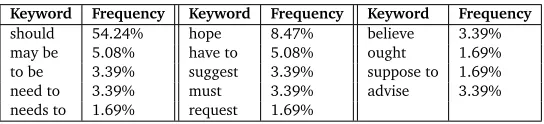
comments and each comment contains one or more sentences. We manually labeled these sentences as actionable comments or non-actionable comments. Our first observation is that 13.6% of the sentences are actionable comments. This is a very small set of candidates and hence justifies the need for detecting actionable comments. Second, to understand how to fil-ter the comments that are non-actionable using some patfil-terns, we further analyzed actionable comments at sentence level and our second observation is that, 88.3% of the actionable com-ments use the keywords listed in the Table 2. These findings are very similar to (Ferrario et al., 2012).
Keyword Frequency Keyword Frequency Keyword Frequency
should 54.24% hope 8.47% believe 3.39%
may be 5.08% have to 5.08% ought 1.69%
to be 3.39% suggest 3.39% suppose to 1.69%
need to 3.39% must 3.39% advise 3.39%
needs to 1.69% request 1.69%
Table 2: Keywords and their relative frequencies in actionable comments.
Using the above keywords we now study the accuracy of identifying the actionable comments. We randomly extracted 550 sentences with the actionable keywords defined in Table 2 and traced for actionable comments. We identified that 83.41% of the comments are actionable and others are non-actionable comments. This observation justifies the need for filtering the user comments using the keywords and generating the candidate set of sentences. For our solution, we rely on data pre-processing by leveraging on these language dynamics.
2.2 Phrase level study
Intuitively, given an actionable comment, the entities can be treated as noun phrases and ac-tions as verb phrases. We observe the following challenges in extracting actionable comments:
Entity extraction: Users tend to express the suggestions either in active voice or passive voice. The first challenge is to identify the correct entity in the actionable comment.
[image:3.420.82.354.312.374.2]Normalization: People may refer to the same entity using different expressions and ideally we should normalize them. The second challenge is to normalize the entity mentions to their canonical form.
Redundancy: Very similar actions can be expressed differently. The third challenge is to nor-malize similar actions to aid in redundancy elimination.
Overall, the first challenge motivates us to detect entity-action pairs as an information ex-traction task and the last two challenges motivate normalizing the entity-action pairs as a normalization task.
3 Task Definition
The goal of our task is to extract and normalize actionable comments from user generated content in response to a news article. The actionable comments will be represented as an entity-action pair. Our problem of detecting normalized actionable comment is defined as follows: Given a news articleAand corresponding candidate commentsC={c1,c2, . . . ,cn}
extracted using the keywords, our goal is to detect pairs of{nei,nai}whereneiis a normalized
entity andnaiis a normalized action.
4 Solution Method
In this section, we first describe our solution for entity-action extraction based on CRF model (Lafferty et al., 2001) and then our normalization model based on the clustering tech-niques for entity and action normalization.
4.1 Entity-action extraction
The entity-action extraction problem can be treated as a sequence labeling task. Let x = (x1,x2, . . . ,xn)denote a comment sentence where eachxiis a single token. We need to assign
a sequence of labels or tagsy= (y1,y2, . . . ,yn)tox. We define our tag set as{BE, IE, BA, IA,
O}, following the commonly used BIO notation (Ramshaw and Marcus, 1995), where E stands for entity and A stands for action.
Features: To develop features, we consider three main properties of actionable comments. First, the entities of the actionable pairs are mostly nouns or pronouns. Second, the entities display the positional properties with respect to the keywords. Third, the entities should be grammatically related to the actions. For example the verb in the action phrase is related to the subject which is an entity of the actionable comment.
a. Parts-of-speech features:To capture the first property, we classify each wordxiinto one of
the POS tags using the Stanford POS tagger3. We combine this feature with the POS features
of neighboring words in[-2,+2]window.
b. Positional features: To capture the second property, we find the position of each word,
xi with respect to the keyword in the given sentence. The feature is represented as positive
numbers for words preceding the keyword and negative numbers for words succeeding the keyword in the sentence. We do the same for neighboring words in[-2,+2]window.
c. Dependency tree features:To capture the third property, for each wordxi, we check if it
is nominal subject in the sentence and represent it bynsubj. The dependency tree features can be extracted using Stanford dependencies tool4.
3http://nlp.stanford.edu/software/tagger.shtml 4http:
The output of this task isS={ei,ai}, a set of entity-action pairs. The next task is to normalize Swhich is described below.
4.2 Entity-action normalization
GivenS={ei,ai}, a set of entity-action pairs, the goal is to generateNS={nei,nai}, a set of
normalized entity-action pairs.
4.2.1 Entity normalization
We use agglomerative clustering which is a hierarchical clustering method which works bottom-up (Olson, 1995) together with expanding the entity with the features from Google and Semantic-Similarity Sieves adopted from Stanford coreference algorithm (Raghunathan et al., 2010).
Features:Two types of features are used to expand an entity mention: first from Google and second from the parse tree structure. The representative of a cluster,neis chosen to be the
entity mention which has the largest average similarity distance from the other entity mentions in the cluster.
a. Alias features:This sieve addresses name aliases, which are detected as follows: Given an entity mention, it is first expanded with the title of the news article and this query is fed to the Google API. Google outputs the ranked matching outputs. One option is to use the entire snippet as the features. Another option is use partial snippet. Google returns snippets that has bolded aliases. We use them as alias features for a given entity mention. For example, alias features for “Ionescu+title” areDr.Ionescu, Silvia Ionescu, Romanian Diplomat Ionescu
etc. This sieve also aids in solving the spell problems.
b. Semantic-similarity features:We follow the following steps from the relaxation algorithm from Stanford coreference resolution tool for both named and unnamed entities: (a) remove the text following the mention head word; (b) select the lowest noun phrase (NP) in the parse tree that includes the mention head word; (c) use the longest proper noun (NNP*) sequence that ends with the head word; (d) select the head word.
4.2.2 Action normalization
The main objective of normalizing the actions is to remove the redundant actions. We choose clustering same as above to normalize the actions associated with same normalized entity. The feature set for this task is simply bag-of-words with stop word removal. The representative action is also chosen similar to the above.
5 Dataset
Since the task of actionable comment extraction is new, we gathered and annotated our own dataset for evaluation. Our dataset consists of 5 contentious news articles and the correspond-ing comments from Asiaone.com, an online forum.
5.1 Pre-processing
candidates for experiments. We calculated the inter-annotator agreement level using Cohen’s kappa. Cohen’s kappa on actionable comments is 0.7679 which displays a strong agreement between the annotators.
6 Experiments
6.1 Experiments on entity-action extraction
To evaluate the entity-action extraction, we prepare the ground truth using the dataset de-scribed in Section 5. We first answer (Q1), how well the model performs in identifying ac-tionable comments. We then evaluate the entity and action extraction from the acac-tionable comments to answer (Q2). We experimented various combinations of features (not reported here) for CRF model and combined feature set gives the best results. We perform 10-fold cross validation for all our experiments. We use this pattern matching technique as a baseline.
Annotation:To prepare the ground truth, we engaged two annotators to label 550 candidate sentences for suggestion, entity and action. For this annotation task the judge should do the following:
1. Look for the person(s) or organization(s) who should execute the suggestion and label the entity with BE (beginning of an entity) and IE (inside an entity).
2. Look out for the action that should be performed by the entity and label it as an action: BA (beginning of an action), IA (inside an action). The others are labeled as O (other). 3. If both entity and action are found, sentence is a valid suggestion. Label it as 1.
Other-wise, label it as 0.
6.1.1 Actionable knowledge detection results
Our model achieved precision of 88.26%, recall of 93.12% and F-score of 90.63% in classify-ing actionable comments and that answers our (Q1). In our analysis, we observed that the model failed in detecting the actionable comments when the sentences have poor grammatical structure. For example, “Dont need to call the helpline..”, has a poor grammatical structure.
6.1.2 Entity extraction results
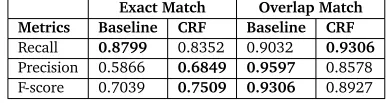
In Table 3, the baseline outperformed the CRF model on the overlap F-score and this is due to the relax mode of the overlap. But, for the exact match CRF has high F-score of 75.09% which is relatively 6.67% higher than the baseline. This answers our (Q2) for entity extraction evaluation.
Exact Match Overlap Match Metrics Baseline CRF Baseline CRF
Recall 0.8799 0.8352 0.9032 0.9306
Precision 0.5866 0.6849 0.9597 0.8578
[image:6.420.105.298.423.475.2]F-score 0.7039 0.7509 0.9306 0.8927
Table 3: Entity Extraction Results
6.1.3 Action extraction results
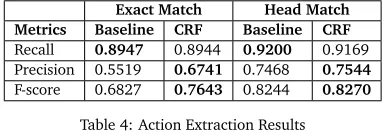
F-score of 76.43% and 82.7%, respectively, which is relatively 11.9% and 0.03% higher than the baseline. Head match has generally high performance for both due to the property that an action is expressed as a verb. This answers our (Q2) for action extraction evaluation.
Exact Match Head Match Metrics Baseline CRF Baseline CRF
Recall 0.8947 0.8944 0.9200 0.9169
Precision 0.5519 0.6741 0.7468 0.7544
[image:7.420.121.315.106.173.2]F-score 0.6827 0.7643 0.8244 0.8270
Table 4: Action Extraction Results
6.2 Experiments on entity-action normalization
We first answer (Q3), between single link and complete link, which technique is more suitable for this problem? We then answer (Q4), how does the clustering-based solution perform in normalizing the entity-action pairs?
6.2.1 Single Link Vs Complete Link
Annotation:The human annotator is given a set of entities from each article and asked to first group the similar entities together and then assign a label to each group.
Single Link Complete Link Article Precision Recall F-Score Precision Recall F-Score
A1 0.5161 0.5039 0.5100 0.8462 0.6929 0.7619
A2 1.0000 0.3333 0.5000 0.7143 0.5238 0.6044
A3 0.7368 0.3218 0.4480 0.5664 0.7356 0.6400
A4 0.6258 0.4567 0.5280 0.5328 0.6689 0.5931
A5 0.9661 0.4560 0.6196 0.7282 0.6000 0.6579
Table 5: F-score results comparison between single link and complete link As shown in Table 5, even though the precision for single link is high, complete link out performs single link on recall and F-score and answers our Q3. For example, “the ceo” and “ceo, smrt ceo ms saw” are grouped into single cluster using complete link. Where as, for single link cluster, “smrt ceo ms saw” is a false negative.
6.2.2 Entity-Action Normalization Results
Annotation:We asked a human judge to validate the normalized entity-action pairs. Only if both entity and action are normalized (entity should be in canonical form and action should be non-redundant), the pair is labeled as valid. If we obtain (e1, a1), (e2, a2), and a1 and a2 refer to the same action, we label one of them as invalid.
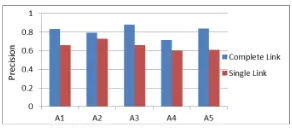
From Figure 1, we notice that on all articles the precision is high for complete link measure. This can be justified due to high F-score from complete link measure.
[image:7.420.87.348.277.349.2]Figure 1: Entity-action normalization results
our Q4. We further analyzed the results for complete link. For article, A4 and the normal-ized entityIonescu, the actionable comments have entity mentions likeasshole,dogetc., which could not be normalized due to non-distinctive feature set.
7 Related Work
Opinion Mining: Opinion mining is a well studied research for the past ten years mainly focussing on the sentiment extraction and classification tasks (Turney, 2002; Pang et al., 2002). However, according to (Hu and Liu, 2004), fine-grained opinion mining and analysis is highly effective like feature identification by (Popescu and Etzioni, 2005), linking opinions to features by (Lin and He, 2009), and polarity classification by (Liu et al., 2005). Assess-ing the usefulness and quality of text has been well studied in natural language processAssess-ing as quality plays a key role in online content (Agichtein et al., 2008) like helpfulness of re-views (Ghose and Ipeirotis, 2011), detecting low quality rere-views (Liu et al., 2007) and detect-ing spam reviews (Lim et al., 2010).
Actionable content: (Zhang et al., 2009) attempted to discover the diagnostic knowledge and defined diagnostic data mining as, “a task to understand the data and/or to find causes of prob-lems and actionable knowledge in order to solve the probprob-lems”. Their work is more focussed towards manufacturing applications in which the problems are identified to aid the designers in the product design improvements. (Simm et al., 2010) analysed actionable knowledge in on-line social media conversation and the concept of actionability is defined as request or sug-gestion. (Ferrario et al., 2012) work aims at discovering aspects of actionable knowledge in the social media. To the best of our knowledge, our problem of extracting and normalizing entity-action pairs from users’ comments is not studied.
Conclusion and perspectives
Actionable content extraction is a new direction in opinion mining process with many oppor-tunities and challenges. With the increasing user generated content in micro blogs, detecting actionable knowledge in such media will be an interesting problem. For example, during Obama’s state union address, apart from political and news forums, the public was asked to express opinions on Twitter using specific hashtags. This triggers the need for gathering ac-tionable content in micro blogs. In the same line, diagnostic opinion detection that talks about what could have happened, who should be blamed, etc., is also an interesting problem.
Acknowledgments
References
Agichtein, E., Castillo, C., Donato, D., Gionis, A., and Mishne, G. (2008). Finding high-quality content in social media. InWSDM ’08: Proceedings of the international conference on Web search and web data mining, pages 183–194, New York, NY, USA. ACM.
Ferrario, M. A., Simm, W., Whittle, J., Rayson, P., Terzi, M., and Binner, J. (2012). Under-standing actionable knowledge in social media: Bbc question time and twitter, a case study. InICWSM.
Ghose, A. and Ipeirotis, P. G. (2011). Estimating the helpfulness and economic impact of product reviews: Mining text and reviewer characteristics. IEEE Trans. Knowl. Data Eng., 23(10):1498–1512.
Hu, M. and Liu, B. (2004). Mining opinion features in customer reviews. InProceedings of the 19th national conference on Artifical intelligence, AAAI’04, pages 755–760. AAAI Press.
Kim, S.-M. and Hovy, E. (2005). Identifying opinion holders for question answering in opinion texts. InProceedings of the AAAI Workshop on Question Answering in Restricted Domains.
Kim, S.-M. and Hovy, E. (2006). Extracting opinions, opinion holders, and topics expressed in online news media text. InProceedings of ACL/COLING Workshop on Sentiment and Subjec-tivity in Text, Sidney, AUS.
Lafferty, J. D., McCallum, A., and Pereira, F. C. N. (2001). Conditional random fields: Prob-abilistic models for segmenting and labeling sequence data. InProceedings of the Eighteenth International Conference on Machine Learning, ICML ’01, pages 282–289, San Francisco, CA, USA. Morgan Kaufmann Publishers Inc.
Lim, E.-P., Nguyen, V.-A., Jindal, N., Liu, B., and Lauw, H. W. (2010). Detecting product review spammers using rating behaviors. InCIKM, pages 939–948.
Lin, C. and He, Y. (2009). Joint sentiment/topic model for sentiment analysis. InProceedings of the 18th ACM conference on Information and knowledge management, CIKM ’09, pages 375– 384, New York, NY, USA. ACM.
Liu, B., Hu, M., and Cheng, J. (2005). Opinion observer: analyzing and comparing opinions on the web. InProceedings of the 14th international conference on World Wide Web, WWW ’05, pages 342–351, New York, NY, USA. ACM.
Liu, J., Cao, Y., Lin, C.-Y., Huang, Y., and Zhou, M. (2007). Low-quality product review detection in opinion summarization. InEMNLP-CoNLL, pages 334–342.
Ma, T. and Wan, X. (2010). Opinion target extraction in chinese news comments. InColing 2010: Posters, pages 782–790, Beijing, China. Coling 2010 Organizing Committee.
Olson, C. F. (1995). Parallel algorithms for hierarchical clustering. Parallel Computing, 21:1313–1325.
Pang, B., Lee, L., and Vaithyanathan, S. (2002). Thumbs up?: sentiment classification using machine learning techniques. InProceedings of the ACL-02 conference on Empirical methods in natural language processing - Volume 10, EMNLP ’02, pages 79–86, Stroudsburg, PA, USA. Association for Computational Linguistics.
Popescu, A.-M. and Etzioni, O. (2005). Extracting product features and opinions from reviews. InProceedings of the conference on Human Language Technology and Empirical Methods in Natural Language Processing, HLT ’05, pages 339–346, Stroudsburg, PA, USA. Association for Computational Linguistics.
Raghunathan, K., Lee, H., Rangarajan, S., Chambers, N., Surdeanu, M., Jurafsky, D., and Manning, C. (2010). A multi-pass sieve for coreference resolution. InProceedings of the 2010 Conference on Empirical Methods in Natural Language Processing, EMNLP ’10, pages 492–501, Stroudsburg, PA, USA. Association for Computational Linguistics.
Ramshaw, L. A. and Marcus, M. P. (1995). Text chunking using transformation-based learning.
CoRR, cmp-lg/9505040.
Simm, W., Ferrario, M. A., Piao, S. S., Whittle, J., and Rayson, P. (2010). Classification of short text comments by sentiment and actionability for voiceyourview. InSocialCom/PASSAT’10, pages 552–557.
Turney, P. D. (2002). Thumbs up or thumbs down?: semantic orientation applied to unsu-pervised classification of reviews. InProceedings of the 40th Annual Meeting on Association for Computational Linguistics, ACL ’02, pages 417–424, Stroudsburg, PA, USA. Association for Computational Linguistics.
Whittle, J., Simm, W., Ferrario, M. A., Frankova, K., Garton, L., Woodcock, A., Nasa, B., Binner, J., and Ariyatum, A. (2010). Voiceyourview: collecting real-time feedback on the design of public spaces. InUbiComp, pages 41–50.