1
On Demand Video Sharing System
Tejas Benke
1, Pratik Wakchaure
2, Vaibhav Deshmukh
3, Amol Sonawane
4& Prof. Kahate S. A.
51,2,3,4 Student, SPCOE, Department Of Computer Engineering, Dumbarwadi, Otur
5 Assistant Professor, SPCOE, Department Of Computer Engineering, Dumbarwadi, Otur
[email protected],[email protected],[email protected],
Abstract- The World Wide Web today has grown so wide and the video-on-demand applications and video share web are becoming very popular day-by-day on the World Wide Web. An efficient video similarity search algorithm for content based video retrieval is important in video-on-demand based services. However, there is no satisfying video similarity search algorithm showing cent percentage performance. The proliferation of mobile cameras has popularized social sharing of videos captured at events such as sports matches, art performances, and lectures. Due to bandwidth and energy constraints, it is often not efficient or desirable to upload all captured videos to a server for sharing immediately after capturing. We propose a pull-based, on-demand mobile video sharing system that allows user to share video captured at an event by using lightweight video metadata extraction algorithm having features like as Point of interest of the data or contents and compass sensor for reading and video selection algorithm, running on the server use to respond the user queries based on accuracy of video which is retrieved as well as cost for uploading video. We propose CCMVA algorithm, in this private agents in the cloud can effectively provide adaptive streaming and perform video sharing means prefetching which is based on analysis of social network.
Index Terms- Video-on-demand; Prefetching; Metadata Extraction; POI(Point Of Interest).
1. INTRODUCTION
The proliferation of video content on the web makes similarity detection an indispensable tool in web data management, searching and navigation. Web video clips are often stored in multiple locations, compressed with different algorithms and bit rates to facilitate downloading and streaming. Similar versions, in part or as a whole, of the same video can also be found on web when some web users modify and combine original content with their own productions. Identifying these similar contents is beneficial to many web video applications. As video is a complex data type, many of the proposed similarity measures are computationally intensive. On the other hand, for every new video added to the database or a query video presented by a user, similarity measurements need to be performed with possibly millions of entries in the database. Thus, it is imperative to develop fast methods in computing similarity measurements for database applications.
We implement a new approach for mobile video sharing that uploads a small amount of metadata information generated on the smartphones to the server initially, instead of uploading the entire video
by default. The server will then only fetch relevant videos, in response to user queries. By uploading only a small amount of metadata information to support queries and
only upload more data on demand, the network and energy cost on the smartphones are reduced.
The proposed system is called a pull-based, on-demand mobile video sharing system or Movisode that allows user to share video captured at an event by using lightweight video metadata extraction algorithm and video selection algorithm, running on the server. It allows user to share video captured at an event like as sport matches, political meetings.
Suppose it is assumes that mobile videos are grouped according to the event during which the videos are shot. Movisode has several key differences from the conventional video sharing approach (e.g., YouTube)
2 displayed applications, section 8 shows development
environment followed by result and conclusion, future scope as well as references.
2. MOTIVATION
Our work is motivated by the trend towards increased sharing of mobile video from crowded events in a timely manner. We propose a new approach for mobile video sharing that uploads a small amount of metadata information generated on the smartphones to the server initially, instead of uploading the entire collaborative techniques into media capture. In MoVi [1], social events are captured collaboratively using sensory cues such as ambient sound and light to detect changes in environment. Crowd Optics facilitates browsing sensor annotated videos in crowded events. Micro-Cool [2] allows concert/event spectators to capture and upload their video clips and use these video clips to reconstruct (either manually or by matching audio content) the concert experience.
B. Geo-tagging Based Techniques
Media capture, retrieval, and classification are also addressed by geo-tagging based techniques that utilize a variety of sensors available in smartphones to annotate media. Sensor-assisted video and image tagging is proposed in SEVA [3]. HORUS [4] use the vehicle trajectory as the camera trajectory and determines most relevant clips that capture a target area. Similarly, Ay et al. [5] uses sensor metadata to rank relevant video clips based on the magnitude of area or time interval captured in each video clip. The ranked results are filtered based on occlusion and Wiki page information [6]. This effort is further extended [7] to introduce energy conservation by uploading
metadata on-demand, and by using WiFi/GSM-based location inference to complement GPS.
C. Crowdsourced Video Retrieval
GigaSight [8] filters videos on a cloud infrastructure, trying to identify privacy-sensitive information from crowdsourced video and uses it for retrieval from cloud. FOCUS [9] uses Structure-from-Motion (SfM) [10] as part of cloud-based architecture for organizing videos. SfM requires all videos to be available for frame-by-frame pairwise comparison of all videos, and camera calibration for all the cameras involved in the video capture. In our application, however, camera calibration with smartphones is challenging. Furthermore, both systems requires all videos from smartphones to be uploaded to the cloud for processing, which is what Movisode wants to avoid.
D. Comparison
Movisode differs from the above techniques in the following manner. First, collaborative and crowd sourced techniques require all the content to be available at the server for processing. Movisode avoids unnecessary upload by using sensory cues to select the required content for upload to achieve significant savings in network/power. Second, Geotagging based schemes rely on localization infrastructure such as GPS to retrieve content, which limit their use to outdoor environments. Movisode does not require any localization to retrieve video content and can work both in indoor and outdoor environments. If location information is available, this information can clearly be incorporated into Movisode to enhance its performance, for example to improve ease of event clustering and finer grained selection based on distance. Finally, unlike existing geo-tagging or crowdsourced schemes which can only select video that has been uploaded, Movisode generates a video clip with contents that can come from multiple users. This helps satisfy user request when no single video available covers the spatial/temporal dimensions of the query.
4. MODULE
A. Extracting the Metadata:
3 Demand mobile video sharing system select the set of
clips, based on video metadata previously uploaded by the users, that balances the con listing objectives of light-weight metadata extraction scheme. For each video, the metadata extracted, besides the start and end times, are the viewing angle and point-of-interest (POI).
B. Selecting the Video:
After the metadata of a video is uploaded from a smartphone to the server, it is available to be selected as part of a response to a user query.
We evaluate CCMVA system in three different ways. We conducted trace-based evaluation in a realistic setting, we use video and sensor data of two events from the mobile video dataset namely NAF 160312 and NAF 230312. Both events were music and dance performance on stage. Due to space constraints, only results for NAF 230312 are shown. We also conduct a phone test bed evaluation to understand propose system performance in real network conditions.
5. ALGORITHM
Movisode is driven by two main algorithms:
1. The first is a light weight metadata extraction algorithm that runs on the smartphone.
2. The second algorithm runs on the server. It takes in metadata information from the smartphones, upload previous queries. The algorithm then decides which video to retrieve from which smartphones to satisfy a given spatio-temporal query from the user.
6. MATHEMATICAL MODEL
System Description
:
Input: Event video and metadata.
Output: Video fetch as per metadata requirements.
Identify data structures: classes, divide and conquer strategies to exploit distributed/parallel/concurrent processing, constraints.
Our system work as a distribute manner. It means that one module is dependent on the another module. The output of previous module is required as a input to the next module. So that before executing previous module we cannot execute the next module.
Success Conditions: Our system will give the proper 2. On demand video retrieval.
8. DEVELOPMENT ENVIRONMENT
The proposed system requires Eclipse that is an open source software development environment. Eclipse consists of an Extensible plugin system and an IDE. The Android project has been developed in the Helios version of Eclipse, as it has plugins that are mainly used for Android.
8. 1 Android SDK
Integrated Development Environment (IDE) is used in Android development in order to make it more straight forward and quick. It has been recommended for the developers because of its simplicity in working. Android is basically a multitasking platform. To give an example, the application has one application for navigation, another application for games, and another messaging. These applications can work simultaneously because of this multitasking ability of the Android platform.
8.2 ADT Plugin
ADT (Android Development Tools) is a plugin developed by Google. Its main purpose is for developing Android mobile applications in Eclipse. It makes it easy and convenient for all the Android developers working in Eclipse environment to quickly create Android projects and debug the programs whenever needed.
4
8.3 Android Emulator
Android emulator is a virtual mobile device which is included in every Android SDK which runs on the users computer. Android emulators are used to test Android applications, so there is no need of any physical device.
Android emulator supports Android Virtual Device (AVD) configuration, which in itself is an emulator containing specific Smartphone Operating System. Using AVD, one can easily test his applications. Any application running on an emulator can use the services provided by the Android platform like play audio, store or retrieve data etc. But with these features comes a few limitations. Neither does it support Bluetooth, nor does it support SMS/MMS communication.
A. Functionalities of the System
Below mentioned are the functionalities provided by the system:
1. Avoid redundant data uploading 2. Solve problem of network jam 3. Avoid battery consumption issue 4. Reduce data usages.
B. Database
The databases created in this application are created in SQLite. User passes a query to access the database. All the rows in the database that match this query are passed as a type of pointer (cursor) and then displayed to the user. The application maintains an Adapter class that handles calls that are made to the database. The databases play an integral part of the system as all the bus information, stop information as well as routes are all stored in these databases.
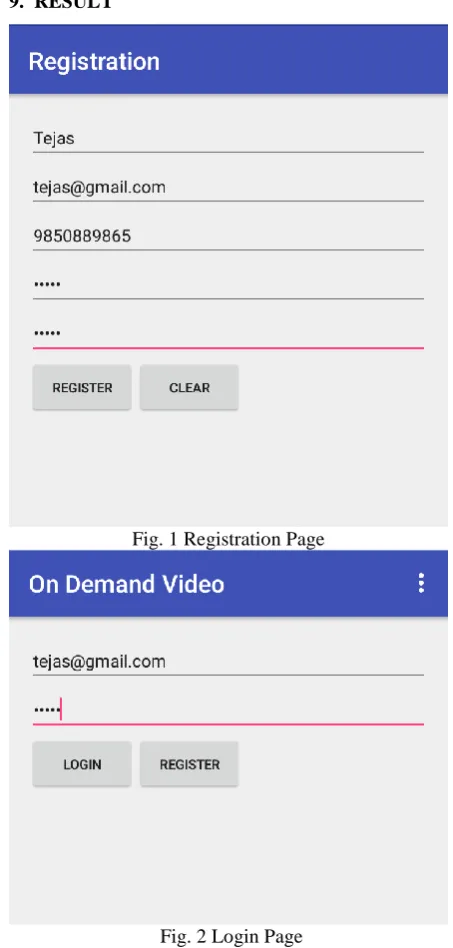
9. RESULT
Fig. 1 Registration Page
Fig. 2 Login Page
10. CONCLUSION
5 system balances the trade-off between spatiotemporal
coverage and energy much better than the other candidate algorithms and provides results which are close the best available videos.
Acknowledgments
We express our sincere thanks to our project guide Prof. Kahate S. A. who always being with presence & constant, constructive criticism to made this paper. We would also like to thank all the staff of COMPUTER DEPARTMENT for their valuable guidance, suggestion and support through the project work, who has given co-operation for the project with personal attention. Above all we express our deepest gratitude to all of them for their kind-hearted support which helped us a lot during project work. At the last we thankful to our friends, colleagues for the inspirational help provided to us through a project work.
REFERENCES
[1] X. Bao and R. Roy Choudhury, “MoVi: Mobile phone based video highlights via collaborative sensing,” in Proc. 8th Int. Conf. Mobile Syst., Appl., Services (MobiSys), 2010, pp. 357–370. [2] (Accessed Jul. 21, 2014). Micro-Cool. [Online].
Available: vku.sdo.com/
[3] X. Liu, M. Corner, and P. Shenoy, “SEVA: Sensor-enhanced video annotation,” ACM Trans. Multimedia Comput., Commun., Appl., vol. 5, no. 3, pp. 24:1–24:26, Aug. 2009.
[4] S. Greenhill and S. Venkatesh, “Distributed query processing for mobile surveillance,” in Proc. 15th Int. Conf. Multimedia (MM), 2007, pp. 413–422. [5] S. A. Ay, R. Zimmermann, and S. Kim,
“Relevance ranking in georeferenced video search,” Multimedia Syst., vol. 16, no. 2, pp. 105– 125, 2010.
[6] Z. Shen, S. A. Ay, S. H. Kim, and R. Zimmermann, “Automatic tag generation and ranking for sensor-rich outdoor videos,” in Proc. 19th ACM Int. Conf. Multimedia (MM), 2011, pp. 93–102.
[7] J. Hao, S. H. Kim, S. A. Ay, and R. Zimmermann, “Energy-efficient mobile video management using smartphones,” in Proc. 2nd Annu. ACM Conf. Multimedia Syst. (MMSys), 2011, pp. 11– 22.
[8] P. Simoens, Y. Xiao, P. Pillai, . Chen, K. Ha, and M. Satyanarayanan, “Scalable crowd-sourcing of video from mobile devices,” in Proc. 11th Annu.
Int. Conf. Mobile Syst., Appl., Services (MobiSys), 2013, pp. 139–152.
[9] P. Jain, J. Manweiler, A. Acharya, and K. Beaty, “FOCUS: Clustering crowdsourced videos by line-of-sight,” in Proc. 11th ACM Conf. Embedded Netw. Sensor Syst. (SenSys), 2013, pp. 8:1–8:14.
[10]N. Snavely, S. M. Seitz, and R. Szeliski, “Modeling the world from internet photo collections,” Int. J. Comput. Vis., vol. 80, no. 2, pp. 189–210, Nov. 2008.
[11] 1. J. Erman and K. Ramakrishnan, “Understanding the super-sized traffic of the super bowl,” in Proc. Conf. Internet Meas. Conf. (IMC), 2013, pp. 353–360.
[12]2. M. Saini, S. P. Venkatagiri, W. T. Ooi, and M. C. Chan, “The jiku mobile video dataset,” in Proc. 4th ACM Multimedia Syst. Conf. (MMSys), 2013, pp. 108–113.
[13]3. X. Bao and R. Roy Choudhury, “MoVi: Mobile phone based video highlights via collaborative sensing,” in Proc. 8th Int. Conf. Mobile Syst., Appl., Services (MobiSys), 2010, pp. 357–370. [14]4. X. Liu, M. Corner, and P. Shenoy, “SEVA: