Predicate Argument Structure Analysis
using Partially Annotated Corpora
Koichiro Yoshino, Shinsuke Mori, Tatsuya Kawahara
School of Informatics, Kyoto University
Yoshida-Honmachi, Sakyo-ku, Kyoto 606-8501, Japan
Abstract
We present a novel scheme of predicate argument structure analysis that can be trained from partially annotated corpora. In order to allow partial annotation, this semantic role labeler does not require word dependency information. The advan-tage of partial annotation is that it allows for smooth domain adaptation of training data and improves the adaptability to a va-riety of domains.
1 Introduction
The predicate-argument (P-A) structure is one of the most fundamental and important representa-tions in linguistics (Fillmore, 1968). Many appli-cations use P-A structure as a component, for ex-ample, QA systems (Shen and Lapata, 2007), text mining systems (Wang and Zhang, 2009), and a spoken dialogue systems (Yoshino et al., 2011).
P-A structure analysis is regarded as a task of semantic role labeling (SRL). A semantic role represents a meaning of the components in P-A structure (i.e. Propbank (Palmer et al., 2005), FrameNet (Baker et al., 1998), and NAIST Text Corpus (NTC) (Iida et al., 2007b)). Traditional P-A structure analyzers estimate the semantic role labels for an input sentence by referring to a model trained on data annotated with not only seman-tic role labels but also dependency labels (Sur-deanu et al., 2008; Hajiˇc et al., 2009). Most of the previous approaches to P-A structure analy-sis assume full annotation for P-A structures and the lower layer labels: word boundaries, parts of speech (POS), and dependencies. Given a corpus fully annotated with them, the structural predic-tion approach was shown to be effective (Watan-abe et al., 2010). However, this pre-annotation in-curs high annotation costs which prevent us from adapting the analyzer to new domains. Having training data that are representative of a domain is essential for constructing a robust semantic role labeler (Pradhan et al., 2008) because the impor-tant information structures are specific to each do-main (R.Grishman, 2003). Fully annotated corpus
in target domain is not available in realistic cases, and it is difficult to apply the current supervised approaches to a new domain.
When annotating only the domain-specific area, the use of a partially annotated corpus (Tsuboi et al., 2008; Sassano and Kurohashi, 2010) that allows incomplete annotations improves accuracy efficiently and reduce the number of annotations. The pointwise approach (Neubig and Mori, 2010) enables efficient use of such incomplete language resources in word segmentation tasks and requires only partial annotations for the relevant tasks and lower layer annotations on which they depend. We design a new P-A structure analysis method that enables us to directly estimate semantic role la-bels by referring to a model that is trained from a corpus that includes only partially annotated tag information without word dependencies.
2 Predicate argument structure analysis
In this section, we give a brief explanation of P-A structure and its problems. Then, we describe the typical method of structural prediction for this task based on supervised machine learning.
2.1 Predicate-argument (P-A) structure A predicate-argument (P-A) structure is a rela-tionship between a verbal expression and its ar-guments, such as the subject, the direct object, and the indirect object. Predicate P in a docu-mentDhas argumentsA1, A2, ..., An that have a
semantic roleS1, S2, ..., Sn. The notion we used
is defined in NAIST Text Corpus (NTC) (Iida et al., 2007b), Japanese text corpora annotated with coreference and P-A relations, which include an-notations of subject, direct object, and indirect ob-ject. Every case has a property ofdependorzero, and these P-A structure relations are annotated not only predicates, but also event nouns (Komachi et al., 2007).
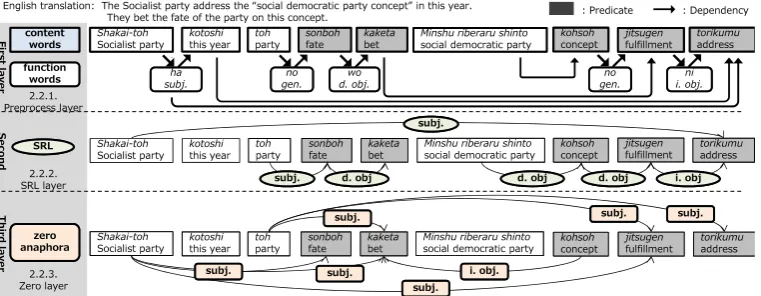
Figure 5shows an example of P-A structures in the NTC. These tags have two properties, one is
dependor zero, the other is intraorinter. de-pend or zeroindicates whether or not the argu-ment has a dependency on the predicate, andintra
POS tag word segment
Size of phenomena P-A structure
NLU
dependency NLP layer
Figure 1: Size of lin-guistic phenomena. or inter indicates
whether or not the argument and the pred-icate exist in the same sentence. NTC also includes annotations of coreference, which we converted into P-A structure tags. As
shown in Figure 1, P-A structure is located in a higher layer of linguistics that approaches natural language understanding (NLU), and this structure depends on some more basic but much more frequent linguistic phenomena: word boundaries, part of speech (POS), and word dependencies.
2.2 Typical solution
The typical solution divides the P-A structure pre-diction into two problems: semantic role labeling (SRL) (Johansson and Nugues, 2008; Bj¨orkelund et al., 2009) and zero-anaphora resolution (Iida et al., 2007a; Sasano and Kurohashi, 2009).
The typical approach requires three pre-processing steps: word segmentation, POS tag-ging, and dependency parsing. After the pre-processing, the task of SRL improves assigning semantic role labels to the edges in word depen-dencies. A semantic role labeler performs two tasks: predicate sense estimation, and SRL. Zero-anaphora resolution is treated as an independent problem from the SRL task in the previous re-search. The zero-anaphora problem is caused by the ellipsis of shared words, and it is a gap in a sentence that has an anaphoric function (Iida et al., 2007a). Some semantic relationships exist in which there is no dependency relationship be-tween their arguments and predicates; this is called zero anaphora.
The task of P-A structure analysis goes beyond the syntactic problem and comes down to a mantic problem to fill in the words that are se-mantically omitted. Various special approaches can be applied after SRL to solve this problem (Sasano and Kurohashi, 2009; Iida and Poesio, 2011; Hayashibe et al., 2011). Some approaches adopt aSalience Reference List(Nariyama, 2002) based on the 1-best argument decision model.
2.3 Open problems in P-A structure analysis Existing approaches require full annotation of word boundaries, POS tags, and word dependen-cies to use them as features. Most previous ap-proaches to P-A structure tasks assume full anno-tation for these lower layers. However, the number of linguistic phenomena decreases as we go higher up the NLP layers as shown in Figure 1. Thus, to prepare only one training example for an existing
katta. katta.
beat
shui shui
the top
fujo-shita fujo-shita
reach
Yankees Yankees
Yankees
Mariners Mariners
Mariners
ha ha
subj.
ni ni
i. obj.
ni ni
i. obj.
Subj. Subj.
Sono Sono
That
kekka kekka
result
subj. i. obj.i. obj. Sentence 2
Sentence 1
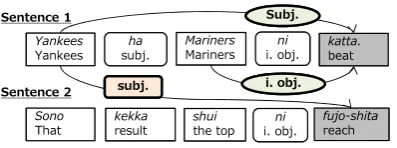
Translation 1: The Yankees beat the Mariners.
Translation 2: As a result, the Yankees (omitted) reached to the top.
Figure 2: Example of training data made from par-tially annotated corpus.
P-A structure analyzer, we need to annotate the en-tire document. To make it worse, these kinds of annotations are costly and difficult for untrained annotators. This difficulty interferes with efficient language resource preparation and reduces domain portability. However, the accuracy of P-A struc-ture analysis increases in accordance with the data size. This indicates that we can realize an im-provement just by easily preparing more training data for the target domain document.
3 Partial annotation for P-A structures
Partial annotation allows annotators to focus on ef-ficient examples in the target domain document, and to maximize the cost-effectiveness of annota-tion. For automatic word segmentation and POS tagging, the scheme allows partial annotation of corpus (Tsuboi et al., 2008; Neubig and Mori, 2010; Neubig et al., 2011) and achieves high ac-curacy and domain portability though annotation of domain-specific areas. Neubig et al. (2011) re-port that a comparable accuracy to a CRF-based sequential labeling method can be achieved with-out referring to the estimated labels for unlabeled words. They call this method a pointwise ap-proach. Even with the pointwise assumption, we can estimate labels as accurately as sequential la-beling just by referring to the appropriate features. We design a P-A structure analyzer that directly estimates the semantic role labels by referring to a model that is trained from a corpus. It includes only partially annotated POS tags but not with de-pendency information for the following reasons. Automatic estimation of POS tags achieves high accuracy in domain adaptation cases, and the an-notation cost is small (Neubig et al., 2011), but the accuracy for dependency parsing (Flannery et al., 2011; Sassano and Kurohashi, 2010) is not sufficiently high. However, handcraft annotation cost of dependency is so high, and it disturbs rapid preparation of annotation data.
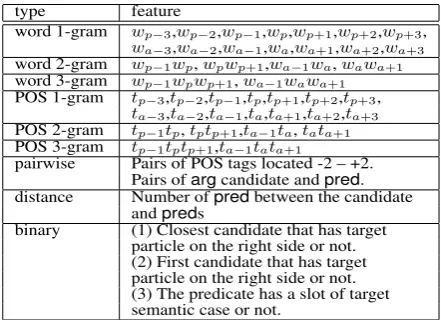
Table 1: Features of SRL:wpis a predicate,wais
an argument candidate,tiis the POS tag ofwi.
type feature
word 1-gram wp−3,wp−2,wp−1,wp,wp+1,wp+2,wp+3,
wa−3,wa−2,wa−1,wa,wa+1,wa+2,wa+3 word 2-gram wp−1wp,wpwp+1,wa−1wa,wawa+1 word 3-gram wp−1wpwp+1,wa−1wawa+1 POS 1-gram tp−3,tp−2,tp−1,tp,tp+1,tp+2,tp+3,
ta−3,ta−2,ta−1,ta,ta+1,ta+2,ta+3 POS 2-gram tp−1tp,tptp+1,ta−1ta,tata+1 POS 3-gram tp−1tptp+1,ta−1tata+1
pairwise Pairs of POS tags located -2 – +2. Pairs ofargcandidate andpred. distance Number ofpredbetween the candidate
andpreds
binary (1) Closest candidate that has target particle on the right side or not. (2) First candidate that has target particle on the right side or not. (3) The predicate has a slot of target semantic case or not.
a domain-adapted morphological analyzer, and the annotator tags three P-A tags.
4 Pointwise P-A structure analysis
In our proposed scheme, syntactic ambiguity reso-lution and predicate sense disambiguation are not used, in order to achieve easy adaptation. We pro-pose two sequential processes for P-A structure analysis that is trained from partially annotated corpora. Following the discussion in Section 3, we do not assume the dependency structures.
4.1 Case existence detection
The first step in the proposed sequential analysis is case existence estimation. The given seman-tic cases differ according to the type of the pred-icate. This predicate and semantic case behavior strongly affects the SRL task.
The oracle of the case existence is used for SRL features. For example, the predicate “bet” in Fig-ure 5 contains information indicating that the pred-icate has two kinds of argument: “subject, zero” and “direct object depend.” We assume that the case existence for each predicate can be es-timated with case frames (Kawahara and Kuro-hashi, 2006). A case frame is a set of a predicate and its potential arguments. It is known that the case frames contribute to the P-A structure analy-sis performance (Sasano et al., 2008).
4.2 SRL and zero-anaphora resolution The second step is SRL that includes zero-anaphora resolution. We handle the problem with a direct approach for SRL that is redefined as a binary classification problem for the pair of an ar-gument candidate and a predicate. Labeled pairs of argument (arg) and predicate (pred) are used as positive training example and unlabeled pairs are used as negative training example. In the ex-ample of Figure 5, the pair of “fate” and “party” is
a positive exampleY, and pairs of “fate” and other candidates are negative examplesN.
The features used for classification are listed in Table 1. We use simple n-gram features based on words and POS tags. The pairwise features are POS pairs located at positions from -2 to +2, and pairs of the predicate and the argument didates. The distance between the argument can-didate and the predicate is used as a feature. We used the number of predicates between the pred-icate and the argument candidate as this feature. Binary features (1) and (2) are based on a previous study on “Centering” theory (Grosz et al., 1995). In this theory, subjects are frequently omitted, and the first candidate tends to be a subject. By con-trast, objects are not omitted, and the last candi-date tends to be an object. To apply the theory to a pointwise approach, we define features that are independent of syntactic structure. Finally, the re-sult of the processing described above is used as a binary feature (3).
4.3 Issues in partial annotation
Two problems arise in applying the classifier to a partially annotated corpus without dependency. First, in existing studies P-A structure analysis leverages a property of the P-A tagsdependand
zero(Iida et al., 2007b). Here,dependrepresents that the P-A tag is added on the edge of depen-dency, and zero means the pair of the predicate and argument does not have a relationship of de-pendency (=zero anaphora). However, it is impos-sible to use dependency information in our frame-work, and the attribution makes it difficult to de-tect the property of the P-A tag. To cope with this problem, we use sentence boundaries, which are trivial in unlabeled documents, for grouping the training set. The other problem is how to create training examples from incomplete annotations. To allow the incomplete annotation perfectly, we incorporate positive examples that are clearly an-notated.
5 Evaluations
We conducted three experiments to evaluate the proposed method: SRL, corpus size discrimina-tion, and domain adaptation.
5.1 Experimental settings
Table 2: Results of P-A analysis (with case frame, using the property ofdependandzero).
role label prec. recall F
dep. subject 0.747 0.754 0.750
d. obj. 0.908 0.930 0.919
i. obj. 0.953 0.947 0.950
total 0.839 0.849 0.844
total (w.o. feat. (3)) 0.744 0.683 0.712
zero subject 0.305 0.120 0.172
d. obj. 0.560 0.212 0.307
i. obj. 0.402 0.127 0.192
total 0.402 0.127 0.192
total (w.o. feat. (3)) 0.251 0.115 0.157
total 0.580 0.321 0.413
cf. subject 0.265 0.302 0.282
(zero) d. obj. 0.092 0.129 0.107
i. obj. 0.048 0.041 0.044
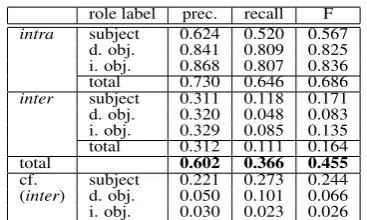
Table 3: Results of P-A analysis (with case frame, using the property ofintraandinter).
role label prec. recall F
intra subject 0.624 0.520 0.567 d. obj. 0.841 0.809 0.825 i. obj. 0.868 0.807 0.836 total 0.730 0.646 0.686
inter subject 0.311 0.118 0.171 d. obj. 0.320 0.048 0.083 i. obj. 0.329 0.085 0.135 total 0.312 0.111 0.164
total 0.602 0.366 0.455
cf. subject 0.221 0.273 0.244 (inter) d. obj. 0.050 0.101 0.066 i. obj. 0.030 0.023 0.026
NTC has lower layer annotations: word bound-aries, POS, and segment-based dependencies. We used the word segments and POS tags as-is, and constructed P-A classifiers. We evaluated the pro-posed SRL in the newspaper article domain. We used linear support vector machine (SVM) (Fan et al., 2008) with the one-versrest method, by us-ing the features described in Table 1.
5.2 Evaluation of SRL
The results using 5-fold cross validation are listed in Table 2 and3. Evaluations that are classified with the existing dependand zeroproperty are given in Table 2. Classifiers used in “w.o. feat. (3)” do not refer to case existence features (the bi-nary feature (3) in Table 1). We can see that case frames play a large role in improving the label-ing accuracy. Thisdependandzeroproperty is based on the dependency, which cannot be referred to in the pointwise approach. As an alternative, we used sentence boundaries for the tag classifi-cation and Table 3 shows the result. The bottom “cf.” rows in Tables 2 and 3 are the result of the previous work (Sasano and Kurohashi, 2011) for comparison1. In the comparison, the accuracies of our work are comparable to the accuracies of the previous work. By comparing the total F
mea-1Sasano and Kurohashi discussed this task, but the article
is written in Japanese. They evaluated the accuracy for zero anaphora in two models: intraandinter, and we calculated the weighted mean of them for fair comparison.
0.45 0.55 0.65 0.75 0.85
train=1/32 train=1/16 train=1/8 train=1/4 train=1/2 train=1/1
Size of training data d. obj., intra
subj., intra i. obj., intra
F measure
Figure 3: Effect of corpus size inintracase.
0.00 0.05 0.10 0.15
train=1/32 train=1/16 train=1/8 train=1/4 train=1/2 train=1/1
Size of training data F measure
d. obj., inter subj., inter
i. obj., inter
Figure 4: Effect of corpus size inintercase.
sure in Table 2 (0.413) and that in Table 3 (0.455), we can say that thisintraandinterproperty works better than thedependandzeroproperty in our pointwise classifier.
5.3 Effect of corpus size
We show the relationship between the training cor-pus size and the accuracy inFigures 3and4. The horizontal axes of these graphs are the log-scaled corpus size. The graphs show that P-A structure analysis accuracy increases linearly in proportion to the log-scaled data size and do not saturate. This result supports our framework of efficient resource usage.
6 Conclusion
We presented a novel scheme of P-A structure analysis based on the pointwise approach that makes it possible to use partially annotated cor-pora. This paper can be seen as an extension of the pointwise approach to a higher NLP layer that al-lows us to concentrate annotation work on the fo-cused task. The results indicated that our scheme reduces the cost of constructing language resource and makes it easy to adapt the P-A structure an-alyzer while maintaining comparable accuracy to current analysis frameworks.
Shakai-toh
Minshu riberaru shinto social democratic party Minshu riberaru shinto social democratic party
jitsugen
Minshu riberaru shinto social democratic party Minshu riberaru shinto social democratic party
kohsoh
Minshu riberaru shinto social democratic party Minshu riberaru shinto social democratic party
kohsoh concept kohsoh concept
subj.
subj. subj.subj.
subj. subj. subj.
subj. subj.subj. subj.subj.
i. obj.
English translation: The Socialist party address the “social democratic party concept” in this year. They bet the fate of the party on this concept.
2.2.1.
Figure 5: Example of P-A structure analysis.
A Figure 5 shows an example of P-A
References
Collin F. Baker, Charles J. Fillmore, and John B. Lowe. 1998. The berkeley framenet project. InProc. ACL-COLING, pages 86–90.
Anders Bj¨orkelund, Love Hafdell, and Pierre Nugues. 2009. Multilingual semantic role labeling. In Proc. CoNLL: Shared Task, pages 43–48.
Rong-En Fan, Kai-Wei Chang, Cho-Jui Hsieh, Xiang-Rui Wang, and Chih-Jen Lin. 2008. Liblinear: A library for large linear classification. Journal of Machine Learning Research, 9(4):1871–1874.
Charles J. Fillmore. 1968. The case for case. In E. Bach and R. Harms, editors,Universals in Linguistic Theory. Daniel Flannery, Yusuke Miyao, Graham Neubig, and
Shin-suke Mori. 2011. Training dependency parsers from par-tially annotated corpora. InProc. IJCNLP, pages 776– 784.
Hagen F¨urstenau and Mirella Lapata. 2009. Semi-supervised semantic role labeling. InProc. EACL, pages 220–228. Barbara J. Grosz, Scott Weinstein, and Aravind K. Joshi.
1995. Centering: a framework for modeling the lo-cal coherence of discourse. Computational Linguistics, 21(2):203–225.
Jan Hajiˇc et al. 2009. The conll-2009 shared task: syntac-tic and semansyntac-tic dependencies in multiple languages. In Proc. CoNLL: Shared Task, CoNLL ’09, pages 1–18. Yuta Hayashibe, Mamoru Komachi, and Yuji Matsumoto.
2011. Japanese predicate argument structure analysis ex-ploiting argument position and type. InProc. IJCNLP, pages 201–209.
Ryu Iida and Massimo Poesio. 2011. A cross-lingual ilp solution to zero anaphora resolution. InProc. ACL-HLT, pages 804–813.
Ryu Iida, Kentaro Inui, and Yuji Matsumoto. 2007a. Zero-anaphora resolution by learning rich syntactic pattern fea-tures.ACM Transactions on Asian Language Information Processing (TALIP), 6(4):12:1–12:22.
Ryu Iida, Mamoru Komachi, Kentaro Inui, and Yuji Mat-sumoto. 2007b. Annotating a Japanese text corpus with predicate-argument and coreference relations. InProc. the Linguistic Annotation Workshop, pages 132–139. Richard Johansson and Pierre Nugues. 2008.
Dependency-based semantic role labeling of PropBank. In Proc. EMNLP, pages 69–78.
Daisuke Kawahara and Sadao Kurohashi. 2006. A fully-lexicalized probabilistic model for japanese syntactic and case structure analysis. InProc. HLT-NACCL, pages 176– 183.
Daisuke Kawahara, Sadao Kurohashi, and Koiti Hasida. 2002. Construction of a Japanese relevance-tagged cor-pus. InProc. LREC, pages 2008–2013.
Mamoru Komachi, Ryu Iida, Kentaro Inui, and Yuji Mat-sumoto. 2007. Learning based argument structure analy-sis of event-nouns in japanese. InProc. PACLING, pages 120–128.
Shinsuke Mori and Graham Neubig. 2011. A pointwise ap-proach to pronunciation estimation for a tts front-end. In Proc. INTERSPEECH, pages 2181–2184.
Shigeko Nariyama. 2002. Grammar for ellipsis resolution in japanese. InProc. TMI, pages 135–145.
Graham Neubig and Shinsuke Mori. 2010. Word-based par-tial annotation for efficient corpus construction. InProc. LREC.
Graham Neubig, Yosuke Nakata, and Shinsuke Mori. 2011. Pointwise prediction for robust, adaptable Japanese mor-phological analysis. InProc. ACL, pages 529–533. Martha Palmer, Daniel Gildea, and Paul Kingsbury. 2005.
The proposition bank: An annotated corpus of semantic roles.Computational Linguistics, 31(1):71–106. Sameer S. Pradhan, Wayne Ward, and James H. Martin.
2008. Towards robust semantic role labeling. Compu-tational Linguistics, 34(2):289–310, jun.
R.Grishman. 2003. Discovery methods for information ex-traction. InProc. ISCA & IEEE Workshop on Spontaneous Speech Processing and Recognition, pages 243–247. Ryohei Sasano and Sadao Kurohashi. 2009. A
probabilis-tic model for associative anaphora resolution. In Proc. EMNLP, pages 1455–1464.
Ryohei Sasano and Sadao Kurohashi. 2011. A discrimina-tive approach to japanese zero anaphora resolution with large-scale case frame.Journal of Information Processing (in Japanese), 52(12):3328–3337.
Ryohei Sasano, Daisuke Kawahara, and Sadao Kurohashi. 2008. A fully-lexicalized probabilistic model for japanese zero anaphora resolution. InProc. COLING, pages 769– 776.
Manabu Sassano and Sadao Kurohashi. 2010. Using smaller constituents rather than sentences in active learning for japanese dependency parsing. InProc. ACL, pages 356– 365.
Dan Shen and Mirella Lapata. 2007. Using semantic roles to improve question answering. InProc. EMNLP-CoNLL, pages 12–21.
Mihai Surdeanu, Richard Johansson, Adam Meyers, Llu´ıs M`arquez, and Joakim Nivre. 2008. The conll-2008 shared task on joint parsing of syntactic and semantic dependen-cies. InProc. CoNLL: Shared Task, pages 159–177. Ivan Titov and Alexandre Klementiev. 2012.
Semi-supervised semantic role labeling: Approaching from an unsupervised perspective. InProc. COLING, pages 2635– 2652.
Yuta Tsuboi, Hisashi Kashima, Hiroki Oda, Shinsuke Mori, and Yuji Matsumoto. 2008. Training conditional random fields using incomplete annotations. InProc. COLING, pages 897–904.
Rui Wang and Yi Zhang. 2009. Recognizing textual related-ness with predicate-argument structure. InProc. EMNLP, pages 784–792.
Yotaro Watanabe, Masayuki Asahara, and Yuji Matsumoto. 2010. A structured model for joint learning of argument roles and predicate senses. InProc. ACL, pages 98–102. Koichiro Yoshino, Shinsuke Mori, and Tatsuya Kawahara.
2011. Spoken dialogue system based on information ex-traction using similarity of predicate argument structures. InProc. SIGDIAL, pages 59–66.