65
A Survey on comparison of Content Based Image
Retrieval Techniques
Arshi A Khan
Department of Electronics Engineering, Father Conceicao Rodrigues COE bandra [email protected]
Abstract- Problems with traditional methods of image indexing have led to the rise of interest in techniques for retrieving images on the basis of automatically-derived features such as colour, texture and shape – a technology now generally referred to as Content-Based Image Retrieval. These techniques encompass diversified areas, viz. image segmentation, image feature extraction, representation, mapping of features to semantics, storage and indexing, image similarity-distance measurement and retrieval, making CBIR system development a challenging task. This paper does a survey & comparison of different methods of content based image retrieval available. It also considers comparison with the techniques which uses concepts like lifting scheme to consider best weights of the images in the database when compared to query and gives improved retrieval performances. It takes a peek into the work done in this field and finally concludes the best method available after comparing all.
Index Terms- Memory learning; Bayesian estimation; color histogram; rotated complex wavelet filters; SVM; CWT; GLCM; CCM.
1. INTRODUCTION-
The earliest use of the term content-based image retrieval in the literature seems to have been by Kato [1992], to describe his experiments into automatic retrieval of images from a database by colour and shape feature. The term has since been widely used to describe the process of retrieving desired images from a large collection on the basis of features (such as colour, texture and shape) that can be automatically extracted from the images themselves. CBIR draws many of its methods from the field of image processing and computer vision, and is regarded by some as a subset of that field. A typical system shown in figure1 allows users to formulate queries by submitting an example of the type of image being sought, though some offer alternatives such as selection from a palette or sketch input. The system then identifies those stored images whose feature values match those of the query most closely, and displays the result.
Fig1. Block diagram for CBIR system
CBIR can be divided in the following stages:
• Preprocessing: The image is first processed in order to extract the features, which describe its contents. The processing involves filtering, normalization, segmentation, and object identification. The output of this stage is a set of significant regions and objects. • Feature extraction: Features such as shape, texture, color, etc. are used to describe the content of the image. Image features can be classified into primitives.
CBIR combines high-tech elements such as: - Multimedia, signal and image processing, - Pattern recognition,
- Human-computer interaction,
- Human perception information sciences.
2. Literature review
66 Zhong Su et al [2], proposed a new relevance
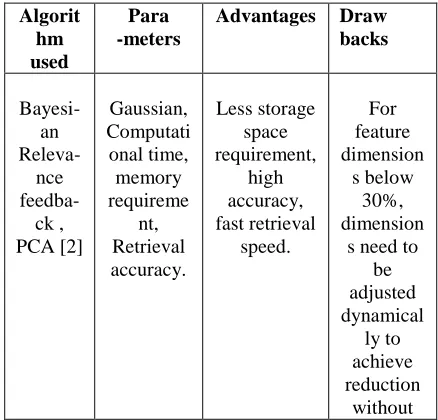
feedback approach to CBIR with progressive learning capability combined with a novel method for the feature subspace extraction. The proposed approach is based on a Bayesian classifier and treats positive and negative feedback examples with different strategies. Positive examples are used to estimate a Gaussian distribution that represents the desired images for a given query; while the negative examples are used to modify the ranking of the retrieved candidates. In addition, feature subspace is extracted and updated during the feedback process using a Principal Component Analysis (PCA) technique and based on user’s feedback. That is, in addition to reducing the dimensionality of feature spaces, a proper subspace for each type of features is obtained in the feedback process to further improve the retrieval accuracy. Experiments demonstrate that the proposed method increases the retrieval speed, reduces the required memory and improves the retrieval accuracy significantly. This dynamic dimension adjusting method is especially effective when the feature dimensions are significantly reduced, e.g., lower than 30% of the original dimensions. The feedback process plays two roles: providing information for updating the Gaussian parameters in the Bayesian feedback, and providing evidence for the adjustment of feature subspace dimensionalities. In principle, the proposed feature subspace extraction method can be incorporated in any other content-based retrieval methods to save memory and to speed-up computation.
Junwei Han et.al [3], in their study reported a framework for effective image retrieval by employing a novel idea of memory learning. It forms a knowledge memory model to store the semantic information by simply accumulating user-provided interactions. A learning strategy is then applied to predict the semantic relationships among images according to the memorized knowledge. Image queries are finally performed based on a seamless combination of low-level features and learned semantics. One important advantage of their framework is its ability to efficiently annotate images and also propagate the keyword annotation from the labeled images to unlabeled images. The presented algorithm has been integrated into a practical image retrieval system. Experimental evaluations on a large-scale image database have already shown very promising results. However, a limitation of the proposed work is that it somewhat lacks sufficient theoretical justification.
Mumtaz et.al[5], presented a novel color image retrieval system (SVMBIR) based on dual tree complex wavelet transform(CWT) and support vector machines (SVM).They have shown how one can improve the performance of image retrieval systems
by assuming two attributes. Firstly, images that user needs through query image are similar to a group of images with same conception. Secondly, there exists non-linear relationship between feature vectors of different images and can be exploited very efficiently with the use of support vector machines. At first level, for low level feature extraction we have used dual tree complex wavelet transform because recently it is proven that CWT can be used for efficient color feature extraction just like texture feature extraction. At second level to extract semantic concepts, we grouped images of typical classes with the use of one against all support vector machines. We have also shown how one can use a correlation based distance metric for comparison of SVM distance vectors. The experimental results show that the proposed approach has superior retrieval performance over the existing linear feature combining techniques.
Zhang et.al [7], in their work applied the watermarking technique into the content based image retrieval system and proposed a novel approach for JPEG image retrieval. The proposed image retrieval system consists of two main phases, offline process and online retrieval process. The feature vector is extracted from each image as the watermark to be embedded into the image, which is the preprocessing operation called offline process. It doesn’t require decompressing the JPEG images but directly embedding the watermark in the DCT domain. The online retrieval process consists of three processes, i.e., query feature computation, watermark extraction and feature vector matching. Since the features are embedded in the image data, it is unnecessary to compute the features but only to extract it from the watermarked image. The system embeds the features in the images, and we need no extra space to save the feature data. Therefore, the storage space is saved.
67 recognition. Using the proposed algorithm RMCM,
the mean processing time is about 0.82 seconds per image. This value is faster than using Motif Co-occurrence Matrix (MCM) by about 2.57 times. The accurate recognition rates are about 95% and 87% as related to vehicles and buildings. Compared with MCM, experiments showed that RMCM has a higher recognition rate based on structure content such as buses and buildings, and natural content such as flowers. It also reduced the time to calculate the feature of images, speeding up the image retrieval system.
Dr Kekre et.al [9], proposed a novel block truncation coding (BTC) extended to color clumps for image retrieval purpose. Total of 24 variations using four color clumps and six color spaces are experimented on image database having 1000 images. Experimental results have shown that the YCbCr color space gives better results than other considered color spaces (YUV, LUV, YCgCb, YIQ and RGB). Performance increases with increase in number of color clumps up to 8 Clumps and then starts to decrease. The Extended BTC 8 Clumps with YCbCr color space is given the best performance in image retrieval.
Bounthanh et.al [10], proposed a novel framework for combining and weighting all of three i.e. color, shape and texture features to achieve higher retrieval efficiency. The color feature is extracted by quantifying the YUV color space and the color attributes like the mean value, the standard deviation, and the image bitmap of YUV color space is represented. The texture features are obtained by the entropy based on the gray level co-occurrence matrix and the edge histogram descriptor of an image. The shape feature descriptor is derived from Fourier descriptors (FDs) and the FDs derived from different signatures. When computing the similarity between the query image and target image in the database, normalization information distance is also used for adjusting distance values into the same level. And then the linear combination has used to combine the normalized distance of the color, shape and texture features to obtain the similarity as the indexing of image. The experimental results of the proposed approach have shown weight variation to achieve higher retrieval efficiency: the efficiency can be achieved in 91% by weight = 70%, = 20% and
= 10%. In addition, we had compared the efficiency and accuracy with other the retrieval scheme, which the our approach had better than the performance of other systems.
Lai et.al [14] proposed a user oriented mechanism based on interactive genetic algorithm (IGA). Color attributes like mean, standard deviation and image bitmap of color image are used as features for retrieval. In addition, Entropy based on Grey level
co-occurrence matrix and edge histograms are considered as texture features. To reduce the gap between user’s expectations and retrieval results, IGA is applied. Experimental results have shown an improvement in retrieval performance due to use of IGA.
Zs. Robotka et al [15] gave a software which was able to search, cluster & classify large sets of different images using low dimensional representation of images to extract relevant images from the database. Images are represented by using Gaussian mixture model. Image matching is done by matching the representations with a distance measure based on approximation of the Kullback Liebler divergence. The GMMs are estimated using improved EM algorithm that avoids convergence to the boundary of the parameter space.
A.M Patil et al [16] proposed a content based image retrieval system based on non separable lifting scheme , genetic algorithm & CBIR. Traditional systems considered searching images from the database using its texture and shape and therefore the entire database gets scanned and the process is time consuming. Whereas the proposed system adapts a multidimensional wavelet filter bank and lifting scheme for identifying best weights. Experiments show that better retrieval results could be obtained by using non separable wavelet instead of separable. Maximum features can be extracted using non separable wavelet. The system is tested under all criteria and is found to be user friendly and scalable.
3. RESUTS & DISCUSSION
[image:3.595.307.526.552.762.2]This section compares various Content based image retrieval techniques. Comparison is made on the basis of algorithm used, parameters which decide the performance of the system, advantages of the proposed system and drawbacks if any.
Table I: Comparison of different CBIR techniques
Algorit hm used
Para -meters
Advantages Draw
backs
Bayesi-an
Releva-nce
feedba-ck , PCA [2]
Gaussian, Computati onal time, memory requireme
nt, Retrieval accuracy.
Less storage space requirement,
high accuracy, fast retrieval
speed.
For feature dimension
s below 30%, dimension
s need to be adjusted dynamical ly to achieve reduction
68 loss of accuracy. Interacti ve Genetic Algorith m [1] Fitness function, Wavelet coefficient With the help of IGA, an explicitly expressed
image as well as an
abstract image could be retrieved accurately & quickly, searches an image with human preference & emotion. More genet- ic operators need to be applied and better encoding methods need to be devised to improve performan -ce. Memor y learning framew ork [4] Semantic correlatio n, Retrieval accuracy. Proposed framework
is able to efficiently annotate images and also propagate the keyword annotation from labeled images to unlabeled ones, A learning strategy is presented to predict hidden semantics thus improving retrieval performance , memorized feedback from previous users improves retrieval accuracy, and system is robust to mild user
errors.
Lack of sophisticat -ed and theoretical learning scheme. Waterm arking [7] Euclidean distance, precision, recall. Since features are embedded in the image for later matching, storage space is saved. Proposed system is faster than direct feature extraction based retrieval scheme in terms of initialization and algorithm time. _ Block truncati on coding [9] Precision, Recall Extended BTC 8 clumps by using YCbCr gives best retrieval performance . _ Region of interest Motif Co-occurre nce matrix [8] Euclidian distance, processing time, precision rate. Lesser time needed to calculate image features, faster retrieval compared to MCM algorithm, Mean processing time is 0.82 seconds/ima ge. _ Weight variatio n [10] Precision, Recall, Hamming distance, Euclidian distance, Fourier Weight variation gives efficiency up to 91%.
69 descriptor
s, mean, standard deviation.
gives inferior performan
ce compared
to [14].
Interacti ve Genetic Algorith
m (IGA)
[14]
Precision, Recall.
Significance improvemen t in retrieval performance due to IGA. As the no generations
increase, 100% precision
could be obtained.
Mutation operator
needs more no
of generation
s to achieve
good results.
DTCW T, SVM
[5]
Correlatio n based distance metric, Retrieval
rate
Proposed system gives
higher retrieval
rates, Effective and efficient
method to retrieve visually similar images having
non-linear relationship among their
feature vectors.
90% precision
could be obtained by
using the proposed approach.
Lesser images are
used for training.
4. CONCLUSION
In this paper a comparison of different CBIR techniques is carried out and it is concluded that a combination of weight variation [10] and IGA [14] will give better performance as compared to various other techniques as it gives high performance based on the weights assigned to various features.
REFERENCES
[1] S.-B.Cho; J.-Y.Lee (2002): A human oriented image retrieval system based on interactive Genetic
Algorithm. IEEE transactions. Syst., Man, Cybern.A, Syst.,Humans, Vol. 32, no.3, pp. 452-458.
[2] Zhong Su; Hongjiang Zhang; Stan Li; Shaoping Ma (2003): Relevance Feedback in Content-Based image Retrieval: Bayesian Framework, Feature subspaces, and Progressive Learning. IEEE Transactions on Image Processing, vol. 12, no. 8.
Gaussian Mixture
model, Expectation
maximizati on algorithm
[15]
Kullback-liebler divergence,
distance matrix
The developed tool is able
to manage GMM building
with different parameters,
1000 images can
be processed
in 3 minutes.
The GMMs are estimated
with an improved expectation maximizati
on algorithm
without which the method is inefficient
as it converges to singular solution in most cases. Non
separable lifting scheme, Genetic algorithm
[16]
Kullback liebler divergence,
Precision, Recall.
System is highly scalable &
user friendly,
uses multidimen sional filter
bank & lifting scheme to
identify best weights, maximum features can be extracted using non separable wavelet compared
to separable.
70 [3]Junwei Han; King N. Ngan; Fellow; Mingjing Li;
Hong-Jiang Zhang (2005): A Memory Learning Framework for Effective Image Retrieval. IEEE Transactions on Image Processing, Vol. 14, no. 4. [4] Manesh Kokare; P. K. Biswas; B. N. Chatterji
(2005): Texture Image Retrieval Using New Rotated Complex Wavelet Filters. IEEE Transactions on Systems, Man, and Cybernetics—Part B:cybernetics, Vol. 35, no. 6. [5]Adeel Mumtaz; S.A.M. Gilani; Tahir Jameel
(2006): A Novel Color Image Retrieval System Based On Dual Tree Complex Wavelet Transform and Support Vector Machines, IEEE.
[6]Te-Wei Chiang; Tienwei Tsai; Yo-Ping Huang (2006): Image Retrieval Based on the Wavelet Features of Interest. IEEE International Conference on Systems, Man, and Cybernetics.
[7] Hao Zhang; Hua Chen; Fa-Xin Yu; Zhe-Ming Lu (2012): Color Image Retrieval System Based on Shape and Texture Watermarks. Second International Conference on Instrumentation & Measurement, Computer, Communication and Control IEEE.
[8]Yen-Shin Lee; Shu-Sheng Halo; Shu-Wei Lin; Sheng-Yi Li (2012): Image Retrieval by Region Of Interest Motif Co-occurrence Matrix. IEEE International Symposium on Intelligent Signal Processing and Communication Systems (ISPACS 2012) November.
[9]Dr. H.B.Kekre; Dr. Sudeep D. Thepade; Anil T. Lohar (2014): Image Retrieval using Block Truncation Coding Extended to Color Clumps. IEEE August.
[10]Machine Bounthanh; Kazuhiko Hamamoto; Boonwat Attachoo; Tha Bounthanh (2013): Content-Based Image Retrieval System Based on Combined and Weighted Multi-Features, 13th International Symposium on Communications and Information Technologies (ISCIT).
[11]S. F. da Silva; M. A. Batista; C. A. Z. Barcelos (2007): Adaptive image retrieval through the use of a genetic Algorithm. in Proc. 19th IEEE Int.Conf. Tools With Artificial Intelligence, pp. 557–564.
[12]John Eakins;Margaret Graham (1999): Content based image retrieval. JTAP.
[13]Ghanshyam Raghuwanshi; Nishchol Mishra; Sanjeev Sharma (2012): Content based Image Retrieval using Implicit and Explicit Feedback with Interactive Genetic Algorithm. International Journal of Computer Applications (0975 – 8887) Volume 43– No.16.
[14]Chih-chin Lai; Ying-Chuan Chen (2011): A User oriented Image Retrieval System based on Interactive Genetic Algorithm. IEEE transactions on Instrumentation and Measurement.
[15]Robotka et al (2009): Image retrieval using Gaussian mixture models. Annales Univ. Sci, Budappest.