Gene Name Extraction Using FlyBase Resources
Alex Morgan
[email protected]Lynette Hirschman
[email protected]The MITRE Corporation
202 Burlington Road
Bedford, MA 01730-1420
Alexander Yeh
[email protected]Marc Colosimo
[email protected]Abstract
Machine-learning based entity extraction re-quires a large corpus of annotated training to achieve acceptable results. However, the cost of expert annotation of relevant data, coupled with issues of inter-annotator variability, makes it expensive and time-consuming to create the necessary corpora. We report here on a simple method for the automatic creation of large quantities of imperfect training data for a biological entity (gene or protein) extrac-tion system. We used resources available in the FlyBase model organism database; these resources include a curated lists of genes and the articles from which the entries were drawn, together a synonym lexicon. We ap-plied simple pattern matching to identify gene names in the associated abstracts and filtered these entities using the list of curated entries for the article. This process created a data set that could be used to train a simple Hidden Markov Model (HMM) entity tagger. The re-sults from the HMM tagger were comparable to those reported by other groups (F-measure of 0.75). This method has the advantage of be-ing rapidly transferable to new domains that have similar existing resources.
1
Introduction: Biological Databases
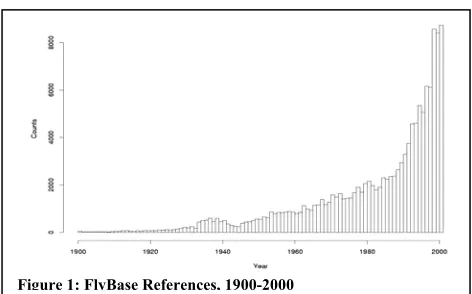
There is currently an information explosion in biomedical research. The growth of literature is roughly exponential, as can be seen in Figure 1 which shows the number of literature references in FlyBase1 organized by date of publication over a
hundred year span.2 This growth of literature
[image:1.612.309.545.271.418.2]makes it daunting for researchers to keep track of the information, even in very small subfields of biology.
Figure 1: FlyBase References, 1900-2000
1 FlyBase is a database that focuses on research in the genetics
and molecular biology of the fruit fly (Drosophila
melangas-tor), a model organism for genetics research: http://www.flybase.org.
Increasingly, biological databases serve to collect and organize published experimental results. A wide range of biological databases exist, including model organism databases (e.g., for mouse3 and
yeast4) as well as various protein databases (e.g.,
Protein Information Resource5 (PIR) or
SWISS-PROT6 and interaction databases such as the
Biomolecular Interaction Network Database7
(BIND). These databases are created by a process of curation, which is done by Ph.D. biologists who read the published literature to cull experimental findings and relations. These facts are organized into a set of structured fields of a database and
2 Of course most of these early references in FlyBase are not
in electronic form. The FlyBase database has been in existence since 1993.
3 http://www.informatics.jax.org/
4 http://genome-www.stanford.edu/Saccharomyces/ 5 http://pir.georgetown.edu/pirwww/pirhome3.shtml 6 http://us.expasy.org/sprot/
linked to the source of information (the journal article). As a result, curation is a time-consuming and expensive process; database curators are in-creasingly eager to adopt text mining and natural language processing techniques to make curation faster and more consistent. As a result, there has been growing interest in the application of entity extraction and text classification techniques to the problem of biological database curation [Hirsch-man02].
2
Entity Extraction Methods
There are two approaches to entity extraction. The first requires manual or heuristic creation of rules to identify the names mentioned in text; the second uses machine learning to create the rules that drive the entity tagging. Heuristic systems require expert developers to create the rules, and these rules must be manually changed to handle new domains. Ma-chine-learning based systems are dependent on large quantities of tagged data, consisting of both positive and negative examples.8 Figure 2 shows
results from the IdentiFinder system [Bikel99] il-lustrating that performance increases roughly with the log of quantity of training data. Given the ex-pense of manual annotation of large quantities of data, the challenge for the machine learning ap-proach is to find ways of creating sufficient quanti-ties of training data cheaply.
Overall, hand-crafted systems seem to outper-form learning-based systems for biology.
[image:2.612.66.303.454.594.2]How-ever, it is clear that the quantities of training have been small, relative to the results reported for en-tity extraction in e.g., newswire [Hirschman03]. There are several published sets of performance results for automatic named biological entity ex-traction systems. The system of Collier et al. [Col-lier00] uses a hidden Markov model to achieve an F-measure9 of 0.73 when trained on a corpus of
29,940 words of text from 100 MEDLINE ab-stracts. Contrast this with Figure 2, which reports results using over 600,000 words of training data, and an F-measure of 0.95 for English newswire entity extraction (and 0.91 for Spanish).
8 For negative examples, the "closed world" assumption
gen-erally is taken to apply: if an entity is not tagged, it is assumed to be a negative example.
Krauthammer et al. [Krauthammer00] have taken a somewhat different approach which encodes char-acters as 4-tuples of DNA bases; they then use BLAST together with a lexicon of gene names to search for 'gene name homologies'. They report an F-measure of 0.75 without the use of a large set of rules or annotated training data.
The PASTA system [Gaizauskas03] uses a combi-nation of heuristic and machine-learned rules to achieve a higher F-measure over a larger number of classes: F-measure of 0.83 for the task of identi-fying 12 classes of entities involved in the descrip-tion of roles of residues in protein molecules. Because they used heuristic rules, they were able to get these results with a relatively small training corpus of 52 MEDLINE abstracts (roughly 12,000 words).
Figure 2: Performance of BBN's IdentiFinder named entity recognition system relative to the amount of training data, from [Bikel99]
These results suggest that machine learning meth-ods will not be able to compete with heuristic rules until there is a way to generate large quantities of annotated training data. Biology has the advantage that there are rich resources available, such as lexi-cons, ontologies and hand-curated databases. What is missing is a way to convert these into training corpora for text mining and natural lan-guage processing. Craven and Kumlien [Cra-ven99] developed an innovative approach that used fields in a biological database to locate abstracts which mention physiological localization of pro-teins. Then via a simple pattern matching
algo-9
Recall) (Precision
Recall) Precision 2
(
+ ⋅
⋅ =
F
rithm, they identified those sentences where the relation was mentioned and matched these with entries in the Yeast Protein Database (YPD). In this way, they were able to automatically create an annotated gold standard, consisting of sentences paired with the curated relations derived from those sentences. They then used these for training and testing a machine-learning based system. This approach inspired our interest in using existing resources to create an annotated corpus automati-cally.
3
r
3.1
FlyBase: Organization and Resources
We focused on FlyBase because we had access to FlyBase resources from our work in the creation of the KDD 2002 Cup Challenge Task 1 [Yeh03]. Through this work, we had become familiar with the multi-stage process of curation. An early task in the curation pipeline is to determine, for a given article, whether there are experimental results that need to be added to the database. This was the task used as the basis for the KDD text data mining "challenge evaluation". A later task in the pipeline creates a list of the Drosophila genes discussed in each curated article. This is the task we focus on in this paper.
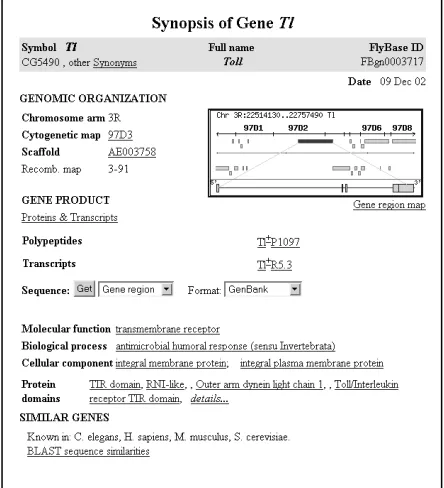
An example of a FlyBase entry can be seen in Fig-ure 3 which shows part of the record for the gene Toll. Under Molecular Function and Biological Process we see that the gene is responsible for en-coding a transmembrane receptor protein involved in antimicrobial humoral response (part of the innate immune system of the fly). We see furthe that “Tl” and “CG5490” are synonymous for Toll (top of the entry next to Symbol), and the link
Synonyms leads to a long synonym list which in-cludes: “Fs(1)Tl”, “dToll”, “CT17414”, “Toll-1”, “Fs(3)Tl”, “mat(3)9”, “mel(3)10”, and “mel(3)9”. Many of these facts about Toll are linked to a par-ticular literature reference in the database. For ex-ample, following the link for Transcripts will lead to a page with links to the abstract of a paper by Tauszig et al. [Tauszig00] which reports on ex-periments which measured the lengths of RNA transcribed from the Toll gene.
For FlyBase, Drosophila genes are the key bio-logical entities; each entity (e.g., gene) is associ-ated with a unique identifier for the underlying
physical entity. If there were a one-to-one relation-ship between gene name and unique identifier, the gene identification task would be straightforward. However, both polysemy and synonymy occur fre-quently in the naming of biological entities, and the gene names of Drosophila are considered to be particularly problematic because of creative nam-ing conventions10. For example, “18 wheeler”,
[image:3.612.309.531.253.497.2]“batman”, and “rutabaga” are all Drosophila gene names. A single entity (as represented by a unique identifier) may have a number of names like Toll or even ATPα, which has 38 synonyms listed in FlyBase.
Figure 3: FlyBase entry for Toll
Resources
We obtained a copy of part the FlyBase database,11
including the lists of genes discussed in each paper examined by the curators. Using the BioPython12
modules, we were able to obtain MEDLINE ab-stracts for 15,144 for these papers. We decided to
10 At the other end of the spectrum is the yeast nomenclature
which is strictly controlled – see <http://genome-
www.stanford.edu/Saccharomyces/gene_guidelines.shtml> for nomenclature conventions.
11 Special thanks to William Gelbart, David Emmert, Beverly
Matthews, Leyla Bayraktaroglu, and Don Gilbert.
set aside the same articles used in the KDD Cup Challenge [Yeh03] for evaluation purposes. This left a training set of 14,033 abstracts, consisting of a total of 2,664,324 lexemes identified by our tokenizer.
4
4.1
It was only with some reluctance that we decided
to focus on journal abstracts. From our earlier work, we recognized that the majority of the in-formation entered into FlyBase is missing from the abstracts and can be found only in the full text of the article [Hirschman03]. However, due to copy-right restrictions, there is a paucity of freely avail-able full text for journal articles. What articles are available in electronic form vary in their format-ting, which can cause considerable difficulty in automatic processing. MEDLINE abstracts have a uniform format and are readily available. Many other experiments have been performed on MEDLINE abstracts for similar reasons.
We also created a synonym lexicon from FlyBase. We found 35,971 genes with associated ‘gene symbols’ (e.g. Tl is the gene symbol for Toll) and 48,434 synonyms; therefore, each gene has an av-erage of 2.3 alternate naming forms, including the gene symbol. The lexicon also allowed us to asso-ciate each gene with one a unique FlyBase gene identifier, providing "term normalization."
Experiments
For purposes of evaluation, our task was the identi-fication of mentions of Drosophila genes in the text of abstracts. We also included mentions of protein or transcript where the associated gene shared the same name. This occurs when, for ex-ample, the gene name appears as a pre-nominal modifier, as in "the zygotic Toll protein". We did
not include mentions of protein complexes because these are created out of multiple polypeptide chains with multiple genes (e.g., hemoglobin). We also did not include families of proteins or genes (e.g. lectin), particular alleles of a gene, genes which are not part of the natural Drosophila ge-nome such as reporter genes (e.g. LacZ), and the names of genes from other organisms (e.g. sonic
hedgehog, the mammalian gene homologous to the Drosophila hedgehog gene).13
Background
Our initial experiment [Hirschman03] had looked at creating a gene name finder by simple pattern matching, using the extensive FlyBase list of genes and their synonyms and identifying each mention which occurred in the lexicon with the appropriate unique identifier. This yielded spectacularly poor results: recall14 on the full papers was quite high
(84%), but precision was 2%! For abstracts, the recall was predictably lower (31%) and precision remained low at 7%. Our analysis showed that polysemy (described in Section 5) and the large intersection of gene names with common English words caused most of the performance problems. In the initial run, where a name was ambiguous, we recorded all gene identifiers; this raised recall but lowered precision. After removing all the names which were ambiguous for a gene, precision climbed to 5% for full papers and 17% in abstracts, with a corresponding drop in recall (77% for full papers, 28% for abstracts). We also tried a few simple filters, such as ignoring all terms three characters or less in length, but the best precision we could achieve was 29% in abstracts, certainly unacceptable.
We were, however, encouraged by the relatively high recall in full papers. Analysis showed that many of the missing names were contained only in figures or tables that had not been downloaded. While these were counted as recall errors when compared to the FlyBase curation, there were, in fact, no mentions of these genes in the text that had been downloaded for this experiment. Similarly, for abstracts, while the recall appeared low com-pared to the complete set of genes discussed in the full paper, these genes were simply not mentioned in the abstract. So from an information extraction
13 There are no curated lists of complexes or families in
Fly-Base, so we did not train a tagger for these tasks. In our man-ual curation, we did create separate tags for complexes and families, since we believe that these will be important for fu-ture tasks.
14 Note that these measures of recall and precision are based
point of view, the simple pattern matching
achieved a very high recall for genes mentioned in the text being processed.
4.2
4.3
4.4
Generating Noisy Training Data
The initial experiment demonstrated that exact match using rich lexical resources was not useful on its own. However, we realized that we could use the lists of curated genes from FlyBase to con-strain the possible matches within an abstract – that is, to "license" the tagging of only those genes known to occur in the curated full article. Our hope was that this filtered data would provide large quantities of cheap but imperfect or noisy training data.
Our next experiment focused on generating this large but noisy training corpus. We used our inter-nal tokenizer, punctoker, origiinter-nally designed for use with newswire data. There were some errors in tokenization, since biological terms have a very different morphology from newswire– see [Cohen02] for an interesting discussion of tokeni-zation issues. Among the problems in tokenitokeni-zation were uses of "-" instead of white space, or "/" to separate recombinant genes. However, an informal examination of errors did not show tokenization errors to be a significant contributor to the overall performance of the entity extraction system.
To perform the pattern matching, we created a suf-fix tree of all the synonyms known to FlyBase for those genes. This was important, since many bio-logical entity names are multi-word terms. We then used longest-extent pattern matching to find candidate mentions in the abstract of the paper. The system tagged only terms licensed by the as-sociated list of genes for the abstract, assigning the appropriate unique gene identifier. Even with the FlyBase filtering, this method resulted in some errors. For example, an examination of an abstract describing the gene to revealed the unsurprising result that all the uses of the word "to" did not refer to the gene. However, the aim was to create data of sufficient quantity to lessen the effects of this noise.
Evaluation
In order to measure performance, we created a small doubly annotated test corpus. We selected a
sample of 86 abstracts and had two annotators mark these abstracts for gene name mentions as previously described. Mentions of families and foreign genes were also identified with different tags during this process, but not evaluated. One curator was a professional researcher in biology with experience as a model organism genome da-tabase curator (Colosimo). This set of annotations was taken as the "gold-standard". The second an-notator was the system developer with no particu-lar annotation experience (Morgan). With two annotators, we were able to measure
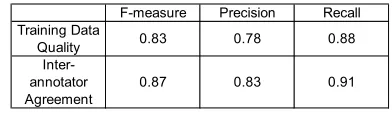
inter-annotator agreement (F-measure of 0.87). We also measured the quality of the automatically created training data by using the lexical pattern matching procedure with filtering to generate annotations for 86 abstracts in the test set. The F-measure was 0.83, when compared against the gold standard, shown in Table 1 below.
F-measure Precision Recall
Training Data
Quality 0.83 0.78 0.88
Inter-annotator Agreement
[image:5.612.327.523.326.383.2]0.87 0.83 0.91
Table 1: Training data quality and inter-annotator agreement
HMM Tagging With Noisy Training Data
We now had a large quantity of noisy training data that we could use to train a statistical tagger. This methodology is illustrated in Figure 4. We chose the HMM-based trainable entity tagger phrag15
[Palmer99] to extract the names in text. We trained phrag on different amounts of training data and measured performance. Our evaluation metric was the standard metric used in named entity
Abstracts from PubMed
Lexicon
FlyBase
Large Quantity of Noisy Training Data
Plain Text
Genes Tagged Gene1 Gene2
Other1 Other2
Start End
Text automatically tagged using FlyBase references and a lexicon is used to train up a tagger capable of tagging gene names in new text, including gene names never observed before.
Trainable Tagger
Figure 4: Schematic of Methodology
15Phrag is available for download at
[image:5.612.315.544.540.679.2]Training Data F-measure Precision Recall 531522 0.62 0.73 0.54 529760 0.64 0.75 0.56 1342039 0.72 0.80 0.65 2664324 0.73 0.79 0.67
No Orthographic Correction
[image:6.612.312.546.71.212.2]Table 2: Performance as a function of training data
Training Data F-measure Precision Recall 531522 0.65 0.76 0.56 529760 0.66 0.74 0.59 522825 0.67 0.76 0.59 1322285 0.72 0.77 0.67 1342039 0.75 0.80 0.70 2664324 0.75 0.78 0.71
Orthographic Correction
Table 3: Improved performance with orthographical correction for Greek letters and case folding for term matching in training data
evaluation, requiring the matching of a name's ex-tent and tag (except that for our experiment, we were only concerned with one tag, Drosophila gene). Extent matching meant exact matching of gene name boundaries at the level of tokens: Ex-actly matching boundaries were considered a hit. Inexact answers are considered a miss. For exam-ple, a multiword gene name such as "fas receptor", which has been tagged for "fas" but not for "recep-tor" would constitute a miss (recall error) and a false alarm (precision error).
Table 2 shows the performance of the basic system as a function of the amount of training data. As with Figure 2, we see there is a diminishing return as the amount of training data is increased. At 2.6 million words or training data, phrag achieved an entity identification F-measure of 73%. We then made a simple modification of the algorithm to correct for variations in orthography due to capi-talization and representation of Greek letters: we simply expanded the search for letters such as "∆" to include "Delta" and "delta". By expanding the matching of terms using the orthographical and case variants, performance of phrag improved slightly, shown in Table 3, improving our best performance to an F-measure of 75%.
5
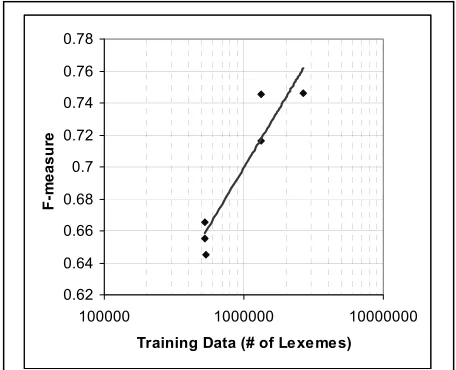
[image:6.612.67.295.498.683.2]Figure 5 shows these results in a graphical form.
Two things are apparent from this graph. Based on the results shown in Figure 2, we might expect the performance to be linear with the logarithm of the amount of training data, and in this case there is a
rough fit with a correlation coefficient of .88. The other result which stands out is that there is con-siderable variation in the performance when train-ed on different training sets of the same size. We believe that this is due to the very limited amount of testing data.
Error Analysis
We have identified three types of polysemy in Drosophila gene names in FlyBase. In some cases, one name (e.g., “Clock”) can refer to two distinct genes: period or Clock. The term with the most polysemy is “P450” which is a family of genes and is listed as a synonym for 20 different genes in FlyBase. In addition, the same term is often used interchangeably to refer to the gene, RNA tran-script, or the protein. [Hazivassloglou01] presents interesting results that demonstrate that experts only agree 78% of the time on whether a particular mention refers to a gene or a protein.16 The most
problematic type of polysemy occurs because many Drosophila gene names are also regular Eng-lish words such as "white", “cycle”, and "bizarre". There are some particularly troublesome examples that occur because of frequent use of short forms (abbreviations) of gene names, e.g., "we", "a", "not”, and even “and” each occur as gene names. These short forms are often abbreviations for the full gene name. For example, the gene symbol of the gene takeout is "to", and the symbol for the 0.62
0.64 0.66 0.68 0.7 0.72 0.74 0.76 0.78
100000 1000000 10000000
Training Data (# of Lexemes)
F
-m
e
asu
re
Figure 5: Performance as a function of the amount of train-ing data. The line is a least-squares logarithmic fit with an
R2 value of .8814.
gene wee is "we". It may be that more sophisti-cated handling of abbreviations can address some of these issues.
An error analysis looking at the results of our sta-tistical tagger demonstrated some unusual behav-ior. Because our gene name tagger phrag uses a first order Markov model, it relies on local context and occasionally makes errors such as not tagging all of the occurrences of the term "rutabaga" in an abstract about rutabaga as gene names. This cer-tainly opens up the opportunity for some sort of post processing step to resolve these problems.
The fact that phrag uses this local context can sometimes be a strength, enabling it to identify gene names it has never seen. We estimated the ability of the system to identify new terms as gene names by substituting strings unknown to phrag in place of all the occurrences of gene names in the evaluation data. The performance of the system at correctly identifying terms it had never observed gave a precision of 68%, a recall of 22% and an F-measure of 33%. This result is relatively encour-aging, compared with the 3.3% precision and 4.4% recall for novel gene names reported by Krau-thammer. Recognizing novel names is important because the nomenclature of biological entities is constantly changing and entity tagging systems should to be able to rapidly adapt and recognize new terms.
6
Conclusion and Future Directions
We have demonstrated that we can automatically produce large quantities of relatively high quality training data; these data were good enough to train an HMM-based tagger to identify gene mentions with an F-measure of 75% (precision of 78% and recall of 71%), evaluated on our small develop-ment test set of 86 abstracts. This compares fa-vorably with other reported results as described in Section 2, and as discussed below, we believe that we can improve upon these results in various ways. These results are still considerably below the re-sults from [Gaizauskas03] and may be too low to be useful as a building block for further automated processing, such as relation extraction. However, in the absence of any shared benchmark evaluation sets, cross-system performance cannot be evalu-ated since the task definition and evaluation cor-pora differ from system to system.
We plan to take this work in several directions. First, we believe that we can improve the quality of the underlying automatically generated data, and with this, the quality of the entity tagging. There are several things that could be improved.
A morphological analyzer trained for biological text would eliminate some of the tokenization er-rors and perhaps capture some of the underlying regularities, such as addition of Greek letters or numbers (with or without preceding hyphen) to specify sub-types within a gene family. There can also be considerable semantic content in gene names and their formatting. For example, many Drosophila genes are differentiated from the genes of other organisms by prepending a "d" or "D", such as "dToll". Gene names can also be explicit descriptions of their chromosomal location or even function (e.g. Dopamine receptor).
The problem of matching abbreviations has been tackled by a number of researchers [e.g. Puste-jovsky02 and Liu03]. As was mentioned above, it seems that ambiguity for "short forms" of gene names could be partially resolved by detecting lo-cal definitions for abbreviations. It should also be possible to apply part of speech tagging and corpus statistics to avoid mis-tagging of common words, such as “to” or “and”.
In the longer term, this methodology provides an opportunity to go beyond gene name tagging for Drosophila. It can be extended to other domains that have comparable resources (e.g. other model organism genome databases, other biological enti-ties), and entity tagging itself provides the founda-tion for more complex tasks, such as relafounda-tion extraction (e.g. using the BIND database) or attrib-ute extraction (e.g. using FlyBase to identify at-tributes such as RNA transcript length, associated with protein coding genes).
and characterization of abbreviations and other transformations would be particularly important in normalization.
By exploiting the rich set of biological resources that already exist, it should be possible to generate many kinds of corpora useful for training high-quality information extraction and text mining components.
References
Bikel D, Schwartz R, Weischedel R. An Algorithm that Learns What's in a Name. Machine Learning, Special
Issue on Natural Language Learning 34 (1999):211-31.
Cohen KB, Dolbey A, Hunter L. “Contrast and variabil-ity in gene names.” Proceedings of the workshop on natural language processing in the biomedical domain, Association for Computational Linguistics, 2002
Collier N, Nobata C, Tsujii J. “Extracting the Names of Genes and Gene Products with a Hidden Markov Model.” Proceedings of COLING '2000 (2000): 201-07.
Craven M, Kumlien J. “Constructing Biological Knowl-edge Bases by Extracting Information from Text Sources.” Proceedings of the Seventh International Conference on Intelligent Systems for Molecular Biol-ogy 1999: 77-86.
Gaizauskas R, Demetriou G, Artymiuk PJ, Willett P. “Protein Structures and Information Extraction from Biological Texts: The PASTA System.” Bioinformatics. 19 (2003): 135-43.
Hatzivassiloglou V, Duboue P, Rzhetsky A. “Disam-biguating Proteins, Genes, and RNA in Text: A Ma-chine Learning Approach.” Bioinformatics 2001: 97-106.
Hirschman L, Park J, Tsujii J, Wong L, Wu C. "Accom-plishments and Challenges in Literature Data Mining for Biology," Bioinformatics 17 (2002):1553-61.
Hirschman L, Morgan A, Yeh A. “Rutabaga by Any Other Name: Extracting Biological Names." Accepted, Journal of Biomedical Informatics, Spring 2003.
Krauthammer M, Rzhetsky A, Morosov P, Friedman C. “Using BLAST for Identifying Gene and Protein Names in Journal Articles.” Gene 259 (2000): 245-52.
Liu H, Friedman C. “Mining Terminological Knowl-edge in Large Biomedical Corpora.” Proceedings of the
Pacific Symposium on Biocomputing. 2003.
Palmer D, Burger J, and Ostendorf M. "Information Extraction from Broadcast News Speech Data." Pro-ceedings of the DARPA Broadcast News and Under-standing Workshop, 1999.
Pustejovsky J, Castaño J, Saurí R, Rumshisky A, Zhang J, Luo W. “Medstract: Creating Large-scale Information Servers for Biomedical Libraries.” Proceedings of the ACL 2002 Workshop on Natural Language Processing in the Biomedical Domain. 2002.
Tauszig et al. “Toll-related receptors and the control of antimicrobial peptide expression in Drosophila.” Pro-ceedings of the National Academy of Sciences 97 (2000): 10520-5.
![Figure 2: Performance of BBN's IdentiFinder named entity recognition system relative to the amount of training data, from [Bikel99]](https://thumb-us.123doks.com/thumbv2/123dok_us/748468.1085781/2.612.66.303.454.594/figure-performance-identifinder-entity-recognition-relative-training-bikel.webp)