Available Online atwww.ijcsmc.com
International Journal of Computer Science and Mobile Computing
A Monthly Journal of Computer Science and Information Technology
ISSN 2320–088X
IJCSMC, Vol. 4, Issue. 6, June 2015, pg.99 – 105
RESEARCH ARTICLE
RECOVER ORIGINAL IMAGE IN
WATERMARKING USING COSINE FUNCTION
Zeeshanali M Darugar
M.Tech student Digital Electronics & Communication, Akshaya Institute of Technology, Tumakuru, India
ANU J P
Assistant Prof., Dept of Electronics & Communication, Akshaya Institute of Technology, Tumakuru, India
Abstract: Internet development, along with improvement in the tools of digital multimedia has created a most important impact in creating the content of multimedia for storage and distribution is a straightforward tasks. To provide security for contents of multimedia becomes a very important issue and there is a requirement in protection of the digital content against illegal copying, counterfeiting. Digital watermarking is a developing field that needs continuous try to find the possible method for protection of multimedia content. In this project embedding a watermark within an image and extracting watermark from an image no distortion of original image using interpolation method and cosine function. Recover back the original image after embedding and extracting of watermark using proposed method. The Peak Signal to Noise Ratio values provides the robustness of the proposed technique.
INTRODUCTION
effortlessly, if the superiority of the watermarked image is critically pretentious later than inserting. The possessions of a lesser amount of deprivation of an image are referred as imperceptibility. A class of delicate watermarking is reversible watermarking. Reversible watermarking is of lossless type. The clandestine message is implanted as an unseen mark in addition to recovered reverse later than the drawing out of watermark. The properties are the identical as watermarking method. The watermark is able to be without difficulty implanted and retrieved by the users.
IMPLIMETATION OF PROPOSED METHOD
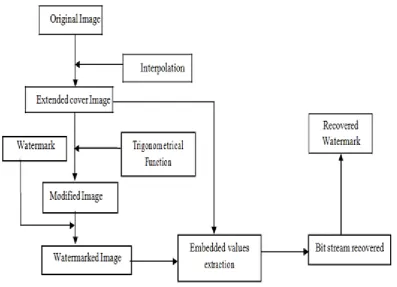
The algorithm description involved different step to get a recover of original image. Embedding of watermark image within the original and extraction of water mark from the original image and recovered back to original image as same as the original image.
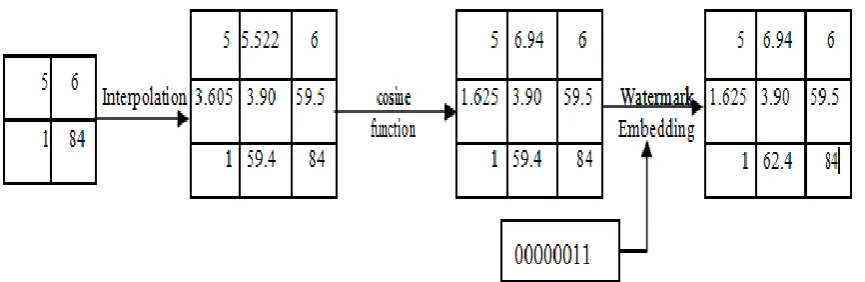
The I is the original image C is the extended cover image this process is in the following
steps
C (1, 1)=I(1,1)=5
C (1, 3) =I (1, 2) =6
C (3, 1) =I (2, 1) =1
C (3, 3) =I (2, 2) = 84
After this process we obtained three rows and three columns of block which is shown in
below.
In the above block place of the zero elements are obtained by using following formulas
5.5227+2cos (5.5) =6.9400
Fig 2 Watermark embedding technique
Watermark extraction from watermarked image
Now we obtained embedding process of watermark image into the original image. A
percentage of random noise is added to the watermarked image it becomes noisy
watermarked image.
Separate the elements of original block from the watermarked block we obtained recovered
image.
Separate the watermark image is subtraction of the 3x3 block obtained using formulas from
After subtracting the difference gives two decimal values. These decimal values are
converted into binary and concatenated to produce 8 bit binary data. This data is kept in the
(1, 1) position.
RESULTS AND DISCUSSIONS
In this chapter the results is obtained by applying interpolation and cosine function to
the original image and to obtain recovered image same as original image. The watermark
embedded and extracted from original image, no distorting the original image. This process
of embedding and extraction is done by using interpolation and cosine function.
Experimental results
CONCLUSION AND FUTURE ENHANCEMENT
In this chapter Conclusion of the dissertation work is presented and also this chapter
provides the future enhancement of the work.
Conclusion
In this project, proposed method suggests the embedding the watermark within the
image and extraction of watermark from the image. In this process of watermark embedding
within the image and extraction of watermark without damaged original image using a
proposed method. In this proposed method using cosine function and interpolation technique.
We are able to recover back the original image. We obtained the robustness of the proposed
method by the high PSNR.
Future work
The proposed method can be extended to video, embedding watermark within the
video and extracted watermark from the video without distorting the original video.
References
[1] H. T. Wu and Y. M. Cheung, "Reversible Watermarking by Modulation and safety improvement”, IEEE communication oninstrumentation and dimension, 59(1), January 2010.
[2] N. Dey, P. Das, S. S. Chaudhuri, A. Das,“Feature investigation for the blind-watermarked electroencephalogram indication in wireless telemonitoring by means of Alattar's method”, procedures of the FifthInternational Conference on safety of and data systempp.87-94,ACM,2012.
[3] N. Dey, P. Maji, P. Das, S. Biswas, A. Das, S. S. Chaudhuri “An Edge Based Blind Watermarking system of
remedial figures with no Devalorizing analytic factor”, InternationalConference on Advances in knowledge and Engineering, pp. 1-5,2013.
[4] N. Dey, S. Mukhopadhyay, A. Das, S. S. Chaudhuri “study of P-QRS-T mechanism customized by Blind
Watermarking method in the Electrocardiogram Signal for verification in Wireless Telecardiology by DWT”,
International Journalofpicture, Graphics and Signal Processing, vol. 4,2012.