An Information Theoretic Perspective on the
Differential Fault Analysis against AES
Yang Li, Shigeto Gomisawa, Kazuo Sakiyama, Kazuo Ohta
The University of Electro-Communications 1-5-1 Chofugaoka, Chofu-shi, Tokyo 182-8585, Japan {liyang,g-shigeto-lfat,saki,ota}@ice.uec.ac.jp
Abstract. Differential Fault Analysis against AES has been actively studied these years. Based on similar assumptions of the fault injection, different DFA attacks against AES have been pro-posed. However, it is difficult to understand how different attack results are obtained for the same fault injection. It is also difficult to understand the relationship between similar assump-tions of fault injection and the corresponding attack results. This paper reviews the previous DFA attacks against AES based on the information theory, and gives a general and easy under-standing of DFA attacks against AES.
We apply the similar analysis on DFA attacks on AES-192 and AES-256, and we propose the attack procedures to reach the theoretical minimal number of fault injections.
Keywords:Differential Fault Analysis, AES, Information theory
1
Introduction
In 1997, public key cryptosystems were pointed to be vulnerable to fault attacks that use the computational errors during the execution to find the secret key [7]. At the same year, Biham and Shamir applied this idea to block cipher DES and introduced the concept of Differential Fault Analysis (DFA) [5]. Given an encryption of a block cipher, a fault-free ciphertext can be obtained for a plaintext. Then by injecting a certain kind of fault during the execution of the cryptographic calculation, attackers can get a faulty ciphertext as well. The assumptions of the fault injection are referred as thefault modelin this paper. DFA obtains the information of the secret based on the fault-free ciphertext and the faulty ciphertext under a certain fault model.
faulty ciphertext with a fault model allowing multiple faulty bytes. In 2006, Moradi, Shalmani and Salmasizadeh proposed a generalized DFA attack against AES [11]. In brief, the generality of their attack is achieved by dividing all possible faults into two groups, and giving attacks for each group. By simulation, they found that for the first group, 6 faulty ciphertexts in average can identify the secret key, while 1500 faulty ciphertexts are needed for the second group. It is not difficult to find that the fault models used in [6] and [11] are also similar to that used in [10, 12, 14, 15], however different attack results are obtained as well.
In this paper, DFA attacks against AES are analyzed through the observation of information theory. Assumptions in a fault model are regarded as the information of the difference between a fault-free intermediate value and a faulty intermediate value. Based on the relationship between the difference of intermediate values and the secret key, we give a simple understanding for the existing DFA attacks against AES. Our analyses find that there is a limitation of the attack efficiency for each fault model. Attacks in [10], [15], [6] and [11] reached the limitations of their fault models, while attacks in [12, 14] did not. Also, we propose a simple model for pre-dicting the attack efficiency. Our prediction model obtains the similar results with the simulation results provided by previous papers. In a word, this paper provides a generalized and simple understanding for the DFA attacks based on the similar fault models, and proposes an optimized attack flow for DFA attacks as well.
For the DFA attacks on AES-192 and AES-256, we manage to predict the min-imal times of the fault injection based on the information theory. Then we also propose the DFA attack procedures that can use the minimal times of fault injec-tions to retrieval the key within a practical computational complexity. The proposed DFA attack on AES-192 has been verified by the simulations based on C language. This paper is organized as follows. In Sect. 2, we briefly explain the structure of AES. In Sect. 3, we generally analyze the DFA attacks through the perspective of information theory. In Sect. 4, several related previous DFA attacks against AES-128 are explained based on the observation of information theory. In Sect. 5, DFA attacks on AES-192 and AES-256 are analyzed and discussed. In Sect. 6, we discuss the possible future research about the DFA attacks against AES. In Sect. 7, we conclude this paper.
2
Overview of the Structure of AES-128
encryption of AES with 128-bit secret key. In this paper a plaintext, an intermediate value and a ciphertext of AES-128 are denoted by P, I andC, respectively. AES operates on a 4× 4state matrix as shown in Table 1. Every element of the state matrix is a byte represented by Iij, where i, j ∈ [0,3] and i, j are its row and
column positions, respectively. Notice that, P, K and C can be expressed in the same manner.
I00 I01I02 I03
I10 I11I12 I13
I20 I21I22 I23
I30 I31I32 I33
Table 1.AES state matrix
AES-128 consists of 10 rounds. Each round has its own round key denoted by
Ki, wherei∈[0,10]. Each round key can be expanded from the original keyK by the AES key schedule scheme. Conversely, obtaining a round key is equivalent to obtaining the original key and all the other round keys. After the initial AddRound-Key, the first 9 rounds of AES are the same consisting of four AES operations as SubBytes, ShiftRows, MixColumns and AddRoundKey. The last round of AES-128 only consists of SubBytes, ShiftRows and AddRoundKey.
Before we introduce the details, we list several notations used in this paper. We denote the faulty intermediate value and the faulty ciphertext by I′ and C′, respectively. The difference betweenI andI′ is denoted by∆I, and that between
CandC′is denoted by∆C.
The functionalities of AES operations on the real values (e.g. I, I′) and differ-ences (e.g.∆I) are briefly explained as follows.
AddRoundKey(ARK)
As shown in Table 2, the AddRoundKey performs the exclusive OR calculation (⊕) between the current state and the corresponding round key. AddRoundKey affects the real value of each byte in the state, but does not affect the difference between the fault-free state and faulty state.
SubBytes(SB)
Each byte of the state is substituted by another value according to the pre-computed S-box table. The mapping of AES S-box is bijective.
ShiftRows(SR)
I00 I01I02 I03
I10 I11I12 I13
I20 I21I22 I23
I30 I31I32 I33 =
I00⊕K00I01⊕K01 I02⊕K02 I03⊕K03
I10⊕K10I11⊕K11 I12⊕K12 I13⊕K13
I20⊕K20I21⊕K21 I22⊕K22 I23⊕K23
I30⊕K30I31⊕K31 I32⊕K32 I33⊕K33
Table 2.AES AddRoundKey
I00 I01I02 I03
I10 I11I12 I13
I20 I21I22 I23
I30 I31I32 I33
SR
−−→
I00 I01I02 I03
I11 I12I13 I10
I22 I23I20 I21
I33 I30I31 I32
Table 3.AES ShiftRows
MixColumns(MC)
A linear transformation performed on each column of the state computed by
I0j
I1j
I2j
I3j =
02 03 01 01 01 02 03 01 01 01 02 03 03 01 01 02
·
I0j
I1j
I2j
I3j ,
where j ∈ [0,3] and the multiplication is performed in GF(28). Since Mix-Columnsis a linear transformation, we haveM C(I)⊕M C(I′) =M C(I⊕I′) =
M C(∆I).
3
Information Theoretic Perspective on DFA
3.1 The Fault Model for DFA
Every fault model assumes that it is possible to inject a certain type of faults at a certain state of the AES calculation. For example, the most discussed fault model in this paper is the one that assumes attackers can disturb a random byte at the input of the 8th round of AES. Hereafter we refer this fault model asPiret’s Fault
model, since it was first introduced in Piret et al.’s paper [14]. And we refer the state where a fault is injected by the injection state. Through the perspective of information theory, the fault model can be considered as the information of ∆I
The difference between two different random 128-bit values have2128−1 can-didates. While in Piret’s fault model, the differentce only have255×16candidates, where255and16correspond to 255 possible difference values and 16 possible fault positions. We can see that this fault model provides−log2 21281 −(−log2 2551×16) = 116bits of information of the∆I at the injection state. In Piretet al.’s paper, based on a pair of(C, C′), the key space of AES-128 can be restricted to240. This result can be understood as the attacker obtains 128 −40 = 88 bits information of the secret key from a pair of(C, C′)and128−12 = 116bits information of∆I at the injection state.
3.2 Basic Attacks for DFA
In the sense of information theory, given a pair of plaintext and ciphertext(P, C), the secret key K can be identified theoretically. As far as our knowledge, for the full-round of AES-128, the exhaustive search is the most effective way to reveal the key information based on(P, C). In the exhaustive search, every possible key can-didate is used to encrypt the plaintext to get a ciphertext cancan-didate. Only when the tested key is the correct one, the obtained ciphertext candidate matches the given ciphertext. However, the exhaustive search over2128 key candidates cannot be per-formed in a practical time.
The exhaustive search for DFA based on(C, C′)and the information of∆I at the injection state also exists. The similar idea was explained in Piret et al.’s pa-per as thebasic attack for DFA [14]. Under a certain fault model, attackers need to get the correct ciphertext C and the faulty ciphertext C′. Every pair of (C, C′) and the fault model can provide information of the key and restrict the key space. Repeat restricting the key space based on new faulty ciphertexts, finally the key can be identified. The algorithm of the basic attack for DFA is shown as follows.
1. Have a guess of the secret keyKg from a list of possible keys.
2. Calculate the values ofIandI′at the fault injection state based on(C, Kg)and
(C′, Kg), respectively.
3. Calculate the difference ∆I =I ⊕I′ and check whether∆I satisfies the fault model or not. If not, deleteKgfrom the key list. Otherwise, keep it in the list.
4. If the key list has more than one candidate, take another faulty ciphertext and repeat steps 1, 2 and 3 to restrict the current key list. Hereafter we refer steps 1, 2 and 3 as aDFA search.
basic attack can fully use the information provided by injected faults in any fault model to restrict the key space, so that it reaches the max attack efficiency with regard to the information theory.
3.3 Divide and Conquer used in DFA Attacks
The basic technique used for turning the basic attack into a practical DFA attack isdivide and conquer. By dividing the 128-bit key into several parts and analyze them part by part, the key search space can be reduced dramatically.
The last three rounds of AES with disturbing one byte at the beginning of the 8thround are shown in Fig. 1.
SB SR MC
ARK 8R
SB SR MC
ARK 9R
SB SR
ARK 10R
K8
K9
K10
I I’ = ∆I
C C’= ∆C
Injection stateTarget state
Fig. 1.The last three rounds of 128-bit AES with disturbing one byte at the beginning of the 8thround.
One byte fault injected at the beginning of the 8thround propagates to four bytes
of its column in the 8thMixColumns. And these four non-zero faulty bytes will be reserved after the 9th SubBytes, and shifts to each column in the 9th ShiftRows. Notice that from the 9thMixColumns to the output of ciphertext, only the 9th
four groups and be searched separately. Each group has four bytes, so that the total search space becomes232×4 = 234.
Under the same fault model, as long as different amounts of information from the fault model are used, different attack results will be obtained. The more infor-mation of ∆I at the injection state used in the DFA search, the less key will be left, as a result the attack will be more efficient in the sense of information the-ory. However, not all the information of∆I can be easily exploited considering the computational cost. There is a limitation for improving the attack efficiency of DFA in each fault model, which can be achieved by the basic attack theoretically but not practically.
4
Review the Previous DFA attacks against AES-128
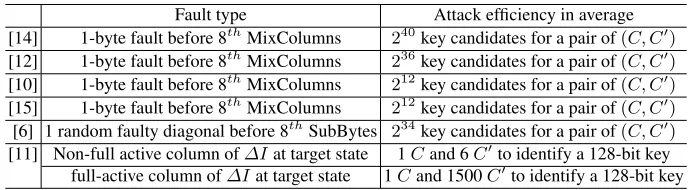
In 2003, Piret and Quisquater proposed a DFA attack against AES based on dis-turbing one random byte of the AES state between the 7th MixColumns and 8th MixColumns [14]. We refer this attack by Piret’s attack in this paper. According to their analysis method, two well-located faults are needed for easy retrieving of the key, and one fault can reduce the size of the key space to240. According to the structure of AES shown in Fig. 1, one non-zero byte of ∆I at the injection state will propagate to 4 non-zero bytes of∆I at the target state. Moreover, each column of ∆I at the target state will have one non-zero byte. Then 16 bytes of K10 are divided into four groups to perform the DFA search independently and DFA search checks whether a column of∆I at the target state has only one non-zero byte. The simulations shows that the average size of the key candidates of 4 key bytes is210, so that the total number of the key candidates is about 240. Note that some of the information of∆I at the target state, such as the positions of 4 non-zero bytes are not used in Piret’s attack.
the key schedule scheme to obtainK9 based on each key candidate of K10. Then each key candidate can be checked whether it comes from the one faulty byte before the 8thMixColumns. For each position, the key space can be restricted to28, so that the total key space can be reduced to212 in the second step. We can see that this work uses all the information of Piret’s fault model and reaches the limitation of Piret’s fault model.
In 2010, Gomisawaet al.proposed very similar DFA attacks based on the Piret’s fault model [10]. First, they found that the positions of 4 faulty bytes at the target state have only 4 patterns instead of 16 patterns analyzed in [12]. So instead of guessing of the exact fault injection position, attackers can guess which position pattern the injected fault belongs to. As a result, the key space can be first restricted from2128to234in the first step. Then by using the information of the fault values of
∆I at the target state, the key space can be restricted to212. In average, the search algorithm proposed by Gomisawaet al.is faster than the algorithm proposed in [15]. For example, the worst case of Gomisawa’s algorithm performs searches over 232 keys for 4 times, while that of Tunstall’s algorithm is 16 times. For details, we refer to [10].
In 2009, Saha, Mukhopadhyay and RoyChowdhury proposed a Diagonal Fault Attack [6]. Their fault model is that multiple faults are injected at the diagonal of the state matrix at the beginning of the 8thround. In their analysis, when only one
diagonal is with fault, a pair of(C, C′)can restrict the total key space to234. We can see that this result is the same with the intermediate result in [10] and it is already the limitation for this attack model. Different form Piret’s fault model, this fault model cannot provide any information about the fault values at the target state.
In 2006, Moradiet al.proposed a generalized method of Differential Fault Anal-ysis against AES [11]. In their analAnal-ysis, all possible faults are divided into two groups. Take a column of∆I at the target state, if at least one of the 4 bytes are fault-free, then this fault belongs to the first group, otherwise, it belongs to the second group. For the first group, the corresponding 32 bits of secret key can be obtained by a fault-free ciphertext and 6 faulty ciphertexts, while it need approx-imately 1500 faulty ciphertexts to identify 32 key bits for the second group. The fault model of their paper only provides information of the number of faulty bytes in a column of∆I at the target state. The information of their fault model is already fully exploited in their analysis.
Fault type Attack efficiency in average [14] 1-byte fault before 8thMixColumns 240key candidates for a pair of(C, C′) [12] 1-byte fault before 8thMixColumns 236key candidates for a pair of(C, C′) [10] 1-byte fault before 8thMixColumns 212key candidates for a pair of(C, C′) [15] 1-byte fault before 8thMixColumns 212key candidates for a pair of(C, C′) [6] 1 random faulty diagonal before 8thSubBytes 234key candidates for a pair of(C, C′) [11] Non-full active column of∆Iat target state 1Cand 6C′to identify a 128-bit key
full-active column of∆Iat target state 1Cand 1500C′to identify a 128-bit key Table 4.The summary of attack results of DFA attacks against AES-128.
4.1 The General Attack Flow of DFA
The attack flow of DFA can be mainly divided into two kinds based on whether plaintext is used. If the plaintext corresponding to the fault-free ciphertext is un-known, only faulty ciphertexts can be used to identify the key. Otherwise, attackers can first restrict the key space to a reasonable size based on faulty ciphertexts, and then apply the exhaustive search based on(P, C)to identify the correct key. We can express this attack flow of DFA as follows.
2128−−−−→C,C′,∆I 2?? −−→P,C 1.
The better DFA attacks should request fewer faulty ciphertexts and cost less computations. As a result, betters DFA attacks should use more information of every pair of(C, C′)and have a reasonable computational cost at the same time. When a fault model is given, attackers directly obtains the information of∆Iat the injection state. Then attackers needs to covert the information at the injection state to the one at the target state. Different types of information at the target state cost differently in DFA searches. We try to propose the best attack flow of DFA making a good trade-off between them.
First we separate the information that can be used in a DFA attacks into four types as follows.
1. The number of non-zero bytes in each column of∆I at the target state. 2. The positions of non-zero bytes of∆I at the target state.
3. The relationship between values of non-zero bytes of∆I at the target state. 4. The information of(P, C).
first type of information. Then since checking the third type of information needs to pass at least two MixColumns, two SubBytes and key schedule, so that divide and conquer cannot be easily applied. The last information can identify the key, but it is the most costly calculation. When these four types of information are all available to attackers, the best attack flow of DFA should first use the first two types of infor-mation to restrict key space to a reasonable size. Then, the third type of inforinfor-mation can be applied to further restrict the key space. Finally, the last information can be used to identify the key.
4.2 Predicting The Attack Efficiency of DFA
In this section, we discuss the relationship between the information of each fault model and the information ofK. According to the structure of AES,(I, I′)at the target state goes through MixColumns, SubBytes, ShiftRows and AddRoundKey to become(C, C′). Since MixColumns and SubBytes are bijective mapping with re-gard to a column of state or the entire state, and ShiftRows only change the positions of faulty bytes, we simplify this transformation as
BM(I)⊕K =C, (1)
BM(I⊕∆I)⊕K =C′, (2)
whereBM stands for a bijective mapping, andI can be a column of target state or the entire target state.
Based on Eq. (1), whenC is fixed, for each value ofI, there is a corresponding value ofK. The key space after a DFA search is equivalent to the number ofI that can pass the Eq (3), where ∆C is fixed by (C, C′) and∆I at the target state are restricted by the information from the fault model.
BM(I)⊕BM(I⊕∆I) =∆C, (3)
For each possible value of ∆C, the space of ∆I has been restricted by the differential distribution table of BM, but the key space has not been restricted. After that, when we use the information from the fault model to further restrict the space of∆I at the target state, the key space begins to be restricted.
∆I that passed the differential distribution table ofBM have the same probability ofq%to pass the restriction of the fault model. Second, we assume that the value of
I are uniformly distributed to the values of possible∆I that passed the differential distribution table of BM. As a result,q%ofI will pass the restriction of both the differential distribution table ofBM and the fault model. Finally,q%ofK are left after the DFA search.
In the case of the introduced DFA attacks against AES, the used fault model should have little correlation between the differential distribution table of BM. And according to the differential distribution table of AES S-box, the values ofIare almost uniformly distributed for each possible∆I as well. In a relaxed environment, we can use the conclusion that the size of ∆I restricted by the conditions for a DFA search is the same with the size of the key space after this DFA search. In other words, DFA attacks against AES can obtain the same amount of information aboutK with the information about∆I used in this attack. It is checked that this prediction matches the simulation results given in [6, 10–12, 14, 15].
For example, we try to predict the attack efficiency of the second type of DFA attacks in [11]. Since the fault model only has the information that four bytes of a column of ∆I at the target state are all non-zero, a pair of (C, C′) provides log2(225532−41) ≃ 0.02259 bit information of 4 bytes of ∆I at the target state.
Ac-cording to our prediction, the key also obtains about0.02259bit information from a pair of(C, C′). As a result, at lease 1420 faulty ciphertexts are needed to recover 32 bits of key (1420 ×0.02259 ≃ 32), where the simulation result in [11] show that in average 1500 ciphertexts can identify 32-bit key. The simulation result also indicates that the information provided by different faulty ciphertexts are almost independent from each other.
5
Observations of DFA attacks on AES-192 and AES-256
The DFA attacks on AES-192 and AES-256 were previously discussed in [1–3] and [4]. The latest and best previous attack results against AES-192 and AES-256 are the ones dicussed in [4]. In [4], the AES-192 key can be indentified with two pairs of correct and faulty ciphertexts and a pair of plaintext and ciphertext. While the AES-256 key can be indentified with three pairs of correct and faulty ciphertexts and a pair of plaintext and ciphertext.
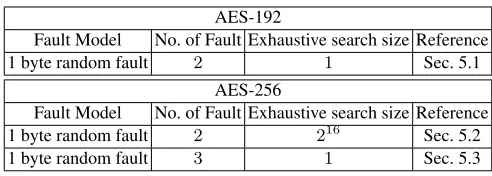
Intuitively, when considering the DFA attacks on AES-192 and AES-256 where the secret information is 192-bit and 256-bit, respectively, the minimal number of required fault injection is two. With two fault injections with known position, the maximal obtainable secret information is 120 ×2 = 240 bits. For AES-192, the secret key should be able to be identified without further exhaustive search. For AES-256, two fault injections should be able to restrict the key space to216that is small enough for the exhaustive search. Compared to the attack results in [4], for AES-192, attackers are not required to know the plaintext anymore. For AES-256, attackers can reduce 1 pair of correct and faulty ciphertexts for recovering the key.
For the simplicity, we show the practical calculation procedures to identify the key for AES-192 and AES-256 with fault injection with known position. Some techniques well used in rebound attacks [16] are used to speed up the key retrieval process. Out attack results are summarized in Table 5. All the introduced attack pro-cedures can be extended for the fault injections with unknown positions. The only penalty is an increase of the calculation complexity. Note that the attack procedures introduced in Sec. 5.1 and Sec. 5.3 are based on the ones introcuded in [4]. The difference is that the final attack procedures are checking the deeper differentials in our attacks instead of the exhaustive search in [4].
Table 5.Summary of our DFA attack results
AES-192
Fault Model No. of Fault Exhaustive search size Reference 1 byte random fault 2 1 Sec. 5.1
AES-256
Fault Model No. of Fault Exhaustive search size Reference 1 byte random fault 2 216
Sec. 5.2 1 byte random fault 3 1 Sec. 5.3
5.1 DFA Attack Against AES-192 based on 2 Faults
SBb11 SRb11 MCb11 AKb11 SBb12 SRb12 AKb12 … … SBb10 SRb10 MCb10 AKb10 SBb9 SRb9 MCb9 AKb9 SBa11 SRa11 MCa11 AKa11 SBa12 SRa12 AKa12 … … SBa10 SRa10 MCa10 AKa10 SBa9 SRa9 MCa9 AKa9 C2 C2’ C1 C1’
Fig. 2.Fault propagation in the DFA attack in AES-192
This attack procedures can identify the key without any exhaustive search in-volving plaintext. Here is the attack procedure:
Step 1 Restrict the key space of K12 to 232 by checking the difference at each column of the stateSBina12.
Step 2 Take a possible candidate of K12, calculate the corresponding left half of
K11. Use the known part of K11 to calculate partial of the difference at state SBina11 and SBinb11. Check whether or not the calculated byte-wise differences satisfy the relationship decided by MixColumns calculation.
Step 3 Repeat Step 2 for all possibleK12, thenK12is expected to be identified. Step 4 Use the identified K12 and the identified left half of K11 to identify the
differential at SBinb11 and to calculate the differential at state SBoutb11. Use the S-box differential distribution table to obtain the possible real values atSBoutb11. Use these values to calculate the possible candidates of the right half ofK11. The size of the key space is expected to be28.
Step 5 For each key guess of K11, calculate and verify the differentials at state SBina11andSBinb10, thenK11can be identified as well.
The technique used in Step 4 can also be applied to Step 1 to speed up the calculation by omitting the exhaustive search with232keys. This attack procedure has been verified by simulating it using the C language. Based on a PC with a Pentium (R) 3.2 GHz CPU and 3.5G RAM, the 192-bit secret key can be identified in about 1 minute without the information of the plaintext.
5.2 DFA Attack Against AES-256 based on 2 Faults
11-SBb13 SRb13 MCb13 AKb13 SBb14 SRb14 AKb14
… … C2
C2’ SBb12 SRb12 MCb12 AKb12 SBb11 SRb11 MCb11 AKb11 SBa13 SRa13 MCa13 AKa13 SBa14 SRa14 AKa14
… … C1
C1’ SBa12 SRa12 MCa12 AKa12 SBa11 SRa11 MCa11 AKa11
Fig. 3.Fault propagation in the DFA attack in AES-256
th round. The propagation of the injected faults is shown in Fig. 3. The requirement is that only one byte of the intermediate value is disturbed, while attackers know which byte it is but does not know the value of the injected fault.
Here is the attack procedure.
Step 1 Restrict the key space of K14 to 232 by checking the difference at each column of the stateSBina14.
Step 2 Take a possible candidate ofK14, calculate the rightmost three columns of
K12 and the differences at state SBoutb13. For the difference of each column at SBinb13, there are28 candidates. Use the S-box differential table to obtain all the possible real values for each column atSBinb13. After that, the real values for each column atSBinb13is expected to have28 candidates.
Step 3 Use the the rightmost three columns ofK12and the real values at stateSBinb13 to calculate three active bytes at SBinb12. Check whether or not the calculated active bytes satisfy the relationship of the MixColumns calculation. After this calculation, the space of real values of the rightmost three columns atSBinb13can be reduced to28.
Step 4 One can use the possible real values atSBinb13and the corresponding cipher-text C2 to calculate the candidates of K13, the space of K13 is expected to be 28+8 = 216. Then one can test each candidates by calculating and checking the difference at SBina13 and SBinb12. The probability of satisfying all the remaining requirements is about 2−24−8 = 2−32, where 2−24 for the difference at SBina13 and2−8 for the difference atSBin
b12.
With the most used fault model, this procedure can identify the 256-bit secret key with 2 fault injections within a practical calculation complexity (248). The attack complexity can be reduced if two faulty ciphertexts are obtained from the same plaintext, since attackers can restrict the space of K13 to 28 instead of 216 before Step 4, then the attack complexity can be reduced to240.
Based on the usage of the differential table of S-box (well used in the rebound attacks [16]), this attack procedure is able to check the differences atSBinb12without any knowledge ofK13. This improvement is the key point making the DFA attacks on AES-256 with two fault injections practical.
5.3 DFA Attack Against AES-256 based on 3 Faults
SBa11 SRa11
MCa11
AKa11
SBb13 SRb13
MCb13
AKb13
SBb14 SRb14 AKb14
… … C3
C3’
SBb12 SRb12
MCb12
AKb12 SBb11
SRb11
MCb11
AKb11
SBa13 SRa13
MCa13
AKa13
SBa14 SRa14
AKa14
… … C1 / C2
C1’ / C2’ SBa12
SRa12
MCa12
AKa12
Fig. 4.Fault propagation in the DFA attack in AES-256
This section shows how to identify the 256-bit secret key with 3 fault injections without any exhaustive search based on plaintext. This attack requires two 1-byte fault injections at the beginning of the 12-th round and another 1-byte fault injection at the beginning of the 11-th round. The propagation of the injected faults is shown in Fig. 4. Only one byte of the intermediate value is disturbed, while attackers know which byte it is but does not know the value of the injected fault.
Here is the attack procedure.
Step 1 Restrict the key space of K14 to 232 by checking the difference at each column of the stateSBina14based on(C1, C1′). Then identifyK14by checking the difference at each column atSBina14based on(C2, C2′).
Step 3 For the identified K14 and each candidate of K13, check the difference at stateSBinb12based on(C3, C3′)and the difference atSB
in
a13based on both(C1, C1′) and(C2, C2′). After step 3, the correct key is expected to be identified.
Compared to the introduced DFA attack on AES-256 in Sec. 5.2, this attack takes one more fault injection, but costs much less computation in the key retrieval process and be able to identify the key without knowing the value of plaintext.
6
Future Research of DFA against AES
Notice that in the DFA attack flow we proposed, DFA attacks first use the informa-tion of∆I at the target state to restrict the key space. Then for the restricted key space, the∆I at injection state is calculated to restrict the key space again. Finally, an exhaustive search based on(P, C)is applied to identify the key. Divide and con-quer makes the information of∆I at the target state can be used in a practical time. The exhaustive search based on (P, C)is quiet difficult to be further improved. A possible future work for DFA attacks against AES is to find a method to speed up the DFA search up to the injection state.
Assume that attackers get a pair of (P, C) and get only one faulty ciphertext
C′ with a fault that is injected trying to follow the Piret’s fault model. When the injected fault actually belongs to Piret’s fault model, the key can be fully retrieved in a practical time. Otherwise, we can consider that multiple faulty bytes rather than a single faulty byte is disturbed. If the multiple faulty bytes locate at a diagonal of
∆I at the injection state, the key can also be fully retrieved in a practical time [15] as well.
However, the injected fault could be two faulty bytes locate at two diagonals at the beginning of the 8th round. In this case, after exploiting the first type of information about ∆I at the target state, the key space can be restricted to 274.3. After that, exploiting the second type of information about ∆I at the target state can restrict the key space to266.54. Then, theoretically, the third type of information about∆Iat the injection state can be used to restricted the key space to222.57that is small enough for an exhaustive search based on(P, C). Unfortunately, the technical used in Sec. 5 seems difficult to be applied here. Finding a method to exploit the third type of information in a practical time could be an interesting future work1.
1
7
Conclusions
This paper analyzes differential fault attacks against AES from an information theo-retic perspective. The assumptions of fault injection are reviewed as the information of two intermediate values. DFA attacks against AES are considered as the crypt-analysis that obtains the information of key based on the two ciphertexts and the information of the fault injection. Several previous DFA works were reviewed from the information theoretic perspective. Based on our analysis, every fault model has a limitation of the attack efficiency and we proposed a method to predict the attack efficiency for all similar DFA attacks. We gave a general DFA attack flow which requires the least faulty ciphertexts with a reasonable computational cost. We also managed to propose practical DFA attacks against AES-192 and AES-256 reaching the theoretically minimal fault injection times.
8
Acknowledgement
The authors would like to thank Chong Hee Kim for kindly showing us his latest research results and his valuable comments to the contents in Sec. 5.
References
1. W. Li, D. Gu, Y. Wang, J. Li, and Z. Liu. “An extension of differential fault analysis on AES.” in Interna-tional Conference on Network and System Security, pages 443–446. IEEE Computer Society 2009. 2. J. Takahashi and T. Fukunaga. “Differential fault analysis on AES with 192 and 256-bit key.” Cryptology
ePrint Archive, Report 2010/023, 2010. http://eprint.iacr.org/
3. A. Barenghi, G. Bertoni, L. Breveglieri, M. Pellicioli, and G. Pelosi. “Low voltage fault attacks to AES and RSA on general purpose processors.” Cryptology ePrint Archive, Report 2010/130, 2010. http://eprint.iacr.org/
4. C. H. Kim. “Differential Fault Analysis against AES-192 and AES-256 with Minimal Faults.” to apper in
FDTC, Springer 2010.
5. E. Biham and A. Shamir. “Differential Fault Analysis of Secret Key Cryptosystems.” inCRYPTO, pages 513–525. Springer 1997.
6. D. Saha, D. Mukhopadhyay and D. RoyChowdhury, “A Diagonal Fault Attack on the Advanced Encryption Standard.” Cryptology ePrint Archive, Report 2009/581, 2009. http://eprint.iacr.org/
7. D. Boneh, R. A. DeMillo, and R. J. Lipton. “On the Improtance of Checking Cryptographic Protocals for Faults. (Extened Abstract)” inEUROCRYPT, pages 37–51. Springer, 1997.
8. J. Blömer and J.-P. Seifert. “Fault based Cryptanalysis of the Advanced Encryption Standard.” Cryptology ePrint Archive, Report 2002/075, 2002. http://eprint.iacr.org/
9. C. Giraud. “DFA on AES.” Cryptology ePrint Archive, Report 2003/008, 2003. http://eprint.iacr.org/ 10. S. Gomisawa, M. Izumi, Y. Li, J. Takahashi, T. Fukunage, Y. Sasaki, K. Sakiyama, and K. Ohta.
“Applica-bility Extension and Efficiency Improvement of Fault Analysis Attack on AES Implementations.” InSCIS, 2010.
12. D. Mukhopadhyay. “An Improved Fault based Attack of the Advanced Encryption Standard.” In
AFRICACRYPT, pages 421–434, 2009.
13. G. Letourneux P. Dusart and O.Vivolo. “Differential Fault Analysis on A.E.S.” Cryptology ePrint Archive, Report 2003/010, 2003. http://eprint.iacr.org/
14. G. Piret and J.-J. Quisquater. “A Differential Fault Attack Technique against SPN structures, with Appli-cation to the AES andKHAZAD.” InCHES, pages 77–88, 2003.
15. M. Tunstall and D. Mukhopadhyay. “Differential Fault Analysis of the Advanced Encryption Standard using a Single Fault.” Cryptology ePrint Archive, Report 2009/575, 2009. http://eprint.iacr.org/