Available online: https://edupediapublications.org/journals/index.php/IJR/ P a g e | 1524
Reliable High Speed Error Detection Architectures for Cryptographic Applications
SINDHURA BIRUDULA, MR.DAYAKAR (H.O.D)
M.Tech Student, PROFESSOR (PH.D)
[email protected] [email protected]
SRIVANI EDUCATIONAL SOCIETY OF GROUP OF INSTITUTIONS
ABSTRACT: In this paper, reliability and false-alarm sensitivity of sensitive cryptographic applications are benchmarked through a case study, i.e., the uneven substitution box of a stream cipher, to elaborate on the respective effects on smart infrastructures. The proposed architectures are benchmarked in terms of error coverage for different fault models and assessed for false-alarm immunity. Moreover, they have been synthesized on an ASIC platform and it is shown that with an acceptable overhead, high error coverage can be achieved for the proposed architectures.The benchmark details the smart infrastructure implications and elaborates on the fact that using the proposed framework, smart infrastructures can be more efficiently and reliably utilized.
KEY WORDS: False alarm sensitivity, ASIC, AES, Encryption, Decryption.
I.INTRODUCTION
High level security, adoptable to diverse application, efficient and exportable are the objectives of AES. In this project work, the plain text of 128 bits is given as input to encryption block in which encryption of data is made and the cipher text of 128 bits is throughout as output. The key length of 128 bits is used in process of encryption. The AES algorithm is a block cipher that uses the same binary key both to encrypt and decrypt data blocks is called a symmetric key cipher. To read an encrypted message of AES a good symmetric key algorithm likeAES should exists with no attack better than key exhaustion.
In this paper an iterated block cipher of AES is used with a fixed block size of 128 and a variable key length. Various transformations are operated on the intermediate results which is called as state. The state is arectangular array of Bytes and the block size is 128 bits.
Basically, it is 16 bytes rectangular array with dimensions 4x4.In the AES algorithm the basic unit for processing is a byte anda sequence of eight bits. These are treated as asingle entity. The input, output and Cipher Key bit sequences are processedas arrays of bytes which are formed by dividing the sequences into groups of eight contiguousbits to form arrays of bytes.
Generally the variable block size andthe row size is fixed to four in AES and the number of columns also varies.In the AES the number of columns isdivided by 32 and it is denoted as Nb. Coming to the cipher key, it is pictured as arectangular array with four rows. The number of columns of the cipher key isequal to the key length divided by 32.So AES uses a variable number of rounds, which are fixed that is represented as key of size 128 has 10 rounds.
Available online: https://edupediapublications.org/journals/index.php/IJR/ P a g e | 1525
implementing a round function 10times. So with the final round it can obtain output from Nr–
1rounds. At last the final State is copied to the output. By using round function, the process is parameterized which consists of a one-dimensional array of four-byte words. These are derived by using the Key Expansion routine.
II. EXISTED SYSTEM
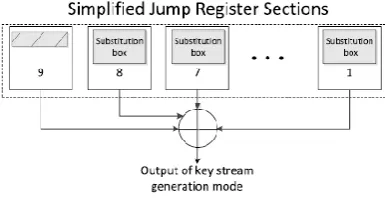
The structure of a jump register section includes jumpcontrol in (JCi ) and out (JCo) signals, which are fed into andout of the section. The substitution box is part of this unitwhich nonlinearly affects the jump control out signal whichis used as an input of the following section. Theaforementioned sections cascaded nine times to contribute tothe key stream of the cipher. As observed in this figure, thisaccumulated cascade jump control in key stream generationmode combines the outputs of the nine sections to reach tothe key stream needed.
As part of its key generation process, Pomaranch useseight uneven substitution boxes with a 9-bit input and a 7-bitoutput. Each substitution unit is based on the inverse moduloan
irreducible polynomial of degree nine, i.e., x9 + x + 1,whose period is 73. The 9-bit output is then converted intoa 7-bit one with deletion of the most significant and leastsignificant bits of the result.For the hardware implementations of the uneven substitutionbox of Pomaranch, multiple instances (memories or lookupTables) are needed. In field-programmable gate array (FPGA)platforms, one needs to use block memories or distributedpipelined memories and in ASIC, memory macros orsynthesized logic is needed which are not preferable forhigh-performance and low-complexity applications. From below figure (1) we can see the block formation of existed system.
In general, time and hardware redundancy are two mainmethods for fault diagnosis. Hardware redundancy addshardware to the original structure for diagnosis and
timeredundancy repeats the operations two times for detectionof transient faults. Permanent faults through time redundancycan be detected using various methods which are,
generally,denoted as recomputation with encoded operands. The faultdiagnosis methods alarm the errors in the architectures;however, even if the overhead is acceptable, there couldbe a chance for false alarms, i.e., detection of faults thatdo not result in erroneous
outputs. Such false alarms couldbe exploited to induce distrust to the user, i.e., repetitive,false detections result in either ignoring the alarms by theuser or abandoning the devices in which the cryptographicarchitectures are embedded.
Available online: https://edupediapublications.org/journals/index.php/IJR/ P a g e | 1526
In this section, we propose fault detection architecturesfor the substitution box of Pomaranch considering thevulnerability of such structures to false alarms due to theiruneven architectures. Specifically, we propose a framework that can be tailored based on the
available resources and thereliability objectives to achieve.
Fault diagnosis approaches are providedfor the architectures presented. Multiterm signaturesare devised and presented as a fault diagnosis frameworkthat can be used depending on the requirements in smartinfrastructures in terms of reliability. We carefully pinpoint thefalse-alarm vulnerability of such approaches and modificationsneeded to counteract such instances are presented. These arebenchmarked in detail in terms of error coverage and efficiencyin the following sections.
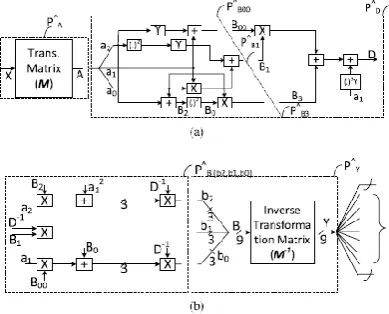
We first present two theorems that are used in derivingthe signatures needed for our fault diagnosis approaches.Based on the structures in multiplicationsin composite fields are used frequently to perform operationsin the subfield GF(23). Moreover, observing
thearchitecture of inversion in GF(23) is shown which is usedin each substitution box iteration. Accordingly, the followingtwo theorems are presented to derive the predicted parities ofthese two important operations in the subfield GF(23). From below figure (2) we can observe the block formation of proposed system.
IV. RESULTS
Register Transfer level
Available online: https://edupediapublications.org/journals/index.php/IJR/ P a g e | 1527 Technology schematic
Lookup Table
Output
V. CONCLUSION
In this paper, reliability and false-alarm sensitivity ofsensitive cryptographic applications are benchmarked througha case study, i.e., the uneven substitution box of a streamcipher, to elaborate on the respective effects on smartinfrastructures. We have presented low-power architecturesfor this stream cipher and then proposed a framework toprovide fault immunity for infrastructures that need to dealwith sensitive information and are smart and
Available online: https://edupediapublications.org/journals/index.php/IJR/ P a g e | 1528
smart infrastructure implications andelaborates on the fact that using the proposed framework,smart infrastructures can be more efficiently and reliablyutilized. VI. REFERENCES
[1] K. Fu and J. Blum, “Controlling for cybersecurity risks of medicaldevice software,”Commun. ACM, vol. 56, no. 10, pp. 35–37,Oct. 2013.
[2] D. Halperin, T. Kohno, T. S. Heydt-Benjamin, K. Fu, and W. H. Maisel,“Security and privacy for implantable medical devices,” IEEE PervasiveComput., vol. 7, no. 1, pp. 30–39, Jan./Mar. 2008.
[3] M. Rostami, W. Burleson, A. Jules, and F. Koushanfar, “Balancingsecurity and utility in medical devices?” in Proc. 50th ACM/EDAC/IEEEInt. Conf. Design Autom., May/Jun. 2013, pp. 1–6.
[4] M. Zhang, A. Raghunathan, and N. K. Jha, “Trustworthiness of medicaldevices and body area networks,” Proc. IEEE, vol. 102, no. 8,pp. 1174–1188, Aug. 2014.
[5] H. Khurana, M. Hadley, N. Lu, and D. A. Frincke, “Smart-grid securityissues,” IEEE Security Privacy, vol. 8, no. 1, pp. 81–85, Jan./Feb. 2010.
[6] M. Mozaffari-Kermani, M. Zhang, A. Raghunathan, and N. K. Jha,“Emerging frontiers in embedded security,” in Proc. 26th Int. Conf. VLSIDesign, Jan. 2013, pp. 203–208.
[7] R. Roman, P. Najera, and J. Lopez, “Securing the Internet of things,” Computer, vol. 44, no. 9, pp. 51–58, Sep. 2011.