The Development of a 10 mK
Refrigeration System for Space
Michael Robert Ernes
Mullard Space Science Laboratory Department o f Space and Climate Physics
University College London
A thesis submitted in accordance with the regulations for the degree o f Doctor o f Philosophy in the University o f London
ProQuest Number: 10013939
All rights reserved
INFORMATION TO ALL USERS
The quality of this reproduction is dependent upon the quality of the copy submitted.
In the unlikely event that the author did not send a complete manuscript and there are missing pages, these will be noted. Also, if material had to be removed,
a note will indicate the deletion.
uest.
ProQuest 10013939
Published by ProQuest LLC(2016). Copyright of the Dissertation is held by the Author.
All rights reserved.
This work is protected against unauthorized copying under Title 17, United States Code. Microform Edition © ProQuest LLC.
ProQuest LLC
789 East Eisenhower Parkway P.O. Box 1346
Abstract
Detectors already require cooling to millikelvin temperatures in space to maximize energy resolution so that more distant sources o f radiation can be identified. The lowest temperature that has been achieved in orbit so far is 302 mK on the infrared telescope for space (IRTS) in 1995. The Japanese ASTRO-E satellite launched unsuccessfully in February 2000 was to achieve 65 mK. Future instruments such as ESA ’s x-ray evolving universe spectrometer (XEUS) will require cooling to 30 mK and below.
This thesis presents the design o f a cryogenic cooling system that will surpass the needs o f XEUS and encourage the development o f a new generation o f very low temperature, high-resolution detectors for space.
With a single mechanical cooler maintaining thermal shield temperatures o f 150 K, 20 K and 4 K, the adiabatic demagnetization refi-igerator (ADR) proposed cools from a bath temperature o f 4 K to 10 mK. The maximum amount o f time for which the ADR can maintain this temperature is around 145 hours with no cooling power on the detector stage. This value falls as the cooling power increases, with a heat lift from the detector stage o f 100 nW possible for 30.6 hours’ continuous operation. A recycle time o f around two hours is required between successive cycles.
Contents
Abstract_________________________________________________________________1
Contents_________________________________________________________________2
List o f Figures____________________________________________________________8
List o f Tables____________________________________________________________13
List o f Abbreviations_____________________________________________________15
Acknowledgements______________________________________________________17
Overview o f Thesis______________________________________________________18
1 Introduction to Space Cryogenics_____________________________________20
1.1 What is space cryogenics?____________________________________________21
1.2 The space environment______________________________________________22
1.2.1 The mechanical environment____________________________________________ 23
1.2.2 The thermal environment_______________________________________________ 25
1.2.2.1 Components of thermal radiation incident upon spacecraft__________________ 26
1.2.2.1.1 Solar radiation__________________________________________________ 27
1.2.2.1.2 Planetary radiation______________________________________________ 28
1.2.2.1.3 Albedo radiation_________________________________________________31
1.2.2.2 Radiation of heat to cold space_______________________________________ 34
1.3 The need for cryogenic temperatures in space__________________________ 35
1.3.1 The need for 10 mK refrigerators in space__________________________________ 37
1.3.1.1 XEUS____________________________________________________________38
1.4 Cooling technologies for space________________________________________39
1.4.1 Passive refrigeration systems____________________________________________ 41
1.4.1.1 Passive radiators___________________________________________________ 41
Contents__________________________________________________________________ :
1.4.1.2.1 Fluids at rest___________________________________________________51
1.4.1.2.2 Fluids in motion________________________________________________51
1.4.2 Active refrigeration systems_____________________________________________52
1.4.2.1 Bimetallic radiation fins_____________________________________________ 52
1.4.2.2 Thermostatic heaters_______________________________________________ 53
1.4.2.3 Active fluid loops__________________________________________________ 53
1.4.3 Cryogenic refrigeration systems_________________________________________ 53
1.4.3.1 Liquid cryogens___________________________________________________ 55
1.4.3.1.1 Helium-4 evaporation_____________________________________________55
1.4.3.1.2 Helium-3 coolers_______________________________________________ 58
1.4.3.1.3 Helium-3/helium-4 dilution_______________________________________ 62
1.4.3.1.4 Conclusions on liquid cryogens____________________________________ 64
1.4.3.2 Mechanical coolers_________________________________________________ 65
1.4.3.2.1 Ideal Carnot cycle refrigeration____________________________________ 65
1.4.3.2.2 Practical refrigeration cycles______________________________________ 70
1.4.3.2.2.1 Stirling cycle cooler_________________________________________ 70
1.4.3.2.2.2 Joule-Thomson cooler________________________________________ 74
1.4.3.2.2.3 Pulse tube refrigerators_______________________________________ 76
1.4.3.3 Adiabatic demagnetization refrigerators (ADRs)__________________________79
1.4.3.3.1 Principle of isentropic cooling_____________________________________ 79
1.4.3.3.2 The ADR cooling cycle__________________________________________ 81
1.4.3.4 Adiabatic nuclear demagnetization refrigerators___________________________84
1.5 Summary of Chapter 1 _____________________________________________ 86
2 The Components o f a 10 mK Space A D R______________________________87
2.1 Components of an A D R ____________________________________________ 88
2.1.1 Paramagnetic sa lt_____________________________________________________ 89
2.1.2 Superconducting magnet________________________________________________ 92
2.1.3 Cold bath____________________________________________________________ 94
2.1.4 Heat switches________________________________________________________ 94
2.1.4.1 Mechanical heat switches____________________________________________ 95
2.1.4.2 Gaseous heat switches______________________________________________ 95
2.1.5 Control systems_______________________________________________________ 96
2.1.6 Thermal Shields______________________________________________________ 96
2.1.7 Mechanical support structure____________________________________________ 98
2.2 ADR designs_____________________________________________________ 101
Contents__________________________________________________________________ ^
2.2.2 Two-stage A D R ____________________________________________________ 103
2.2.3 Double ADR (dADR)________________________________________________ 104
2.3 The 10 mK ADR for space_________________________________________ 106
2.4 Summary of Chapter 2 ____________________________________________ 107
3 Mechanical Design_________________________________________________109
3.1 Launch vibration qualification tests_________________________________ 111
3.1.1 Sinusoidal vibration qualification levels for launch_________________________ 111
3.1.2 Random vibration qualification for launch________________________________ 112
3.2 Mechanics of single-mass excitations_________________________________ 113
3.3 Numerical prediction of single-mass vibration response (Model 1 )________ 125
3.3.1 Runge-Kutta algorithm for vibrations analysis_____________________________ 126
3.4 Single-mass analytical model for vibrations (Model 2 ) __________________ 128
3.4.1 Calculation of effective linear stiffness__________________________________ 129
3.4.2 Evaluation of stresses in straps_________________________________________ 133
3.4.3 The effect of angular displacements on linear response______________________ 133
3.4.4 The effect of non-linearities on vibration response_________________________ 134
3.4.5 Ensuring that the straps do not slacken___________________________________ 135
3.4.6 Derivation of single-mass analytical model (Model 2)_______________________ 136
3.4.6.1 Steady-state response______________________________________________ 137
3.4.6.2 Transient response________________________________________________ 138
3.5 Comparison of results of single-mass analytical and numerical programs 140
3.5.1 Simultaneous excitations in more than one direction________________________ 141
3.6 Five-mass analytical model (Model 3 ) ________________________________ 144
3.7 Stresses and flexibility within the aluminium enclosures________________ 149
3.7.1 Conclusions on effects of enclosure flexibility_____________________________ 167
3.7.2 Stresses in enclosure walls due to strap tensions___________________________ 167
3.8 Results of mechanical modelling____________________________________ 170
3.8.1 Sinusoidal vibrations analysis__________________________________________ 170
3.8.1.1 Vertical (y-direction) excitation analysis_______________________________ 171
3.8.1.1.1 Near resonance response of system________________________________ 178
3.8.1.1.2 Vertical excitations with damping reduced by a factor of ten____________ 179
3.8.1.2 Analysis of lateral (x-z plane) vibrations_______________________________ 183
Contents__________________________________________________________________ t
3.8.3 Comparison of predicted stresses with launch qualification levels_____________ 192
3.8.3.1 Sinusoidal results compared to launch qualification levels_________________ 192
3.8.3.2 Random vibrations results compared to qualification levels________________ 194
3.9 Summary of Chapter 3 _____________________________________________194
4 Thermal Design____________________________________________________196
4.1 Heat lifts required to maintain enclosure temperatures_________________ 197
4.1.1 Radiated heat incident on each enclosure_________________________________ 198
4.1.2 Conducted heat transfer between enclosures_______________________________ 201
4.1.3 Current lead heating of enclosures_______________________________________ 204
4.1.3.1 High Tc superconducting current leads for 4 K - 20 K _____________________ 213
4.1.4 Total heat load on each enclosure________________________________________ 214
4.2 Performance of the ADR____________________________________________217
4.2.1 Development of Mathcad model to predict ADR performance_________________ 217
4.2.2 Results of ADR modelling_____________________________________________ 220
4.2.3 System performance with power input directly to both pills___________________ 222
4.2.4 The hold time at temperatures above 10 m K _______________________________ 224
4.3 Summary of Chapter 4 _____________________________________________226
Optimization o f Thermal Shields and Geometry o f A D R________________229
5.1 Physical characteristics of each shield________________________________ 230
5.1.1 Material choice______________________________________________________ 230
5.1.2 Thickness of enclosures_______________________________________________ 231
5.1.3 Insulation of thermal shields____________________________________________ 233
5.2 The optimum number of thermal shields_____________________________ 234
5.2.1 Fewer shields _______________________________________________________ 234
5.2.2 More shields________________________________________________________ 235
5.2.2.1 Mechanical performance with 65 K shield_____________________________ 235
5.2.2.2 Thermal performance with 65 K shield________________________________ 240
5.3 The optimum temperatures for the shields____________________________ 241
5.4 Spacing of the shields_____________________________________________ 242
5.5 Optimization of geometry within the ADR____________________________ 244
5.5.1 No geometric constraints on size of A D R _________________________________ 246
Contents__________________________________________________________________ 6
5.5.2.1 Optimization with larger diameter suspension cords______________________ 253
5.6 Summary of Chapter 5 ____________________________________________ 255
6 Magnet design_____________________________________________________256
6.1 Introduction to magnet former design________________________________257
6.2 Analytical magnetic field modelling__________________________________258
6.3 The field due to a single solenoid____________________________________ 269
6.4 The field with solenoid and cancellation coils__________________________ 273
6.5 Stresses in magnet formers_________________________________________ 279
6.5.1 Stresses due to axial component of field___________________________________ 280
6.5.2 Stresses due to radial component of field__________________________________ 284
6.5.2.1 Total stresses acting on windings and copper former_____________________ 290
6.5.3 Magnet mass with copper former________________________________________ 293
6.5.4 Aluminium alloy formers______________________________________________ 294
6.6 Eddy current heating of formers____________________________________295
6.6.1 Minimization of eddy current heating_____________________________________ 300
6.6.1.1 Reducing the rate of change of field__________________________________ 301
6.6.1.2 Laminating or slotting the former____________________________________ 302
6.6.2 Conclusions on eddy current heating with copper and aluminium formers________ 313
6.7 The design of a hybrid magnet form er_______________________________314
6.7.1 Materials for a hybrid former___________________________________________ 315
6.7.2 Stresses in a hybrid magnet former_______________________________________ 316
6.7.2.1 Stresses in hybrid former due to axial component of field________________ 317
6.1.22 Stresses in hybrid former due to radial component of field________________ 320
6.7.3 Mass of hybrid magnet former__________________________________________ 324
6.7.4 Eddy currents in a hybrid magnet former__________________________________ 325
6.7.5 Thermal testing of hybrid magnet former__________________________________ 328
6.7.5.1 Cooling to 4.2 K with Cu, A1 and composite formers_______________________ 328
6.7.5.2 Magnet test with hybrid former________________________________________ 335
6.8 Summary of Chapter 6 ____________________________________________335
7 Summary o f Thesis and Conclusions_________________________________ 337
Contents__________________________________________________________________ ]
7.2 Conclusions______________________________________________________ 341
7.3 Recommendations for further w o rk _________________________________ 342
7.3.1 Design work________________________________________________________342
7.3.1.1 High Tc current leads______________________________________________ 343
7.3.1.2 Reliable mechanical heat switches_____________________________________343
7.3.1.3 Electronics and control systems______________________________________ 343
7.3.1.4 ADR geometry optimization for expected heat loads_____________________ 343
7.3.1.5 Performance of ADR for bath temperatures above 4 K_____________________ 344
7.3.2 Experimental work___________________________________________________344
7.3.2.1 Testing of full-size hybrid magnet former______________________________ 344
1 3 2 2 Vibration testing___________________________________________________344
7.3.2.3 Thermal testing____________________________________________________345
7.4 Summary of Chapter 7 ____________________________________________ 345
List of Figures
Figure Figure Figure Figure Figure Figure Figure Figure Figure Figure Figure Figure Figure Figure Figure Figure Figure Figure Figure Figure Figure Figure Figure-1 : Axial acceleration profile for Ariane 4 ... 24
-2: Components of radiation incident upon spacecraft...27
-3: View factor geometry between planet and satellite...30
-4: Albedo radiation incident on satellite... 32
-5: ISO spacecraft...36
-6: Lower and lower temperatures required for space instruments...37
-7: Spacecraft refi'igeration systems... 40
-8: Carbon - Carbon (C-C) radiator... 42
-9: Worst case passive radiator performance... 45
-10: Spacecraft orbiting the Earth with constant attitude...46
-11: Optimum attitude for constant attitude spacecraft...46
-12: View factor and visibility factor as functions of orbital position, 0 ... 47
-13: Cooling power vs. orbital angle, 0, for various radiator temperatures, T ... 48
-14: Mean cooling power over orbit as a function of radiator temperature, T ... 48
-15: Components of radiation as a function of 6 for 200 K radiator...50
-16: Bimetallic radiation fins...52
-17: Temperatures typically achievable with various cryogenic technologies... 54
-18: Equilibrium between helium liquid and vapour... 55
-19: Flight cryostat for COBE...58
-20: A helium adsorption cooler for space... 60
-21: Schematic of helium-3/helium-4 dilution refi*igerator for space... 63
-22: Ideal Carnot refrigeration cycle set-up... 66
-23: T-S diagram for Carnot reftigeration cycle... 67
Figure 1-24: Carnot cycle COP for all Tc/Th...69
Figure 1-25: Carnot cycle COP for low Tc/Th... 69
Figure 1-26: Ball Aerospace Stirling cycle cooler...71
Figure 1-27: Schematic o f Stirling refiigeration c y c le ... 72
Figure 1-28: p-v diagram for Stirling refrigeration c y c le ...73
Figure 1-29: T-S diagram for Stirling refrigeration cycle... 73
List o f Figures
Figure 1-31 : Various pulse tube refrigerator heads... 76
Figure 1-32: AIRS pulse tube refrigerator for space... 78
Figure 1-33: Principle of isentropic cooling...80
Figure 1-34: Principle of adiabatic demagnetization refrigeration... 81
Figure 1-35: T-S diagram for magnetic cooling (for comparison with Figure 1-23)... 81
Figure 2-1 : Components of an A DR...88
Figure 2-2: DGG crystal for space ADR...92
Figure 2-3: Superconducting magnet for laboratory A DR... 93
Figure 2-4: Thermal shields around 10 mK A D R ... 97
Figure 2-5: Typical strap shape...98
Figure 2-6: Possible strap attachment regime... 99
Figure 2-7: Suspension strap geometry (third angle projection)... 100
Figure 2-8: Single-stage ADR layout... 101
Figure 2-9: Laboratory single-stage ADR... 102
Figure 2-10: Two-stage ADR layout... 103
Figure 2-11: Solid model of laboratory dADR...105
Figure 2-12: Double ADR (dADR) layout...106
Figure 3-1 : Position vectors of suspension straps...116
Figure 3-2: The effect of variable stiffiiess on strap tension... 122
Figure 3-3: Geometry of straps connecting adjacent enclosures... 130
Figure 3-4: Rotation of a mass subjected to sinusoidal vibrations... 134
Figure 3-5: Single-mass model for vibrations analysis...136
Figure 3-6: Stresses in suspension straps as functions of tim e... 140
Figure 3-7: Stresses due to simultaneous excitations in x, y and z-directions...143
Figure 3-8: Five-mass analytical model for prediction of launch vibrations... 144
Figure 3-9: Physical significance of rigid enclosure approximation... 149
Figure 3-10: Displacement of rod element... 150
Figure 3-11: First normal mode of shell vibration...158
Figure 3-12: Schematic of shell showing in-phase displacements... 159
Figure 3-13: Second normal mode of shell vibration...159
Figure 3-14: Schematic of shell showing anti-phase displacements... 160
Figure 3-15: Worst case geometry with flexible enclosures... 161
Figure 3-16: Difference between midpoint displacement and end displacement...162
List o f Figures____________________________________________________________ 10
Figure 3-18: Stress profile along shell for excitation frequency of 2000 H z...165
Figure 3-19: Calculation of gravity-force induced stress along the shell... 166
Figure 3-20: Variation of gravity-force induced stress along shell... 166
Figure 3-21: Vertical straps for calculation of shield stress due to strap tensions...168
Figure 3-22: Displacements of bodies under y-direction (vertical) excitation...172
Figure 3-23: Initial response of masses to sinusoidal excitations... 172
Figure 3-24: Velocities of masses under sinusoidal y-direction excitation...173
Figure 3-25: Initial velocities of masses subjected to vertical excitations... 174
Figure 3-26: Stresses in five-mass system under vertical sinusoidal excitation...175
Figure 3-27: Forcing acceleration to failure under y-direction (vertical) excitations...177
Figure 3-28: Near resonance response of system...178
Figure 3-29: Peak stresses with damping constant reduced by factor often... 180
Figure 3-30: Comparison of normal damping and low damping peak stresses...181
Figure 3-31 : Forcing acceleration to failure with 1/10**’ damping constant... 182
Figure 3-32: Forcing acceleration to failure at natural frequency with 1/10**’ damping 183 Figure 3-33: Peak stresses under x-z plane sinusoidal excitation... 184
Figure 3-34: Forcing acceleration to failure under x-z plane excitations... 186
Figure 3-35: x-z plane forcing acceleration to failure near resonance... 186
Figure 3-36: x-z plane forcing acceleration to failure with 1/10**’ damping...187
Figure 3-37: x-z plane acceleration to failure with 1/10**’ damping near resonance...188
Figure 4-1: Dimensions of aluminium enclosures...197
Figure 4-2: Heat flow between concentric enclosures...199
Figure 4-3: Calculation of strap lengths...202
Figure 4-4: Heat flow in current leads...205
Figure 4-5: Temperature distribution along 150 K - 300 K current leads...211
Figure 4-6: Optimum current lead diameter for aluminium wires...212
Figure 4-7: Heat load components on 4 K enclosure... 215
Figure 4-8: Heat load components on 20 K enclosure... 216
Figure 4-9: Heat load components on 150 K enclosure... 216
Figure 4-10: Hold time for 10 mK dADR as a function of detector heat load...220
Figure 4-11 : Effect of changing cord diameter on hold time... 221
Figure 4-12: Hold time as a function of cord diameter for low input powers... 222
Figure 4-13: Hold time as a function of heat load on DGG...223
Figure 4-14: Hold time as a function of heat load on CMN...223
List o f Figures____________________________________________________________ H
Figure 5-1 : The effect of MLI on radiative heat transfer... 233
Figure 5-2: Mechanical model with 65 K shield... 236
Figure 5-3: Double ADR layout for suspension cord optimization...244
Figure 5-4: Clearance required for attaching cords... 247
Figure 5-5: Hold times for an optimized dADR with no heat load on detectors... 250
Figure 5-6: The effect of changing cord length with 1 pW heat load on detector stage 250 Figure 5-7: The effect of changing cord lengths with 0 W on CMN, 20 pW on DGG 251 Figure 5-8: Hold time vs. cord length with 200 nW on CMN, 20 pW on DGG... 252
Figure 6-1: Schematic of dADR former...257
Figure 6-2: Field contribution due to each current loop... 259
Figure 6-3: Cross-section through magnet former showing distance between wires... 261
Figure 6-4: Alternative orientation for nearest wires... 262
Figure 6-5: Mesh of nodes for description of magnetic field... 264
Figure 6-6: Grouping of wire loops to reduce computations... 265
Figure 6-7: Definition of turns density...266
Figure 6-8: Optimum geometry of main magnet winding... 268
Figure 6-9: Field modulus as a function of axial position... 270
Figure 6-10: 3-D plot of single solenoid’s field occupied by CM N ...271
Figure 6-11 : Variation of field components with radius (z = 90 mm)...272
Figure 6-12: Variation of field components with axial position (r = 44 mm)...273
Figure 6-13: Arrangement of main solenoid with cancellation coils...274
Figure 6-14: Fields due to left cancellation coil (r = 44 mm)... 275
Figure 6-15: Fields due to right cancellation coil (r = 44 mm)... 275
Figure 6-16: Field strength vs. axial position with cancellation coils (r = 44 mm)... 276
Figure 6-17: Field components vs. radius with cancellation coils (z = 90 mm)... 277
Figure 6-18: Effect of cancellation coils on field modulus vs. axial position... 278
Figure 6-19: Schematic of magnet former and windings... 279
Figure 6-20: Plane strain conditions for former and windings... 280
Figure 6-21 : Axial force on each loop of w ire... 284
Figure 6-22: Forces within the windings due to radial component of field...285
Figure 6-23: Equal and opposite forces compressing the windings...286
Figure 6-24: Stresses at midpoint (z = 50 mm) of main solenoid... 291
Figure 6-25: Radial displacement as a function of radius (z = 50 mm)...291
Figure 6-26: Eddy currents flowing in elemental annulus... 296
List o f Figures____________________________________________________________ 12
Figure 6-28: Magnet former with m slots of depth d... 303
Figure 6-29: Eddy current heating as a function of slot depth for copper former... 308
Figure 6-30: Eddy current heating as a function of number of slots for copper... 309
Figure 6-31 : Eddy current heating as a function of slot depth for aluminium former 310 Figure 6-32: Eddy current heating as a function of number of slots for aluminium 311 Figure 6-33: Hybrid magnet former layout...314
Figure 6-34: Section through hybrid magnet former... 316
Figure 6-35: Axial stresses in hybrid former... 321
Figure 6-36: Stresses for hybrid former with 2 mm copper conductor layer... 322
Figure 6-37: Stresses for hybrid former with 0.5 mm aluminium conductor layer 323 Figure 6-38: Hybrid magnet former design for eddy current analysis...326
Figure 6-39: Design of formers for experimental testing of cooling performance... 329
Figure 6-40: Cooling curve for solid copper magnet former... 330
Figure 6-41: Cooling performances of simple formers... 331
13
List of Tables
Table 1-1: Sources of structural loading... 23
Table 1-2: Temperature tolerances of typical spacecraft components... 26
Table 1-3: Average planetary albedo, a... 31
Table 1-4: Radiator performance at various temperatures, T ... 49
Table 2-1 : Important properties of some paramagnetic materials...90
Table 2-2: Comparison between types of ADR... 107
Table 2-3: Summary of ADR components... 108
Table 3-1 : Sinusoidal vibration qualification levels... 112
Table 3-2: Random vibration qualification levels... 113
Table 3-3: Physical parameters for single-mass vibration analysis...115
Table 3-4: Comparison of Model 1 and Model 2 results... 141
Table 3-5: The effect of combined excitation in more than one direction... 142
Table 3-6: Dimensions of suspension straps... 147
Table 3-7: Masses of system components... 148
Table 3-8: Natural frequencies for y-direction excitation...176
Table 3-9: Natural frequencies for x-z plane (lateral) excitations...184
Table 3-10: Natural frequencies for vibrations in x, y and z-directions...189
Table 3-11 : Results of y-direction random vibration analysis...190
Table 3-12: Results of x-z plane random vibrations analysis...191
Table 3-13: Comparison of sinusoidal results with launch qualification levels... 192
Table 3-14: Safety factors for sinusoidal excitation... 193
Table 3-15: Salient forcing accelerations to failure... 195
Table 4-1 : Net radiated heat load upon each enclosure...201
Table 4-2: Suspension strap material choices... 203
Table 4-3: Conducted heat loads on each enclosure...204
Table 4-4: Minimum heat loads along current leads...210
List o f Tables_____________________________________________________________ 14
Table 4-6: Cryocooler heat lift capability... 214
Table 4-7: Default parameters for thermal modelling of ADR... 218
Table 4-8: Hold time as a function of final CMN temperature... 225
Table 4-9: Summary of ADR performance...226
Table 5-1: Properties of possible thermal shield materials... 231
Table 5-2: Safety factors and masses for various shield thicknesses... 232
Table 5-3: Description of suspension system with 65 K shield... 237
Table 5-4: Description of masses in six-mass system...238
Table 5-5: Natural frequencies of six-mass system...238
Table 5-6: Summary of mechanical performance with 65 K enclosure... 239
Table 5-7: Salient forcing accelerations to failure...239
Table 5-8: Heat loads with 65 K shield... 240
Table 5-9: Heat loads without 65 K shield... 241
Table 5-10: Summary of hold times with optimized geometries... 254
Table 6-1 : Maximum values of k for different wires...262
Table 6-2: Summary of maximum stresses in magnet (MPa)... 292
Table 6-3: Summary of maximum stresses in magnet with 20 mm former (MPa)...292
Table 6-4: Stresses in magnet with 5 mm thick aluminium 6082 former (MPa)...294
Table 6-5: Comparison of eddy current heating with aluminium and copper formers...299
Table 6-6: Summary of effect of slotting copper former...309
Table 6-7: Summary of effect of slotting aluminium 6082 former... 311
Table 6-8: Stresses (MPa) for hybrid former with 2 mm copper conductor... 323
Table 6-9: Stresses (MPa) for hybrid former with 0.5 mm aluminium conductor...324
Table 6-10: Summary of magnet former performances...327
15
List of Abbreviations
A BRIXA S A BRoadband Imaging X-ray All-sky Survey A D R Adiabatic Demagnetization Refrigerator A IR S Atmospheric InfraRed Sounder
A ST R O -E Fifth Japanese x-ray astronomy mission C C D Charge Coupled Device
C E A Commissariat a l’Energie Atomique (French atomic energy authority) C F R P Carbon-Fibre Reinforced Plastic
C IS Cryogenic Imaging Spectrometer C M N Cerium Magnesium Nitrate C O B E COsmic Background Explorer
C O BR A S COsmic Background Radiation Anisotropy Satellite C O P Coefficient O f Performance
C PA Chromic Potassium Alum
dA D R double Adiabatic Demagnetization Refrigerator D G G Dysprosium Gallium Garnet
e.m.f. electromotive force
E M I ElectroMagnetic Interference E O S Earth Observing System ESA European Space Agency F IR P Far InfraRed Photometer G G G Gadolinium Gallium Garnet
G SFC Goddard Space Flight Center (NASA) IR A S InfraRed Astronomical Satellite IR T S InfraRed Telescope for Space
ISAM S Infrared Stratospheric And Mesospheric Sounder ISO Infrared Space Observatory
List o f Abbreviations 16
J P L Jet Propulsion Laboratory (NASA) J T Joule-Thomson
LE O Low Earth Orbit M L I Multi-Layer Insulation M M S Matra-Marconi Space M S Maximum Stress
M SSL Mullard Space Science Laboratory
NASA National Aeronautics and Space Administration O PT R Orifice Pulse Tube Refrigerator
PL A N C K Formerly COBRAS/SAMBA - renamed in honour o f Max Planck PSD Power Spectral Density
RA L Rutherford Appleton Laboratories r.m .s. root mean square
SAM BA SAtellite for Measurement o f Background Anisotropies SET Service des Basses Températures (Grenoble, France) SH O O T Superfluid Helium On Orbit Transfer
SR Stirling cycle Refrigerator
S T J Superconducting Tunnel Junction
ST J-C Superconducting Tunnel Junction Camera TES Transition Edge Sensor
W EI Wide Field Imager
XEUS X-ray Evolving Universe Spectroscopy mission XRS X-Ray Spectrometer
Y BCO Yttrium Barium Copper Oxide
17
A cknowledgements
My thanks go to my supervisor, Ian Hepburn, and the rest o f the team at MSSL. In particular, I would like to thank W ilf Oliver for his advice on vibrations modelling and Eric Crofts for his help with the hybrid magnet former design.
I’ve appreciated Graham Hardy’s efforts to entertain me with Quake III, and the football crew ’s unswerving commitment, with countless entertaining episodes on the rabbit-warren.
18
Overview of Thesis
This thesis presents the design o f a long-life refrigeration system capable o f cooling to 10 mK in space.
The first chapter introduces the field o f space cryogenics, explaining why cooling to 10 mK in space is desirable and outlining the current technologies that can provide such low temperatures. The harsh space environment is described, including the thermal environment in which the spacecraft must operate and the mechanical stresses to which spacecraft are subjected before, during and after launch. It is shown that the technology best suited to achieving a temperature o f 10 mK in space is an adiabatic demagnetization refrigerator (ADR), pre-cooled by passive radiators and a mechanical cooler.
The components o f a 10 mK ADR are described in Chapter 2. In particular, the importance o f the paramagnetic refrigerant, the superconducting magnet and the suspension straps is stressed.
Overview o f Thesis________________________________________________________ 19
Chapter 5 presents an optimization o f both the system o f thermal shields that reduces the radiative heat load on the coldest parts o f the system and the geometry o f the ADR. The latter is particularly important if paramagnetic materials and suspension straps compete for a limited amount o f space within the magnet bore.
The design o f the superconducting magnet is the subject o f Chapter 6. The magnetic field profile, the stresses in the magnet and the eddy current heating in the former are analysed for a space ADR. A ‘hybrid’ aluminium alloy/composite magnet former is presented, which has low mass and good thermal and mechanical properties.
With the main features o f the 10 mK refrigerator established, the conclusions o f the thesis are presented in Chapter 7. This includes a summary o f what has been achieved, and suggestions for further work.
Finally, references are listed in Chapter 8.
20
1
Introduction to Space
Cryogenics
Overview o f Chavter 1
In this chapter, we discuss what ‘space cryogenics’ means, why it is useful and what different cryogenic technologies exist.
First, Section 1.1 answers the question ‘what is space cryogenics’. Section 1.2 describes the space environment and contrasts the temperatures available with cryogenic cooling with the ambient temperature in space. This is followed in Section
1.3 with a discussion o f what space cryogenics has to offer, and Section 1.3.1 outlines the need for 10 mK refrigeration in space.
Section 1.4 moves on to the more practical question o f how cryogenic temperatures are achieved in space and outlines the benefits o f the various technologies available.
Chapter 1 Introduction to Space Cryogenics_________________________________21
1.1
What is space cryogenics?
The word cryogenics is derived from the Greek word ‘kruos’, which means ‘frost’ or ‘icy cold’. According to the Oxford English Dictionary, cryogenics is therefore “the branch o f physics and technology that deals with the production o f very low temperatures and their effects” \ ‘Very low temperatures’ means different things to different people, but it seems reasonable to assume that the temperatures o f all ‘cryogens’ must be cryogenic. The cheapest and most widely used cryogen is liquid nitrogen, which makes accessible temperatures down to its boiling point o f 77 K (- 196 °C). Probably the most common concept o f a cryogenic temperature is therefore a temperature around or below the boiling point o f liquid nitrogen at 77 K.
In fact, this thesis describes a refrigeration system capable o f cooling to 10 mK (- 273.14 °C), one hundredth o f a degree Celsius above absolute zero (-273.15 °C). In the context o f this thesis, therefore, a ‘very low temperature’ usually refers to a temperature below 1 K (-272.15 °C). Nevertheless, ‘cryogenic’ will generally be used to describe temperatures below around 77 K.
Chapter 1 Introduction to Space Cryogenics__________________________________22
1.2
The space environment
In addition to the obvious difficulty in providing maintenance in space, there are three important differences between a space environment and that o f a laboratory on Earth.
Firstly, there is no atmosphere in space. Our atmosphere traps much o f the infrared radiation that is emitted by the surface o f the planet by the greenhouse effect. This means that the mean temperature on the surface o f the Earth remains relatively constant over a twenty-four hour period, at 22 °C In London in July, for example, the average maximum daily temperature is 22.8 °C and the minimum at night is 12.8 °C Mercury is a planet without an atmosphere, and has an average temperature o f 350 °C during its day and -170 °C at night^. The changes in temperature experienced by a body in space when moving fi*om shadow into sunlight will therefore be much greater and more sudden than corresponding changes on Earth (as day becomes night). These rapid temperature changes can impart significant thermal stresses upon spacecraft due to differential thermal contraction between materials. Today’s satellites therefore carry complex temperature regulation systems.
Secondly, the Ig gravitational force to which we are accustomed on Earth is absent in space. This means that any processes that rely on gravity will not function in space as they would in a laboratory on Earth.
Finally, the vacuum in space causes the outgassing o f some materials, as the extreme low pressure causes sublimation o f surface atoms at temperatures encountered during operation. For a sublimation rate o f 10 /a n per year, for example, cadmium requires a temperature o f 77 °C, whereas titanium requires 1070 °C and tungsten 2150 °C Although outgassing at this rate is unlikely to have a significant effect on mechanical performance, subsequent deposition o f material can damage optical and electrically sensitive devices. The choice o f material is therefore important.
Chapter 1 Introduction to Space Cryogenics 23
assumptions that govern the design o f traditional cryogenic systems must be compromised to achieve a balance between thermal and mechanical performance.
The mechanical environment is the subject o f Section 1.2.1 below.
1.2.1
The mechanical environment
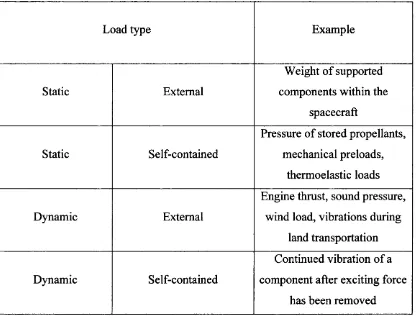
To provide a satisfactory mechanical design for the refrigeration system, we require knowledge o f the mechanical environment to which the spacecraft will be subjected. Structural loads upon the spacecraft will be o f several forms and are summarized in Table 1-1 below"^.
Load type Example
Static External
Weight o f supported components within the
spacecraft
Static Self-contained
Pressure o f stored propellants, mechanical preloads,
thermoelastic loads
Dynamic External
Engine thrust, sound pressure, wind load, vibrations during
land transportation
Dynamic Self-contained
Continued vibration o f a component after exciting force
has been removed
Chapter 1 Introduction to Space Cryogenics 24
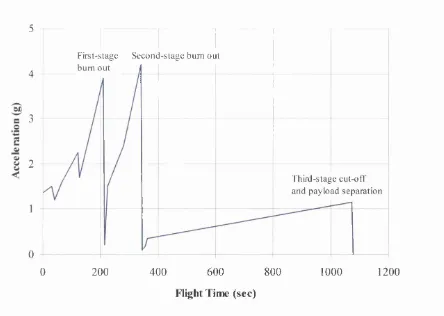
Launch generates the greatest loads for most structures, but any other event can be critical for parts o f the structure. The highest acceleration during a typical Ariane 4 launch is around 4.2g as shown in Figure 1-1 below (load factor of 4.2) Dramatic spikes in acceleration, which represent the launch vehicle’s dynamic response to transients, are observed at certain times such as when the first stage bums out and the second stage ignites. The deterministic loads upon the structure can be predicted as a function o f time by analysing the transmission o f (usually sinusoidal) vibrations from the base o f the spacecraft. Random loads such as due to acoustic pressure can only be estimated statistically.
5
First-stage Secon d -stage bum out bum out
4
3
2
Third-stage cut-off' and payload separation
0
600 800 1000 1200
0 200 400
Flight Time (sec)
Figure 1-1 : Axial acceleration profile for Ariane 4
Chapter 1 Introduction to Space Cryogenics_________________________________ 25
vibrations. In this analysis, we attempt to find both the most suitable materials and the best geometric configuration o f the system. For a refrigeration system, the best material is determined not ju st by mechanical properties such as density. Y oung’s Modulus, and tensile and compressive yield stresses but also by thermal properties such as thermal conductivity.
The large range o f temperatures the materials must operate under further increases the complexity o f the design, as both mechanical and thermal properties vary with temperature. The system outlined in this thesis will cool from around 300 K to 0.01 K (a factor o f 30000 decrease in absolute temperature).
The thermal conditions under which the refrigeration system must operate are discussed in Section 1.2.2 below.
1.2.2
The thermal environment
It is a common misconception that it is always cold in space. In fact, the temperature varies greatly between around 2.73 K in deep space when isolated from all radiation, and around 300 K for a body orbiting the Earth in direct view o f the sun. O f course, higher temperatures still are obtained by bodies closer to the sun. Recall from Section
1.2 above that the daytime surface temperature o f Mercury is 350 °C - i.e. 623 K. The temperature at the surface o f the sun is 5800 K.
Chapter 1 Introduction to Space Cryogenics 26
Component Minimum
Temperature (°C)
Maximum Temperature (°C)
Electronic equipment (operating) -10 +40
Batteries -5 +15
Fuel (e.g. hydrazine) +9 +40
Microprocessors -5 +40
Bearing mechanisms -45 +65
Solar cells -60 +55
Solid-state diodes -60 +95
Table 1-2: Temperature tolerances o f typical spacecraft components
The components o f thermal radiation incident upon the spacecraft are discussed in Section 1.2.2.1 and illustrated in Figure 1-2 below. The emission o f heat fi’om the spacecraft to space is discussed in Section 1.2.2.2. Heat is also transferred between warm and colder parts o f the spacecraft.
1.2.2.1
Components of thermal radiation Incident upon spacecraft
Chapter 1 Introduction to Space Cryogenics 27
1.2.2.1.1 Solar radiation
This is radiation emitted by the sun that is directly incident upon the spacecraft. The spectral energy distribution of the sun resembles a Planck curve^ with effective temperature 5800 K, which means that 99% o f the solar energy has wavelengths between 150 nm and 10 /jm with a maximum at around 450 nm.
Radiation from Spacecraft
Solar Radiation
t
Albedo Radiation Planetary
Emissions
Figure 1-2: Components o f radiation incident upon spacecraft
With the total power output o f the sun, P = 3.8 • 10^^ W , the solar radiation intensity,
Chapter 1 Introduction to Space Cryogenics_________________________________ 28
The solar radiation falling at right angles onto an area o f 1 at a distance o f 1 AU («150 million km) from the sun, Js,p, is approximately 1371 W/m^ and is called the solar constant. The total power input, , to the satellite from solar radiation is then given by the sum o f the power absorbed by each o f the spacecraft’s surfaces:
where Ai^s is the projected area o f the surface / in the direction o f the sun and or, is the absorptance o f the spacecraft surface material to short wavelength solar radiation.
1.2.2.1.2 Planetary radiation
This is the thermal radiation emitted by the planets due to their temperatures. The planets behave as black body radiators and the Earth emits predominantly infrared radiation with a wavelength greater than 1.5 /mi.
At satellite altitudes, it is reasonable to assume that the planetary radiation emanates from the entire surface o f the planet. Although planetary emissions vary seasonally and with latitude, long-term averages provide an adequate approximation for thermal design o f spacecraft, with a figure o f Jp = 231 W/m^ generally used for the Earth.
Chapter 1 Introduction to Space Cryogenics_________________________________ 29
[ 1 . 3 ] ^2
nx
where ^ and ^ are the angles between a line joining the two surfaces and the normals to the respective surfaces. The power input to surface i o f the spacecraft due to planetary emissions is then:
[ 1 4 ] =
where Fp^i is the view factor between the planet and the surface, Ai is the area o f the surface and at,p is the absorptance o f the surface material for planetary (long- wavelength) emissions. In fact, for long-wavelength radiation, the surface absorptance is approximately equal to the surface emissivity, £■,. The total planetary radiation absorbed by the spacecraft is therefore:
[ 1 - 5 ] Q ^ = Y , J p - F , y A , - s ,
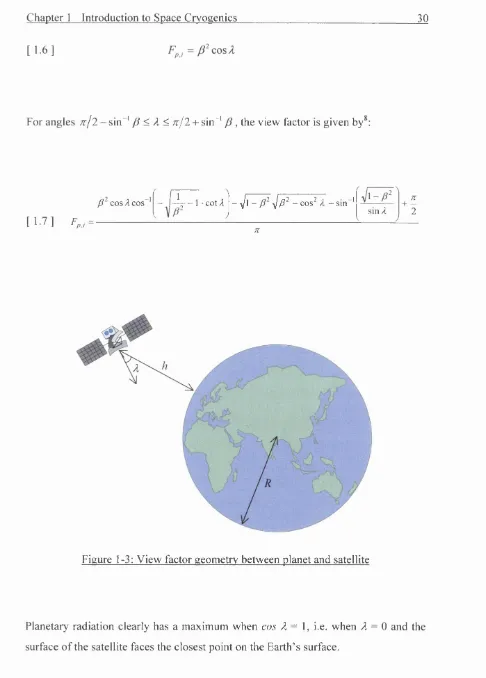
To find the view factor between a spherical planet and a spacecraft surface, the surface is modelled as a flat plate. The view factor then depends on the angle, A, between the normal to the plate and the local vertical on the planet surface, the altitude o f the spacecraft, h, and the radius o f the Earth, R (see Figure 1-3 below).
Writing P = —^ — , the view factor for angles 0 < A < ;r/2 - sin"^ p is given by*:
Chapter 1 Introduction to Space Cryogenics 30
[ 1.6 ]
For angles f c j l - s \ n ' yS < ^ < ;r/2 + sin ' , the view factor is given by*
P~ COS A cos"
[ 17 ] Fp, =
- I-V -1 cot A - l / ' - -\p^ -c o s^ /l - sin '
sin/I V
n
+ —
2
Figure 1-3: View factor geometry between planet and satellite
Chapter 1 Introduction to Space Cryogenics 31
1.2.2.1.3 Albedo radiation
Some solar radiation reflects o ff the Earth before reaching the spacecraft. Planetary albedo, a, is the fraction o f the incident solar radiation reflected from the planet.
[ 1.8 ] J „ = a- Js , p
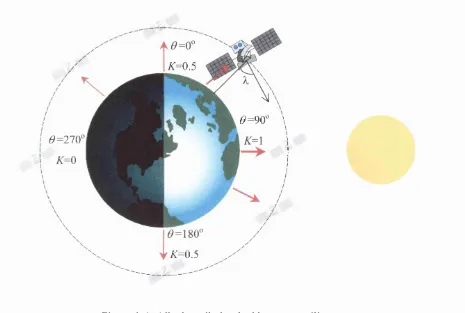
Earth’s albedo varies with surface conditions - for clouds it is 0.8 whereas for forests and fields it ranges from 0.03 to 0.3.^ The average albedos o f the planets o f the solar system and the moon are compared in Table 1-3 below. As for planetary radiation described above, the amount o f albedo radiation that is incident upon a spacecraft is a function o f its altitude and attitude. The geometric view factors for planetary radiation also apply for albedo radiation. They must be adapted, however, to account for the brightness o f the part o f the Earth’s surface visible to the satellite. This is shown in Figure 1-4 below.
Mercury 0.06
Venus 0.61
Earth 0.34
Mars 0.15
Jupiter 0.41
Saturn 0.42
Uranus 0.45
Neptune 0.52
Pluto 0.16
Moon 0.07
Chapter 1 Introduction to Space Cryogenics 32
^=0.5
I 6! =90" \
<9=270
K=OJ
Figure 1-4: Albedo radiation incident on satellite
The visibility factor for albedo radiation is defined as the proportion o f albedo
radiation intercepted by the spacecraft. The visibility factor, F, can be defined as some fraction, K, o f the view factor, Fpj.
[ 1 . 9 ] F = K F .p,i
where 0 < AT < 1. The value o f K can be made to take the values required by writing:
Chapter 1 Introduction to Space Cryogenics_________________________________ 33
The total albedo radiation incident upon the surface z, Ja,i, is therefore:
[ 1 1 1 ] =
and the total albedo radiation absorbed by the surface is:
[ 1 1 2 ] Q , a = J . y A - a , ,
where at,a is the absorptance o f the spacecraft surface material for albedo radiation. Since albedo radiation is simply reflected solar radiation, the absorptance o f albedo radiation will be the same as the absorptance o f solar radiation, a,.
We can therefore write an expression for the total albedo radiation absorbed by the spacecraft:
[ 1 1 3 ]
Chapter 1 Introduction to Space Cryogenics__________________________________M
1.2.2.2
Radiation of heat to
co/d
space
As shown in Figure 1-2 above, the spacecraft also radiates heat to cold space. This has a residual temperature o f 2.73 K from the big bang. Cold space can therefore be modelled as a 2.73 K black body for precise calculations, although it is considered to be a 0 K black body for most approximations.
Heat loss occurs over the entire surface o f the spacecraft, although passive radiators are designed for the specific purpose o f reducing surface temperature. I f surface / o f the spacecraft is at temperature 7}, the heat radiated by the spacecraft to cold space (at temperature To) is given by Stefan’s Law^ as:
where Ai is the area o f the surface /, £/ is the emissivity o f the surface material and cr is the Stefan-Boltzmann constant with value 5.67 10“* W m'^K'"^.
We assume for now that there is negligible heat generated internally within the spacecraft and that the spacecraft uses no active or cryogenic cooling systems (which are described in Sections 1.4.2 and 1.4.3 below respectively). The spacecraft’s equilibrium surface temperature will then be that temperature at which the heat radiated from the spacecraft, , is exactly balanced by the heat incident upon the
spacecraft due to solar, planetary and albedo radiation, Q.„ = f t + 2 ^ + ôa •
Chapter 1 Introduction to Space Cryogenics_________________________________ ^
the subject o f Section 1.3. This is followed in Section 1.4 with a description o f the technologies available for achieving these temperatures.
1.3
The need for cryogenic temperatures in space
At present, the main requirement for space cryogenics is to improve the precision o f sensing equipment. Generally, “the requirement for cryogenic cooling in space revolves around the need to reduce ‘noise’ and fundamental principles o f detector physics”^. The need for cryogenic temperatures in space is well-documented^’^® and will not be covered in detail here. Examples o f technologies that require cryogenic temperatures are any detectors employing superconductivity (such as superconducting tunnel junctions - STJs), which will not operate at all above their critical temperatures, and bolometric x-ray detectors, which detect quanta o f heat and have an energy resolution that is proportional to The lower we can keep the temperatures o f these detectors, the lower the energy o f the radiation that can be detected (and therefore the more distant the sources that can be resolved). Cryogenic temperatures are also required by infrared sensors on satellites, with applications such as military surveillance and environmental monitoring (including the ozone hole and greenhouse gases/pollution).
Chapter 1 Introduction to Space Cryogenics 36
Nevertheless, there have been countless successful sounding rocket and orbital
spacecraft missions employing a variety o f cooling technologies (see Section 1.4 and
Figure 1-6). In 1983, the Infrared Astronomical Satellite, IRAS, carried liquid helium
(see Section 1.4.3.1.1) into orbit for the first time, spending 300 days in space and
maintaining a temperature below 1.8 K. Further successes with liquid helium include
the Cosmic Background Explorer mission (COBE) in 1989, which achieved 1.5 K for
306 days, and the Superfluid Helium On Orbit Transfer mission (SHOOT). This
proved the feasibility o f topping up liquid helium supplies during orbit. The
extremely successful Infrared Space Observatory (ISO) was launched in 1995 and is
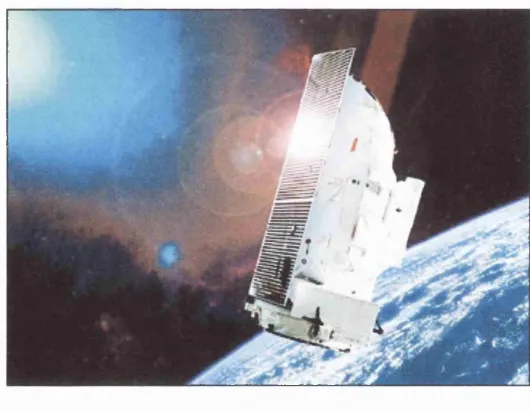
shown in Figure 1-5 below. ISO operated successfully for 863 days. Mechanical
coolers (see Section 1.4.3.2 below) have also been successfully used in space since
the Improved Stratospheric And Mesospheric Sounder (ISAMS) mission in 1991.
A
Figure 1-5: ISO spacecraft1 2
Despite the successes o f previous missions, none has achieved a temperature
approaching those that will be required by the next generation o f space detectors. The
Chapter 1 Introduction to Space Cryogenics 37
1.3.1
The need for 10 mK refrigerators in space
As detector technology becomes more and more advanced, it demands lower and lower temperatures, requiring increasingly sophisticated cooling systems to minimize noise and to maximize energy resolution. There is therefore a constant drive to develop refrigeration systems capable o f cooling to millikelvin temperatures^^. A summary o f the lowest temperatures achieved or required in space for past and future missions is given by Figure 1-6 below^.
Several new detector technologies require cooling to 100 mK and below. These include superconducting tunnel junctions (STJs) and superconducting transition edge sensors (TESs)^^. Current and future space missions already demand sub 100 mK temperatures, with the most recent (unsuccessful) launch, ASTRO-E, requiring 65 mK. Within the next ten to twenty years, the NASA observatory, Constellation-X^^, and the European Space A gency’s (ESA’s) X-ray Evolving Universe Spectroscopy mission (XEUS*"^) will demand 50 mK and 30 mK respectively.
100
Visible/IR Radiometer Various
g -a
i
g 12
IRAS COBE
1975 1980 1985 1990 X 1995 2000 2005 2010 IRTS
Year
ASTRO-E
XEUS
0.01
Chapter 1 Introduction to Space Cryogenics__________________________________^
Since the requirements o f XEUS most closely match the capabilities o f the refrigeration system developed here at Mullard Space Science Laboratory (MSSL), it will be described in Section 1.3.1.1 below in some detail.
1.3.1.1
XEUS
The XEUS mission planned for launch in 2010-2015 will require cooling to 30 mK and will probably employ either STJs or TESs. The refrigeration system presented here aims to exceed the requirements o f XEUS. The specifications for XEUS are therefore used as a benchmark throughout the design study.
The XEUS mission aims to place a permanent x-ray observatory in low Earth orbit (LEO) with a telescope aperture equivalent to the largest ground-based optical telescope built to date’^. The payload o f XEUS will include three x-ray imaging spectrometers. Firstly, there will be a wide field imager (WFI), using charge-coupled devices (CCDs) at around 150 K. In addition to this, there will be two cryogenic imaging spectrometers (CISs) with operating temperatures between 30 mK and 200 mK. The x-ray observatory will be operated continuously for periods o f around 5 years between successive rendezvous with the International Space Station (ISS).
The XEUS project identified four target science areas*®:
i. The behaviour o f matter under strong gravity, near the event horizons o f black holes
ii. The exploration o f distant objects and the evolution o f the high-energy universe
iii. The creation and redistribution o f the elements
Chapter 1 Introduction to Space Cryogenics_________________________________ ^
The temperature o f 30 mK is required by the CISs to give an extremely high energy resolution. This represents a considerable challenge, and will require a refrigeration system superior to any that has been flown to date. Existing technologies for cooling in space are described in Section 1.4 below.
1.4
Cooling technologies for space
Thermal control for the spacecraft as a whole is usually achieved by a combination o f active and passive cooling systems. Passive systems, such as radiators, require no power and no feedback control, and operate continuously. Active systems such as thermostatic heaters, on the other hand, may use power-consuming mechanical or thermoelectric devices and often have moving parts. They are therefore inherently less reliable than passive systems.
The systems required for maintenance o f a stable spacecraft temperature are inadequate for providing cryogenic cooling for components that require particularly low temperatures. Even if a radiator were shielded from all radiation and insulated from conducted heat indefinitely (which could never happen in practice), it could only ever achieve a temperature approaching that o f deep space at To, i.e. 2.73 K. This is because the cooling power, , in Equation [ 1.14] becomes zero when T = Tq. In
fact, the lowest temperature that can be achieved with typical radiators^ is around 60 K. In order to achieve the detector temperature o f 10 mK required, therefore, specialized cryogenic refrigeration techniques are needed.
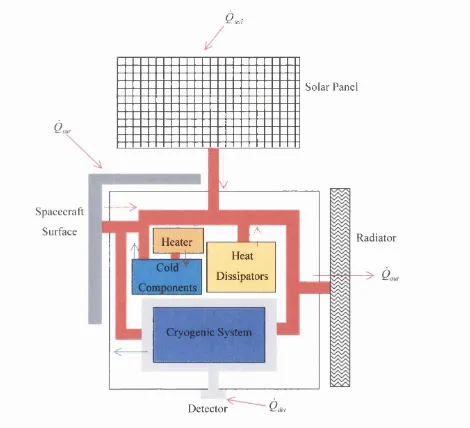
Figure 1-7 below is a schematic showing the heat flows in a basic spacecraft and the relationship between passive, active and cryogenic refrigeration systems. Red arrows represent positive heat flows and blue arrows represent negative heat flows.
Heat flows into the spacecraft from solar radiation absorbed by the surface material
Chapter 1 Introduction to Space Cryogenics 40
components such as electronics, and escapes from the spacecraft via the
passive (or active - see Section 1.4.2.1) radiator. Cold components that must be kept
warm to operate (recall Table 1-2) are heated by active thermostatic heaters (see
1.4.2.2). In order to maintain the detectors, which receive power input at the
desired temperature, a cryogenic cooling system is required. This cryogenic system
may either be pre-cooled by the passive radiator or else take heat out o f the system to
assist the radiator, depending on the format o f the cryogenic system and the
prevailing operating conditions. Passive, active and cryogenic refrigeration systems
are described in Sections 1.4.1, 1.4.2 and 1.4.3 respectively.
Qs o l
Spacecraft
Surface
Solar Panel
t
Heater ----
r-H----,_
f1Heat Dissipators Cold
Components
Cryogenic System
Radiator
a
Detector d el
Chapter 1 Introduction to Space Cryogenics__________________________________41
1.4.1
Passive refrigeration systems
Passive thermal control systems operate by using materials and surface finishes chosen so that the temperature remains within acceptable limits for the range o f orientations and incident radiation levels expected during the spacecraft’s lifetime^. A simple example o f a passive system is a space radiator thermally coupled to heat generating components by conductive paths.
1.4.1.1
Passive radiators
As described in Section 1.2.2.2 above, heat can be radiated by a hot body to its colder surroundings. This effect is employed by passive radiators. Heat flows from heat dissipating equipment to a specially designed radiator with large surface area.
Traditional radiators have been constructed from honeycombed aluminium panels, although Carbon - Carbon (C-C) composite radiators are currently being developed in the United States*^. C-C is a composite material with pure carbon used for both the reinforcing fibres and the matrix (see Figure 1-8 below). This yields a material with high thermal conductivity in all directions, high strength and a density o f only 65% o f that o f aluminium. Furthermore, unlike mechanically inferior honeycombed aluminium, C-C can be used as a structural material itself, not ju st as a covering for the surface o f the underlying structure. Research so far suggests that C-C, which is currently used on the leading edge o f Space Shuttle wings, may soon feature in a wide range o f spacecraft components, including radiators, battery sleeves and electronics boxes^^.
Chapter 1 Introduction to Space Cryogenics 42
The amount o f cooling power that can be provided by a passive radiator at
temperature T is a function o f the difference between the total incident radiation
falling upon the spacecraft and the heat radiated into cold space by the spacecraft.
This cooling power is required to compensate any heat generated internally within the
spacecraft as well as providing any pre-cooling o f cryogenic refrigeration systems.
Figure 1-8: Carbon - Carbon (C-C) radiator16
Equation [ 1.14 ] in Section 1.2.2.2 above gives the amount o f heat emitted by the
spacecraft to cold space. The total radiation incident upon the spacecraft due to solar,
planetary and albedo components is given by:
[ 1.15] Qin - Q s ^ Q p ^ Q a
and from [ 1.2 ],[ 1.5 ] and [ 1.13 ], the radiation incident on the surface is
Chapter 1 Introduction to Space Cryogenics 43
so the total heat absorbed by the satellite is:
[ 1 1 6 ] A,s + 4
The cooling power, , can then be obtained from Equations [ 1.14 ]
and [ 1. 16] . Approximating the temperature o f deep space, To, to be zero:
[ 1 1 7 ] = E
\
V y
Passive radiators are designed to maximize the heat radiated from the spacecraft and
minimize the heat absorbed. This is achieved by using a large area radiator made
from a material with a low absorptance to emissivity ratio {c d é ) and by linking the
radiator thermally to the heat generating components o f the spacecraft. This way, as
much heat as possible is made to flow to the radiator so that it can be radiated to deep
space. Performance o f passive radiators is obviously greatly affected by the
orientation o f the spacecraft with respect to the planets and the sun, the position o f the
radiator and the orbit o f the spacecraft.
Consider the cooling power o f a passive radiator operating at 150 K, the operating
temperature for the first spectrometer on XEUS^"^. Assuming that the spacecraft
attitude is controlled so that the radiator never faces the sun, the projected area o f the
radiator in the direction o f the sun, Ar,s, is zero. The cooling power o f the radiator,
Chapter 1 Introduction to Space Cryogenics 44
[ 1 . 1 8 ]
which can be expressed in words:
Q r =
heat emitted incident planetary incident albedo
by radiator radiation radiation
For a large two-stage radiator'^ o f surface area A r= 12 with emissivity £>• = 0.9 and temperature Tr= 150 K, the heat emitted by the radiator (the first term o f [ 1.18 ] above) becomes 310 W.
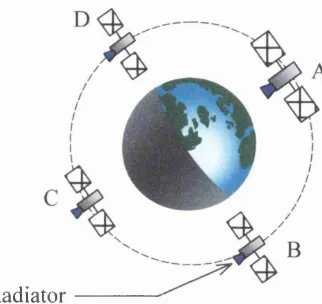
The remainder o f Equation [ 1.18 ], i.e. the incident radiation, will depend on the orientation o f the radiator with respect to the planet and the sun. When the radiator faces away from the planet (as at point C in Figure 1-9 below) so that Fp^ = 0, the cooling power has its maximum value o f 310 W. If the radiator were ever to face the planet directly with the sun behind (as at point A in Figure 1-9 below), then the planetary and albedo power inputs would both be maximum (with cos X = \ and K =
1). The cooling power o f the radiator would therefore have a minimum.
I f we assume that the absorptance o f the radiator ov = 0.2, the Earth’s planetary emissions Jp = 231 W/m^, the LEO altitude h = 700 km, the radius o f the Earth R = 6380 km, the solar radiation J,s,p 1371 W/m , and Earth’s albedo a = 0.34, then
cos>^
Equation [ 1.6 ] gives ^ = 0.81 for maximum heat input.