IJEDR1601040
International Journal of Engineering Development and Research (www.ijedr.org)231
Performance evaluation of textured cutting tools – a
review
1
Ishankumar Upadhyay,
2Pankaj Rathod
1ME Student,2Associate Professor 12Mechanical Engineering Department 12L.D.College of Engineering, Ahmedabad
________________________________________________________________________________________________________
Abstract – The novel micro textured cutting tools have been found to be very efficient in improving the machinability of difficult to machine materials like; Ti, Ni based alloys, Al based alloys, hardened steel, etc. Textured tools by using solid lubricants like; MOS2, WS2 etc. are more effective in reducing cutting forces, surface roughness, cutting temperature and co-efficient of friction at tool chip interface and hence reduce energy required for the machining and increase tool life significantly. The main reasons for the improvement in machinability are; 1) reduction in tool chip contact area and 2) textures acting as reservoirs for solid lubricants and formation of self lubricating layer at tool chip interface. The effectiveness of textured tools by and large depends on the texture pattern, orientation of texture with respect to chip flow direction, textured area on the rake face of the cutting tools, lubrication method used etc.
Index Terms – Textured tools, Difficult to cut materials, Cutting forces, Surface roughness, Co-efficient of friction. ________________________________________________________________________________________________________
I.INTRODUCTION
Surface texture is defined as, “ a patterned surface with regular array of surface height features amenable to some sensible surface description”, “ Structured surfaces are those where the surface structure is a design feature intended to give a specific functional performance”, The function of such surfaces cannot be related to traditional surface finish parameters.“Structured”, “textured” or “engineered” surfaces with a fine scale, periodic structures offer designers additional freedom to create novel functions or combinations of functions. Micro/Nano textures on the rake surface of the tool reduces the contact area between the tool and chip and ultimately reduces the cutting forces as shown in the Fig.1 [1]
Surface textures are produced on the cutting tools by different advance manufacturing methods like; photo lithography, laser technology, micro wire cut electron discharge machining, focused ion beam machining, reactive ion etching method(RIE)etc. Focused ion beam machining is most preferred method for the accurate positioning and dimensions of surface textures but is a very time consuming process. Different types of textures normally produced on the cutting tools are; micro holes, linear grooves (perpendicular and parallel grooves with respect to the chip flow direction), circular grooves, square grooves, elliptical grooves, wavy grooves, areal type, etc.
The orientation of texture with respect to direction of chip flow on the tool is one of the most important factors for the improvement in the performance of the cutting tool. Perpendicular oriented textures are more effective than parallel textures because fewer adherences are found in perpendicular textures.
Solid lubricants have their own effectiveness for the performance of the textured tools. Molybdenum disulfide (MoS2),
Tungsten disulfide (WS2), Titanium dibromide (TiB2), Calcium difluoride (CaF2), graphite, etc. are normally used as solid
lubricants. Textures acting as reservoirs for the solid lubricants and forming a self lubricating layer between tool and chip interface is the main reason for the effectiveness of the textured tools along with solid lubricants. The textured tools are very effective in reducing cutting forces, surface roughness, cutting temperature and co-efficient of friction at tool chip interface and hence reduce energy required for the machining and increase tool life significantly.
II. EXISTING LITERATURE
A. Blatter et al. [2] studied the laser micro patterned sapphire flats and its lubrication effect and frictional behaviour. The microscopic pattern was created on highly polished synthetic single crystal sapphire flats of size 10 X 10 X 0.5 mm3. Pin-on-disk
tests revealed a pronounced effect of the pattern on the tribological characteristics of the flats. Much longer sliding life of patterned sample reflected the potential of microscopic grooves to store the lubricant and to replenish the sliding track with fresh oil. Each particular application certainly requires its own optimization of the grooves as to their dimensional features, their position relative to the contact area, and their orientation relative to the sliding direction.
IJEDR1601040
International Journal of Engineering Development and Research (www.ijedr.org)232
Xiaolei Wang et al. [3] worked upon surface texture design of SiC thrust bearing sliding in water. Micro-pits, evenly distributed in a square array as a textured pattern was selected and formed on one of the contact surfaces by reactive ion etching (RIE).The experiment of sliding friction was performed between the end faces of the cylinder as shown in fig. 2. (a) and a disc (b). It was reported that there exists an optimum range for the pit geometry factor, depth-diameter ratio h/d, and the distribution factor, pit area ratio r, where the critical load can be improved at least twice over that of an untextured surface. From the experiment it was found that the maximum increment of critical load was about 2.5 times that of an untextured one, which was obtained for pit conditions with the diameter of 350 µm, the depth at 3.2 µm and the pit area ratio at 5%
Fig.2.The appearance of the specimens, (a) cylinder, (b) disk.[3]
Shuting Lei et al. [4] studied the performance of micro pool (surface textured) cutting tool. Microholes had been produced using femtosecond laser on the rake face of the uncoated tungsten carbide insert (as shown in Fig.3). Solid lubricant (Tungsten disulfide) had been used to fill the microholes to form micropools. It was established that micropool lubrication brought minimum amount of lubricant into the chip–tool interface and improved the severe contact conditions by reducing the coefficient of friction and thus, reduced the energy loss due to friction in metal cutting. It was proven that the strength of the textured cutting tool did not reduce because of the presence of textures with the help of finite element method (FEM). Micropool lubrication has proved to be very effective in reducing cutting force, thus cutting energy, and chip–tool contact length. It also promotes chip curl and facilitates chip removal.
Fig.3 Optical images of microholes created on tungsten carbide insert. [4]
Tianchang Hu et al.[5] fabricated tools with micro-dimples having different dimple density on the surface of Ti-6Al-4V by using laser (as shown in fig.4).The effect of dimple density on the friction behaviour of the titanium alloy was investigated under dry friction and coated MoS2. It has been shown that the textured surface with higher dimple density had lower friction coefficients
only at low load and speed under dry friction. The dimpled texture entrapped the wear debris and acted as reservoir for the MoS2
and thus improved the load bearing capacity of the material.
Deng Jianxin et al. [6] worked upon design, fabrication and properties of a self lubricated tool in dry cutting. Micro-holes were made using micro-EDM on the rake and flank face of the cemented carbide (WC/Co) tools. Molybdenum disulfide (MoS2) solid
lubricants were filled into the micro-holes to form lubricated tools (ML-1and-2) as shown in fig.5 and fig. 6. The ML-1 self-lubricated tool with one micro-hole in its rake face possessed the lowest friction coefficient at the tool–chip interface; while the ML-2 self-lubricated tool with one micro-hole in its flank face revealed more flank wear resistance. The mechanism responsible was explained as the formation of a self-lubricating film between the sliding couple, and the composition of this lubricating film was found to be MoS2 solid lubricant, which has been released from the micro-hole and smeared on the rake or flank face, and
acted as lubricating additive during dry cutting processes.
IJEDR1601040
International Journal of Engineering Development and Research (www.ijedr.org)233
Fig.5 Micro hole in the rake face of the carbidetool filed (a) without (b) with MoS2 solid
lubricants. [6]
Fig.6 Micro hole in the flank face of the carbide tool filled (a) without (b) with MoS2 solid
lubricants.[6]
Song Wenlong et al. [7] investigated the performance of cemented carbide tool embedded with different solid lubricants. Four micro holes using Micro EDM had been created as shown in fig.7 on the rake surface of the cemented carbide tools. MoS2, CaF2,
and graphite solid lubricants were respectively embedded into the four micro-holes to form self-lubricated tools (SLT-1, SLT-2, and SLT-3). Dry machining tests on hardened steel were carried out with these self-lubricated tools and conventional tools (SLT-4). In agreement with physical properties of solid lubricants, the self-lubricating tools embedded with different solid lubricants possessed different lubricating behaviours due to sensitivity to cutting speed (cutting temperature). The SLT-1 self-lubricated tool just exhibited good self lubricating effect in cutting speed of below 100 m/min, the forces of SLT-2 self-lubricated tool were reduced much just in cutting speed of above 100 m/min, and the SLT-3 self-lubricated tool possessed steady lubricating behaviours under the test conditions.
Fig. 7 Micro holes in the rake face of the carbide tools filled (a) without solid lubricants (b) with MoS2, (c)with CaF2,
(d)with graphite[7]
Deng Jianxin et al. [8] worked upon friction and wear behaviours of the carbide tools embedded with solid lubricants and on the surface of the WC/TiC/Co cemented carbide micro holes have been made as shown in Fig.8. From the experiments it was shown that the friction coefficient of the conventional carbide is much higher than that of the carbide embedded with solid lubricants through reciprocating sliding tests. The cutting forces, cutting temperature, surface roughness, and friction coefficient at the tool– chip interface of the carbide tool embedded with solid lubricants reduced compared with that of the conventional carbide tool.
Fig.8 SEM micrographs of the micro-holes in the surface of the cemented carbide, (a) sample for reciprocating sliding wear tests, (b) sample for cutting tests [8]
IJEDR1601040
International Journal of Engineering Development and Research (www.ijedr.org)234
Fig. 9 Experiment setup of face millingtests[9]
Fig 10 cutting tool with nano/micro textured surface[9]
Noritaka Kawasegi et al. [10] developed cutting tools with microscale and nanoscale textures to improve frictional behaviour. The effect of the texture shape on the machinability of an aluminium alloy had been investigated with a turning experiment applying the minimum quantity lubrication method. Direction of texture represented in the SEM images of cutting tool with micro and nano texture is shown in the Fig.11. The cutting force required for the nanotextured tool was somewhat less than that required for the microtextured tool, indicating that the nanotexture to be more effective. SEM images of the tool rake faces after turning aluminium alloy are shown in Fig.12. The work material adhered to the tool surfaces, and more material was observed on the textured tools. The microtextures were almost buried by the work material [Fig.12 (b)] but nanotexture was not buried [Fig.12 (c & d)]. This was due to the difference in the size of the texture and the waviness, which was wider than the nanostructure texture. The presence of unburied textures caused the decrease in the cutting force observed for the nanotextured tool. Perpendicular textures decreased cutting forces while the cutting forces were same or more in case of parallel textures.
Fig. 11 Schematic diagrams showing the direction of the texture (a) perpendicular and (b) parallel to the chip flow direction. (c) Cross-patterned texture.[10]
Fig.12 SEM images of the cutting tool after turning Al alloy at a cutting speed of 600 m/min: (a) nontextured tool,(b)micro textured tool, and(c) nanotextured tool.(d) Side view of c.[10]
Wenlong Chang et al. [11] created three different microstructure patterns, i.e. a number of micro-scale grooves which were in the directions of horizontal (0◦), perpendicular (90◦) and sloping at 45◦ to the cutting edge of the rake face, have using focused ion beam machining on three identical end mill cutters as shown in the Fig.13. The experimental results showed that smallest cutting force was observed when using perpendicularly microstructured tool. The smallest flank tool wear of 0.134 mm was also achieved for this tool. The microstructure in the direction perpendicular to the cutting edge is the best structure which can reduce tool wear and give prolonged tool life.
Fig.13 SEM images of the microstructured milling cutters and a normal milling cutter. [11]
IJEDR1601040
International Journal of Engineering Development and Research (www.ijedr.org)235
that the micro-texture became more effective as the pattern size of micro-texture decreased or the depth of texture increased. Micro-texture improved the lubrication conditions more effectively as the pattern of Micro-texture became smaller and deeperFig.14 Four types of micro-texture fabricated at the flat rake face: (a) perpendicular; (b) parallel; (c) pit and (d) dot. [12]
Toshiyuki enomoto et al. [13] developed highly wear resistant cutting tools with textured surface for the machining of steel. New TiAlN-coated cutting tools with periodical stripe-grooved surfaces were developed as shown in Fig.15. Face-milling experiments on steel materials showed that the new texture and coating on the tool surface significantly reduced the tool wear. Micro-stripe grooves that were 5 mm deep, 20 mm wide, and 20 mm apart, and parallel to the main cutting edge and TiAlN coating significantly improved the wear resistance and lubricity of the cutting tool surface.
Fig.15 Newly developed cutting tool with periodical stripe grooved surface.[13]
Wu Ze et al. [14] fabricated a textured pattern on the cemented carbide (WC/Co) cutting tool inserts as shown in the Fig.16. Molybdenum disulfide solid lubricants were filled into the textured grooves to form lubricating textured tools. The self-lubricating textured tool with elliptical grooves on its rake face is named STT-R, and the one with linear grooves on its flank face is named STT-F. The application of STT-R tool reduced the cutting forces significantly. The STT-F tool was only marginally better than the conventional tool under the same cutting conditions. Using STT-R tool with elliptical textures on its rake face reduced the friction coefficient and as a consequence reduced the chip thickness ratio. Surface textured tools exhibited superior anti-wear ability. A SEM image of worn rake face is shown in the Fig.17.
Fig.16 Surface textures filled with solid lubricant on a) the rake face or b) the
flank face[14]
Fig.17 SEM micrograph of the worn rake face of a) conventional tool and b)the STT-R tool after 3-min cutting
at V=120 m/min)[14]
IJEDR1601040
International Journal of Engineering Development and Research (www.ijedr.org)236
effectively. From the high speed camera it was known that micro grooves on the rake surface of the tool could change the direction of chip flow and hence resulting in reduction of cutting force.Fig.18 Four different arrangements of microgrooves for microstructured faces [15]
Jin Xie et al. [16] investigated the effect of micro-grinding of micro-groove array on tool rake surface for dry cutting of titanium alloy. Two different surface textured patterns on the rake surface of the cutting tool were developed by using micro grinding technique. Two texture patterns as shown in Fig.19 viz. 1) orthogonal micro grooved 2) diagonal micro grooved were fabricated. The objective was to rapidly dissipate cutting chips and heat from cutting zone using deep micro-grooves instead of coolant. Compared to traditional plate tool, the micro-grooved tools reduced cutting sparks, tool-chip contact length and tool wear. The diagonal micro-grooved tool decreased tool wear by 6.7% compared to orthogonal one. The reason being the diagonal micro groove direction is identical to the cutting chip flowing on tool rake surface. Diagonal micro-grooved tool improved surface quality by 37.3% against orthogonal micro-grooved tool. The diagonal micro-grooved tool had strong chip breaking ability and decreased shear angle by about 24.3% against the orthogonal micro-grooved tool, thus leading to stable turning.
Fig. 19 Three tools with different rake surface features a) Traditional plate tool b) Orthogonal micro grooved tool and c) Diagonal micro-grooved tool[16].
Fujian Sun et al. [17] studied machining performance of a grooved tool in dry machining Ti-6Al-4V. The main failure mechanisms of the cutting tool were adhesion wear, crater wear, and dissolution-diffusion wear. The resistance to chipping was enhanced due to the decreased cutting pressure of the chips on the major cutting edge. The resistance to plastic deformation of tool nose was weakened at the cutting speed of more than 60 m/min. Fig.20 shows the SEM images of rake faces of grooved tool after 6 min machining.
Fig.20 SEM photograph of rake faces of grooved tool after 6 min machining: a) Rake face, b) Rake face close to nose, c) Crater, and d) Chipping (cutting speed of 50 m/min, feed rate of 0.1 mm/rev, and depth of cut of 1.0 mm)[17]
IJEDR1601040
International Journal of Engineering Development and Research (www.ijedr.org)237
compared to that of dry cutting conditions. Results indicated that the cutting tool with microgrooves combined with CMQL reduced the adhesion of Ti-6Al-4V titanium alloy compared with that of the same tool under dry cutting conditions. The tool with microgrooves 29 μm in depth, 59 μm in width, 53 μm in spacing, and 250 μm away from main cutting edge had the best effect on cutting performance compared with other cutting tools.Fig. 21 SEM and optical topography of microgroove array on the rake face of cemented carbide tool[18]
Youqiang Xing et al. [19] developed novel Al2O3/TiC cutting tool with coating and laser technologies. Nano textured pattern
on the surface of the ceramic cutting tools were deposited with WS2/Zr composite soft-coatings. Utilization of WS2/Zr composite
soft-coatings and surface nano textures on Al2O3/TiC ceramic cutting tools improved the cutting performance and reduced the
tool wear compared to conventional tool. The Nano-textured Al2O3/TiC ceramic cutting tools deposited with WS2/Zr composite
soft-coatings proved to be more effective in reducing the cutting force, cutting temperature, friction coefficient and tool wear compared with the WS2/Zr coated tool without nano-textures on its rake face. The WS2/Zr coated cutting tool with areal
nano-textures was the most effective in improving the cutting performance and reducing the tool wear. SEM images of perpendicular, parallel and areal type of texture are shown in the Fig.22.
Fig.22 SEM Images of the three types of nano-textures on the tool rake face :(a)–(c) PE;(d)–(f) AN-PA;(g)–(i) AN-A.[19]
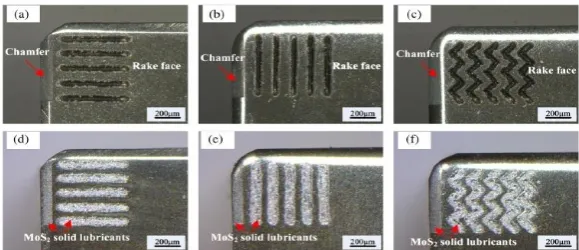
Youqiang Xing et al. [20] examined the cutting performance, wear mechanism of nanoscale and microscale textured Al2O3/TiC
IJEDR1601040
International Journal of Engineering Development and Research (www.ijedr.org)238
Fig. 23 Optical images of nanoscale and microscale textured tools filledwith and without MoS2 lubricants.[20]
Wu Ze et al. [21] evaluated the performance of micro textured self lubricating and pulsating heat pipe self cooling tools in dry machining of a titanium alloy. The concept of self lubricating and self cooling tools have been combined i.e.the pulsating heat pipe and face texturing. Textured pattern is shown in the Fig.24 and schematic of self cooling tool with heat pipe is shown in the Fig.25. Compared to the conventional tool, SLTs and SLCTs reduced the main cutting force Fz, radial thrust force Fy and axial thrust force Fx by 10–15%, 15–25% and 10–20%, respectively. Textured tools also reduced the average friction coefficient at the tool–chip interface by 5–20%. SLTs, SCTs and SLCTs reduced the cutting temperature compared to the conventional tool. Solid lubricants in the textured grooves released and smeared at the tool–chip interface in cutting process, reducing the cutting forces and the cutting temperature and increasing the chip coiling by lubricating action. Fig.26 shows the worn rake faces of the tools after 3 min. cutting.
Fig.24 Morphology of textured grooves on rake face of cutting tool: (a) textured grooves without lubricants, (b) stereoscopic profile of textured grooves and (c) textured grooves filled with solid lubricants[21]
Fig. 25 Schematic of the pulsating heat pipe self-cooling tool[21]
Fig.26 SEM micrograph of the worn flank face of (a) CT, (b) SLT, (c) SCT and (d) SLCT tools after 3-min cutting at speed of 90 m/min.[21]
Pankaj Rathod et al.[22] evaluated the effectiveness of the novel surface textured tools in enhancing the machinability of titanium alloy (Ti6Al4V)”. The texture with linear grooves (perpendicular to chip flow direction), square grooved texture and circular grooved texture have been produced using Focused Ion Beam Machining as shown in the Fig.27. Square Textures were more effective in reducing cutting forces than linear grooves and circular grooves. Circular grooves have been little less efficient than squared grooves but the time taken to produce these grooves had been half that of square and linear grooves using FIB machining. Reduction of friction force was attributed to the reduction of chip tool contact area, influence of the solid lubricant WS2 and having better heat conduction and less heating of the tool tip owing to larger surface area resulted due to the patterns.
IJEDR1601040
International Journal of Engineering Development and Research (www.ijedr.org)239
Fig. 27 Types of surface textures developed at the rake face of cutting tools a) Linear Grooves b) Square Grooves c) Circular Grooves[22]
Dong Min Kim et al. [23] carried out hard turning of bearing steel (AISI52100) using a micro textured tool as shown in Fig.28. Four types of microtextures were considered on the tool rake face: nontexture, perpendicular, parallel, and rectangle. Johnson-Cook (J-C) material constitutive law has been considered for the workpiece with temperature-dependent material properties. It was observed that the predicted cutting forces and effective friction were decreased with the perpendicular type texture. A 6 % reduction in the main cutting force and 25 % reduction in the effective friction were reported with perpendicular texture compared to a non-textured flat tool.The perpendicular texture at an edge distance of 100 μm, pitch size of 100 μm, and texture height of 50 μm proved to be the most effective shape and size giving the minimum cutting forces and effective friction.
Fig. 28 A model assembly and boundary conditions [23]
Jianfeng Ma et al. [24] investigated the performance of micro grooved cutting tool in dry orthogonal machining of mild steel (AISI 1045 steel). Machining experiment was done on lathe machine and both regular and microgrooved inserts were tested. The result of the FE simulation is shown in the Fig.29. Cutting forces were recorded using a LABVIEW based data acquisition system. Chips were collected and cutting tools were examined using an optical microscope. They found the approximately same results in experiment and finite element simulation with variation of about 10 %. Because of the difference in the experiments (turning) and simulation (orthogonal cutting), the three cutting force components from the experiments are converted into their equivalents in orthogonal cutting using machining theory so that they can be compared with these from the simulations. Cutting force increased slowly with groove width from 70 to 200 µm. For certain groove geometry, the microgroove served as a microcutter as the chip passed over the rake face, resulting in highly localized pressure and temperature, that led to microchip curling into the microgroove. Microgrooves on the tool rake face caused localized high wear near the groove walls where high stress and high temperature occurred.
IJEDR1601040
International Journal of Engineering Development and Research (www.ijedr.org)240
Xing Youqiang et al. [25] investigated the effect of laser surface texturing on Si3N4/TiC ceramic sliding against steel under dryfriction. Wavy grooves and linear grooves has been produced by an Nd:YAG laser surface texturing(LST) as shown in the fig.30 . Effect of surface texturing on the stress distribution was studied by finite element method (FEM). The wavy-grooved samples exhibited the lowest friction coefficient and wear rate; Large texture density proved to be the best for reduction of friction and wear of textured samples. The wear rate of balls sliding against textured surfaces was larger than that of balls sliding against smooth surfaces. FEM results showed that surface texturing improved the stress distribution of contact interfaces and reduced stress concentration.
Fig. 1. Optical micrographs of textured surfaces: (a) wavy groove, (b) linear groove, (c) a single groove, (d) schematic diagram of ST-WG sample, and (e) schematic diagram of ST-ST-WG sample.
III.SUMMARY
After comprehensive study of existing literature on textured cutting tools, following observations have been made:
The textured tools have proved to be very efficient in improving the machinability of difficult to machine materials such as Ti and Ni based alloys.
Textured tools by using solid lubricants like; MoS2, WS2, etc. are more effective in reducing cutting forces, surface
roughness, cutting temperature and co-efficient of friction at tool chip interface and hence reduced energy required for the machining and increase tool life significantly.
The attributed for the aforementioned improvements are; 1) Reduction of tool chip contact area and
2) Formation of self lubricating film at the tool chip interface.
The effectiveness of textured tools by and large depends on the texture pattern, orientation of texture with respect to cutting edge and the textured area on the rake face of the cutting tool.
The orientation of texture with respect to chip flow direction is very important for the improvement in the performance of the cutting tool. Perpendicular texture orientation is more effective than parallel texture orientation because fewer adherences have been found in perpendicular texture.
REFERENCES
[1] C. J. Evans and J. B. Bryan, "“Structured”,“textured” or “engineered” surfaces," CIRP Annals-Manufacturing Technology, vol. 48, pp. 541-556, 1999.
[2] A. Blatter, M. Maillat, S. Pimenov, G. Shafeev, and A. Simakin, "Lubricated friction of laser micro-patterned sapphire flats," Tribology letters, vol. 4, pp. 237-241, 1998.
[3] Xiaolei Wang, Koji Kato, Koshi Adachi and Kohj Aizawa ," Loads carrying capacity map for the surface texture design of SiC thrust bearing sliding in water," Tribology International, vol.36, pp.189–197,2003.
[4] Shuting Lei,Sasikumar Devarajan,Zenghu Chang," A study of micropool lubricated cutting tool in machining of mild steel," journal of materials processing technology, vol. 20.9, pp.1612–1620, 2009.
[5] Tianchang Hu, Litian Hu , Qi Ding, “Effective solution for the tribological problems of Ti-6Al-4V: Combination of laser surface texturing and solid lubricant film”,Surface & Coatings Technology, vol. 206,pp.5060–5066,2012.
[6] Deng Jianxin,SongWenlong,ZhangHui," Design, fabrication and properties of a self-lubricated tool in dry cutting,",International Journal of Machine Tools & Manufacture,vol.49, pp. 66–72, 2009.
[7] Song Wenlong, Deng Jianxin, Wu Ze & Zhang Hui, Yan Pei, Zhao Jun, Ai Xing," Cutting performance of cemented-carbides-based self-lubricated tool embedded with different solid lubricants," Int. Journals of Advance Manufacturing Technology, vol.52, pp.477-485,2011.
IJEDR1601040
International Journal of Engineering Development and Research (www.ijedr.org)241
[9] Tatsuya Sugihara,Toshiyuki Enomoto," Development of a cutting tool with a nano/micro-textured surface—Improvementof anti-adhesive effect by considering the texture patterns", Precision Engineering, vol. 33, pp.425–429, 2009.
[10] Noritaka Kawasegi,, Hiroshi Sugimori, Hideki Morimoto, Noboru Morita, Isao Hori," Development of cutting tools with microscale and nanoscale textures to improve frictional behavior", Precision Engineering, vol. 33, pp.248–254,2009. [11] Wenlong Chang, Jining Sun, Xichun Luo, James M. Ritchie, Chris Mack, " Investigation of microstructured milling tool
for deferring tool wear" , Wear, vol. 271, pp. 2433– 2437,2011.
[12] Toshiyuki Obikawa, Akihiro Kamio, HidemitsuTakaoka, Akira Osada," Micro-texture at the coated tool face for high performance cutting", International Journal of Machine Tools & Manufacture , vol.51, pp. 966–972, 2011.
[13] Toshiyuki Enomoto, Tatsuya Sugihara, Satoshi Yukinaga, Kenji Hirose, Urara Satake, “Highly wear-resistant cutting tools with textured surfaces in steel cutting”,CIRP Annals - Manufacturing Technology,vol.61,pp.571–574,2012.
[14] Wu Ze,Deng Jianxin,Chen,Yang,Xing Youqiang and Zhao Jun," Performance of the self-lubricating textured tools in dry cutting of Ti-6Al-4V", Int. Journals for Advance Manufacturing Technology, vol .62,pp.943–951,2012.
[15] Toshiyuki Obikawa and Bunji Kani, " Micro Ball End Milling of Titanium Alloy Using a Tool with a Microstructured Rake Face" , Journal of Advanced Mechanical Design,Systems, and Manufacturing, vol. 6, pp. 1121– 1131,2012.
[16] Jin Xie, Min-Jian Luo, Jian-Lin He, Xu-Ran Liu and Ting-Wu Tan, "Micro-grinding of Micro-groove Array on Tool Rake Surface for Dry Cutting of Titanium Alloy," International Journal Of Precision Engineering And Manufacturing, Vol. 13, No. 10, pp. 1845-1852,2012.
[17] Fujian Sun, Shengguan Qu, Yuxiang Pan, Xiaoqiang Li, Chao Yang," Machining performance of a grooved tool in dry machining Ti-6Al-4V," Int. Journals of Advance Manufacturing Technology,vol .73,pp.613-622,2014.
[18] Yinfei Yang, Yongsheng Su, Liang Li, Ning He, Wei Zhao," Performance of cemented carbide tools with microgrooves in Ti-6Al-4V titanium alloy cutting," Int. Journals of Advance Manufacturing Technology ,2014.
[19] Youqiang Xing, Jianxin Deng , Shipeng Li,Hongzhi Yue,Rong Meng,Peng Gao, " Cutting performance and wear characteristics of Al2O3/TiC ceramic cutting tools withWS2/Zr soft-coatings and nano-textures in dry cutting ", Wear, vol.
318, pp.12–26, 2014.
[20] Youqiang Xing, Jianxin Deng , Jun Zhao, Guodong Zhang, Kedong Zhang, " Cutting performance and wear mechanism of nanoscale and microscale textured Al2O3/TiC ceramic tools in dry cutting of hardened steel" , Int. Journal of Refractory
Metals and Hard Materials, vol. 43, pp. 46–58,2014.
[21] Wu Ze , Deng Jianxinb, Su Chuna, Luo Chen , Xia Dan , "Performance of the micro-texture self-lubricating and pulsating heat pipe self-cooling tools in dry cutting process" , Int. Journal of Refractory Metals and Hard Materials, vol. 45, pp.238-248,2014.
[22] Pankaj Rathod,Sivanandam,Aravindan,Venkateswara Rao Puruchuri, "Evaluating the effectiveness of the novel surface textured tools in enhancing the machinability of titanium alloy (Ti6Al4V) ", Journal of Advanced Mechanical
Design, Systems, and Manufacturing,Vol. 9,No.3,2015.
[23] Dong Min Kim & Vivek Bajpai & Bo Hyun Kim &Hyung Wook Park, “Finite element modeling of hard turning process
via a micro-textured tool”, Int. Journals of Advance Manufacturing Technology ,2014.
[24] Jianfeng Ma, Nick H. Duong, Shing Chang, Yunsong Lian, Jianxin Deng, Shuting Lei, " Assessment of Microgrooved
Cutting Tool in Dry Machining of AISI 1045 Steel" , Journal of Manufacturing Science and Engineering, vol.137,
pp.31001-9,2015.
[25] Xing Youqiang, Deng Jianxin, Feng Xiuting, Yu Sheng, “Effect of laser surface texturing on Si3N4/TiC ceramic sliding
![Fig.2.The appearance of the specimens, (a) cylinder, (b) disk. [3]](https://thumb-us.123doks.com/thumbv2/123dok_us/8256006.1375100/2.595.97.505.479.578/fig-appearance-specimens-cylinder-b-disk.webp)
![Fig.6 Micro hole in the flank face of the carbide tool filled (a) without (b) with MoS2 solid lubricants.[6]](https://thumb-us.123doks.com/thumbv2/123dok_us/8256006.1375100/3.595.69.533.315.448/fig-micro-hole-flank-carbide-filled-solid-lubricants.webp)
![Fig 10 cutting tool with nano/micro textured surface[9]](https://thumb-us.123doks.com/thumbv2/123dok_us/8256006.1375100/4.595.112.247.53.164/fig-cutting-tool-nano-micro-textured-surface.webp)
![Fig. 19 Three tools with different rake surface features a) Traditional plate tool b) Orthogonal micro grooved tool and c) Diagonal micro-grooved tool[16]](https://thumb-us.123doks.com/thumbv2/123dok_us/8256006.1375100/6.595.107.490.429.526/different-surface-features-traditional-orthogonal-grooved-diagonal-grooved.webp)
![Fig. 21 SEM and optical topography of microgroove array on the rake face of cemented carbide tool[18]](https://thumb-us.123doks.com/thumbv2/123dok_us/8256006.1375100/7.595.181.442.353.553/fig-sem-optical-topography-microgroove-array-cemented-carbide.webp)
![Fig. 27 Types of surface textures developed at the rake face of cutting tools a) Linear Grooves b) Square Grooves c) Circular Grooves[22]](https://thumb-us.123doks.com/thumbv2/123dok_us/8256006.1375100/9.595.167.426.573.735/textures-developed-linear-grooves-square-grooves-circular-grooves.webp)