http://dx.doi.org/10.4236/am.2014.517253
How to cite this paper: Yılmaz, Ş. and Büyükköroğlu, T. (2014) On Two Problems for Matrix Polytopes. Applied Mathemat-ics, 5, 2650-2656. http://dx.doi.org/10.4236/am.2014.517253
On Two Problems for Matrix Polytopes
Şerife Yılmaz
*, Taner Büyükköroğlu
Department of Mathematics, Faculty of Science, Anadolu University, Eskisehir, Turkey Email:*[email protected],[email protected]
Received 21 July 2014; revised 20 August 2014; accepted 8 September 2014
Copyright © 2014 by authors and Scientific Research Publishing Inc.
This work is licensed under the Creative Commons Attribution International License (CC BY).
http://creativecommons.org/licenses/by/4.0/
Abstract
We consider two problems from stability theory of matrix polytopes: the existence of common quadratic Lyapunov functions and the existence of a stable member. We show the applicability of the gradient algorithm and give a new sufficient condition for the second problem. A number of examples are considered.
Keywords
Stable Matrix, Matrix Family, Common Quadratic Lyapunov Functions, Switched System, Gradient Method
1. Introduction
Consider the switched system
( )
( )
,{
1, 2, , N}
x t =Ax t A∈ A A A (1)
where x t
( )
∈n, t≥0. In Equation (1), the matrix A switches among N matrices A A1, 2,,AN.Switching signal
σ
( )
t is piecewise continuous from the right functionσ
: 0,[
∞ →) {
1, 2,,N}
and the switching times are arbitrary. For the switched system (1) with initial condition x( )
0 =x0 and with switchingsignal
σ
( )
t denotes the solution by x t x(
, 0,σ
( )
⋅)
.Definition 1. The origin is uniformly asymptotically stable (UAS) for the system (1) if for every ε >0 there exists δ >0 such that for every signal
σ
( )
t and initial state x0 with x0 <δ
, the inequality( )
(
, 0,)
x t x
σ
⋅ <ε
is satisfied for all t>0 and uniformly on σ ⋅( )
( )
(
0)
lim , , 0.
t→∞x t x σ ⋅ =
system is UAS (T denotes the transpose).
In this case there exists a common P>0 such that
(
)
T 0 1, 2, ,
i i
A P+PA < i= N (2) and P is called a common solution to the set of Lyapunov matrix inequalities (2).
The problem of existence of common positive definite solution P of (2) has been studied in a lot of works (see [1]-[9] and references therein). Numerical solution for common P via nondifferentiable convex optimiza-tion has been discussed in [10].
In the first part of the paper, the problem of existence of CQLF is investigated by Kelley’s method. This me-thod is applied when CQLF problem is treated as a convex optimization problem.
Second part of the paper is devoted to the following question:
Let l
B⊂ be a compact, for q∈B the matrix A q
( )
is a real n n× matrix. Is there a Hurwitz stable member (all eigenvalues lie in the open left half plane) in the family( )
{
A q :q∈B}
or equivalently is there q*∈B such that A q
( )
* is stable? This problem is one of the hard and important problems in control theory (see [11]). Numerical solution of this problem is considered in [12]. In this paper we reduce this problem to a non-convex optimization problem.2. Common Quadratic Lyapunov Function
For the switched system
{
1, 2, , N}
x= A A A x
consider the problem of determination of CQLF V x
( )
=x PxT where 0P> . We are going to investigate it by Kelley’s cutting-plane method. This method gives new sufficient condition (Theorem 2) and new algorithm (Algorithm 1) which is more effective in comparison with the algorithm from [10].
Consider the problem of existence of a common P>0 such that
(
)
T
0 1, 2, ,
i i
A P+PA < i= N . (3)
Let x∈r be xT =
(
x x1, 2,,xr)
and P be an n n× symmetric matrix defined as( )
(
)
1 2
2 1 2 1
2 1
1
2 n
n n
n n r
x x x
x x x n n
P P x r
x x x
+ −
−
+
= = =
Define
( )
(
T)
T(
T)
1 max 1 , 1
max i N i i max i N u i i .
x A P PA u A P PA u
φ = ≤ ≤ λ + = ≤ ≤ = + (4)
If there exists x* such that P x
( )
* >0 andφ
( )
x* <0 then the matrix P x( )
* is required solution. This problem can be reduced to the minimization of a convex function under convex constraints.Consider the following convex minimization problem
( )
( )
T 1
minimize.
minv 0
x
v P x v
φ
= →
> (5)
Let X ⊂n be a convex set and F X: → be convex function. The vector g∈n is said to be a sub-gradient of F x
( )
at x*∈X if for all x∈X( )
( )
T(
)
* *
The set of all subgradients of F x
( )
at x=x* is denoted by ∂F x( )
* . If x* is an interior point of Xthen the set ∂F x
( )
* is nonempty and convex. The following proposition follows from nondifferentiable opti-mization theory.Proposition 1. Let
φ
( )
x be defined as( )
x maxy Y f x y( )
,φ
= ∈ (6)where Y is compact, f x y
( )
, is continuous and differentiable in x. Then( )
( )
,( )
conv f x y :
x y Y x x
φ ∂
∂ = ∈
∂
where Y x
( )
is the set of all maximizing elements y in (6), i.e.( )
{
:( ) ( )
,}
Y x = y∈Y f x y =
φ
x .If for a given x the maximizing element is unique, i.e. Y x
( )
={
y x( )
}
thenφ
( )
x is differentiable at xand its gradient is
( )
x f x y( )
, .x
φ
∂∇ =
∂
In the case of the Function (4)
( )
(
T(
T)
)
(
T)
max
conv : maximizes ,
is a corresponding unit eigenvector .
i i i i
x u A P PA u i A P PA
x
u
φ ∂ λ
∂ = + +
∂
If for the given x the maximizing i is unique and
λ
max(
A PiT +PAi)
is a simple eigenvalues, the diffe-rentiability of φ at the point x is guaranteed [13].We investigate problem (5) by Kelley’s cutting-plane method. This method converts the problem (5) to the problem
( )
( )
(
)
T
1 2
min
0, 0, 1 i 1 1, 2, ,
c z
c z c z x i r
→
≥ ≥ − ≤ ≤ = (7)
where z=
(
x x1, 2,,x Lr,)
T,(
)
T
0, 0, , 0,1
c= , c z1
( )
= −Lφ
( )
x ,( )
T 2 minv 1
c z = = v Pv. Let z0 be a starting point and z0,z1,,zk be k+1 distinct points.
At the
(
k+1)
th iteration, the cutting-plane algorithm solves the following LP problem( )
( )
( )
( )
( )
( )
( )
( )
( )
( )
( )
( )
T 0 T 0 0 0
1 1 1
T 0 T 0 0 0
2 2 2
T T
1 1 1
T T
2 2 2
minimize
subject to
1 1
k k k k
k k k k
i
L
h z z h z z c z h z z h z z c z
h z z h z z c z h z z h z z c z
x
− ≥ − −
− ≥ − −
− ≥ − −
− ≥ − −
− ≤ ≤
(8)
where hj
( )
zi denotes a subgradient of −cj( )
z at zi(
i=1, 2)
. Let z*k be the minimizer of the problem (8).( ) ( )
imate solution of the problem (7).
Otherwise define j* as the index for the most negative
( )
*k j
c z , update the constraints in (8) by including the linear constraint
( )
( )(
)
* *
1 T 1 1
0
k k k
j j
c z + −h z + z−z + ≥
and repeat the procedure.
Recall that our aim is to find x* such that P x
( )
* >0 andφ
( )
x* <0, but not the solution of the minimiza-tion problem (5), (7).Theorem 2. If there exists k such that
( )
( )
1 * , 2 * 0
k k k
c z >L c z >
where z*k =
(
x L*k, k)
is the minimizer of the problem (8), then the matrix P=P x( )
*k is a common solution to (3).Proof:
( )
* 1( )
* 0,k k k
x L c z
φ
= − <( )
T( )
2 * *
1
0 k min k
v
c z v P x v
=
< =
and by (5),
( )
*k 0P x > is a common solution to (3).
For the problem (5), (7) Kelley’s method gives the following
Algorithm 1.
Step 1. Take an initial point z0 =
(
x L0, 0)
T. Compute φ( )
x0 and( )
0 2c z . If φ
( )
x0 <0 and( )
02 0
c z >
stop; otherwise continue.
Step 2. Determine z*k by solving LP problem in (8). If c z1
( )
*k >Lk and 2( )
*k 0c z > then stop; otherwise continue. Set zk+1=z*k, update the constraints in (8) and repeat the procedure.
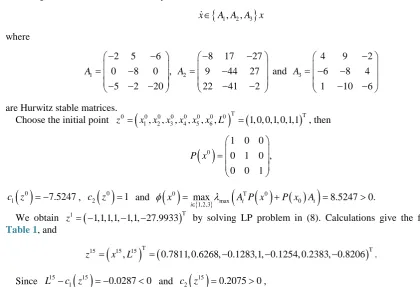
Example 1. Consider the switched system
{
1, 2, 3}
x∈ A A A x
where
1 2 3
2 5 6 8 17 27 4 9 2
0 8 0 , 9 44 27 and 6 8 4
5 2 20 22 41 2 1 10 6
A A A
− − − − −
= − = − = − −
− − − − − − −
are Hurwitz stable matrices.
Choose the initial point z0 =
(
x x x x x x L10, 20, 30, 40, 50, 60, 0)
T =(
1, 0, 0,1, 0,1,1)
T, then( )
01 0 0
0 1 0 ,
0 0 1
P x
=
( )
01 7.5247
c z = − , c2
( )
z0 =1 and( )
{ }(
( )
( )
)
0 T 0
max 0
1,2,3
max i i 8.5247 0.
i
x A P x P x A
φ
λ
∈
= + = >
[image:4.595.81.502.425.712.2]We obtain z1= −
(
1,1,1,1, 1,1, 27.9933− −)
T by solving LP problem in (8). Calculations give the followingTable 1, and
(
)
T(
)
T15 15 15
, 0.7811, 0.6268, 0.1283,1, 0.1254, 0.2383, 0.8206 .
z = x L = − − −
Since L15−c z1
( )
15 = −0.0287<0 and( )
152 0.2075 0
Table 1. Kelley’s algorithm for Example 1.
k k
L 1
( )
k
c z 2
( )
k
c z
1 −27.9933 ‒209.7383 −1.9999
2 −24.4038 ‒127.1153 −2.3326
3 −14.2596 ‒106.2473 −1.8092
4 −10.0497 ‒63.4433 −1.8878
14 −0.8465 −1.1881 0.2694
15 −0.8206 −0.7919 0.2075
( )
150.7811 0.6268 0.1283
0.6268 1 0.1254
0.1283 0.1254 0.2383
P P x
−
= = −
− −
is a common positive definite solution for
(
)
T
0 1, 2, 3 .
i i
A P+PA < i=
3. Stable Member in a Polytope
This part is devoted to the following question: Given a matrix family
{
A q( )
:q∈B}
where B⊂l is a compact, is there a stable matrix in this family?In [12], a numerical algorithm has been proposed for a stable member in the affine matrix family
( )
{
A q :q∈l}
. In this algorithm the uncertainty vector q varies in the whole space l. On the other hand we consider the case where q varies in a box B⊂Rl and use the gradient algorithm for minimization of the nonconvex maximum eigenvalue function. By choosing appropriate step-size, we obtain the convergence.Let 1, 2, ,
(
1)
2 r
n n Z Z Z r= +
be a basis for the subspace of n n× symmetric matrices and
( ) ( )
(
T( )
( )
)
,
i i i i
Q q = −Z ⊕ A q Z +Z A q
( )
max( )
1 ,
r
i i i
x q x Q q
φ λ
=
=
∑
where x=
(
x x1, 2,,xr)
T,(
)
T 1, 2, , k
q= q q q . Consider the problem
( )
( )
T 1,
, minimize.
min 0
x q Q
x q
v P x v
φ
= ∈ →
>
Theorem 3. There is a stable matrix in the family A q
( )
if and only if φ* =min( )x q, φ( )
x q, <0.Proof:
(
)
( )
* * * * *
1
0 there exists , such that 0
r
i i i
x q x Q q
φ
=
< ⇔
∑
<( )
( )
* T * * * *
0
r r r
i i i i i i
x Z A q x Z x Z A q
⇔ − ⊕ − + − <
( )
* *( ) ( ) ( ) ( )
* T * * * 10 and 0.
r
i i i
P x x Z A q P x P x A q
=
⇔ =
∑
> + <By Lyapunov theorem, the matrix A q
( )
* is stable.Example 2. Consider the family of matrices
( )
0 1 1 2 2 3 3, 1, 2, 3[
1,1]
A q =A +q A+q A +q A q q q ∈ −
where
0 1 2 3
1 0 2 0 2 0 3 0 1 0 2 0 1 0 0 1
2 0 3 0 1 0 3 2 3 1 3 0 1 2 3 2
, , , .
5 1 1 0 3 3 1 0 3 2 1 2 1 2 0 1
3 1 0 2 4 1 0 2 2 1 0 2 0 2 1 5
A A A A
− − − − − − − − − − − − − = = = = − − − − − − − − − − − − − − − − − − −
For q=
(
0, 0, 0)
T, A q( )
=A0 is unstable. We apply the gradient algorithm to find a stable member in the family.Let
T 0 1, 0, 0, 0, , 0, 0, , 0,1 1 1
2 2 2 2
x =
and
(
)
T 0
1, 0, 0
q = . So
(
)
T0 0, 0 1, 0, 0, 0, , 0, 0, , 0, ,1, 0, 01 1 1 .
2 2 2 2
a = x q =
Then
( )
( )
( ) ( ) ( ) ( )
0 10 0 0 T0 0 0 0
1
0
0
1 2 0 0 0 0 0 0 0
0 1 2 0 0 0 0 0 0
0 0 1 2 0 0 0 0 0
0 0 0 1 2 0 0 0 0
.
0 0 0 0 1 0 5 0
0 0 0 0 3 0 6 2
0 0 0 0 8 4 2 0
0 0 0 0 7 2 0 4
i i i
P x x Q q
A q P x P x A q
= − = + − − − − = − − − − − − − −
∑
Maximum eigenvalue of this matrix and its corresponding unit eigenvector are
(
)
Tmax 2.1866,v 0, 0, 0, 0, 0.7644, 0.4480, 0.1668, 0.4324
λ
= = − − −respectively. Gradient of the function φ at a0 is
(
)
0
T
2.44, 1.86, 11.04, 2.78,1.93, 7.50, 4.30, 2.52, 7.46, 2.35, 0.28, 0.50, 2.73 . a
φ
∇ = − − − − −
The first tencomponent of the vector 0
1 0
a
a =a − ⋅∇t
φ
should be on the ten dimensional unit sphere. There-fore t=0.01531 and(
)
T1
0.53, 0.02, 0.16, 0.04, 0.47, 0.11, 0.06, 0.46, 0.11, 0.46, 0.99, 0.007, 0.04 .
a = − − − −
After 4 steps, we get
(
)
(
)
T4 4 4
, 0.59, 0.03, 0.04, 0.009, 0.41, 0.05, 0.04, 0.49, 0.15, 0.45, 0.98, 0.03, 0.08
and
φ
(
x q4, 4)
= −0.2585<0. Therefore A q( )
4 is stable.4. Conclusion
Two important problems from control theory are considered: the existence of common quadratic Lyapunov functions for switched linear systems and the existence of a stable member in a matrix polytope. We obtain new conditions which give new effective computational algorithms.
References
[1] Boyd, S. and Yang, Q. (1989) Structured and Simultaneous Lyapunov Functions for System Stability Problems. Inter-national Journal of Control, 49, 2215-2240. http://dx.doi.org/10.1080/00207178908559769
[2] Büyükköroğlu, T., Esen, Ö. and Dzhafarov, V. (2011) Common Lyapunov Functions for Some Special Classes of Sta-ble Systems. IEEE Transactions on Automatic Control, 56, 1963-1967. http://dx.doi.org/10.1109/tac.2011.2137510
[3] Cheng, D., Guo, L. and Huang, J. (2003) On Quadratic Lyapunov Functions. IEEE Transactions on Automatic Control,
48, 885-890. http://dx.doi.org/10.1109/tac.2003.811274
[4] Dayawansa, W.P. and Martin, C.F. (1999) A Converse Lyapunov Theorem for a Class of Dynamical Systems Which Undergo Switching. IEEE Transactions on Automatic Control, 44, 751-760. http://dx.doi.org/10.1109/9.754812
[5] King, C. and Shorten, R. (2004) A Singularity Test for the Existence of Common Quadratic Lyapunov Functions for Pairs of Stable LTI Systems. Proceedings of the American Control Conference, Boston, 30 June-2 July 2004, 3881- 3884.
[6] Mason, O. and Shorten, R. (2006) On the Simultaneous Diagonal Stability of a Pair of Positive Linear Systems. Linear Algebra and Its Applications, 413, 13-23. http://dx.doi.org/10.1016/j.laa.2005.07.019
[7] Narendra, K.S. and Balakrishnan, J. (1994) A Common Lyapunov Function for Stable LTI Systems with Commuting A-Matrices. IEEE Transactions on Automatic Control, 39, 2469-2471. http://dx.doi.org/10.1109/9.362846
[8] Shorten, R.N. and Narendra, K.S. (2002) Necessary and Sufficient Conditions for the Existence of a Common Qua-dratic Lyapunov Function for a Finite Number of Stable Second Order Linear Time-Invariant Systems. International Journal of Adaptive Control and Signal Processing, 16, 709-728. http://dx.doi.org/10.1002/acs.719
[9] Shorten, R.N., Mason, O., Cairbre, F.O. and Curran, P. (2004) A Unifying Framework for the SISO Circle Criterion and Other Quadratic Stability Criteria. International Journal of Control, 77, 1-8.
http://dx.doi.org/10.1080/00207170310001633321
[10] Liberzon, D. and Tempo, R. (2004) Common Lyapunov Functions and Gradient Algorithms. IEEE Transactions on Automatic Control, 49, 990-994. http://dx.doi.org/10.1109/tac.2004.829632
[11] Polyak, B.T. and Shcherbakov, P.S. (2005) Hard Problems in Linear Control Theory: Possible Approaches to Solution. Automation and Remote Control, 66, 681-718. http://dx.doi.org/10.1007/s10513-005-0115-0
[12] Polyak, B.T. and Shcherbakov, P.S. (1999) Numerical Search of Stable or Unstable Element in Matrix or Polynomial Families: A Unified Approach to Robustness Analysis and Stabilization. Robustness in Identification and Control Lecture Notes in Control and Information Sciences, 245, 344-358. http://dx.doi.org/10.1007/bfb0109879