A STUDY OF ZERO-SET INEQUALITIES OF MARKOV AND BERNSTEIN THEORY OF POLYNOMIAL APPROXIMATION AND ITS EFFECTIVE PROBLEM-SOLVING
APPLICATION
Vikas Kumar1, Dr. Rajeev Jha2
Department of Mathematics
1,2
Shri Venkateshwara University, Gajraula (Uttar Pradesh)
Abstract
This paper is a broad picture of zero-set of polynomial and its effective problem solving application in inequalities: using Markov’s and Bernstein theory. The inequalities of Markov and Bernstein are a fundamental theory for the proof of many inverse theorems in zeros and the theory of polynomial approximation. Bernstein's inequalities were carried out on analytic geometry, differential equations and analytic functions. The main objective is to develop new techniques in which Bernstein's inequality can be used for projections of analytical sets and to apply this method to study bifurcations, periodic orbits and so on.
1. OVERVIEW
Those who try to respect historical details (e.g., Duffn–Schaeffer) call Markov’s inequality the inequality of the brothers Markoff, because these details are as follows.
The first Markov, Andrei (1856-1922), was the famous Russian mathematician (Markov chains), while the second, Vladimir (1871-1897), was his kid brother who wrote only two papers and died from tuberculosis at age 26.
Both results appeared in Russian in (as Boas put it) not very accessible papers, so that (to cite Boas once again) they must be ones of the most cited papers and ones of least read.
great interest, some of which still inspire research in Mathematics.
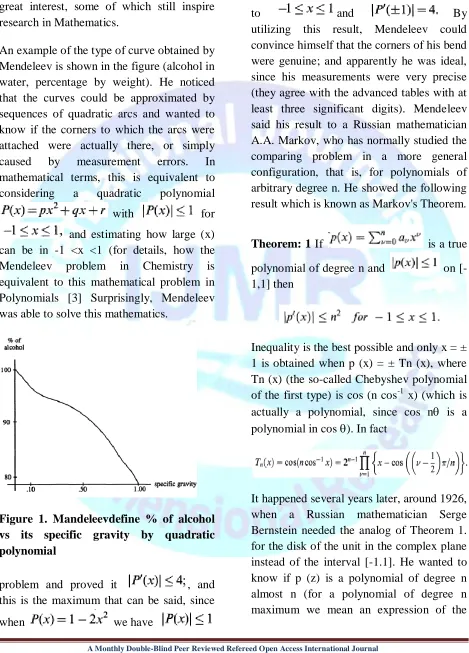
An example of the type of curve obtained by Mendeleev is shown in the figure (alcohol in water, percentage by weight). He noticed that the curves could be approximated by sequences of quadratic arcs and wanted to know if the corners to which the arcs were attached were actually there, or simply caused by measurement errors. In mathematical terms, this is equivalent to considering a quadratic polynomial
with for
and estimating how large (x) can be in -1 <x <1 (for details, how the Mendeleev problem in Chemistry is equivalent to this mathematical problem in Polynomials [3] Surprisingly, Mendeleev was able to solve this mathematics.
Figure 1. Mandeleevdefine % of alcohol vs its specific gravity by quadratic polynomial
problem and proved it , and this is the maximum that can be said, since
when we have
to and By
utilizing this result, Mendeleev could convince himself that the corners of his bend were genuine; and apparently he was ideal, since his measurements were very precise (they agree with the advanced tables with at least three significant digits). Mendeleev said his result to a Russian mathematician A.A. Markov, who has normally studied the comparing problem in a more general configuration, that is, for polynomials of arbitrary degree n. He showed the following result which is known as Markov's Theorem.
Theorem: 1 If is a true
polynomial of degree n and on [-1,1] then
Inequality is the best possible and only x = ± 1 is obtained when p (x) = ± Tn (x), where Tn (x) (the so-called Chebyshev polynomial of the first type) is cos (n cos-1 x) (which is actually a polynomial, since cos n is a polynomial in cos ). In fact
form , a complex variable and
a variable) for what is
max |p`(z)| for . The response to this is given by the accompanying, which is known as Bernstein's inequality [4].
Markov Inequality: The inequality
Holds for every
Bernstein Inequality: The inequality
Holds for every and
In the two previous theorems and in the whole thesis denotes the supreme norm on . The inequalities of Markov and Bernstein in Lp norm are discussed, for example, in Borwein and Erdelyi [5], DeVore and Lorentz [6], Lorentz, Golitschek and Makovoz [7], Nevai [8], Mate and Nevai [9], Rahman and Scmeisser [10], Milovanovic et al. [11], A. Odlyzko and B. Poonen, [12]. The inequalities of Markov and Bernstein have their intrinsic interest. Moreover, many of them play a key role in the reverse approximation theorem test. Markov and Bernstein's inequalities for polynomial classes under various restrictions have attracted several authors. For example, Bernstein [13] noted that Markov's inequality for monotonic polynomials is not
essentially better than that for arbitrary polynomials. He proved that if n is odd, then
This is the story of the classical Markov inequality for the k-th derivative of an algebraic polynomial, and of the remarkably many attempts to provide it with alternative proofs that occurred all through the last century. In our survey we inspect each of the existing proofs and describe, sometimes briefly, sometimes not very briefly, the methods and ideas be-hind them. We discuss how these ideas were used (and can be used) in solving other problems of Markov type, such as inequalities with majo-rants, the Landau–Kolmogorov problem, error of Lagrange interpolation, etc. We also provide a bit of some less well-known historical details, and, finally, for techers and writers in approximation theory, we show that the Markov inequality is not as scary as it is made out to be and over two candidates for the “book-proof” role on the undergraduate level.
2. ZERO OF POLYNOMIALS
obvious on the graph. Complex arrangements contain nonexistent numbers. A fanciful number is a number that equivalents the square base of negative one. The Fundamental Theorem of Algebra expresses that the level of the polynomial is equivalent to the number of zeros the polynomial contains.
2. PROBLEM SOLVING
POLYNOMIALS
The general technique for competition greater than-quadratic polynomials is really direct; however the procedure can be time-devouring. Note: The terminology for this subject is frequently utilized indiscreetly. In fact, one "tackles" an equation, for example, "(polynomial) equals (zero)"; one "finds the roots" of a function, for example, "(y) equals (polynomial)." On this page, paying little mind to how the theme is encircled, the point will be to discover the majority of the answers for "(polynomial) equals (zero)", regardless of whether the inquiry is expressed in an unexpected way, for example, "Discover the foundations of (y) equals (polynomial)".
You can align this with the use of Descartes's Rule of Signs, in the remote possibility you desire, to reduce what conceivable zeros are better to control. In case you have a graphing calculator that you can use, it is not difficult to complete a chart. The x acquisitions of the graph are the same as the zeros (of real value) of the equation. Seeing where the line appears to cross the x-axis can quickly reduce its reduction in imageable zeros that will initially be needed to verify.
3. METHODS TO PROVE MARKOV– BERNSTEIN INEQUALITIES
In mathematical analysis, asymptotic analysis, generally called asymptotic, is a system to describe limiting behavior. As represent, we accept to get involved with the properties of a function f (n) when n ends up being generous. If f (n) = n2 + 3n, for when n ends up being large, the term 3n ends insignificantly appeared differently in relation to n2. It is said that the function f (n) is "asymptotically indistinguishable from n2, as n → ∞". This is usually written symbolically as f (n) ~ n2, which examines how "f (n) is asymptotic to n2".
4. BERNSTEIN TYPE DEGREES FOR POLYNOMIANS WITH ALL THEIR ZEROS IN A CIRCLE
Let's start again with the Bernstein inequality that if p (z) is a polynomial of
maximum degree then
with equality holding for the polynomials
being a complex number.
In case the polynomialp(z) has all its zeros
in then as is evident from
( a complex number) it is not possible to improve upon the bound. Hence
Theorem: 2 If p(z) is a polynomial of degree n, having all its zeros in
then
Here the equality holds for the polynomial
A simple and direct proof of this result was which is as follows.
If is a polynomial
of degree n having all its zeros then
That is,
Where is real. Choosing o such that
we get
from equation in theorem as follows.
The above argument does not hold for K >
1, for then may not be greater than or equal to 1/(1+K).
5. APPLICATIONS
Many practical applications it is important to approximate or recreate a function as a formula from given solid or feeble scattered
data. Imperative examples are space displaying, surface reconstruction, bit based learning or the numerical solution of halfway differential equations and the references there in). There are for the most part two manners by which the reconstruction should be possible, to be specific interpolation and approximation. Application of Bernstein inequalities to analytic geometry, differential equations and analytic functions has been completed. The fundamental objective was to grow new systems where Bernstein inequality can be used to projections of analytic sets and apply this technique to think about bifurcations and periodic orbits.
Kinematics of mechanisms. As already mentioned, this is the point of origin of the theory of the approximation of functions for polynomials or, in general, for functions of various types that depend on different parameters. This is his favourite area and he has drawn his thoughts for several decades. However, it is not the purpose of this article to take into consideration the numerous notes related to this topic.
6. CONCLUSION
In this paper we introduce the Bernstein Markov Property for polynomials in C and some variants concerning weighted polynomials and sequences of ratio-nal functions with restricted poles; we essentially base our exposition. We present these properties also by some examples. Some standard facts in Logarithmic Potential Theory, we establish some convergence results for sequences of Green functions, this will be a tool later. We compare the different Bernstein Markov properties finding out some conditions for the polynomial Bernstein Markov Property to imply the rational one. We give a sufficient condition for a finite Borel measure of compact support to satisfy the rational Bernstein Markov Property on its support. Finally, we give an application of the rational Bernstein Markov Property: we relate the L2 approximation numbers of a given continuous function f to the property of being the restriction to K := supp of a meromorphic function on a certain specific domain related to K, this extends the classical result of Bernstein and Walsh.
REFERENCES
[1]. A. Markov, (1948) On a question by D. I. Mendeleev, ZapiskiImper. Akad. Nauk, 62 (1890), 1–24 = Selected Works, Gostechizdat, Moscow, pp. 51–75 (Russian), both articles are available as pdf-files at HAT [25], together with the English translation by de Boor–Holtz.
[2]. R. P. Boas, (1978)Extremal problems for polynomials, Amer. Math. Monthly, 85, 6, 473–475. [3]. R.P. Boas, (1969), Inequalities for
the derivatives of polynomials, Mathematics Magazine 42 165-174. [4]. S. Bernstein, (1912)Sur L’ordre de
la meilleur approximation des fonctions continues par des polyn6mes de degr6 donn, Memoire de l’Acadmie Royal de Belgique (2) 4,1-103.
[5]. P.B. Borwein,(1985) “Markov's inequality for polynomials with real zeros,” Proc. Amer. Math. Soc.93, 43-48.
[6]. R.A. DeVore and G.G. Lorentz, (1993) Constructive Approximation, Springer-Verlag, Berlin,.
[7]. G.G. Lorentz, M. von Golitschek,
and Y. Makovoz,
(1996).Constructive Approximation, Advanced Problems, Springer, Berlin,
[8]. P. Nevai, (1979) “Bernstein's inequality in Lp, 0 <p< 1,” J. Approx.
Theory27, 239-243.
[9]. A. Máté and P. Nevai, (1980) “Bernstein inequality in Lp for 0 <p<
1, and C, 1) bounds of orthogonal polynomials,” Ann. of Math.111, 145-154.
[10]. Q.I. Rahman, and G. Schmeisser, (1983)LesInégalités de Markoff et de Bernstein, Les Presses de L'Université de Montreal,.
Inequalities, Zeros, World Scientific, Singapore,
[12]. A. Odlyzko and B. Poonen, (1993) “Zeros of polynomials with 0,1 coefficients,” Ens. Math.39, 317-348.