www.ijiset.com
Cooperation of Big data Exploration and
Cloud Service for Rapid and Analogous
Truthful Computing Structure
G. Sumathi1, Dr.S.Rajesh2
1Asst.Prof., Department of IT, Kalasalingam Institute of Technology, Krishnankoil – 626126,
Tamilnadu, India
2 Associate Prof., Department of IT, Mepco Schlenk Engg College, Sivakasi – 626005,
Tamilnadu, India
Abstract— For any cloud computing platform needs high trustworthy service is as the fundamental task. Clients are willing to convey their processing tasks and the most delicate information to cloud server farms, which depends on the trust relationship set up among clients and cloud service providers. In any case, with the improvement of coordinated cloud computing, how to supplier quick reaction for an expansive number of clients' service requests turns into a challenging issue. . So as to rapidly give deeply reliable services, the services stage must productively and rapidly answer countless services demands, also, naturally coordinate make a huge number of services resources. In this unique situation, lightweight and quick trust computing plans turn into the major interest for actualizing a dependable and collaborative cloud. In this paper, we propose a creative and parallel trust computing plan dependent on big data analysis for the reliable cloud service environment. Execution investigation and trial results check feasibility and adequacy of the proposed plan.
Index Terms— Cloud computing, service behavior monitoring, trust computing, big data analysis.
I. INTRODUCTION
The trust processing way to deal with distributed framework security was created as a response to the deficiency of customary approval components. From the client's perspective, building up trust in a cloud situation gives the accompanying two key advantages:
• Enhanced Security. Not the same as
customary authentication system in cyber security, trust instrument can give dynamic behavior seeing ability. Consequently, trust component can take prudent steps against destructive behavior from validated VMs.
• Enhanced Quality of Service (QoS). Through
seeing and mining the constant service behavior, trust mecha-nism can powerfully see QoS of VMs. This can adequately elevate
service resources to give a steady service as indicated by Service Level Agreement (SLA) among clients and suppliers.
Scholars for the most part consider that trust figuring component is viewed as the survival foundation of cloud comput-ing applications [10]. Unique in relation to conventional verification system in system security, trust mecha-nism can give dynamic service conduct seeing capa-bility. Consequently, trust component can take careful steps against harmful service conduct from confirmed service providers in service giving.
From numerous researchers understanding [9]– [12], to expand the appropriation of the coordinated effort cloud services, cloud suppliers should initially set up trust to lessen the stresses of countless users.
In this manner, the new extended trust processing model will contain information that can be imported existing properties (that is, security, availablity, accessibility, and so on.) to shape a multidimensional trust representation [11], So as to rapidly give very reliable service s, the service stage should effectively and rapidly answer a huge number of service demands, and consequently coordinate make a huge number of service resources. In this unique situation, light-weight and quick (fast, low-overhead) trust computing plans turn into the basic interest for executing dependable and distributed cloud service .
Whatever remains of this paper is organized as pursues: Segment II gives a review of related work. Past work is depicted in Area III. Area IV diagrams the subtleties of the proposed framework. Area V is the investigation of execution. At last, Segment VI closes the paper and proposes future headings.
www.ijiset.com
II.RELATED WORK ABOUT CLOUD CHECKING AND TRSUTWORTHY CLOUD SERVICE
Khan and Malluhi [10]have investigated the trust needs in the cloud framework. They break down the issues of trust from what a CU would expect as for their information as far as security and protection. They further examine that what sort of procedure the Cloud Service Providers (CSPs) may embrace to improve the trust of the (Customer User)CU in cloud services and suppliers. They have recognized control, proprietorship, anticipation and security as the key viewpoints that choose CUs' dimension of trust on services. Decreasing control and absence of straightforwardness have distinguished as the issues that reduce the client's trust on cloud frameworks. The creators have anticipated that remote access control offices for resources of the clients, straightforwardness regarding CSPs activities as programmed recognizability facilities, accreditation of cloud security properties and capacities through an autonomous certification authority and giving security enclave to CUs could be utilized to upgrade the trust of CUs in the services.
Singhal et al. [1] proposed proxy based multi-cloud comput-ing structure permits dynamic, on-the-fly coordinated efforts and resource sharing among cloud-based services, tending to trust, approach, and protection issues without reestablished joint effort agreements or standardized interfaces. The creators accentuate that setting up trust among various cloud suppliers to energize coordinated effort, and systems for joint effort over numerous clouds must experience a thorough, inside and out security investigation to distinguish new dangers and concerns coming about because of cooperation. They should have the help of imaginative, efficient, and usable instruments that give powerful security to information and applications. Such security instruments are fundamental for picking up the trust of the overall population and associations in receiving this new worldview.
Shen and Liu [7] proposed Congruity, a proficient and trust-commendable resource sharing stage for community oriented cloud com-puting, which coordinates resource management and reputation management in an agreeable way. Concordance can accomplish improved and joint service of resources and reputation crosswise over
distributed resources in shared distributed
computing. Not the same as the past resMgt and repMgt strategies, Amicability empowers a hub to find its ideal resources and furthermore discover the notoriety of the located resources, with the goal
that a customer can pick resource suppliers by
resource accessibility as well as by the supplier's
notoriety of giving the resource.
Hwang and Li [13]suggested utilizing a trust-overlay network over numerous server farms to actualize a notoriety framework for building up trust between service organizations and information proprietors. The creators fabricate notoriety frameworks utilizing a Distributed hash-table (DHT)- based trust-overlay systems among virtualized server farms and circulated document frameworks. These systems over cloud resources provisioned from different server farms for trust the executives and dispersed security implementation. Information shading and programming watermarking systems secure shared information objects and enormously appropriated programming mod-ules. These procedures protect multi-way confirmations, empower single sign-on in the cloud, and fix get to control for delicate information in both open and private clouds. Hwang and Li[13] just centered around the trust issues of client side, and they didn't make reference to about server-side trust issue.
Fan and Perros [12]propose a trust the board structure for multi-cloud situations, they address the issue of trust the board in multi-cloud conditions utilizing a trust the executives engineering dependent on a gathering of appropriated Trust Service Providers (TSPs). The proposed trust management structure for a multi-cloud condition depends on the proposed trust assessment display and the trust proliferation network.
III.PREVIOUS WORK
There are numerous proficient calculations to help a check component between two system elements, for example, Pretty Good Privacy (PGP)- based signature instrument [12], [13]. Fig. 1 shows the PGP-based signa-ture instrument to help check related issues among MAs and the broker.
Fig. 1. PGP-based signature mechanism that supports verification-related issues between between MAs and the broker.
www.ijiset.com
The PGP-based mark system can carry identity related concerns in a completely self-sorted out way. PGP does not utilize an accreditation expert (AE). Rather, every substance ensures the authoritative of IDs and open keys of different elements. As appeared in Fig. 1, when MAs and the broker trade trust message, the PGP-based mark component can carry honesty checking and message validation. Trustworthiness checking is performed to decide if any changes were made to the sent trust message. Message verification is performed to decide if the trust message has been sent by the MAs that is professing to be the message sender. Every MAs or bro-ker makes its own private-public key combines locally utilizing this PGP-based innovation, and the arrangement of certificates is inserted into the type of PGP certificates [15]. This mech-anism empowers taking an interest MAs to set up their online personality in a totally self-sorted out way utilizing a sig-nature message as the identity qualification in a PGP authentication.
It likewise empowers the certification procedure without depending on any confided in CA. To check trust agents to be hawked or hacked by malicious clients, we can send a confirmation mechanism among operators and the screen to reinforce the security of the trust framework, which can remove the information altering issue. There are numerous effective calculations to help a check component between two system elements, for example, Pretty Good Privacy (PGP)- based mark instrument [15], [14]. PGP-based Verification. Existing framework has some real drawbacks, for example, Compatiblity Issues and No Recovery from cloud datacenters gives less trusted environments.The existing framework has Monitoring Agent, Service resource, Communication and Agent Module are appeared in Fig 1.
IV. PROPOSED SYSTEM
There are 3 key security issues engaged with the proposed trust scheme: (1) there are numerous product agents in the design, which are utilized for detailing checking information. Is it accurate to say that they are reliable or trusted? (2) the establishment of the proposed methodology depends on trusted in practices, and how to guarantee these gathered practices are reliable? (3) what occurs if these practices have altered and how to avert man-in-the-center assault? Following, we will clear up the three key issues, which may keep the effective arrangement of the proposed methodology.
A. Main Idea and Contributions
In a collaborative distributed computing condition, the trust-worthy resource coordinating procedure for the most part comprises of three stages:
(1) Service conduct view of extensive scale service providers in service giving. The checked information establishes a major data set, which is the proof of trust assessment. (2) Trust computing dependent on these huge data set. (3) Automatic resource coordinating dependent on trust estimation of these resources. In this paper, we proposed an inventive and lightweight trust computing plan dependent on big data examination for reliable cloud service condition. By a majority of original plan, the proposed plan can proficiently see service conduct of substantial scale VMs, and rapidly complete the reliability computing of service resources dependent on these expansive scale and real-time seeing information. The key commitments of this paper goes past existing methodologies as far as the accompanying perspectives:
(1)A distributed and measured seeing design for vast scale VMs' service conduct is proposed depending on scattered monitoring agents. Checking operator innovation gives nonconcurrent components that could speak to the best decision for successful observing of cloud [14]. Through appropriated and measured plan, this architecture can rapidly see VMs service conduct in the cloud condition with gigantic system entity.Users can get the service through a chose cloud broker (SETCSB). Giving quick, dependable, and secure service in the fundamental duty of the SETCSB.
(2)Based on substantial scale, continuous, dynamic and multi-dimensional conduct information seen by the scattered agents, a versatile, lightweight and parallel trust computing plan is then proposed. As per the time-decay, this work utilizes an imaginative system with a joining calculation of window mech-anism and time-dacay capacity to compute the trustness of VMs, which can successfully fulfill the precision require-ment of trustworthiness computing. In the meantime, because of the utilization of a blocked and parallel computing instrument, the speed of trust computation is significantly quickened, which makes this trust computing plan is entirely reasonable for huge scale distributed computing condition.
www.ijiset.com
B.SERVICE BEHAVIOR PERCEIVING ARCHITECTURE
As indicated by the meaning of service conduct based trust relationship [9], a cloud client will believe a cloud service resource (or service
provider) if the cloud broker expresses that the
cloud service resource will complete the client's tasks as per the SLA agreement between the client
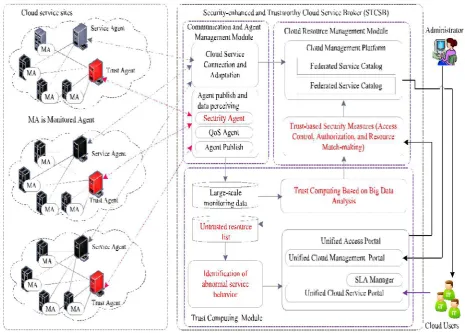
and the service provider. Agents in the proposed architecture are dispersed and sensible substances that have a few abilities, for example, service conduct checking, substantial scale observing information pre-preparing, reat-time trust degree mining, trust-based access control and approval, etc. Fig 2 demonstrates the SETCSB design
Fig. 2. Security-enhanced and trustworthy cloud service Broker (SETCSB) architecture.
If the cloud broker expresses that the cloud service resource will finish the client's tasks as per the SLA agreement among the client and the
service provider. Agents in the proposed design are
appropriated and sensible elements that have a few abilities, for example, service conduct checking, substantial scale observing data pre-handling,
real-time trust degree mining, trust-based access control
and approval, etc.
C. The Main Function Modules
In this paper, we utilize a measured design to screen huge scale VMs' service conduct dependent on dispersed checking agents. Through appropriated and isolated plan, this architecture can rapidly see VMs service conduct in the cloud environ-ment with enormous system substances.
Clients can acquire the service through a chose cloud broker (SETCSB). Giving quick, reliable, and secure service in the primary task of the SETCSB. Additionally, this architecture is a security-improved cloud ser-vice broker. The effect of trust computing can be utilized for trust-based safety efforts, for example, access control, approval, and resource coordinate making. As appeared in Fig. 1, security-enhanced and
trustworthy cloud service broker (SETCSB) is
comprised by three core modules:
Communication and agent management module,
which has two fundamental capacities: cloud service association and adapta-tion, and agent based information perceiving. The cloud service association and adjustment sub-module is utilized
www.ijiset.com
to gather and record all resource data from various suppliers.
Cloud resource management module. Through the
feder-ated service index, this module stores all accessible and dependable services from which it can consequently choose extremely trustworthy services to meet client's requirements.
Trust computing module. This module is not only the core of the dependable distributed computing framework, but on the other hand is a key focal point of this paper. Utilizing this module, the trust com-puting framework can progressively sort superior service resources by analyzing real-time
service conduct checked by the distributed agents.
D. Security and QoS-Based Trust Behavior
As an integral innovation with security, trust tackles the issue of giving comparing access control dependent on making a decision about the
quality of services, and it makes the conventional
security benefits more robust and reliable by guaranteeing that all the imparting hubs are trusted during verification, approval, or key service.
From the perspective of security upgrading and QoS guar-anteeing, based on [11] and 15], we principally focus around two sorts of trust characteristics of cloud service conduct, which comprises of security-related conduct and QoS-related behav-ior. The security-QoS-related conduct
incorporates four trust
indi-cators: the authentication type, the authorization type, the self-security competence
and the number of malicious access. The
QoS-related conduct comprises of the present CPU uti-lization rate, memory utiuti-lization rate, hard disk utilization rate, average response time and average
task success ratio. Therefore, the pointer
arrangement of trust cloud service is comprised of 9 individuals, which is reviewed in Table I.
TABLE I SECURITY AND QOS
ATTRIBUTORS
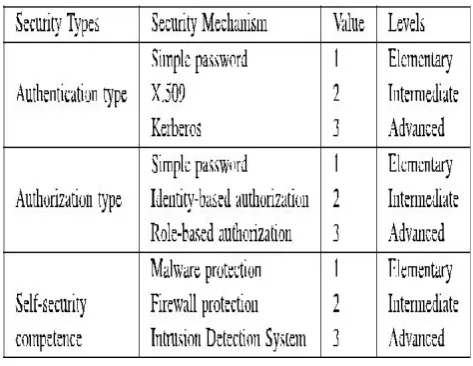
In Table I, s1, s2, s3 and s4 mirror the security limit of an resource. The validation type s1 is checked dependent on the confirmation component. The approval type s2 is checked dependent on the kind of approval system. The self-security fitness s3 is confirmed by the security production system. The quantity of malicious access s4 is the quantity of unlawful access or filtering of sensitive ports.
To speed up perceiving and pre-handling
speed of these trust conduct markers, we have
conveyed two kinds of delicate product agents: SMAs (security monitoring agents) and QMAs (QoS monitoring agents). SMAs are in charge of gathering security-related conduct information, for example, the confirmation type, the approval type, the self-security fitness and the quantity of malicious access.
Referring to [15], the values for s1, s2, and s3 could be characterized as positive whole numbers 1, 2, or 3 (Table II), reflecting basic, middle, and propelled security levels, individually. It is underscored that rather than the above positive whole numbers 1, 2, or 3, we can utilize some other number that has the property of reflecting a relative quality relationship among security levels. Our decision of the above settings is there for simplicity
of understanding and estimation.
TABLE II
SECURITY LEVEL EVALUATION
QMAs (QoS monitoring agents) are in charge of gathering and pre-preparing QoS-related conduct information, the vast majority of which are
www.ijiset.com
the roundabout trust markers, and need estimation and pre-handling.
E. TRUST COMPUTING BASED ONBIG DATA
ANALYSIS
In a shared cloud application condition, there are a huge number of administration resource, a huge number of clients and a huge number of service observing information. Consequently, how to rapidly and naturally forms and breaks down cloud service conduct in such a cloud domain with gigantic net-work elements is a key assignment of this work. As per the time-decay ,this work utilizes a creative instrument with a joining calculation of
time-window component and time-decay capacity to register the reliability of VMs, which can adequately fulfill the precision necessity of
trustworthiness computing. At the same time,
because of the utilization of a blocked and parallel
computing method, the speed of trust count is
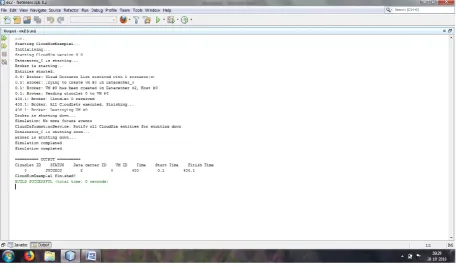
incredibly quickened, which makes this trust computing plan is truly reasonable for expansive scale distributed computing condition. CloudSim tool is utilized for the simulation of cloud condition. It represents demonstrating and reproduction of substantial scale distributed computing server farms and supports re-enactment of virtualized host [8].
Figure 3: Data Centre Creation
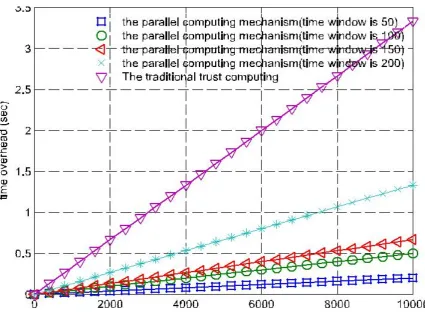
In conventional trust computing plans, if n → ∞, at that point the speed of the trust total estimation will turn out to be moderate. In this work, we utilize a blocked and parallel computing component, the speed of trust computation is enormously quickened, which makes this trust processing plan is entirely appropriate for expansive scale distributed computing environment.We looked at the proposed blocked and parallel computing scheme and the conventional trust com-puting. Under the four states of the time window changing from 50 to 200,
the proposed blocked and parallel computing component requires less calculation time. Utilizing the proposed blocked and parallel computing scheme, the time overhead is step by step decreased with the time window developing. Since the proposed trustworthiness computing system has quicker computation speed than the conventional non-parallel computing scheme, the proposed blocked and parallel computing scheme is reasonable for huge scale trusted information examination in the collective distributed computing condition,Fig 4 shows the test window uppdation based on windows
www.ijiset.com
Fig. 4. Trust value updating based on time window.
V.PERFORMANCE ANALYSIS
In this segment, we initially depict how to set up the exper-imental strategy in a genuine cloud condition, including how to convey the proposed trust scheme on the Eucalyptus-based condition and how to set the experiment configura-tions. At that point, the exploratory outcomes are reported.
A. Computational Efficiency
This work is the first to give a lightweight and parallel trust computing plan dependent on big data analysis for trust-based cloud service. Because of the speed of trust estimation is enormously quickened, which makes this trust computing plan is truly appropriate for expansive scale distributed computing condition. To our best information, at present there is few of a similar sort of work which can be utilized for comparative analysis with this work
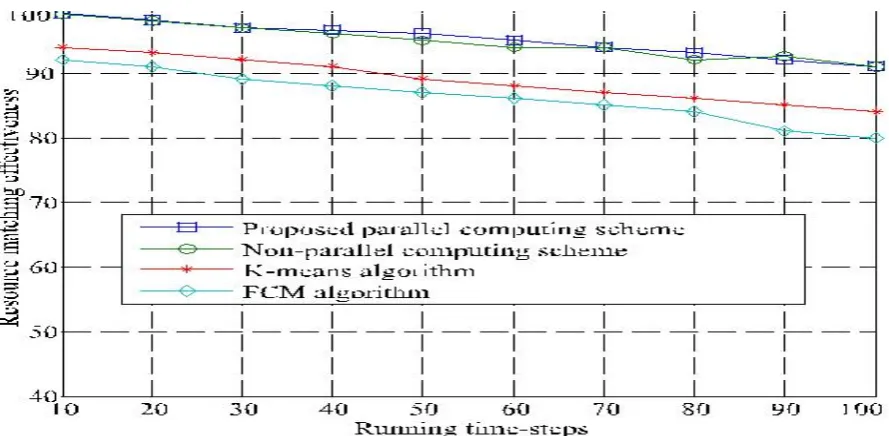
Fig. 5 demonstrates the RMSR examination for four trust computing plans. In trials, the total number of resources (VMs) is 100. Three sorts of client's activity are con-sidered, (1) the total
number of users'job is 30, (2) the total number of users'job is 50, and (3) the total number of users'job is 80. Fig. 5 reflects a circumstance with little system load, where the quantity of accessible resource is a lot more greater than the quantity of clients' activity. In this circumstance with little system load, each of the three trust-based resource matchmaking plan have generally great RMSR for resource matchig, which their normal RMSRs are past 86%. The trial results in Fig. 5 reflects that the four plans can successfully com-plete trust-based resource matchmaking tasks in circumstance with little system load. Further examining the outcomes in Fig. 5, the RMSRs of the parallel figuring plan is 96.15%, the non-parallel registering plan calculation is 96.25%, K-means calculation is 87.44%, and FCM calculation is 86.22%. The normal RMSRs of the proposed plan and non-parallel processing plan have nearly a similar value, which reflects the proposed plan has an incredible execution with little system load.
www.ijiset.com
Fig 5:Fast and Parallel Computing Scheme
A good resource matchmaking plan can sig-nificantly enhance the achievement rate of resource
matching. But, it doesn't tackle the issue of absence
of service resources. The cooperative distributed computing stage is which interconnects the physical resources that permit sharing the resources among clouds and suppliers with large measure of resources to clients. At the point when a cloud supplier doesn't have adequate resources then it will utilize resource structure different clouds which they need, which is the appeal of the colloborative cloud computing environment.
VI. CONCLUSION
As a corresponding innovation with conventional security instrument, trust tackles the issue of giving corresponding access control dependent on making a decision about the service conduct, and it makes the conventional security benefits increasingly powerful and solid by guaranteeing that all the conveying hubs are trusted during confirmation, approval, or key administration.
In this work, depending on distributed and
intelligent agents, we proposed an imaginative plan
for security and QoS-related trust conduct perceiving and mining. By a plural-ity of original structure, the proposed plan can proficiently per-ceive service conduct of extensive scale virtual machines (VMs), and rapidly complete the
trustworthiness computing of service resources
dependent on these continuous perceiving information. Execution investigation and test
results checked attainability and adequacy of the proposed plan.
However, key research directions could in any case be investigated top to bottom in the future. To begin with, assessing our proposed framework on different cloud collective service condition, for example, distributed information sharing and remote computing, is a key directions for future research. Another direction is the strategy to compute the trust estimation of cloud resources with various estimation of the time window.
REFERENCES
[1] M. Singhal et al., “Collaboration in multicloud computing environments: Framework and security issues,” Computer, vol. 46, no. 2, pp. 76–84, 2013.
[2] D. Niyato, Z. Kun, and P. Wang, “Cooperative virtual machine manage-ment for multi-organization cloud computing environment,” in Proc. Int. Workshop Game Theory Commun. Netw. (Gamecomm), Paris, France, May 2011, pp. 528–537.
[3] Y. Demchenko, M. X. Makkes, R. Strijkers, and C. de Laat, “Intercloud architecture for interoperability and integration,” in Proc. IEEE 4th Int. Conf. Cloud Comput. Technol. Sci. (CloudCom), vol. 1. Dec. 2012,
pp.666–674.
[4] M. Shojafar, N. Cordeschi, and E. Baccarelli, “Energy-efficient adap-tive resource management for real-time vehicular cloud services,” IEEE Trans. Cloud Comput., to be published, doi: 10.1109/TCC.2016.2551747.
[5] I. Butun, M. Erol-Kantarci, B. Kantarci, and H. Song, “Cloud-centric multi-level authentication as a service for secure public safety device networks,” IEEE Commun. Mag., vol. 54, no. 4, pp. 47–53, Apr. 2016.
[6] H. F. Mohammadi, R. Prodan, and T. Fahringer, “A truthful dynamic workflow scheduling mechanism for commercial multicloud envi-ronments,” IEEE Trans. Parallel Distrib. Syst., vol. 24, no. 6,
pp.1203–1212, Jun. 2013.
[7] F. Paraiso, N. Haderer, P. Merle, R. Rouvoy, and L. Seinturier, “A fed-erated multi-cloud PaaS infrastructure,”
www.ijiset.com
in Proc. 5th IEEE Int. Conf. Cloud Comput. (CLOUD), Jun. 2012, pp. 392–399.
[8] H. Shen and G. Liu, “An efficient and trustworthy resource sharing platform for collaborative cloud computing,” IEEE Trans. Parallel Distrib. Syst., vol. 25, no. 4, pp. 862–875, Apr. 2014.
[9] X. Li, H. Ma, F. Zhou, and W. Yao, “T-broker: A trust-aware service brokering scheme for multiple cloud collaborative services,” IEEE Trans. Inf. Forensics Security, vol. 10, no. 7, pp. 1402–1415, Jul. 2015.
[10] K. M. Khan and Q. Malluhi, “Establishing trust in cloud computing,” IT Prof., vol. 12, no. 5, pp. 20–27, 2010. [11] X. Li, H. Ma, F. Zhou, and X. Gui, “Service
operator-aware trust scheme for resource matchmaking across multiple clouds,” IEEE Trans. Parallel Distrib. Syst., vol. 26, no. 4, pp. 1419–1429, May 2014, doi: 10.1109/ TPDS.2014.2321750.
[12] W. Fan and H. Perros, “A novel trust management framework for multi-cloud environments based on trust service providers,” Knowl.-Based Syst., vol. 70, pp. 392– 406, Nov. 2014.
[13] K. Hwang and D. Li, “Trusted cloud computing with secure resources and data coloring,” IEEE Internet Comput., vol. 14, no. 5, pp. 14–22, Sep./Oct. 2010. [14] H. Kim, H. Lee, W. Kim, and Y. Kim, “A trust evaluation
model for QoS guarantee in cloud systems,” Int. J. Grid Distrib. Comput., vol. 3, no. 1, pp. 1–10, Mar. 2010. [15] P. D. Manuel, S. T. Selvi, and M. I. A. El Barr, “Trust
management system for grid and cloud resources,” in Proc. 1st Int. Conf. Adv. Comput. (ICAC), Dec. 2009, pp. 176–181.