Scholarship@Western
Scholarship@Western
Electronic Thesis and Dissertation Repository
5-11-2015 12:00 AM
Standing For Something Not Present: Contested Representations
Standing For Something Not Present: Contested Representations
in Contemporary Art
in Contemporary Art
Trista E. Mallory
The University of Western Ontario
Supervisor Dr. Bridget Elliott
The University of Western Ontario
Graduate Program in Art and Visual Culture
A thesis submitted in partial fulfillment of the requirements for the degree in Doctor of Philosophy
© Trista E. Mallory 2015
Follow this and additional works at: https://ir.lib.uwo.ca/etd
Part of the Contemporary Art Commons, Theory and Criticism Commons, and the Visual Studies Commons
Recommended Citation Recommended Citation
Mallory, Trista E., "Standing For Something Not Present: Contested Representations in Contemporary Art" (2015). Electronic Thesis and Dissertation Repository. 2892.
https://ir.lib.uwo.ca/etd/2892
This Dissertation/Thesis is brought to you for free and open access by Scholarship@Western. It has been accepted for inclusion in Electronic Thesis and Dissertation Repository by an authorized administrator of
STANDING FOR SOMETHING NOT PRESENT: CONTESTED REPRESENTATIONS IN CONTEMPORARY ART
Thesis format: Monograph
by
Trista Elizabeth Mallory
Graduate Program in Visual Arts
A thesis submitted in partial fulfillment of the requirements for the degree of
Doctor of Philosophy
The School of Graduate and Postdoctoral Studies The University of Western Ontario
London, Ontario, Canada
ii
Abstract
This dissertation looks at the limits and possibilities for the representation of political
conflicts in the Middle East through the work of three contemporary artists: Emily Jacir, Eric
Baudelaire, and Jafar Panahi. Situated within a moment of increasing uncertainty and global
unrest evidenced by the continuing involvement of the United States in various wars in the
Middle East, the rise of new terrorist formations like ISIS, and the ongoing geopolitical
struggle between Israel and Palestine, to name but a few examples, three interrelated
questions are taken up in this study: Given the increasing pressure placed upon truth claims
and the documentary image, how can we reassess modes of signification and representation
to redeploy them within our contemporary moment? What is necessary to make intelligible
political positions that are traditionally kept outside of the political and representational
realm, as is the history and demands of terrorist groups? How might we think through the
relationship between specific material histories and the politics of representation?
With these questions in mind, chapter one looks at Emily Jacir's Material for a Film
(2005-ongoing) and Material for a Film (Performance) (2006) which represents the history
of Wael Zuaiter, a Palestinian assassinated in 1972. I argue that Jacir’s works engage with
the propagandistic modes of representing the Palestinian struggle utilized in the 1970s by
producing a material and narrative challenge to these modes. I contend that she accomplishes
this by producing a ‘filmic installation’ that upsets the linear narrative of historical writing
and the closed narrative arc of traditional documentary film.
Chapter two further investigates the linearity of historical narrative, documentary
representation, and fragmented archival accounts through Eric Baudelaire’s installation and
iii
images (2011), a project which struggles over how to represent the history of the Japanese
Red Army’s participation with the Palestinian Liberation Organization in a series of terrorist
attacks. Rather than settling on one historical account, which could be read as sympathetic
support or damning condemnation, I argue that Baudelaire instead produces three modes of
historical explanation in order to shift his viewer’s focus toward the register of
representational possibilities.
Chapter three pursues the question of censorship through Jafar Panahi's This is not a
Film (2011). Made in Iran while Panahi was confined to house arrest and smuggled out in a
USB drive hidden in a cake, I contend that Panahi puts his own oeuvre at the crux of his
negation of film by creating an argument in This is Not a Film through appropriated footage
from, and commentary on, his previous work.
The three chapters of my dissertation elaborate on my theoretical questions through a
close engagement with the work. As each artist struggles over the terms of representing
fraught political and material histories, I analyze the social and political stakes of their
engagement with new narrative and representational modes.
Keywords
iv
Acknowledgments
This dissertation is dedicated to the women in my family. It is among their strong voices that
I have found my place in the world.
Many thanks to Bridget Elliott for mentoring me through the early stages of the
program, for guiding me through my first teaching experiences with warmhearted advice and
support, and for her generosity and criticism through the process of writing this dissertation.
Many thanks also to my committee, Sarah Bassnett, Kirsty Robertson and Joy James for their
careful reading and thoughtful comments. Thanks also to Tony Purdy, Susan Schupili, and
Christine Sprengler who informed the early stages of this project with much wit and
curiosity. I’m grateful to Jenn Orpana and Stephanie Radu who helped me keep one foot in
Canada while living in the States; along with Janice Gurney, Andy Patton and Corinna
Ghaznavi they have been exemplary peers. To Paula Dias, Marlene Jones and Sandy
Leboldus, thanks for your hard work and for your advice in navagating the administrative ins
and outs of the University.
Many thanks to Emily Jacir and Eric Baudelaire for sharing unpublished material and
generously talking me through their work. They have been an inspiration and have
challenged my thoughts in the formulation of this dissertation. I’m grateful to Joan Young,
curator at the Guggenheim, New York for talking through the hanging of Jacir’s show for the
Hugo Boss Prize and for giving me access to the exhibitions folders before they went into the
archive. Ted Bonin and Kathryn Gile at Alexander and Bonin have been tremendously
helpful in providing me with documentary material for Emily Jacir’s work and I’m grateful
to Tim Saltarelli, Robert Leckie, and Julian Ross for material on Baudelaire’s exhibition at
v
I owe a great debt of gratitude to Ron Clark for many generous and challenging
conversations during my year at the ISP and in the years following. Much appreciation to my
ISP adviser, Emily Apter, and to my peers and the extended ISP community of fellows and
teachers for their exacting questions and engaging conversations, especially Tom Ackers,
Lindsay Caplan, Alex Fletcher, Park McArthur, and Kristina Scepanski, Aliza Shvarts and
Angel Szymanek.
Jen Kennedy has supported me in every way imaginable since we met at Binghamton
University and has read through my work countless times with tireless generosity and
enthusiasm, there are not enough words of thanks.
I want also to thank the incredible women in my dissertation writing group in San
Francisco: Anne Gross, Katie Harper, Serena Le and Carrie Ritter who welcomed me into
their community at Berkeley and lent much needed support and camaraderie through the last
months of writing and who continue to be a constant source of inspiration. I’m tremendously
lucky to have an extended family: Allison Applebaum, Stanley Applebaum, Nancy Gort, Liz
Park and Maria Rapicavoli, all of whom have supported me and nurtured me, and have
worked together to keep me afloat over these last months.
And finally thanks to Chris Glazowski, without his support and unshakable belief I
vi
Table of Contents
Abstract ... ii
Acknowledgements ... iv
Table of Contents ... vi
List of Figures ... vii
Introduction ...1
Chapter 1. Watching Photographs: Material for a Film ...27
Chapter 2. Grounds and Landscapes: The Anabasis of a Film ...80
Chapter 3. A Film is no Substitute for Anything ...137
Conclusion ...184
Selected Bibliography ...191
vii
List of Figures
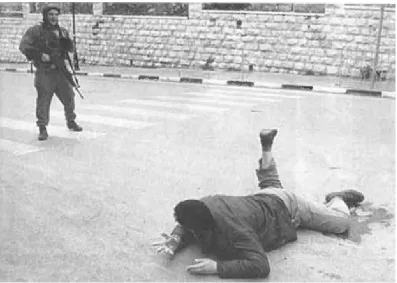
Figure 1 Alex Levac, Hebron, 2000. ... 36
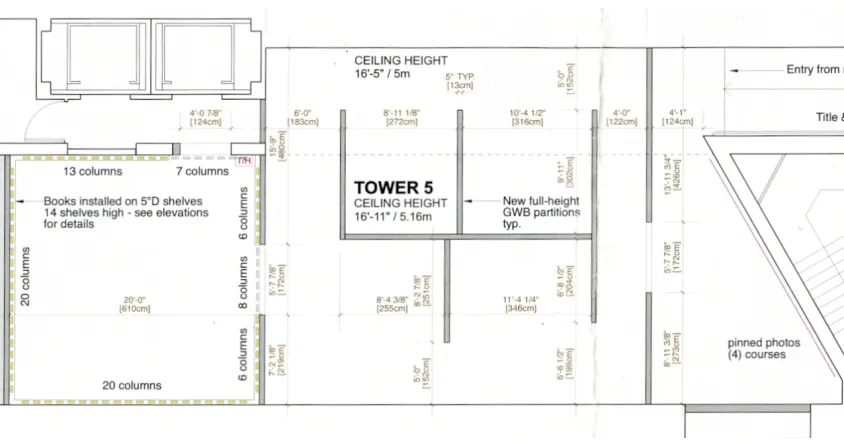
Figure 2 Floor plan for Emily Jacir’s exhibition at the Guggenheim Museum, New York,
2009... 44
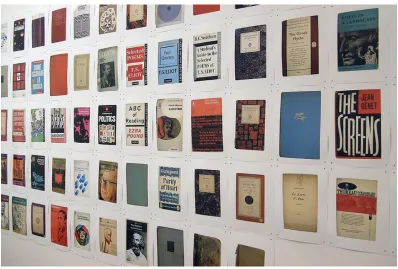
Figure 3 Emily Jacir, Material for a Film (Performance), installation detail, 2009. Photo:
Greg Weight. Courtesy Alexander and Bonin and the artist. ... 45
Figure 4 Material for a Film, installation detail, 2009. Courtesy Alexander and Bonin and the
artist... 46
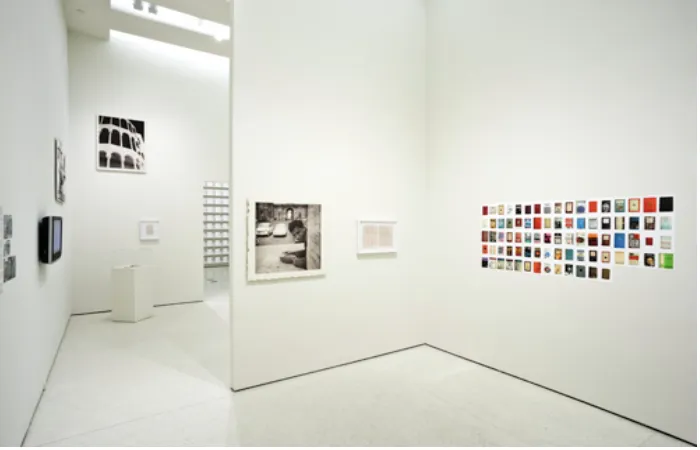
Figure 5 Material for a Film, installation view, 2009. Courtesy Alexander and Bonin and the
artist... 47
Figure 6 Material for a Film and Material for a Film (Performance), installation view, 2009.
Courtesy Alexander and Bonin and the artist. ... 51
Figure 7 Material for a Film (Performance), installation detail, 2009. Courtesy Alexander
and Bonin and the artist. ... 52
Figure 8 Material for a Film, installation view, 2009. Courtesy Alexander and Bonin and the
artist... 55
Figure 9 Material for a Film, installation view, 2009. Courtesy Alexander and Bonin and the
artist... 57
Figure 10 Material for a Film, installation view, 2009. Courtesy Alexander and Bonin and
viii
Figure 11 Eric Baudelaire, The Dreadful Details (2006), installation view courtesy the artist.
... 84
Figure 12 Eric Baudelaire, Sugar Water (2007), installation view courtesy the artist. ... 86
Figure 13 Eric Baudelaire, Circumambulation (2007), installation view courtesy the artist. 88
Figure 14 Eric Baudelaire, Chanson D’Automne, detail, courtesy the artist. ... 96
Figure 15 Eric Baudelaire, The Anabasis of May and Fusako Shigenobu, Masao Adachi and
27 years without images, installation view at Gasworks, London, courtesy the artist. ... 98
Figure 16 Eric Baudelaire, The Anabasis of May and Fusako Shigenobu, Masao Adachi and
27 years without images, installation view at Gasworks, London, courtesy the artist. ... 100
Figure 17 Eric Baudelaire, The Anabasis of May and Fusako Shigenobu, Masao Adachi and
27 years without images, installation view at Gasworks, London, courtesy the artist. ... 102
Figure 18 Eric Baudelaire, The Anabasis of May and Fusako Shigenobu, Masao Adachi and
27 years without images (2012) video still. ... 118
Figure 19 Eric Baudelaire, The Anabasis of May and Fusako Shigenobu, Masao Adachi and
27 years without images (2012) video still. ... 118
Figure 20 Eric Baudelaire, The Anabasis of May and Fusako Shigenobu, Masao Adachi and
Introduction
Since the events of September 11 2001, the subsequent US invasion of Iraq and
Afghanistan, the emergence of information regarding US prisons and torture, the
bombings in Madrid and London, the popular uprising of the Arab Spring, the ongoing
military conflicts in Syria, and the emergence of ISIS, there have been attempts to map
the space of conflict through documentary means.1 However, along with the emergence
of such attempts, recent digital transformations have facilitated the manipulation of
photographs and digital videos, some of which already often require experts to read: for
example the kind of aerial views that are produced by heat-sensing and drone cameras.
Hence, the notion of “truth” has been placed into crisis in the realm of images and
narrative, raising concerns that the images presented to us as evidence might have been
manipulated either materially or discursively, a claim which generates uncertainties about
how they are being mobilized discursively within such a fraught geopolitical landscape.2
1 I do not want to claim that this is the only period of crisis historically, nor that its use of images is wholly
unique – photography and documentary have developed historically alongside political crises. Instead I want to stress that our contemporary moment is one that seems to engage in documentary on a different scale. Along with the archival turn which has led to institutional support for documentary practices in an unprecedented way, there have also been shifts in technology, which have allowed citizens to become ‘witnesses’ and ‘filmmakers’ with their mobile devices, and have their media snippets circulate through the internet to a world wide audience within moments of their capture. For more on the attacks in London and Madrid, see ft. nt. 165 below.
2 Indeed Stephen Cobert coined the phrase “truthiness” during the pilot episode for political satire
The political use-value of the documentary image has surged. Despite the destabilization
of the truth claims of documentary practices, artists and curators have continued to
experiment with documentary. As Michael Renov observes, “If there is a consensus
emerging among the newest generation of documentary scholars, it may just be that
representations of the real have more rather than less power to shape our world.”3 The
sites for viewing documentary images have also expanded to include 24-hour cable TV
news, various news outlets and social media interfaces on the Internet that the
proliferation of hand-held devices has made more ‘mobile’, subway posters and
billboards in urban centers, as well as exhibitions within museums and galleries.
In the last year alone, major museums in New York and Bologna mounted
exhibitions on the intersections between art and politics in the Middle East. The titles of
these exhibitions, Here and Elsewhere4 and Trop tôt/ Trop Tard. Middle East and
Modernity5, pay homage to French avant-garde films that interrogate the politics and
know intuitively "from the gut" in that it "feels right" without regard to evidence, logic, intellectual examination, or facts. (See http://www.cbsnews.com/stories/2006/12/12/opinion/meyer/main2250923.shtml
and http://www.colbertnation.com/the-colbert-report-videos/24039/october-17-2005/the-word---truthiness. (both accessed 18 November 2009).
3 Michael Renov, “Documentary Horizons: An Afterward,” in Collective Visible Evidence, ed. Jane M.
Gaines and Michael Renov, (Minneapolis: University of Minnesota Press, 1999), 324.
4 At the New Museum in New York from 16 July until the 28 of September 2014, it exhibited the works of
45 contemporary artists from the Arab world.
5 At the Pinacoteca Nazionale di Bologna from 22 January until the 12 April 2015. The exhibition is
political limitations of representation.6 The issues raised by these exhibitions dovetail
with three interrelated questions: given the increasing pressure placed upon truth claims
and the documentary image, how can we reassess modes of signification and
representation to redeploy them within our contemporary moment? What is necessary to
make intelligible political positions that are traditionally kept outside of the political and
representational realm, as is the history and demands of terrorist groups? How might we
think through the relationship between specific material histories and the politics of
representation?
The exhibitions are also engaged specifically with the return to theories and
modes of representation developed in the 1960s and 1970s in contemporary art.7 Between
the two films, and by extension between the two exhibitions that refer to them, there is an
attempt to map the spatial (Here and Elsewhere) and temporal (Too early, Too late)
coordinates of representation with regard to the writing of historical narratives.8 What are
6
Ici et Ailleurs (1976) by Jean-Luc Godard, Jean-Pierre Gorin, and Anne-Marie Miéville, and Trop tôt/ Trop Tard (1982)by Jean-Marie Straub and Danièle Huillet.
7 The theories I have in mind are specifically those of the Birmingham School of Cultural Studies
developed throughout the 60s and 70s. This group brought together theories of feminism, psychoanalysis, structuralism, and Marxism. The work of Stuart Hall and Raymond Williams has been particularly useful for me. Other influences include the back and forth in the pages of the British film journal Screen Magazine
and its French counterpart Cahiers du cinema.
8 How you make the East and West representationally available has been a growing area of inquiry by
artists and scholars, it encompasses discussions about who has the right to speak on behalf of another culture and questions around blockages of language and vision (translation and opacity). See, for instance, Gayatri Spivak, “Can the Subaltern Speak?” in Marxism and the Interpretation of Culture, eds. Cary
Nelson and Lawrence Grossberg, (London: Macmillan, 1988), 271-313, Edward Said, Culture and
Imperialism (New York: Vintage Books, 1994) and Power, Politics, and Culture, ed. with an intro by Gauri
Viswanathan, (New York: Vintage Books, 2001), Édouard Glissant, “For Opacity” in Over Here: International Perspectives on Art and Culture, eds., Gerardo Mosquera and Jean Fisher, (New York and
the narrative structures available to us for the retelling and representing of contested
histories? If we forego a linear historical narrative, how do we make sense of a
scrambling of temporalities within history?9 This dissertation focuses on projects by three
artists who work through these questions using photographs, installation and film to
address the politics of representation in the Middle East: Emily Jacir’s Material for a
Film (2005-ongoing) and Material for a Film (Performance) (2006), Eric Baudelaire’s
The Anabasis of May and Fusako Shigenobu, Masao Adachi and 27 years without images
(2008-2012), and Jafar Panahi’s This is Not a Film (2011). Each of the works under
consideration explore the political crisis they aim to represent through material and
formal experiments — in other words, the form is crucial to their political content.10 This
emphasis on the material and formal quality of the work is not simply descriptive. My
overarching argument here is that without looking closely at the form and material that
comprise these works, we miss out on the heart of their political and representational
intervention. This dissertation then, is an investigation into the way the contextual,
material and formal qualities of a work fundamentally structure what it is that is
represented and how this representation can be understood.11 Before moving on to a
longer discussion of the works and theories I take up, I first want to look at the examples
Zone: A New Comparative Literature (Princeton: Princeton University Press, 2005), as well as Walid
Raad’s ongoing project The Atlas Group.
9 Laura Mulvey takes this question up slightly differently in her book Death 24x a Second (London:
Reaktion Books, 2006).
10 Peter Wollen, “’Ontology’ and ‘Materialism’ in Film” and “The Two Avant-gardes” in
Readings and Writings, (New Left Books, 1982), 189-207, 92-104.
11 Stuart Hall, “The rediscovery of ‘ideology’: return of the repressed in media studies” in Culture, Society
of the exhibitions of Here and Elsewhere and Trop tôt/ Trop Tard in order to better
understand why this question of representation has become important again in art history.
Certain Resemblances: Here and Elsewhere and Trop tôt/Trop
tard
Here and Elsewhere and Trop tôt/Trop tard are not the only recent exhibitions on
contemporary art in the Middle East — there have been numerous examples of these in
the past decade.12 And certainly these two exhibitions only represent a handful of artists
who are working in this context.13 However, they draw attention to a series of questions
about representation and historical narrative that I take up in this dissertation and they
perform a political maneuver that is also at work in the artist’s projects I consider, namely
the exhibitions look at contemporary politics of representation using historical theories of
representation developed in the 1970s.
Here and Elsewhere, curated by Natalie Bell and Massimiliano Gioni, does this
through reference to the Dziga Vertov Group’s 1976 film Ici et Ailleurs (Here and
Elsewhere), a film which had two moments of making. First, in 1970, Jean-Luc Godard
and Jean-Pierre Gorin were commissioned by the Information Service Bureau of Fatah to
12 Other exhibitions include: Contemporary Arab Representations. Beirut/London, (2002-2003) at Witte de
With, Rotterdam, Fundació Antoni Tàpies, Barcelona and BildMuseet, Umeå, DisORIENTation: Contemporary Arab Art Production from the Near East, Egypt, Palestine, Lebanon, Jordan, Syria and Iraq, (2003) at the Haus der Kulturen der Welt, Berlin, Without Boundary: Seventeen Ways of Looking,
(2006) Museum of Modern Art, New York, Tarjama/Translation: Contemporary Art from the Middle East, Central Asia, and Their Diasporas, (2009) Queens Museum, New York, Light from the Middle East: New Photography, (2012-2013) Victoria and Albert Museum, London, Safar/ Voyage: Contemporary Works by Arab, Iranian, and Turkish Artists, (2013) Museum of Anthropology, University of British Columbia,
Vancouver.
13 Indeed there are a number of artists who are represented in both exhibitions: Kader Attia, Khaled Jarrar,
make a film about the group’s dedication to the liberation of Palestine through armed
struggle.14 Godard and Gorin went to Palestine, Lebanon, Jordan and Syria over the
summer of 1970 and filmed Palestinian fedayeen as they trained for guerrilla warfare.15
The film they were making was to be called, Jusqu’àla victorie: Méthodes de pensée et
de travail de la revolution palestinienne (Until Victory: Thinking and Working Methods
of the Palestinian Revolution). In September of 1970 hopes for Palestinian victory were
swept away in the wave of raids and attacks on Palestinian refugee camps authorized by
King Hussein of Jordan.16 Since the footage Godard and Gorin shot in the autumn
depicted the bodies of those killed in these attacks, the film could no longer be about
Palestinian victory.
The second moment for this film came three years later in 1973, when Godard
took it up again in collaboration with Anne-Marie Miéville. The devastation of
September 1970, followed by other catastrophes for the Palestinians, called for a different
kind of film: Ici et Allieurs incorporates the original footage from Syria, Lebanon and
Jordan with new footage filmed in Grenoble in 1974. The film shifts back and forth —
here, France, elsewhere, the Arab world — and through the use of intertitles, news
footage, and a deeply reflexive narrative voiceover, it investigates what these spaces are
14 Fatah - formerly the Palestinian National Liberation Movement - founded as a political movement in
1959, as a party in 1965 and led by Yassir Arafat until his death in 2004.
15 For other attempts to represent this moment see Masao Adachi’s film Sekigun-P.F.L.P: Sekai senso
sengen (Red Army/PFLP: Declaration of World War, 1971), which I discuss in chapter 2 and also Jean
Genet, Prisoner of Love, translated by Barbara Bray, introduction by Ahdaf Soueif, (New York: New York
Book Review, 1986).
16 For an account of this shift in politics see Edward Said, “The Question of Palestine” and “Toward
Palestinian Self-Determination” in The Question of Palestine (New York: Vintage Books Edition, 1992)
and how they are formed politically, discursively, representationally. But the footage’s
temporal lag — shot for one film, used in another — is equally important in the
conception of what this film does for the history of documentary. No longer able to
support the historical narrative of Palestinian victory, Godard and Miéville ruminate
throughout Ici et Allieurs on how the earlier footage is now marshaled to tell a different
story. In other words, at the heart of the film is an investigation into the representational
capacities of film for a historically fraught reality.
Here and Elsewhere at the New Museum takes its title from Godard and
Miéville’s temporal and spatial collage created in the wake of Jordan’s expulsion of the
Palestinians.17 Bell and Gioni state that they aim to exhibit the work of artists who “share
roots in the Arab world and a critical sensibility with regard to images and
image-making…”18 The works included in the exhibition are engaged with contemporary
practices of film and photography.19 The curators use this title to allude to unfolding
geographical struggles in the region while also signalling the temporality at the crux of
the film Ici et Allieurs: that an image taken at one moment cannot be read in the same
way at another. And yet, as evidenced in these exhibitionary undertakings and others like
them, there is an urgency to return to these images of struggle in the past in order to make
sense of them in our present moment. How can we narrate images of past events? Does
17 In his review for Art and America, David Markus discusses other possible framing titles of the show
indicating that to hold together works from the Middle East under an encompassing frame is at best difficult, “Here and Elsewhere,”Art and America, 3 November 2014.
http://www.artinamericamagazine.com/reviews/here-and-elsewhere/ (accessed 12 January 2015).
18 Natalie Bell and Massimiliano Gioni, “Here and Elsewhere” in Here and Elsewhere, Exhibition
Catalogue, (New York: New Museum, 2014), 17.
19 Indeed Bell and Gioni exhibited over twelve hours of video making the exhibition a demanding viewing
the discursive frame of the image usurp the original intent of the photographer?20 How
can we ask images to witness, and what kinds of historical narratives can we ask them to
support?
Pushing these questions in a different direction Too Early, Too Late. Middle East
and Modernity, like Here and Elsewhere, takes its title from a film. Jean-Marie Straub
and Danièle Huillet’s footage for Trop tôt/Trop tard is divided geographically between
the rural landscapes of Brittany and the urban settings of Egypt, and temporally between
the peasant revolts in France in 1789 during the French Revolution and the unrest in
Egypt in 1952. Straub and Huillet, like Godard, Gorin and Miéville, re-write the images
they capture with a voiceover and, in doing so, they point out how meaning can be made
or disrupted through filmic language. The film opens with a continuous shot from a car
window in Paris, circling around a center we never see — the Bastille square. This is a
metaphor; we can circle around a moment in history, we can look out and try to see its
effects, but its core, the essence of the event, is lost to the flow of time. Tracking shots
continue to pan back and forth over the landscape in France, while the film's clipped
audio track delivers statistical information about rates of starvation and
disenfranchisement among peasants in the regions and towns of France leading up to the
French Revolution in 1889, or information about Egypt in the 1950s. Indeed Straub and
Huillet underscore the difficulty of picturing an historical event.
Trop tôt/Trop tard unfolds between very different historical times and spaces. In
this respect, the film is about knowing how and when to look, or as Celine Condorelli
recently put it in an interview with Straub, “knowing how to wait to be able to see what
one sees, in terms of what is too early or too late.”21 But it is also a film about the
position of those looking, the point of view geography and history provides and what
these access points do to understandings of the thing looked at or filmed. These ideas
about looking, about moving back and forth in time to register a moment in history, or in
circling around the effects of an event we can no longer access, are examined in each of
the case studies I consider in this dissertation.
Too Early, Too Late at the Pinacoteca Nazionale di Bologna ambitiously charts
the historical relationships between East and West. Beginning with the foundations of
Orientalism in the Christian west by the Council of Vienne in 1312 and moving forward
to cold-war nationalist and socio-economic conflicts between the West and the Soviet
Bloc,22Too Early, Too Late concludes its history with the still unfolding divide between
the East and West, which it argues is no longer framed through national and economic
divides of the Cold War, but rather through competing notions of ‘civilization’
conceptualized through religion and the historically loaded idea of modernity. The
exhibition, like the film it takes its title from, is concerned not only with presenting a
history, but also with placing the moment of these historical shifts in language, in
learning, in representation. Questions about overarching historical narratives and their
disruptions also run through the chapters in this study.
21 Celine Condorelli and Jean-Marie Straub, “Speaking of revolutions: Too Early, Too Late,”
http://lux.org.uk/blog/speaking-revolutions-too-early-too-late (accessed 1 March 2015). The interview and film were recently part of a larger project, Il n'y a plus rien. 9 Mar 2011.
22 The council was most famous for disbanding the Knights Templar, although it also elected chairs of
Arabic, Hebrew and Syriac, in Bologna, Paris, Oxford, Avignon and Salamanca. However, as Robert Irwin points out in his book For lust of knowing, (New York: Penguin, 2007), 47-8, the chairs of Arabic were not
actually established. Irwin’s text is written as a critical response to Edward Said’s Orientalism, (New York:
These exhibitions draw on films which were created during a particular moment
in the theory of representation and politics, specifically a moment when filmmakers were
grappling with how to make representations in the wake of the deterioration of colonial
power, the student strikes in Japan against ANPO in the early 1960s, the 1967 disaster in
Palestine and the subsequent breakup of the Arab alliance, the student revolts and general
strike of May and June 1968 and the Vietnam War protests. At the heart of these filmic
investigations is a re-interrogation of the truth claims of documentary film and
photography.23 Experiments with voiceover, the incorporation of newsreel and other mass
media forms, interviews, and guerrilla filmmaking, were pursued not simply as formal
investigations, but rather as issues of political urgency. As Sylvia Harvey notes in her
book May ’68 and Film Culture, “political debates were often the motive force behind
the emergence of different conceptions of film-making and…of film criticism.”24 In a
similar vein, this dissertation is concerned with work that seeks to represent fraught
historical moments by emphasizing and experimenting with material histories.
Theoretical Framework
The experimental works examined in this dissertation unfold on two levels: first
on the level of historical narrative, where Jacir, Baudelaire and Panahi scramble, retrace,
and otherwise upset the dominant understanding of a historical event, and second on the
level of the image, where each artist also works with the accrued histories of film and
23 Sylvia Harvey, May ’68 and Film Culture, (London: BFI Publishing, 1980), 13.
photography in particular national contexts to either undermine or support the narratives
they put forward. In order to understand the narrative operations at work in these projects,
I return to theories of meta-history from the mid-to-late 1970s and to different
understandings of realism that draw on fields as diverse as the philosophy of science,
sociology, cultural studies and Marxism. Working through these theories sheds light on
the debates surrounding realism and representation and helps us understand where these
artists’ practices can best be located.25
In 1978 Hayden White collected a series of essays that spanned his writing from
the mid-sixties to mid-seventies and published them under the title, Tropics of Discourse:
Essays in Cultural Criticism. Beginning with a piece from 1966 “The Burden of
History,” the essays collected in the volume attempted to make sense of the relationship
between reality and the narrative structures which organize its representation, or as White
says in the opening pages of his introductory essay,
Our discourse always tends to slip away from our data
towards the structures of consciousness with which we are
trying to grasp them; or what amounts to the same thing, the
data always resist the coherency of the image which we are
trying to fashion of them.26
25 These debates have spiraled in a number of directions in our contemporary moment and it can be
confusing to comprehend the stakes of a particular project without understanding the implications of the realism it addresses. I’m thinking for instance of the burgeoning field of Object Oriented Ontology, which is quite different from the epistemological realism I have settled on here. See for instance the recent Texte Zur Kunst issue on Speculation 93 (March, 2014).
26 Hayden White, Introduction: Tropology, Discourse, and the Modes of Human Consciousness” in Tropics
White puts forward two important concerns in this text: first, as I’ve already mentioned,
he is preoccupied with the gaps and excesses between events and our attempts to make
sense of them through narrative discourses or structures of meaning, and second, White
lays out a theory of the tropic, which he explains is “the process by which all discourse
constitutes the objects which it pretends only to describe realistically and to analyze
objectively.”27 Discourse, for White is not just a system of mimetic description — a form
of representation — but is constitutive of the very ground upon which we decide what
will count as fact and what modes of comprehension and communication are best suited
to conveying those facts.28 The tropic in White’s theorization is a double plane; it is both
the figure and the ground.
Hayden White joined the newly formed History of Consciousness program at
University of California, Santa Barbara in 1978 and helped to shape the future directions
of that program throughout the 1980s. He and his fellow faculty members (like James
Clifford, Fredric Jameson, and Donna Haraway, among others) were not alone in their
attempts to locate the epistemological and ontological status of discourse, narrative and
fiction. In a related field, Thomas Pavel, a literary theorist and novelist at the University
of California, Santa Cruz, published a book Fictional Worlds (1986) in which he traced
how the field of literary studies systematically imported theories from analytical
1-25, 1. See also White, Metahistory: the Historical Imagination in Nineteenth-Century Europe,
(Baltimore: Johns Hopkins University Press, 1973) and The Content of the Form: Narrative Discourse and Historical Representation, (Baltimore and London: The Johns Hopkins University Press, 1987).
27 White, Tropics, 2.
philosophy and speech-act theory in order to explain the semantics of fiction.29 These
studies were generally limited to modal logic (i.e. if, then statements) where theorists
were less interested in fiction itself than in the implications of fictional statements for
representational language.30 While the further development of fictional worlds and
possible worlds theory is outside the purview of this dissertation, it’s important to note
that theorists like Pavel, Ruth Ronen and Marie-Laure Ryan were working through
narrative structures and the formation of ‘worlds’ as “a way for describing epistemic
accessibility and even as a metaphor in the philosophy of science denoting relationships
between mutually exclusive paradigms.”31 In other words, these studies were likewise
concerned with how to structure the relationship between narrative and the realities or
‘worlds’ they sought to describe.
But how does this relationship between the figure and the ground, or between the
world of representation and the world of reality map onto investigations in the field of
contemporary art? The figure and the ground — the epistemology and the ontology in
this model — is a theme that is explored, for instance, in Eric Baudelaire’s The Anabasis
of May, which I focus on in my second chapter. Baudelaire works through this
relationship in his film and exhibition by looking at the Japanese theory of Landscape
29 Thomas Pavel, Fictional Worlds, (London and Cambridge: Harvard University Press, 1986).
30 See both Ruth Ronen, Possible worlds in literary theory, (Cambridge: University of Cambridge Press,
1994), and Pavel for their analysis of this shift fiction makes from philosophy to literary studies. For key texts in the further development of fictional worlds, or possible worlds theory see: Marie-Laure Ryan’s three books, Possible Worlds, Artificial Intelligence (Bloomington and Indianapolis: Indiana University
Press, 1991), Narrative as Virtual Reality (Baltimore and London: The Johns Hopkins University Press,
2001) and Avatars of Story (Minneapolis and London: University of Minnesota Press, 2006) and Michael
T. Saler, As If: Modern Enchantment and the Literary Prehistory of Virtual Reality (Oxford: Oxford
University Press, 2012).
film or fûkeiron that Masao Adachi develops in his films from the 1970s.32 Adachi was
interested in seeing if the landscape could offer up a more encompassing understanding
of the structures of power than focusing on the narrative of singular subjectivities.
Baudelaire explores this question again, but in his work the figure and the ground shift —
the figure is the field of representation, the ground is the hegemony and the historical
context that allow these representations to be read. For Baudelaire, unlike White, the
figure and the ground are on resolutely different planes. Baudelaire’s work is also
interested in world construction and in how these different conceptions of worlds are
taken up — what does a revolutionary ideal consist of if not imagining an altogether
different world? How can we understand these revolutionary aims without stepping into
the logic that underpins them? In the case of Baudelaire’s work, this is the terrorist logic
of the Japanese Red Army. As Pierre Zaoui summaries from Hegel’s thoughts on
Revolutionary Terror, “their liberation and revolution[ary] ideal was nothing but an ideal
devoid of content…a confusion between images and reality…”33
British sociologist Terry Lovell takes up these ideas of reality and fiction in her
book Pictures of Reality: Aesthetics, Politics and Pleasure (1980).34 Lovell is specifically
interested in the changes that Louis Althusser’s theories of Marxism wrought on the field
of cultural studies. She engages with Marxist categories to more fully theorize a Marxist
theory of mass culture in order to find, as she claims, “meaningful and causal
32
Ryakushô renzoku shasatsuma (A.K.A. Serial Killer, 1969) and Red Army/ PFLP:Declaration of World War (1971).
33 Pierre Zaoui, “Anabasis of Terror: Trying (Not) to Understand” in the Libretto for Eric Baudelaire’s The
Anabasis of May and Fusako Shigenobu, Masao Adachi and 27 years without images, 2011, 26.
relationships between art, mass culture and society.”35 Interested in the way art and mass
culture function as social phenomena, Lovell attempts to account for them within a
sociological study, but before doing so, she provides an overview of three accounts of
realism: empiricism, conventionalism and historical realism and discusses how these
theories of realism have affected our ability to understand art and mass culture.36 The
accounts she discusses differ in both their approaches and in their effects, but each
grapples with the issue of how to relate our experience of the world to the representations
we make of it, or put differently, how to negotiate the registers of epistemology and
ontology. Lovell’s discussions of these different theories of realism have been important
for my analysis of what realism is and how it relates to the terms epistemology and
ontology. Each of the chapters in my dissertation are ultimately concerned with this
question in material and artistic representations.
Empiricism, according to Lovell, is an ontology which posits a world independent
of theories of consciousness (so empiricism is in this way different from the dual
structures of figure and ground that White posits in his theory) and it relies on sense
experience to verify reality.37 We can say something is true about the world only when
we can observe it directly, but because observation can very quickly become subjective,
empiricists are stringent regarding experimental controls. This is all well and good,
according to Lovell, except that empiricism collapses an understanding between what is
35 Lovell, 7.
36 See also the impressive collections of essays assembled in the anthologies, Marxism and the
Interpretation of Culture, edited and with an introduction by Cary Nelson and Lawrence Grossberg, Urbana
and Chicago: University of Illinois Press, 1988) and David Morley and Kuan-Hsing Chen, Stuart Hall: Critical Dialogues in Cultural Studies, (London and New York: Routledge, 1966).
known and what can be known (through verifiable sense experience). Ontology, as she
says, rather than remaining a separate category, is instead reduced to epistemology, what
can be observed is reduced to what is.38 The problem with this model is twofold: the
subject which observes is unproblematized in the theory of empiricism (it is universal,
and ahistorical), and the theories themselves become slippery — they are simply shared
constructs for thinking about the world, but their relationship to that world exists only
through observation and an agreement on the conventions of the model for thinking these
observations through (shared concepts of language, space and time).
Conventionalism, according to Lovell, seizes upon the problem empiricism
grappled with — that there is no universal, a-historical observer and no neutral language
through which one can communicate their observations. Lovell points to Thomas Kuhn’s
conventionalist idea that “all languages of observation and experience are
theory-impregnated.”39 Here, then, we see the bind in Hayden White’s theory of the tropic in
historical narrative played out in theories of scientific observation — the theory argues
that we can attempt to make claims about the world, but these claims are themselves
structured through systems of language and therefore already presuppose certain
structures of knowledge. For Kuhn different theories, different modes of explaining the
world are incommensurable because they do not operate within the same terms and there
38 Ibid.
39 Lovell, 15. Thomas Kuhn is perhaps best known for his book The Structure of Scientific Revolutions,
is no neutral language to arbitrate between them. Therefore all systems of knowledge
constitute their own worlds and relativism is the result.40
For the humanities, of course, epistemological relativism reigned in the period of
postmodernism — the problem of establishing criteria to determine which claims should
be privileged over others is impossible within this model.41 The problem with
epistemological relativism within the sciences perhaps reveals the danger of this more
immediately — if the world is constructed by theory, how can we account for the
consistency through which the material reality of the world operates? In other words, in a
really practical sense, how do we get technology to work? Don’t our theories have to
reliably relate back to a world that is outside our theoretical construct?42
The third category Lovell lays out in her text is ‘epistemological realism’. She
notes that this model acknowledges that much knowledge is socially constructed and
historically contingent. But it also insists that “the world cannot be reduced to language
or to theory but is independent of both, and yet knowable.”43 In other words,
epistemological realism is a system of knowledge that relies on a deeper structure of
ontology. Lovell goes on to explain, realism in this sense, with a depth model of ontology
requires its theorists to take into account the fact that reality is not reducible to what is
40 There is a fascinating connection here between experimental scientific worlds and the fictional worlds
taken up in possible worlds theory. It’s very difficult to imagine what conventionalism looks like spatially, there is no center from which to map, there is no criteria for judging which of the possible worlds is more “real” than the others.
41 Frederic Jameson, “The Cultural Logic of Late Capitalism” in
Postmodernism, Or, The Cultural Logic of Late Capitalism, (Durham: Duke University Press, 1991), 1-54.
42 Frederic Jameson takes this up in a discussion of Saussure’s theories in his book The Prison House of
Language (Princeton: Princeton University Press, 1972), 32-33.
observed (empiricism) so we must develop theories about how the world works, but these
theories cannot be an end in and of themselves (conventionalism) they must return back
to the world to be tested.44 There must be a correspondence between theories and what is
observed and experienced in the world.45
I have used the distinctions Lovell makes across the areas of empiricism,
conventionalism and epistemological realism to navigate the slippages between fact and
fiction in contemporary art and the debates that have been ongoing since the advent of
post-modernism around ‘truth’ claims. How to make sense of these when thinking
through work? How to place them within the larger field of knowledge production? This
has seemed increasingly important as artists have begun to use history as the content for
their artworks.46 What counts as truth claims and for whom? Who gets to circulate these
claims and how can art intervene in these kinds of representations? How does our
organization of the epistemological and ontological planes impact our ability to
understand historical representations? While I do not claim to answer these questions
fully in my dissertation, part of my project is to look at these questions through my case
studies. Judith Butler has recently and helpfully pointed out that this project, “is hardly
new but bears repeating …whether and how we respond to the suffering of others, how
we formulate moral criticisms, how we articulate political analyses, depends upon a
44 Lovel, 18-22.
45 Here Lovell goes much further into the philosophy of science than is useful for me here. See her
bibliography for “Recent Debates in Philosophy of Science,” 102-104. Eventually Lovell brings her discussion to ‘Marxism as a realism’ and indeed there is a correspondence between her notion of realism and Marx’s formulation of appearance vs. reality — both insist upon a depth model of ontology.
certain field of perceptible reality having already been established.”47 Attempting to
understand theories of realism and representation through the categories of epistemology
and ontology has helped me to think through the complexities of truth claims and the
struggles over meaning in photographic and filmic representation of contested histories.
Arresting Images
In her recent book, Regarding the Pain of Others, Susan Sontag asserts that “The
photographer’s intentions do not determine the meaning of the photograph, which will
have its own career, blown by the whims and loyalties of the diverse communities that
have use for it.”48 Her assertion comes at the end of the second chapter, following a
discussion of photography’s role in waging war and preceding the third chapter which
takes up photography as a galvanizing tool for protest. Though both of these chapters
explore the affective role a photograph can play in political struggle, Sontag insists that it
is the discursive space that surrounds the photograph that pushes its claims in one
direction or another. The photograph stands in as evidence for a narrative produced
elsewhere; the photographer is relegated to engaging the shutter.
In Frames of War, Judith Butler catches this narrative deferral in Sontag’s writing
and pushes it elsewhere, calling attention to the ways the framing of the photograph helps
to narrate its content, “The question for war photography thus concerns not only what it
shows, but also how it shows what it shows. The “how” not only organizes the image, but
47 Judith Butler, Frames of War: When is Life Grievable? (London: Verso, 2010), 64.
works to organize our perception and thinking as well.”49 Between Butler and Sontag
there is a push and pull over what the image is and can do — does the image narrate
events in the world? Is it subjected and inserted into discourses which subsume it? And of
course depending on which images and when, the answers to these questions are
different. But the questions themselves are crucial and are differently inflected in each of
the chapters I take up in this dissertation. Sontag and Butler’s conception of the image
comes up explicitly in my chapter on Jacir’s Material for a Film,where I use their
theories to help read Ariella Azoulay’s idea that we should watch the photograph in order
to produce a more ethical reading. But these questions about how photographs can
represent and what their relationship is to time and narration moves through my second
and third chapters as well.50 In addition to thinking through how the photograph enters
into a structure of meaning, is the question of the photograph’s material relationship to
the world.
Photographic discourses have been concerned with notions of realism from their
inception, using the notion of the index to secure the relationship between representation
and reality in the photograph. The notion of what has been there in Roland Barthes’
theorization sears the photographic substrate, imprinting it with light that has touched the
object or person represented. It is a material guarantee. The photograph operates on a
second register, that of the image. Here the photograph is a guarantee in that it resembles
the objects or persons captured. Furthermore, the photographic representation has been
49 Butler, 71.
50 In preparing this introduction I came across a recent article that brings together Sontag and Azoulay’s
theorized as an impartial one — it is a mechanical capture. Whereas in a painting the eye
and the hand of the artist would necessitate choices, hierarchies and biases, in a
photograph no such subjective intervening appears. Of course we know the story is more
complicated than this because photographs can be altered, doctored, cropped. They can
be cut and rearranged. They can be destroyed. This promise of impartial representation
that the photograph offers through its mechanical capture and dual function as index and
image is frustrated throughout Jacir’s, Baudelaire’s and Panahi’s work. In each of these
chapters I investigate how the artists complicate the ostensible neutrality of the
photographic record. Jacir does this by setting up a narrative and then allowing for its
reversal and re-reading within the space of the exhibition. She points to the instance of
the photographic capture and the impossibility of returning to any historical moment.
Baudelaire unsettles the indexical quality of the photograph in two ways. First, by
juxtaposing photographs and film, and, second, by experimenting with historical
narratives that depend on the highly unstable discursive placement of photographs for
their meaning, Baudelaire stresses that photographic images are only ever partial
captures. Panahi likewise strains the relationship between index and image through his
use of documentary and fictional modes of filmmaking.
The central question in my dissertation is how the contextual, material, and formal
qualities of a work fundamentally structure what it is that is represented and how this
representation can be understood. This question arose during my research into Emily
Jacir’s Material for a Film. While working through the floor plan, checklist, and
installation photographs for the exhibition, I realized that the whole exhibition was
traveled to while researching Wael Zuaiter’s life and photographs she created of archival
material she found. This material aspect of the exhibition had been largely ignored in
reviews that emphasized the conceptual and political aspects of her work, but it became
central to my argument — namely that Jacir creates a filmic installation purposefully to
invoke the specific language of 1970s Palestinian film while refusing to suture it into a
film of this kind with a set duration and a closed narrative arc. I argue that to read Jacir’s
work only at the conceptual and political level is to ignore how the work works, that is
how it represents and disrupts the narrative of Wael Zauiter’s life and the struggle for
Palestinian Liberation. This kind of careful looking at both the content and material
components of work is also present in my reading of Eric Baudelaire’s Anabasis of May
and Jafar Panahi’s This is Not a Film. In each chapter the central question arose through
an investigation into the artist’s source materials and conceptual framework. Most of my
research therefore took place in curatorial files, through floor plans, checklists and
installation shots, in interviews with the artists and curators, and in the careful watching
of films.
Chapter Summaries
The chapters of my dissertation are organized around three case studies: Emily
Jacir’s Material for a Film, Eric Baudelaire’s The Anabasis of May, Fusako Shigenobu
Masao Adachi and 27 years without images, and Jafar Panahi’s This is Not a Film. Each
chapter focuses on one case study in order to provide an in depth reading of the
materiality of the work and to thoroughly unpack its historical and political context. The
from the still to the moving image while engaging in questions of duration, documentary
realism and historical narration, but, at the same time, they also move from gestures of
potentiality in Jacir’s Material for a Film through a journey (narratively and
representationally) in Baudelaire’s The Anabasis of May to finally end with negation in
Panahi’s This is Not a Film. This organization not only foregrounds the way that each
work deals with questions of representation differently, but also stresses their similar
insistence on working through representation as both material history as well as on the
conceptual level.
This selection of case studies also contemplates historical narration and
representation across a range of moments and locations while staying primarily within the
historical and political context of the Middle East. Chapters one and two look at works
that focus on the contested space of Palestine in the late 1960s and early 1970s by trying
to make sense of struggles over its territory and conception in our contemporary moment.
Emily Jacir’s work is specifically focused on Wael Zuaiter, a Palestinian writer and
translator who was assassinated in Rome in 1972, and her project is an investigation into
his life and the circumstances of his death. Chapter two examines Eric Baudelaire’s The
Anabasis of May, a film and installation that attempts to account for the years that Fusako
Shigenobu, the leader of the Japanese Red Army, went underground in Lebanon and
linked up with the Palestinian Liberation Organization’s struggle for a Palestinian state
and world revolution. Chapter three moves beyond the Arab world to take up the more
recent past of the aftermath of 1978-1979 Iranian Revolution and the Islamic
government’s censorship of artists, which continues even after the recent 2009 Green
archival film clips, interviews, and anecdotal evidence in order to think through different
modes of representation.
Chapter one looks closely at two of Emily Jacir’s works, Material for a Film and
Material for a Film (Performance) installed together at the Guggenheim, New York,
when she won the Hugo Boss Prize in 2009. One part of this chapter traces the way
Jacir’s construction of a filmic installation necessarily informs how we read Material for
a Film, and indeed her spatialization of Wael Zuaiter’s life is an answer to previous
Palestinian propaganda films from the 1970s. I argue that Jacir deliberately avoided
making a film about Zuaiter’s assassination, in order create a representation that is more
complex. Unlike earlier Palestinian films, her work includes a multitude of narrative
temporalities, spatial reversals, and an open narrative arc. Building on this, the second
part of this chapter looks at Emily Jacir’s ‘filmic installation’ through the lens of Ariella
Azoulay’s idea of ‘watching photographs’ in order to further investigate what duration
does to our reading of the still image. In essence, I ask what these two kinds of looking
produce narratively in relation to the material they address.
Chapter two focuses on Baudelaire’s The Anabasis of May and its exploration of
narrative and representation. Like Jacir’s work, Baudelaire takes up a moment in the
history of Palestine — for him however it is the story of the Japanese Red Army leader
Fusako Shigenobu linking up with the Palestinian Liberation Organization as told from
the view point of Fusako Shigenobu’s daughter May and Japanese filmmaker Masao
Adachi. To date, accounts of Baudelaire’s work, like those of Jacir’s, have concentrated
on its conceptual framework, but instead my chapter focuses on the way the film, the
complicate each other’s narrative structures. In this case, while the film itself is a
complex series of interviews and archival excerpts, the exhibition and Libretto present
further versions of how this story can be assembled and told. Using three different modes
of historical narration in the same space allows Baudelaire to investigate their limits, and
looking at these limits sheds further light on potential relationships between still and
moving imagery that are taken up in my first chapter. In essence, Baudelaire produces a
kind of wandering research that struggles over the epistemological ground of the events
he recounts, and in the process, forces us to question how we understand the narratives
his work puts forward. As revolutionary struggle? As accounts made by terrorists? Who
gets to determine these labels and when they are used? Whereas my investigation of
Jacir’s work in chapter one is concerned with the way material histories inflect how
historical events are communicated, my discussion of Baudelaire’s work focuses on how
the structures of narration shape the histories we receive in the film, installation, and
libretto.
I also consider how Baudelaire’s work investigates the temporality of the ‘event’
and its capture. Arguing that Baudelaire portrays events as a ‘breaks’ or ‘ruptures’ in the
Benjaminian or Badiouian sense, I show how these function in disruptive ways: by
forcing us to look again at the nature of reality and representation, or by asking us to
account for events and think about our relationship to the past. His work asks whether we
can recognize events as they unfold or only once they have taken place? Or if the images
we create of events are merely the results of their effects? Or, further, how the images we
My final chapter looks at Jafar Panahi’s This is Not a Film. Like Jacir and
Baudelaire’s work, Panahi’s film has been read as a political film, but much of its
reception has not taken into account how the film itself is constructed formally. I contend
that Panahi puts his own oeuvre at the crux of the negation in This is Not a Film by
fabricating it from excerpts from and commentary on his earlier works in order to
reconsider their status as “films”as well as the stakes in the politics of representation
within the context of stringent government censorship in Iran.
This is Not a Film unfolds in the wake of the 2009 Presidential election in Iran
and the resulting Green Revolution. The film undoes itself by proposing different
documentary modes of representation and then undermining them, before moving on to
fictional modes of narration and undermining those as well. It centers on the stakes of
representation in a context that conspires against it, all of which returns me, at the end of
the dissertation, to the urgent questions I asked at the beginning. How can we represent a
contested history? Who can represent it, how and to whom? How do the material
histories alter and nuance our understanding of what is represented? Such questions are
not new, because as I noted earlier, they preoccupied activists, artists, writers, theorists
and filmmakers in the 1960s and 1970s, but they are resurfacing once again in
Chapter 1
Watching Photographs:
Material for a Film
Form is something more than the random, casually selected clothing draped across the body of a political ‘context’.51
It is as if one saw a screen with scattered colour-patches, and said: the way they are here, they are unintelligible; they only make sense when one completes them into a shape. --Whereas I want to say: Here is the whole. (If you complete it, you falsify it.)52
“I went back to Rome in 2005 to continue collecting material for a film.”53
In 2009 at the Guggenheim Museum, New York two works by Palestinian artist Emily
Jacir were on display: Material for a Film (2004-ongoing) and Material for a Film
(Performance) (2006).54 In these works Jacir makes, collects and assembles documents
including photographs, film and audio pertaining to Palestinian poet and writer Wael
51 Harvey, 72.
52 Ludwig Wittgenstein, Remarks on the Philosophy of Psychology (Oxford, 1980), vol. 1, Remark 257.
Cf., Victor Burgin, The Remembered Film (London: Reaktion Books, 2004), 7.
53 Emily Jacir, Emily Jacir, (Kunstmuseum St. Gallen, 2009), 72.
54
Material for a Film was exhibited in the 2007 Venice Biennial and Material for a Film (Performance)
was commissioned for the 2006 Biennial of Sydney. The works are shown together for the first at the Guggenheim in 2009. As of spring 2015 it is also the last time they are exhibited together. In a discussion with Jacir she stated her ambivalence about the result of their combined installation, indicating that
Zuaiter’s life. At first glance her research appears to be compiled to redress a historical
wrong — to bring to light the murky circumstances surrounding Zuaiter’s death and the
reason for his assassination in 1972, to put the historical record straight. However it
quickly becomes clear that Jacir’s projects are as much about the construction of an
archive of a life, as they are a commentary on the materials available for inclusion within
this archive, and an investigation into narrative and filmic representation.
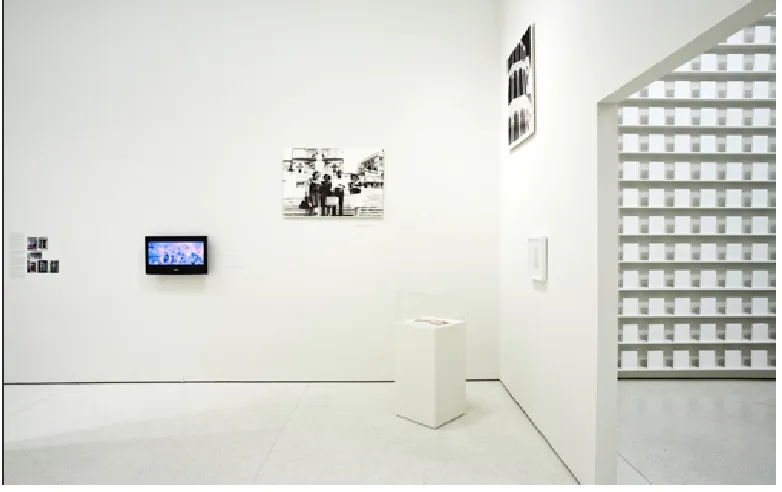
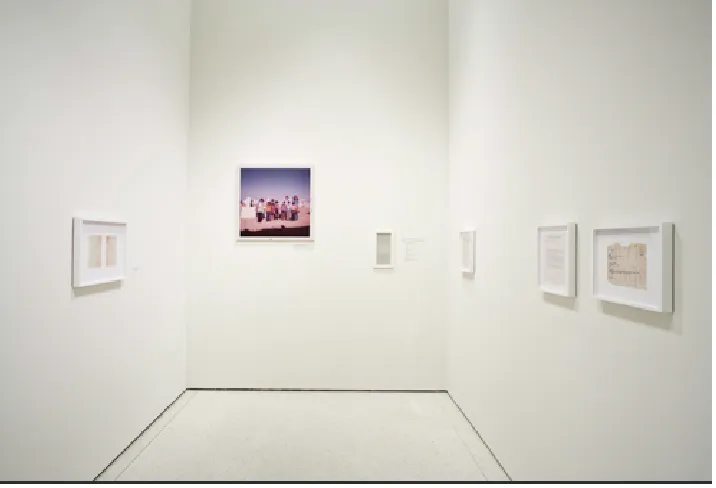
Arranged within a gallery space divided into four small rooms, Material for a
Film contained letters and postcards, photographs Jacir made of the covers of books from
Zuaiter’s personal library, and photos of Zuaiter as a young man. Jacir incorporated
sound and video into this installation as well - Mahler’s Ninth Symphony played
intermittently at the entrance to the main gallery space, a recording of Janet
Venn-Brown’s telephone conversations tapped by the Italian police played at a low volume in
one corner, and a series of short clips from the movie The Pink Panther in which Zuaiter
played an extra looped on a flat screen.55 The installation presented an archive of
materials that had been sought out and meticulously researched by Jacir. The second
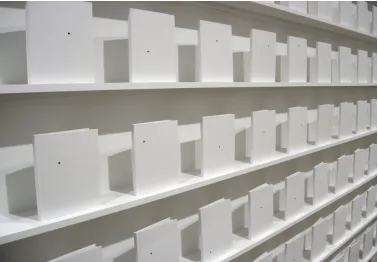
component of the show, Material for a Film (Performance), was created by Jacir at a
shooting range, and was present in its effects only — one thousand pristine, white books
arranged in funereal rows on narrow shelves at the far end of the gallery, each book
55 Jacir was in fact the first to spot Wael Zuaiter’s participation in this film and she strung together this
bearing the trace of a single uniform bullet, shot by Jacir with a .22 caliber pistol.56 These
books were shown along with sixty-seven photographs from Zuaiter’s copy of A
Thousand and One Nights, the book he was carrying in his pocket when he was
assassinated in 1972, a stray .22 caliber bullet later found lodged in its spine. Jacir’s scans
begin with this errant bullet’s point of entry and trace its path through the pages of the
text.
While the overall archival structure of Jacir’s installation has been noted in the
limited reviews of this work, little critical attention has been paid to the peculiarity of the
archival material itself, namely the fact that nearly everything in the exhibition,
excluding a few original documents, is photography.57 In other words, in Jacir’s archival
installation we lack the material specificity of each of the objects, the thickness and
56 There is one other record of this performance, a photograph of Jacir at a firing range that appears in the
catalogue which accompanies the show.
57 T.J. Demos, for instance, writing on Jacir’s installation in the catalogue for the 2008 Hugo Boss Prize,
surmises, “Material for a Film exemplifies Jacir’s ambition to express her relation to the recent travails of
Palestinians living under occupation and diaspora, which she does via conceptualist strategies presented in a variety of mediums.” He then includes a characterization of her other works (like Crossing Sudra (2002), Ramallah/New York (2004-2005), Memorial to 418 Palestinian Villages which were Destroyed,
Depopulated, and Occupied by Israel in 1948 (2000) and Where We Come From (2001-2003)), going on to
say, “Roving over photography and video, painting and sculpture, Jacir’s heterogeneous practice parallels the dispersion of Palestinian Life.” The Hugo Boss Prize, 2008 (New York: The Solomon R. Guggenheim
Foundation, 2008), 59. His examination of Jacir’s work does not unpack the effects of this materiality on the reading of her work. Neither do other reviewers: See for instance, Ken Johnson, “Material for a Palestinian’s Life and Death,” The New York Times, Art and Design, 12 February 2009,
http://www.nytimes.com/2009/02/13/arts/design/13jaci.html (accessed 26 February 2011) and “Bones’ Beat: Emily Jacir at the Guggenheim,” The Village Voice, 19 March 2009,
http://blogs.villagevoice.com/music/2009/03/emily_jacir_is.php?_r=1&scp=4&sq=jacir&st=cse (accessed 26 February 2011). For an interview discussion of the work which provides more details of Jacir’s thinking, but also doesn’t unpack the materiality of the work I want to signal here see Murtaza Vali, “All that Remains” ArtAsiaPacifica (Jul/Aug 2007)