Recursive Trees for Practical ORAM
Tarik Moataz
1, Erik-Oliver Blass
2and Guevara Noubir
31
Telecom Bretagne, IMT, France,
and Colorado State University, CO, USA,
[email protected]
2
Airbus Group Innovations, 81663 Munich, Germany,
[email protected]
3
Northeastern University, MA, USA,
[email protected]
Abstract
We present a new, general data structure that re-duces the communication cost of recent tree-based ORAMs. Contrary to ORAM trees with constant height and path lengths, our new construction r -ORAM allows for trees with varying shorter path length. Accessing an element in the ORAM tree results in different communication costs depending on the location of the element. The main idea be-hindr-ORAM is a recursive ORAM tree structure, where nodes in the tree are roots of other trees. While this approach results in a worst-case access cost (tree height) at most as any recent tree-based ORAM, we show that the average cost saving is around 35% for recent binary tree ORAMs. Be-sides reducing communication cost, r-ORAM also reduces storage overhead on the server by 4% to 20% depending on the ORAM’s client memory type. To prove r-ORAM’s soundness, we conduct a detailed overflow analysis. r-ORAM’s recursive approach is general in that it can be applied to all recent tree ORAMs, both constant and poly-log client memory ORAMs. Finally, we implement and benchmarkr-ORAM in a practical setting to back up our theoretical claims.
1
Introduction
Outsourcing data to external storage providers has become a major trend in today’s IT landscape.
In-stead of hosting their own data center, clients such as businesses and governmental organizations can rent storage from, e.g., cloud storage providers like Amazon or Google. The advantage of this approach for clients is to use the providers’ reliable and scal-able storage, while benefiting from flexible pricing and significant cost savings.
The drawback of outsourced storage is its po-tential security implication. For various reasons, a client cannot always fully trust a cloud storage provider. For example, cloud providers are frequent targets of hacking attacks and data theft [14, 15, 31]. While encryption of data at rest is a standard technique for data protection, it is in many cases not sufficient. For example, an “adversary” might learn and deduce sensitive information just by ob-serving the clients’ access pattern to their data.
world. Unfortunately, closing the gap between cur-rent ORAM techniques and the theoretical lower-bound of Ω(logN) [10] would require another major breakthrough.
Consequently, we focus on practicality of tree-based ORAMs. In general, to access an element in a tree-based ORAM, the client has to down-load the whole path of nodes, from the root of the ORAM tree to a specific leaf. Each node, also called a bucket, contains a certain number of en-tries (blocks). In case of constant client memory, there are O(logN) [28] entries per bucket, other-wise there are a small constantzmany entries, e.g.,
z= 5 [30]. In any case, downloading the whole path of nodes is a costly operation, involving the down-load of multiple data entries for each single element to be accessed. Communication cost primarily de-pends on the height of the tree and, correlated, the number of entries per tree node and the eviction mechanism.
Contrary to recent κ-ary tree ORAMs, in this paper, we propose a new, different data structure called recursive trees that reduces tree height and therewith cost compared to regular trees. In ad-dition to reducing communication overhead, recur-sive trees also improve storage overhead. Our new data structurer-ORAM offers variable height and therefore variable communication complexity, in-troducing the notion of worst and best cases for ORAM trees. r-ORAM is general in that it is a flex-ible mechanism, applicable to all recent tree-based ORAMs and possibly future variations thereof.
A second cost factor for a client is the total storage required on the cloud provider to hold the ORAM construction [21]. For an N element tree-based ORAM with entries of size l bits, the total storage a client has to pay for is at least (2N −1)· logN ·l [28] or (2N−1)·z·l [30]. In addition, a “map” translating ORAM addresses to leaves in the tree needs to be stored, too.
Technical Highlights: We present a new data structure reducing the average or expected path length, therefore reducing the cost to access blocks. Our goal is to support both constant and poly-log client memory ORAMs. Straightforward tech-niques to reduce the tree height, e.g., by using κ -ary trees [8], require poly-logarithmic client mem-ory due to the more complex eviction mechanism. The idea behind our technique called r-ORAM is to store blocks in a recursive tree structure. The
proposed recursive data structure substitutes tra-ditional κ-ary (κ ≥ 2) trees with better commu-nication. Starting from an outer tree, each node in a tree is a root of another tree. After r trees, the recursion stops in a leaf tree. The worst-case path length ofr-ORAM is equal toc·logN, with
c = 0.78, yet this worst-case situation occurs only rarely. Instead in practice, theexpectedpath length for the majority of operations is c ·logN, with
c= 0.65 for binary trees. The shortest paths in bi-nary trees have length 0.4·logN. In addition to sav-ing on communication, ther-ORAM approach also saves up to 0.8 on storage due to fewer nodes in the recursive trees. To support our theoretical claims, we have also implementedr-ORAM and evaluated its performance. The source code is available for download [25].
r-ORAM is a general technique that can be used as a building block to improve any recent tree-based ORAM, both withO(1) client memory such as Shi et al. [28],O(logN) client memory such as Stefanov et al. [30], and O(log2N) client memory such as Gentry et al. [8] – and variations of these ORAMs. In addition to binary tree ORAM, r-ORAM can also be applied toκ-ary trees. Targeting practical-ity, we abide from non-tree based poly-log ORAMs, such as Kushilevitz et al. [18]. While they achieve
O(log loglog2NN) worst-cast communication cost, their approach induces a large constant∼30.
2
Recursive Binary Trees
A Naive Approach: To motivate the rationale behindr-ORAM, we start by describing a straight-forward attempt to reduce the path length and therewith communication cost. Currently, data el-ements added to an ORAM are inserted to a tree’s root and then percolate down towards a randomly chosen leaf. As a consequence, whenever a client needs to read an element, the whole path from the tree’s root to a specific leaf needs to be downloaded. This results in path lengths of logN.
Figure 1: Structure of anr-ORAM
example, the minimum path length now becomes 1. However, the distribution of path lengths with this approach is biased to its maximum length of logN: for a tree ofN nodes, roughly N2 are at the leaf level. Thus, the expected path length would be ≈ log(N)−1, resulting in negligible savings. This raises the question whether a better technique exists, where the distribution of path lengths can be “adjusted”.
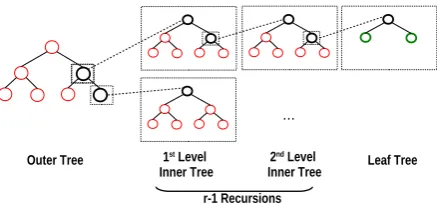
r-ORAM Overview: We first give an overview about the structure of our new recursive ORAM constructions. In r-ORAM, parameter r denotes the recursion factor. Informally, anr-ORAM com-prises a single outer binary tree, where each node (besides the root) is the root of an inner binary tree. Recursively, a node in an inner tree is the root of another inner tree, cf. Fig. 1. After the outer tree andr−1 inner trees, the recursion ends in a binary leaf tree. That is, each node (besides the root) in an (r−1)th inner tree is the root of a leaf tree. The fact that a root of a tree is never a (recursive) root of another tree simply avoids infi-nite duplicate trees.
Let the outer tree havey leaves and height logy, where y is a power of two and log the logarithm base 2. Also, inner trees havey leaves and height logy. Leaf trees have x leaves, respectively, and height logx. The number of elements N that can be stored in anr-ORAM equals the total number of leaves in all leaf trees, similarly to related work on tree-based ORAM [28].
2.1
Operations
First,r-ORAM is an ORAM tree height optimiza-tion, applicable to any kind of tree-based ORAM scheme. r-ORAM follows the same semantics of previous tree-based ORAMs [7, 8, 28, 30], i.e., it
supports the operations Add, ReadAndRemove, andEvict. For a given addressaand a data block
d, to simulate ORAM Read(a) and Write(a, d), the client performs aReadAndRemove(a) followed by Add(a, d). For the correctness of tree ORAM schemes, the client has to invoke an Evict oper-ation after every Add operation. Also, r-ORAM uses the same strategy of address mapping as the one defined in previous tree-based ORAMs – we de-tail this in Section 2.6. For now, assume that every leaf inr-ORAM has a unique identifier calledtag. Every element stored in anr-ORAM is uniquely de-fined by its addressa. We denote byP(t) the path (the sequence of nodes) containing the set of buck-ets inr-ORAM starting from the root of theouter tree to a leaf of aleaf tree identified by its tagt. If
P(t) andP(t0) represent two paths inr-ORAM, the least common ancestor, LCA(t, t0), is uniquely de-fined as the deepest (from the root of the outer tree) bucket in the intersection P(t)TP(t0). In this
pa-per, we use the terms node and bucket interchange-ably. Each bucket comprises a set ofz entries. We start the description ofr-ORAM by briefly explain-ingAdd,ReadAndRemove, andEvictoperations.
OperationsAdd andReadAndRemove are simi-lar to previous work, and details can be found in, e.g., Shi et al. [28].
• Add(a, d): To add data d at address a in r -ORAM, the client first downloads and decrypts the bucket ORAM of the root of the outer tree from the server. The client then chooses a uni-formly random tag t for a. The tag t uniquely identifies a leaf inr-ORAM where dwill perco-late to. The client writesdandtin an empty en-try of the bucket, IND-CPA encrypts the whole bucket, and uploads the result to the root bucket. Finally, the recursive map is updated, i.e., the addressais mapped to t.
• ReadAndRemove(a): To read an element at ad-dress a, the client fetches its tag t from the re-cursive map which identify a unique leaf in r -ORAM. The client then downloads and decrypts the path P(t). This algorithm outputs d, the data associated to a, or⊥ if the element is not found.
where the client has constant size (in N) mem-ory available. The second one, “with memory”, assumes that the client has a local memory storage that is poly-log in N. For each category, we use different eviction techniques that we present in the following two paragraphs.
Constant Client Memory: The eviction opera-tion is directly performedafter anAddoperation. Let us denote bytthe leaf tag and byχthe eviction rate.
Evict(χ, t): Let S = {P, such that |P| = |−Rt→|}
be the set of all paths from the rootRof the outer tree, to any leaf of a leaf tree that have the same length than the path fromRto the leaf tagged with
t. We call the distance from a node on a path inS
itslevel L.
For each levelL,1≤L≤ |−Rt→|, the client chooses from all nodes that are on the same levelL, respec-tively, random subsets of χ ∈N nodes. For every chosen node, the client randomly selects a single block and evicts it to one of its children. The client write dummy elements to all other children to stay oblivious.
Poly-Log Client Memory: For the case of poly-log client memory, the eviction operation follows that of Gentry et al. [8] and Stefanov et al. [30]:
Evict(t): LetP(t) denote the path from the root of the outer tree R to the leaf with tag t. Every element of a node inP(t) is defined by its data and unique tagt0. For eviction, the client pushes every element in the nodes in the path P(t), which are tagged with leaft0, to the bucketLCA(t, t0).
The eviction operation is performed at thesame
time as an Add operation. Instead of storing the element in the root bucket during theAdd opera-tion, the client performs anEvict. Thus, they store, and at the same time evict, all elements as far as possible “down” on the path. Eviction can be de-terministic [8] or randomized [30].
2.2
Security Definition
As in any ORAM construction, r-ORAM should meet the typical obliviousness requirement, re-stated below.
Definition 2.1. Let −→a = {(op1, d1, a1),(op2, d2, a2), . . . ,(opM, dM, aM)} be a sequence of M ac-cesses (opi, di, ai), where opi denotes a ReadAn-dRemove or an Add operation, ai the address of
the block, anddithe data to be written ifopi=Add
anddi=⊥ifopi=ReadAndRemove.
Let A(−→a) be the access pattern induced by se-quence −→a, sp is a security parameter, and (sp)
negligible in sp. We say that r-ORAM is secure
iff, for any PPT adversary D and any two same-length sequences −→a and−→b, access patterns A(−→a)
and A(−→b), |P r[D(A(−→a)) = 1]−P r[D(A(−→b)) = 1]| ≤(sp).
As standard in ORAM, all blocks are IND-CPA encrypted. Every time a block is accessed by any type of operation, its bucket is re-encrypted.
2.3
Storage Cost
For a total number ofN elements, we haveN corre-sponding leaves inr-ORAM. To compute the total number of nodesν, we start by counting the num-ber of leaf trees inr-ORAM. For the outer tree, we have 2y−2 possible nodes which are the root for another recursive inner tree. Each inner tree has also 2y−2 nodes, and since we have r−1 levels of recursion aside from the outer tree, the following equality holds:
N = (2y−2)·(2y−2)r−1·x= (2y−2)r·(1)x
= 2r·x·(y−1)r. (2)
Each of the nodes in an r-ORAM is a bucket
ORAM of size z, wherez is a security parameter, e.g.,z=O(logN) [28]. The total number of nodes
ν, withN leaves, in anr-ORAM (main tree) is the sum of all nodes of all leaf trees plus the nodes of all inner trees, the outer tree, and its root, i.e.,
ν(N) = (2y−2)r·(2x−2) +
r
X
i=0
(2y−2)i
(1)
= (2N−2·N x) +
(2y−2)r+1−1
(2y−2)−1 = 2N+ (2y−2
2y−3−2)·
N x −
1 2y−3. Thus, the total storage cost for r-ORAM is
ν(N)·z·lwith blocks (bucket entries) of sizelbits. This storage does not take into account the posi-tion map. The total storage of the entirer-ORAM
structure equalsν(N)·z·l+Pd logN logβe−1
logβNi−1, where β is the position map factor. For
l=ω(log2N) the sum in the storage complexity is negligible. The total storage then equalsν(N)·z·l. For appropriate choices ofxand y, discussed in the next section,r-ORAM reduces the storage cost in comparison with the (2N−1)·z·lbits of storage of related work. So for example, with x = 2 and
y = 4, the storage is equal to 8N5 resulting in a reduction by 20% of the number of nodes compared to existing tree-based ORAMs. However, this does not mean the same reduction for storage overhead. In fact, Section 4 will show that the size of the bucket can be reduced for Shi et al. [28]’s ORAM and increased for Path ORAM. Consequently, our storage saving varies between 4% to 20% depending on the ORAMr-ORAM.
As of Eq. (2), for a given number of elementsN,
r-ORAM depends on three parameters: recursion factorr, the number of leaves of an inner/outer tree
y, and the number of leaves of a leaf treex. We will now describe how these parameters must be chosen to achieve maximum communication savings.
2.4
Communication Cost
In ORAM, the “communication cost” is the num-ber of bits transferred between client and server. We now determine the communication cost of read-ing an element inr-ORAM, e.g., during a ReadAn-dRemove operation. Reading an element implies reading the entire path of nodes, each comprising ofzentries, and each entry of sizelbits. In related work, any element requires the client to read afixed
number of logN·l·z bits. For the sake of clarity in the text below, we only compute the number of nodes read by the client, i.e., without multiplying by the number of entrieszand the size of each entry
l. Since the main data tree and the position map have different block sizes, computing the height of
r-ORAM independently of the block size enable us to tackle both cases at the same time. At the end, to compute the exact communication complexity of any access we can just multiply the height with the appropriate block sizes, see Section 2.7.
A path going over a node on theith level in the
outer tree requires reading one bucket ORAM less than a path going over a node on the (i+ 1)thlevel
in the outer tree. Consequently withr-ORAM, we need to analyze its best-case communication cost
(shortest path), worst-case cost (longest path), and most importantly the average-case cost (average length).
The worst-case cost to read an element in r -ORAM occurs when the path comprises nodes of the full height of every inner tree until its leaf level, before finally reading the corresponding leaf tree. The worst-case costCequals
C(r, x, y) =r·logy+ logx. (3)
The best-case occurs when the path comprises one node of every inner tree before reading the leaf tree. The best-case costBequals
B=r+ logx. (4)
The worst-case cost in this setting is a function of three parameters that must be carefully chosen to minimize worst- and best-case cost. Theorem 2.1 summarizes how the recursion factorr, the number of leavesyin inner trees, and the number of leaves in leaf treesxhave to be selected.
Minimizing the worst-case path length is cru-cially important, as it also determines the average path-length. We will see later that the distribu-tion of paths’ lengths (and therewith the cost) fol-lows a normal distribution. That is, minimizing the worst case also leads to a minimal expected case and therewith the best configuration forr-ORAM. Similarly, as the paths’ lengths follow a normal dis-tribution, average and median cost are equivalent. A client can use the minimal worst-case param-eters to achieve the “cheapest configuration” for a
r-ORAM structure storing a given number of ele-mentsN.
Theorem 2.1. If r = log((N2)21.7), x = 2, and
y= 12·(N2)1r+ 1, the worst-case costCis minimized
and equals
C= 1 + 2.08·log((N 2)
1
2.7)≈0.78·logN.
The best-case costB is
B= 1 + log((N 2)
1
2.7)≈0.4·logN.
2.5
Average-Case Cost
While the parameters for a minimal worst-case cost also lead to a minimal average-case cost, we still have to compute the average-case cost. The cost of reading an element ranges fromB, the best-case cost, to C, the worst-case cost. Also, due to the recursive structure of the r-ORAM, the average-case cost of accessing a path is not uniformly dis-tributed.
In order to determine the average-case cost, we count, for each path lengthi, the number of leaves that can be reached. That is, we compute the dis-tribution of leaves in an r-ORAM with respect to their path length starting from the root of the outer tree. Let non-negative integeri∈(B,B+ 1, . . . ,C) be the path length and therewith communication cost. We computeN(i), the number of leaves in a leaf tree that can be reached by a path of length
i. Thus, the average cost, Av can be written as
Av =
C P
i=B
i·N(i)
N , where N is the total number of
elements and therefore leaves in ther-ORAM.
Theorem 2.2. For:
N(i) = 2i· r
X
j=0
(−1)j r
j
i−log(x)−j·log(y)−1
r−1
,
the average cost of a r-ORAM access is Av =
C P
i=B
i·N(i)
N .
Proof. Counting the number of leaves for a path of lengthiis equivalent to counting the number of different paths of lengthi. The intuition behind our proof below is that the number of different paths of lengthican be computed by the number of different paths in therrecursive treesR(i) times the number of different paths in the leaf tree, N(i) = R(i)· W(i).
As stated earlier, the leaf tree has x leaves,
W(i) = 2logx=x.
To computeR(i), we introduce an arrayArofr
elements. For a path P of lengthi, elementAr[j],
1 ≤ j ≤r, stores the number of nodes in thejth
inner tree that have to be read, i.e., the maximum level in the jth tree that P covers. For a path P
of length i, we have i=Pr
j=1Ar[j] + log(x). For
all j, 1 ≤ Ar[j] ≤ log (y). For any path P of length i, we can generate 2i−log(x) other possible
paths covering exactly the same number of nodes in every recursive inner tree, but taking different routes on each of them. For illustration, let pathP
go through two levels in the second inner tree – this means that there are actually 22 other paths that
go through the same number of nodes. Therefore, if we denote the possible number oforiginal paths of lengthi byK(i), thetotal number of paths equals
R(i) = 2i−log(x)· K(i),for any integer i∈ {B, . . . , C}. We compute K(i), by computing the number of solutions of equation
Ar[1] +Ar[2] +· · ·+Ar[r] =i−logx ⇔
(Ar[1]−1) +· · ·+ (Ar[r]−1) =i−r−logx.(5)
Computing the number of solutions of Eq. (5) is equivalent to counting the number of solutions of packingi−r−logx(indistinguishable) balls in
r (distinguishable) bins, where each bin has a fi-nite capacity equal to log(y)−1. Here,Ar[j]−1 denotes the size of the bin. This can be counted using the stars-and-bars method leading toK(i) = Pr
j=0(−1) j r
j
i−log(x)−j·log(y)−1 r−1
.WithN(i) = 2i· K(i),we conclude our proof.
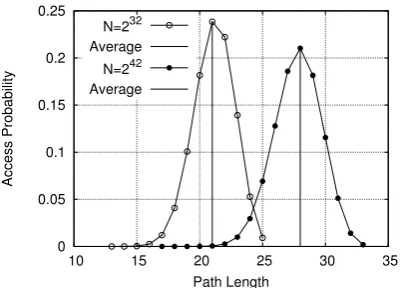
The average as formalized in the previous theo-rem does not give any intuition about the behavior of the average cost. For illustration, we plot the exact combinatorial behavior of the distribution of the leaf nodes. We present two cases that show the behavior of the leaf density, i.e., the probability to access a leaf in a given level in r-ORAM. We com-pute as well the average cost of accessingr-ORAM in two different cases, for N = 232 and N = 242, see Fig. 2.
We can simplify our average-case equation. The number of possibilitiesK of indistinguishable balls packing in distinguishable bins can be approxi-mated by a normal distribution [2, 3]. For a given leveli∈ {B,· · ·,C}we have
K(i)≈ A s√2π·e
−(i−r−log(x)−c2)2
2s2 , (6)
where c=r·(log(y)−1), s= c2+1
$ ,A=r·log(y),
and$being the solution of the equation$·e−$22 =
√
2π·(c 2+1)
A .
Since the number of leaves in the ith level ofr
0 0.05 0.1 0.15 0.2 0.25
10 15 20 25 30 35
Access Probability
Path Length N=232
Average
N=242 Average
Figure 2: r-ORAM path length distribution
a mean c
2, which roughly equals the worst case over
2. The average case is the mean of the Gaussian distribution, therefore minimizing the worst case is equivalent to minimizing the average case. Thus, we can use the same parameters obtained in Th. 2.1 to compute the minimal value of the average case. As both best- and worst-case path lengths are in
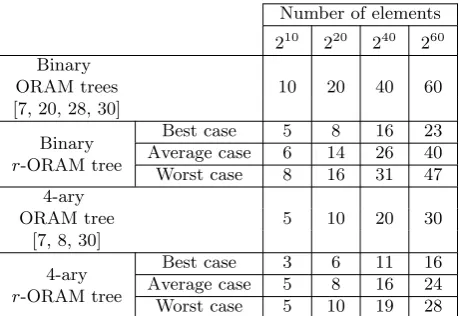
O(logN), the average-case length is in Θ(log(N)). Further simplification of the average cost will result in very loose bounds. Targeting practical settings, we calculate the average page lengths for various configurations and compare it to related work in Table 1. While this table is based on our theoretical results, the actual experimental results ofr-ORAM height are presented in Fig. 7.
Notice that our structure is a generalization of a binary tree forx= 1 andy= 2. Throughout this paper, the values x, y, and r equal the resulting optimal values given by Theorem 2.1.
2.6
r
-ORAM Map addressing
In order to access a leaf in the r-ORAM struc-ture, we have to create an encoding which uniquely maps to every leaf. This will enable us to retrieve the path from the root to the corresponding leaf node. The encoding is similar to the existing ones in [8, 28, 30]. The main difference is the introduc-tion of the new recursion, which we have to take into account. Every node in the outer or inner trees can have either two children in the same in-ner tree or/and two other children as a consequence of the recursion. Consequently, we need two bits
to encode every possible choice for each node from
the root of the outer tree to a leaf. For the non-recursive leaf trees, one bit is sufficient to encode each choice.
For tree-based ORAM constructions with full binary-trees, to map N addresses, a logN bit size encoding is sufficient for this purpose. This encod-ing defines the leaf tag to which the real element is associated.
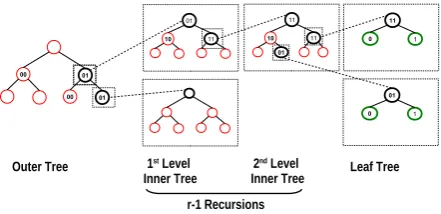
In r-ORAM, we define a vector v composed of two parts, a variable-size part vv and a constant-size partvc, such that v= (vv, vc). For the encod-ing, we will associate to every node in the outer and inner trees two bits. For every node in the leaf tree only one bit. Above, we have shown that the short-est path to a leaf node has lengthr+ log(x) while the longest path has lengthr·log(y) + log(x). Con-sequently, for the variable-size vector vv, we need
to reserve at least 2·r bits and up to 2·r·log(y) bits for the worst case.
The total size of the mapping vector v, |v| =
|vv|+|vc|, is bound by 2r+ log(x) ≤ |v| ≤ 2r·
log(y) + log(x), which is in Θ(log(N)). Figure 3 shows an address mapping example for two leaf nodes. The size of the block in ther-ORAM posi-tion map is upper bounded by 2·logNbits. Finally, the mapping is stored in a position map structure following the recursive construction in [30]. To ac-cess the position map, the communication cost has, as inr-ORAM, a best-case cost ofO(B ·log2(n)·z) bits and worst-case cost of O(C ·log2(n)·z) bits, where z is the number of entries. This complexity is in term of bits, not blocks. For larger blocks, we can neglect the position map. In Path ORAM or Shi et al. constructions, the size to access the po-sition map is inO(z·log3N) which is the result of accessing a path containing logN buckets a logN
number of time. Each bucket has z blocks where each has size equal toO(logN).
2.7
Communication complexity
First, we briefly formalize that the height can be seen as a multiplicative factor over all the recursion steps taking into consideration the eviction. LetN
be the number of elements in the ORAM, denote by
z the size of a bucket, β the position map factor,
h the tree-structure height, l the block size and
Figure 3: r-ORAM Map addressing
can be formulated as follows:
CT =O(χ·z·h·l
| {z }
Data access
+β·z·h·χ·logN
| {z }
Recursion
)
Reducing the heighthdecreases the entire commu-nication overhead.
In this section, we are interested on computing the exact communication complexity (download-ing/uploading) to access one block of sizel. We will use for our computation the average height which is equal to≈0.65· logN, see Table 1. In the follow-ing, we compute the communication complexities
C1,r of r-ORAM over Path ORAM [30] and C2,r
for r-ORAM over Shi et al. [28]. We denote the communication complexity for one access of Path ORAM and Shi et al. [28] by Cp and Cs. For an
access, we download the entire path and upload it again. For Path ORAM, the eviction occurs at the same time when writing back the path. There is no additional overhead in the eviction. In the follow-ing equations, we take into consideration the varia-tion of the bucket size. We later show in Secvaria-tion 4 that the size of r-ORAM applied to Path ORAM buckets increases by a factor of 1.2, while it expect-edly decreases by 30% if applied to Shi et al. [28]. The variation of the bucket size impacts the height reduction in both cases as follows:
C1,r≈2·0.65·logN·l·z1,r+Pd logN
logβe−1
i=1 2·0.65· z1,r· logβNi · log
N
βi−1 ≈0.65·
z1,r
zp ·Cp= 0.78·Cp. For Shi et al. [28]’s ORAM, for an eviction rate equal to 2, we are downloading 6 paths, plus the first one from which we have accessed the informa-tion. Thus, for each access, one has to download a total of 7 paths.
C2,r≈2·0.65·7·logN·l·z2,r+Pd logN logβe−1
i=1 2·0.65·
7·z2,r· logβNi· log
N
βi−1 ≈0.65·
z2,r
zs ·Cs≈0.5Cs.
In this result, we make use of an approximation due to the size of the position map. In Section 2.6, we have shown that that to map an element, ap-proximately 2·logNbits is needed instead of logN. We will show that these results match the experi-mental results in Section 5.
3
κ
-ary Trees
So far, we have used a binary tree for the recur-sion in r-ORAM, i.e., leaf and inner trees are full binary trees. In this section, we extend r-ORAM to κ-ary trees, cf. Gentry et al. [8]. Generally, the usage ofκ-ary trees reduces the height by a multi-plicative factor equal to ln(κ)1 . For example, if we choose a branching factor κ= logN, the commu-nication complexity decreases by a multiplicative factor equal to log (logN). We will now show that applying r-ORAM to aκ-ary tree will further de-crease the communication complexity compared to the originalκ-ary construction.
For parametersxandy defined above, the num-ber of elementsN can be computed by calculating the number of nodes in the outer and inner κ-ary tree fora recursion factorr:
N = (
logκy
X
i=0
κi−1)r·x= (1−κ
1+logκy
1−κ −1) r
·x
= ( κ
κ−1·(y−1))
r·x (7)
Th. 3.1 shows how one should choose the recur-sion factor r, the height of the inner trees logy
and leaf trees logx to minimize the cost of read-ing a path of κ-ary r-ORAM structure. In sec-tion 2.7, we have shown that the height factors over the total communication overhead reduction. Thus, any reduction applies for the the entire com-munication overhead computation. Also, we show in Section 4 based on our security analysis thatr -ORAM’s bucket size over Gentry et al. [8]’s ORAM decreases, thereby decreasing communication cost even more.
Theorem 3.1. Let f(κ)>1 be a decreasing func-tion in κ. If r = logκ((Nκ)f(1κ)), x = 2, and
best and worst-case cost equal
C= 1+logκ((N
κ)
1 f(κ))·log
κ((κ−1)·κ
f(κ)−1+1), and
B= 1 + 1
f(κ)·logκ(
N κ).
The decreasing functionf depends on the choice of κ, the branching factor. For κ= 4, f(4) ≈ 2, while for κ = 16, f(16) ≈ 1.6. The proof of the Theorem 3.1 is similar to the proof of Theorem 2.1, so we will only provide a sketch, highlighting the differences, see Appendix A.2.
Example: For κ= 4, the optimal values for the best and worst-case cost respectively equal B ≈
0.55·logκN andC ≈0.95·logκN.
4
Security Analysis
4.1
Privacy Analysis
Theorem 4.1. r-ORAM is a secure ORAM fol-lowing Definition 2.1, if every node (bucket) is a secure ORAM.
Proof (Sketch). If the ORAM buckets are secure ORAMs, we only need to show that two access pat-terns induced by two same-length sequences−→a and
− →
b are indistinguishable. To prove this, we borrow the idea from Stefanov et al. [30] and show that the sequence of tagst in an access pattern is indistin-guishable from a sequence of random strings of the same length.
To store a set of N elements, r-ORAM will comprise N leaves and N different paths. Dur-ing Add and ReadAndRemove ORAM operations, tags are chosen uniformly and independently from each other. Since the access pattern A(−→a) in-duced by sequence −→a consists of the sequence of tags (leaves) “touched” during each access, an ad-versary observes only a sequence of strings of size logN, chosen uniformly from random. The nodes inr-ORAM are bucket ORAMs, i.e., for an ORAM operations they are downloaded as a whole, IND-CPA encrypted, and uploaded exactly as in re-lated work, they are secure ORAMs.
4.2
Overflow probability
To show that our optimization is a general tech-nique for tree-based ORAMs, we compute the
over-flow probabilities of buckets and stash for both con-stant and poly-logarithmic client memory schemes. Specifically, we analyzer-ORAM for the construc-tions by Shi et al. [28], Gentry et al. [8], and Ste-fanov et al. [30]. Surprisingly, for the first scheme, we are able to show in Theorem 4.4 thatr-ORAM will reduce the bucket size while maintaining the exact same overflow probability. This is significant from a storage and communication perspective: it shows thatr-ORAM can improve storage and com-munication overhead not only due to a reduction of the number of nodes (as shown in Section 2.3 and 2.7), but also by reducing the number of entries in every bucket.
For the second scheme which uses a “temporary” poly-log stash during eviction (needed to compute the least common ancestor), we show in Theo-rem 4.6 thatr-ORAM offers improved communica-tion complexities and a slightly better bucket size. Finally for Path ORAM, we prove that the stash size increases only minimally and remains small. In Theorem 4.8, we show that this small increase is outweighed by smaller tree height.
We now determine the ORAM overflow proba-bility for two cases, (1) r-ORAM applied to the constant client memory approach, and (2) to the poly-log client memory approach. For the first case, we consider an eviction similar to the one used by Shi et al. [28]. That is, for every level, we will evict
χbuckets towards the leaves, whereχis called the eviction rate. For the second case, we consider a deterministic reverse-lexicographic eviction similar to Gentry et al. [8] and Fletcher et al. [7]. In par-ticular, for the poly-logarithmic setting, we investi-gate the application ofr-ORAM over two different schemes. The first case consists of the application of r-ORAM over the scheme by Gentry et al. [8]. For this, we study the overflow probability of the buckets and we show that the recursive structure offers better bucket size bounds. The second case represents the application of r-ORAM over Path ORAM. We determine the overflow probability of the memory, dubbedstash, where each bucket inr -ORAM has a constant number of entries z. Using deterministic reverse-lexicographic eviction greatly simplifies the proof while insuring the same bounds as the ones in randomized eviction [30].
To sum up, we are studying three different cases. (1) r-ORAM over Shi et al. [28] construction, (2)
(3) r-ORAM over Path ORAM [30]. For the first two, we have to quantify the bucket size while for the third one we have to quantify the stash size and the size of the bucket as well. For each setting, an asymptotic value of the number of entries z is provided. The main difference between the compu-tation of the overflow probability inr-ORAM and related work is the irregularity of path lengths of our recursive trees. To better understand the dif-ferences, we start by presenting a different model of our construction in 2-dimensions.
Description: A 2-dimensional representation of
r-ORAM consists of putting all the recursive inner trees as well as the leaf trees in the same dimension as the outer tree. Consequently, the outer tree, the recursive inner trees, as well as the leaf trees will together constitute only one single tree we call the
general tree. The main difficulty of this representa-tion is to determine to which level a given recursive inner tree is mapped to in the general tree.
The general tree, by definition, will have leaves in different levels. This can be understood as a direct consequence of the recursion, i.e., some leaves will be accessed with shorter paths compared to others. Moreover, the nodes of the recursive trees will be considered as interior nodes of the general tree with either 4 children or 2 children. Any interior node of an inner or outer tree is a root for a recursive inner tree which means that any given interior node of an inner/outer tree has 2 children related to the recursion as well as another 2 children related to its inner/outer tree. These 4 children belong to the same level in our general tree.
Also, leaf nodes of inner or outer trees have only 2 children. Ultimately, we will have different dis-tributions of interior nodes as well as leave nodes throughout the general tree. In the following, we will use the term of interior node as well as aleaf node in the proofs of our theorems to denote an interior or leaf node of the general tree. Figure 4 illustrates the topology of the general tree model of
r-ORAM.
In the ith level, we may have leaf nodes as well
as interior nodes. Also, the leaf/interior nodes re-side in different levels with different non-uniform probabilities. Therefore, we will first approximate the distribution of the nodes in a given level of the
r-ORAM structure by finding a relation between the leaf nodes and interior nodes of any level ofr
-Figure 4: Structure of anr-ORAM
ORAM. Then, we compute the relation between the number of nodes in theithand (i+ 1)th level. This last step will help us to compute the expected value of number of nodes in any interior nodes in poly-log client memory scenarios. Finally we will conclude with the overflow theorems and their proofs for each scenario.
We present a relation between I(i), the num-ber of interior nodes, andN(i), the number of leaf nodes, for a leveli > r, whereris the recursion fac-tor. Notice that, for other levelsi≤r, there cannot be leaf nodes. Also, the leaves of the general tree are the leaves of the leaf trees. The maximum value ofiequals the worst caseC.
Lemma 4.2. Let f(r, x, y) = 1+rlog(y)2s−2r−2 log(x)
and s > 0. For any i > r, e−f(r,x,y) ≤ NI(i)(i) ≤
2−log(x)·r.
The proof of the lemma is in Appendix A.3. We will now show that, once we have a relation between leaves and interior nodes of the same level, finding the relation between any nodes of two dif-ferent levels will be straightforward. We write the number of nodes as a sum of leaf nodes and interior nodes, such thatL(i) =N(i) +I(i). Recall that for
i≤r, we haveN(i) = 0. We writeµ= L(i+1)L(i) (this will represent the expected value of the number of real elements in any interior nodes in Theorem 4.6). We present our result in the following lemma.
Lemma 4.3. Letµ= L(i+1)L(i) andX(i) = 1−NL(i)(i). For 1 ≤ i ≤ C, µ is bounded by 2·X(i) ≤ µ ≤
4·X(i).
We refer the reader to the Appendix A.4 for the proof.
From this result, for i ≤r, we have 2 ≤µ≤4, as N(i) = 0.
memory setting, and we compute the overflow prob-ability of interior nodes. The overflow probabil-ity computation for leaf nodes, either for constant client memory or with poly-log client memory, is similar to the one presented by Shi et al. [28], based on a standard balls-into-bins argument. We omit details for this specific case. The last two theo-rems tackle tree Based ORAM constructions with memory.
Constant client memory: First, we compute the overflow probability of interior nodes. Then, a corollary underscoring the number of entries z
will be presented.
Theorem 4.4. For eviction rateχ, if the number of entries in an interior node is equal toz, the over-flow probability of an interior node in the ith level
is at most θz
i, where, for i≤rand s=dlog4(χ)e, θi= 2
s
2χ, and fori > r: θi= 2s
2χ·( 1 1+x
r )i−r.
We refer the reader to Appendix A.5 for the proof.
In practice, the eviction rateχequals 2. So,sis then equal to 1. In this case, the number of entries
z in each bucket has the following size.
Corollary 4.5. r-ORAM with N elements over-flows with a probability at mostω1if the size of each interior bucket z in the ith level equalslogNω
fori≤randz≈ 1 i−r+1·log
N
ω fori > r.
Sketch. By applying the union bound over the en-tire r-ORAM interior buckets, the probability of overflow is at most N ·θz
i. Setting this value to
the target overflow ω gives us the results for both underlined cases in Th. 4.4. For the second equal-ity, the approximation follows from the remark log (1 +xr)<1, sincex≤rin our optimal setting of Th. 2.1.
The size of the internal buckets inr-ORAM are smaller compared to those of Shi et al. [28] by a multiplicative factor of approximatelyi−1r+1fori > r.
For ω = 2−64, N = 220, and r = 7, the size of
the bucket equals 84 blocks fori≤7 while for, e.g.,
i = 11, the bucket size equals ≈ 17 blocks. For
i≤r, the bucket size is equal to the constant client memory construction, i.e., inO(logNω).
Poly-logarithmic client memory: Let us now tackle the case wherer-ORAM is applied over tree
ORAMs with poly-logarithmic client memory. For this, we consider two scenarios. The first deals with
r-ORAM applied over Gentry et al. [8]’s ORAM. The second one deals with r-ORAM over Path ORAM. In both cases, our overflow analysis is based on a deterministic reverse lexicographic evic-tion.
Th. 4.6 determines the overflow probability of buckets in r-ORAM over Gentry et al. [8] scheme. For each access, the eviction is done deterministi-cally independently of the accessed path. We show that the overflow probability varies for buckets in different levels due to the interior/leaf node distri-bution. The parameter δ represents the unknown that should be determined for a given (negligible) overflow probability.
Theorem 4.6. Let f(r, x, y) =
1+rlog(y)−r−2 log(x)
c , and c >0. For anyδ >0, for
any interior node v, the probability that a bucket has size at least equal to (1 +δ)·µ is at most
e−δ
2·µ
2+δ, whereF1≤µ≤F2.
Fori≤r: F1= 2 andF2= 4,
fori > r:
F1= 4·(1− 1
1 + 2−log(x)·r)andF2= 2·(1−
1
1 +e−f(x,y,r)),
We refer the reader to Appendix A.6 for the proof.
Corollary 4.7. Leµi be the expected size of buck-ets in theithlevel. r-ORAM withN elements
over-flows with a probability at mostω, if the size of each interior bucketzin theithlevel equalsµi+ lnN
ω for F1≤µi ≤F2.
Proof (Sketch). By using the union bound, the probability that the system overflows equals ω =
N·e−δ
2·µ
2+δ. This is a quadratic equation inδthat has one valid root (non-negative) approximately equal to 1
µi ·ln
N
w, where µi is the expected value of i th
level. The size of the bucket in this case equals
z= (1 +δ)·µi=µi+ lnNω.
Theorem 4.8. For buckets of size z= 6and tree height L = dlogNe, the stash overflow probability computes to
Pr(st(r-ORAM6L)> R)≤1.17·0.88R·(1−0.54N).
We refer the reader to Appendix A.7 for the proof.
Discussion: The probability is negligible in R
(since 0.88 ¡1 and 1−0.54N −→∞ 1). So, for a fixed overflow probability ω 1, we have to define the corresponding value of R by solving the equation
ω = 1.17·0.88R·(1−0.54N). An r-ORAM stash withNelements overflows with probability at most
ω1, if the size of each bucket is 6, and the stash has sizeR= 1
ln 0.88·ln ω
1.17·(1−0.54N). For large val-ues ofN, R∈Ω(ln(ω−1)).
We have made a number of approximations in our proof that slightly bias the choice of the bucket size and round the upper bound. We could improve our upper bound by a more accurate approximation of the number of subtrees in r-ORAM. Also, we assume the worst expected value for each bucket on all levels which is 4. Theorem 4.8 is valid for any bucket sizez≥6.
5
Performance Analysis
We now analyze the behavior ofr-ORAM when ap-plied to different tree-based ORAMs. As a start, we compute the communication complexity of r -ORAM access, based on the average height, and estimate the monetary cost of access withr-ORAM on Amazon S3 cloud storage infrastructure. This first part is based on ourr-ORAM theoretical re-sults above. For all previous binary tree-based ORAMs, the communication complexity for a num-ber of elements is always constant for fixed N. With previous ORAMs, you must always download an entire path. Following our theoretical estimates, we go on to present ourr-ORAM implementation results and compare with Path ORAM [30]. We compare both the average height and the result-ing communication improvements, and, finally, also evaluate the behavior of the stash.
5.1
Theoretical Results
Even if the worst-case complexity is in O(logN), the underlying constants gained withr-ORAM are
Table 1: Tree height comparison
Number of elements
210 220 240 260 Binary
10 20 40 60
ORAM trees [7, 20, 28, 30]
Binary
r-ORAM tree
Best case 5 8 16 23
Average case 6 14 26 40
Worst case 8 16 31 47
4-ary
5 10 20 30
ORAM tree [7, 8, 30]
4-ary
r-ORAM tree
Best case 3 6 11 16
Average case 5 8 16 24
Worst case 5 10 19 28
significant. Table 1 compares between the height of a binary tree as with [7, 20, 28, 30] and the height of r-ORAM. Also, we compare r-ORAM on κ-ary trees, instead of binary ones, and we show that the recursive κ-ary tree r-ORAM gives better perfor-mances in terms of height access and communica-tion cost.
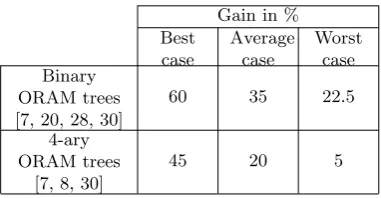
Table 1 has been generated using parameters from Theorems 2.1 and 3.1. This table compares only the complexity of accessing an element in the tree, i.e., going from the root to the leaf. It does not take the communication overhead of accessing the position map into account which we will deal with later. Moreover, Table 1 computes only the number and not the size of nodes accessed. The overall communication complexities will vary from one scheme to the other, and we detail costs below, too. Table 2 shows the gain (in %) of r-ORAM applied to binary trees ORAM, not distinguishing whether a scheme has constant or poly-log memory complexity.
As shown in Table 2, we improve on average 35% whenr-ORAM is applied to any binary tree ORAM and 20% when applied to 4-ary ORAM trees. Com-pared to binary trees, the gain for κ-ary trees is smaller due to the reduction of the height of the tree. Trees are already “flat”, so the benefit of re-cursion diminishes.
Table 2: Tree-based ORAM gain
Gain in % Best
case
Average case
Worst case Binary
ORAM trees [7, 20, 28, 30]
60 35 22.5
4-ary ORAM trees
[7, 8, 30]
45 20 5
The number of entries (blocks) in every node varies depeding on the scheme. We apply the result of Theorem 4.4 and Theorem 4.6 to vary the size of the buckets accordingly. For the poly-logarythmic client memory, the size of the buckets of r-ORAM over Path ORAM are set to z= 6 based on Theo-rem 4.8. We take communication and storage over-head of the position map into account as well as the overhead induced by eviction (eviction rate equal to 2 for the constant client memory case).
Figure 5 depicts the communication cost per ac-cess, i.e., the number of bits transmitted between the client and the server for any read or write op-eration. The graph shows that r-ORAM applied to Path ORAM (z= 6) gives the smallest commu-nication overhead. For example, with a dataset of 1 GByte, an access will cost 100 KByte in total. Moreover, if we set the number of entrieszto 3 in-stead of 6, see [7], communication costs are divided by 2.
The storage overhead of tree-based ORAMs is still significant. Poly-log client memory ORAMs perform better, but still induce roughly a factor of 10. r-ORAM reduces this overhead down to a factor of 9.6, i.e., a reduction by 4%. Forr-ORAM over Shi et al. [28] scheme, the saving is greater than 50% since we are reducing not only the height but also the size of the bucket.
Finally, we calculate the cost in US Dollar (USD) associated with every access, cf. Fig. 6. As we obtain smallest communication overhead by us-ing r-ORAM on top of Path ORAM, one would na¨ıvely expect this to be the cheapest construc-tion. However, Amazon S3 pricing is based not only on communication in terms of transferred bits (Up to 10 TB/month, 0.090 USD per GBytes), but also on the number of HTTP operations performed (GETs and PUTs), 0.005 USD per 1,000 requests
for PUT and 0.004 USD per 10,000 requests per month for GET. Surprisingly, the construction by Gentry et al. [8] with branching factorκ= log(N) is cheaper as it involves fewer HTTP operations compared to Path ORAM (however, in practice, the branching factor cannot be large since it will increase the size of the bucket).
5.2
Experimental Results
For a real-world comparison, we have implemented Path ORAM and r-ORAM including the position map in Python. Our source code is available for download [25]. Experiments were performed on a 64 bit laptop with 2.8 GHz CPU and 16 GByte RAM running Fedora Linux. For each graph, we have simulated 1015random access operations. The standard deviation of ther-ORAM height (commu-nication complexity) was low at 0.015. The rela-tive standard deviation for the average height (com-munication complexity) for 93312≈216.5 elements
equals to 0.125.
The experiments begin with an empty ORAM. We randomly insert the corresponding number of elements. This step represents the initialization phase. Afterwards, we run multiple random ac-cesses to analyze the height behavior and the stash size forr-ORAM over Path ORAM.
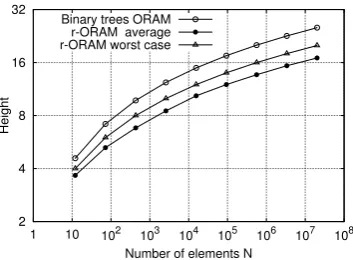
Fig. 7 shows three curves: the height of binary tree ORAM (Path ORAM) from one hand and r -ORAM average and worst case height from the other hand. The height curves for r-ORAM are the result of 1015 accesses with a standard
devia-tion of 0.015.
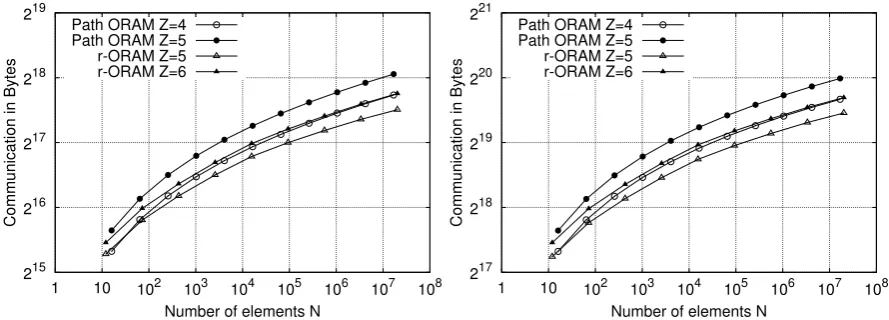
Our second comparison tackles communication including the recursion induced by the position map as well as the eviction per single access for different bucket sizes, see Fig. 8. Figures 12 and 13 show that r-ORAM improves communication even with larger block size, see Appendix B. The evic-tion inr-ORAM is performed at the same time the path is written back. Also, we consider both the up-load/download phases. For example, withN = 214
sav-104
105
106
107
108
10 102 103 104 105 106 107
Communication in Bytes
Number of elements N Shi et al.
Shi-r-ORAM Gentry et al.
Gentry-r-ORAM Path ORAM Path-r-ORAM
Figure 5: Communication per access
0.001 0.01 0.1 1
10 102 103 104 105 106 107
Cost in (USD)
Number of elements N Shi et al.
Shi-r-ORAM Gentry et al.
Gentry-r-ORAM Path ORAM Path-r-ORAM
Figure 6: Communication cost per 100 ac-cesses
2 4 8 16 32
1 10 102 103 104 105 106 107 108
Height
Number of elements N Binary trees ORAM
r-ORAM average r-ORAM worst case
Figure 7: Average height comparison
214 215 216 217 218
1 10 102 103 104 105 106 107 108
Communication in Bytes
Number of elements N Path ORAM Z=4
Path ORAM Z=5 r-ORAM Z=5 r-ORAM Z=6
Figure 8: Communication per access, block 512 Bytes
ing in terms of communication complexity is 20%. These curves represent the average of 1015random
accesses.
Finally, we measure r-ORAM’s stash size for a number of random accesses between 210 and 220.
The number of operations represent a security pa-rameter for our scenario, the more operations we perform the more likely the stash size increases. The upper bound of Th. 4.8 depends of the num-ber of elements N, however for N > 2 the stash will have the same size independently ofN because 1−0.54N ≈ 1 for larger N. Thus, the stash in r-ORAM over Path ORAM has a logarithmic be-havior in function of the security parameter, see Theorem 4.8.
Our experimental results confirm the upper bound given by Theorem 4.8, namelyR = ln 0.881 ·
ln1.17·(1−ω0.54N)≈
1 ln 0.88·ln
ω
1.17. For example, for a
probability of overflow equal toω= 2−20,the
secu-rity parameter here equals 20, the theoretical stash
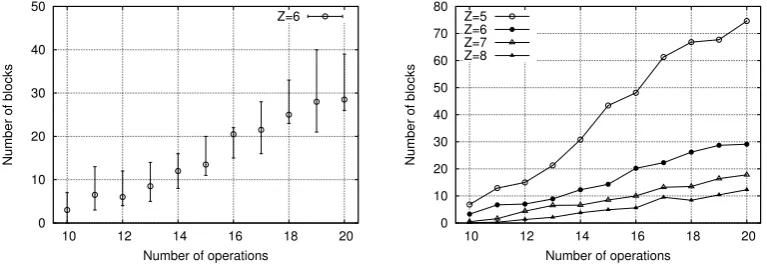
size R equals ∼110 blocks for any N > 10. In Fig. 9, you can see that, for bucket sizez= 6 (See Appendix B for larger bucket size), we have exactly a logarithmic behavior as shown in the theorem. This figure shows the stash behavior based on the maximum, minimum, and median values. For a confidence level of 95%, the margin error is around 1.25. For 220operations, the maximum stash value
equals 40 which is smaller than 110, the theoreti-cal value, which is not surprising since some loose bounds have been used in the proof. Forz= 5, see Appendix B. The stash seems to increase logarith-mically with the number of operations. However, theoretically the stash size behavior is not bounded. The graphs are logarithmic in the number of oper-ations. In Fig. 10, we show the average behavior of the stash size, to also indicate its logarithmic behavior.
more. This will not have any repercussion on the communication complexity. One might argue that the overall client memory sizeMhas to be larger. However, the client memory size is defined as the stash plus the downloaded path during the opera-tion such thatM=R+P whereRis the stash size andP the number of blocks downloaded for a given pathp. We haveP =z·|p|blocks where|p|= logN
for Path ORAM and|p| ≈0.78·logN forr-ORAM (worst-case). For a number of elements N = 220 and a bucket sizez = 5, Path ORAM has to have 20 more blocks thanr-ORAM and this will increase for greater number of elements.
6
Related Work
ORAM, first introduced by Goldreich and Ostro-vsky [10], recently received a revived interest from the research community [1, 4, 5, 7–13, 18, 20, 24, 26, 28, 30, 32, 33]. The current state of the art on ORAM can be divided into two main categories. The first one comprises schemes where a client is restricted to constant local memory, while the sec-ond allows the client (sub-linear) local memory.
Constant client memory: Constant client-side memory schemes are very useful for scenarios with very limited memory devices such as embedded de-vices. Recent works have been able to enhance amortized and worst-case communication complex-ity [11, 12, 18, 20, 24, 26, 28]. Goodrich and Mitzen-macher [11] and Pinkas and Reinman [26] introduce schemes with a poly-logarithmic amortized cost in
O(log2(N)). However, the worst-case cost remains linear. Goodrich et al. [12] present a better worst-case communication overhead,O(√N·log2(N)).
All schemes prior to the one by Shi et al. [28] differentiate between worst-case and amortized-case overhead. The worst-case scenario in these ORAM constructions occurs when a reshuffling is performed. Shi et al. [28] present a tree-based ORAM, where the nodes of the tree are small bucket ORAMs, see also [10, 23]. Accessing an element in this structure implies accessing a path of the tree. After each access, a partial reshuf-fling, confined to only the path accessed in the tree, is performed. The worst-case and amortized case overhead achieved with such construction are both equal and poly-logarithmic, i.e.,O(log3(N)).
Mayberry et al. [20] improve the complexity of
the tree-based ORAM by Shi et al. [28]. Instead of using traditional ORAM bucket nodes in the tree, a PIR [19] is used to retrieve a data element from a specific node. Mayberry et al. [20] show that therewith the worst-case communication complex-ity equals O(log2(N)). Note that this complexity can be enhanced by using aκ-ary tree instead of a binary tree.
Kushilevitz et al. [18] present a hierarchical solu-tion that enhances the asymptotic communicasolu-tion complexity defined in previous works with a worst case equal to O(log(log(Nlog2(N)))). For large block sizes, the scheme is in practice significantly less efficient compared to, e.g., [20, 28].
Devadas et al. [6] present a tree-based construc-tion, Onion ORAM, with constant communication complexity. However, their block size is large with
B = Ω(log6(N)). Recently, Moataz et al. [22] im-proved Onion ORAM by reducing the server com-putation as well as the block size by a factor of
log2N. Note that our recursive tree structure can be applied to both of these ORAMs, too, further reducing communication costs.
Sub-linear client memory Past research with
O(√N) client-side memory [32, 33] has sub-linear amortized communication complexity, but linear worst-case complexity. Boneh et al. [1] improve the worst-case to be inO(√N), however still with
O(√N) client-side memory. Stefanov et al. [29] show how to reduce the amortized cost to be poly-logarithmic in O(log2(N)), but still with a large
O(√N) client memory.
Gentry et al. [8] enhance previous tree-based ORAM work by modifying the structure of the tree. Instead of a binary tree, a multi-dimensional tree with a branching factorκis used. If the number of data elements stored in every node and the branch-ing factor are equal to O(logN), the worst-case
communication overhead is in log(log(N))log3(N) . Gentry et al. [8] also introduce a reverse lexicographic evic-tion that is used in recent poly-logarithmic client memory schemes. The poly-logarithmic client memory in O(log2N) is due to its eviction algo-rithm, where the client has to memorize elements in order to percolate them towards the leaves.
0 10 20 30 40 50
10 12 14 16 18 20
Number of blocks
Number of operations Z=6
Figure 9: Stash size,z = 6, number of opera-tions in log2
0 10 20 30 40 50 60 70 80
10 12 14 16 18 20
Number of blocks
Number of operations Z=5
Z=6 Z=7 Z=8
Figure 10: Average stash size, operations in log2
et al. [7] further optimized Path ORAM, reduc-ing the communication cost by 6∼7%. Similarly, Ren et al. [27] improve upon Path ORAM and SSS ORAM [29], resulting in better bandwidth parame-ters but still inO(logN) and withO(√N) for large block sizes. Also for this ORAM, our framework can enhance communication overhead even more.
7
Conclusion
r-ORAM is a general technique for tree-based ORAM costs optimization. r-ORAM improves both communication cost as well as storage cost. We formally show thatr-ORAM preserves the same overflow probability as related work. r-ORAM is general and can be applied to any existing as well as future derivations of tree-based ORAMs. For any binary tree-based ORAM, the average cost is reduced by 35%, and storage cost is reduced by 4 to 20%. As future work, we plan to investigate the dynamics of r-ORAM, i.e., instead of considering constant height for outer and inner trees, we aim at dynamically varying the height, which has the potential of further cost reductions.
Acknowledgement. This work was partially sup-ported by NSF grant 1218197
References
[1] D. Boneh, D. Mazi`eres, and R.A. Popa. Remote oblivious storage: Making oblivious RAM practical, 2011. http://dspace.mit.
edu/bitstream/handle/1721.1/62006/
MIT-CSAIL-TR-2011-018.pdf.
[2] K. Brown. Balls in bins with limited capac-ity, 2014.http://www.mathpages.com/home/ kmath337.htm.
[3] G. Casella and R.L. Berger. Statistical in-ference. Duxbury advanced series in statis-tics and decision sciences. Thomson Learning, 2002. ISBN 9780534243128.
[4] K.-M. Chung and R. Pass. A Simple ORAM.
IACR Cryptology ePrint Archive, 2013:243, 2013.
[5] I. Damg˚ard, S. Meldgaard, and J.B. Nielsen. Perfectly Secure Oblivious RAM without Ran-dom Oracles. In Proceedings of Theory of Cryptography Conference –TCC, pages 144– 163, Providence, USA, March 2011.
[6] Srinivas Devadas, Marten van Dijk, Christo-pher W. Fletcher, and Ling Ren. Onion ORAM: A constant bandwidth and con-stant client storage ORAM (without FHE or SWHE). IACR Cryptology ePrint Archive, 2015:5, 2015.
[8] Craig Gentry, Kenny A. Goldman, Shai Halevi, Charanjit S. Jutla, Mariana Raykova, and Daniel Wichs. Optimizing ORAM and Us-ing It Efficiently for Secure Computation. In
Proceedings of Privacy Enhancing Technolo-gies, pages 1–18, 2013.
[9] O. Goldreich. Towards a Theory of Soft-ware Protection and Simulation by Oblivious RAMs. In Proceedings of the 19th Annual ACM Symposium on Theory of Computing – STOC, pages 182–194, New York, USA, 1987.
[10] Oded Goldreich and Rafail Ostrovsky. Soft-ware protection and simulation on oblivi-ous rams. J. ACM, 43(3):431–473, May 1996. ISSN 0004-5411. doi: 10.1145/ 233551.233553. URL http://doi.acm.org/
10.1145/233551.233553.
[11] M.T. Goodrich and M. Mitzenmacher. Privacy-preserving access of outsourced data via oblivious ram simulation. In Proceedings of Automata, Languages and Programming –ICALP, pages 576–587, Zurick, Switzerland, 2011.
[12] M.T. Goodrich, M. Mitzenmacher, Olga Ohri-menko, and Roberto Tamassia. Oblivious ram simulation with efficient worst-case ac-cess overhead. In Proceedings of the 3rd ACM Cloud Computing Security Workshop – CCSW, pages 95–100, Chicago, USA, 2011.
[13] M.T. Goodrich, M. Mitzenmacher, O. Ohri-menko, and R. Tamassia. Privacy-preserving group data access via stateless oblivious RAM simulation. In Proceedings of the Symposium on Discrete Algorithms –SODA, pages 157– 167, Kyoto, Japan, 2012.
[14] Google. A new approach to China, 2010. http://googleblog.blogspot.com/
2010/01/new-approach-to-china.html.
[15] D. Gross. 50 million compromised in Evernote hack, 2013. http://www.cnn.com/2013/03/
04/tech/web/evernote-hacked/.
[16] J Hsu and P Burke. Behavior of tandem buffers with geometric input and markovian output. Communications, IEEE Transactions on, 24(3):358–361, 1976.
[17] L. Kleinrock. Theory, Volume 1, Queueing Systems. Wiley-Interscience, 1975. ISBN 0471491101.
[18] E. Kushilevitz, S. Lu, and R. Ostrovsky. On the (in)security of hash-based oblivious ram and a new balancing scheme. In Proceedings of the Symposium on Discrete Algorithms – SODA, pages 143–156, Kyoto, Japan, 2012.
[19] Eyal Kushilevitz and Rafail Ostrovsky. Repli-cation is not needed: Single database, computationally-private information retrieval. In Proceedings of Foundations of Computer Science –FOCS, pages 364–373, Miami Beach, USA, 1997.
[20] T. Mayberry, E.-O. Blass, and A.H. Chan. Path-pir: Lower worst-case bounds by combin-ing oram and pir. InProceedings of the Net-work and Distributed System Security Sympo-sium, San Diego, USA, 2014.
[21] T. Moataz, T. Mayberry, E.-O. Blass, and A.H. Chan. Resizable Tree-Based Oblivious RAM. In Proceedings of Financial Cryptog-raphy and Data Security, Puerto Rico, USA, 2015.
[22] Tarik Moataz, Travis Mayberry, and Erik-Oliver Blass. Constant Communication ORAM with Small Blocksize. InACM Confer-ence on Computer and Communications Secu-rity, Denver, CO, USA, 2015.
[23] R. Ostrovsky. Efficient computation on oblivi-ous rams. InProceedings of the Symposium on Theory of Computing –STOC, pages 514–523, Baltimore, USA, 1990.
[24] R. Ostrovsky and V. Shoup. Private infor-mation storage (extended abstract). In Pro-ceedings of the Symposium on Theory of Com-puting –STOC, pages 294–303, El Paso, USA, 1997.
[25] PASMAC. r-ORAM source code, 2015. http://pasmac.ccs.neu.edu/resources/ r-ORAM.zip.
[27] Ling Ren, Christopher W. Fletcher, Albert Kwon, Emil Stefanov, Elaine Shi, Marten van Dijk, and Srinivas Devadas. Ring ORAM: clos-ing the gap between small and large client stor-age oblivious RAM. IACR Cryptology ePrint Archive, 2014:997, 2014.
[28] E. Shi, T.-H.H. Chan, E. Stefanov, and M. Li. Oblivious RAM with O(log3(N)) Worst-Case Cost. InProceedings of Advances in Cryptology – ASIACRYPT, pages 197–214, Seoul, South Korea, 2011. ISBN 978-3-642-25384-3.
[29] E. Stefanov, E. Shi, and D.X. Song. Towards practical oblivious ram. InProceedings of the Network and Distributed System Security Sym-posium, San Diego, USA, 2012. The Internet Society.
[30] Emil Stefanov, Marten van Dijk, Elaine Shi, Christopher W. Fletcher, Ling Ren, Xiangyao Yu, and Srinivas Devadas. Path ORAM: an extremely simple oblivious RAM protocol. In
ACM Conference on Computer and Commu-nications Security, pages 299–310, 2013.
[31] Techcrunch. Google Confirms That It Fired Engineer For Breaking Internal Privacy Poli-cies, 2010. http://techcrunch.com/2010/
09/14/google-engineer-spying-fired/.
[32] P. Williams and R. Sion. Usable pir. In Pro-ceedings of the Network and Distributed Sys-tem Security Symposium, San Diego, USA, 2008.
[33] P. Williams, R. Sion, and B. Carbunar. Build-ing castles out of mud: practical access pattern privacy and correctness on untrusted storage. In ACM Conference on Computer and Com-munications Security, pages 139–148, Alexan-dra, USA, 2008.
A
Proofs
A.1
Proof of Theoram 2.1
Proof. FunctionC depends on three variables that we can reduce to two by substituting Eq. (2) into Eq. (3). From Eq. (2), we have logx= log(N)−
r−r·log(y−1).The worst-case cost then computes to
C(r, y) = log(N)−r+r·log( y
y−1). (8) By fixing r > 0, the worst-case cost is a non-increasing function in y, since y 7→ log(y−y1) is a non-increasing function for y > 1. Thus, for any non-negative r, the minimum value of the worst cost is smaller for larger values ofy.
Also, with x ≥ 2, the number of the leaves of inner treesyis upper bounded: N ≥2·(2y−2)r⇒ y≤ 1
2·( N
2)
1 r + 1.
For small x, we therewith get a larger upper bound for y. Therefore, we have to fix x to its minimum value which equals 2. This could not be inferred from Eq. 3 while not decreasing the num-ber of variables of the linear system. The optimum number of leaves for the inner trees then equals
y = 12 ·(N2)1r + 1. Putting these values back in Eq. (8), results in C depending on only one vari-abler, the recursion factor:
C(r) = 1 +r·log(1 2.(
N
2) 1
r + 1) (9)
Finally, we derive the minimum of the worst-case cost by computing the first derivative of the convex function C(r). The derivative is dC
dr(r) = log( 1 2 ·
(N2)1r + 1)− ln( N
2)·( N
2) 1 r
2r·(1 2·(
N 2)
1 r+1).
We achieve ddrC(r)≈0 forr0 ≈log((N2)21.7). Since C(r) is convex, the value ofr0 is the minimum for any r≤log(N)−1. Replacingr0 in equations (4) and (9) gives the worst-case and best-case costs of the theorem, therefore completing the proof.
Careful readers will notice that we have bounded
to the same path withx= 2 with two times more elements.
A.2
Proof of Theorem 3.1
(Sketch). The first step in the proof is to represent the number of leaves x as a function of N, y, r, andκthe branching factor. That is, we reduce the number of variables in our optimization problem by one. Taking the logarithm of Eq. (7) leads to logκ(x) = logκ(κ−κ1N)−r·logκ(y−1). Since our first goal is the minimization of the worst-case cost, we substitute logκ(x) in the worst-case cost Eq. (3)
by the value computed in the above equation and minimize the new expression. Note that the loga-rithm is baseκinstead of 2 in the worst-case cost formula.
For simplicity, we consider the branching factor as a (given) constant, as it has an impact on the overflow probability. So, we assume a fixed branch-ing factor matchbranch-ing a given bucket size. Finally, we follow the same steps as the proof of Theorem 2.1 to find the optimal recursive factorr, the number of leaf tree leavesx, and the number of inner/outer tree leavesy.
A.3
Proof of Lemma 4.2
Proof. First, we determine the number of interior nodes for i > r. In the same spirit as the proof of Theorem 2.2, we denote by Aj an array ofj ∈[r]
positions that has all positions initialized to zero.
Aj represents the number of possible paths to a
given level. The difference between counting the number of leaves and the number of interior nodes consists of the fact that an interior node may exist in any level without going through all recursions, i.e., it may happen that we reach a level without go-ing through the last level of recursions. This means that elements of the array are equal to zero.
Counting of interior nodes boils down to divide Eq. (5) of Theorem 2.2 in r sub-equations, where each will count the number of ways to reach a spe-cific level while all the positions of the array are still equal to 1. Therefore, the set of solutions of the following sub-equations has an empty set
inter-section.
A1[1]−1 = i−1−log(x),
(A2[1]−1) + (A2[2]−1) = i−2−log(x), · · ·
(Ar[1]−1) +· · ·+ (Ar[r]−1) = i−r−log(x),
where, for eachj ∈[r], we have 1≤Aj[i]≤log(y).
Discussion: To have an intuition about these partitions, consider an example where r = 4 and
y = 16. We have 4 sub-equations, where each rep-resents the possible ways to reach an interior node in, e.g., the 4th level. The first array has only one
position that can take values from 1 to 4. The first sub-equation will count the number of ways to get to an interior node at level 4 under the constraint that we have to stay in one recursion. In this case, the array can have only one value which is 4. For the second equation, we can have different combi-nations such as (2,2), (3,1), etc., but we do not have (4,0), because it is already accounted for in the first sub-equation. We follow the same reason-ing for the other sub-equations.
So,I(i) =S1+· · ·+Sr, the total number of
solu-tions of the sub-equasolu-tions. Also, we have Sr ≥Sj
for any j ∈ [r−1], that is, I(i) ≤ r·Sr. From
Theorem 2.2, we know that the number of solu-tions for the last equationSr equals 2i−logx· K(i).
Therefore, with the result of Theorem 2.2, we can conclude thatI(i)≤2i−log(x)·r· K(i).
Also from Th. 2.2, the number of leavesN(i) = 2i· K(i). This leads to our first inequality I(i)
N(i) ≤
2−log(x)·r.
For our second inequality, notice that for any interior node of any level i > r, I(i) ≥ N(i+1)2 . This follows from the property that the ancestors of leaves in the (i+ 1)th level are interior nodes in
the upper level. Using equalityN(i) = 2i· K(i),
I(i)
N(i) ≥
N(i+ 1) 2N(i) = K(i+ 1)
K(i) .