Comparative Analyses Of Nursing Documentations In The
Clinical Settings
Chiejina E.NP 1
P
Ph.D e-mail: 31TU[email protected]U31T
Phone No: +2348037463279
Odira CCP 1
P
M.Sc
e-mail: 31TU[email protected]
Anieche JEP 1
P
M.Sc e-mail: 31TU[email protected]U31T
1. Department of Nursing Science, Faculty of Health Sciences and Technology, Nnamdi Azikiwe University, Nnewi Campus Nigeria.
Abstract
The study focused on comparative analyses Nursing documentations in the clinical settings. Judgmental and simple random sampling methods were used to select documented nursing actions for 264 clients from tertiary, secondary and primary health care institutions all in Anambra State of Nigeria. One research question and three null hypotheses guided the study. The instrument used for data collection was checklist titled “Checklist on Nursing Documentation in the clinical setting”. Descriptive statistics of frequency, mean score and standard deviation (SD) were used to summarize the variables, and Pearson product moment correlation were used to answer the research question. Analyses of variance (ANOVA) was adopted in testing the null hypotheses at 0.05 level of significance. Nursing documentation was observed to have significant legal implications. In addition, nursing documentations in the medical, surgical and maternity units of the health facilities significantly differed with regard to timeliness, promotion of interdisciplinary communication and in the core principles of documentation.
Keywords: Nursing documentation, Clinical specialty, Clinical setting.
Introduction.
Tools are needed to support the continuous and efficient shared understanding of a patient’s
care history that simultaneously aids sound intra and inter-disciplinary communication and
decision-making about the patient’s future care (Joint Commission on the Accreditation of
Health care Organisations, 2005). Such tools are vital to ensure that continuity, safety and
quality of care endure across the multiple handovers made by the many clinicians involving
in patient care. Generally, tools are implements held in the hands, which in the healthcare
setting refer to documentation. Potter and Perry (2010) describe documentation as anything
written or electronically generated that describes the status of a client or the care or services
given to that client. Nursing documentation refers to written or electronically generated client
information obtained through the nursing process (ARNNL, 2010). Nursing documentation is
a vital component of safe, ethical and effective nursing practice regardless of the context of
practice or whether the documentation is paper based or electronic, it is an integral part of
nursing practice and professional patient care rather than something that takes away from
patient care, and it is not optional.
According to Potter and Perry (2010), nursing documentation must provide an accurate and
honest account of what and when events occurred, as well as identify who provided the care.
The documentation should be factual, accurate, complete, current (timely), organized and
compliant with standards (Professional and Institutional). Potter and Perry (2010) further
stated that these core principles of nursing documentation apply to every type of
documentation in every practice setting.
Documentation in nursing covers a wide variety of issues, topics and systems
(Yocum, 2002; Huffman, 2004, Lindsay et al 2005; Johnson et al 2006). Such areas of
coverage include all aspects of nursing process, plan of care, admission, transfer, transport,
discharge information, client education, risk taking behaviours, incident reports, medication
administration, verbal orders, telephone orders, collaboration with other health care
professionals, date and time of any event as well as signature and designation of the recorder.
The primary purpose of documentation is to facilitate information flow that supports
the continuity, quality and safety of care. Potter and Perry (2010) pointed out that data from
documentation allow for communications and continuity of care, quality improvement/
assurance and risk management, establish professional accountability, make provision for
legal coverage, funding and resource management, and also expand the science of nursing.
Potter and Perry (2010) also explained that clear complete and accurate health records serve
many purposes for the clients, families, registered nurses and other health care providers.
Delaune and Ladner (2002) further affirmed that documentation is the professional
responsibility of all health care practitioners, and that it provides written evidence of the
practitioner’s accountability to the client, the institution, the profession and the society.
Literature has revealed that the tensions surrounding nursing documentation include
the amount of time spent in documenting, the number of errors in the records, the need for
legal accountability, the desire to make nursing work visible, and the necessity of making
nursing notes understandable to the other disciplines (Spraque and Trapanier 1999;
Castledine, 1998; Dimond, 2005; Pearson, 2003). This study therefore focused on
comparative analyses of nursing documentations in the Clinical settings.
Research Question.
• To what extent does the documented nursing actions relate with the legal implications
of the documentation?
Hypotheses.
• Significance difference does not exist across the medical, surgical and maternity units
of Health Institutions with regard to timeliness of documentation of Nursing actions.
• There is no significant difference in nursing documentations across the medical,
surgical and maternity units with regard to promotion of interdisciplinary
communication.
• The core principles of nursing documentation do not significantly differ across the
medical, surgical and maternity units of the Primary, Secondary and tertiary Health
Institutions.
Materials and Methods
Design and Sampling.
The study was a retrospective research design. Judgmental sampling technique was adopted
in selecting one Teaching Hospital and one specialist Hospital (tertiary Health Institutions) in
Anambra State of Nigeria. Simple random sampling was used to select two General Hospitals
(Secondary Health Institutions) and two comprehensive Health Centres (Primary Health
Institutions) out of the 24 General Hospitals and 10 comprehensive Health Centres in
Anambra State. This was to give all the primary and secondary health institutions equal
chance of being selected for the study (Nworgu, 1991).
Nursing documentations on Clients were obtained from three units (medical, surgical and
maternity units) of each of the selected health institutions. Other units (e.g. Emergency unit,
Out-patient Department, and other special units) were excluded in the study. Documented
nursing actions for 96 clients were obtained from the selected tertiary health institutions, 72
were obtained from secondary health institutions and 96 from the primary health institutions.
On the whole nursing documentation for 264 clients were used for the study. Ethical approval
were obtained from the six institutions used for the study. Informed consent was also
obtained from the clients whose records were used. Confidentiality was ensured by not
including the names of the health institutions in the data collection. Alphabetical codes were
used to represent the selected health institutions while numerical codes were used for the
patients whose records were obtained for the study. Generally, records of nursing
documentations from July – September 2015 were used for the study.
Instrument.
The instrument used for data collection in the study was checklist titled checklist on Nursing
Documentation in the clinical setting (CNDCS). Section A of the instrument provided general
information of the health institution (eg level of health institution, clinical specialty, form of
documentation, client’s clinical diagnosis, documentation of accountability, section B of the
instrument was made up of eight sub-sections designed to measure documented nursing
actions (eg admissions, transfers, discharges, plan of care, client education, medication,
incident reports, vital signs, etc), extent of ensuring core principles in the documentation (eg
whether factual, accurate, complete, timely, organized and compliant with standards),
ensuring promotion of interdisciplinary communication (eg name(s) of the people involved in
the collaboration, date and time of the contact, information provided to or by healthcare
provider, responses from healthcare provider, etc), timeliness of the documentation (eg how
timely, chronological and frequency), preciseness of the documentation (eg objectivity,
unbiased, legibility, clear and concise, etc), Legal implications (eg use of authorized
abbreviations, informed consent, advanced directive, etc), impact on quality assurance/
improvement (eg facilitates quality improvement initiative, facilitates risk management, and
used to evaluate appropriateness of care), and impact on the science of nursing (eg provides
data for nursing/health research, used to assess nursing intervention and client outcomes, etc).
The instrument was designed in a 4 – point scale ranging from 1 to 4 with poor/many
omissions having I point, 2 points for fair/incomplete with few omissions, 3 points for
good/almost complete, and 4points for very good/complete.
The instrument was subjected to reliability test by collecting data from nursing
documentations for 15 patients from three levels of health institutions (primary, secondary
and tertiary) in another State of Nigeria that was not used for the study. The instrument test/
retest reliability was 0.65.
Data Analysis.
Standard descriptive statistics of frequency, means and standard deviation were used to
summarize the variables. Mean score, standard deviation and Pearson Product moment
correlation (r) were used to answer the research question while Analysis of variance
(ANOVA) was adopted in testing the null hypotheses at 0.01 and 0.05 levels of significance
respectively.. SPSS version 21 was used in the data analysis.
Result. Table 1.General Information of the Health Institutions used for the study.
Variable Frequency Percentage
Level of Health Institution:
Primary
Secondary
Tertiary
96
72
96
36.4
27.3
36.4
Clinical Specialty:
Medical unit
Surgical unit
Maternity unit
97
63
104
36.7
23.9
39.4
Form of Documentation:
Written documentation
Electronic documentation
262
2
99.2
0.8
Client Diagnoses:
Obstetric condition
Medical condition
Surgical condition
Sepsis/Infection
105
93
61
5
39.8
35.2
23.1
1.9
Demonstration of Accountability:
Primary provider
Secondary provider
Third party provider
247
15
2
93.6
5.7
0.8
Total N = 264
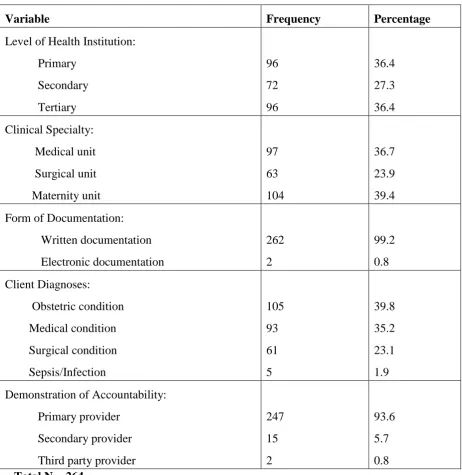
Table 1 shows the general information of the health institutions used for the study. Primary
Health Centre constituted 36.4% of the Health institutions, 27.3% constituted secondary level
while tertiary level constituted 36.4%. The clinical specialties of the health institutions that
were used for the study were medical unit 36.7%, surgical unit 23.9% and maternity unit
which formed 39.4%. Out of the forms of nursing documentations, 99.2% was written
documentation while electronic documentation formed 0.8%; 39.8% was obstetric conditions,
medical conditions 35.2%, surgical conditions 23.1% while documented infective conditions
constituted 1.9%. For demonstration of accountability in the documented nursing actions,
93.6% was done by primary providers, 5.7% by secondary providers, while third party
providers accounted for 0.8% of the documentations. Total number of each variable was 264.
Table 2. Descriptive Statistics of the Measured Variables.
Variable N Minimum Maximum Mean SD
Nursing Action Documentation 264 23.00 76.00 54.6402 9.86811
Core principles of Documentation 264 11.00 24.00 19.2462 2.38101
Promotion of interdisciplinary
communication
264 9.00 36.00 30.8485 5.61433
Timeliness of Documentation 264 6.00 12.00 9.5568 1.32703
Preciseness of Documentation 264 18.00 40.00 31.9470 3.30299
Legal implication 264 11.00 24.00 19.6439 2.47153
Impact on Quality Assurance 264 4.00 12.00 9.6250 1.63129
Impact on Nursing Science 264 4.00 16.00 13.7462 2.43860
Valid N (Listwise) 264
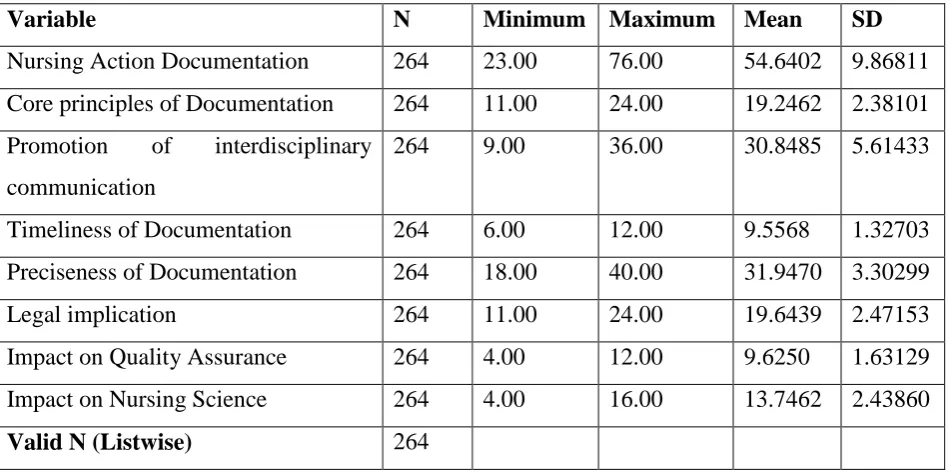
Table 2 shows the descriptive statistics of the measured variables. Out of the 264 documented
nursing actions, the mean was 54.6402 and the standard deviation (SD) was 9.86811. Mean
for the core principles of the documentation 19.2462 with SD of 2.38101. For promotion of
interdisciplinary communication, the mean was 30.8485 with SD of 5.61433. Timeliness of
documentation had a mean of 9.5568 with SD of 1.32703. Mean for preciseness of the
documentation was 31.9470 with SD of 3.30299. For legal implications, the mean was
19.6439 with SD of 2.47153. Impact of the documentation on quality assurance had a mean
of 9.6250 with SD of 1.63129, while impact on Nursing Science had a mean of 13.7462 with
SD of 2.43860.
Table 3. Relationship between documented nursing actions and the legal implications of
the documentation.
Variables N X SD r Critical
value
Level of
significance
Nursing Action
Documentation
264 54.6402 9.86811 **
0.615
0.000 0.01
Legal implications 264 19.6439 2.47153
Correlation was significant at 0.01 level (2 – tailed).
Table 3 shows that r correlational value for the relationship between documented nursing
actions and the legal implications was 0.615, and it was significant at 0.01 level.
Table 4. ANOVA showing comparison of documented nursing actions in the medical,
surgical and maternity units with regard to the timeliness, promotion of
interdisciplinary communication and core principles of nursing documentation.
Variable Units in the Health
Institution
N X SD Source Sum of
squares
df Mean
squares
F-cal F-crit
(sig) T im el in es s o f D oc um ent at ion
Medical 97 9.3299 1.43412 Between
Groups
7.963 2 3.981 2.283 0.104
Surgical 63 9.7143 1.36108
Maternity 104 9.6731 1.17781 Within
Groups
455.185 261 1.744
Total 264 9.5568 1.32703 463.148 263
pr om ot ion of in te rd is cip lin ar y com m un ic at ion
Medical 97 29.4433 6.64262 Between
Groups
339.342 2 169.671 5.570 0.004
Surgical 63 31.0635 6.02113
Maternity 104 32.0288 3.77384 Within
Groups 7950.598 8289.939 261 263 30.462
Total 264 30.8485 5.61433
C o re P ri nc ipl es of N u rs ing doc um ent at ion
Medical 97 18.6701 2.50301 Between
Groups
61.703 2 30.851 5.634 0.004
Surgical 63 19.2540 2.33465
Maternity 104 19.7788 2.18093 Within
Groups
1429.293 261 5.476
Total 264 19.2462 2.38101 1490.996 263
Probability: 0.05 level of significance.
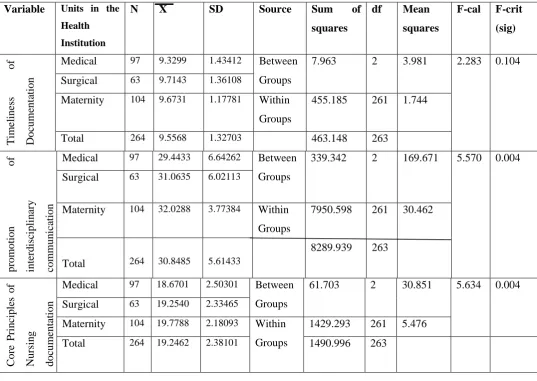
In table 4, the calculated F-ratio for timeliness of documented nursing action was 2.283, for
promotion of interdisciplinary communication, the F-ratio was 5.570, and for the core
principles of nursing documentation, the F-ratio was 5.634. These results were more than the
critical values. Therefore the null hypotheses are rejected. Scheffe (Akuezuilo and Agu,
2004) test of multiple comparison of means was used to determine the order of significant
differences across the medical, surgical and maternity units of the Health Institutions.
Table 5. Scheffe (Post Hoc) test of multiple comparison of the means of the timeliness,
promotion of interdisciplinary communication and the core principles of nursing
documentation.
Dependent
variable
(1) Units in the
Health
institutions
(J) Units in the
Health Institutions Mean Difference (1 – J) Standard Error Sig
(F – Crit)
T im el ine ss of N ur si ng D oc um ent at ion
Medical unit Surgical unit
Maternity unit -0.38439 -0.34318 0.21369 0.18641 0.073 0.067
Surgical unit Medical unit
Maternity unit 0.38439 0.04121 0.21369 0.21084 0.074 0.845
Maternity unit Medical unit
Surgical unit 0.34318 -0.04121 0.18641 0.21084 0.067 0.845 P rom ot ion of Int er di sc ipl ina ry com m uni ca ti on
Medical unit Surgical unit
Maternity unit -1.62019 -2.58555* 0.89307 0.77907 0.071 0.001
Surgical unit Medical unit
Maternity unit 1.62019 -0.96535 0.89307 0.88115 0.071 0.274
Maternity unit Medical unit
Surgical unit 2.58555* 0.96535 0.77907 0.88115 0.001 0.274 C or e pr inc ipl es of N ur si ng D oc um ent at ion
Medical unit Surgical unit
Maternity unit -0.58387 -1.10874* 0.37866 0.33032 0.124 0.001
Surgical unit Medical unit
Maternity unit 0.58387 -0.52488 0.37866 0.37360 0.124 0.161
Maternity unit Medical unit
Surgical unit 1.10874* 0.52488 0.33032 0.37360 0.001 0.161
Key: * The mean difference was significant at 0.05 level
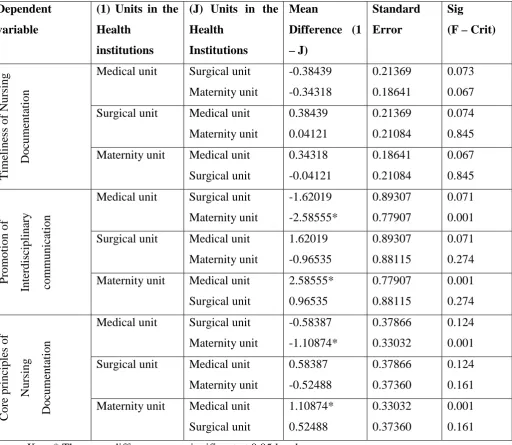
Table 5 shows that mean difference of 2.58555 existed between maternity and medical unit,
and it was in favour of the maternity unit with regard to promotion of interdisciplinary
communication. For core principles of nursing documentation, the mean difference of
1.10874 between maternity and medical units was in favour of the maternity unit.
Discussion
Findings from the study indicate significant correlation (r=0.615) between nursing
documentation and the impact on legal implication (table 3). Kozier et al (2004) stated that
client’s record is a legal document and is usually admissible in court as evidence. According
to American Nurses Association code of ethics (2001), the nurse has a duty to maintain
confidentiality of all patient information. Lyre and Camp (1999) cautioned that accurate,
complete documentation should give legal protection to the nurse, the client’s other care
givers, the health care facility and the client. Admissible in court as a legal document, the
clinical record provides proof of the quality of care given to a client. Documentation is
usually viewed by juries and attorneys as the best evidence of what really happened to the
client (Lyre and Camp, 1999).
Findings from the study indicate significant differences across the clinical specialty
units of the health institutions with regard to timeliness of the documentations, promotion of
interdisciplinary communication and in ensuring core principles of documentation (table 4).
DeLaune and Ladner (2002) state that documentation will differ depending on the health care
facility (eg hospital, nursing home, home health agency, etc) and the setting within the
facility (eg emergency room, perioperative, medical-surgical unit) and with specific client
populations (eg obstetrics, paediatrics, geriatrics). Estes (2002) advised that the care giver
should follow institutional guidelines on frequency of Charting. Kozier et al (2004) added
that the care provider should adjust the frequency as a client’s condition indicates, for
example, a client whose blood pressure is changing requires more frequent documentation
than a client whose blood pressure is constant.
Harper (2007) asserts that in creating interdisciplinary communication, documentation is
critical in developing a strong interdisciplinary practice. According to DeLaune and Ladner
(2002), health care services are delivered by a multidisciplinary team (eg physicians, nurses,
pharmacists, social worker, physical therapists, Radiologists, etc); nurses coordinate the care
provided by other personnel, and because nurses work with these other care providers on an
ongoing basis, it is necessary to understand the role of each provider which will be reflected
in the peculiarities in nursing action documentations of their roles in client care.
For the mean differences across the units (table 5), superiority of maternity unit over the
medical and surgical units in ensuring core principles and promotion of inter-disciplinary
communication in their nursing documentations could be related to the busy nature of the unit
and to the multiple health care providers in maternity care for example obstetrician,
physician, paediatrician, etc.
Conclusion.
This study indicates that nursing documentations have significant legal implications, and that
timeliness of documentation, promotion of interdisciplinary communication and ensuring the
core principles of documentation differ with clinical specialties in health care facilities.
References.
Akuezulo EO, Agu N. (2004). Research and statistics in Education & Social Science:
Methods and Applications. Awka: Nuel Centi Publishers and Academic Press Ltd.
American Nurses Association. (2001). Code of ethics for nurses with interpretive statements.
Washington DC: Author.
Association of Registered Nurses of Newfoundland and Labrador (ARNNL). (2010).
Documentation Standards for registered nurses. St. John’s NL: Author.
Castledine G. (1998). The blunders found in nursing documentation. British Journal of
Nursing, 7, 1218.
DeLaune SC, Ladner PK. (2002). Fundamentals of Nursing: Standards & Practice (2P
nd
P
ed.).
New York: Delmar Thomson Learning.
Dimond B. (2005). Exploring the legal status of healthcare documentation in UK. British
Journal of Nursing, 14, 517 – 518.
Estes MEZ. (2002). Health assessment and physical examination (2P
nd
P
ed.). Albany, NY:
Delmar Publishers.
Harper C. (2007). How interdisciplinary documentation improves the bottom line.
Rehabilitation Nursing, 32 (3), 91-92; III.
Huffman M. (2004). Redefine care delivery and documentation. Nursing Management, 35(2),
34 – 38.
Kozier B, Erb G, Berman A, Snyder SJ. (2004). Fundamentals of Nursing: Concepts, Process
and Practice (7P
th
P
ed.). Upper Saddle River, NJ: Pearson Prentice Hall.
Lindsay PM, Kelloway L, McConnel H. (2005). Research to practice nursing Stroke
assessment guideline link to clinical performance indicators. AXON, 26 (4) 22-27.
Johnson K, Hallsey D, Meredith RL, et al. (2006). A nurse-driven system for improving
patient quality outcomes. Journal of Nursing Care Quality, 21(2), 168 – 175.
Joint Commission on the Accreditation of Healthcare Organisation. (2005). Hospital
accreditation Standards, Oakbrook Terrace II: Joint Commission Resources.
Lyer PW, Camp N H. (1990). Nursing documentation: A nursing process approach (3P
rd
P
ed.).
St. Louis, MO: Mosby.
Nworgu BG. (1991). Educational Research: Basic Issues and Methodology. Owerri: Wisdom
Publisher Limited.
Pearson A. (2003). The role of documentation in making nursing work visible. International
Journal of Nursing Practice, 9, 271.
Potter PA, Perry AG. (2010). Canadian Fundamentals of nursing. Toronto, ON: Elsevier
Canada.
Sprague A, Trepanier MJ. (1999). Charting in record time. AWHONN Lifeline. 3(5), 25 – 30.
Yocum R. (2002). Documenting for quality patient care. Nursing, 32, 8, 58 – 63.