A Study on Some Quality Control of Pasteurized Milk
in Sudan
Nawal N. Abu el-Hassan*¹; Ibrahim, M.T.² ; Ochi,E.B.3
¹ Animal Production Research Centre, Hilat Kuku, Khartoum North
²Sudan University of Science and Technology College of Veterinary Medicine and Animal Production
P.O. Box 204 Hilat Kuku, Khartoum North
3
University of Juba , College of Natural Resources and Environmental Studies, Department of Animal Production. P.O. Box 82 Juba South Sudan
*Corresponding Author Email: [email protected]
Abstract
This study was carried out to determine some physical properties and bacterial quality of pasteurized milk in two factories in Khartoum (A) and White Nile (B) States. A total of thirty packages of pasteurized milk samples were investigated. ANOVA, Student-test and SPSS-10 programme were used. No significant differences (p>0.05) in colour, taste, flavour and consistency of the samples revealed. Clot on boiling test revealed no acidity on day 3 and 6 day post production. However, on day 9, 40% of the samples in factory A and 20% in factory B revealed positive on COB test. Titratable acidity test revealed no significant differences (p>0.05) in both factories which complied with the standards of Sudanese Standard and Metrology Organization (SSMO). Phosphatase test revealed 6.7% in factory A only. Total nonpathogenic bacterial count revealed high significant differences (p < 0.01). The presence of Escherichia coli at the rate of 6.7 % in factory A and 60% in factory B indicates faecal contamination. Further studies are needed for the quality of pasteurized milk and safety of the consumers in South Sudan.
Key words: Pasteurized milk, Bacterial Quality Control , Physical properties , Sudan.
Introduction
Pasteurization has been and is still one of the indispensable technological advances in fluid milk processing (Andrewes,1997) in order to reduce and mitigate total bacterial count, coliform bacterial count and other pathogens(El-zubeir et al.,2007). Quality control of pasteurized milk is very crucial for milk hygiene as pasteurized milk provides safety to the products fit for human consumption (Kameni et al., 2002). In
Sudan pasteurization of milk is practiced by multiple firms including Khartoum State (Elmagli and Elzubeir ,2006).However, ineffective pasteurization might occur during processing which could lead to milk of low keeping quality as a consequence of contamination (Campbell and Marshal, 1975).
Milk contamination encounters substantial economic constraints to milk industry in many developing countries including Sudan which necessitates achievement of high keeping quality milk. High quality standard products are made by sound management of the whole production cycle (Dasilva et al., 2001). Attainment of hygienic milk is a crucial factor in achieving the overall goals of dairy farmers and factory owners as well.
The purpose of this study was to determine some physical properties and bacteriological quality of pasteurized milk produced by two factories in Khartoum and White Nile States in accordance with the Sudanese Standards and Metrology Organization charter.
Materials and Methods
A total of thirty packages of pasteurized milk samples produced in factories: A and B were randomly collected from different groceries in Khartoum and White Nile States, respectively. The products were packaged into carton and plastic containers with validity period of 7 days. Both factories used high temperature and short time (HTST) pasteurization method and the milk containers were stored at 4°C in the grocery’s refrigerators. The samples were immediately transported to laboratory using refrigerated vehicles at 4°C.
Sensory evaluation of the colour, flavour, taste and consistency tests were performed (Gomez and Gomez ,1984).) and Clots on Boiling (COB) Test was performed to observe clotting or coagulation and precipitation. Acidity test was conducted as described by Griffiths and Goffl (2006). The percentage of lactic acid is expressed by the volume of sodium hydroxide solution divided by 10.
Phosphatase Enzyme Test: In two sterile test tubes A (for pasteurized milk) and C (for raw milk), 5ml milk poured into each one, then one tablet lactognost I , one tablet lactognost II and one-measuring spoonful of lactognost III were added. Both tubes were incubated at 37°C for 20 min. to observe changes in colourations.
Total Bacterial Count (TBC) Test was conducted as described by Gross and Rowe (1985). Thus, bacterial colonies were counted on standard plates count( Houghtby et al.,1999).
Isolation of E.coli: One drop of milk sample was taken by a sterile loop, streaked into Eosin Methylene Blue (EMB) solid media onto petri-dishes and incubated at 37°C for 18 – 24 hrs. Visual examination of all cultures on solid media was performed for detecting growth of the colonies on EMB plate.
Statistical Analysis: ANOVA and t-test at significance level of p<0.05 and the statistical package for social sciences (SPSS) programme were used.
Results
Sensory Evaluation: (colour, flavour, taste and consistency). The pasteurized milk of both factories: A and B revealed similar white- creamy colour. No significant change in colour or in taste was observed due to storage on days 3, 6 and 9. Panel test revealed acceptable to less acceptable taste. Similarly, the consistency was neither affected by the source nor by the storage period. Nonetheless, it varied from watery to thick.
Clot on Boiling Test revealed no significance in all samples of both factories on day 3 and 6 post pasteurization. However, 40% and 20% of them were significant on day 9 post pasteurization in factory A and B, respectively.
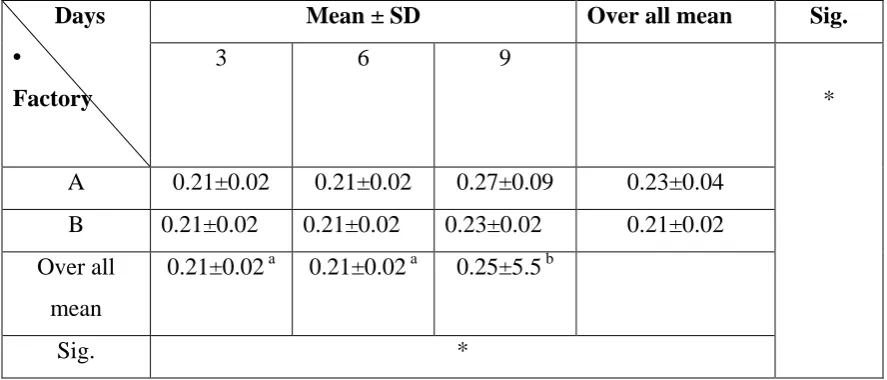
Titratable Acidity revealed no significant differences (p>0.05) on day 3 and 6 for both factories in the obtained values compared to the SSMO. However, it was significantly (p<0.05) higher than that of the SSMO on day 9 (table, 1).
Phosphatase Enzyme Test revealed that all samples tested in factory B were freed of phosphatase as indicated by brown colour. But, 6.7% of the samples obtained from factory A revealed blue colour, indicating the presence of phosphatase.
Isolation of E.coli bacteria showed higher values (60%) from factory B compared to (6.7%) from factory A. The colonies of E.coli revealed a green metallic colour. Total Bacterial Countsshowed a significant effect of storage time (3, 6 and 9 days) on total bacterial counts (table 2). Moreover, the pasteurized milk of factory B contained high total bacterial count compared to factory A.
Table (1): Titratable acidity of the pasteurized milk of factories: A and B on day 3, 6 and 9 post pasteurization:
Days
•
Factory
Mean ± SD Over all mean Sig.
3 6 9
*
A 0.21±0.02 0.21±0.02 0.27±0.09 0.23±0.04 B 0.21±0.02 0.21±0.02 0.23±0.02 0.21±0.02 Over all
mean
0.21±0.02 a 0.21±0.02 a 0.25±5.5 b
Sig. *
*= significant differences (p < 0.05) SD= Standard Deviation
a, b= means within the same row with different superscription are significantly different (p < 0.05). •15 samples for each factory (A and B).
Table (2): Total bacterial count (10-4) of the pasteurized milk of factories: A and B at day 3, 6 and 9 post pasteurization:
Days
*
Factory
Mean ± SD Over all mean sig
3 6 9
** A 1040.6±1617.6 349.9±495.6 10.0±14.1 466.8±1007.4 B 161.1±197.4 963.4±1703.0 1009.9±1685.62 711.5±1346.9 Over all
mean
600.86±1181.15a 656.68±1225.85a 509.95±1241.22b
Sig **
**= high significant differences (p < 0.01) SD= Standard Deviation.
a, b= means within the same raw with different superscription are significantly different (p<0.05). * 15 samples for each factory (A and B)
Discussion and Conclusion
The sensory evaluation of colour, flvour, taste and consistency showed no significant differences in the thirty packaged pasteurized milk samples in both factories: A and B ,which had eventually met the requirements of the standards (Harrigan and Park ,1991).The negativity of Clot and Boiling test on day 3 and 6 post production of pasteurized milk in both factories complied with the standards. However, on day 9, 40% and 20%of the samples in the respective factories: A and B were clotted. Acidity degree showed no significant differences between the two factories. This is in line with the standards which rates 0.18% to lactic acid (Harrigan and Park ,1991). However, Elmagli and Elzubeir (2006) reported that the mean titratable acidity of pasteurized milk was valued as 0.14 and 0.86% lactic acid. Moreover, it was revealed that the titratable acidity for Sudanese dairy milk had a range of 0.16-0.22% with a mean of 0.19% lactic acid (Hayes et al., 2001).Such disparities could be attributed to the status of initial raw milk. Phosphatase enzyme test showed a positivity of 6.7% in samples of factory A, but no positivity for factory B. This indicates that the samples of factory A have not met the standards (Harrigan and Park,1991) compared to factory B whose samples are in line with (Griffiths and Goffl ,2006 ; Dasilva et al.,2001).This could be obviously explained by proper process of milk pasteurization. The presence of E.coli at the rate of 6.7% and 60% in the pasteurized milk in factories A and B, respectively might be due ineffective pasteurization of milk and or poor hygienic production (Campbell and Marshal, 1975 ; Idris et al.,1975). This result is in line with that of (Richardson ,1985; Sayed Ahmed, 2006) ,but is not doing so with health conditions (Harrigan and Park ,1991).In developing countries it has been found that the enterotoxigenic E.coli (ETEC) bacteria represent the important potentiality for diarrhoea in all age groups in areas of poor hygiene particularly in the tropics where isolation rate of ETEC ranged between 10% and 70% (Smit ,2005).Moreover, the presence of E.coli may explain faecal contamination of pasteurized milk due to enteric pathogens. Total bacterial counts
showed significant differences (p<0.05) at concentration of 10-4 between the milk produced by both factories. However, indicator of the hygienic conditions of pasteurized milk is expressed in the sense that the nonpathogenic organisms shall be 50,000 cells per milliliter (Harrigan and Park ,1991).Thus; the high total bacterial counts are due to high temperature, which enhances growth and multiplication of bacteria under tropical conditions. In addition, inadequate sanitary conditions for milk production in dairy farms, unavailability of cooling system during handling and transportation of milk have exacerbated the keeping quality of milk. Samia et al. (2013) revealed that the log total bacterial count (cfu/ml) at the temperature 5˚C and 10˚C was 2.448±0.064 and 2.534±0.057, respectively. While the log total coliform (cfu/ml) under similar circumstances was found to be 0.223± 0.034 and 0.235±0.031, respectively. Furthermore, improper application of hazard analysis control critical point (HACCP) principles could contribute to the production of unhygienic pasteurized milk (SSMO, 2007) .Hence partial application of the standards by some factories might have led to low pasteurized milk in Khartoum and White Nile States as supported by Harrigan and Park (1991) who indicated high total bacterial counts and the presence of E.coli. Hence, pasteurization process is efficient in reducing microorganisms as supported by the findings of Dumalisile et al.(2005).It is recommended that the HACCP system be established and that the standards be abided by rather than implementation of quality insurance programmes. This necessitates a regular monitoring and evaluation of all factories and dairy plants by the key stakeholders. Further studies are needed to investigate factors influencing the keeping quality of milk and milk products under Sudan conditions.
ACKNOWLEDGEMENTS
We are grateful to Administration of Animal Production Research Centre, Hilat Kuku, Khartoum North and the staff members, Milk laboratory, Sudan University for Science and Technology College of veterinary Medicine and Animal Production Khartoum North for amicable cooperation in undertaking this research .
References:
Andrewes, W. (1997). Manual of food quality control for microbiological analysis, FAO , Food and Drug Administration Washington D.C (U.S.A.). Campbell , John.R and Marshal ,Robert T. (1975). The Science of providing milk for man. Newyork, St.Louis, San Francisko.
Dasilva ZNDA, CunhaAS, LinsMC, Carneiro LDEAM, Almeidia AC and
Queuro ML (2001) . Isolation and serological identification of entero pathogenic Escherichia coli in pasteurized milk in Brazil, Rev.Sande bublica,35(4):375-379.
Dumalisile, P.,Witthuhn , R. and Jbritz , T (2005). Impact of different pasteurization temperatures on the survival of microbial contaminants isolated from pasteurized milk.International Journal of Dairy Technology.58(2):74- 82.
Elmagli , A.A.O and El Zubeir , I.E.M. (2006).Study on the compositional quality of pasteurized milk in Khartoum State (Sudan). International Journal of Dairy Sciences. 1(1):12– 20.
El Zubeir, I.E.M., V. Gabriechise , Q. Johnson (2007). Study on some quality control measures of pasteurized milk of the Western Cape , South Africa. International Journal of Dairy Sciences. 2(4):372-379.
Gomez, K.A and Gomez, A.A.(1984).Statistical procedures for agricultural research. 2nd edition Wiley and Sons,Inc.
Griffiths, M.W. and Goffle, H.D. (2006) . Major advances in fresh milk and milk products . Fluid milk products and frozen desserts. American Dairy Science.69: 1163-1173.
Gross, R. J. and Rowe, B. (1985). Escherichia coli diarrhea .J. Hyg. Comb. 95:531- 550.
Harding, F.(1999).Milk quality. 2nd edition.Aspen publishers, Inc. printed in Britain at St. Edmunsbury press.
Harrigan, W.F. and Park, R.W.A (1991).The hazard analysis critical control point system and its implementation. In : Making safe food: A management guide for microbiological quality-P.p146-148.
Hayes, M.C ,Murphy,R.D ,Ralyea, SC, Carey NR, Scarlelt JM and Bo or KJ(2001). Identification and characterization of elevated microbial counts
in bulk tank raw milk. J.Dairy sci.84:292-298.
Houghtby , G. A. , Maturin, L. J. and Koenig , E. K.(1999). Microbiological count
methods . In: Standard methods for the examination of dairy products.
Marshal , T.R. (Editor) . American Public Health Association, Washington, DC, USA.
Idris, O.F., Mustafa A. A. and Wahbi A. A. (1975). Physiochemical and bacterial composition of raw milk supply to three towns. Sud. J. Vet. Sci and Ani. Husb. 16, 87-93.
Kameni, A., Imele, H. and Mbanya, N.J. (2002). An alternative heat treatment for milk pasteurization in Cameroon. International Journal of Dairy
Technology.55(1):40-43.
Richardson, G.H (1985). Standard methods . Examination of dairy products. Phosphatase method: 311-315.
Sayed Ahmed, B.M. (2006). Isolation of coli form Escherichia coli, and other aerobic bacteria from pasteurized milk samples in Khartoum and Khartoum North. M.Sc. Thesis, University of Khartoum.
Smit, G. (2005). Dairy processing improving quality. Future trends, pp.69-230. SSMO.(2007). Sudanese Standards and Metrology Organization.