Figure 1: The Chinese whispers main panel
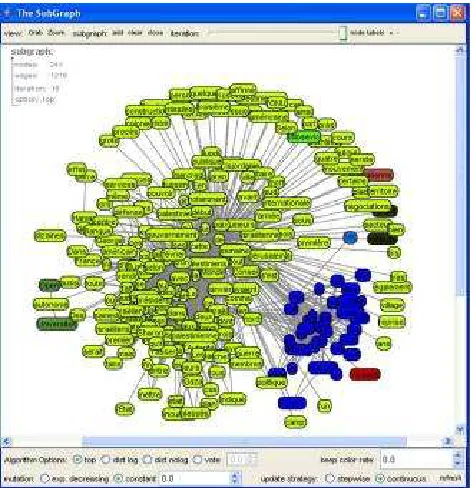
Figure 2: The visualization of a a subgraph after a cluster-ing
Pretrees can be trained using data from databases, files or directly given input. Trained pretrees can be saved directly or pruned beforehand. The tool allows also to use pretrees for classification (see Fig. 4).
3.3. Zipf’s Law Visualization for Corpora
For an introduction to quantitative linguistics, this tool en-ables to visualize Zipfian distributions (Zipf, 1949) for word frequency lists and documents. Various parameters are computed, rank-frequency lists are browseable and the plot can be exported in various formats. The tool uses input from a file, a database or from plain text input. It extracts the words from the given input, calculates the frequencies and other values of the words and presents the results in ta-bles and in a diagram. The output panel contains several
Figure 3: The pretree train panel
Figure 4: The pretree classify panel
subpanel which report the following results.
On the “Statistics” subpanel, the overall figures for the corpus are summarized (see Fig. 5); the “Table” subpanel lists all word types with their frequency (see Fig. 6). The “Ranks” subpanel provides a similar view as the “Table” subpanel, but for a selected subset of ranks. The “Count” subpanel gives a comparison of the real data and the fitted Zipfian distribution. The results can be exported to an open document table or a csv file. The diagram can be saved as a
Figure 6: The Zipf distribution analysis tool table panel
Figure 7: A fitted Zipfian distribution
png file and is displayed in the diagram panel (see Fig. 7).
3.4. Hierarchical Agglomerative Clustering
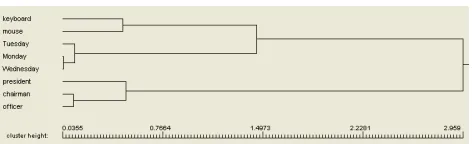
This basic implementation of hierarchical agglomerative clustering allows clustering elements represented as vectors using various norms and distance measures (Heyer et al., 2006). As example configuration, words can be clustered by their common significant co-occurrences (available from LCC in 15 languages). The result can be exported as XML file or in dendrogram picture format (see Fig. 8).
To determine the distance between clusters based on their member elements, the following distance functions are se-lectable:single, complete, average, average group and cen-troid linkage and Ward’s method. As distance functions between two vectors the following function are selectable: L1- and L2-norm, Dice and Jaccard coefficient and the co-sine.
The clustering tool can read feature vectors from files and from a database.
Figure 8: A sample clustering of words for English
Figure 9: The Genetomorph panel
3.5. Genetic Morphology Analysis: Genetomorph
This tool provides a genetic algorithm that is able to detect morphological regularities in word lists (Kazakov, 1997; Kazakov, 2001). A fitness function that minimizes the cost of describing morphological rules is optimized, individual solutions can be browsed and the progress until conver-gence is visualized in a plot. Sample data is available for German nouns and adjectives.
The algorithm is initialized with a list of words containing morphological marks. These marks can be set randomly but can also represent given morphological knowledge.
4.
Linguistic Tools
4.1. Similar Words: Levenshtein Distance
Based on a Directed Acyclic Word Graph (DAWG) imple-mentation, this tool allows efficient basic spell checking by offering words from a given word list with Levenshtein distances (Levenshtein, 1965). As resources, we provide the top frequent 50.000 words for 15 languages. Building DAWGs from custom word lists is possible.
For example, the Italian wordlist returns for the misspelled input word “spagetti” the correct spelling “spaghetti” with distance 1 and offers “spetti”, “soggetti”, “panetti” and “paletti” with distance 2 (cf. Fig. 10 with the French ex-ample “humanitai”).
There are two kinds of output. One list contains all words that have the specified maximum amount of Levenshtein distance, sorted in ascending order. The other contains all possible continuations of the entered (possibly partial) word (see Fig. 10).
4.2. Baseform Reduction and Compound Noun Splitting
Figure 10: The Levenshtein tool panel
size. In applications, this results in sparse data, challeng-ing a number of NLP applications. For IR experiments with German, Braschler et al. report that decompound-ing results in higher text retrieval improvements than stem-ming (Braschler and Ripplinger, 2003).
Most string classification problems can be solved by using a Compact Patricia Tree (CPT, see Sect. 3.2.). Accordingly, this module, designed to perform baseform reduction and compound splitting, comprises an efficient implementation of a CPT and is bundled with data for base form reduction for English, German and Norwegian, as well as German noun compound splitting.
Applied to real-world problems, such as the baseform re-duction, precision and recall depend mostly on the size and variety of the training data and achieves F-values in the high 90% range. CPTs have sucessfullt applied to other tasks including name gender classifications or as a gener-alization module in an unsupervised morpheme segmenta-tion algorithm (Bordag, 2007). Unsupervised approaches of learning compound splits are described in (Larson et al., 2000; Monz and de Rijke, 2002; Holz and Biemann, 2008). In (Holz and Biemann, 2008) CPTs are built up for splitting and for periphrasing compounds.
To facilitate experimentation with training or unclassified data, the GUI is split into two parts: base form reduction and compound noun decomposition.
The base form reduction panel is designed to reduce word form to their base forms. For this, the language and the part of speech must be provided (see Fig. 11).
The noun compound decomposition panel is designed to specifically split compounds into their consecutive parts and additionally reduce the parts to their base forms.
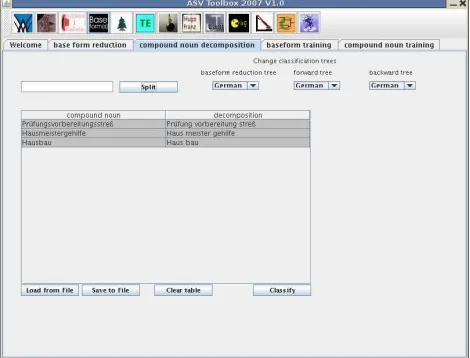
As parameter one of the provided languages or own data in form of a CPT has to be chosen (see Fig. 12). Com-pound decomposition is implemented by recursively apply-ing CPT classifiers to split parts from the beginnapply-ing and the end of the word. Once the parts are identified, they are re-duced to base form by applying a POS-independent base form reducer.
Figure 11: The base form reduction panel
Figure 12: The compound noun decomposition panel
4.3. Terminology Extraction
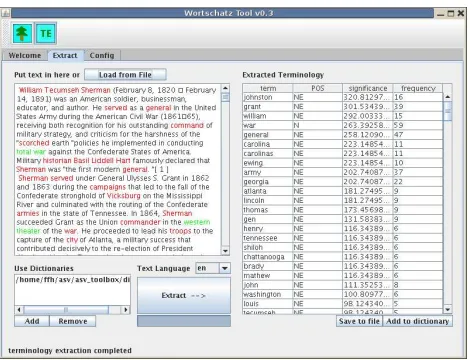
Comprising the non-interactive part of (Witschel, 2004)’s terminology extraction method, this tool extracts termino-logically relevant terms and phrases from documents by comparing them to a background corpus and given POS-tag patterns. Currently, it is available for English, Finnish and German.
There are several approaches to extract index terms from documents, e.g. statistical (Salton et al., 1975; Cohen, 1995), linguistical (Bourigault, 1992) and hybrid (Daille et al., 1994). One important statistical method is the so-called differential analysis which measures the extent to which the frequency of a word win the given text deviates from its frequency in general usage (Witschel, 2004). The latter fre-quency is determined using a reference corpus, i.e. a large and well-balanced collection of documents in the given lan-guage. The termhood ofwis quantified using a statistical significance measure reflecting the significance of the fre-quency deviation.
Lawrence R. Rabiner. 1989. A tutorial on hidden markov models and selected applications in speech recognition. In Proceedings of the IEEE, volume 77 (2), pages 257– 286.
G. Salton, A. Wong, and C.S. Yang. 1975. A vector space model for automatic indexing. Communications of the ACM, 18(11):613–620.
Mark Steyvers and Josh Tenenbaum. 2005. The large scale structure of semantic networks: Statistical analyses and a model of semantic growth. Cognitive Science, 29(1):41– 78.
Andrew J. Viterbi. 1967. Error bounds for convolu-tional codes and an asymptotically optimum decoding algorithm. IEEE Transactions on Information Theory, 13(2):260–269.
D. J. Watts and S. H. Strogatz. 1998. Collective dynamics of ’small-world’ networks. Nature, 393:440–442. F. Witschel and C. Biemann. 2005. Rigorous
dimen-sionality reduction through linguistically motivated fea-ture selection for text categorisation. In Proceedings of NODALIDA.
Hans Friedrich Witschel. 2004. Text, W¨orter, Morpheme – M¨oglichkeiten einer automatischen Terminologie-Extraktion. Ergon Verlag.
I.H. Witten and E. Frank. 2000. Weka: Practi-cal Machine Learning: Tools and Techniques with Java Implementations. Morgan Kaufmann, http://www.cs.waikato.ac.nz/˜ml/weka/.