Proceedings of Recent Advances in Natural Language Processing, pages 78–85,
Exploiting and Evaluating a Supervised, Multilanguage Keyphrase
Extraction Pipeline for Under-Resourced Languages
Marco Basaldella* and Muhammad Helmy† and Elisa Antolli Mihai Horia Popescu and Giuseppe Serra* and Carlo Tasso*
Artificial Intelligence Laboratory, University of Udine Via Delle Scienze, 208, Udine, Italy
*{name.surname}@uniud.it, †[email protected],
[email protected], [email protected]
Abstract
This paper evaluates different techniques for building a supervised, multilanguage keyphrase extraction pipeline for lan-guages which lack a gold standard. Starting from an unsupervised English keyphrase extraction pipeline, we imple-ment pipelines for Arabic, Italian, Por-tuguese, and Romanian, and we build test collections for languages which lack one. Then, we add a Machine Learning mod-ule trained on a well-known English lan-guage corpus and we evaluate the perfor-mance not only over English but on the other languages as well. Finally, we re-peat the same evaluation after training the pipeline over an Arabic language corpus to check whether using a language-specific corpus brings a further improvement in performance. On the five languages we analyzed, results show an improvement in performance when using a machine learn-ing algorithm, even if such algorithm is not trained and tested on the same language. 1 Introduction
Automatic Keyphrase Extraction (herein AKE) is the task of extracting “a short list of phrases (typi-cally from five to fifteen noun phrases) that cap-tures the main topics discussed in a given doc-ument” (Turney, 2000). Recently, Automatic keyphrase extraction has received a lot of atten-tion, because it has been successfully used in many natural language processing (hence NLP) and in-formation retrieval tasks, such as text summariza-tion (Zhang et al., 2004) or document clustering (Hammouda et al.,2005).
The AKE problem is tackled with different techniques. For example, researchers proposed
solutions using e.g. supervised Machine Learn-ing algorithms (herein ML), graph-based rankLearn-ing algorithms, or clustering techniques, the first be-ing the most successful one (Hasan and Ng,2014; Merrouni et al.,2016).
Resources to train and evaluate AKE algorithms are available for a variety of domains, like scien-tific papers, abstracts, newswire texts, emails, etc. (Hasan and Ng, 2014). However, AKE is typi-cally performed on the English language, mainly due to the fact that datasets were not available in other languages. Recently, though, there has been a surge in interest in building AKE datasets in dif-ferent languages, like French or Arabic (Bougouin et al.,2016;Helmy et al.,2016a).
Following this path, in this paper we propose a multilingual keyphrase extraction pipeline, which performs keyphrase extraction in English, Ara-bic, Italian, Portuguese and Romanian. However, while resources for English and Arabic are read-ily available, to our knowledge for the latter three languages there are no publicly available AKE datasets. Nevertheless, we show that it is actually possible to build an AKE pipeline for a language which lacks a gold standard. To prove our hypoth-esis, we first train a ML model that can extract keyphrases in English and Arabic. Then, we use that model to extract keyphrases in the other lan-guages. Finally, we validate the proposed solution using expert knowledge.
2 Related Work
The problem of multilinguality in AKE is not new. It started in late 90’s in order to provide ap-proaches for IR users to handle multilingual doc-uments: for example,Tseng(1998) built an unsu-pervised, language-independent AKE system and demonstrated its effectiveness on English and Chi-nese. Since then, many language-independent
proaches have been proposed, but most of them are still unsupervised or require the collection of ad-hoc corpora when evaluated on languages other than English.
For example, DegExt (Litvak et al.,2013) was introduced as an unsupervised language indepen-dent keyphrase extractor. DegExt uses a simple graph-based syntactic representation of text and web documents (Schenker et al.,2005). The eval-uation was performed on an English corpus (DUC 2002) and one purpose-built corpus of 50 Hebrew documents.
Bougouin et al.(2013) proposed TopicRank as an unsupervised, language-independent AKE sys-tem. TopicRank creates a graph of the document where each node is a topic appearing in the doc-ument, then it uses graph ranking techniques to score the topics and select keyphrases belonging to the top ranked topics. The authors evaluate their approach on four datasets, two on the English lan-guage (the SEMEVAL 2010 corpus (Kim et al., 2010) and the Inspec dataset (Hulth, 2003)), and two on the French language, one freely available and one purpose-built by them.
DIKpE-G (Degl’Innocenti et al.,2014) was pro-posed as a novel multi-language, unsupervised, knowledge-based approach towards keyphrase generation. DIKpE-G integrates several kinds of knowledge for selecting and evaluating meaning-ful keyphrases, ranging from linguistic to statisti-cal, meta/structural, social, and ontological knowl-edge, and it has been evaluated on the Italian lan-guage using a custom-built dataset of 50 scientific papers.
Finally, LIKE (Aquino et al., 2013) was pre-sented as a supervised method that uses feed-forward neural networks for automatically extract-ing keywords from a document regardless of the language used in it. While the authors claim that LIKE is a truly language-independent AKE sys-tem, it is trained and evaluated only on the English language.
3 Multilanguage Keyphrase Extraction To build an AKE system for a specific language the first step is to understand which parts of the pipeline needs to be adapted. Therefore, we divide the AKE pipeline in modules and we identify the language-dependent ones:
1. Low-level NLP: sentence and word segmen-tation, part-of-speech tagging and stemming;
2. Candidate generation: selection of the possi-ble keyphrases in the document. It is usually performed by detecting the phrases which match certain known part-of-speech tags pat-terns;
3. Feature extraction: candidates are assigned some features, like position in the text, fre-quency, etc.
4. Candidate scoring: the feature extracted in the previous step are used to assign a score to the candidates; then, the top ranked can-didates are usually used to evaluate the pipeline.
In this work we focus on the first, second and fourth steps, which are the ones which rely mostly on language-specific knowledge, by implementing several AKE pipelines in the Distiller keyphrase extraction framework (Basaldella et al.,2015).
3.1 Low-level NLP
The first step of the AKE pipeline consists in preparing the document to identify the potential keyphrases, by splitting the text into sentences and the sentences into tokens and, finally, performing part-of-speech tagging, stemming and/or lemmati-zation.
We use off-the-shelf libraries to perform these tasks. For the English and Arabic languages, we used the Stanford CoreNLP library for all the tasks except stemming, since it offers state-of-the-art performance. Due to the limited availabil-ity of languages available for CoreNLP, for the Portuguese and Italian languages we used the the Apache OpenNLP1library with the default models
for Portuguese and Ciapetti’s models for the Ital-ian language2. For the Romanian language, the
models were not available, so we built them our-selves; we describe this process in Section 3.1.1.
To stem the tokens, we used the Tartarus stem-mer (Porter, 1980) for all languages but Arabic, where lemmatization was used instead of stem-ming. Thus, the lemmatizer used for the Arabic language is the AraMorph lemmatizer ( Buckwal-ter,2002).
3.1.1 Romanian
We were not able to find any suitable CoreNLP or OpenNLP models for the Romanian language to
1https://opennlp.apache.org/ 2https://github.com/aciapetti/
perform sentence splitting, tokenization, and PoS tagging. Thus, we decided to build our own mod-els for Apache OpenNLP using the ROMBAC3
dataset (Ion et al.,2012).
The corpus contains about 41,000,000 words in-cluding punctuation and it is divided in five do-mains: journalism, pharmaceutics and medicine, law, biographies of Romanian literary person-alities, and fiction. We tested different train-ing/testing split to obtain the best possible per-formance. For the training of the sentence detec-tor and tokenizer, we used the journalism domain, while to train the POS tagger we used the journal-ism, medicine, and fiction domains.
3.1.2 Arabic
Being very different from the Western languages we previously described (Farghaly and Shaalan, 2009;Habash,2010), the Arabic language needed additional text preprocessing steps.
The text is cleaned by removing all unneces-sary characters like the special Arabic punctuation marks, diacritics, and Kashida4. In addition, some
Arabic characters have various forms which we normalize into a single one to decrease the pro-cessing complexity.
Another issue about Arabic is that punctuation is used differently than in English and other West-ern languages. In fact, Arabic has traditionally no punctuation, and it is still usual to find modern Arabic books written in this way (Dickins et al., 2016). In the other languages we analyze, we triv-ially assume that all the words of a keyphrase have to appear within the same sentence. Since it may be not possible to distinguish sentences in an Ara-bic input text, we follow the approach described in (Helmy et al.,2016b), assuming that the tokens of a keyphrase in the Arabic language should appear in the same syntactic noun phrase.
3.2 Candidate Generation
Candidate generation requires more domain knowledge than simply using an off-the-shelf li-brary. To generate the candidate keyphrases, we scan the text for phrases that match certain part-of-speech tag sequences (we will call such sequences
PoS patternsfrom now on). For example, for the present document, a valid keyphrase may be
“mul-3The Romanian Balanced Annotated Corpus
4Also called Tatweel, it is a form of Arabic text justifica-tion that, instead of adding whitespace, adds an horizontal, slightly curvilinear stroke between certain letters.
tilingual keyphrase extraction”, which PoS pattern is “(adjective, noun, noun)”.
These patterns are typical of the AKE task and they require to be engineered by a domain ex-pert, since they are significantly different from language to language. For example, the English phrase “software engineering” is translated in Ital-ian as “ingegneria del software”, wheredel is an
articulated preposition, i.e. the union of an arti-cle with a preposition, a part of speech which does not exist in the English language. This example shows also that in some languages we will look for shorter n-grams, while other, more verbose lan-guages may require a larger n. For example, in English we look typically up to 3-grams (Pudota et al.,2010;Kim et al.,2010), while in Italian our system will look for 1 to 5-grams.
For the English, Arabic, and Italian language, we used known PoS patterns from the literature (Basaldella et al., 2016; Helmy et al., 2016b; Basaldella et al.,2015). For the other languages, we were not aware of existing PoS patterns. For this purpose, we collected about 500 author as-signed keyphrases both in Portuguese and Roma-nian from scientific repositories and we performed PoS tagging on them. Then, we picked the most frequent patterns, after manually removing or cor-recting the erroneous ones (e.g. pattern with only conjunctions, etc.).
3.3 Features Extraction
After the identification of the candidate keyphrases we assign to each of them seven features. Most of the features assigned to can-didate keyphrases rely simply on statistical and structural information (like the position in the text, frequency, TF-IDF, and so on) (Hasan and Ng, 2014). While researchers have developed language-dependent features, based e.g. on part of speech tags (Hulth, 2003), on anaphora resolution (Basaldella et al., 2016) or based on external knowledge like Wikipedia (Medelyan et al., 2009), this kind of features requires long computational times and specialized tools which may not be available for all languages. Thus, we decided to leave them out of our pipeline.
In our system, we take four features from Pu-dota et al. (2010) and we use them for unsuper-vised keyphrase extraction only. These features are:
a candidate appears in the document normal-ized to the number of sentences;
Height i.e. the relative position of the first occur-rence of the candidate in the document;
Depth i.e. the relative position of the last occur-rence of the candidate in the document;
Lifespan i.e. the difference between the last and the first appearance of the candidate, i.e. given a candidate kp for a docu-ment d, lifespan(kp, d) = depth(kp, d)− height(kp, d).
We add three other features to this set to per-form supervised kephrase extraction, namely:
Frequency i.e. the number of times a keyphrase
kpappears in a documentd. While this fea-ture may seem redundant with normalized frequency, our experiments showed that us-ing both features leads to better results. To see why, just consider the word “candidate” in the present document: it has been repeated many times in the same sentence, e.g. in the definition of thelifespanfeature;
TF-IDF i.e. one of the first features used for AKE along withheight(Witten et al.,1999). A common statistic used in information re-trieval to identify which candidates are pe-culiar of that particular document with re-spect to a corpus, is the product of theterm frequency tf and the inverse document fre-quencyidf;
DPM i.e. Document Phrase Maximality, is used to discriminate between overlapping keyphrases and it helped to reach new state-of-the-art performance in the AKE task (Haddoud and Abdeddaim, 2014). Given a documentdand the candidate keyphrasekp, we define the set sup(kp, d) of the supert-erms ofkp candidate keyphrase, i.e. the set of the candidates that contain kp as a sub-string. For example, if we have a docu-mentdwhich talks about “software engineer-ing”, we have that “software engineering”
∈sup(“software”, d).
3.4 Candidate Scoring
To score the candidates, the most trivial approach in this kind of AKE pipeline is to assign heuristi-cally crafted weights to the features, like inPudota
et al.(2010). Typically, however, one can train a machine learning algorithm over a dataset, like the SEMEVAL 2010 dataset (Kim et al., 2010), and use the generated model to identify keyphrases of new documents. Unfortunately, as pointed out in the introduction, datasets are available only for a minority of languages, so this is not always a vi-able option.
In our system we used three different scoring techniques. First, since we do not have training sets for all five languages, we assigned manual weights to four of our features, using values which have proven to work on the English language ( Pu-dota et al.,2010). Then, we trained two models, one for English using the SEMEVAL 2010 dataset and one for Arabic using the AKEC dataset. Fi-nally, we used the models trained on these lan-guages to score keyphrases in Italian, Romanian and Portuguese as well.
3.4.1 Manual Weights
In this approach we follow a very simple tech-nique. Given a candidate keyphrase kp, a fea-ture f, and the set of the features F, we define
value(kp, f)as a function which returns the value offfor the candidatekp. For each feature, we also assign a weightw, whose value is defined below. Then, the score of a keyphrasekpis computed as follows:
score(kp) =
|F|
X
i=1
wi×value(kp, fi)
As mentioned in Section3.3, the features used in this step are normalized frequency, height,
depth, andlifespan, and the values of their weights
wi are respectively 0.1, 0.32, 0.16 and 0.12, as presented inPudota et al.(2010). We did not re-compute the values of the weights by ourselves, because authors already proved its effectiveness, and since we just want to use them as a baseline.
3.4.2 Supervised Weights
The manual weights technique is trivially limited by the fact that these weights are used to compute a simple linear function. Many machine learning algorithms are instead able to learn nonlinear func-tions, and for this reason are commonly used for AKE in literature (Hasan and Ng,2014).
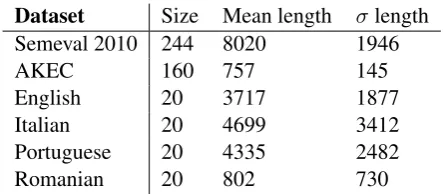
For the English language, we use the dataset from the “SEMEVAL-2010 Task 5: Automatic Keyphrase Extraction from Scientific Articles” challenge (Kim et al., 2010) (herein, simply SE-MEVAL 2010). For the Arabic language, the net-work has been trained on the recent AKEC corpus (Helmy et al.,2016a). The corpora have 244 and 160 documents respectively, of which 144 are used for training and 100 for testing in the SEMEVAL 2010 dataset, and 100 are used for training and 60 for testing in the AKEC dataset (see Table1) .
The neural network has been trained using the
nnetpackage in the R programming language us-ing theentropyparameter. The network uses one neuron per input feature, a hidden layer with two times the input neurons, and one output neuron. The keyphrases are ranked according to the score assigned by the network, which is the value of the output neuron.
We use the models trained on these datasets to extract keyphrases in all our five languages. This is possible because the neural network ignored the text of the actual candidate keyphrase, since it does not receive any information about its words or about its meaning, but only statistical informa-tion about its appearance(s) in the input document.
4 Experimental Evaluation
While it is straightforward to analyze the perfor-mance of our model in English and Arabic since both the SEMEVAL 2010 and AKEC datasets pro-vide test sets, for Italian, Portuguese and Roma-nian we are not aware of publicly available collec-tions of keyphrase extraction datasets.
For this reason, we asked mother tongue speak-ers of these three languages to collect 20 docu-ments per language and assign 15 keyphrases to each document, ranking them by importance. To have a further verification of our techniques, we did the same process for 20 documents in the En-glish language as well. The collected datasets are described in Table 1. For English, Italian and Portuguese, we have collected similar datasets with a majority of scientific documents, which is reflected by mean of about 4000 words per document. For Romanian, we collected mainly
newswire documents, so we have a mean of 800 words per document, close to the AKEC dataset. All the purpose-built datasets have a greater vari-ability in the number of words with respect to the SEMEVAL 2010 and AKEC datasets, because
Dataset Size Mean length σ length Semeval 2010 244 8020 1946
AKEC 160 757 145
English 20 3717 1877
Italian 20 4699 3412
Portuguese 20 4335 2482
Romanian 20 802 730
Table 1: The datasets used to train and test the pipelines, with their number of documents, their mean length in words, and the standard deviation
σof the length in words.
while these datasets are composed by only one kind of documents with strict constraints on the length, our test datasets are mixed, containing sci-entific papers, newswire text, web pages, etc.
For all three approaches, we evaluate our al-gorithms using Precision computed on the top 5 extracted keyphrases (herein Precision@5 or P@5), and Precision and F1-score computed on the top 15 extracted keyphrases (herein P@15 and F1@15) and Mean Average Precision (MAP). Note that for our own datasets, since they have only 15 expert-assigned keyphrases, the Precision score and the F1 score on the top 15 candidates are equal5, so for these datasets we show only the
former.
5 Experimental Results
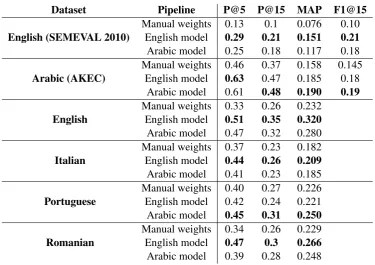
We present the results obtained in our experiments in Table 2. As expected, the manual weights method achieves the lowest performance. This is true in particular for the SEMEVAL 2010 dataset; on the other datasets, though, the performance is higher, with 40% and 46% P@5 score on the Portuguese language and Arabic language re-spectively. This scores seem to be particularly good, since the best performing system in the SE-MEVAL 2010 challenge obtained 40% in P@5.
Using the English model we obtained better per-formance on the SEMEVAL 2010 dataset with 21% F-Score, which would be enough to be placed
9thover 19 systems in the challenge. Since we are not interested in getting the best score but we want to get an average AKE system, this result looks acceptable. Moreover, the score of our neural net-work greatly outperforms the manual baseline, so
5Because the size of the set of the retrieved documents is equal to the size of the set of the relevant documents, hence
Dataset Pipeline P@5 P@15 MAP F1@15
Manual weights 0.13 0.1 0.076 0.10
English (SEMEVAL 2010) English model 0.29 0.21 0.151 0.21
Arabic model 0.25 0.18 0.117 0.18 Manual weights 0.46 0.37 0.158 0.145
Arabic (AKEC) English model 0.63 0.47 0.185 0.18 Arabic model 0.61 0.48 0.190 0.19
Manual weights 0.33 0.26 0.232
English English model 0.51 0.35 0.320
Arabic model 0.47 0.32 0.280 Manual weights 0.37 0.23 0.182
Italian English model 0.44 0.26 0.209
Arabic model 0.41 0.23 0.185 Manual weights 0.40 0.27 0.226
Portuguese English model 0.42 0.24 0.221 Arabic model 0.45 0.31 0.250
Manual weights 0.34 0.26 0.229
Romanian English model 0.47 0.3 0.266
Arabic model 0.39 0.28 0.248
Table 2: The results obtained with the different 15 experiment we executed.
were are satisfied and we decided to use it on the other languages.
The Arabic model obtains similarly satisfactory results on the AKEC dataset. We have no other systems to compare our model with, since the dataset has been recently released, but the 61% P@5 Score is hugely outperforming the best sys-tem in the SEMEVAL 2010 challenge and a 15% improvement over the manual weights, so we’re satisfied with this result.
After we validated the machine learning mod-els, we proceeded to use them for the other lan-guages. Using the English and Arabic models to extract keyphrases in Italian, Portuguese, and Romanian offersalwaysan improvement with re-spect to the manual weights, and the same holds for our English countercheck collection.
Analyzing the results for each language, we see that the English model outperforms the Arabic one on the English, Italian and Romanian language, while the Arabic model performs better on the Portuguese language only. Looking at the Preci-sion@15 score, of particular interest is the English model on the English and Romanian collections, and the Arabic model again on the English col-lection and on the Portuguese one, all of which reach and/or surpass 30%, outperforming again the best performing systems on the SEMEVAL 2010 dataset.
Anyway, a direct comparison of our results with the one obtained in the SEMEVAL 2010 challenge is clearly not fair, since the documents in our col-lections are significantly shorter, so the problem we had to solve was easier (Hasan and Ng,2014). This is the reason why our English model per-forms better on our collections than on the SE-MEVAL 2010 dataset, the reason why the Ara-bic model performs better on the AKEC collection than on the other datasets, and a probable reason of the poor performance of the unsupervised weights, sincePudota et al.(2010) tailored them on docu-ments with a different length.
6 Conclusions
Our approach showed that it is possible to build an effective supervised keyphrase extraction pipeline for an under-resourced language which lacks a keyphrase extraction gold standard by training it on another language. In fact, by training our AKE pipeline over English and Arabic, we were able to obtain good performance on Italian, Romanian and Portuguese as well.
Adam Schenker, Abraham Kandel, Horst Bunke, and Mark Last. 2005. Graph-theoretic techniques for web content mining, volume 62. World Scientific. Yuen-Hsien Tseng. 1998. Multilingual keyword
ex-traction for term suggestion. InProceedings of the 21st annual international ACM SIGIR conference on Research and development in information retrieval. ACM, pages 377–378.
Peter D. Turney. 2000. Learning algorithms for keyphrase extraction. Information Retrieval 2(4):303–336.
Ian H. Witten, Gordon W. Paynter, Eibe Frank, Carl Gutwin, and Craig G. Nevill-Manning. 1999. Kea: Practical automatic keyphrase ex-traction. In Proceedings of the Fourth ACM Conference on Digital Libraries. ACM, New York, NY, USA, DL ’99, pages 254–255. https://doi.org/10.1145/313238.313437.