TexAFon 2.0:
A text processing tool for the generation of expressive speech in TTS
applications
Juan María Garrido, Yesika Laplaza, Benjamin Kolz, Miquel Cornudella
Department of Translation and Language Sciences, Pompeu Fabra University, Barcelona, Spain Roc Boronat 138, 08108 Barcelona, Spain
E-mail: [email protected], [email protected], [email protected], [email protected]
Abstract
This paper presents TexAfon 2.0, an improved version of the text processing tool TexAFon, specially oriented to the generation of synthetic speech with expressive content. TexAFon is a text processing module in Catalan and Spanish for TTS systems, which performs all the typical tasks needed for the generation of synthetic speech from text: sentence detection, pre-processing, phonetic transcription, syllabication, prosodic segmentation and stress prediction. These improvements include a new normalisation module for the standardisation on chat text in Spanish, a module for the detection of the expressed emotions in the input text, and a module for the automatic detection of the intended speech acts, which are briefly described in the paper. The results of the evaluations carried out for each module are also presented.
Keywords: emotion detection, speech act detection, text normalisation
1.
Introduction
Language and speech technological applications in general, and TTS systems in particular, have increasingly to deal, among many other aspects, with the processing and generation of expressive language (messages coming from speech-based person-machine interfaces, e-mail, SMS, chat or Twitter, for example). Current text processing modules of TTS systems have to be improved with new capabilities to process efficiently this type of text:
• Text normalisation. Many of these texts with expressive content are not written ‘correctly’ (that is, following the standard orthographic conventions of the input language): ‘see U’, in English, or ‘a10’ in Catalan, are becoming usual expressions in many contexts. Classical text processing modules are not able to handle them correctly, because they expect an orthographically correct input text. New correction and normalisation procedures have to be implemented in those systems to convert this ‘incorrect’ input text to a standard form.
• Text analysis. Expressiveness in speech is mainly transmitted through prosody, which is related to several linguistic and paralinguistic factors, such as the presence of focused words, the speech act of the utterance or the emotion being expressed. Current TTS systems do not produce good expressive speech, among other factors, because they cannot extract from texts information relative to the emotion, the speech act or the words that should be pronounced as bearing focus. New procedures should then be included in text processing modules in order to extract from the text as many information as possible relevant for the generation of expressive prosody.
This paper describes several improvements introduced in TexAFon (Garrido et al., 2012) to process correctly text with expressive content. TexAFon is a text processing module in Catalan and Spanish for TTS systems which performs all the typical tasks needed for the generation of synthetic speech from text. Its output can be directly used to generate speech using several synthesis engines, such the one by Cereproc (Garrido et al., 2008) or MBROLA (Dutoit et al., 1996), but it can also be used for other purposes (automatic phonetic transcription, building of phonetic dictionaries). The improvements described here have been focused on the normalisation of non-standard text, and the detection of emotions and speech acts in the input text. Normalisation and emotion detection has only been developed for the Spanish module, but speech act detection is already available both for Catalan and Spanish.
2.
TexAfon 2.0 overview
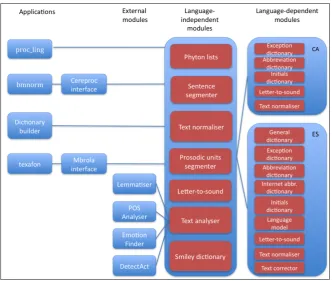
TexAFon is a set of Catalan/Spanish text processing tools for automatic normalization, phonetic transcription, syllabication, prosodic segmentation and stress prediction from text. It has been jointly developed by researchers of the Computational Linguistics Group (GLiCom) of Pompeu Fabra University and the Speech and Language Group at Barcelona Media. Fully developed in Python, TexAFon uses linguistic knowledge-based approaches to perform the text processing tasks. This linguistic knowledge has been implemented in the form of:
• Python procedures, containing the linguistic rules; • Python lists, containing non-editable information; • External dictionaries, stored in text files (then
editable by external users).
Figure 1: General TexAFon 2.0 architecture
Table 2 presents two examples of this normalisation process.
Input text Eso k t llevas Cuando tngas 40 Token
classification Eso [word] K [abbreviation] T
[abbreviation] Llevas [word]
Cuando [word] Tngas [word] 40 [number]
Token expansion
Eso: [eso] K: [que, qué] T: [te, tu, tú] Llevas: [llevas]
Cuando [cuando]
Tngas [angas, ingas, ingás, tajas, tajás, tangas, tanjas, tejas, tengas, tengo as, tijas, tingas, togas, tojas, tongas, tugas, tujas, tungas, unjas, vengas] 40 [cuarenta]
Final correct form selection
Eso: [eso] K: [que, qué] T: [te, tu, tú] Llevas: [llevas]
Cuando [cuando]
Tngas [angas, ingas, ingás, tajas, tajás, tangas, tanjas, tejas, tengas, tengo as, tijas, tingas, togas, tojas, tongas, tugas, tujas, tungas, unjas, vengas] 40 [cuarenta]
Output Text Eso que te
llevas Cuando tengas cuarenta
Table 2: Normalisation workflow for two sample chat utterances of the analysis corpus.
3.2 Evaluation
Table 3 summarizes the results of the evaluation carried out to analyse the performance of the normaliser. It was done on a corpus of 1,222 chat messages (4,069 tokens), different to the one used for the analysis task. The obtained results show that, by applying this normalisation procedure, 70.3% of the tokens considered as ‘incorrect’ by TexAFon 2.0 where correctly normalised, with a final percentage of 85.9% of correct tokens in the output normalised text (24.7% of improvement). These results are similar to the ones obtained with other similar systems described in the literature for Spanish (Armenta et al., 2003, for example).
Standard Non-standard
Text Tokens % Tokens %
Original 2,490 61.2 1,579 38.8
Normalised 3,495 85.9 574 14.1
Table 3: Results of the evaluation of the new normalization module.
4.
Emotion detection
by a separate module (Lemmatiser) which has also been integrated in TexAFon.
EmotionFinder is able to detect eight different emotions in the input text: ‘admiration’, ‘affection’, ‘disappointment’, ‘interest’, ‘happiness’, ‘surprise’, ‘rejection’ and ‘sadness’. It assigns also an emotion intensity label (1, 2 or 3) to the detected emotion.
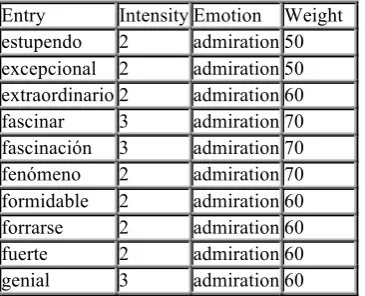
Entry Intensity Emotion Weight estupendo 2 admiration 50 excepcional 2 admiration 50 extraordinario 2 admiration 60
fascinar 3 admiration 70
fascinación 3 admiration 70
fenómeno 2 admiration 70
formidable 2 admiration 60
forrarse 2 admiration 60
fuerte 2 admiration 60
genial 3 admiration 60
Table 4: Sample entries of the emotional dictionary.
The EmotionFinder module is made up of two components:
• An emotional dictionary, which includes words and expressions associated to a given emotion and intensity, and a weight indicating its reliability to detect that emotion. Table 4 shows some examples of entries of this dictionary.
• A set of functions, one per emotion, which combine searching for key words (taken from the emotional dictionary) and regular expressions with rule-based emotion inference.
Both the emotional dictionary and the rules included in the functions have been developed using the results of the analysis of a set of 4,207 utterances of real chat messages in Spanish, which is a subset of the corpus of chat conversations used for the development of the normalisation module. This corpus was labeled with emotional tags by the same annotator who carried out the analysis of orthographic deviations, using the inventory of emotions described in Garrido et al. (2012a), and then partially revised by two people different from the main annotator. This corpus was also used to determine the set of emotions to be detected by EmotionFinder, which is a subset of the list emotions more frequently expressed in the chat conversations of the corpus.
More details about EmotionFinder and its development process can be found in Kolz et al. (2014).
4.1 Emotion detection procedure
The emotion labelling process in EmotionFinder works as follows:
• The input sentence is provided as input to every emotion detection functions to check for possible cues related to the considered emotions. If a function detects one or several cues for its corresponding emotion in the input sentence, it generates as output the following information: label of the candidate emotion; the predicted intensity of the emotion (1, 2 or 3); and an associated weight indicating how reliable is the cue for the detection of that emotion, which is the sum of the weights all of hits found for the selected emotion in the sentence. So for example, the output of the function corresponding to ‘happiness’ for the Spanish sentence “Estoy feliz y encantado con el plan” would be ‘ALEGRIA(3):70’ (happiness with intensity level 3, and weight 70), which would be the result of the combination of the information of two different cues detected in the sentence: the presence of the word ‘feliz’, labeled in the emotional dictionary as ‘ALEGRIA(2):40’ and ‘encantado’, labeled in the dictionary as ‘ALEGRIA(3):30’. This output information is added to the list of ‘candidate emotions’ of the sentence. • After applying all the functions to the input sentence,
the list of candidate emotions is ordered according to the weights obtained by each emotion/intensity pair. The emotion label and intensity with the highest weight is selected as the emotion label for the sentence. If the candidate list is empty, the sentence is labeled as ‘neutral’.
Figure 2: EmotionFinder workflow.
4.2 Evaluation
7.
References
Armenta, A., Escalada, J. G., Garrido, J. M. & Rodríguez, M. A. (2003). Desarrollo de un corrector ortográfico para aplicaciones de conversión texto-voz. Procesamiento del Lenguaje Natural, 31, pp. 65-72. Dutoit, T., Pagel, V., Pierret, N., Bataille, F., & Van der
Vrecken, O. (1996). The MBROLA Project: Towards a Set of High-Quality Speech Synthesizers Free of Use for Non-Commercial Purposes. Proceedings ICSLP 96, Philadelphia, 3, pp. 1393-1396.
García, D. & Alías, F. V. (2008). Identificación de emociones a partir de texto usando desambiguación semántica. Procesamiento del Lenguaje Natural, 40, pp. 75-82.
Garrido, J. M., Bofias, E., Laplaza, Y., Marquina, M., Aylett, M., & Pidcock, Ch. (2008). The CEREVOICE speech synthesiser. Actas de las V Jornadas de Tecnología del Habla (Bilbao, 12-14 noviembre 2008), pp. 126-129.
Garrido, J. M., Laplaza, Y., Marquina, M, Pearman, A., Escalada, J. G., Rodríguez, M. A. and Armenta, A. (2012a). The I3MEDIA speech database: a trilingual annotated corpus for the analysis and synthesis of emotional speech, LREC 2012 Proceedings: pp.
1197-1202. Online:
http://www.lrec-conf.org/proceedings/lrec2012/pdf/86 5_Paper.pdf, accessed on 21 March 2014.
Garrido, J. M., Laplaza, Y., Marquina, M., Schoenfelder, C., and Rustullet, S. (2012b). TexAFon: a multilingual text processing tool for text-to-speech applications. Proceedings of IberSpeech 2012, Madrid, Spain, November 21-23, 2012, pp. 281-289.
Kolz, B., Garrido, J. M., Laplaza, Y. (2014). Automatic prediction of emotions from text in Spanish for expressive speech synthesis in the chat domain, Procesamiento del Lenguaje Natural, 52. Online:
http://journal.sepln.org/sepln/ojs/ojs/index.php/pln/arti cle/view/4904/2918, accessed on 21 March 2014. Leech, G. and Weisser, M. (2003). Generic speech act
annotation for task oriented Dialogues. Proceedings of the Corpus Linguistics 2003 conference, University Centre for Computer Corpus Research on Language, Technical Papers 16.1, pp. 441-446.
Python Language Website, http://www.python.org/. Webb, N., Hepple, M., & Wilks, Y. (2005). Dialogue act