A Graph Technique to Determine the Minimum Number of Wavelength for
some WDM Optical Networks
B. Amutha*1, R.Nithya2
1Assistant Professor, Department of Mathematics, Prist University, Thanjavur, Tamilnadu, India 2M. Phil Scholar , Department of Mathematics, Prist University, Thanjavur, Tamilnadu, India
ABSTRACT
Wavelength division multiplexing (WDM) is a promising technique to utilize the enormous bandwidth of the optical fibre (~50 terabits per second) into multiple communication channels with bandwidths (~10 gigabits per second) compatible with the electronic speed of the end users. In WDM network, it is possible to route data to their respective destinations based on their wavelengths. The use of wavelength to route data is referred to as wavelength routing and a network which employs this technique is known as a wavelength routed network. When network does not employ any intermediate O/E conversion between access stations, it is called as an all-optical wavelength routed network. In order to send data from one access station to another station, one needs to establish a connection in the optical layer similar to the case in a circuit-switched network. This can be realized by determining a path in the network between the two nodes and allocating a free wavelength on all of the links on the path. Such an all optical path is referred to as a light path and may span multiple fiber links without any intermediate electronic processing. The entire bandwidth available on this light path is allocated to the connection during its holding time during which the corresponding wavelength cannot be allocated to any other connection. This requirement is referred to as wavelength continuity constraint.
Keywords : Wavelength Division Multiplexing, Circuit-Switched Network, Bruijn Networks, Shuffle-Exchange
I.
INTRODUCTIONA connection or lightpath in a WDM network is an ordered pair of nodes (x,y) corresponding to transmission of packet from source x to destination y. We assume that no wavelength converter facility is available in the network. Thus, a connection must use the same wavelength throughout its path. In this case, the lightpath satisfies the wavelength continuity constraint. The number of wavelengths required for a collection of connections in a WDM network under the wavelength - continuity constraint is determined using a graph G = (V,E), in which each connection in the network is represented by a vertex in G. Let E be the set of edge and * be the binary operation defined on E is a combination of edge in E such that resultant
element is light path and F = (E, *) be the light path which is a path between the vertices, to apply the colouring technique for the following networks we consider the nodes as the vertex set and edge set as the algebraic system F.
This problem has been studied extensively and is of use for various applications (Ali et al2000, Bermond et al 2000, Chen et al 2002, Hu et al 1998, Hadas 2000, Hadas et al 2002Malli et al 1998, Pankaj 1999, Sahasrabudde et al 1999, Thaker et al 2002, Xin et al2004, Noronha et al 1996, Rouskas 2002 and Zhang et al 2000).
Multicast Assignment
Due to the non uniform nature of multicast communication, the study of multicast communication is, in general, much more difficult and complex than that of uni cast communication. To facilitate the analysis, a well defined type of multicast communication pattern referred to as multicast assignment is investigated in this thesis. A multicast assignment is a mapping from a set of network nodes(the source nodes)to a maximum set of network nodes (the destination node) with no overlapping allowed among the destination nodes of different source nodes. Some examples of multicast assignment in a 4 -node network is shown in Fig(i)
Fig(i) Examples of multicast assignment in a 4-node network.
Some Regular Networks Linear Array Network
An n node WDM linear array and a random set of connections in it is shown in Fig(2). Clearly, there are only two possible directions for any connection in a linear array. In such network each connections between a source and destination is either right ward or leftward. In a WDM network, the connections on the same link in different directions may use the same wavelength. To determine the sufficient number of wavelengths for a multicast assignment,
we assume the connections in the same direction use different wavelengths. At any network state, if an existing connection is released, the wavelength it used can be reused by a new connection in either direction, notice that there are at most N - 1 connection in the same direction in a multicast assignment.
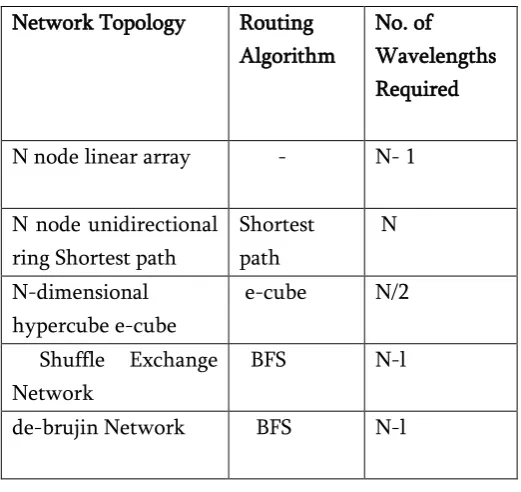
Let E be the set of edge and * be the binary operating defined on E is a combination of edge in E such that resultant element is light path and F = (E,*) be the light path between the vertices to apply the coloring problem for the following networks we consider the nodes as the vertex set and edge set as the algebraic system F. For a linear array, there exists a light path between every pair of vertices in the network. Hence except the source node the remaining vertices should be coloured with different colours. Therefore the chromatic number of the coloring problem is N - 1. Thus N - 1 wavelengths are required for a linear array.
Ring Network
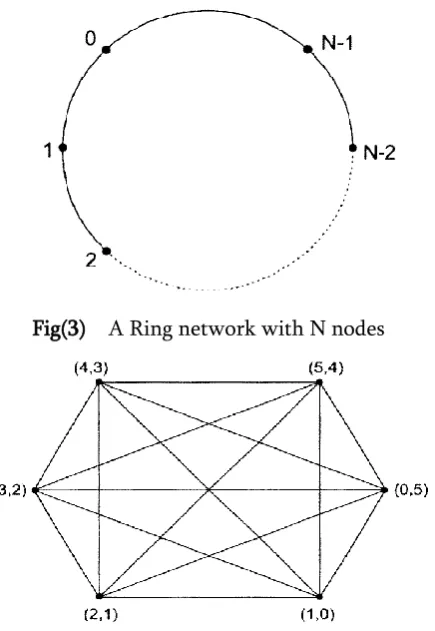
Fig(3) A Ring network with N nodes
Fig(4) Multicast Assignment of Ring Network
Based on the definition of a multicast assignment, there are a total of N connections in any multicast assignment. If a new connection is requested, assign it a wavelength that is not currently used. If an existing connection is released, its wavelength can be reused.
Consider the multicast assignment ( ∏ * ( ) + Fig.4, shows such an assignment for N = 6). Since each node in the network is the source of one connection and each connection covers N - 1 nodes that are the sources of other connection, each connection shares links with other N-l connections. This implies that each connection shares link with all other connections. In this case we known that the graph of this multicast assignment is an N-node complete graph as shown in Fig 4, Clearly the chromatic number of the graph is N. Hence, at least, N wavelengths are required.
Hypercube (Cube - Connected) Network
A hyper cube network consists of 2k nodes forming a
k - dimensional hypercube. The nodes are labeled 0, 1,2..., 2k-1; two nodes are adjacent if their
labels differ in exactly one bit position. A three - dimensional hypercube is shown in Fig 5
Fig(5). A hypercube with eight nodes
In our analysis of wide- sense nonblocking condition for WDM hypercube, ecube routing algorithm is used, which is a deterministic shortest path routing algorithm with dimension crossing from the lowest to highest. Specially, e-cube routing is defined as follows. To present our results, for WDM hypercubes, the following definitions are used. Based on the binary address of each node, a hypercube can be divided into two subcubes. In the 0 subcube, the first bit of the binary address of each node is 0. In thel Subcube, the first bit of the binary address of each node is 1. For a connection in the hypercube, if the destination of this connection is in the 0-subcube, it is referred to as a 0- connection; if the destination of the connection is in thel -subcube, it is referred to as a 1- connection.
another through 1 connection). Therefore we need N/2 lightpaths to reach through 1 connections from 0 connections because there are only as many destinations are available. Hence if we apply colouring for these edges constituted by the lightpaths, the chromatic number is found out as N/2, so N/2 wavelengths are sufficient.
Shuffle- Exchange and de-Bruijn networks. Shuffle-Exchange.
A Shuffle-Exchange network with 8 nodes shown if Fig 6, has two kinds of connections, called shuffle and exchange. The shuffle connections are always unidirectional whereas exchange connections are always bidirectional. Exchange connections link pairs of nodes whose numbers differ in their least significant bit. The perfect shuffle connection links node i with node 2i mod (N-l), with the exception that node N-l is connected to itself. Every node in shuffle exchange network has two outgoing and two incoming links. Hence there are 4N links altogether for an N node network.
Fig(6). Shuffle - Exchange Network with Eight nodes
de-Bruijn :
A de-Bruijn network shown in Fig.7 consists of N=2k
nodes. Let expressed in binary,
be the address of a node in the de-Bruijn Network. The two nodes reachable via directed edges from that node are,
Through the de Bruijn network contains only shuffle connections, every node in this network also has to outgoing and two incoming links as in the case of
shuffleexchange network. Hence, again there are totally 4N links in this network for N nodes.
Fig(7). A 8 Node de Bruijin Network
III. REFERENCES
1. Agarwal A., Bar-Noy A., Coppersmith D., Ramaswami R., Schieber B, and Sudan M. (1994), ‘Efficient routing and scheduling algorithms for optical networks’, Proc. OfACM-SIAM Symposium on Discrete Algoriiims, pp.412-423.