Evaluating Multilingual Question Answering Systems at CLEF
Pamela Forner
1, Danilo Giampiccolo
2, Bernardo Magnini
3, Anselmo Peñas
4, Álvaro Rodrigo
5,
Richard Sutcliffe
61-2 Center for the Evaluation of Language and Communication Technologies (CELCT), Trento, Italy 3 Fondazione Bruno Kessler (FBK), Trento, Italy
4-5 NLP & IR Group, UNED, Madrid, Spain 6 University of Limerick, Limerick, Ireland
[email protected], [email protected], [email protected], [email protected], [email protected], [email protected]
Abstract
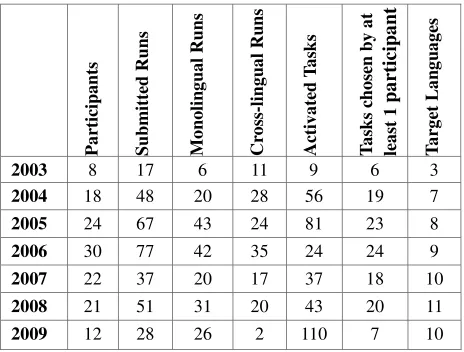
The paper offers an overview of the key issues raised during the seven years’ activity of the Multilingual Question Answering Track at the Cross Language Evaluation Forum (CLEF). The general aim of the Multilingual Question Answering Track has been to test both monolingual and cross-language Question Answering (QA) systems that process queries and documents in several European languages, also drawing attention to a number of challenging issues for research in multilingual QA. The paper gives a brief description of how the task has evolved over the years and of the way in which the data sets have been created, presenting also a brief summary of the different types of questions developed. The document collections adopted in the competitions are sketched as well, and some data about the participation are provided. Moreover, the main evaluation measures used to evaluate system performances are explained and an overall analysis of the results achieved is presented.
1.
Introduction
Under the promotion of the TREC-8 (Voorhees and Tice, 1999) and TREC-9 (Voorhees, 2000) Question Answering tracks, research in Question Answering (QA) received a strong boost. The aim of the TREC QA campaigns was to assess the capability of systems to return exact answers to open-domain English questions. However, despite the great deal of attention that QA received at TREC, multilinguality was outside the mainstream of QA research. Multilingual QA emerged as a complementary research task, representing a promising direction for at least two reasons. First, it allowed users to interact with machines in their native languages, contributing to easier, faster, and more equal information access. Second, cross-lingual capabilities enabled QA systems to access information stored only in language-specific text collections.
Since 2003, a Multilingual Question Answering Track has been carried out at the Cross Language Evaluation Forum (CLEF)1
.
The introduction of multi-linguality represented not only a great novelty in the QA research field, but also a good chance to stimulate the QA community to develop and evaluate multilingual systems. During the years, the effort of the organizers was focused on two main issues. One concern was to offer an evaluation exercise characterized by cross-linguality, covering as many languages as possible. From this perspective, major attention was given to European languages, adding at least one new language each year. However, the offer was also kept open to languages from1http://www.clef-campaign.org
all over the world, as the inclusion of Indonesian shows. The other important issue was to maintain a balance between the established procedure – inherited from the TREC campaigns – and innovation. This has allowed newcomers to join the competition and, at the same time, offered “veterans” more challenges.
An additional merit of the QA track at CLEF is the creation of reusable multilingual collections of questions and related answers, which represent a useful benchmark resource.
This paper is organized as follows: Section 2 gives a brief description of how the task has evolved over the years, the way in which the data sets have been created, giving also a brief overview of the different types of question developed, the document collections adopted and some data about participation; Section 3 gives a brief explanation of the different measures adopted to evaluate system performance; in Section 4 some results of the participants are discussed highlighting some important features; and finally in Section 5 some conclusions are drawn.
2.
The QA Track at CLEF
The QA task consists of taking a short question and a document collection as input and producing an exact answer as output.
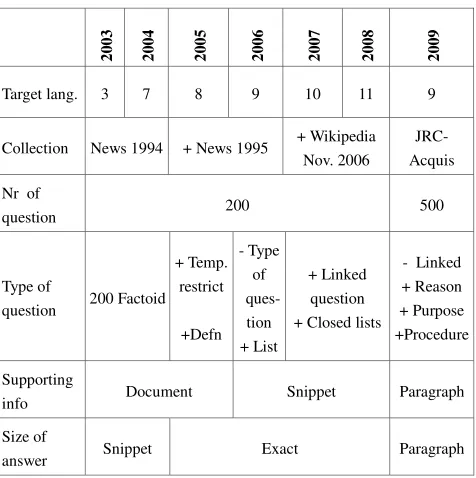
of the document in which the exact answer was found, and depending on the year, also by portion(s) of text, which provided enough context to support the correctness of the exact answer. Table 1 summarizes all the novelties that have been introduced in the main task over the years of QA campaigns. Each year, a main task was proposed, which constantly evolved, becoming more and more challenging by addressing different types of questions and requiring different types of answer format as output.
Table 1: Evolution of the task of QA at CLEF campaigns
In all campaigns, the QA track was structured in both monolingual and bilingual tasks. The success of the track showed an increasing interest in both monolingual non-English QA – where questions and answers are in the
same language – and in cross-lingual QA – where the
question is posed in a language and the answer must be found in a collection of a different language.
2003 2004 2005 2006 2007 2008 2009
QA Tasks
Multiple Language QA Main
Task ResPubliQA
Answer Validation
Exercise (AVE) GikiCLEF Real
Time
QA over Speech Transcriptions (QAST)
WiQA WSD QA
Table 2: Pilot tasks at QA at CLEF campaigns over the years
QA at CLEF was also an opportunity to experiment with several pilot tasks, as Table 2 shows, i.e. Real Time Question Answering (Noguera et al., 2007), Answer Validation (Peñas et al., 2006), Question Answering over Speech Transcripts (Lamel et al., 2007), Word Sense Disambiguation for Question Answering, Question
Answering using Wikipedia (Jijkoun & de Rijke, 2007), and GikiCLEF (Santos & Cabral, 2009).
The common goal of these pilot tasks was to investigate how QA systems and technologies are able to cope with different types of questions from those proposed in the main task, experimenting with different scenarios.
2. 1 Data Collection
The procedure for generating questions did not significantly change over the years. For each target language, a number of questions (ranging from 100 to 200 depending on the campaign) were manually produced, initially using the topics of the Ad-Hoc track at CLEF. The use of topics was originally introduced to reduce the number of duplicates in the multilingual question set. Together with the questions, a gold standard was also produced, by manually searching for at least one answer in a document collection. The questions were then translated into English, which acted as lingua franca, so that they could be understood and reused by all the other groups. Once the questions were collected in a common format, native speakers of each source language, with a good command of English, were recruited to translate the English version of all questions into their own languages, trying to adhere as much as possible to the original.
The introduction of back translation to create cross-lingual question-answer pairs – a paradigm developed in 2003 and used ever since – is one of the most remarkable features of QA at CLEF.
Questions were classified according to different types. In the first campaigns, only two types of questions were considered, i.e.:
– factoid questions, i.e. fact-based questions, asking for the name of a person, a location, the extent of something, the day on which something happened, etc., for example:
Ex. 1:
• Who was Lisa Marie Presley's father?
• What year did the Second World War finish?
• What is the capital of Japan?
• What party did Hitler belong to?
– definition questions, i.e. questions like "What/Who is X?”, for example:
Ex. 2:
• Who is Lisa Marie Presley?
• What is Amnesty International?
• What is a router?
• What is a tsunami?
In 2006, list questions were introduced for the first time. They consisted of both "closed lists", i.e. questions that require one answer containing a determined number of items (see Example 3), and “open lists”, where many correct answers could be returned (see Example 4).
20
03
20
04
20
05
20
06
20
07
20
08
20
09
Target lang. 3 7 8 9 10 11 9
Collection News 1994 + News 1995 + Wikipedia Nov. 2006
JRC- Acquis
Nr of
question 200 500
Type of
question 200 Factoid
+ Temp. restrict
+Defn - Type
of ques-
tion + List
+ Linked question + Closed lists
- Linked + Reason + Purpose +Procedure
Supporting
info Document Snippet Paragraph
Size of
Ex. 3:
Q: Name all the airports in London, England. A: Gatwick, Stansted, Heathrow, Luton and City.
Ex. 4:
Q: Name books by Jules Verne.
A: A Journey to the Centre of the Earth, From the Earth to the Moon, Twenty Thousand Leagues Under the Sea, Around the World in Eighty Days, Eight Hundred Leagues on the Amazon.
In 2007, with the introduction of topic-related questions, the procedure followed to prepare the test set changed considerably. First of all, each organizing group, responsible for a target language, freely chose a number of topics. For each topic, one to four questions were generated. The topic-related questions consisted of clusters of questions which were related to the same topic. The requirement for related questions on a topic necessarily implies that the questions refer to common concepts and entities within the domain in question. Unlike in the previous campaigns, topics could be not only named entities or events, but also other categories such as objects, natural phenomena, etc.
Topics were not given in the test set, but could be inferred from the first question/answer pair. For example, if the topic was George W. Bush, the cluster of questions
related to it could have been:
Ex. 5:
Q1: Who is George W. Bush?; Q2: When was he born?; Q3: Who is his wife?
The requirement that questions are grouped by topics implied that the questions related to the same topic could refer to common concepts and entities within the cluster. In a series of questions this is expressed especially by co-reference – a well known phenomenon within Natural Language Processing which nevertheless had not been considered in previous QA at CLEF exercises.
In 2009 significant changes were introduced in the task. The exercise consisted of extracting not an exact answer but an entire paragraph of text, containing the information needed to satisfy the query, from a set of legal European Union documents. Moreover, new types of questions were introduced, i.e.:
– Purpose questions, asking for the aim, goal or objective of something, for example:
Ex. 6:
Q: Why have the imports of live poultry from Romania been suspended?
P: (2) Commission Decision 2005/710/EC of 13 October 2005 concerning certain protection measures in relation to highly pathogenic avian influenza in Romania [5] provides that Member States are to suspend imports of live poultry, ratites and farmed and
wild feathered game and hatching eggs of those species from the whole territory of Romania and of certain products from birds from parts of that territory.
– Procedure questions, asking for a set of actions which is the official or accepted way of doing something, for example:
Ex. 7:
Q: How do you find the maximum speed of a vehicle? P: The maximum speed of the vehicle is expressed in
kilometers per hour by the figure corresponding to the closest whole number to the arithmetical mean of the values for the speeds measured during the two consecutive tests, which must not diverge by more than 3 %. When this arithmetical mean lies exactly between two whole members it is rounded up to the next highest number.
2.2 Document Collections
Before 2009, the target corpora in all languages, released by ELRA/ELDA, consisted of large, unstructured, open-domain text collections which were comparable because they were made up of newspaper and news agency articles referring to the same time span (1994/1995). The texts were SGML tagged and each document had a unique identifier (docid) that systems had to return together with the answer, in order to support it.
The choice of a different collection was a matter of long discussion, copyright issues remaining a major obstacle. A step towards a possible solution was made by the proposal of the WiQA pilot task, which represented a first attempt to set the QA competitions in their natural context, i.e. the Internet. As nowadays such large information sources are available on the web, this was considered a desirable next level in the evolution of QA systems. An important advantage of Wikipedia was that it is freely available in all languages considered.
In 2007, the Wikipedia was also adopted in the main task, beside the data collections composed of news articles. The “snapshots” of Wikipedia were made available for download both in XML and HTML versions. The answers to the questions had to be taken from actual entries or articles of Wikipedia pages. However, the variations in the size of each Wikipedia, depending on the language, were problematic.
In 2009, a subset of the JRC-Acquis Multilingual Parallel Corpus was used. JRC-Acquis 2 is a freely
available parallel corpus of European Union (EU) documents, mostly of a legal nature. It comprises the contents, principles and political objectives of the EU treaties; EU legislation; declarations and resolutions; international agreements; acts and common objectives. Texts cover various subject domains, including economy, health, information technology, law, agriculture, food, politics and more. JRC-Acquis is being used again in 2010,
In the second experiment, UNED compared the performance of the baseline systems across languages. Because all languages were answering the same questions on the same collection, this enabled them to estimate the intrinsic difficulty of the language itself. By applying the resulting difficulty coefficients to the various submitted runs, they were able to make more accurate comparisons between them.
5 Conclusions
Prior to QA at CLEF, almost all QA was in English. Since the task was started in 2003, numerous groups have participated and experiments have been conducted in many different language pairs. The result is that there are now several QA research groups in almost all the European countries and they have sufficient expertise to create systems which can perform complex tasks. In addition to numerous research innovations within systems themselves, there have also been steps forward in the evaluation process itself. These have included the use of several new evaluation measures, the progress towards comparison of systems in different languages, and the development of sophisticated tools for the organization of the tasks.
Another important output has been the multilingual test sets and their associated gold standard answers and document collections. These are made possible by the ingenious paradigm of back-translation which was introduced in 2003 and has been very successfully used at CLEF ever since. Moreover, all this material is available online allowing groups in future to re-use the data produced in order to develop and tune their systems.
Finally, what can be concluded from the results about the QA task itself? Generally, English factoid QA as investigated at TREC over the years is considered to be a solved problem which is no longer worth investigating. Following the activity at CLEF, performance of monolingual non-English systems has improved substantially, to the extent that they are approaching that of the best English systems. Now is the time, therefore, to look at different types of question and different task scenarios, a process which has already started in 2009 with ResPubliQA4.
Concerning cross-lingual systems, their performance has not shown a comparable improvement over the years to that of monolingual ones because high-performance machine translation remains an unsolved problem, especially where named entities are concerned (e.g. ‘Sur les quais’ translates as ‘On the Waterfront’). Thus translation in the QA domain warrants further investigation if multilingual barriers to text processing are to be overcome.
4http://celct.isti.cnr.it/ResPubliQA
6 Acknowledgements
The QA evaluation campaigns at CLEF is a joint effort of several institutions and people which collaborated at the creation of the data set in the various languages involved each year.
Also TrebleCLEF Coordination, within FP7 of the European Commission, Theme ICT-1-4-1 Digital Libraries and Technology Enhanced Learning (Contract 215231) support must be acknowledged for its fund for ground truth creation.
Álvaro Rodrigo has been supported by the Education Council of the Regional Government of Madrid and the European Social Fund.
7 References
Forner, P., Peñas, A., Alegria, I., Forascu, C., Moreau, N., Osenova, P., Prokopidis, P., Rocha, P., Sacaleanu, B., Sutcliffe, R., Tjong Kim Sang, E. (2008). Overview of the CLEF 2008 Multilingual Question Answering Track. In C. Peters, T. Mandl, V. Petras, A. Peñas, H. Müller, D. Oard, V. Jijkoun, D. Santos (Eds.),
Evaluating Systems for Multilingual and Multimodal
Information Access, 9th Workshop of the
Cross-Language Evaluation Forum, CLEF 2008, Aarhus, Denmark, September 17-19, 2008, Revised Selected Papers.
Giampiccolo, D., Forner, P., Herrera, J., Peñas, A., Ayache, C., Forascu, C., Jijkoun, V., Osenova, P., Rocha, P., Sacaleanu, B., Sutcliffe, R. (2007). Overview of the CLEF 2007 Multilingual Question Answering Track. In: C. Peters, V. Jijkoun, T. Mandl, H. Müller, D.W. Oard, A. Peñas, D. Santos (Eds.), Advances in Multilingual and Multimodal Information Retrieval, 8th Workshop of the
Cross-Language Evaluation Forum, CLEF 2007, Budapest, Hungary, September 19-21, 2007, Revised Selected Papers.
Herrera, J., Peñas, A., Verdejo, F. (2005). Question Answering Pilot Task at CLEF 2004. Multilingual Information Access for Text, Speech and Images. CLEF 2004. Volume 3491 of Lecture Notes in Computer
Science, 581--590.
Jijkoun, V., and de Rijke, M. (2007). Overview of the WiQA Task at CLEF 2006. In C. Peters, P. Clough, F. C. Gey, J. Karlgren, B. Magnini, D. W. Oard, M. de Rijke, M. Stempfhuber (Eds.), Evaluation of Multilingual and Multi-modal Information Retrieval,
7th Workshop of the Cross-Language Evaluation Forum, CLEF 2006, Alicante, Spain, September 20-22, 2006, Revised Selected Papers.
Lamel, L., Rosset, S., Ayache, C., Mostefa, D., Turmo, J., Comas P. (2007). Question Answering on Speech Transcriptions: the QAST Evaluation in CLEF. In: C. Peters, V. Jijkoun, T. Mandl, H. Müller, D.W. Oard, A. Peñas, D. Santos (Eds.), Advances in Multilingual and Multimodal Information Retrieval, 8th Workshop of the
Magnini, B., Giampiccolo, D., Forner, P., Ayache, C., Jijkoun, V., Osenova, P., Peñas, A., Rocha, P., Sacaleanu, B., Sutcliffe, R. (2006). Overview of the CLEF 2006 Multilingual Question Answering Track. In C. Peters, P. Clough, F. C. Gey, J. Karlgren, B. Magnini, D. W. Oard, M. de Rijke, M. Stempfhuber (Eds.), Evaluation of Multilingual and Multi-modal Information Retrieval, 7th
Workshop of the Cross-Language Evaluation Forum, CLEF 2006, Alicante, Spain, September 20-22, 2006, Revised Selected Papers.
Magnini, B., Vallin, A., Ayache, C., Erbach, G., Peñas, A., de Rijke, M., Rocha, P., Simov, K., Sutcliffe, R. (2004). Overview of the CLEF 2004 Multilingual Question Answering Track. In C. Peters, P. Clough, J. Gonzalo, G. J. F. Jones, M. Kluck, B. Magnini (Eds.), Multilingual Information Access for Text, Speech and Images, 5th
Workshop of the Cross-Language Evaluation Forum, CLEF 2004, Bath, UK, September 15-17, 2004, Revised Selected Papers.
Magnini, B., Romagnoli, S., Vallin, A., Herrera, J., Peñas, A., Peinado, V., Verdejo, F., de Rijke, M. (2003). The Multiple Language Question Answering Track at CLEF 2003. In C. Peters, J. Gonzalo, M. Braschler, M. Kluck (Eds.), Comparative Evaluation of Multilingual Information Access Systems, 4th Workshop of the
Cross-Language Evaluation Forum, CLEF 2003, Trondheim, Norway, August 21-22, 2003, Revised Selected Papers.
Noguera, E. Llopis, F. Ferrandez, A. Escapa, A. (2007). Evaluation of Open-Domain Question Answering systems within a time constraint. In Advanced Information Networking and Applications Workshops,
AINAW '07. 21st International Conference.
Peñas, A., Forner,P., Sutcliffe, R., Rodrigo, Á., Forascu, C., Alegria, I., Giampiccolo, D., Moreau, N., Osenova, P. (2009). Overview of ResPubliQA 2009: Question Answering Evaluation over European Legislation. In Borri, F., Nardi, A. and Peters, C. (Eds.), Cross Language Evaluation Forum: Working Notes of CLEF 2009, Corfu, Greece, 30 September - 2 October.
Peñas, A., Rodrigo, Á., Verdejo, F. (2007). Overview of the Answer Validation Exercise 2007. In C. Peters, V. Jijkoun, T. Mandl, H. Müller, D.W. Oard, A. Peñas, V. Petras, and D. Santos, (Eds.), Advances in Multilingual and Multimodal Information Retrieval, LNCS 5152,
September 2008.
Peñas, A., Rodrigo, A., Sama, V., Verdejo, F. (2006). Overview of the Answer Validation Exercise 2006. In C. Peters, P. Clough, F. C. Gey, J. Karlgren, B. Magnini, D. W. Oard, M. de Rijke, M. Stempfhuber (Eds.),
Evaluation of Multilingual and Multi-modal Information Retrieval, 7th Workshop of the Cross-Language
Evaluation Forum, CLEF 2006, Alicante, Spain, September 20-22, 2006, Revised Selected Papers. Rodrigo, Á., Peñas, A., Verdejo, F. (2008). Overview of the
Answer Validation Exercise 2008. In C. Peters, T. Mandl, V. Petras, A. Peñas, H. Müller, D. Oard, V. Jijkoun, D. Santos (Eds.), Evaluating Systems for Multilingual and Multimodal Information Access, 9th Workshop of the
Cross-Language Evaluation Forum, CLEF 2008, Aarhus, Denmark, September 17-19, 2008, Revised Selected Papers.
Santos, D. and Cabral, L.M. (2009). GikiCLEF: Crosscultural issues in an international setting: asking non-English-centered questions to Wikipedia. In Borri, F., Nardi, A. and Peters, C. (Eds.), Cross Language Evaluation Forum: Working Notes of CLEF 2009, Corfu,
Greece, 30 September - 2 October.
Turmo, J., Comas, P., Rosset, S., Lamel, L., Moreau, N., Mostefa, D. (2008). Overview of QAST 2008. In In C. Peters, T. Mandl, V. Petras, A. Peñas, H. Müller, D. Oard, V. Jijkoun, D. Santos (Eds.), Evaluating Systems for Multilingual and Multimodal Information Access, 9th
Workshop of the Cross-Language Evaluation Forum, CLEF 2008, Aarhus, Denmark, September 17-19, 2008, Revised Selected Papers.
Turmo, J., Comas, P.R., Rosset, S., Galibert, O., Moreau, N., Mostefa, D., Rosso, P. Buscaldi, D. (2009). Overview of QAST 2009. In Borri, F., Nardi, A. and Peters, C. (Eds.), Cross Language Evaluation Forum: Working Notes of CLEF 2009, Corfu, Greece, 30
September - 2 October.
Vallin, A., Magnini, B., Giampiccolo, D., Aunimo, L., Ayache, C., Osenova, P., Peñas, A., de Rijke, M., Sacaleanu, D., Santos, D., Sutcliffe, R. (2005). Overview of the CLEF 2005 Multilingual Question Answering Track. In C. Peters, F. C. Gey, J. Gonzalo, H. Müller, G.J.F. Jones, M. Kluck, B. Magnini, M. de Rijke (Eds.), Accessing Multilingual Information Repositories, 6th Workshop of the Cross-Language Evaluation Forum,
CLEF 2005, Vienna, Austria, 21-23 September, 2005, Revised Selected Papers.
Voorhees, E.M., Tice, D.M. (1999). The TREC-8 Question Answering Track Evaluation. In Proceedings of the Eight Text Retrieval Conference (TREC-8).
Voorhees, E. M. (2000). Overview of the TREC9 Question Answering Track. In Proceedings of the Ninth Text Retrieval Conference (TREC-9) .