An Adaptive Framework for Named Entity Combination
Bogdan Sacaleanu
1, Günter Neumann
21
IMC AG, 2DFKI GmbH 1
New Business Department, 2Language Technology Department Saarbrücken, Germany
E-mail: [email protected], Gü[email protected]
Abstract
We have developed a new OSGi-based platform for Named Entity Recognition (NER) which uses a voting strategy to combine the results produced by several existing NER systems (currently OpenNLP, LingPipe and Stanford). The different NER systems have been systematically decomposed and modularized into the same pipeline of preprocessing components in order to support a flexible selection and ordering of the NER processing flow. This high modular and component-based design supports the possibility to setup different constellations of chained processing steps including alternative voting strategies for combining the results of parallel running components.
Keywords: Named Entity recognition, voting, meta-model
1.
Introduction
We describe a flexible and dynamic architecture for developing platform independent Named Entities (NE) processors based on existing open source tools. It provides a lightweight framework, called NER-Hub, for integrating and combining reusable text processing components like sentence detectors, tokenizers and NE extractors. Compared to similar platforms like GATE (Cunningham, 2011), the system provides an extended functionality of pulling together the result of comparable components for producing better precision and higher recall than the best of the individual components. This distinctive feature uses a voting mechanism to combine the results of several NE extractors and it can be easily extended to cover other combination approaches.
The NER-Hub framework described in this paper covers
both processing tools mandatory for NE recognition and a voting mechanism for combining results at different stages in the workflow. Along with the framework come implementations of every processing step, namely paragraph selection, sentence detection, tokenization and NE extraction wrapped around components from open-source projects like LingPipe [1], OpenNLP [2] and Stanford NLP [3]. The voting framework delivers a simple implementation of statistics-based methods for combining the results of different NE extraction systems and it can be easily extended to the other stages of processing.
2.
System Architecture
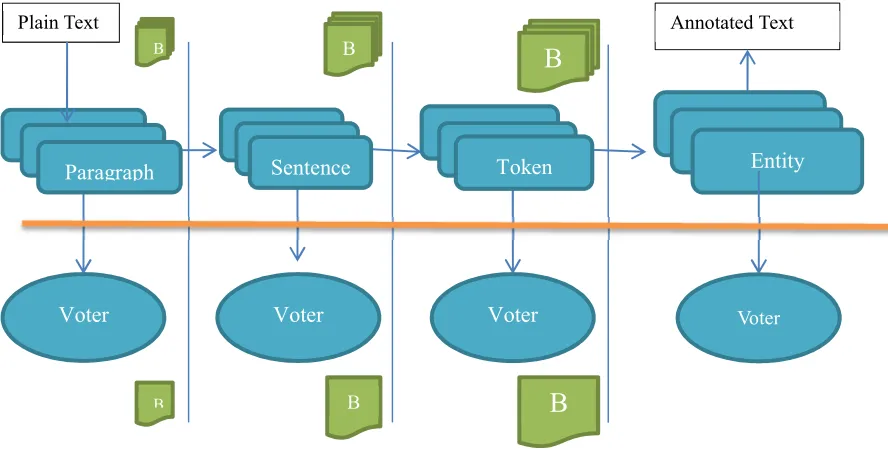
The NER-Hub framework is based on a blackboard architectural model (Figure 1), similar to systems such as Hearsay-II (Erman, 1980), where the communication between modules happens through a shared knowledge structure that is iteratively updated by a group of specialist
Paragraph
Sentence
Token
Plain Text
Paragraph Sentence Token
Voter
Annotated Text
Entity
B B
B
B B
B
Voter
Voter
Voter
Token
Sentence
Paragraph
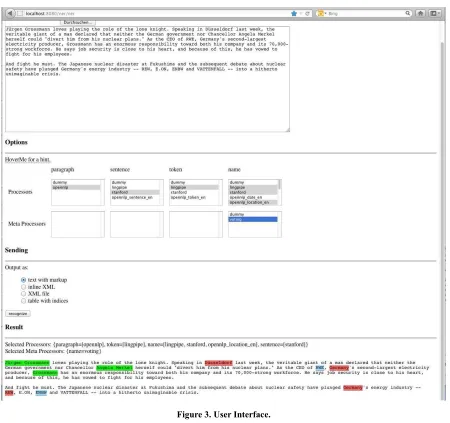
tokenization, sentence detection, named entity recognition, and voting (meta-processor). Typically only one processor can be selected per task. In the case of named entity recognition, one or more options can be selected, but when only one NER is chosen, no voting is performed.
4.
Combining Results by Voting
System combination as a way of improving performance over the individual systems has been reported for different tasks: (Van Halteren et al., 1998) describe successful experiments for part-of-speech tagging, (Kim Sang, 2000) presents improved performance for noun phrase recognition, (Florian et al., 2002) demonstrate significantly lower error rate for word sense disambiguation. Improved results for NE recognition have been reported by (Florian et al., 2003) and (Sigletos et al., 2005) announced better performance for information extraction. A common factor of these system combination approaches is the use of a voting framework that allows different instantiations like count-based voting, confidence-based voting and probability-based voting. Of these voting methods the
probability-based combination of system is significantly delivering improved performance, while simpler statistics-based methods only improve either precision or recall.
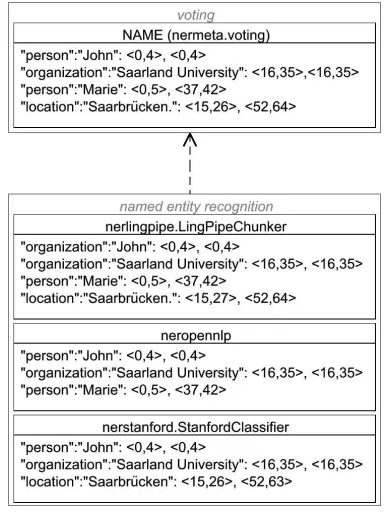
The current version of our NER-Hub framework includes reference implementations for three basic voting methods, namely length-based, count-based and confidence-based voting. The first method returns the candidate(s) with the longest length, whereby the empty candidates are considered to have a length of zero. The count-based method groups candidates by label, start index, and end index and computes a tally. The group with the highest counts are returned as winners (Figure 4).
The confidence-based method allows setting priority values to individual processing units, such that the results of a component are preferred over other results in case of an non-deterministic case (prefer comp1 over all others if output is comp1:x, comp2:y and comp3:z). Due to the high adaptability feature of OSGi-based systems, these voting methods can be called individually or mixed into a new linear workflow.
5.
Status and Running Example
Currently the NER-Hub framework is fully implemented and offering reference implementation for all modules based on components from open-source projects like LingPipe, Open NLP and Stanford NLP.
We demonstrate the main workflow of the system with a practical example, namely what happens with a sample input text in the different processing stages.
Example settings:
• Input text: John studies at Saarland University. Marie lives in Saarbrücken.
• Processors:
o paragraph = opennlp o sentence = lingpipe o token = Stanford
o entity = lingpipe, stanford, opennlp
•
Meta processors: votingThe input gets passed from the user interface to the Controller and wrapped in a NerResultObject at the level “document” with begin and end indices spanning the whole input. The Controller then calls the different available processors (paragraph, sentence, token, and finally name) with it. The wrapped input is first passed to the three components performing text pre-processing tasks. Paragraph detection, sentence splitting and tokenization processors each generate an intermediate NerResultObject representation encoding the additional information they provide. All of these results are combined in a hierarchical structure, which gets passed to every next processor.
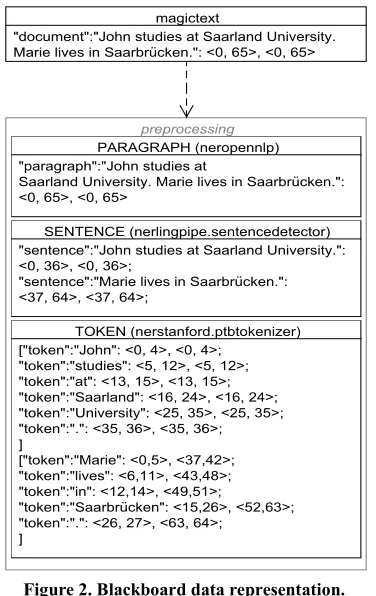
For this particular example, the intermediate results generated by the pre-processors are displayed in Figure 2. The first processor which is called, the OpenNLP paragraph detector, returns only one paragraph, due to the small text example. LingPipe sentence detector recognizes the two sentences, whose NerResultObject parent is set to the paragraph. Finally, the tokens found by the Stanford tokenizer are assigned to their corresponding parent sentences in the hierarchy.
Each NerResultObject in Figure 2 is additionally described by two sets of indices indicating its position in the text. The first set denotes the position with respect to its parent in the hierarchy, and the second – to the original input. This is
visible at the token level, where due to the fact that the first six tokens belong to the first sentence, and the rest to the second, the two sets of indices describing the tokens in the second sentence differ.
After calling all of the pre-processing components, the Controller calls the meta processor for named entity recognition. This processor is responsible for calling the actual named entity recognizers, collecting the results from them and voting on the final result. The input NerResultObject which it receives from the Controller already contains all the information provided by the paragraph, sentence and token processors. The different levels of the hierarchy can be used by each NER individually, based on the kind of input it accepts.
The result produced by the three NERs and the final result after voting can be seen in Figure 4. The two example sentences illustrate the advantage of using the voting strategy, since in this case it manages to avoid all of their individual errors and produces the desired output.
Figure 4. Example of Count-based Voting.
(2002). Combining Classifiers for Word Sense Disambiguation. In Natural Language Engineering 8, 4, 327-341.
Florian, R., Ittycheriah, A., Jing, H., Zhang, T. (2003). Named entity recognition through classifier combination. In Proceedings HLT-NAACL 2003 - Volume 4 (CONLL '03), 168-171.
van Halteren, H., Zavrel, J., Daelemans, W. (1998). Improving data driven wordclass tagging by system combination. In Proceedings of ACL - Volume 1, 491-497.
Tjong Kim Sang, E. F. (2000). Noun phrase recognition by system combination. In Proceedings of NAACL. San Francisco, CA, USA, 50-55.
Sigletos, G., Paliouras, G., Spyropoulos, C. D. and Hatzopoulos, M. (2005). Combining information extraction systems using voting and stacked generalization. In Journal of Machine Learning Research, 6:1751-1782.
Systems
[1] Alias-i. 2011. LingPipe 4.1.0.
http://alias-i.com/lingpipe (accessed February, 2011). [2] Apache Incubator. 2011. OpenNLP 1.5.0.
http://incubator.apache.org/opennlp/index.html (accessed February, 2011).