Using the Annotated Bibliography as a Resource for Indicative Summarization
Min-Yen Kan, Judith L. Klavans, and Kathleen R. McKeown
Department of Computer Science Columbia University New York, New York 10027 USA
fmin,klavans,[email protected]
Abstract
We report on a language resource consisting of 2000 annotated bibliography entries, which is being analyzed as part of our research on indicative document summarization. We show how annotated bibliographies cover certain aspects of summarization that have not been well-covered by other summary corpora, and motivate why they constitute an important form to study for information retrieval. We detail our methodology for collecting the corpus, and overview our document feature markup that we introduced to facilitate summary analysis. We present the characteristics of the corpus, methods of collection, and show its use in finding the distribution of types of information included in indicative summaries and their relative ordering within the summaries.
1.
Introduction
Automatic text summarization has largely been synony-mous with domain-independent, sentence extraction tech-niques (for an overview, see Paice (1990)). These ap-proaches have used a battery of indicators such as cue phrases, term frequency, and sentence position to choose sentences to extract and form into a summary. An alter-native approach is to collect sample summaries and apply machine learning techniques to identify what types of infor-mation are included in a summary, and identify their stylis-tic, grammatical, and lexical choice characteristics and to generate or regenerate a summary based on these charac-teristics. In this paper, we examine the first step towards this goal: the collection of an appropriate summary cor-pus. We focus on annotated bibliography entries, because they are written without reliance on sentence extraction. Futhermore, these entries contain both informative (i.e., de-tails and topics of the resource) as well as indicative (e.g., metadata such as author or purpose) information. We be-lieve that summary texts similar in form to annotated bib-liography entries, such as the one shown in Figure 1, can better serve users and replace standard n-top sentence or
query word in context summaries commonly found in cur-rent generation search engines.
Our corpus of summaries consists of 2000 annotated bibliography entries collected from various Internet web-sites using search engines. We first review aspects and di-mensions of text summaries, and detail reasons for collect-ing a corpus of annotated bibliography entries. We follow with details on the collection methodology and a descrip-tion of our annotadescrip-tion of the entries. We conclude with some current applications of the corpus to automatic text summarization research.
2.
Dimensions of summarization
With the current widespread language resources that are available on the web, constructing a large corpus of docu-ment summaries is becoming easier. However, docudocu-ment summaries have many different aspects and purposes (Mani and Maybury (1999), introduction), and thus it is impor-tant to clarify which aspects of summarization a collection
Maxwell, S. E., Delaney, H. D., & O’Callaghan, M. F. (1993). Analysis of covariance. In L. K. Edwards (Ed.), Applied analysis of ...
This paper gives a brief history of ANCOVA, and then discusses ANCOVA in the context of the general linear model. The authors then provide a numerical example, and discuss the assumptions of ANCOVA. Then four advanced topics are covered: ... This paper is quite theoretical and complex, but contains no matrix alge-bra.
Figure 1: Sample excerpt from an annotated bibliography entry.
covers. We briefly examine several different dimensions of summaries.
Extract versus Abstract - Summaries that are
con-structed by extracting important passages, sentences or phrases from the source document are considered
extracts. In contrast, an abstract may or may not
con-tain words in common with the document. Authors using abstractive techniques are not as constrained as those using extractive ones, and can summarize a wider range of materials effectively (e.g., narratives) and often with smaller amounts of text.
Informative versus Indicative - Informative
sum-maries attempt to include all important points of the document in the summary. Examples include book re-ports or scientific abstracts of technical articles. In-dicative summaries hint at the topics of the document, and do not serve as any type of surrogate for the source document. From an information retrieval perspective, we can think of the indicative summary as text that helps a user to decide whether they should consider retreiving the full text of the source document. Exam-ples of indicative summaries include annotated bibli-ography entries and library card catalog entries.
Generic versus Query-based - Summaries that treat
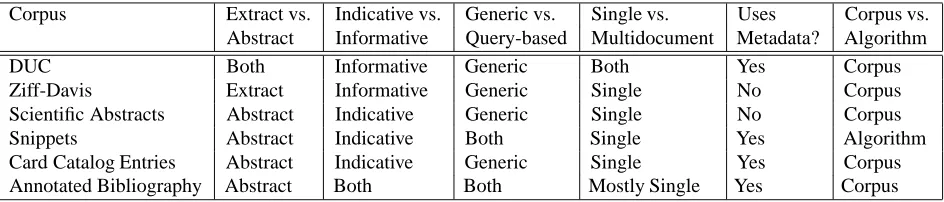
Corpus Extract vs. Indicative vs. Generic vs. Single vs. Uses Corpus vs. Abstract Informative Query-based Multidocument Metadata? Algorithm
DUC Both Informative Generic Both Yes Corpus
Ziff-Davis Extract Informative Generic Single No Corpus
Scientific Abstracts Abstract Indicative Generic Single No Corpus
Snippets Abstract Indicative Both Single Yes Algorithm
Card Catalog Entries Abstract Indicative Generic Single Yes Corpus
Annotated Bibliography Abstract Both Both Mostly Single Yes Corpus
Table 1: Sample summary corpora types mentioned in this paper.
Instead, we examined a different class of summary texts, the annotated bibliography entry. Annotated bibli-ographies are created mostly by abstractive methods and include both indicative and informative forms. An anno-tated bibliography entry is a summary of a book or other resource that annotates a resource with a description of the text, as shown in Figure 1.
From our empirical observations of both annotated bib-liography entries, snippets and library card catalog entries, bibliography entries have some unique features that make them attractive and challenging to process. Bibliography entries often:
are lengthier than both card catalog summaries and
snippets. They often exhibit more variation of sen-tence structure and lexical choice. This makes the sub-sequent analyses rich and allows (re)generation based on these analyses to construct more varied and inter-esting text.
are organized around a theme, making them ideal
stan-dard for “query-based” summaries. Bibliography en-tries also have more explicit comparison of one re-source versus another, which can help a user deter-mine whether which document to choose for a partic-ular purpose.
have prefacing text that overviews the documents in
the bibliography. This preface text is a good model for summarizing a set of related items (e.g., different books on arms and armor or different earthquakes re-ports in 1992). This is in contrast to multidocument summaries that summarize articles with mostly over-lapping information (news reports on a single event and updates to the event).
are rich in meta-information document features —they
often mention edition, title, author and purpose. These document features are not always present in or in-ferrable from the body text of a source document. Our previous study of library card catalog entries showed that these document features are well represented (and thus important).
The construction of annotated bibliographies is a well-established field in information science studies. Thus, the form has many descriptive guidelines that we examined that validate the above observations. Writing guides such as (Rees, 1970; Engle et al., 1998; Lester, 2001; Anne Arun-del Community College, 1998; Williams, 2002) indicate
specific types of information that should be included in an-notated bibliographies; and are synopsized in Table 2.
Ree70 EBC98 Les01 AACC98 Wil02 Accuracy/Currency X X
Audience X X X X
Authority X X X
Cross-resource Comparison X
Contents X X
Coverage X X
Defects/Weakness X X
Navigation X
Purpose X X X
Quality X
Relevance X X
Subjective Assessment X X Special Features X X
Table 2: Prescribed features of annotated bibliographies from several sources
These resources are all guidelines for the content of an-notated bibliography entries. The guidelines are prescrip-tive, and thus, it is important to validate them by examin-ing actual annotated bibliographies to see whether a) the guidelines on content are followed, and b) to establish the content’s ordering and grammatical structure.
5.
Annotated bibliography language
resource
Our language resource of annotated bibliography en-tries was designed to ease the collection of the corpus as well as to make many features available for subsequent analysis for summarization and related natural language ap-plications.
5.1. Collection methodology
The collection of the bibliography entries was done by spidering search result pages from two search engines (Al-taVista and Google) for the keywords “annotated bibliog-raphy”. The collection was compiled in September 2001 and software filters were written to parse and retrieve the contained URLs from each site (200 from AltaVista and an additional 1000 from Google). By our estimates, roughly 60% of the pages that were gathered had errors in retrieval (e.g., were stale URLs), were duplicate entries, or did not contain bibliographic entries. This leaves an approximate 500 pages with actual bibliographic entries to draw from.
less common; we suspect that this is due to the inherent bias of the search engine ranking metric to rank sites that are more prominent (which we believe is highly correlated with larger collections). The smaller collections were of-ten a part of a larger website or were the last section of a larger webpage on the topic of interest. With this struc-ture in mind, we decided to take at most 50 entries from each source document to ensure that we covered a breadth of annotated bibliography entry sources in collecting the fi-nal corpus. We examined the documents in order of their appearance on the AltaVista hitlist, and as a result, only a total of 64 documents from the AltaVista spidered collec-tion were used to create the 2000-entry corpus. If all of the bibliographic entries were extracted from the documents, it would easily exceed 20,000 entries in size (as many of the collections had many more than 50 entries). Docu-ments spidered from Google have so far not processed and added to the bibliography collection; we plan to include the processing of these documents and other sources as future project time allows.
5.2. Encoding the XML bibliographic entry corpus
Bibliography entries from the 64 spidered pages were then manually cut-and-pasted into the corpus collection web interface. This was both to ensure that the entries were being correctly delimited, and to add fields to each entry that may assist in future analysis and serve as a gold stan-dard for future machine learning tasks. The corpus is en-coded in XML and includes the following fields in addition to the bibliographic entry itself.
Subject: the subject or theme of the annotated
bibliog-raphy page.
Domain: annotated to aid analysis of differentiation of
features that are domain-independent from ones that are domain-dependent. We encode the domain rather coarsely (e.g., all ofmedicineas a single domain) and in an ad-hoc manner without the assistance of an ontology. Finer granularity is provided by the above
subjectfield.
Micro Collection (optional): the internal division in
the bibliography page that the entry is a part of (e.g., “reference books” section of a bibliography on the colonial times in Jamestown).
Macro Collection (optional): the division that the
physical bibliography page represents in the set of re-lated bibliography pages (e.g., “all colonies in colonial times in the U.S.” with respect to the last example). The macro collection field is used when the bibliogra-phy bibliogra-physical page relates itself to other bibliogra-physical pages. In our observations, only very large collections exhibit both micro and macro collection attributes. Figure 2 illustrates the relation of these two attributes.
Offset: the position of the entry on the page.
Before Context: text before the body of the annotated
entry itself. This often contains cataloging and
biblio-graphic information, such as the title, author, and call number1.
After Context (optional): text that is distinctly marked
off as coming after the body of the annotated entry. Used sometimes to mark publisher information, web URLs and pointers to other resources. Information that typically is contained in this field in one docu-ment may simply be appended to the end of the bib-liographic entry in other documents; this distinction may be more of a stylistic one.
URL: the location of the source document where the
entry was drawn from.
Micro Collection: References books Title: Jamestown resources Macro Collection / Website:
Bibliography of resources on the colonial times in the United States
Figure 2: Relation of micro and macro collection attributes
To facilitate our local analysis of the corpus, all of the bibliographic entries have also been parsed with a proba-bilistic dependency parser (Collins, 1996). These parsed entries are also included in the XML corpus, as a sepa-rate XML field attached to each entry (the parsedEn-tryfield). Figure 3 shows a sample entry after it has been parsed into our XML format.
<bibEntry id="id26" title="Analysis of covariance" url="http://www.math.yorku.ca/SCS/biblio.html" type="paper" domain="statistics"
microCollection="Analysis of Covariance" offset="4">
<beforeContext>
Maxwell, S. E., Delaney, H. D., & O’Callaghan, M. F. (1993). Analysis of ...
</beforeContext>
<entry><OVERVIEW>This <MEDIATYPES>paper</MEDIATYPES> gives a brief history of ANCOVA, and then discusses ANCOVA in ... contains no matrix
algebra.</DIFFICULTY> </entry>
<parsedEntry>
PROB 14659 -112.252 0 TOP -112.252 S -105.049 NP-A -8.12201 NPB -7.82967 DT 0 This NN 0 paper ... </parsedEntry>
</bibEntry>
Figure 3: Portion of the annotated bibliographic entry from Figure 1, represented as structured fields in our XML cor-pus.
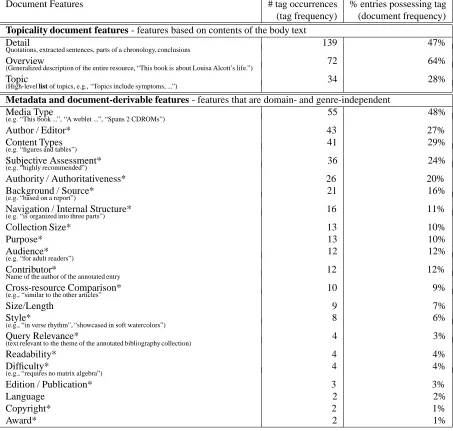
5.3. Semantic annotation of document features To perform a detailed study of what information is nor-mally present in annotated bibliographic entries, we needed to inventory the different document features (types of in-formation) used in the entries. We re-used our original 14
1Currently, this is saved as an unstructured text field. It would
Document Features # tag occurrences % entries possessing tag (tag frequency) (document frequency) Topicality document features - features based on contents of the body text
Detail 139 47%
Quotations, extracted sentences, parts of a chronology, conclusions
Overview 72 64%
(Generalized description of the entire resource, “This book is about Louisa Alcott’s life.”)
Topic 34 28%
(High-level list of topics, e.g., “Topics include symptoms, ...”)
Metadata and document-derivable features - features that are domain- and genre-independent
Media Type 55 48%
(e.g. “This book ...”, “A weblet ...”, “Spans 2 CDROMs”)
Author / Editor* 43 27%
Content Types 41 29%
(e.g. “figures and tables”)
Subjective Assessment* 36 24%
(e.g. “highly recommended”)
Authority / Authoritativeness* 26 20%
Background / Source* 21 16%
(e.g. “based on a report”)
Navigation / Internal Structure* 16 11%
(e.g. “is organized into three parts”)
Collection Size* 13 10%
Purpose* 13 10%
Audience* 12 12%
(e.g. “for adult readers”)
Contributor* 12 12%
Name of the author of the annotated entry
Cross-resource Comparison* 10 9%
(e.g., “similar to the other articles”
Size/Length 9 7%
Style* 8 6%
(e.g., “in verse rhythm”, “showcased in soft watercolors”)
Query Relevance* 4 3%
(text relevant to the theme of the annotated bibliography collection)
Readability* 4 4%
Difficulty* 4 4%
(e.g., “requires no matrix algebra”)
Edition / Publication* 3 3%
Language 2 2%
Copyright* 2 1%
Award* 2 1%
Table 3: Distribution of the document features in the 100 entry annotated portion of the corpus. Starred entries denote metadata fields.
document features. We are also in the continuing process of refining our tagset (particularly in further differentiating
detail sentences into particular subclasses) and collecting
and annotating additional corpus entries.
9.
Conclusions
We have presented our motivations for collecting a cor-pus of annotated bibliography entries, as a means of study-ing appropriate summary forms for documents in informa-tion retrieval displays. Annotated bibliography entries are constructed by abstractive techniques and display both in-dicative and informative qualities. While topical, content based features are prominent and necessary in summaries, guidelines have suggested that summaries should also in-clude metadata and critical document features. Our corpus study has shown that these guidelines are followed in ac-tual annotated entries, and furthermore have quantitatively assessed their importance and explored their internal order-ing within summaries of different lengths.
We have detailed the methodology used to collect the
2000-entry corpus and detailed our annotation and docu-ment feature distribution across 100 randomly selected en-tries. The corpus is available for non-profit research use and we would like to encourage other researchers to use and contribute to this corpus as well.
10.
Acknowledgments
This research is supported by the National Science Foundation under Digital Library Initiative Phase II Grant Number IIS-98-17434. We would also like to acknowledge the Linguistic Data Consortium and our local legal consel in helping us clarify intellectual property issues involved with this work.
11.
References
Einat Amitay. 2000. Trends, fashions, patterns, norms, conventions... and hypertext too. Technical Report 66, CSIRO.
Anne Arundel Community College. 1998.
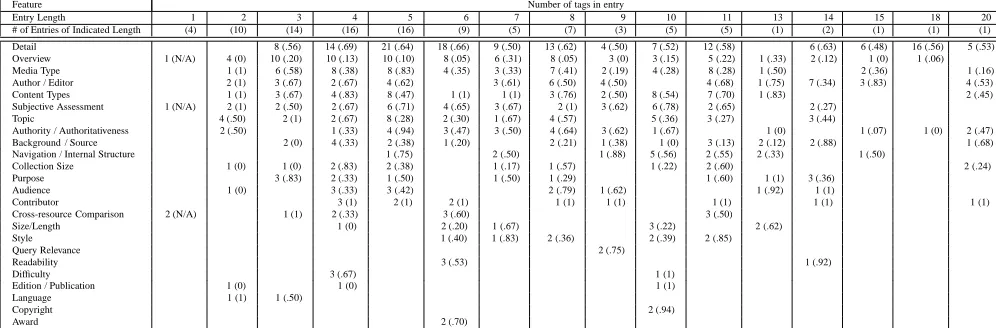
Feature Number of tags in entry
Entry Length 1 2 3 4 5 6 7 8 9 10 11 13 14 15 18 20
# of Entries of Indicated Length (4) (10) (14) (16) (16) (9) (5) (7) (3) (5) (5) (1) (2) (1) (1) (1) Detail 8 (.56) 14 (.69) 21 (.64) 18 (.66) 9 (.50) 13 (.62) 4 (.50) 7 (.52) 12 (.58) 6 (.63) 6 (.48) 16 (.56) 5 (.53) Overview 1 (N/A) 4 (0) 10 (.20) 10 (.13) 10 (.10) 8 (.05) 6 (.31) 8 (.05) 3 (0) 3 (.15) 5 (.22) 1 (.33) 2 (.12) 1 (0) 1 (.06) Media Type 1 (1) 6 (.58) 8 (.38) 8 (.83) 4 (.35) 3 (.33) 7 (.41) 2 (.19) 4 (.28) 8 (.28) 1 (.50) 2 (.36) 1 (.16) Author / Editor 2 (1) 3 (.67) 2 (.67) 4 (.62) 3 (.61) 6 (.50) 4 (.50) 4 (.68) 1 (.75) 7 (.34) 3 (.83) 4 (.53) Content Types 1 (1) 3 (.67) 4 (.83) 8 (.47) 1 (1) 1 (1) 3 (.76) 2 (.50) 8 (.54) 7 (.70) 1 (.83) 2 (.45) Subjective Assessment 1 (N/A) 2 (1) 2 (.50) 2 (.67) 6 (.71) 4 (.65) 3 (.67) 2 (1) 3 (.62) 6 (.78) 2 (.65) 2 (.27)
Topic 4 (.50) 2 (1) 2 (.67) 8 (.28) 2 (.30) 1 (.67) 4 (.57) 5 (.36) 3 (.27) 3 (.44)
Authority / Authoritativeness 2 (.50) 1 (.33) 4 (.94) 3 (.47) 3 (.50) 4 (.64) 3 (.62) 1 (.67) 1 (0) 1 (.07) 1 (0) 2 (.47) Background / Source 2 (0) 4 (.33) 2 (.38) 1 (.20) 2 (.21) 1 (.38) 1 (0) 3 (.13) 2 (.12) 2 (.88) 1 (.68) Navigation / Internal Structure 1 (.75) 2 (.50) 1 (.88) 5 (.56) 2 (.55) 2 (.33) 1 (.50)
Collection Size 1 (0) 1 (0) 2 (.83) 2 (.38) 1 (.17) 1 (.57) 1 (.22) 2 (.60) 2 (.24)
Purpose 3 (.83) 2 (.33) 1 (.50) 1 (.50) 1 (.29) 1 (.60) 1 (1) 3 (.36)
Audience 1 (0) 3 (.33) 3 (.42) 2 (.79) 1 (.62) 1 (.92) 1 (1)
Contributor 3 (1) 2 (1) 2 (1) 1 (1) 1 (1) 1 (1) 1 (1) 1 (1)
Cross-resource Comparison 2 (N/A) 1 (1) 2 (.33) 3 (.60) 3 (.50)
Size/Length 1 (0) 2 (.20) 1 (.67) 3 (.22) 2 (.62)
Style 1 (.40) 1 (.83) 2 (.36) 2 (.39) 2 (.85)
Query Relevance 2 (.75)
Readability 3 (.53) 1 (.92)
Difficulty 3 (.67) 1 (1)
Edition / Publication 1 (0) 1 (0) 1 (1)
Language 1 (1) 1 (.50)
Copyright 2 (.94)
Award 2 (.70)
Table 4: Feature distribution across entries of different document lengths. Frequency of document feature given as entry, average relative position of feature given in parentheses (0 indicates the beginning of the entry, 1, the end of the entry). Document features listed in order of descending frequency in the annotated corpus.
http://www.aacc.cc.md.us/library/annobib.htm, Last accessed March 2002.
Michael John Collins. 1996. A new statistical parser based on bigram lexical dependencies. In Proc. of the 34th
ACL, Santa Cruz.
Michael Engle, Amy Blumenthal, and Tony Cos-grave. 1998. What is an annotated bibliography. http://www.library.cornell.edu/okuref/research/skill26.htm, Last accessed March 2002.
Donna Harman and Daniel Marcu, editors. 2001.
Doc-ument Understanding Conference, New Orleans, USA,
September. ACM SIGIR.
Hongyan Jing and Kathleen R. McKeown. 1999. The de-composition of human-written summary sentences. In
Proceedings of 22nd Annual International Conference on Research and Development in Information Retrieval (SIGIR 99).
Min-Yen Kan, Kathy McKeown, and Judith Klavans. 2001. Domain-specific informative and indicative summariza-tion for informasummariza-tion retrieval. In Proc. of the Document
Understanding Conference (DUC), pages 19–26, New
Orleans, USA.
Julian Kupiec, Jan Pedersen, and Francine Chen. 1995. A trainable document summarizer. In ACM SIGIR, pages 68–73.
James D. Lester. 2001. Writing Research Papers : A
Com-plete Guide. Longman, 10th edition.
Inderjeet Mani and Mark Maybury, editors. 1999.
Ad-vances in Automatic Text Summarization. MIT Press.
C. D. Paice. 1990. Constructing literature abstracts by computer: techniques and prospects. Information
Pro-cessing and Management, 26(1):171–186.
Dragomir R. Radev and Kathleen R. McKeown. 1998. Generating natural language summaries from multiple on-line sources. Computational Linguistics, 24(3):469– 500, September.
Herbert Rees. 1970. Rules of Printed English. Darton, Longman and Todd, London.
Owen Williams. 2002. Writing an annotated bibliography. http://www.crk.umn.edu/library/links/annotate.htm, Last