Volume 2008, Article ID 732895,14pages doi:10.1155/2008/732895
Research Article
Binaural Rendering in MPEG Surround
Jeroen Breebaart,1Lars Villemoes,2and Kristofer Kj ¨orling2
1Philips Research, HTC 34, 5656 AE Eindhoven, The Netherlands
2Dolby Sweden AB, G¨avlegatan 12A, 11330 Stockholm, Sweden
Correspondence should be addressed to Jeroen Breebaart,[email protected]
Received 29 June 2007; Revised 12 November 2007; Accepted 21 December 2007
Recommended by Antonio Ortega
This paper describes novel methods for evoking a multichannel audio experience over stereo headphones. In contrast to the conventional convolution-based approach where, for example, five input channels are filtered using ten head-related transfer functions, the current approach is based on a parametric representation of the multichannel signal, along with either a parametric representation of the head-related transfer functions or a reduced set of head-related transfer functions. An audio scene with multiple virtual sound sources is represented by a mono or a stereo downmix signal of all sound source signals, accompanied by certain statistical (spatial) properties. These statistical properties of the sound sources are either combined with statistical properties of head-related transfer functions to estimate “binaural parameters” that represent the perceptually relevant aspects of the auditory scene or used to create a limited set of combined head-related transfer functions that can be applied directly on the downmix signal. Subsequently, a binaural rendering stage reinstates the statistical properties of the sound sources by applying the estimated binaural parameters or the reduced set of combined head-related transfer functions directly on the downmix. If combined with parametric multichannel audio coders such as MPEG Surround, the proposed methods are advantageous over conventional methods in terms of perceived quality and computational complexity.
Copyright © 2008 Jeroen Breebaart et al. This is an open access article distributed under the Creative Commons Attribution License, which permits unrestricted use, distribution, and reproduction in any medium, provided the original work is properly cited.
1. INTRODUCTION
The synthesis of virtual auditory scenes has been an ongoing research topic for many years [1–5]. The aim of so-called binaural rendering systems is to evoke the illusion of one or more sound sources positioned around the listener using stereo headphones. The positions of the sound sources can preferably be modified in terms of the perceived azimuth, elevation, and distance. More advanced systems also include room acoustic models to simulate the acoustical properties such as reflecting walls within the virtual space.
Binaural rendering has benefits in the field of research, simulation, and entertainment [6]. Especially in the field of entertainment, the virtual auditory scene should sound very compelling and “real.” In order to achieve such a realistic percept, several aspects have to be taken into account, such as the change in sound source positions with respect to head movement [7], room acoustic properties such as early reflections and late reverberation [8], and using system personalization to match the anthropometric properties of the individual user [9–11]. Because of the complex nature
of current state-of-the-art systems, several concessions are required for feasible implementations (cf. [12]), especially if the number of sound sources that has to be rendered simultaneously is large.
Recent trends in consumer audio show a shift from stereo to multichannel audio content as well as a shift from immo-bile to moimmo-bile devices. These developments cause additional constraints on transmission and rendering systems. Firstly, the number of audio channels that has to be transmitted increases significantly (e.g., from two to six). The corre-sponding increase in transmission bandwidth for conven-tional, discrete-channel audio coders is often undesirable and sometimes even unavailable. Secondly, consumers often use headphones for audio rendering on a mobile device. To expe-rience the benefit of multichannel audio, a dedicated binau-ral rendering system is required. This can be quite a challenge given the limited processing power and battery life of mobile devices.
on a parametric representation of a multichannel original signal and a corresponding downmix signal, as is defined by the recently finalized MPEG Surround standard [13] for multichannel audio compression. An outline of the basic principle of MPEG Surround is given inSection 2. The first method, referred to as “parametric approach,” is based on the analysis and synthesis of perceptually relevant attributes “binaural parameters” of a virtual auditory scene. This method is especially suitable for low-complexity simulation of anechoic situations (possibly extended with parametric methods for room acoustics simulation). The analysis and synthesis of binaural parameters is outlined in Sections 3.2 and 3.3, and the integration of this method into MPEG Surround is described in Section 5. The second method is based on convolution-based synthesis that can be applied directly on the downmix signal, without the need of independent channel signals (as in conventional methods). This method, which is referred to as a “morphed-filter” approach, will be outlined inSection 4. It is especially suitable to simulate echoic virtual environments and/or if the parametric approximation of binaural parameters is not sufficiently accurate. Finally, the two different methods are evaluated in the context of MPEG Surround by means of listening tests.
2. MPEG SURROUND
MPEG Surround [13–17] is a novel parametric method for efficient transmission of multichannel audio. In this audio coding format, a multichannel audio signal is represented as a downmix signal (typically mono or stereo) and a set of “spatial parameters” that, among other aspects, describe the statistical relations of the original multichannel signals in terms of (relative) signal powers and correlation coeffi -cients. The processing flow of MPEG Surround is visualized in Figure 1. An MPEG Surround encoder (left panel of Figure 1) generates a mono or stereo downmix from a multichannel input signal and accompanying spatial param-eters. These parameters are extracted for individual time/ frequency tiles of the input signals. The bandwidth of each tile is approximately equal to one critical band, and the duration is in the order of tens of milliseconds. The downmix can be encoded using existing compression methods (legacy coders). A multiplexer combines the resulting downmix bit stream with the parameter bit stream to form an output bit stream. The decoder, shown in the right panel of Figure 1, performs the inverse process to generate the multichannel output signals. The coding efficiency provided by the parametric approach to represent spatial attributes is quite significant; a parameter bit rate of about 6 to 12 kbps (in addition to the bit rate required for the mono or stereo coder) suffices to achieve high-quality multichannel audio [16–18].
The MPEG Surround coder operates in a hybrid quadra-ture mirror filter (QMF) bank domain [19] to enable independent processing of individual time/frequency tiles. The spatial parameter extraction process (at the encoder side) and the spatial synthesis process (at the decoder side) are all performed in this filterbank domain. The spatial
encoding process is provided by so-called two-to-One (TTO) and three-to-two (TTT) encoding blocks, as outlined in Figure 2. The first type, which is essentially similar to a “parametric stereo” coder [19–24] encodes a stereo signal by means of a mono signal, a channel level difference (CLD) and an interchannel cross-correlation (ICC) parameter. The second type (TTT block) represents three input signals (typically, a left, right and center signal) as a stereo downmix accompanied by two channel prediction coefficients (CPCs) that enable decoder-side prediction of a third signal from the two downmix channels. A possible prediction loss may be compensated for by transmission of an additional ICC parameter (see [14,16,17,25] for more details).
Several TTO and TTT encoding blocks (Ei) can be con-nected to create a certain tree configuration. Two examples of such tree configurations are shown inFigure 2. The left panel ofFigure 2shows a combination of 5 TTO encoding blocks to represent a 6-channel input (lf,rf,c,ls,rs, and LFE for the left front, right front, center, left surround, right surround, and low frequency effects channel, resp.) as a mono signalx
accompanied by spatial parameters (Pi). A tree configuration for stereo output, involving 3 TTO encoding blocks and one TTT encoding block, is shown in the right panel, resulting in a stereo downmix pairxl,xr.
3. BINAURAL PARAMETER ANALYSIS AND SYNTHESIS
3.1. Background
There is evidence that spatial parameters such as employed in MPEG Surround and related spatial coding approaches (see [14, 20, 26, 27]) can also be employed to describe so-called head-related transfer functions (HRTFs) that are used for binaural synthesis. Sound-source localization in the horizontal plane is facilitated by interaural time differences (ITDs) and interaural level differences (ILDs) [5, 28, 29], caused by the relative path lengths and acoustic shadow effect of the head. The properties of sound propagation also result in an intricate frequency dependence of these cues. Sound source elevation is predominantly facilitated by elevation-dependent spectral peaks and notches that are superimposed on the original sound source spectrum [11]. The perceived distance of a sound source is based on the overall signal level, the ratio of direct and reverberant sound, and spectral cues [1,2,30,31].
M
ulti-c
h
annel
input
Encoder
Spatial parameter bit stream MPEG
Surround encoder
Legacy down mix encoder
Multi plexer
(a)
Demulti plexer
Legacy down mix decoder
MPEG Surround
decoder
Spatial parameter bit stream Decoder
M
ulti-c
h
annel
o
utput
(b)
Figure1: Concept of MPEG Surround. A multichannel audio signal is represented as a downmix signal and accompanying spatial parameters (MPEG Surround encoder). The downmix can be encoded using an existing (legacy) compression method. The decoder separates the spatial parameters from the core coder bitstream (demultiplexer), decodes the downmix, and reconstructs multichannel audio by reinstating the spatial properties (MPEG Surround decoder).
lf
rf
c
LFE
ls
rs
E3
(TTO)
E4
(TTO)
E2
(TTO)
P3
P4
P2 E1
(TTO)
P1 E0
(TTO)
P0 x
(a)
lf
ls
rf
rs
c
LFE
E0
(TTO)
E1
(TTO)
E2
(TTO)
sl
P0 sr
P1 sc
P2 E3
(TTT)
P3 xr
xl
(b)
Figure2: Two encoder tree configurations for 6-channel input and a mono downmix (left panel) or a stereo downmix (right panel). Each block (Ei) represents a TTO or TTT encoding block and generates a set of parameters (Pi).
of shoulders and the pinnae) are more important [34]. Other researchers have successfully demonstrated that the frequency-dependent ITD can be replaced by a constant, position-dependent ITD without perceptual consequences [14, 32, 35, 36]. A related finding is that the interaural time difference can be replaced by a constant interaural phase difference (IPD) within various frequency bands. The resulting piecewise constant-phase curve does not result in audible differences provided that the frequency bands are not broader than critical bands [14].
There is also considerable evidence that certain details of the HRTF magnitude spectra are irrelevant [37–39]. Specifically, it seems thatconstantspectral cues within critical bands (or frequency bands that follow the ERB scale [40]) are a sufficient requirement for high-quality binaural rendering [14,38].
Given the commonalities between the parametric ap-proach for audio compression and a parametric apap-proach to describe HRTFs, these can be efficiently combined in a single binaural rendering application. In such a combined approach, the so-called “binaural parameters” are estimated representing simultaneous playback of all audio channels over a virtual standard loudspeaker setup [41]. The inter-relations between the virtual loudspeaker signals are given by spatial parameters, while the relations between a virtual loudspeaker and the resulting ear-drum signals are described by HRTF parameters. The binaural parameter estimation process is outlined in the next section.
3.2. Binaural parameter analysis
In conventional binaural rendering systems, a sound source
iwith associated discrete-sampled time-domain signalzi is rendered at a certain position by convolving the signal with a pair of head-related impulse responseshL,i,hR,i, for the left and right ears, respectively, to result in binaural signalsyL,i,
yR,i:
ym,i=zi∗hm,i, (1)
withm ∈ {L,R}. This process is visualized in the left panel ofFigure 3.
Expressed in a (complex-valued) subband domain with time-indexkand frequency band indexb, the power of signal
ym,i(k,b) within a certain analysis framek=0,. . .,K−1 is given by
σ2
ym,i(b)= 1
K
k
ym,i(k,b)ym∗,i(k,b), (2)
with (∗) the complex conjugation operator. If the HRTF magnitude spectra are locally stationary (i.e., constant within the frequency bandb), this can be simplified to
σ2
ym,i(b)=σ
2
hm,i(b)σ
2
zi(b), (3)
withσ2
hm,i(b) the power within parameter bandbof HRIRhm,i andσ2
zi(b) the power of the source signalziin parameter band
Thus given the local stationarity constraint, the power in a certain parameter bandbat the level of the ear drums follows from a simple multiplication of the power of the sound source and the power of the HRTF in corresponding parameter bands. In other words, statistical properties of binaural signals can be deducted from statistical properties of the source signal and from the HRTFs. This parameter-based approach is visualized in the right panel ofFigure 3. Similar derivations lead to estimates of the interaural-phase difference (IPD) between the signalsyL,iandyR,i:
IPD(b)=∠
k
yL,i(k,b)yR∗,i(k,b)
. (4)
Under the assumption of local stationarity of interaural HRTF phase spectra, the IPD can be derived directly from the HRTF spectra themselves, without involvement of the sound source signal:
IPD(b)=φi(b), (5)
with φi(b) the average interaural-phase difference of the HRTF pair corresponding to positioniand parameter band
b:
φi(b)=∠
k
hL,i(k,b)h∗R,i(k,b)
. (6)
The equations above assume local stationarity of HRTF magnitude and interaural phase difference spectra to esti-mate the resulting binaural parameters. This stationarity constraint has been shown to result in correct sound-source localization properties [14]. However, strong deviations from stationarity within analysis bands result in a decrease in the interaural coherence (IC) for certain frequency bands, since the relation between the two HRTF spectra within the band of interest cannot be accurately described by a single phase and level difference. Such decrease in the IC is perceived as a change in the spatial “compactness” [2]. To capture this property, the IC is estimated for each parameter bandb. In our context, the coherence is defined as the absolute value of the average normalized cross-spectrum:
IC(b)=kyL,i(k,b)y ∗ R,i(k,b)
KσyL,i(b)σyR,i(b)
. (7)
The IC parameter has a dependency on the source signalzi. The expected value is given by
IC(b)=ρi(b), (8)
with
ρi(b)=|
khL,i(k,b)h∗R,i(k,b)|
KσhL,i(b)σhR,i(b)
. (9)
In summary, under the local stationarity constraint, the binaural parametersσyL,σyR, IPD, and IC resulting from a single sound source can be estimated from the sound-source parametersσziand the HRTF parametersσhL,i,σhR,i,φi, andρi.
For multiple simultaneous sound sources, conventional systems convolve each individual source signal i with an HRTF pair corresponding to the desired position, followed by summation:
ym=
i
zi∗hm,i. (10)
The binaural parameters σyL, σyR, IPD, and IC between signals yL, yR resulting from the ensemble of simultaneous sound sources zi can be estimated in a very similar way as described above, based on the sound source parametersσzi and their mutual normalized correlation coefficientsci1,i2on
the one hand, and the HRTF parametersσhL,i,σhR,i,φi, andρi on the other hand:
σ2
ym=
i
σ2
hm,iσ
2
zi
+ i1
i2=/i1
rm,i1i2ci1,i2cos
φ i1−φi2
2
,
(11)
with
rm,i1i2=σ
2
hm,i1σ
2
hm,i2σ
2
zi1σ
2
zi2ρi1ρi2. (12)
In a similar way, the IPD and IC are given by
IPD=∠(χ), IC= |χ|
σyLσyR
, (13)
with
χ=
i
ejφiρ
iσz2iσhL,iσhR,i
+ i1
i2=/i1
e(jφi1+jφi2)/2ci 1,i2 qi1i2
,
(14)
with
qi1i2=σ
2
hL,i1σ
2
hR,i2σ
2
zi1σ
2
zi2ρi1ρi2. (15)
In the equations above, the subband index (b) is omitted for clarity. The reader is referred to [14] for a more detailed derivation ofσyL,σyR, IPD, and IC.
3.3. Binaural parameter synthesis
3.3.1. Synthesis from mono downmix
In the case of an MPEG-Surround encoded signal with a mono downmix, the synthesis process comprises reinstating the binaural parameters on the mono downmix signalxof the object signals. Assuming incoherent source signalszi, the downmix is given by
x=
i
zi. (16)
In the case of (partially) correlated source signals (i.e., the pairwise correlation coefficient ci1,i2 is nonzero for certain
signal pairs), the downmix is preferably scaled in each frequency band and for each frame independently to ensure energy preservation (cf. [14,16]). As a result, the powerσ2
Source signal
zi
Binaural signals
yL,i
hL,i HRIRs
hR,l
yR,i
(a)
Binaural parameters Source parameters
σzi
HRTF parameters
σhL,i ρhL,ihR,i σhR,i
σyL,i σyR,i
IPD, IC (b)
Figure3: Synthesis of a virtual sound source by means of HRIR convolution (left panel) and by means of parametric representations (right panel).
each parameter bandbof a downmix signal framekis then given by
σ2
x =
i
σ2
zi. (17)
The required binaural parameters are derived from HRTF parameters (σhL,i,σhR,i,φi, ρi) and signal parameters
(σzi,ci1,i2) as described inSection 3.2. The signal parameters
σziandci1,i2are assumed to be available as side information
accompanying the down-mix x. In the case of MPEG Surround, the statistical properties of the input signals are described as pairwise level differences (CLDs) and correlations (ICCs) in a tree structure (cf. Figure 2, left panel), which need to be converted to relations between the original input channels. The CLDi(b) is defined as the power ratio of the two input signals (q1,q2) in parameter bandbof
the encoding block TTOi:
CLDi(b)=
σ2
q1(b)
σ2
q2(b)
. (18)
Given the tree structure shown in the left panel ofFigure 2, the powers of the input signalszlf,zls,zrf,zrs,zcare derived from the CLDs by combining the individual energy ratios of each TTO element:
σ2
zl f(b)=
CLD0(b)
1 + CLD0(b)
CLD1(b)
1 + CLD1(b)
CLD3(b)
1 + CLD3(b)
,
σ2
zr f(b)=
CLD0(b)
1 + CLD0(b)
CLD1(b)
1 + CLD1(b)
1 1 + CLD3(b)
,
σ2
zc(b)=
CLD0(b)
1 + CLD0(b)
1 1 + CLD1(b)
,
σz2ls(b)=
1 1 + CLD0(b)
CLD2(b)
1 + CLD2(b)
,
σ2
zrs(b)=
1 1 + CLD0(b)
1 1 + CLD2(b)
.
(19)
In the equations above, the LFE signal is assumed to be merged with the center speaker as one single signal, and hence the parameters of OTT4 are absent in the equations
above.
The ICCi(b) is defined as the normalized cross-corre-lation coefficient of the two input signals of TTOi. As can be observed fromFigure 2, four ICC parameters (i.e., exclud-ing TTO4) are available to represent 10 unique pairwise
correlation coefficients ci1,i2 of 5 input channels. This
ill-defined problem is solved by a heuristic rule that all pairwise correlations are set to zero, except for
clf,rf =ICC3, cls,rs=ICC2. (20)
The reconstructed binaural signalsyL,yRcan be obtained using a matrix operation M(b) that is derived for each parameter band (b):
⎡ ⎣yL(k,b)
yR(k,b) ⎤ ⎦=M(b)
⎡
⎣ x(k,b)
D(x(k,b)) ⎤
⎦, (21)
withD(·) a so-called “decorrelator” which generates a signal that has virtually the same temporal and spectral envelopes as its input but is independent from its input. This method of binaural synthesis is identical to the parameter synthesis method applied in “parametric stereo” decoders [20]. The matrix coefficients ensure that for each frame, the two binaural output signals yL, yR have the desired levels, IPD and IC relations. A suitable solution for the synthesis matrix
M(b) is given by (see [20] for details)
M(b)= ⎡
⎣ λL(b)cos
α(b)+β(b) λL(b) sin
α(b)+β(b)
λR(b)cos
−α(b)+β(b)) λR(b) sin
−α(b)+β(b) ⎤ ⎦,
(22)
with λL(b), λR(b) two scale factors that determine the (complex) gain between the downmix signal and the left and right binaural output signals, respectively:
λL(b)=
σyL(b)
σx(b)e
+jIPD(b)/2, λ
R(b)=
σyR(b)
σx(b)e
−jIPD(b)/2.
The angleα(b) determines the coherence betweenyL,yR according to
α(b)=1
2arccos
IC(b), (24)
while the angle β(b) minimizes the decorrelator output signal:
β(b)=tan
σ
yR(b)−σyL(b)
σyR(b) +σyL(b)
arctanα(b). (25)
3.3.2. Extension to stereo downmixes
In the previous sections, binaural parameters were analyzed and reinstated from a mono downmix signalx. For several applications, however, it is beneficial to provide means to extend the downmix channel configuration to stereo. An example of a relevant application scenario is the synthesis of a virtual multichannel “home cinema setup” using a stereo downmix signal pair xL, xR accompanied by spatial parameters. This process will be discussed in the context of the MPEG Surround tree structure shown in the right panel ofFigure 2. In the 3 TTO encoding blocks, input signals are pairwise combined to result in three intermediate signalssL,
sR, and sC. These intermediate signals are then combined into a stereo downmix pairxL,xR by a TTT encoding block according to
⎡ ⎣xL
xR ⎤ ⎦= ⎡ ⎢ ⎢ ⎢ ⎣
1 0 1 2
√ 2
0 1 1 2 √ 2 ⎤ ⎥ ⎥ ⎥ ⎦ ⎡ ⎢ ⎢ ⎢ ⎣ sL sR sC ⎤ ⎥ ⎥ ⎥
⎦. (26)
The extracted CPC parameters enable reconstruction of the intermediate signalssL,sR, andsC at the MPEG Surround decoder side (using a corresponding decoder block indicated by TTT−1) according to
⎡ ⎢ ⎢ ⎢ ⎣
sL(k,b)
sR(k,b) sC(k,b) ⎤ ⎥ ⎥ ⎥
⎦=M−TTT1 (b)
⎡ ⎣xL(k,b)
xR(k,b) ⎤
⎦, (27)
with an upmix matrix M−1
TTT(b) for each parameter band
depending on the CPC parameters (see [16] for more details).
For each of the three reconstructed intermediate signals
sL, sR, and sC, an individual 2× 2 upmix matrix W(b) is computed for those virtual sources that are present in that particular downmix signal. In other words, one matrix
WsL(b) is estimated to reinstate the binaural parameters resulting from channels lf and ls, one matrix WsR(b) to reinstate binaural parameters resulting from rf and rs, and one matrix to reinstate the binaural parameters from channel c, assuming that the content of the LFE channel is also reproduced by the center channel (i.e., CLD2 =
∞). The required channel powersσz are derived from the
MPEG Surround OTT parameters (right panel ofFigure 2) according to
σ2
lf =
CLD0
1 + CLD0
,
σ2
ls=
1 1 + CLD0
,
σr2f =
CLD1
1 + CLD1
,
σr2s=
1 1 + CLD1
.
(28)
Furthermore, the channel correlation coefficients are assumed to be zero (i.e.,ci1,i2=0, fori1=/ i2). The derivation
of the matrix elements is equal to the method described in Section 3.3.1, with the exception that the coherence (IC) for each individual matrix is assumed to amount to +1. This assumption is based on the observation that the coherence of these matrices predominantly represents coherence in a front/back direction, which is assumed to be a less salient cue than coherence in a left/right direction. Given a coherence value of +1, no decorrelator signal is required in the synthesis and hence each individual matrix simplifies to
Ws(b)= ⎡
⎣λL,s(b) 0
λR,s(b) 0 ⎤
⎦. (29)
Subsequently, the individual outputs of each 2×2 matrix operating on one intermediate signal are simply summed to result in the binaural output pairyL,yR:
⎡ ⎣yL(k,b)
yR(k,b) ⎤
⎦=WsL(b) ⎡ ⎣sL(k,b)
0 ⎤ ⎦
+WsR(b) ⎡ ⎣sR(k,b)
0 ⎤
⎦+WsC(b) ⎡ ⎣sC(k,b)
0 ⎤ ⎦.
(30)
Given the fact that the intermediate signals sL, sR, and
sC follow from the downmix pair xL, xR given a matrix operationM−1
TTT(b) according to (27), the complete binaural
rendering process can be written as a single, 2×2 matrix operationM(b) for each parameter bandb:
⎡ ⎣yL(k,b)
yR(k,b) ⎤
⎦=M(b) ⎡ ⎣xL(k,b)
xR(k,b) ⎤
⎦. (31)
4. MORPHED-FILTER APPROACH
4.1. Introduction
functions (BRTFs)), the parametric approach is not capable of accurate modeling of all relevant perceptual aspects. In this case, a less compact HRTF or BRTF representation can be obtained by extending the 2×2 processing matrix in the time domain (i.e., having multiple “taps”). This extension is only defined for a stereo downmix and will be outlined below.
The basic principle is to combine the original set of HRTFs or BRTFs into a limited set of four impulse responses that can be directly applied on the stereo downmix. This is feasible when a representation of the original multichannel signal is available, which relies on stereo downmix and a set of spatial parameters, as is the case for MPEG Surround. The proposed method is beneficial since it only operates on four filters as opposed to ten filters normally used for binaural rendering of a five channel signal, and furthermore, it enables the use of echoic impulse responses (BRIRs). A design goal of the method is to maintain a waveform match with the conventional reference binaural signal (32) in situations where the MPEG Surround multichannel signal obtains a waveform match with the original multichannel signal. For a mono downmix this only happens for single loudspeaker sources, but for a stereo downmix the MPEG Surround decoding system enables waveform reconstruction for many two-loudspeaker combinations. The term “morphed-filter” approach refers to a dynamic combination of the front/back contributions which can be thought of as the creation of a virtual loudspeaker that for each time-frequency tile replaces a front/back loudspeaker pair. The corresonding HRTF data is interpolated in phase and amplitude with weights depending on the parametric surround side information.
4.2. Subband filter representations
The signal modifications of MPEG surround are performed in the domain of a complex modulated filter bank which is not critically sampled; see [19]. Its particular design allows for a given time-domain filter to be implemented at high precision by filtering each subband signal in the time direction with a separate filter. The resulting overall SNR for the filter implementation is in the 50 dB range with the aliasing part of the error significantly smaller. Moreover, these subband domain filters can be derived directly from the given time-domain filter. The filter conversion is specified in [13] and the details of its derivation can be found in [42].
We will consider a single fixed subband of the QMF filterbank and omit any subband indexing for clarity. The frequency resolution of the spatial parameters is adapted to this filterbank in the sense that there is only one parameter per subband. The reference output of the filtering approach is the superposition of the conventional single source contributions originating from each loudspeaker position, as given by (1). For the binaural rendering purpose, it is assumed that the contribution from the LFE channel is incorporated in the center channel, hence only five channels are considered in the derivations. Inside an arbitrary but fixed subband, this amounts to the two by five processing:
ym=
5
i=1
hm,i∗zi, m=L,R, (32)
where the star denotes convolution in the time direction and the subband signalsziare those of the original multichannel signal (lf,ls,rf,rs,c) in that order.
4.3. Combining the HRTF filters based on
the spatial parameters
As outlined in Section 3.3.2, an MPEG Surround decoder operates on a downmix signal which is input to a TTT−1 module, that recreates a center channel, a right side channel, and a left side channel. These three channels are further processed by several OTT modules yielding the six output channels.
The guiding principle is to require a very high fidelity of the binaural signal for the cases where the MPEG Surround decoding process can approach a waveform match with the original multichannel signal. This holds for example in subbands where only one channel or a selected pair of channels is active. For the more complex cases, rules for combining of the MPEG Surround parameters with the subband filters are applied, which aim at reinstating the correct channel powers of the reference binaural signal (32) in each parameter band. The IPD and IC cues are only indirectly considered.
The spatial parameters for the TTT and OTT modules are used to derive a limited set of HRTFs that can be applied directly on the downmix signal in the QMF filter-bank domain. More precisely, the combination of spatial parameters and the subband domain BRIR responses hm,i results in the following two-by-two matrix processing, where (x1,x2) is the subband representation of the transmitted
downmix:
ym=
2
i=1
gm,i∗xi. (33)
The filter combination is performed in two steps, one for each layer of the corresponding tree-structured encoder as depicted in Figure 4. In the figure, five of the ten BRIR responses are morphed into two filters, based on the parameters obtained during the encoding process, as depicted in the right panel ofFigure 2.
4.3.1. OTT-based front/back morphing
The object of the front/back morphing is to arrive at a modified binaural reference signal defined by the two- by three- processing,
ym=
3
p=1
hm,p∗sp, (34)
where the signals si are intermediate combined signals (L,R,C) resulting from the TTO encoding process, see Section 3.3.2. The filtershm,1andhm,2 from (32) are to be
combined intohm,1based on the left-side TTO parameters,
and the filters hm,3 andhm,4are to be combined into hm,2
hm,1
hm,2
hm,3 E0
(TTO)
E1
(TTO)
E2
(TTO)
E3
(TTT)
hm,1
hm,2
hm,3
hm,4
hm,5
P0
P1
P2
P3 gm,1
gm,2
Figure4: Tree structure overview of the morphing of five of the ten BRIR responseshm,i. Note the similarity to the encoding process
depicted in the right panel of Figure 2. Also note that the LFE channel is not taken into account in the HRTF filtering, and thus
hm,3=hm,5.
subsequent TTT combination. Without loss of generality, we will consider only the left side case and also omit the output channel index. From the CLD parameter of the TTO encoding block, one derives normalized weight parameters
w1 andw2 such that w21 +w22 = 1, and w1/w2 equals the
CLD in the linear domain. For instance, panning to the front corresponds tow1 = 1 andw2 = 0, while panning to the
back results inw1=0 andw2=1. The morphing consists of
forming a complex linear combination
h=t1h1+t2h2, (35)
where the complex coefficients (t1,t2) depend on the weight
parameters (w1,w2) and the filters (h1,h2). The
contri-bution h∗s1 should mimic the effect of the conventional
approach of convolution followed by summation, that is,
h1∗z1+h2∗z2according to the guiding principles mentioned
above. More precisely, the extreme cases (w1,w2) = (1, 0)
and (w1,w2)=(0, 1) should lead to the correct single source
response, and the output energy should be preserved for all cases in between.
Let the complex inner product between subband signals be defined in the usual way,
x,y = k
x(k)y∗(k). (36)
The energy of a subband signal is the square of the induced normx2 = x,x. For subband signalsx,ythat
have been filtered by HRTF related subband filtersb,d, the following approximation will be assumed
b∗x,d∗y ≈ b,dx,y. (37)
This approximation is justified by the fact that the time step of the applied time frequency transform is large in comparison to the main delay differences of the HRTF filters such that the energy of the subband domain filters is
concentrated in a dominant single tap. (An alternative model situation where (37) holds for general filters is when the subband signals have only lag zero correlation.)
Applying the approximation (37) to align the energy of
h∗s1with that ofh1∗z1+h2∗z2leads to the requirement
t12 h1
2
+t2 2
h2
2
+ 2Ret1t∗2
h1,h2s1
2
=h12z12+h22z22+ 2Re
h1,h2
z1,z2
.
(38)
From the MPEG Surround encoding process, it can be assumed that the combined signals1carries the total energy
of the front and back signalss12 = z12+z22. Hence
the energy distribution derived from the weights (w1,w2) is
given byz12 = w21s12 andz22 =w22s12. Note that
taking into account the last term of the right hand side of (38) would require knowledge of the complex inner product z1,z2, but the phase of this product is not available from
the real valued ICC parameter conveyed in MPEG Surround. Instead, this term is neglected, and the modified requirement reads, after removing the common factors12
t12 h1
2
+t2 2
h2
2
+ 2Ret1t∗2
h1,h2
=w12h12+w22h2.
(39)
A first solution consists of inserting the simple superposi-tion coefficients (t1,t2)=c(w1,w2) in (39) and subsequently
deriving the necessary gain adjustment factor c. The first guiding principle is satisfied in the sense that a perfect output is achieved in the extreme cases (w1,w2)=(1, 0) and
(w1,w2) = (0, 1). However, the resulting gain adjustment
varies in an erratic and oscillatory manner as a function of frequency. In practical implementations it is necessary to limit the value of the gain c and a remaining spectral colorization of the signal cannot be avoided. Instead, phase factors are included as follows:
t1,t2
=cw1e−jw
2 2φ,w
2ejw
2
1φ, (40)
where φ is the phase angle of h1,h2, unwrapped over
subbands. The role of this phase parameter in the morphing of filters is twofold. First, as it can easily be verified by insertion of (40) in (39), it makes the necessary gain compensation factor c stay between 1 and 1/√2. Second, it realizes a delay compensation of the two filters prior to superposition which leads to a combined response which models a main delay time corresponding to a source position between the front and the back speakers. Athough this latter property was not explitly stated as a design goal, it leads to a desirable interpolation of binaural contributions.
4.3.2. TTT−1 combination
inserting the decoded combined channelsspin place of the encoder channels sp in (34). If the approximationsp tosp is good, this approach achieves the quality of the modified reference and thus it satisfies our first design principle, but in the general case the signalsspcarry linear dependencies due to the spatial upmix process. This fact does not prevent a high playback quality for multichannel loudspeaker listening. However, feeding a collection of binaural filters with such signals can give rise to unwanted spectral coloring. The second design principle of reinstating the correct binaural powers is solved here as in the front/back morphing by introducing gain compensation factors (γ1,γ2) for the left
and right binaural output. Denoting the entries of the three by two upmix matrix in (27) byMp,i, the resulting filters are
gm,i=γm
3
p=1
Mp,ihm,p. (41)
In order to derive appropriate values of the compensation gainsγm, the first step is to model the combined encoding and decoding stages of the TTT, respectively, TTT−1modules by
sp=
3
q=1
Ap,qsq, (42)
where the three by three matrix with entriesAp,qis obtained as the product of the upmix matrix of (27) and the downmix matrix of (26). The resulting decoder output is given by
ym=γm
3
p,q=1
Ap,qhm,p∗sq. (43)
The task is then to adjustγmsuch that the binaural output energy is equal to that of the modified reference ym2 = ym2. For this, in addition to the rule (37), we assume that the three combined channelssqare uncorrelated. Indeed, this situation coincides to a large extent with the cases where the TTT−1 upmix leads to a significant prediction loss. A comparison of (43) and (34) reveals that the values of the compensation gains are a function of the relative energy distribution ofsp, for p=1, 2, 3. By coincidence, under the assumption of uncorrrelated channels there is a one to one map from the CPC parameters to the energy distribution of the channels. Now it is clear that all the necessary information is present for deriving compensation gains as a function of the transmitted parameters and the HRTF responses in the subband domain. For the final formulas which incorporate further algebraic simplifications due to the CPC parameterization, the reader is referred to [13].
5. APPLICATION TO MPEG SURROUND
5.1. Binaural decoding mode
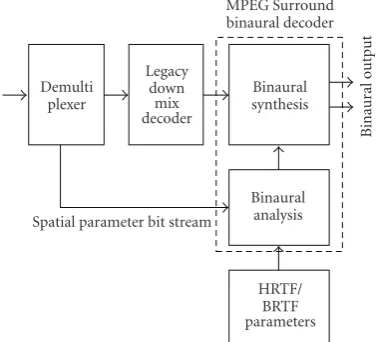
The parametric and morphed-filter approaches as described in Sections3and4can be integrated in an MPEG Surround decoder. The mode of operation is referred to as “binau-ral decoding mode” and its architecture is visualized in
Spatial parameter bit stream Demulti
plexer
MPEG Surround binaural decoder
B
inaur
al
output
HRTF/ BRTF parameters
Binaural synthesis
Binaural analysis Legacy
down mix decoder
Figure 5: Overview of a binaural decoding mode for MPEG Surround.
B
inaur
al
output
Hybrid QMF synthesis Hybrid
QMF analysis
2×2 matrix
M
Do
w
n
-mix
input D
Figure6: Overview of a binaural synthesis stage based on a mono downmix.
Figure 5. Instead of directly applying the transmitted spatial parameters to the output signals to generate multichannel output, the parameters are used in a binaural analysis stage to compute binaural parameters (using a parametric approach) or morphed filters (using the morphed-filter approach) that would result from the combined spatial decoding and binaural rendering process. The binaural output signals are subsequently generated by the binaural synthesis stage.
The binaural synthesis process is performed in a filter-bank domain to enable independent processing of various time-frequency tiles. The synthesis stage for a mono down-mix using a parametric approach is outlined in Figure 6. A hybrid QMF filter bank provides 71 down-sampled, nonlinearly spaced subbands that can be grouped in 28 parameter bands that approximate the bandwidth of critical bands. In case of a mono downmix, the hybrid-QMF-domain signal is processed by a decorrelator that consists of lattice all-pass filters to generate a signal that is statistically independent from its input [19, 21]. In case of a stereo downmix, the two downmix signals serve as input to the spatial synthesis stage (without decorrelator). Subsequently, a 2×2 matrixMis applied for each subband to generate two signals. The final binaural output is obtained by two hybrid QMF synthesis filter banks.
50 milliseconds, and the parameters are typically placed at or near positions where spatial attributes of the audio content show strong deviations over time.
For positions in-between parameter positions, the spatial properties of the incoming signals are not accurately defined and hence an interpolation scheme is required. Preferably, the interpolation scheme has a relatively low computational complexity such that the system could run on battery-powered devices such as mobile audio players. From infor-mal tests it was observed that a piecewise linear approxima-tion of the time-varying synthesis matrix variaapproxima-tion (i.e., by linear interpolation of the synthesis matrix) did not have any negative effects on the resulting quality compared to more advanced interpolation schemes.
5.2. Evaluation (parametric approach)
5.2.1. Procedure
A listening test was pursued to evaluate the subjective quality of the proposed parametric binaural synthesis method. In this test, the quality of the MPEG Surround (MPS) binaural decoding mode (“MPS binaural”) is compared to a reference condition. This reference condition comprised convolution of an original multichannel audio excerpt with HRIRs and subsequent downmix to stereo. As a control condition, the combination of MPEG Surround multichannel decoding followed by conventional HRIR convolution was employed (denoted “MPS + HRIR”). For all configurations in this test, anechoic KEMAR HRIRs [43] were used with a length of 128 samples at a sampling frequency of 44.1 kHz.
For both the binaural decoding mode and the con-trol condition, the same MPEG Surround bit stream was employed. This bit stream was generated using a state-of-the-art MPEG Surround encoder using a mono down-mix configuration. This mono downdown-mix was subsequently encoded using a high-efficiency AAC (HE-AAC) encoder [44] at 44 kbps. The spatial parameters generated by the MPEG Surround decoder occupied approximately 4 kbps. This rather low bit rate of 48 kbps total was selected because it is foreseen that the binaural decoding mode is especially suitable for mobile applications that are under severe transmission bandwidth and complexity constraints.
Twelve listeners participated in this experiment. All listeners had significant experience in evaluating audio codecs and were specifically instructed to evaluate the overall quality, consisting of the spatial audio quality as well as any other noticeable artifacts. In a double-blind MUSHRA test [45], the listeners had to rate the perceived quality of several processed excerpts against the reference condition (i.e., uncoded items processed with HRIRs) excerpts on a 100-point scale with 5 labels, denoted as “bad,” “poor,” “fair,” “good,” and “excellent.” A hidden reference and the low-pass filtered anchor (reference with a bandwidth limitation of 3.5 kHz) were also included in the test. The subjects could listen to each excerpt as often as they liked and could switch in real time between all versions of each excerpt. The experiment was controlled from a PC with an RME Digi 96/24 sound card using ADAT digital out. Digital-to-analog
Table1: Test excerpts
Excerpt Name Category
1 BBC applause Pathological/ambience
2 ARL applause Pathological/ambience
3 Chostakovitch Music
4 Fountain music Pathological/ambience
5 Glock Pathological
6 Indie2 Movie sound
7 Jackson1 Music
8 Pops Music
9 Poulenc Music
10 Rock concert Music
11 Stomp Music (with LFE)
conversion was provided by an RME ADI-8 DS 8-channel D-to-A converter. Beyerdynamic DT990 headphones were used throughout the test. Subjects were seated in a sound-insulated listening room.
A total of 11 critical multichannel excerpts were used as listed in Table 1. The excerpts are the same as used in the MPEG Call for Proposals (CfP) on Spatial Audio Coding [46], and range from pathological signals (designed to be critical for the technology at hand) to movie sound and multichannel music productions. All input and output excerpts were sampled at 44.1 kHz.
5.2.2. Results
The results of the listening test are shown in Figure 7. The various excerpts are given along the abscissa, while the ordinate corresponds to the average MUSHRA score across listeners. Different symbols refer to different configurations. The error bars denote the 95% confidence intervals of the means.
The hidden reference (square symbols) has the highest scores. The results for the binaural decoding mode are denoted by the diamonds; the control condition using con-volution is represented by the downward triangles. Although the scores for these methods vary between 45 and 85, the binaural decoding approach has scores that are higher than the conventional method for all excerpts. Finally, the low-pass anchor has the lowest scores of around 20.
The average scores for each method across subjects and excerpts are shown inFigure 8. The difference between the binaural decoding mode and the control condition amounts to 12 points in favor of the binaural decoder.
0 20 40 60 80 100
BBC
applause
ARL
applause
Chostak
o
vi
tc
h
Fo
u
n
ta
in
m
u
si
c
Gloc
k
Indie2
Ja
ck
so
n
1
Po
p
s
P
o
ulenc
Ro
ck
co
n
ce
rt
St
omp
Ref MPS binaural
MPS + HRIR BW35
Test results (subjects: 12, items: 11, codecs: 4)
MUSHRA
Figure 7: Subjective test results averaged across subjects for the parametric approach. Error bars denote the 95% confidence intervals of the means.
0 20 40 60 80 100
Re
f
MPS
b
inaur
al
MPS
+
HRIR BW
3
5
Test results (overall mean)
MUSHRA
Figure8: Overall mean scores (across subjects and excerpts) for the parametric approach.
5.2.3. Discussion
The results of the perceptual evaluation indicate that both of the binaural rendering methods (the parametric binaural decoding mode and the conventional HRIR convolution method) are distinguishable from the reference. This is most probably due to the low bit-rate (48 kbps total) that was employed to represent the multichannel signal in MPEG Surround format. For loudspeaker playback, the perceived quality of MPEG Surround operating at 48 kbps has been shown to amount 65 in other tests [15,47]. In that respect, the quality for the test and control conditions isin line with earlier reports.
The parametric representation of MPEG Surround aims at perceptual reconstruction of multichannel audio. As such, at the bit rate that was under test, MPEG Surround does not deliver full waveform reconstruction of the multichannel output signals. Such waveform reconstruction requires the use of “residual coding” as supported by MPEG Surround. However, residual coding results in a significant increase in the bit rate which is undesirable or even unavailable in mobile applications. Given the low scores for MPEG Surround decoding followed by HRIR convolution, the multichannel signals resulting from the parametric repre-sentation seem unsuitable for further post processing using HRIRs. This is a property that is often observed for lossy audio coders. The binaural decoding mode, however, which does not rely on processing of decoded signals, outperforms the convolution-based method, both in terms of perceived quality and computational complexity. This clearly indicates the advantages of parameter-domain processing compared to the signal-domain approach.
5.3. Evaluation (morphed-filter approach)
5.3.1. Procedure
A second listening test was employed to assess the quality of the QMF-domain morphed-filter approach. The reference, control, test and anchor conditions were generated in the same way as described in Section 5.2.1, however with the following modifications to reflect a different application scenario, that is, that of an online music store. In this application scenario, multichannel audio is encoded using the MPEG Surround format employing a stereo downmix to ensure stereo backward compatibility. The down-mix was encoded using AAC at a bit of 160 kbps, a common bit rate for stereo content in online music stores, while the MPEG Surround parameter bit rate was set to 12 kbps. In the current test, echoic BRIRs were employed that were also used in the MPEG selection tests [48]. The test procedure and excerpts are identical to those employed in the previous test. A total of 12 subjects participated in this test.
5.3.2. Results
0 20 40 60 80 100
BBC
applause
ARL
applause
Chostak
o
vi
tc
h
Fo
u
n
ta
in
m
u
si
c
Gloc
k
Indie2
Ja
ck
so
n
1
Po
p
s
P
o
ulenc
Ro
ck
co
n
ce
rt
St
omp
Ref MPS binaural
MPS + HRIR BW35
Test results (subjects: 12, items: 11, codecs: 4)
MUSHRA
Figure 9: Subjective test results averaged across subjects for the morphed-filter approach. Error bars denote the 95% confidence intervals of the means.
different configurations. The error bars denote the 95% confidence intervals of the means.
The trend observed in Figure 9 is very similar to the one observed for the parametric approach inFigure 7. The hidden reference (squares) has scores around 100. The MPEG Surround binaural decoding mode (diamonds) has scores between 77 and 95 and has in all cases a higher mean across subjects than the control condition (downward triangles).
The mean across subjects and excerpts for each con-figuration is shown in Figure 10. On average, the MPEG Surround binaural decoding mode scores about 90, which is roughly 10 MUSHRA points higher than the control condition.
The computational complexity of the morphed-filter approach in this case amounts to 41 million operations, compared to 47 million for the control condition (MPEG Surround multichannel output followed by BRIR convolu-tion in the FFT domain).
5.3.3. Discussion
In analogy to the test results for the parametric approach, the QMF-domain filtering method achieves a higher quality than the control condition (i.e., multichannel decoding and subsequent HRTF or BRIR convolution). Hence, for both
0 20 40 60 80 100
Re
f
MPS
b
inaur
al
MPS
+
HRIR BW
3
5
Test results (overall mean)
MUSHRA
Figure10: Overall mean scores (across excerpts and subjects) for the morphed-filter approach. Error bars denote the 95% confidence intervals of the means.
methods, it is beneficial to combine the spatial decoding and binaural rendering processes to achieve maximum perceptual quality.
The overall scores for the QMF-domain filtering approach are higher than those for the parametric method. This difference can be attributed to several factors.
(i) The employed binaural rendering method. The para-metric approach employs a lossy HRTF representa-tion, while the QMF-domain filtering method results in a more accurate representation of the original impulse response.
(ii) The spatial parameter bit rate. In the second test, the bit rate used for spatial parameters is higher than the bit rate employed in the first test, which results in a more accurate representation of the multichannel audio content.
(iii) The downmix configuration. In the second test, a stereo downmix was employed, while in the first test, one single audio channel was used as downmix signal. MPEG Surround will in most cases achieve a higher quality for stereo downmixes than for mono downmixes.
Although it is difficult to assess the effect of the individual factors on the resulting quality based on the current test results, it is expected that the downmix coder (and the associated channel configuration) has quite a large effect on the overall quality, a trend that can also be observed in loudspeaker reproduction test results published in [17,18].
6. CONCLUSIONS
Two novel methods for binaural rendering based on para-metric representations were outlined. In contrast to con-ventional, convolution-based methods, HRTFs or BRTFs are transformed to the parameter domain or filterbank domain and combined with parameters that describe the statistical properties of the various signals, which are radiated by virtual sources. From this combination, a 2 × 2 matrix operation (including the option to have taps in the time direction) is derived that converts a mono (using an addi-tional decorrelator circuit) or stereo downmix to a binaurally rendered signal without the need of individual source signals as intermediate step.
The proposed method can be easily integrated with parametric multichannel audio coders (MPEG Surround) that rely on interchannel cues such as level differences and interchannel correlations. Results of a listening test revealed that the proposed method outperforms conven-tional, convolution-based methods in terms of perceived quality and computational complexity. These properties, combined with the unsurpassed compression efficiency of MPEG Surround, make the proposed method very suitable for mobile applications.
ACKNOWLEDGMENT
The authors would like to thank the anonymous reviewers and the associate editor for their thorough reading and valuable comments and suggestions for improving the manuscript.
REFERENCES
[1] D. R. Begault,3-D Sound for Virtual Reality and Multimedia, Academic Press, Cambridge, Mass, USA, 1994.
[2] J. Blauert,Spatial Hearing: The Psychophysics of Human Sound
Localization, MIT Press, Cambridge, Mass, USA, 1997.
[3] P. Rubak, “Headphone signal processing system for out-of-the head localization,” inProceedings of the 90th AES Convention, Paris, France, January 1991, in paper 3063.
[4] F. Rumsey,Spatial Audio, Focal Press, Oxford, UK, 2001. [5] F. L. Wightman and D. J. Kistler, “Headphone simulation
of free-field listening—I: stimulus synthesis,” Journal of the
Acoustical Society of America, vol. 85, no. 2, pp. 858–867, 1989.
[6] B. G. Shinn-Cunningham, “Applications of virtual auditory displays,” in Proceedings of the 20th Annual International Conference of the IEEE Engineering in Medicine and Biology
Society (EMBS ’98), vol. 3, pp. 1105–1108, Hong Kong,
October-November 1998.
[7] P. Minnaar, S. K. Olesen, F. Christensen, and H. Møller, “The importance of head movements for binaural room synthesis,”
in Proceedings of the International Conference on Auditory
Display (ICAD ’01), Espoo, Finland, July-August 2001.
[8] B. G. Shinn-Cunningham, “The perceptual consequences of creating a realistic, reverberant 3-D audio display,” in
Proceedings of the International Congress on Acoustics (ICA ’04),
Kyoto, Japan, April 2004.
[9] H. Møller, D. Hammershøi, C. B. Jensen, and M. F. Sørensen, “Evaluation of artifical heads in listening tests,”Journal of the
Audio Engineering Society, vol. 47, no. 3, pp. 83–100, 1999.
[10] H. Møller, M. F. Sørensen, C. B. Jensen, and D. Hammershøi, “Binaural technique: do we need individual recordings?”
Journal of the Audio Engineering Society, vol. 44, no. 6, pp. 451–
469, 1996.
[11] F. L. Wightman and D. J. Kistler, “Individual differences in human sound localization behavior,” The Journal of the
Acoustical Society of America, vol. 99, no. 4, pp. 2470–2500,
1996.
[12] J.-M. Jot, M. Walsh, and A. Philp, “Binaural simulation of complex acoustic scenes for interactive audio,” inProceedings
of the 121st AES Convention, San Francisco, Calif, USA,
October 2006, in paper 6950.
[13] ISO/IEC JTC1/SC29/WG11, “MPEG audio technologies— part 1: MPEG surround,” ISO/IEC FDIS 23003-1:2006(E), 2004.
[14] J. Breebaart and C. Faller,Spatial Audio Processing: MPEG
Sur-round and Other Applications, John Wiley & Sons, Chichester,
UK, 2007.
[15] J. Breebaart, J. Herre, C. Faller, et al., “MPEG spatial audio coding / MPEG surround: overview and current status,” in
Proceedings of the 119th AES Convention, New York, NY, USA,
October 2005, in paper 6599.
[16] J. Breebaart, G. Hotho, J. Koppens, E. Schuijers, W. Oomen, and S. van de Par, “Background, concept, and architecture for the recent MPEG surround standard on multichannel audio compression,”Journal of the Audio Engineering Society, vol. 55, no. 5, pp. 331–351, 2007.
[17] J. Herre, K. Kj¨orling, J. Breebaart, et al., “MPEG surround— the ISO/MPEG standard for efficient and compatible multi-channel audio coding,” in Proceedings of the 122th AES
Convention, Vienna, Austria, May 2007.
[18] J. R¨od´en, J. Breebaart, J. Hilpert, et al., “A study of the MPEG surround quality versus bit-rate curve,” inProceedings of the
123rd AES Convention, New York, NY, USA, October 2007.
[19] E. Schuijers, J. Breebaart, H. Purnhagen, and J. Engdeg˚ard, “Low complexity parametric stereo coding,” in Proceedings
of the 116th AES Convention, Berlin, Germany, May 2004, in
paper 6072.
[20] J. Breebaart, S. van de Par, A. Kohlrausch, and E. Schuijers, “Parametric coding of stereo audio,” EURASIP Journal on
Applied Signal Processing, vol. 2005, no. 9, pp. 1305–1322,
2005.
[21] J. Engdeg˚ard, H. Purnhagen, J. R¨od´en, and L. Liljeryd, “Syn-thetic ambience in parametric stereo coding,” inProceedings of
the 116th AES Convention, Berlin, Germany, May 2004.
[22] H. Purnhagen, “Low complexity parametric stereo coding in MPEG-4,” inProceedings of the 7th International Conference on
Digital Audio Effects (DAFx ’04), Naples, Italy, October 2004,
http://dafx04.na.infn.it/.
[23] H. Purnhagen, J. Engdegard, W. Oomen, and E. Schuijers, “Combining low complexity parametric stereo with high efficiency AAC,” ISO/IEC JTC1/SC29/WG11 MPEG2003/ M10385, December 2003.
Proceedings of the 114th AES Convention, Amsterdam, The Netherlands, March 2003, in paper 5852.
[25] G. Hotho, L. Villemoes, and J. Breebaart, “A stereo backward compatible multi-channel audio codec,”IEEE Transactions on
Audio, Speech and Language Processing, vol. 16, pp. 83–93,
2008.
[26] F. Baumgarte and C. Faller, “Binaural cue coding—part I: psychoacoustic fundamentals and design principles,” IEEE
Transactions on Speech and Audio Processing, vol. 11, no. 6, pp.
509–519, 2003.
[27] C. Faller and F. Baumgarte, “Binaural cue coding—part II: schemes and applications,”IEEE Transactions on Speech and
Audio Processing, vol. 11, no. 6, pp. 520–531, 2003.
[28] F. L. Wightman and D. J. Kistler, “Headphone simulation of free-field listening—II: psychophysical validation,”Journal of
the Acoustical Society of America, vol. 85, no. 2, pp. 868–878,
1989.
[29] F. L. Wightman and D. J. Kistler, “Resolution of front-back ambiguity in spatial hearing by listener and source movement,” Journal of the Acoustical Society of America, vol. 105, no. 5, pp. 2841–2853, 1999.
[30] D. S. Brungart, N. I. Durlach, and W. M. Rabinowitz, “Auditory localization of nearby sources—II: localization of a broadband source,”Journal of the Acoustical Society of America, vol. 106, no. 4, pp. 1956–1968, 1999.
[31] B. G. Shinn-Cunningham, S. Santarelli, and N. Kopco, “Tori of confusion: binaural localization cues for sources within reach of a listener,”Journal of the Acoustical Society of America, vol. 107, no. 3, pp. 1627–1636, 2000.
[32] W. M. Hartmann and A. Wittenberg, “On the externalization of sound images,”Journal of the Acoustical Society of America, vol. 99, no. 6, pp. 3678–3688, 1996.
[33] E. H. A. Langendijk and A. W. Bronkhorst, “Fidelity of three-dimensional-sound reproduction using a virtual auditory display,”Journal of the Acoustical Society of America, vol. 107, no. 1, pp. 528–537, 2000.
[34] F. L. Wightman and D. J. Kistler, “The dominant role of low-frequency interaural time differences in sound localization,”
Journal of the Acoustical Society of America, vol. 91, no. 3, pp.
1648–1661, 1992.
[35] A. Kulkarni and H. S. Colburn, “Role of spectral detail in sound-source localization,” Nature, vol. 396, no. 6713, pp. 747–749, 1998.
[36] A. Kulkarni, S. K. Isabelle, and H. S. Colburn, “Sensitivity of human subjects to head-related transfer-function phase spectra,”Journal of the Acoustical Society of America, vol. 105, no. 5, pp. 2821–2840, 1999.
[37] J. Breebaart,Modeling binaural signal detection, Ph.D. thesis, Eindhoven University of Technology, Eindhoven, The Nether-lands, 2001.
[38] J. Breebaart and A. Kohlrausch, “The perceptual (ir)relevance of HRTF magnitude and phase spectra,” inProceedings of the
110th AES Convention, Amsterdam, The Netherlands, May
2001, in paper 5406.
[39] J. Huopaniemi and N. Zacharov, “Objective and subjective evaluation of head-related transfer function filter design,”
Journal of the Audio Engineering Society, vol. 47, no. 4, pp. 218–
239, 1999.
[40] B. R. Glasberg and B. C. J. Moore, “Auditory filter shapes in forward masking as a function of level,” Journal of the
Acoustical Society of America, vol. 71, no. 4, pp. 946–949, 1982.
[41] ITU-R, “Multichannel stereophonic sound system with and without accompanying picture,” ITU-R Recommend. BS.775-1, 1994.
[42] L. Villemoes, “Efficient filtering with a complex modulated filterbank,” in Patent application WO2007/085275A1, 2007. [43] B. Gardner and K. Martin, “HRTF measurements of a KEMAR
dummy-head microphone,” Perceptual Computing Technical Report 280, MIT Media Lab, Cambridge, Mass, USA, 1994. [44] M. Wolters, K. Kj¨orling, D. Homm, and H. Purnhagen, “A
closer look into MPEG-4 high efficiency AAC,” inProceedings
of the 115th AES Convention, Los Angeles, Calif, USA, October
2003, in paper 5871.
[45] ITU-R, “Method for the subjective assessment of intermediate quality level of coding systems (MUSHRA),” ITU-R Recom-mend. BS.1534, 2001.
[46] ISO/IEC JTC1/SC29/WG11, “Call for proposals on spatial audio coding,” ISO/IEC JTC1/SC29/WG11 N6455, October 2004.
[47] L. Villemoes, J. Herre, J. Breebaart, et al., “MPEG surround: the forthcoming ISO standard for spatial audio coding,” in
Proceedings of the 28th AES Conference, pp. 213–230, Pitea,
Sweden, June-July 2006.