R E S E A R C H
Open Access
Numerical solution of Volterra partial
integro-differential equations based on
sinc-collocation method
Atefeh Fahim
1, Mohammad Ali Fariborzi Araghi
1*, Jalil Rashidinia
1,2and Mehdi Jalalvand
3*Correspondence:
1Department of Mathematics,
Central Tehran Branch, Islamic Azad University, Simaye Iran Street, Tehran, 14676-86831, Iran Full list of author information is available at the end of the article
Abstract
We provide the numerical solution of a Volterra integro-differential equation of parabolic type with memory term subject to initial boundary value conditions. Finite difference method in combination with product trapezoidal integration rule is used to discretize the equation in time and sinc-collocation method is employed in space. A weakly singular kernel has been viewed as an important case in this study. The convergence analysis has been discussed in detail, which shows that the approach exponentially converges to the solution. Furthermore, numerical examples and illustrations are presented to prove the validity of the suggested method.
MSC: 65R99; 45A99; 45K05
Keywords: partial integro-differential equation; sinc-collocation method; finite difference method; product trapezoidal integration rule
1 Introduction
We consider a Volterra integro-differential equation with memory term of the form
ut(x,t) =
t
k(t–s)uxx(x,s)ds+f(x,t), x∈,t∈J, ()
subjected to initial and boundary conditions
u(a,t) =u(b,t) = , t∈J,
u(x, ) =u(x), x∈,
()
where= [a,b]⊆RandJ= [,T]. Hereut=∂∂ut,uxx=
∂u
∂x, andkis a real-valued and
positive definite kernel, that is,
T
ϕ(t)
t
k(t–s)ϕ(s)ds dt≥ ()
for allT> and any continuousϕ: [,T]−→R, andf is a real-valued function. Ifkis a smooth function onR+, equation () is hyperbolic, whereas ifkhas a weak singularity at
, such ask(t) =tβ(–β), <β< , then it adopts a parabolic behavior [–]. Withuxx=∇u, the evolution equation () is sometimes called a fractional wave equation [], because in the limiting case whereβ= , after differentiation with respect tot, we obtain
utt(x,t) =∇u(x,t) +f(x,t),
and asβ→, we get the heat equation
ut(x,t) =∇u(x,t) +f(x,t).
Modeling phenomena in viscoelasticity, biological models, chemical kinetics, heat con-duction in materials with memory, population dynamics, fluid dynamics and nuclear re-actor dynamics, mathematical biology, financial mathematics, compression of viscoelastic media, and other similar areas are all done by partial integro-differential equations of type (). See, for example, [] and the references therein. This problem governs many physical systems occurring in diffusion problems as a particular case [].
To treat the partial integro-differential equations (PIDEs), a substantial number of meth-ods have been applied. For example, the pseudo-spectral Legendre-Galerkin method for solving a parabolic PIDE with convolution-type kernel was presented in []. Combina-tion of radial basis funcCombina-tions and finite difference for solving nonlinear-type PIDEs with smooth kernel containing an unknown function was considered in []. Also, a spectral method was proposed in [] for the PIDEs with a weakly singular kernel.
The numerical solution of equation () with a weakly singular kernel was considered by many authors, such as finite-element methods [, ], finite-difference methods [, ], compact difference schemes [], spectral collocation methods [], orthogonal spline col-location methods [], variational iteration and Adomian decomposition methods [], radial basis functions methods [], and quasi-wavelet methods []. However, construc-tion of precise numerical methods for integro-differential equaconstruc-tions is still a challenge owing to the weak singularity of the kernelkthat contains sharp states of transitions in the solution. This lack of smoothness of the solution neart= results in a decay in the order of the practical performance of familiar timestepping methods for equation (). For instance, the trapezoidal rule with product integration of the quadrature term does not produce expectedO(t) errors [].
The sinc approximation has been studied by many authors to solve various equations such as integral equations [], ordinary differential equations [], partial differential equations [–], integro-differential equations [], and so on, due to high accuracy, exponential rate of convergence, and near optimality of this method []. With these back-grounds, we extend the sinc-collocation method for solving partial integro-differential equations of type ().
This paper is organized as follows. Section provides some basic definitions, assump-tions, and preliminaries of sinc approximation. In Section , we develop the sinc collo-cation method to solve Volterra partial integro-differential equations. In Section , we discuss the convergence analysis of the proposed method. Finally, in Section , numerical examples are solved to verify the accuracy and efficiency of the proposed approach.
2 Preliminaries
The goal of this section is to recall notation and definitions of the sinc function and state some known theorems important for the rest of this paper, which were discussed thor-oughly in [, ].
The sinc method is basically defined on the real line. So, the sinc function is defined on the whole real line by
sinc(z) =
⎧ ⎨ ⎩
sin(πz)
πz , z= ,
, z= ,
and the translated sinc functions with evenly spaced nodes are given as
S(j,h)(z) =sinc
z–jh
h
, j= ,±,±, . . . . ()
The sinc function at the interpolating pointsxk=khis given by
S(j,h)(kh) =δ()jk =
⎧ ⎨ ⎩
, k=j,
, k=j.
They are based on the infinite stripDdin the complex plane
Dd=
w=u+iv:|v|<d≤π
.
Letf be a function defined onR, and let h> be the mesh size. Then the Whittaker cardinal function is defined by the infinite series as follows:
C(f,h,x) =
∞
j=–∞
f(jh)S(j,h)(x).
However, in practice, the finite number of terms are used in this series such as j= –N, . . . ,N, where N+ is the number of sinc grid points. So,
C(f,h,x)≈ N
j=–N
f(jh)S(j,h)(x),
To construct an approximation on the interval= [a,b], we consider the conformal map
φ(z) =log
z–a b–z
. ()
The mapφcarries the eye-shaped region
DE=
z=x+iy:arg
z–a b–z
<d≤π
ontoDdsuch thatφ(a) = –∞,φ(b) =∞, wherea,bare the boundary points ofDE with
a,b∈∂DE. For the sinc method on the interval= [a,b], basis functions are derived from the composite translated sinc functions
Sj(z) =S(j,h)◦φ(z)=sinc
φ(z) –jh h
, j= ,±,±, . . . .
The inverse map ofw=φ(z) is
z=φ–(w) =a+be w
+ew .
Letψdenote the inverse map ofφ, so we define the range ofφ–on the real line as
=ψ(u) =φ–(u)∈DE: –∞<u<∞
= [a,b].
Forh> , let the pointsxkonbe given by
xk=ψ(kh) =
a+bekh
+ekh , k∈Z. ()
Definition ([], p. ) LetB(DE) denote the class of functionsf analytic inDE such that, for some constantγ with ≤γ < ,
ψ(u+)
f(z)dz=O|x|γ, u→ ±∞,
where={iη:|η|<d≤π
}, and, for a simple closed contourδinDE,
N(f,DE)≡ lim
δ→∂DE
δ
f(z)dz<∞,
where∂DErepresents the boundary ofDE.
Definition ([], p. ) ByLα(DE) we denote the set of all analytic functionsf for which there exists a constant,Csuch that
f(z)≤C |ρ(z)|
α
( +|ρ(z)|)α, z∈DE, <α≤, ()
The following theorem presents the convergence result on the approximation of deriva-tives particularly useful for approximate solving some differential equations.
Theorem ([], p. ) Ifφu∈B(DE)and
The sinc-collocation method requires the derivatives of the composite sinc function to be evaluated at the nodes. So, we need to recall the following lemma.
Lemma ([], p. ) Letφbe the conformal one-to-one mapping of the simply connected domain DEonto Ddgiven by().Then
3 Description of the method
In this section, we give the sinc-collocation method for solving the partial integro-differential equation with kernelk(t–s) = (t–s)–β:
ut(x,t) =
t
(t–s)–βuxx(x,s)ds+f(x,t), <x< ,t∈J, ()
with boundary and initial conditions
u(,t) =u(,t) = , ≤t≤T,
u(x, ) =u(x), ≤x≤.
()
a weakly singular kernel. First of all, a description of the spatial-temporal discretization for this type of equations is provided in detail. The sinc-collocation algorithm is then de-scribed for solving equation ().
3.1 Discretization in time
Now, the backward Euler method is applied for time derivatives in equation (). Lettn=
ntwith time stept,un=u(x,tn), andfn=f(x,tn) forn= , , . . . ,M,M= [T
k],k∈N. By
substitutingt=tn+into the left-hand side of () for the first term, we have
ut(x,tn+)≈
un+(x) –un(x)
t +Rn+,, <x< ,n≥, ()
whereRn+,=O(t) is the order of the backward Euler method. The integral term of ()
can be approximated by unusual quadrature approximation, that is, a kind of the product trapezoidal integration rule [] as follows:
tn+
Substituting equations () and () into equation (), we get the temporal semi-discrete form of () as follows:
and with additional initial condition
u(x) =u(x). ()
Ignoring the small error termRn+, we arrive at the semidiscrete scheme
un+(x) –Bn,nunxx+(x) =tfn+(x) +un(x) + n
l=
ρn,lulxx(x), <x< ,n≥. ()
The scheme () is implicit because the integral term depends onun+ and is accurate of orderRn+=O(t). In fact, we find that
u(x) –B,uxx(x) =tf(x) +u(x),
and, forn≥, by applying () at each step the right-hand side involves the solution at all previous time levels. As a consequence, we have a linear ordinary differential equation in the form () with boundary conditions () in each time level. Now, in each time level, we can use the sinc-collocation method to estimate the solution of the linear boundary value problem ()-().
3.2 Discretization in space: sinc-collocation method
We discretize the spatial direction by the described sinc-collocation method. Assume that the approximate solution of () defined by
unm(x) = N
j=–N
cnjS(j,h)◦φ(x), m= N+ , ()
and
φ(x) =log
x
–x
()
and that the unknown coefficients cnj in () are determined by the sinc-collocation method. The points in the sinc-collocation method are
xk=
ekh
+ekh, k= –N, . . . ,N,h=
πd
αN, ()
so
d dxu
n
m(x) =
N
j=–N
cnj d
dx
S(j,h)◦φ(x)
= N
j=–N
cn j
φ(x)S()j (x) +φ(x)Sj()(x), ()
where
S(jl)(x) = d
(l)
dφ(l)
Thus, by Theorem ,
By substituting () and () into () we have
N the identity matrix, andI()andI()are symmetric and skew-symmetric Toplitz matrices of order N+ , respectively. We define the (N+ )×(N+ ) diagonal matrix as follows:
By multiplying both sides of () by
(φ(xi)) we have
Therefore, system () can be written in a matrix form as
or in a compact form as
PCn+=RtFn++Cn+ n
l=
where
Q=
hD
φ
I()+
hI (),
R=D
φ
,
P=R–Bn,nQ,
()
and
Cn+=cn–+N,c–n+N+, . . . ,cnN+t, Fn+=f–nN+,f–nN++, . . . ,fNn+t. ()
If we set
Gn+=RtFn++Cn+ n
l=
ρn,lQCl, ()
then the system of equations can be written as follows:
PCn+=Gn+ ()
with additional initial condition
C=u(x–N),u(x–N+), . . . ,u(xN)
t
. ()
For eachn, system () is a linear system of equations consisting of N+ equations and N+ unknowns. The coefficientscn
j in the approximate solution () can be determined by solving this linear system.
4 Convergence analysis
In this section, we consider the ODE (), and for simplicity, we can rewrite it as
un+(x) –Bn,n
d dx
un+(x)=g(x), ()
where
g(x) =tfn+(x) +un(x) + n
l=
ρn,l
d dx
ul(x),
associated with boundary conditions
un+() =un+() = .
Letun+(x) be the exact solution of ODE (), that is, the solution of given equations
()-() at time level (n+ )th. Also, we assume thatun+
equation () by using the sinc-collocation (). The computed solution of equations
()-, which is given in the following lemma.
Lemma Let the matrix P be defined by equation().For x∈φ–((–∞,∞)),we can
where(·)∗denotes the conjugate transpose of a matrix,and
H=D
If the eigenvalues of matrix H are nonnegative,then there exists a constant c,independent of N,such that
for a sufficiently large N.
Proof Letλi(·),i= , , . . . , N+ , be the eigenvalues of a matrix ordered asλi(·)≤λi+(·),
and letσibe the singular values of the matrixPsatisfyingσi≤σi+. Note that the matrix I()is a symmetric, negative definite Toeplitz matrix with bounded eigenvalues and matrix I()is a skew-symmetric Toeplitz matrix with complex eigenvalues ([], p. -). From
([], p. , []) we have
The following theorem gives a bound for|un+
Theorem Let un+
m (x)be an approximate solution of equation(),and let wnm+(x)be an
approximate solution of equations()-().Then,there exists a constant c,independent of N,such that
Proof By equations () and () and the Cauchy-Schwarz inequality we have
un+
Using equation () in (), we have
Cn+–Vn+
. For simplicity, we denote
rk=
PVn+–Gn+k, k= –N, . . . ,N,
and using equation (), we obtain
|rk|=g(xk) –gm(xk)
Now, using Theorem , we obtain
wherecandcare constants independent ofN, andK=c+Bn,nc. We know that
PVn+–Gn+≤√N+ PVn+–Gn+∞,
and using inequality (), we obtain
PVn+–Gn+≤√K Nexp–(πdαN)/. ()
Now, using Lemma and inequality () in (), we have
Cn+–Vn+≤ √
dK( +c)
απBn,n
Nexp–(πdαN)/. ()
So, from () and () we get
sup
x∈
unm+(x) –wnm+(x)≤cNexp–(πdαN)/,
wherec=
√
dK(+c)c
απBn,n .
Theorem Let un+(x)be the exact solution of ODE(),and let un+
m (x)be its sinc
ap-proximation defined by Eq. ().Then,under the assumptions of Theoremsand,there exists a constant c,independent of N,such that
sup
x∈
un+(x) –unm+(x)≤cNexp–(πdαN)/. ()
Proof Applying the triangular inequality,
un+(x) –unm+(x)≤un+(x) –wmn+(x)+wnm+(x) –unm+(x). ()
After Applying Theorem , there exists a constantcindependent ofNsuch that
un+(x) –wmn+(x)≤cN/exp
–(πdαN)/. ()
Also, using Theorem , we obtain
wnm+(x) –unm+(x)≤cNexp–(πdαN)/, ()
wherecis a constant independent ofN. Finally, applying solutions to () and (), we conclude
sup
x∈
un+(x) –umn+(x)≤cNexp
–(πdαN)/,
wherec=max{c,c}.
O(t) andO(t–β), respectively [–, , ]. Then, by applying () the truncation
error of the proposed approach for solution of equations ()-() can be written as fol-lows:
u(x,t) –um(x,t)∞≤γ
Nexp–(πdαN)/+t,
whereγ is a constant independent ofN.
5 Numerical results
In this section, we provide numerical experiments of the suggested method. In all exam-ples, we set the parametersd=π andα= and denote the computational solution and exact analytical solution byuappanduex, respectively. The error estimation is given to show the accuracy of approximation, and the following maximum pointwise error between the exact and approximate solution is given:
· ∞= Max
i,n uapp(xi,tn) –uex(xi,tn), i= –N, . . . ,N,n= , , . . . ,M.
To implement the method, the following algorithm is given.
The linear algebraic system in step of Algorithm is solved directly by using ‘linsolve’ command from ‘LinearAlgebra’ package in Matlab Ra software, and to overcome the ill-conditioning faced in this problem, we used the following Tikhonov regularization [], which states that ‘solve the systemAx=bby replacing minx∈RnAX–b by the least square problemminx∈Rn{AX–b+μX}’. All the calculations were supported by In-tel CORE Dual-Core at . GHz CPU with GB RAM.
Algorithm Implementation of the proposed approach
: InputM,N,n,u(x),f(x,t),uex(x,t),
: Setxi:= e ih
+eih,i= –N, . . . ,N,
: Settj:=jt,j= , , . . . ,n,
: Computeuex(xi,tj),
: Computeuapp(xi,tj) as follows:
: Setuapp(xi,t) :=C,i= –N, . . . ,N, based on Eq. ()
forj= :n– do fori= –N:Ndo
uapp(xi,tj+) :=Cj+by applying Eqs. (), (), and ()
error(xi,tj) :=|uex(xi,tj) –uapp(xi,tj)|, end do
end do
Example Consider the following homogenous Volterra partial integro-differential equation []:
ut(x,t) =
t
(t–s)–/uxx(x,s)ds, <x< , <t< ,
u(,t) =u(,t) = , ≤t≤,
u(x, ) =sin(πx), ≤x≤,
with analytic solution [, ]
u(x,t) =
∞
k=
(–)k
k+
–
π/t/ksin(πx).
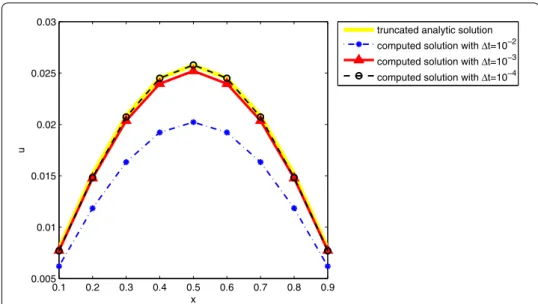
To evaluate the analytic solution practically at a specific point, we truncate this infinite series by the term k= . In Table , the outcomes of the three-point explicit method (TPEM), three-point implicit method (TPIM), Crank-Nicolson method (CNM), Crandall method (CM) (see []) witht= –are presented in order to compare with the
sinc-collocation method solving the arising system solved by the Linsolve package (SMLP) and the sinc-collocation method solving the arising system by the Tikhonov regularization (SMTR) witht= –,t= –, andt= –. In Figure and Figure , we can also
observe that the computational solution is highly consistent with the truncated analytical solution whentis selected small enough. Furthermore, in Table , the maximum point-wise errors and condition numbers for various values ofNatt= .,t= –, andT=
for SMLP and SMTR are reported, which shows the improved rate of convergence when the number of sinc points increases. Also, the global maximum pointwise errors atN= andt= –are plotted in Figure (a) for SMLP and in Figure (b) for SMTR in order
to compare with the thin plate spline-radial basis function method (TPS-RBF), inverse multiquadric-radial basis function method (IMQ-RBF), and hyperbolic secant-radial ba-sis function method (Sech-RBF) (see []) witht= –atN= . These figures show
that our method achieved more accurate results with less data grid points. Convergence curves of Table are plotted in Figure . This figure indicates that the maximum errors decline at an exponential rate with respect to N for both SMLP and SMTR, and these graphs confirm the theoretical results.
Example Consider the following nonhomogenous Volterra partial integro-differential equation [, ]:
ut(x,t) =
t
(t–s)–/uxx(x,s)ds+f(x,t), <x< , <t< ,
u(,t) =u(,t) = , ≤t≤,
u(x, ) =sin(πx), ≤x≤.
In the case of
f(x,t) = t
/ √
π
Figure 1 Truncated analytic and computed solutions of Example 1 withN= 4 att= 1 by using the Linsolve package.
Figure 2 Truncated analytic and computed solutions of Example 1 withN= 4 att= 1 by using
Tikhonov regularization.
Table 2 Results for Example 1 att= 0.01
N SMLP SMTR Cond(P) =PP–1
4 1.10×10⁻² 8.27×10⁻³ 4.61×10²
8 2.85×10⁻³ 7.94×10⁻⁴ 6.71×10³
16 4.68×10⁻⁴ 9.32×10⁻⁵ 3.88×10⁴ 32 9.75×10⁻⁵ 4.71×10⁻⁵ 1.30×10⁵
the analytic solution is given byu(x,t) =sinπx– t√/
π sinπx. We apply our presented
Figure 3 The global maximum pointwise errors atN= 4 andt= 10–3(a) by using the Linsolve package, (b) by using of Tikhonov regularization.
Figure 4 Convergence of the SMLP and SMTR methods for various values ofNatt= 0.01,t= 10–4,
andT= 1.
Table 3 Results for Example 2
n t = 10–5 t = 10–6
QWM SMLP SMTR QWM SMLP SMTR
50 4.9343e–004 5.1621e–005 7.5561e–006 1.5630e–005 9.8142e–006 2.7356e–006 150 2.5228e–003 2.9006e–004 8.6902e–005 8.0470e–005 9.8142e–006 2.9441e–006 250 5.3616e–003 6.4177e–004 1.1924e–004 1.7272e–004 2.0303e–005 9.1242e–006 350 8.7631e–003 1.0796e–003 6.6327e–004 2.8572e–004 3.4165e–005 1.5836e–005 450 1.2588e–002 1.5898e–003 1.1745e–004 4.1611e–004 5.0328e–005 2.3042e–005
in the solutions have been computed for th, th, th, th, and th time levels and tabulated in Table , which shows that the sinc method in comparison with QWM is considerably accurate. The analytic and exact solutions are compared in Figure for
Figure 5 Analytic and computed solutions of Example 2 witht= 10–6andN= 32 by using the Linsolve package.
Figure 6 The global maximum pointwise errors atN= 32 andt= 10–6(a) by using the Linsolve
package, (b) by using Tikhonov regularization.
Figure 7 The global maximum pointwise errors forN= 32 att= 0.00045,t= 10–6, andT= 1 (a) by
using the SMLP method, (b) by using the SMTR method.
Example Consider equation () in the nonhomogenous form whenk(t–s) = (π(t–
solu-Table 4 Results for Example 3
N t = 10–5 t = 10–6 t = 10–7
SMLP SMTR SMLP SMTR SMLP SMTR
8 2.75×10⁻³ 8.52×10⁻⁴ 1.05×10⁻³ 8.28×10⁻⁴ 3.57×10⁻⁶ 9.81×10⁻⁷
2.83×10⁻³ 8.94×10⁻⁴ 2.58×10⁻³ 8.41×10⁻⁴ 1.65×10⁻⁴ 7.34×10⁻⁶
2.87×10⁻³ 9.86×10⁻⁴ 2.61×10⁻³ 9.73×10⁻⁴ 4.35×10⁻⁴ 6.52×10⁻⁵
2.88×10⁻³ 9.71×10⁻³ 2.61×10⁻³ 8.84×10⁻³ 6.13×10⁻⁴ 1.41×10⁻⁴
16 2.75×10⁻⁴ 7.32×10⁻⁵ 2.63×10⁻⁴ 7.28×10⁻⁵ 9.00×10⁻⁵ 6.87×10⁻⁷
2.92×10⁻⁴ 6.54×10⁻⁵ 2.66×10⁻⁴ 1.79×10⁻⁵ 2.56×10⁻⁴ 5.62×10⁻⁶
6.45×10⁻⁴ 8.30×10⁻⁵ 2.67×10⁻⁴ 5.48×10⁻⁵ 2.61×10⁻⁴ 6.42×10⁻⁶
1.08×10⁻³ 9.24×10⁻⁵ 2.67×10⁻⁴ 6.74×10⁻⁵ 2.61×10⁻⁴ 7.83×10⁻⁶
32 5.28×10⁻⁵ 9.12×10⁻⁶ 9.81×10⁻⁶ 5.41×10⁻⁶ 8.66×10⁻⁶ 1.19×10⁻⁷ 2.92×10⁻⁴ 4.37×10⁻⁵ 9.81×10⁻⁶ 4.09×10⁻⁶ 8.66×10⁻⁶ 4.72×10⁻⁷ 6.45×10⁻⁴ 5.83×10⁻⁵ 2.04×10⁻⁵ 6.49×10⁻⁶ 8.66×10⁻⁶ 7.28×10⁻⁷
1.08×10⁻³ 7.34×10⁻⁵ 3.43×10⁻⁵ 8.51×10⁻⁶ 8.66×10⁻⁶ 8.63×10⁻⁷
64 5.28×10⁻⁵ 3.41×10⁻⁶ 1.67×10⁻⁶ 9.86×10⁻⁷ 6.11×10⁻⁸ 7.53×10⁻⁸
2.92×10⁻⁴ 1.92×10⁻⁵ 9.24×10⁻⁶ 5.17×10⁻⁶ 2.28×10⁻⁷ 8.91×10⁻⁸
6.45×10⁻⁴ 4.56×10⁻⁵ 2.04×10⁻⁵ 6.84×10⁻⁶ 6.45×10⁻⁷ 9.52×10⁻⁸
1.08×10⁻³ 5.37×10⁻⁵ 3.43×10⁻⁵ 7.13×10⁻⁶ 9.44×10⁻⁷ 1.54×10⁻⁷
Figure 8 Truncated analytic and computed solutions of Example 3 witht= 0.00001 andN= 16 by
using the Linsolve package.
tion is given by []
u(x,t) =
∞
k=
(–)k(π
t/)k
( + k)
+t ∞
k=
(–)k (π
t/)k
( + k)
sin(πx).
To evaluate the analytic solution practically at a specific point, the infinite series given above is truncated by the termk= . In Table , we show the results of the th, th, th, and th time levels of the three different grid sizest= –,t= –, and
t= –for SMLP and SMTR methods whenN= , , , , which verify that the sinc
Figure 9 The global maximum pointwise errors atN= 16 andt= 10–5(a) by using the Linsolve package, (b) by using Tikhonov regularization.
Figure 10 The global maximum pointwise errors forN= 16 att= 0.0035,t= 10–5, andT= 1 (a) by
using the Linsolve package, (b) by using Tikhonov regularization.
6 Conclusions
In this paper, the sinc-collocation method was applied to solve linear Volterra partial integro-differential equations by using the Linsolve package and Tikhonov regularization methods for a final ill-conditioned system. To illustrate the effectiveness of the method, some examples were solved based on the proposed algorithm. Also, the convergence of the method was given. The results show that the proposed method is practically reliable and consistent in comparison with other mentioned methods, and using the Tikhonov regularization method for solving the final ill-conditioned algebraic system, the rate of convergence improved.
Acknowledgements
The authors would like to thank the reviewers for their constructive comments to improve the quality of this work.
Competing interests
The authors declare that they have no competing interests.
Authors’ contributions
Author details
1Department of Mathematics, Central Tehran Branch, Islamic Azad University, Simaye Iran Street, Tehran, 14676-86831,
Iran.2School of Mathematics, Iran University of Science and Technology, Daneshgah Street, Tehran, 16846-13114, Iran. 3Department of Mathematics, Shahid Chamran University of Ahvaz, Golestan Blvd, Ahvaz, 61357-83151, Iran.
Publisher’s Note
Springer Nature remains neutral with regard to jurisdictional claims in published maps and institutional affiliations.
Received: 10 July 2017 Accepted: 31 October 2017
References
1. McLean, W, Mustapha, K: A second-order accurate numerical method for a fractional wave equation. Numer. Math.
105(3), 481-510 (2007)
2. McLean, W, Thomée, V, Wahlbin, LB: Discretization with variable time steps of an evolution equation with a positive-type memory term. J. Comput. Appl. Math.69(1), 49-69 (1996)
3. McLean, W, Thomée, V: Numerical solution of an evolution equation with a positive-type memory term. ANZIAM J.
35(1), 23-70 (1993)
4. Schneider, W, Wyss, W: Fractional diffusion and wave equations. J. Math. Phys.30(1), 134-144 (1989) 5. Renardy, M, Nohel, JA: Mathematical Problems in Viscoelasticity, vol. 35. Longman, Harlow (1987)
6. Yanik, EG, Fairweather, G: Finite element methods for parabolic and hyperbolic partial integro-differential equations. Nonlinear Anal., Theory Methods Appl.12(8), 785-809 (1988)
7. Fakhar-Izadi, F, Dehghan, M: An efficient pseudo-spectral Legendre-Galerkin method for solving a nonlinear partial integro-differential equation arising in population dynamics. Math. Methods Appl. Sci.36(12), 1485-1511 (2013) 8. Avazzadeh, Z, Rizi, ZB, Ghaini, FM, Loghmani, G: A numerical solution of nonlinear parabolic-type Volterra partial
integro-differential equations using radial basis functions. Eng. Anal. Bound. Elem.36(5), 881-893 (2012) 9. Fakhar-Izadi, F, Dehghan, M: Space-time spectral method for a weakly singular parabolic partial integro-differential
equation on irregular domains. Comput. Math. Appl.67(10), 1884-1904 (2014)
10. Mustapha, K, McLean, W: Discontinuous Galerkin method for an evolution equation with a memory term of positive type. Math. Comput.78(268), 1975-1995 (2009)
11. Dehghan, M: Solution of a partial integro-differential equation arising from viscoelasticity. Int. J. Comput. Math.83(1), 123-129 (2006)
12. Tang, J, Xu, D: The global behavior of finite difference-spatial spectral collocation methods for a partial
integro-differential equation with a weakly singular kernel. Numer. Math., Theory Methods Appl.6(3), 556-570 (2013) 13. Luo, M, Xu, D, Li, L: A compact difference scheme for a partial integro-differential equation with a weakly singular
kernel. Appl. Math. Model.39(2), 947-954 (2015)
14. Kim, CH, Choi, UJ: Spectral collocation methods for a partial integro-differential equation with a weakly singular kernel. ANZIAM J.39(3), 408-430 (1998)
15. Bialecki, B, Fairweather, G: Orthogonal spline collocation methods for partial differential equations. J. Comput. Appl. Math.128(1), 55-82 (2001)
16. Yoon, J-M, Xie, S, Hrynkiv, V: Two numerical algorithms for solving a partial integro-differential equation with a weakly singular kernel. Appl. Appl. Math.7(1), 133-141 (2012)
17. Biazar, J, Asadi, MA: FD-RBF for partial integro-differential equations with a weakly singular kernel. Appl. Comput. Math.4(6), 445-451 (2015)
18. Long, W, Xu, D, Zeng, X: Quasi wavelet based numerical method for a class of partial integro-differential equation. Appl. Math. Comput.218(24), 11842-11850 (2012)
19. Linz, P: Analytical and Numerical Methods for Volterra Equations. SIAM, Philadelphia (1985)
20. Rashidinia, J, Zarebnia, M: Solution of a Volterra integral equation by the sinc-collocation method. J. Comput. Appl. Math.206(2), 801-813 (2007)
21. Rashidinia, J, Maleknejad, K, Taheri, N: Sinc-Galerkin method for numerical solution of the Bratu’s problems. Numer. Algorithms62(1), 1-11 (2013)
22. Rashidinia, J, Barati, A, Nabati, M: Application of sinc-Galerkin method to singularly perturbed parabolic convection-diffusion problems. Numer. Algorithms66(3), 643-662 (2014)
23. Rashidinia, J, Barati, A: Numerical solutions of one-dimensional non-linear parabolic equations using sinc collocation method. Ain Shams Eng. J.6(1), 381-389 (2015)
24. El-Gamel, M: A note on solving the fourth-order parabolic equation by the sinc-Galerkin method. Calcolo52(3), 327-342 (2015)
25. Maleknejad, K, Khalilsaraye, IN, Alizadeh, M: On the solution of the integro-differential equation with an integral boundary condition. Numer. Algorithms65(2), 355-374 (2014)
26. Sugihara, M: Near optimality of the sinc approximation. Math. Comput.72(242), 767-786 (2003) 27. Lund, J, Bowers, KL: Sinc Methods for Quadrature and Differential Equations. SIAM, Philadelphia (1992) 28. Stenger, F: Numerical Methods Based on Sinc and Analytic Functions, vol. 20, p. 565. Springer, New York (2012) 29. Dixon, J: On the order of the error in discretization methods for weakly singular second kind non-smooth solutions.
BIT Numer. Math.25(4), 623-634 (1985)
30. Marshall, AW, Olkin, I, Arnold, B: Inequalities: Theory of Majorization and Its Applications. Springer, London (2010) 31. Hansen, PC: Rank-Deficient and Discrete Ill-Posed Problems: Numerical Aspects of Linear Inverse p. 128. SIAM,
Philadelphia (1998)
32. Tang, T: A finite difference scheme for partial integro-differential equations with a weakly singular kernel. Appl. Numer. Math.11(4), 309-319 (1993)