Volume 2011, Article ID 453947,14pages doi:10.1155/2011/453947
Research Article
MAC Layer Jamming Mitigation Using a Game
Augmented by Intervention
Zhichu Lin and Mihaela van der Schaar
Department of Electrical Engineering, University of California Los Angeles (UCLA), Los Angeles, CA 90095-1594, USA
Correspondence should be addressed to Zhichu Lin,[email protected]
Received 13 April 2010; Revised 21 August 2010; Accepted 11 November 2010
Academic Editor: Ashish Pandharipande
Copyright © 2011 Z. Lin and M. van der Schaar. This is an open access article distributed under the Creative Commons Attribution License, which permits unrestricted use, distribution, and reproduction in any medium, provided the original work is properly cited.
MAC layer jamming is a common attack on wireless networks, which is easy to launch by the attacker and which is very effective in disrupting the service provided by the network. Most of the current MAC protocols for wireless networks, for example, IEEE 802.11, do not provide sufficient protection against MAC layer jamming attacks. In this paper, we first use a non-cooperative game model to characterize the interactions among a group of self-interested regular users and a malicious user. It can be shown that the Nash equilibrium of this game is either inefficient or unfair for the regular users. We introduce a policer (an intervention user) who uses an intervention function to transform the original non-cooperative game into a newnon-cooperative game augmented by the intervention function, in which the users will adjust to play a Nash equilibrium of the augmented game. By properly designing the intervention function, we show that the intervention user can effectively mitigate the jamming attacks from the malicious user, and at the same time let the regular users choose more efficient transmission strategies. It is proved that any feasible point in the rate region can be achieved as a Nash equilibrium of the augmented game by appropriately designing the intervention.
1. Introduction
Due to the broadcast nature of the wireless medium, wireless networks are not only sensitive to the mutual interferences among the legitimate (regular) users, but also highly vulnerable to malicious attacks from adversarial users. Malicious attacks are usually more detrimental than interference from legitimate users because theyintentionally disrupt the network service. One of the most effective and simple attacks on wireless networks is a Denial-of-Service (DoS) or jamming attack [1]. These attacks from one or more adversarial users make a network and its service unavailable to the legitimate users. DoS attacks can be carried out at different layers of the wireless networks. For example, a DoS attack at the physical layer [2] can be launched by a wireless jammer which sends high power signal to cause an extremely low signal-to-interference and noise ratio (SINR) at a legitimate user’s receiver. A MAC layer DoS attacker [1,3] can disrupt legitimate users’ packet transmission by sending jamming packets to a contention-based network. At the application layer, a brute force DoS attack [4] is to
flood a network with an overwhelming number of requests of service.
In this paper, we will focus on mitigating MAC layer DoS attacks, for the following reasons: (i) unlike a physical layer jammer, a MAC layer jammer does not need special hardware such as directional antenna or power amplifier, hence it can be easily implemented and deployed; (ii) higher-layer antijamming techniques will simply fail if MAC higher-layer is not well-protected from jamming attacks; most importantly, (iii) the existing IEEE 802.11 MAC protocol, which is widely adopted in most current wireless ad hoc networks, does not provide sufficient protection to even simple and oblivious jamming attacks, as shown in [5].
cross-layer protocol-hopping scheme is proposed to provide resiliency to jamming attacks in wireless networks. However, this approach can significantly complicate the protocols of all the users. Optimal jamming attack and defense strategies are developed in [1] by formulating a game between attacker and defenders in wireless sensor networks. Reactive and proactive jamming mitigation methods are compared in [8] in multi-radio wireless networks using max-min game for-mulation. There are also research works focusing on physical layer jamming. For example, a nonzero-sum power-control game between a legitimate user and a jammer is analyzed in [2].
In this paper, we propose a novel method to mitigate MAC layer jamming attacks in a contention-based (e.g., ALOHA) network. Unlike the above mentioned existing techniques and protocols to combat MAC layer jamming, which all require modifications to the protocol stack or algorithms of existing legitimate users, our proposed method introduces a new intervention user which allows the legitimate users to keep their protocols unchanged. The intervention user designs an intervention rule which prescribes the desired transmission strategies of all the other users in the network. The intervention rule is announced to all the users or learned by them through repeated interactions. After the legitimate and malicious users act, the intervention is implemented according to their actions. The objective of the intervention user is to appropriately shape the incentive of both legitimate and malicious users such that the legitimate users can achieve higher utilities. Our solution does not require any assumption about the utility functions of legitimate users, therefore it can be applied to networks with various applications.
The idea of using an intervention user to networking problems was first introduced in [9], where an intervention function transforms a non-cooperative contention game into an augmented game with intervention, and the Nash equilibriums of the augmented game are shown to be more efficient than the Nash equilibriums of the original game. With similar network settings, the main difference between this paper and [9] is that the users in [9] are all self-interested, but they do not intend to decrease the utilities of other users; however, in this work we consider a non-cooperative game with malicious users, who intentionally try to decrease the utilities of all the other users. This key difference leads to some important distinctions between our intervention function and the one in [9]. For example, in [9] when all the other users transmit according to the target strategies set by the intervention user, the intervention user will not intervene; however, in our case with a malicious user, the intervention user has to intervene even when its target strategies are fulfilled by all the other users. In this paper, we also show that a single intervention function can intervene in order to shape the behavior of both the self-interested regular users and malicious users. Hence, the proposed solution can mitigate the adversarial attacks from the malicious users, while at the same time help to avoid network collapse caused by selfish behaviors of regular users. Furthermore, we consider a multi-channel case in which multiple malicious users may exist.
The rest of this paper is organized as follows. In Section 2, the considered network setting is described and the problem is formulated as a non-cooperative game, and an intervention user is introduced to transform the original game into an augmented game. Section 3 investigates the benefit of introducing intervention user in the single channel case, and it is shown that by using a properly designed intervention function, any point in the feasible rate region can be achieved as a Nash equilibrium of the augmented game. The solution is extended to multi-channel case in Section 4.Section 5discussed the information requirement for different users to play the original and also the augmented game. Some illustrative numerical examples are given in Sections6and7concludes the paper.
2. Problem Formulation
2.1. Network Setting. We consider a set N = {1, 2,. . .,N}
of users sharing a group of independent channels K = {1, 2,. . .,K}. The network is slotted and the time slots are synchronized across all the channels [10]. For usern, we let
Kn ∈ K denote the set of channels it can access, and we
assume that these{Kn}n∈N do not change over time. When
a user has traffic to transmit at the beginning of a time slot, it will choose one of the channels it can access to transmit the packet. We letPn(0≤Pn ≤1) be the probability that user
nhas traffic to transmit at a certain time slot (or its traffic load), and let pn.k be the probability that user ntransmits
on channel k. For simplicity, we letpn = (pn,1,. . .,pn,K)
thetransmission strategyfor usern,p= (p1,. . .,pN) be the
strategy profile of all the users, andp−nthe strategy profile
for all the users inN other than usern. We denotePnas the
set of all possible transmission strategies of usern, that is,
Pn=
⎧ ⎨ ⎩pn|
k∈Kn
pn,k≤Pn,pn,k=0 (k /=Kn)
⎫ ⎬ ⎭ (1)
andP as the set of all the possible strategy profiles across all the users.
We assume that we have a slotted-ALOHA-type MAC [11,12]. Hence, a transmission is successful if and only if there is only one user transmitting in a certain time slot.
The set of usersN consists of both regular and malicious users, and they have different interests. The usersNreg =
{1, 2,. . .,N−1}areregular(i.e., legitimate) users, and user n’s utility is defined as a function of its average throughput (over all the channels), that is, the utility for usernis
un p
=Un
⎛ ⎝
k∈Kn
pn,k
m /=n
1−pm,k
⎞⎠
,
for 1≤n≤N−1,
(2)
where Un is an increasing function. As noted in [13], not
hand, some applications (referred to as inelastic traffic, and including real-time video transmission, online games, etc.) have stringent delay deadlines and their performances degrade greatly when the rate is below a certain threshold, which makes their utilities nonconcave [13,14]. Hence, we do not make any further assumption about the concavity of Un. Note that our assumptions for the regular user’s
utility function also includes the case of heterogeneous regular users, in which regular users can have different utility functionsundue to their applications, and so forth.
The user N is a malicious user whose objective is to decrease the sum utility of all the regular users. Since the utility functions of the regular users are usually unknown to the malicious user, we assume that the malicious user can only observe the sum throughput of all the regular users (This can be done, as shown in [15], by listening to the wireless medium and estimating the probability that there is a successful transmission), and try to lower the sum throughput by transmitting its jamming packets. We assume the malicious user has a certain power budgetPN, and hence
the set of all possible transmission strategies of the malicious user can be defined as PN = {pN |
K
k=1pN,k ≤ PN}.
We also assume the malicious user has a transmission cost which is linear to its total transmission power. Therefore, we can define the utility of the malicious user similar to the formulation in [2], as
malicious user,cN is the cost of userN for each unit of its
transmission, andqk(p−N)=
N−1
n=1 pn,k
N−1
m=1,m /=n(1−pm,k)
is the sum-throughput of all the regular users over channel k if there is no jamming attack. We note that the form of functionUN depends on regular users’ utility functions. For
example, if there is only one regular user then the malicious user can have UN(r) = U1(rmax)−U1(r), where rmax is
the maximum rate which the regular user can get. We can find out that if U1(r) is concave then UN(r) is a convex
function; ifU1(r) is nonconcave,UN(r) is also not convex.
Since we do not make any assumption about the concavity ofUn,UN can also be convex or non-convex, depending on
whether the malicious user models regular users traffic as elastic or inelastic traffic. We also assume thatUN(r) satisfies
the following conditions in its domain (0, +∞):
(1)UN(r) is continuous and differentiable;
(2)UN(r)≥0 for anyr≥0 and it is decreasing inr.
2.2. A Non-Cooperative Game Model. We use a non-cooperative game model to characterize the behavior of both the self-interested regular users and also the malicious user. We define the non-cooperative game by the tuple
Γ = N, (Pn), (un), where N,Pn, andun are defined as
in Section 2.1. It is easy to show that Γis a nonzero-sum game (similar to the formulation in [2]), because of the transmission cost of the malicious user.
Each user in the game Γ chooses its best-response transmission strategypBR
n to maximize its utility by taking
all the other users’ transmission strategiesp−nas given, that
is,
for the regular users, and
pBRN p−N
for the malicious user. The outcome of this non-cooperative game can be characterized by the solution concept ofNash equilibrium (NE), which is defined as any strategy profile
pNE=(pNE
It is straightforward to verify that this definition is equivalent to
Note that the game we defined in the paper is generally not zero-sum, because we do not make specific assumptions about either the regular or malicious user’s utility function. However, if their utility functions are chosen such that the game is zero-sum, all the analysis and results still apply. Hence if the game is zero-sum, it will just be a special case of the game we defined.
Existing research has investigated the inefficiency of Nash equilibrium in various networking problems [9,16]. We will next introduce an intervention user to transform the gameΓ into a new game which can yield higher utility for regular users at its equilibriums. Later we will also discuss how the same intervention user can mitigate the jamming effect while simultaneously leading the regular users to play a more efficient equilibrium.
2.3. A Non-Cooperative Game Augmented by an Intervention User. We introduce an intervention user (user 0), which has an intervention function g : P → P0, where P0 is the set of all the possible transmission strategies of the intervention user within its power budgetP0, that is,P
0 =
{p0 | K
k=1p0,k ≤ P0}. We assume that user 0 can access
Table1: The timing of the game with intervention user.
At the beginning of a time-slot
(a) the intervention user determines its intervention functiongand announces it to all the regular and malicious users; (b) knowing the intervention function, each user chooses its own transmission strategy;
(c) intervention user calculates its intervention level after observing all the users’ strategies; During the time slot
(d) all the users transmit according to its selected strategy; At the end of the time slot
(e) all the users payoffs are realized
function can be considered as a reaction to all the regular and malicious users’ joint transmission strategy. The idea of using intervention function in networking problems was first investigated by [9], in which an intervention user was introduced to prevent the regular users from playing at inefficient Nash equilibriums in contention-based networks. In this paper, besides enforcing the regular users to behave less selfishly, the intervention user also prevents the malicious user from jamming the regular users with a high transmission rate.
In each time-slot, the new game augmented by an intervention user is played as inTable 1. If the set-up time, that is, the duration before (d), is negligibly short compared to a time-slot, then the new utility functions of the regular users can be defined in a similar way asun, but taking the
intervention into account, that is,
un p,g
=Un
⎛ ⎝
k∈Kn
pn,k 1−p0,k
m /=n
1−pm,k
⎞⎠
, (8)
for 1≤n≤N−1. The intervention levelp0=(p0,1,. . .,p0,K)
is determined by intervention functiongas
p0= p0,1,. . .,p0,K
=g p. (9) For the malicious user, we will have the following utility after considering the intervention:
uN p,g
=UN
⎛ ⎝K
k=1
qk p−N 1−pN,k 1−p0,k
⎞⎠
−cN
⎛ ⎝K
k=1
pn,k
⎞
⎠, p0,1,. . .,p0,K=g pN.
(10)
The introduction of the intervention user (and its
intervention function g) transforms the game Γ =
N, (Pn), (un)into a new gameΓg = N, (Pn), (un(p,g)).
We call the gameΓg annon-cooperative game augmented by
an intervention functiong. The intervention user has a target strategy profile p, and its objective is to let all the other players operate according to its target strategy, while applying a minimal level of intervention. A strategy profile pNEis a Nash equilibrium of the augmented gameΓgif
un
pNEn ,pNE−n,g
≥un
pn,pNE−n,g
,
for anypn∈Pn, n∈N.
(11)
Table2: Key notations.
User 1, 2,. . .,N−1: regular users UserN: intervention user User 0: intervention user
K= {1, 2,. . .,K}: set of channels pn: usern’s transmission strategy
un: usern’s utility function
g:P → P0: intervention function
Γ= N, (Pn), (un): the non-cooperative game
Γg= N, (Pn),un: the augmented non-cooperative game
p: intervention user’s target strategy profile
In the following sections, we will show that with a properly designed intervention function, the regular users can get higher payoffs at an NE of game Γg than at an NE of the
original gameΓ.
We have summarized some key notations in this section inTable 2.
3. The Single Channel Case
3.1. Using Intervention to Mitigate Malicious Jamming. We first consider a single channel case (K = {1}) and assume that the malicious and intervention user have P0 = PN =
1. The intervention user’s objective is to both mitigate jamming as well as to enforce regular users to play a more efficient equilibrium. Hence, we first assume that regular users’ strategies are fixed and investigate how an intervention user can mitigate the malicious jamming and how much performance gain for the regular users can be achieved by using intervention. InSection 3.2, we will discuss how the intervention user can enforce the regular users to comply with certain desirable target strategies.
Since we assume that all the regular users’ transmission strategies are fixed asp−N = {p1,p2,. . .,pN−1}, we have the malicious user’s utility (when there is no intervention) as
uN pN
=UN q p−N 1−pN
−cNpN (12)
withq(p−N)=
N−1
n=1 pn
N−1
m=1,m /=n(1−pm). For simplicity,
we will use from now onqinstead ofq(p−N) when there is
no ambiguity, and we also letyq(pN)=UN(q(p−N)(1−pN)).
Hence, the utility function can be rewritten as uN(pN) =
0 0.1 0.2 0.3 0.4 0.5 0.6 0.7 0.8 0.9 1 0
0.5 1 1.5 2 2.5 3 3.5 4 4.5 5
r
UN
Elastic traffic
(a)
0 0.1 0.2 0.3 0.4 0.5 0.6 0.7 0.8 0.9 1
0 0.5 1 1.5 2 2.5 3 3.5 4 4.5 5
Elastic traffic
pN yq
(b)
0 0.1 0.2 0.3 0.4 0.5 0.6 0.7 0.8 0.9 1
0 0.5 1 1.5 2 2.5 3 3.5 4 4.5 5
r
UN
Inelastic traffic
(c)
0 0.1 0.2 0.3 0.4 0.5 0.6 0.7 0.8 0.9 1
0 0.5 1 1.5 2 2.5 3 3.5 4 4.5 5
Inelastic traffic
pN yq
(d)
Figure1: Two examples ofUN(r) andyq(pN).
From the properties ofUN, we can easily verify that given
q, yq(pN) should satisfy the following properties over its
domain in its domain [0, 1]:
(1) yq(pN) is continuous and differentiable;
(2) yq(pN) is increasing in pN andUN(q) ≤ yq(pN) ≤
UN(0) for anypN ∈[0, 1];
(3) yq(pN) is concave (convex) if UN(r) is concave
(convex).
In Figure 1, we give two examples of UN(r) and its
correspondingyq(pN). (We letq=0.9 in both examples.) If
the malicious user models the regular users’ traffic as elastic traffic, both UN(r) and yq(pN) will be convex functions
(Figures1(a)and1(b)); if it models regular users’ traffic as inelastic, both UN(r) and yq(pN) are non-convex (Figures
1(c)and1(d)).
Hence, given q, the malicious user’s optimal jamming strategy when there is no intervention can be obtained by solving the following optimization problem:
p∗N =arg maxp
N yq pN
−cpN
s.t. 0≤pN ≤1.
(13)
Generally, this optimization problem is not convex because we do not make any assumption about the concavity of UN(r) and henceyq(pN) can be nonconcave. Therefore, an
explicit solution to (13) may not always exist. Fortunately,
our following results only require yq(pN) to be
monotoni-cally increasing, and hence they can be applied to networks with either elastic or inelastic traffic.
Since the regular users’ transmission strategies are fixed, the intervention function reduces to a function of pN, that
is,p0 =g(pN) withg : [0, 1] → [0, 1]. The malicious user’s
utility will be
uN pN,g
=yq pN,g
−cNpN (14)
with
yq pN,g
=UN q 1−pN 1−g pN
. (15)
We note that the properties (3)–(5)yq(pN) are not
necessar-ily satisfied foryq(pN,g). For example,yq(pN,g) may not be
monotonically increasing inpN.
The optimal strategy of the malicious user with interven-tion funcinterven-tiongis
pN∗ g
=arg max
pN yq pN
,g−cpN
s.t. 0≤pN≤1.
(16)
We can have the following lemma which shows that given the sameqandpN, the malicious user’s utility will not decrease
if an intervention functiongis applied.
Lemma 1. For any fixed q and pN,q,pN ∈ [0, 1], and
Conversely, for any function f(pN) that satisfies yq(pN) ≤
FromLemma 1we can see that the intervention function can reshape the utility of the malicious user, and if properly designed, the intervention can suppress the level of attack from the malicious user, that is, we can have pN∗(g) < p∗N.
However, we note that at the same time the intervention user will also decrease the throughput of the regular user due to its own transmission. Hence, a problem that needs to be answered is whether the intervention function can really improve the regular users’ utility by suppressing the malicious user?
Theorem 1. For any givenq,candUN, and anypN < p∗Nthere
exists an intervention functiong(pN)which satisfies
(1) pN∗(g)=pN;
small positive number. It is easy to verify that for any 0 ≤
pN ≤ 1, yq(pN) ≤ f(pN)≤ yq(1). Hence, fromLemma 1
we know there exists an intervention function g such that
yq(pN,g) = f(pN). As shown in Figure 2 (the X-axis is
malicious user’s strategy pN and Y-axis is its utility UN),
yq(pN,g) designed by (18) is a piecewise linear function.
The intervention is applied when the malicious user jams the channel with a probability lower than its optimal jamming probability without intervention, which isp∗N.
Now we check the utility function uN(pN,g) =
Figure2: An illustrative example of using intervention to suppress malicious attacks.
Therefore, the optimal jamming strategy for the malicious user isp∗N(g)=pN.
Since yq(pN∗(g),g) < yq(p∗N), based on the monotonic
decreasing property of UN, we have (1 −g(p∗N(g)))(1 −
pN∗(g))>(1−p∗N).
The first part ofTheorem 1guarantees that for anypN <
pN∗, there always exists an intervention function which makes
pN the optimal jamming strategy of the malicious user. The
second part of the theorem shows that any such intervention functions would enable the regular users to experience a higher throughput than the case without intervention, given that the malicious user always takes its optimal jamming strategy. If the malicious user does not take its optimal strategy, it gets lower utility for itself. In Figure 2, we give an illustrative example in which the intervention function is constructed as inTheorem 1to reshape the malicious user’s utility function fromy(pN) toy(pN), and its optimal strategy
is changed fromp∗Ntop∗N. The second part ofTheorem 1can
also be interpreted as the following: if we letr =q(1−p∗N)
and r = q(1−g(pN∗(g)))(1− p∗N(g)), we can find that
UN(r)> UN(r), hencer <r.
From Theorem 1, we know that there always exists an intervention function that can increase the regular users’ sum throughput (and also individual regular user’s utility) by suppressing the malicious user’s attack level to p∗N(g).
However, we are more interested in how the intervention function should be designed such that the regular users’ utilities can be most improved. If we define the optimal intervention function as
Theorem 2. Under the optimal intervention functiongopt:
(1)the malicious user’s optimal jamming strategy will be
pN∗(gopt)=0;
(2)the regular users’ sum throughput is upper-bounded by
U−1
N [UN(q(1−p∗N))−cpN∗].
If we letr∗(p∗N) = arg maxg(1−g(p∗N))(1−p∗N), then
arg maxp∗Nr ∗(p∗
N)=0.
Proof. Since pN∗(g) is the optimal jamming strategy with
intervention functiong, we have
uN p∗N g
,g≥uN p∗N,g
. (22)
Substituting (14) and (15) into (22), we have
UN q 1−g pN∗ g 1−p∗N g
−cp∗N g
≥UN q 1−p∗N
−cp∗N.
(23)
Hence, if we letr(g) be the regular users’ sum throughput under intervention function g, that is, r(g) = q(1 −
g(pN∗))(1−pN∗), then
UN r g
≥UN q 1−pN∗
−c pN∗−p∗N g
≥UN q 1−pN∗
−cpN∗.
(24)
Noting thatUN is a monotonically decreasing function, we
prove thatr(g) is upper-bounded byUN−1[UN(q(1−p∗N))−
cp∗N], whereUN−1 is the inverse function of UN. Moreover,
p∗N(g) = 0 is a necessary condition to achieve the
upper-bound. Hence, we must havep∗N(gopt)=0.
From the proof of Theorem 2, we can also know that one of the methods to construct the optimal intervention function is to follow (18), and set pN = 0. With such an
intervention function, the regular users’ sum throughput can approach arbitrarily close to its upper-bound, which is
U−1
N [UN(q(1−p∗N))−cpN∗] as shown inTheorem 2.
InFigure 3, we give a numerical example to show the improvement of the sum throughput of the regular users by using the optimal intervention function to mitigate jamming from the malicious user, under different values of the malicious user’s costc. We can see that in the low-cost region, the network will be unavailable (zero throughput) to any regular user when there is no intervention. However, the regular user can still successfully access the channel when an intervention user exists. Similar improvements can also be observed as the cost of the malicious user increases.
3.2. Nash Equilibrium of the Game Augmented by an Inter-vention User. In the previous subsection, we assumed that all the regular users’ transmission strategies are fixed. However, in many networking scenarios, users are self-interested, and they choose their strategies in order to maximize their own utilities. Many research works have shown that the selfish behavior may result in extremely poor performance for individual users. For example, as shown in [9], if each regular user selfishly maximizes its own utility, then either every user
5 10 15 20 25 30
c
w/o intervention
With intervention 0
0.1 0.2 0.3 0.4 0.5 0.6 0.7 0.8 0.9
Su
m
thr
oug
hput
of
re
gular
users
1
Figure3: Sum throughput of the regular users without and with intervention.
has 0 throughput, or only one user has nonzero throughput. Similar results for CSMA/CA networks are also shown in [16].
In this subsection, each regular user is considered to be self-interested and chooses its transmission strategy to maximize its own utility. Hence we can use the non-cooperative game Γ = N, (Pn), (un) in Section 2.2 to
model this scenario. The Nash equilibriums of gameΓmust satisfy the following property.
Proposition 1. Ifp =(p1,. . .,pN)is an NE of gameΓ, then
at least one of the following two properties holds forp:
(1)the malicious user haspN =1as its optimal jamming
strategy, that is,
pN=arg max pN
uN p−N,pN
=1; (25)
(2) pN = arg maxpNuN(p−N,p
N) < 1, and at least one
regular usernhaspn=1.
Proof. If pN =1, then any transmission strategy pngives 0
utility for regular usern, hencep=(p1,. . .,pN) is an NE as
long aspN=arg maxpNuN(p−N,p
N)=1.
If pN =arg maxp
NuN(p−N,p
N)<1, supposepn<1 for
any 1≤n≤N−1, then user 1’s optimal strategy should be p1∗=arg maxp1p1
N
n=2(1−pn)=1, which contradicts with
the assumption thatpn<1 for any 1≤n≤N−1. Hence, if
pN =arg maxpNuN(p−N,p
N)<1, there must be at least one
regular usernwhich haspn=1.
nonzero utility, and it still suffers from a certain level of jamming from the malicious user.
To avoid these undesirable properties of Nash equilib-rium, we can use an intervention user with its intervention
function g to transform the game Γ to an augmented
game Γg. Unlike the reduced form intervention function
in the previous subsection, now we need an intervention function which reacts to all the regular and malicious users’ transmission strategies, that is,p0=g(p1,p2,. . .,pN).
The following theorem establishes the main result of this section, which shows that for any strategy profilep =
(p1,. . .,pN−1, 0) with pn > 0 for any 1 ≤ n ≤ N−1, we
can design an intervention functiongsuch thatpis a Nash equilibrium of the augmented gameΓg.
Theorem 3. For any strategy profile p = (p1,. . .,pN−1, 0) with pn > 0 for any 1 ≤ n ≤ N −1, we can design an
intervention functiong(p1,p2,..,pN)=1−
N
n=1(1−gn(pn)),
in which gn(pn) = [1−pn/pn]10([x] 1
0 = min(1, max(x, 0))) for1≤n≤N−1, andgN(pN)is constructed as inTheorem 1
with pN = 0 as its target strategy, such that p is a Nash
equilibrium of game Γg, which is the augmented game with
intervention functiong.
Proof. To prove that pis a Nash equilibrium ofΓg, we just
need to check the optimal transmission strategy of each user under intervention function g, if all the other users take actions according to{pn}1≤n≤N. For any regular user 1≤n≤
N−1, its optimal transmission strategy will be
p∗n =arg maxp
n pn
m /=n
1−pm 1−g p1 ,. . .,pn,pN
=arg max
pn
pn
2− pn
pn
1
0
m /=n
1−pm
=pn.
(26)
By using [x]10=min(1, max(x, 0)), we can finally reach that
p∗n =pn. (27)
When pn = pnfor any 1≤n≤N−1,g(p1,p2,. . .,pN)=
1−Nn=1(1−gn(pn))= g(pN). Hence the malicious user’s
optimal strategy will bepN, as proved inTheorem 1.
Remark 1. In the above, we only consider a strategy profile
p=(p1,. . .,pN−1, 0) as the target strategy of the intervention
user. In fact, forp = (p1,. . .,pN−1,pN) with pN =/ 0, there
still exists an interventiongsuch thatpis a Nash equilibrium of Γg. However, as proved in Theorem 2, to maximize the
regular users’ utilities, the optimal intervention function should havepN =0 as its target. Therefore, we only consider
these Nash equilibriums withpN=0.
Remark 2. pn is actually a dominant strategy for any
regular usernin game Γg (A transmission strategy pnis a
dominant strategy for usernin the game Γg if and only if
un(pn,p−n,g)≥un(pn,p−n,g), for any feasible pnandp−n.
By checking this definition with the intervention function in
Theorem 3, we can verify that pnis a dominant strategy for
any regular usern). (However, pN = 0 is not necessarily a
dominant strategy for the malicious user N.) Hence, p =
(p1,. . .,pN−1, 0) is the only NE of the gameΓg. Moreover,
if all the regular and malicious users start with an arbitrary strategy profile p(0) at the beginning of the game (called round 0) and the intervention function is also given at this time, and each user takes its best-response strategy in the next round, then the unique Nash equilibrium will be reached in round 2. This is because any regular usernwill take its dominant strategypnin round 1, and in round 2 the
malicious user will takepN =0 as its best-response to all the
regular users’ joint strategies{p1,. . .,pN−1}.
Remark 3. In [9], the intervention user does not need to intervene when its target strategies are fulfilled by all the other users. However, in our setting with a malicious user, the intervention user needs to implement its intervention even when its target strategies are fulfilled, as shown inTheorem 3.
Note that we did not discuss the case of multiple malicious users in a single channel. This is because: first, we do not have a complete analysis of the scenario in which there are multiple malicious users that are non-cooperativewith each other, because it requires an elaborate model of how the non-cooperative malicious users decide to interact in the presence of other malicious users; secondly, if these malicious users arecooperative, that is, they have a common objective to degrade the regular users’ throughput, this will be equivalent to having a single malicious user. For instance, even if these malicious users have a higher combined power budget, this is analogous to the case of a single malicious user, because there is only one channel. However, when there is more than one channel, multiple malicious users have the ability to jam multiple channels simultaneously. This is also why we will consider multiple malicious users in a multi-channel case.
4. The Multichannel Case
4.1. Single Malicious User. We still first assume that the regular users have agreed on choosing their transmission strategies according to a certain transmission profile. We also assume there is only one malicious user. The malicious and intervention users have their power budgets asP0=PN =1,
and we assume that either of them can access at most one channel in a certain time slot. We also assume that all the channels are sorted such thatq1 ≥ q2 ≥ · · · ≥ qK, where
qk =
N−1
n=1 pn,k
N−1
m=1,m /=n(1−pm,k) is the sum throughput
of all the regular users over channel k when there is no malicious or intervention user.
The optimal jamming strategy of the malicious user when there is no intervention is given by
p∗N=arg maxp
N UN ⎛ ⎝K
k=1
qk 1−pN,k
⎞⎠
−cN
⎛ ⎝K
k=1
pn,k
⎞ ⎠. (28)
Similar to the single channel case, we define yq(pN) =
determine the achievable region of the modified utility functionyq(pN,gN).
Lemma 2. For any feasiblepN and intervention functiong,
yq(pN)≤yq(pN,g)≤yq(p1N); conversely, if a function f(pN)
Similar to the proof of Theorem 1 and also based on Lemma 2, we can verify that there exists an intervention functiongN(pN) such that yq(pN,gN) = f(pN), and under
this intervention function any jamming strategy pN with
K
k=1pN,k=pN is an optimal strategy for the malicious user.
Similar to the single channel case, we can show in the following corollary that the optimal intervention function should havep∗N =(0, 0,. . ., 0).
Corollary 1. If we let the optimal intervention be
g∗=arg max
Figure4: A sigmoid utility function.
The proof is similar to the proof of Theorem 2 and is omitted here.
We note that the intervention function designed in Theorem 4 requires that the intervention user monitors all the channels and responds to the malicious user’s jamming strategy (i.e., its jamming probabilities) over all the channels. An alternative approach would be to deploy the intervention function which we designed for the single channel case over each channel. In this case, each intervention function only monitors its own channel and also only intervenes in this channel. Interestingly, by comparing these two approaches, we can find that the former one requires a smaller power budget for the intervention user, but the intervention user needs to be capable of monitoring and intervening in all the channels.
4.2. Multiple Malicious Users. We now consider a scenario when there exist Nm malicious users, who are cooperative
with each other to maximize their system utility, which is defined the same as (3). Since all the malicious users are cooperative, we can consider them as afictitiousmalicious user (still denoted as user N) but let its power budget be
PN =N
m, andpN will be the joint effect of all the malicious
users. Hence, userN’s optimal jamming strategy will be
p∗N =arg max
In this scenario, unlike in the single malicious user case described in the previous subsection, an intervention user with unit power budget, that is, P0 = 1 may not be able to enforce the malicious users to have p∗N = (0, 0,. . ., 0)
the most energy-efficient intervention function, we need to determine how largeP0(this corresponds to the number of intervention users if each of them has unit power budget) should be in order to have an optimal intervention function which enforcesp∗N=(0, 0,. . ., 0).
First we note that the optimal jamming strategy without intervention will be in the form of p∗N =
(1,. . ., 1,pN,l, 0,. . ., 0), withl−1 +pN,l< PN and 0≤pN,l≤
1. The following theorem gives the minimum value of P0 which can fully suppress the malicious users’ jamming, that is, to havep∗N=(0,. . ., 0).
Theorem 5. For given q = (q1,. . .,qK), c, and UN, if
the optimal jamming strategy without intervention is p∗N =
(1,. . ., 1,pN,l, 0,.., 0)for a certainPN >1, then the minimum
4.3. Nash Equilibrium of the Augmented Game. Similar to the main result (Theorem 3) we get in the single channel case, we can also design an intervention function to mitigate jamming attack and at the same time enforce self-interested regular users to choose certain target strategies. The following theorem is an extension ofTheorem 3to the multi-channel case.
a Nash equilibrium of the augmented game with intervention
g.
The proof is similar toTheorem 3, but we combine the result fromTheorem 4 and the complete proof is omitted here. We note that when all the regular users fulfilled their target strategies, then the intervention function reduces to the one we designed inTheorem 4.
5. Information Requirements for
Playing the Game
When a user tries to maximize its own utility, it needs to observe some information about all the other users before making its decision. We will discuss different information requirements for different users (regular, malicious and intervention user), in both the game without and with intervention. We first note that from usern’s point of view, the channel observed at a certain time slot must be in one of the following four states: idle (no user transmits);busy (at least one other user transmits); success (only user n transmits);fail(usernand at least one other user transmit). We letpidlen,k,psuccn,k be the probabilities that usernobserves the
channelkin idle and success states, respectively.
In the non-cooperative game Γ, a regular or malicious usern∈N only needs to knowm /=n(1−pm,k) for every
channel k ∈ Kn in order to compute its best-response strategy as in (4) or (5). For a certain channel k, similar to [15], an estimation of m /=n(1−pm,k) can be obtained
by computing pidle
n,k/1− pn,k or pnsucc,k/ pn,k, because pidlen,k =
In the augmented gameΓg with intervention functiong,
interactions with the intervention user [9]. However, if the intervention function has a structure asg(p1,p2,. . .,pN)=
1−N
n=1(1−gn(pn)) inTheorem 3, each user only needs
to know part of the intervention, that is, gn(pn) for user
n, and the communication overhead for announcing the intervention function or the time required to learn it can be greatly reduced. We also note that there is no need for explicit information exchange among regular users. This also helps to reduce the communication overhead in the network, and eliminates the possibility of any information exchange getting jammed.
The intervention user also needs to know some infor-mation about the regular and malicious users in order to compute the optimal intervention function and implement it when other users take their transmission strategies. To compute the optimal intervention function, the intervention user needs to know the utility function of the malicious user; to implement its intervention, it needs to know each user’s transmission strategy pn. We assume that the
utility function of the malicious user is already available to the intervention user from some previous modeling about the malicious user’s behavior. To know the transmission strategy pn, as in [15], the intervention user can decode
the successfully transmitted packet when there is only one regular or malicious user transmitting, and identify the sender. We let pidle
0,k be the probability that the intervention
user finds channel k is idle, and qk(n) is the probability
that usernhas a successful transmission over channelk. We can have pidle
0,k = (1−p0,k)
m∈N(1− pm,k) andqk(n) =
pn,k(1−p0,k)
m /=n(1−pm,k), hence pn,k can be computed
by pn,k = qk(n)/qk(n) + p0,idlek, and pn can be obtained by
combining all thepn,kover different channels. Therefore, the
transmission strategypncan be obtained by the intervention
user without any explicit message exchange.
6. Illustrative Results
We will give several illustrative results to show how much the intervention user can help the regular users to improve throughputs when there is one or multiple malicious jam-ming users. The numerical results are computed based on our previous analysis.
6.1. General Setting. To numerically show the rate regions in different cases, we assume the regular users have sigmoid utility functions as in Figure 4, that is, un(rn) = 1/(1 +
e−α(rn−θ)) for 1≤n < Nwherer
nis the throughput of usern.
This is a widely used utility function to model the quality of service at different rates, as in [13,17]. Hence, the malicious user’s utility function can be defined byuN(pN)=
un(1)−(1/(1 +e−α(q(1−pN)−θ)))−cpN in whichqis the sum
throughput of the regular users, and cis the transmission cost.
6.2. Achievable Rate-Region for Two-User Single-Channel Case, with or without Intervention. We first use a two-user single-channel case to compare the achievable rate regions of two regular users under different network settings. The three cases being compared inFigure 5are: (a) no malicious
user or intervention user; (b) one malicious user with optimal jamming strategy; (c) the intervention user adopts its optimal intervention function and the malicious user acts with its optimal jamming strategy given the intervention function.
InFigure 5,r1 andr2 are the rates (throughputs) of the two regular users, respectively, and we set α = 6, θ =
0.5, and c = 0.5. In the first two cases (Figures 5(a) and 5(b)), we give both the rate region achieved by independent random access (left), and the rate region of all the Nash equilibriums (right). The independent access rate region in Figure 5(a)is also shown by the dotted line in Figures5(b) and5(c) for comparison. We can see fromFigure 5(c)that the optimal intervention can help the regular users achieve a larger rate region compared toFigure 5(b). In [4], it was shown that any point in the feasible region ofFigure 5(a)can be achieved by a properly designed intervention function. This result can be extended to the case when there exists a malicious jamming user. Based onTheorem 3inSection 3.2, we can also design an intervention function to enforce the transmission strategies of both regular and malicious users, hence any point in the rate region of Figure 5(c) can be achieved at a Nash equilibrium of an augmented game with a certain intervention function.
6.3. Sum Throughput of(N−1)Regular Users Transmitting with Probability 1/N − 1. Next, we compare the sum throughput of all the (N−1) regular users when each of them takes transmission strategy 1/(N−1), that is,pn=1/(N−1)
for any 1 ≤ n ≤ (N −1). It is well known that such a strategy profile achieves maximum sum throughput for (N−
1) users when there is no malicious jamming to the channel. InFigure 6, we compare the sum throughputs between two cases: when there is a malicious user but no intervention, and when there are both malicious and intervention users.
We consider both convex and non-convexUN(r) for the
malicious user. When modeling the regular users’ traffic as elastic traffic, the malicious user will have a convexUN(r); it
will have non-convexUN(r) when modeling regular users’
traffic as inelastic. We also have two different numbers of regular users, withN−1=3 andN−1=30, respectively. We can see that when the costcis low, the regular users cannot get any successful transmission if there is no intervention.
We also note that when UN(r) is convex, there is
a threshold phenomenon: when the cost is below this threshold, the jammer will jam the channel with probability 1, and if the cost is beyond the threshold, it will not jam at all. This is because when UN(r) is convex, the problem
in (13) becomes a maximization problem on a convex function, which can only have its optimal solution at two extreme points, that is, p∗N = 1 or p∗N = 0. However,
0 0.1 0.2 0.3 0.4 0.5 0.6 0.7 0.8 0.9 1 0
0.1 0.2 0.3 0.4 0.5 0.6 0.7 0.8 0.9 1
r1
r2
0 0.1 0.2 0.3 0.4 0.5 0.6 0.7 0.8 0.9 1
0 0.1 0.2 0.3 0.4 0.5 0.6 0.7 0.8 0.9 1
r1
r2
(a) No malicious user or intervention user
0 0.1 0.2 0.3 0.4 0.5 0.6 0.7 0.8 0.9 1
0 0.1 0.2 0.3 0.4 0.5 0.6 0.7 0.8 0.9 1
r1
r2
0 0.1 0.2 0.3 0.4 0.5 0.6 0.7 0.8 0.9 1
0 0.1 0.2 0.3 0.4 0.5 0.6 0.7 0.8 0.9 1
r1
r2
(b) One malicious user and no intervention
0 0.1 0.2 0.3 0.4 0.5 0.6 0.7 0.8 0.9 1
0 0.1 0.2 0.3 0.4 0.5 0.6 0.7 0.8 0.9 1
r1
r2
(c) One malicious user and optimal intervention
N−1=3, w/o intervention
N−1=3, with intervention
N−1=30, w/o intervention
N−1=30, with intervention
0.1 0.2 0.3 0.4 0.5 0.6 0.7 0.8 0.9 1
0 0.05 0.1 0.15 0.2 0.25 0.3 0.35 0.4 0.45
c
Su
m
thr
oug
hput
of
re
gular
users
(a) with a non-convexUN(r)
N−1=3, w/o intervention
N−1=3, with intervention
N−1=30, w/o intervention
N−1=30, with intervention
0.1 0.2 0.3 0.4 0.5 0.6 0.7 0.8 0.9 1
0 0.05 0.1 0.15 0.2 0.25 0.3 0.35 0.4 0.45
c
Su
m
thr
oug
hput
of
re
gular
users
(b) with a convexUN(r)
Figure6: Sum throughput of all the regular users under different costc.
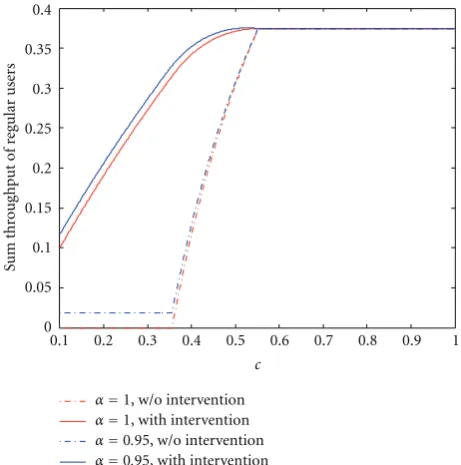
6.4. An “Imperfect” Jammer—Considering Range Effect. In Figure 7, we investigate the range effect in our setting. Particularly, we consider the case when the jammer is further away from the access point than the regular users. Due to the signal strength degradation along the transmission path, there is a small probability that its transmission cannot jam the regular users. We let αbe the probability a packet transmitted by the malicious user can reach the access point, and simulate withN−1=30 regular users. Each regular user
α=1, w/o intervention
α=1, with intervention
α=0.95, w/o intervention
α=0.95, with intervention
0.1 0.2 0.3 0.4 0.5 0.6 0.7 0.8 0.9 1
0 0.05 0.1 0.15 0.2 0.25 0.3 0.35 0.4
c
Su
m
thr
oug
h
put
o
f
regular
users
Figure7: Sum throughput of all the regular users under “imper-fect” jammer.
1 1.5 2 2.5 3 3.5 4
0.4 0.6 0.8 1 1.2 1.4 1.6 1.8
PN
P
0 min
Figure8: The minimum requiredP0
minto have optimal interven-tion.
takes transmission strategy 1/(N−1), that is, pn=1/(N−
6.5. Power Budget Requirement for the Intervention User. We also compute the power budget requirement for the intervention user when there are multiple malicious users in a multi-channel network. We assume there are 4 chan-nels and 5 regular users. Each regular user has the same transmission strategy as (1/5, 1/5, 1/5, 1/5). The malicious user’s utility is again assumed to be uN(pN) = un(1) −
1/(1 +e−α(q(1−pN)−θ))−cp
N, with transmission costc=0.1.
According toTheorem 5, we compute the minimum power budget of the intervention user in order to have optimal intervention, that is, enforce the malicious users to not attack at all. InFigure 8we illustrate the minimum requiredP0
min for differentPN ∈[1, 4] (PN corresponds to the number of
malicious users, or more generally the total power budget of the malicious users. APN larger than 4 is not necessary
because there are only 4 channels).
7. Conclusion
We investigated the problem of efficient channel access when there is a malicious jammer who tries to intentionally decrease all the regular users’ throughputs. Using a non-cooperative game model, we showed that the regular users have very poor performance at the Nash equilibriums because of the jamming attacks and also their own selfish transmissions. To better utilize the channel and mitigate jamming attacks, we introduce an intervention user to transform the original game into an augmented game with an intervention function. The intervention function compels the selfish regular users to behave cooperatively by punishing their excessive access to the channel, and at the same time suppresses the jammer by providing additional incentives when it lowers its attacking level. It is shown that any point in the feasible rate region can be achieved as a Nash equilibrium of the augmented game with properly designed intervention function. Future extensions of this work may include the investigation of nonlinear cost for the malicious user and also the effect of network topology on the design of intervention function.
References
[1] M. Li, I. Koutsopoulos, and R. Poovendran, “Optimal jam-ming attacks and network defense policies in wireless sensor networks,” in Proceedings of the 26th IEEE International Conference on Computer Communications (INFOCOM ’07), pp. 1307–1315, Anchorage, Alaska, USA, May 2007.
[2] E. Altman, K. Avrachenkov, and A. Garnaev, “A jamming game in wireless networks with transmission cost,” inProceedings of the 1st EuroFGI International Conference on Network Control and Optimization, vol. 4465 of Lecture Notes in Computer Science, pp. 1–12, Avignon, France, June 2007.
[3] B. Awerbuch, A. Richa, and C. Scheideler, “A jamming-resistant MAC protocol for single-hop wireless networks,” in Proceedings of the 27th ACM SIGACT-SIGOPS Symposium on Principles of Distributed Computing (PODC ’08), pp. 45–54, August 2008.
[4] YI. Xie and S. Z. Yu, “Monitoring the application-layer DDoS sttacks for popular websites,”IEEE/ACM Transactions on Networking, vol. 17, no. 1, pp. 15–25, 2009.
[5] E. Bayraktaroglu, C. King, X. Liu, G. Noubir, R. Rajaraman, and B. Thapa, “On the performance of IEEE 802.11 under jamming,” in Proceedings of the 27th IEEE Conference on Computer Communications (INFOCOM ’08), pp. 1265–1273, April 2008.
[6] I. Aad, J. P. Hubaux, and E. W. Knightly, “Impact of denial of service attacks on ad hoc networks,”IEEE/ACM Transactions on Networking, vol. 16, no. 4, pp. 791–802, 2008.
[7] X. Liu, G. Noubir, R. Sundaram, and S. Tan, “SPREAD: foiling smart jammers using multi-layer agility,” inProceedings of the 26th IEEE International Conference on Computer Communi-cations (INFOCOM ’07), pp. 2536–2540, Anchorage, Alaska, USA, May 2007.
[8] S. Khattab, D. Mosse, and R. Melhem, “Jamming mitigation in multi-radio wireless networks: reactive or proactive?” in Proceedings of the 4th International Conference on Security and Privacy in Communication Networks (SecureComm ’08), September 2008.
[9] J. Park and M. van der Schaar, “Stackelberg contention games in multiuser networks,” EURASIP Journal on Advances in Signal Processing, vol. 2009, Article ID 305978, 15 pages, 2009. [10] I. E. Pountourakis, “Throughput evaluation of multichannel slotted Aloha-type protocols with receiver collisions,” Telecom-munication Systems, vol. 5, no. 4, pp. 413–419, 1996.
[11] D. Bertsekas and R. Gallager,Data Networks, Prentice Hall, Englewood Cliffs, NJ, USA, 1987.
[12] E. Altman, R. El Azouzi, and T. Jim´enez, “Slotted Aloha as a game with partial information,”Computer Networks, vol. 45, no. 6, pp. 701–713, 2004.
[13] S. Shenker, “Fundamental design issues for the future Inter-net,”IEEE Journal on Selected Areas in Communications, vol. 13, no. 7, pp. 1176–1188, 1995.
[14] M. Chiang, “Nonconvex optimization of communication systems,” inAdvances in Mechanics and Mathematics, Special Volumn on Strang’s 70th Birthday, D. Gao and H. Sherali, Eds., Springer, Berlin, Germany, 2008.
[15] A. H. M. Rad, J. Huang, M. Chiang, and V. W. S. Wong, “Utility-optimal random access without message passing,” IEEE Transactions on Wireless Communications, vol. 8, no. 3, pp. 1073–1079, 2009.
[16] M. ˇCagalj, S. Ganeriwal, I. Aad, and J. P. Hubaux, “On selfish behavior in CSMA/CA networks,” in Proceedings of the 24th Annual Joint Conference of the IEEE Computer and Communications Societies (INFOCOM ’05), pp. 2513–2524, Miami, Fla, USA, March 2005.