R E S E A R C H
Open Access
Anonymous gateway-oriented password-based
authenticated key exchange based on RSA
Fushan Wei
*, Chuangui Ma and Qingfeng Cheng
Abstract
A gateway-oriented password-based authenticated key exchange (GPAKE) is a three-party protocol, which allows a client and a gateway to establish a common session key with the help of an authentication server. To date, most of the published protocols for GPAKE have been based on Diffie-Hellman key exchange. In this article, we present the first GPAKE protocol based on RSA, then prove its security in the random oracle model under the RSA
assumption. Furthermore, our protocol can resist bothe-residue and undetectable on-line dictionary attacks. Finally, we investigate whether or not a GPAKE protocol can achieve both client anonymity and resistance against
undetectable on-line dictionary attacks by a malicious gateway. We provide an affirmative answer by adding client anonymity with respect to the server.
Preprint submitted to EURASIP JWCN October 16, 2011to our basic protocol.
Keywords:RSA, password-based authentication, gateway, anonymity, random oracle
1. Introduction
1.1. Password-based authenticated key exchange
Password-based authenticated key exchange (PAKE) protocols allow users to securely establish a common key over an insecure open network only using a low-entropy and human-memorable password. Owing to the low entropy of passwords, PAKE protocols are suscepti-ble to so-calleddictionaryattacks [1]. Dictionary attacks can be classified into three types [1]: on-line, off-line, and undetectable on-line dictionary attacks. In on-line dictionary attacks, an adversary first guesses a password, and tries to verify the password using responses from a server in an on-line manner. On-line password guessing attacks can be easily detected, and thwarted by counting access failures. In off-line dictionary attacks, an adver-sary tries to determine the correct password without the involvement of the honest parties based on information obtained during previous executions of the protocol. Thus, the attacker can freely guess a password and then check if it is correct without limitation in the number of guesses. The last type is undetectable on-line dictionary at-2 tacks, where a malicious insider tries to verify a password guess in an on-line manner. However, a failed
guess cannot be detected by the honest client or the ser-ver. The malicious insider participates in the protocol legally and un-detectably many times to get sufficient information of the password. Among these attacks, on-line dictionary attack is unavoidable when low-entropy pass-words are used, the goal of PAKE protocols is to restrict the adversary to on-line dictionary attacks only. In other words, off-line and undetectable on-line dictionary attacks should not be possible in a PAKE protocol.
In 1992, Bellovin and Merritt first presented a family of password protocols known as encrypted key exchange (EKE) protocols [2] which can resist dictionary attacks. They also investigated the feasibility of implementing EKE using three different types of public-key crypto-graphic techniques: RSA, ElGamal, and Diffie-Hellman key exchange. They found that RSA-based PAKE in their protocol is not secure against e-residue attacks [2,3], and pointed out that EKE is only suitable for implementation using Diffie-Hellman key exchange. From then on, lots of PAKE protocols based on Diffie-Hellman have been proposed [1,2,4-9]. While the approach of designing PAKE protocols with RSA is far from maturity and perfection. In 1997, Lucks presented a scheme called OKE (open key exchange) [10] which is based on RSA. It was later found to be insecure against * Correspondence: [email protected]
Department of Information Research, Zhengzhou Information, Science and Technology Institute, Zhengzhou 450002, China
a variant of e-residue attacks because of MacKenzie et al. [11]. Furthermore, the authors modified OKE and proposed the first secure RSA-based PAKE protocol SNAPI. Since SNAPI protocol required that the RSA public exponent should be a larger prime than RSA modular, it is not practical. Later, Zhang proposed PEKEP and CEKEP protocols [12], which allow using both large and small prime numbers as RSA public exponents. To resist the e-residue attack, PEKEP proto-col needs multiple RSA encryptions, and it is not very efficient. In 2007, Park et al. presented another efficient RSA-EPAKE protocol [13] which can resist thee-residue attack based on number-theoretic techniques. Unfortu-nately, as pointed by Youn et al. [14], RSA-EPAKE is insecure against aseparation attack. Though the attack can be easily avoided by limiting the number of failed trials, an adversary can get remarkably much informa-tion of the password from single trial. Therefore, the separation attack is still a threatening attack against RSA-EPAKE protocol.
1.2. Related work
In 2005, Abdalla et al. [4] put forward the first gateway-oriented password-based authenticated key exchange (GPAKE) protocol among a client, a gateway, and an authentication server. The client and the server initially share a common password for authentication, but the session key is generated between the client and the gate-way via the help of the server. In addition to the usual notion of semantic security of the session key, two addi-tional security goals, namely key privacy with respect to honest-but-curious server and pass-word protection with respect to malicious gateway, are considered to capture dishonest behaviors of the server and the gate-way, respectively. In 2006, Byun et al. [8] showed that the GPAKE protocol proposed by Abdalla et al. [4] was vulnerable to an undetectable on-line dictionary attack. A malicious gateway can iteratively guess a password and verify its guess without being detected by the server. They also proposed a countermeasure for the attack by exploiting MAC of keying material sent to the authenti-cation server from the client. In 2008, Shim [15] showed that Byun’s countermeasure was still insecure against the same undetectable on-line dictionary attack contrary to the claim in [8] that it was. In addition, Shim also designed its enhanced version (S-GPAKE) using a sym-metric encryption algorithm to overcome the attack. Nevertheless, Yoon et al. [16] pointed out that the S-GPAKE protocol was inefficiently and incorrectly designed. Recently, Abdalla et al. [6] presented an anon-ymous variant of the original GPAKE protocol [4] with similar efficiency. They proposed a new model having stronger security which captured all the security goals in a single security game. The new security model also
allowed corruption of the participants. They proved the security of the new protocol in the enhanced security model. However, partially owing to client anonymity, the new protocol is still subjected to undetectable on-line dictionary attacks. It is quite interesting to ask whether there exists a GPAKE protocol which can achieve both client anonymity and resistance against undetectable on-line dictionary attacks.
1.3. Our contribution
In this article, we investigate GPAKE protocol based on RSA. We first propose an efficient RSA-based GPAKE protocol. The new protocol involves three entities. The client and the server share a short password while the client and the gateway, respectively, possess a pair of RSA keys. However, all the RSA public/private keys are selected by the entities rather than distributed by a cer-tificate authentication center, so no public-key infra-structure is needed. To resist e-residue attacks, the client uses the public keyeof an 80-bit prime. The pro-posed protocol can be resistant toe-residue attacks and provably-secure under the RSA assumption in the ran-dom oracle model.
To achieve previously mentioned requirements, the authenticators and the final session key in the proposed protocol rely on different random numbers. In this way, the authenticators between the client and the server will leak no information of the password to the gateway, and the session key established between the client and the gateway is private to the server. Furthermore, standard techniques in threshold-based cryptography can also be used to achieve threshold version of the proposed proto-col. It is worth pointing out that our protocol does not require public parameters. The client and the server only need to establish a shared password in advance and do not need to establish other common parameters such as generators of a finite cyclic group. This is appealing in environments where clients have insuffi-cient resources to authenticate public parameters.
We also investigate whether or not a GPAKE protocol can achieve both client anonymity and resistance against undetectable on-line dictionary attacks by a malicious gateway. These two requirements seem to contradict each other (it seems that the server needs to know who the user is in order to resist undetectable on-line dic-tionary attacks). Nevertheless, this can be reconciled by saying that a server learns whether it is interacting with a user that belongs to a defined set of authorized users, but nothing more about which user it is in that set. We provide an affirmative answer to the above question by adding client anonymity to our GPAKE protocol based on RSA.
some security definitions of GPAKE protocols. In Sec-tion 3, we present our protocol and show that the new protocol is provably-secure under the RSA assumption in the random oracle model. We show in Section 4 how to add client anonymity to the basic scheme using sym-metric private information retrieval (SPIR) protocols [17]. We conclude this article in Section 5.
2. Security model
In this section, we recall the security model for GPAKE protocols introduced in [4]. We will prove security of our protocol in this model. We refer the reader to [4] for more details.
2.1. Overview
A GPAKE protocol allows a client to establish an authenticated session key with a gateway via the help of an authentication server. The password is shared between the client and the server for authentication. It is assumed that the communication channel between the gateway and the server is authenticated and private, but the channel connecting the client to the gateway is insecure and under the control of an adversary.
The main security goal of the GPAKE protocol is to securely generate a session key between the client and the gateway without leaking information about the pass-word to the gateway. To achieve this goal, Abdalla et al. [4] defined three security notions to capture dishonest behaviors of the client, the authentication server, and the gateway, respectively. The first one issemantic securityof the session key, which is modeled by a Real-Or-Random (ROR) game; the second one is key privacywith respect to the server, which entails that the session key estab-lished between the client and the gateway is unknown to the passive server; and the last one is server password protectionagainst a malicious gateway, which means that the gateway cannot learn any information about the cli-ent’s password from the authentication server.
Protocol participants
The participants in a gateway-oriented password-based key exchange are the clientC∈C, the gatewayG∈G, and the authentication serverS∈S. We denote by U the set of all the participants (i.e.,U =C∪G∪S) and by
Ua non-specific participant inU.
Long-lived keys
Each clientC∈C holds a password pwc. Each server
S∈S holds a vector of passwords pwS =
pwC
C∈C with an entry for each client.pwc andpwsare also called the long-lived keys of clientCand serverS, respectively.
2.2. Security Model
The security model we adopted here is the ROR model of Abdalla et al. [5]. The adversary’s capabilities are
modeled through queries. During the execution, the adversary may create several concurrent instances of a participant. LetUidenote the instanceiof a participant
U. The list of oracles available to the adversary is as fol-lows:
•Execute(Ci,Gj): This query models passive eaves-dropping of a protocol execution between a client instanceCiand a gateway instanceGj. At the end of the execution, a transcript is given to the adversary, which logs everything an adversary could see during the execution.
•Send(Ui,m): This query models an active attack against the client or gateway instanceUi, in which the adversary may intercept a message and then modify it, create a new one, or simply forward it to the intended recipient. InstanceUiexecutes as speci-fied by the protocol and sends back its response to the adversary.
•Test(Ui): This query is used to measure the semantic security of the session key of instanceUi, if the latter is defined. If the key is not defined, return the undefined symbol⊥. Otherwise, return either the session key held by instanceUiif b= 1 or a random key of the same size ifb= 0, wherebis a hidden bit chosen uni-formly at random at the beginning of the experiment defining the semantic security of session keys.
In the ROR model, the adversary can ask Testqueries for all the sessions. All theTest queries will be answered using the same random bit b that was chosen at the beginning of the experiment. In other words, the keys returned by theTestoracle are either all real or all ran-dom. However, in the random case, the same random key is returned for two partnered instances (see the notion of partnering below). The goal of the adversary is to guess the value of the hidden bit b used to answer
Testqueries. The adversary is said to be successful if it guessesbcorrectly.
It should be noted that Reveal oracle exists in the Find-Then-Guess (FTG) model is not available to the adversary in the ROR model. However, since the adver-sary in FTG model is restricted to asking only a single query to the Test oracle, the ROR security model is actually stronger than the FTG security model. Abdalla et al. demonstrated that proofs of security in the ROR model can be easily translated into proofs of security in the FTG model. For more details, refer to [5].
2.3. Security notions
the concatenation of all the messages of the conversation between the client and the gateway instances before the acceptance. Two instances are partnered if they hold the same non-null session identification.
Definition 1. A client instance Ci and a gateway instance Gjare said to be partnered if the following con-ditions are met: (1) both Ci and Gj accept; (2) both Ci and Gj share the same session identification; (3) the partner identification for Ci is Gj and vice versa; (4) no instance other than Ci and Gj accepts with a partner identification equal to Cior Gj.
The adversary is only allowed to perform tests on
fresh instances. Otherwise, it is trivial for the adversary to guess the hidden bitb. The freshness notion captures the intuitive fact that a session key is not trivially known to the adversary.
Definition 2. An instance of a client or a gateway is said to be fresh in the current protocol execution if it has accepted.
Semantic security
Consider an execution of the key exchange protocolP by the adversaryAin which the latter is given access to
Execute, Sendoracles, as well as to Test oracle calls to fresh instances. The goal of the adversary is to guess the value of the hidden bit b used by the Testoracle. Let
Succ denote the event in which the adversary success-fully guesses the hidden bitb used byTest oracle.
Definition 3.The advantage of an adversaryAin vio-lating the AKE semantic security of the protocolPin the ROR sense, when passwords are uniformly drawn from a dictionaryD,is defined as
AdvakeP,D−ror(A) = 2·Pr[Succ]−1.
The advantage function of the protocolPis defined as
AdvakeP,D−ror(t,R) =max{AdvakeP,D−ror(A)},
where maximum is over allAwith time-complexity at most t and using resources at most R (such as the num-ber of oracle queries).
We have the following definition of semantic secure GPAKE protocol, which is the same as in [4].
Definition 4. A GPAKE protocol Pis said to be semantically secure if the advantage AdvakeP,D−ror(t,R)is only negligibly larger thankn/|D|, where n is number of active sessions, and k is a constant.
Note that k= 1 is the best one can hope for since an adversary that simply guesses the password in each of the active sessions has an advantage ofn/|D|.
Key privacy
In GPAKE protocols, the session key between the client and the gateway is established with the help of the
server. In order to reduce the amount of trust one puts into the server, we require that the session key should be even indistinguishable to an honest but curious ser-ver who knows all the passwords of the clients. The notion of key privacy with respect to the server was first introduced in [5] to capture this security requirement.
To define the notion of key privacy, we consider a ser-ver which knows all the passwords of the clients, and behaves in an honest but curious manner. We give the server access to all the oracles, but restricts the server to testing session keys generated by two oracles. To achieve this aim, we use a new type ofTestPair oracle which was first introduced in [5]. TheTestPairoracle is defined as follows:
•TestPair(Ci,Gj): If the client instanceCi and the gateway instanceGjdo not share the same key, then return the undefined symbol⊥. Otherwise, return either the session key established betweenCi andGj
ifb = 1 or a random key of the same size if b = 0, wherebis a hidden bit chosen uniformly at random at the beginning of the experiment defining the key privacy of session keys.
Consider an execution of the key exchange protocolP by an adversaryAwith access to all the passwords held by the server as well as to the Execute, Send, and Test-Pair oracles. Let Succ denote the event in which the adversary is successful in guessing the hidden bitb used by TestPairoracle. The advantage of an adversaryAin violating the key privacy of the protocolP in the ROR sense (AdvakeP,D−kp(A)) and the advantage function of P(AdvakeP,D−kp(t,R)), when passwords are uniformly drawn from a dictionaryD, can be defined as in Defini-tion 3.
Definition 5.A GPAKE protocol Pis said to achieve key privacy if the advantage AdvakeP,D−kp(t,R)is negligible.
Server password protection
One of the security goals of GPAKE protocol is to pre-vent the gateway from learning the client’s password that is stored in the server. If the adversary interacts
not be detected by the server, then we say the malicious gateway is successful. Let AdvakeP,D−uoda(A) denotes the success probability of the gateway.
Definition 6.A GPAKE protocolPcan resist undetect-able on-line dictionary attacks if AdvakeP,D−uoda(A)is negli-gibly larger than kn/|D|, where n is number of active sessions, and k is a constant.
3. Our GPAKE protocol based on RSA
In this section, we describe our GPAKE protocol based on RSA, and present its security results.
3.1. Description
Define hash functions H1,H2,H3 : {0,1}* ®{0, 1}k, and
H: {0,1}*®Zn, wherekis a security parameter, e.g.,k= 160. We assume that H1,H2,H3, and Hare independent random functions in the following.
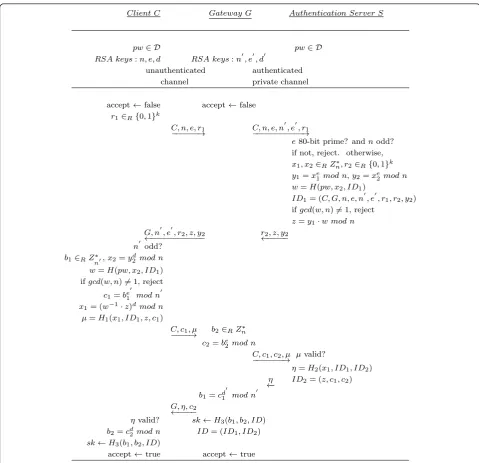
The protocol runs among a client, a gateway, and an authentication server. Its description is given in Figure 1. The client and the authentication server initially share a lightweight string pw, the password, uniformly drawn from the dictionaryD. The client has generated a pair of RSA keys n, e, and d, wherenis a large positive integer equal to the product of two primes of the same size,eis an 80-bit prime relatively prime toj(n), and dis a posi-tive integer such thated≡1 modj(n). The gateway also has generated a pair of RSA keysn’,e’, and d’, wheren’is a large positive integer equal to the product of two primes of the same size, e’is a positive integer relatively prime toj(n’), andd’is a positive integer such thate’d’≡
1 modj(n’). The channel connecting the gateway to the authentication server is assumed to be authenticated and private. The protocol proceeds as follows:
1. The clientCsends her public key (n, e) and a ran-dom numberr1 Î {0, 1}k to the gatewayG, and G
just forwards the message and her RSA public key (n’, e’) to the authentication server.
2. The authentication server Sverifies if eis an 80-bit prime, and nis an odd integer.Smay also verify that the integernis large enough, e.g.,n> 21023. If e
is not an 80-bit prime orn is not an odd integer,S
rejects; otherwise, Sselects three random numbers x1,x2∈Z∗n, and r2 Î{0, 1}k. Sthen computesy1=xe1
mod n and y2=xe2modn, S also computes w =H
(pw, x2,C, G, n, e, n’, e’, r1,r2,y2) and checks whether
gcd (w, n) = 1. Ifgcd(w, n) = 1, Scomputesz=y1 ·
w mod nand sends (r2,z, y2) to the gateway. Upon receiving (r2,z, y2),Gsends (n’, e’, r2,z, y2) toC. 3. Upon receiving (n’, e’, r2, z, y2) fromG, Cverifies if n’is an odd integer andn’is large enough, e.g.,n’
> 21023.Cselects a random numberb1∈Z∗n.Cthen decrypts x2=yd2 mod n, computes w using her
passwordpwand x2, then checks ifwandnare rela-tively prime. Ifgcd (w, n) = 1,Cdecryptsx1 = (w-1 ·
z)dmodn, computesc1=be
1 modn’. Finally,C
com-putesμ =H1(x1,C, G, n, e, n’, e’, r1,r2, y2,z, c1) and sends (c1,μ) toG. Upon receiving (c1,μ),Gselects a random numberb2∈Z∗n, computes c2=be2mod n,
sends (c1,c2,μ) toS.
4.S checks whetherμis valid or not. If μis valid, S
computes her authenticatorh= H2(x1,C, G, n, e, n’, e’, r1,r2,y2,z, c1,c2). Finally,Ssendshto G.
5. Upon receivingh, Gdecryptsb1=cd
1 modn’, sets
the session keysk =H3(b1, b2, ID), whereIDis the concatenation of all the exchanged messages. G
sendshandc2to C.
6. C checks whether his valid or not. If valid, C
decryptsb2=cd2mod nand sets the session key to
besk=H3(b1, b2,ID), whereIDis the concatenation of all the exchanged messages.
In RSA-based protocols, security against e-residue attacks [3] has to be considered. To void such ane -resi-due attack, we adopt the approach of [18] and require the public key of the client is an 80-bit prime. However, [18] is basically a two-factor protocol, and their main concern is security against replacement attacks. Hence, in this context, we still briefly prove the security against
e-residue attacks of our protocol. Suppose the adversary Agenerates the RSA parameter (n,e), wheree is an 80-bit prime and gcd(e, j(n)) = e. Upon receiving (n, e), the authentication server S randomly chooses x1,x2∈Z∗n, computesy1=xe1mod nand y2=xe2modn,
then S calculates w using the password pw and x2. Finally,Ssends (r2, z, y2) back to the adversary, where z
=y1 ·w mod n. To mount an e-residue attack, first of all, the adversary should correctly find out the com-mitted valuex2. Sincey2=xe2modn, which is equivalent
to e·indgx2 ≡ indgy2 mod j(n). The congruence has exactly e solutions because gcd (e, j(n)) = e and e|
indgy2. The success probability that the adversary cor-rectly find out the committed value is 1/e, which is neg-ligible sinceeis an 80-bit prime.
Remark 1To resist e-residue attacks, we require that the client use the public key eof an 80-bit prime, the server needs to test the primality for the 80-bit prime. However, there is no restriction on the gateway’s public keye’. This is because the gateway’s public key is only used to establish the session key and has nothing to do with the password.
protocol is quite efficient in computation cost. Further-more, if we exclude perfect forward secrecy from con-sideration, we need not to generate them in each session, this further improves the efficiency of our protocol.
3.2. Security
In this section, we prove the security of our protocol within the formal model of security given in Section 2. In our analysis, we assume the intractability of the RSA problem.
RSA assumption [13]
Letlbe the security parameter of RSA. Let key genera-torGEdefine a family of RSA functions, i.e., (e, d, n)¬
GE (1l), where n is the product of two primes of the same size, gcd (e, j(n)) = 1, and ed= 1 modj(n). For any probabilistic polynomial-time algorithm Cin running timet, the following probability
Advrsac (t) = Pr
xe=c mod n: (e,d,n)←GE(1l),
c∈R{0, 1}l,x←C(1l,c,e,n)
Client C Gateway G Authentication Server S
pw∈ D pw∈ D
RSA keys:n, e, d RSA keys:n, e, d
unauthenticated authenticated
channel private channel
accept←false accept←false r1∈R{0,1}k
C, n, e, r1
−−−−−−→ C, n, e, n
, e, r1 −−−−−−−−−−−→
e80-bit prime? andnodd? if not, reject. otherwise, x1, x2∈RZ∗n, r2∈R{0,1}k
y1=xe
1mod n,y2=xe
2 mod n
w=H(pw, x2, ID1)
ID1= (C, G, n, e, n, e, r1, r2, y2) ifgcd(w, n)= 1, reject
z=y1·w mod n G, n, e, r2, z, y2
←−−−−−−−−−−−− r←−−−−−2, z, y2 n odd?
b1∈RZ∗
n,x2=y d
2 mod n
w=H(pw, x2, ID1) ifgcd(w, n)= 1, reject
c1=be
1 mod n
x1= (w−1·z)dmod n
μ=H1(x1, ID1, z, c1) C, c1, μ
−−−−→ b2∈RZn∗
c2=be
2 mod n
C, c1, c2, μ
−−−−−−−→ μvalid?
η=H2(x1, ID1, ID2) η
←− ID2= (z, c1, c2) b1=cd
1 mod n
G, η, c2 ←−−−−
ηvalid? sk←H3(b1, b2, ID) b2=cd2 mod n ID= (ID1, ID2) sk←H3(b1, b2, ID)
accept←true accept←true
is negligible. In the following, we useAdvrsa(t) to denote maxC{AdvrsaC (t)}, where the maximum is taken over all the polynomial-time algorithms of running timet.
Semantic security
As the following theorem states, our protocol is a secure gateway-oriented password-based key exchange protocol as long as the RSA problem is intractable. The proof of security assumes Dto be a uniformly distributed dic-tionary and of size smaller than 2k. The proof of Theo-rem 3.1 can be found in Appendix A.
Theorem 3.1. LetAbe an adversary which runs in time t and makes Qsend,Qsend ≤|D|,queries of type Send to different instances. Then, the adversary’s advantage in attacking the semantic security of the proposed protocol is bounded by
AdvakeP,D−ror(A)≤2Qsend
|D| + (3Qsend+ 2Qexecute)Advrsa(O(t))
+(2Qsend+Qexecute)Qoh
φ(n) + Qsend
2k−1 + Qsend
279 ,
where Qexecutedenotes the number of queries of type Execute, and Qohdenotes the number of random oracle calls.
Key privacy
As the following theorem shows, our protocol achieves the goal of key privacy as long as the RSA problem is intractable.
Theorem 3.2. LetAbe an adversary which runs in time t and makes Qexecutequeries of type Execute to dif-ferent instances. Then, the adversary’s advantage in attacking the key privacy of the proposed protocol is bounded by
AdvakeP,D−kp(A)≤QexecuteAdvrsa(O(t)).
The proof of Theorem 3.2 is similar to the proof of Lemma A.1 in Appendix A. The only difference is that in this case the adversary knows the passwords of all the clients. However, this only brings negligible advantage to the adversary since the authenticators and the session keys rely on different random numbers. In order to dis-tinguish the session key from random numbers chosen from {0, 1}k, the adversary still needs to break RSA. We omit the proof of Theorem 3.2 for simplicity.
Server password protection
As is shown by the following theorem, a malicious gate-way cannot do much better than eliminating one pass-word from the list of possible candidates with each interaction with the server. As a result, afterq interac-tions with the server, the advantage of a malicious gate-way would be only negligibly larger than q/|D|. Furthermore, a failed guess of the malicious gateway will be detected by the authentication server. A mali-cious gateway cannot iteratively guess a password and
verify its guess without being detected. Hence, our pro-tocol can resist undetectable on-line dictionary attacks. The proof of Theorem 3.3 can be found in Appendix B.
Theorem 3.3.LetAbe a malicious gateway which runs in time t and makes Qsendqueries of type Send to server instances. Then, the advantage of the malicious gateway in violating the resistance to undetectable on-line dic-tionary attacks of the proposed protocol is bounded by
AdvakeP,D−uoda(A)≤ Qsend |D| +
Qsend
2k +
Qsend
280 .
4. Adding client anonymity
Anonymity is one of the most important security goals of protocols on public networks. Many of the privacy problems that arise out of Internet use can be solved using anonymous Internet connections such that a cli-ent’s actions are unlinkable. Implementing anonymity of clients not only protects their personal information but also reduces the chances of attacks based on impersona-tion. In this section, we show how to add client anon-ymity to our protocol.
The basic idea is same as Abdalla et al.’s [6]. We assume that there are many gateways, but the authentica-tion server is unique. In order to add client anonymity, we try to hide the client identity to the authentication server using SPIR [17] protocols. An SPIR protocol allows a client to retrieve an item from a server in possession of a database without revealing which item they are retriev-ing, and it also allows for the restricting of the number of items a given client may retrieve. When the gateway receives an authorization request from a client, the gate-way can run an SPIR protocol with the authentication server, such that the server does not know the real iden-tity of the client and the gateway only gets the answer to the actual client. More precisely, the authentication server can be seen as a dynamic database. For each authoriza-tion request, the authenticaauthoriza-tion server computes the answers for all the possible clients, and the gateway retrieves the one it is interested in. At the end of the SPIR protocol, the authentication server does not know which answer the gateway gets and the gateway will not get more than the number of the values it is allowed to retrieve.
receiving (n, e, n’, e’, r1), the server dynamically gener-ates a database by computing the answers for each mes-sage (Ci, n, e, n’, e’, r1), and thus for all the possible clientsCi, since it does not know which one is interact-ing with the gateway. More precisely, the server chooses r2∈ {0, 1}k,x1∈Z∗n, and for each Ci, the server also chooses x2i∈Z∗n, computes y1=xe1modn and y2i=xe2i modn. The dynamic database consists of all the blocks
Bi = (r2, zi, y2i), wherezi = y1 ·wi mod n and wi =H (pwi, x2i, Ci,G, n, e, n’, e’, r1,r2,y2i). Then, the gateway runs the SPIR protocol to get the correctBj, while pre-serving the anonymity of the client. The remains are the same as the proposed GPAKE protocol except that the valuesμandhare computed as H1(x1,G, n, e, n’, e’, r1,
r2) andH2(x1,G, n, e, n’, e’, r1,r2,c1,c2), respectively. It is worth pointing out that achieving client anonym-ity, our protocol still can resist the undetectable on-line dictionary attack in the sense that a failed guess of the malicious gateway will be detected by the server. To impersonate a client successfully, the malicious gateway needs recovery1 using the guessed password of the vic-tim client and then obtains x1 by decryptingy1. If the guessed password is not correct, then the valueμis not valid and the server will detect the attack, and then some measures should be taken to protect the pass-words of the clients.
5. Conclusion
In this article, we investigate the design of RSA-based GPAKE protocols. First, we develop a new GPAKE pro-tocol using RSA public-key cryptosystem. The proposed protocol is secure against e-residue attacks. Then, we provide a formal security analysis of our protocol under the RSA assumption and the random oracle model. We also show that our protocol is secure against undetect-able on-line dictionary attacks. Finally, we investigate whether or not such a protocol can achieve both client anonymity and resistance to undetectable on-line dic-tionary attacks. We give an affirmative answer by adding client anonymity to our basic protocol.
Appendix A. Proof of Theorem 3.1
We prove Theorem 3.1 using similar techniques as described in [19]. We define a series of hybrid experi-ments. In each experiment, we modify the way session keys are chosen for instances involved in protocol execution. We start by choosing random session keys for instances for which the Execute oracle is called. Then, we continue to choose random session keys for instances for which the Send oracle is called. These instances are gradually changed over five hybrid experi-ments and in the last experiment, all the session keys are selected uniformly at random. Thus, the adversaryA
cannot distinguish them from random numbers. We denote these hybrid experiments byP0,P1, ...,P4 and by Adv(A,Pi)the advantage of A when participating in experimentPi.
ExperimentP0
This describes the real adversary attack. During the attack, the adversaryAmakes a number of oracle calls (Send, Execute, and Test) as specified in Section 2. In addition, the adversaryAhas access to four independent random oracles
H:{0, 1}∗→Zn,H1,H2,H3:{0, 1}∗→ {0, 1}k.
Each random oracleHi(orH) maintains a list of input-output pairs (q0,r0), (q1, r1)···. On a new inputq, Hi(or H) checks if q was queried before. If there existsqi in the list such thatq=qi, then the random oracle returns the correspondingri as its reply. If qis not in the list, the random oracle chooses a random numberr, returns
r as its reply and adds the pair (q, r) to its list. It is clear that Adv(A) =Adv(A,P0).
ExperimentP1
In this experiment, theExecuteoracle is modified so that the session keys of instances for which Executeis called are selected uniformly at random, that is, if the oracle
Execute(Ci,Gj) is called, then the session keysk is set equal to a random number selected from {0, 1}k, rather than the output of the random oracleH3. The following lemma shows that modifying theExecute oracle in this way affects the advantage ofAby a negligible value.
Lemma Appendix A.1
For every polynomial-time adversaryAmaking Qexecute oracle calls of type Execute,
|Adv(A,P1)−Adv(A,P0)| ≤2QexecuteAdvrsa(O(t)) +QexecuteQoh/φ(n),
where Qohdenotes the number of random oracle calls, and t is the running time ofA.
Proof. We prove this lemma by showing how any advantage thatA has in distinguishingP1 from P0 can be used to break RSA. In experimentP0, the session key is the output of the random oracleH3 on the input (b1,
b2, ID), where ID is the concatenation of all the exchanged messages. If the adversary does not know b1
andb2, she cannot distinguish the output ofH3 from a random number uniformly selected from {0, 1}k. Hence, the adversaryAcan distinguishP1 andP0 if and only if Acan recover the integersb1andb2. Letpb1(pb2)denote
the probability thatArecovers the integerb1(b2). For a easier analysis, we let the adversary win if the adversary recovers the integerb2. To boundpb2, we
GameG1
The adversary A carries out an honest execution between the instancesCiand Gjas the protocol descrip-tion. When the game ends, the adversaryAoutputs her guess of the integerb2.
GameG2
This game is similar to gameG1except that we use pri-vate oracles when we computew,μ, and h.
Letpb2(G1)denote the probability thatAmakes a
cor-rect guess of b2 in gameG1. Likewise, pb2(G2)denote
the probability that pb2 =pb2(G1)makes a correct guess
of b2 in game G2. It is clear thatA. Let AskH denote the event thatAqueries random oracleHon (pw, x2,C, G, n, e, n’, e’, r1, r2, y2). Let AskH1,2 denote the event thatAqueries random oracle H1 on (x1, C, G, n, e, n’, e’, r1, r2,y2,z, c1) orH2 on (x1,C, G, n, e, n’, e’, r1,r2, y2,
z, c1,c2), whileAskH does not happen. Then, we have
|pb2(G1)−pb2(G2)| ≤Pr[AskH] + Pr[AskH1,2],
pb2(G1)≤Pr[AskH] + Pr[AskH1,2] +pb2(G2).
LetQoh denote the number of random oracle calls to H1 and H2 by AIn the following, we bound the prob-abilities of eventsAskHandAskH1,2, and also show that pb1(G2)≤Adv
rsa(O(t)).
Given RSA public key (n, e) and integerc ÎRZn, we construct an efficient algorithm Cto decrypt cas fol-lows: algorithmC runs the adversary Aexactly as in game G2 except that when simulate the authentication server, Cfirst chooses two random numbers x, x∈Zn∗, computes y2 =xe·c modn, and setz to bez =x’e· c·
wmodn, wherewis uniformly chosen fromZ∗n. Finally, when simulate the gateway, C set c2 to be c. If event
AskH happens, which meansAqueries random oracle
H on (pw, x2, C, G, n, e, n’, e’, r1, r2, y2), where xe2=xe·cmodn, then we can decryptcby x2/xmod n. If event AskH does not happen, then z is a random number fromA’s view. Acan select a random number x∈Zn∗as her guess onx1and verifies the correctness of
x’by comparingμ(orh). Then,
Pr(AskH) =AdvrsaC (O(t))≤Advrsa(O(t)), Pr(AskH1,2) =Qoh/φ(n).
Similarly, ifA’s output (denoted byb2) in game G2 is correct, thenb2is the decryption ofc.
pb2(G2) =Adv
rsa
C(O(t))≤Advrsa(O(t)),pb2≤2Adv
rsa(O(t)) +Qoh/φ(n). Assume thatAmakesQexecuteoracle calls of type Exe-cutein the hybrid experimentP1, then
|Adv(A,P1)−Adv(A,P0)| ≤2QexecuteAdvrsa(O(t)) +QexecuteQoh/φ(n).
Before we present the experiments P2,P3, andP4, we describeSendoracles which an active adversaryAuses.
•Send0(Ci): the instanceCiselects a pair of RSA pub-lic/private keyse, d, n, and a random numberr1 Î{0, 1}k. It returnsC, n, e, andr1 to the adversaryA. •Send1(Gj, C, n, e, r1): the instanceGjselects a pair of RSA public/private keys (e’, d’, n’), sends (C, n, e, n’, e’, r1) to the server.Gj obtains (r2, z, y2) as the reply of the server. It returns (n’, e’, r2, z, y2) to the adversaryA.
•Send2(Ci,n’, e’, r2,z, y2): the instanceCiverifies ifn’is big enough, i.e.,n’> 1023. Then,Ciselects a random numberb1∈Z∗n, and decrypts x2=yd2modn, then
computeswusing her passwordpwandx2, checks ifw
andnare relatively prime. Ifgcd(w, n) = 1,Cidecrypts
x1= (w-1·z)dmodn, computesc1=be
1modn’. Finally,
Cicomputesμ=H1(x1,C, G, n, e, n’, e’, r1,r2,y2,z, c1) and returns (c1,μ) to the adversaryA.
•Send3(Gj,c1,μ): the instanceGjselects a random num-berb2∈Z∗n, computesc2=be2modn, sends (c1,c2,μ) to
S.Gjobtainshas the reply of the server. It decrypts b1=cd
1modn’, sets the session keysk=H3(b1,b2,ID),
whereIDis the concatenation of all the exchanged messages. It returnshandc2to the adversaryA. •Send4(Ci,h, c2): the instance Cichecks whetherh is valid or not. Ifhis invalid, it rejects. Otherwise, it decryptsb2=cd2mod n, and computes sk =H3(b1,
b2, ID), where ID is the concatenation of all the exchanged messages.
A message is said to have been oracle-generated if it was output by an instance; otherwise, it is said to have been adversarially-generated. A message generated by instanceUiis said to have beenUi-oracle-generated.
ExperimentP2
In this experiment, an instanceGjreceives a Ci -oracle-generated message (C, n, e, r1) in aSend1 oracle call. If both CiandGjaccept, they are given the same random session keys skÎ {0, 1}k, and ifGj accepts butCidoes not accept, then onlyGjreceives a random session key, and no session key is defined forCi.
Lemma Appendix A.2
For every polynomial-time adversaryAmaking Qsend ora-cle calls of type Send to different instances,
|Adv(A,P2)−Adv(A,P1)| ≤2QsendAdvrsa(O(t)), where t is the running time ofA.
after receiving aCi-oracle-generated message (C, n, e, r1) in a Send1 oracle call. Since the RSA public key (e, n) was generated byCi, not byA, the private keydis not known toA. As shown in the proof of Lemma A.1, the probability forAto recover the random number x1 is upper bounded by Advrsa(O(t)). Hence, except for a probability as small as Advrsa(O(t)), Gjhas received a
Ci-oracle-generated message in a Send3 oracle whenGj
accepts. Similarly, if Ci accepts, then it has received a
Gj-oracle-generated message in a Send4 oracle call. If bothCiandGjaccept, then they share the same session key which is equal to the output of the random oracle
H3 on (b1,b2,ID), whereID is the concatenation of all the exchanged messages. Hence, the modification of the session keys ofCi andGjaffects the adversary’s advan-tage by a value as small asAdvrsa(O(t)). SinceAmakes
Qsendoracle calls of type Sendto different instances,A’s advantage in distinguishing betweenP2 andP1 is upper boundedby QsendAdv
rsa (O(t)).
ExperimentP3
In this experiment, an instanceCi receives aGj -oracle-generated message (n’, e’, r2, z, y2) in aSend2 oracle call, while the instanceGjhas received aCi-oracle-generated message (C, n, e, r1) in a Send1 oracle call. If bothCi
andGjaccept, then they are given the same random ses-sion keys skÎ{0, 1}k. It is clear that the advantage ofA inP3is the same as its advantage inP2.
Lemma Appendix A.3
For every polynomial-time adversaryAmaking Qsend ora-cle calls of type Send to different instances,
Adv(A,P3) =Adv(A,P2).
ExperimentP4
In this experiment, we consider an instance Ci (or Gj) that receives an adversarially-generated message in a
Send2 (or Send1) oracle call. In this case, if Ci(or Gj) accepts, then the experiment is halted, and the adversary is said to have succeeded. This certainly improves the probability of success of the adversary.
Lemma Appendix A.4
For every polynomial-time adversaryAmaking Qsend ora-cle calls of type Send to different instances,
Adv(A,P3) =Adv(A,P4).
At this point, we have given random session keys to all the accepted instances that receive Executeor Send
oracle calls. We next proceed to bound the adversary’s success probability in P4. The following lemma shows
that the adversary’s success probability in the experi-mentP4is negligible.
Lemma Appendix A.5
For every polynomial-time adversaryAmaking Qsend ora-cle calls of type Send to different instances, Qsend≤|D|,
Adv(A,P4)≤
2Qsend
|D| + 2QsendAdvrsa(O(t)) +
2QsendQoh φ(n) +
Qsend
2k−1+
Qsend
279 ,
where Qohdenotes the number of random oracle calls, and t is the running time ofA.
Proof. Let Qsend1 and Qsend2 denote the number of
Send1 andSend2 oracle calls made by the adversary in experiment P4, respectively. We consider the following two cases:
Case 1: Consider an instanceCireceives an adversa-rially-generated message (n’, e’, r2, z, y2) in aSend2 ora-cle. Assume thatCi returns (n, e, r1) in a Send0 oracle. After receiving (n’, e’, r2, z, y2), Ci first decrypts y2 to obtainx2, then queries the random oracleHon (pw, x2,
C, G, n, e, n’, e’, r1,r2, y2) and receiveswfromH. With-out lose of generality, we assume that gcd (w, n) = 1. Then, Ci computes x1 = (w-1 · z)d mod n and c1=be
1
modn’, whereb1∈Z∗n.C i
queriesH1 on (x1,C, G, n, e, n’, e’, r1, r2, y2, z, c1) and returns the reply (denoted by μ) to the adversaryA. To succeed in this case,Amust generate a numberhwhich is equal to the output of the random oracleH2on (x1,C, G, n, e, n’, e’, r1,r2,y2,z, c1,
c2). Without the knowledge ofx1, the probability forA to generate his just 2-k. Let px1denote the probability
thatAcan recover the integer x1. The adversary’s suc-cess probability in this case is bounded by
Pr[Succ]≤Qsend2(px1+ 2−
k).
Ifzwas selected byAat random fromZ∗n, then similar to the proof of Lemma A.1, we can prove that px1is
bounded by
px1≤Adv
rsa(O(t)) + Qoh φ(n).
Next, assume thatzwas generated byAas follows:A selected two random numbers x1,x2∈Z∗n, as well as a candidate password pw∈D,Aqueries the random ora-cleHon (pw’, x2,C, G, n, e, n’, e’, r1,r2,y2) and receives the reply w, thenAcomputed z=xe1·wmod n. In this scenario, ifAguesses the correct password pw =pw’, thenAsucceeds. IfAguesses an invalid passwordpw≠ pw’, then zcan be treated as a random number in Zn∗. Hence, we have
px1≤
1
The adversary’s success probability in Case 1 is upper
Case 2: Consider an instanceGjreceives an adversa-rially-generated message (C, n, e, r1) in a Send1 oracle, where n is an odd integer, and e is odd prime. The instance Gj sends (C, n, e, n, e, r1) to the server. The server replies (r2, z) according to the protocol descrip-tion. To succeed in this case,Amust send back a num-berμwhich is equal to the output of the random oracle
H1 on (x1, C, G, n, e, n’, e’, r1, r2, z, c1). Without the knowledge ofx1, the probability for Ato generateμis just 2-k. Letpx1denote the probability thatAcan recover
the integerx1.
Note that (n, e) was generated byA. Ifgcd(e,j(n)) = 1, thenAcan computew=H(pw’, x2,C, G, n, e, n’, e’, r1,r2,
y2) using a guessing password pw’. Then, congruence z=xe
1·wmodnhas a unique solution becausegcd(e,j
(n)) = 1. IfAguesses the correct passwordpw=pw’, then Acan obtainx1correctly. IfAdoes not guess the correct password, thenAwill not succeed. On the other hand, if
gcd(e,j(n))≠1, since we require thateis an 80-bit prime, then the congruence y2=xe2modnhase solutions. In
order to recover the correctx1, the adversary needs to find out the correctx2. As is shown in Section 3, the probabil-ity to find out the correctx2is 1/280, which is negligible.
Hence, the adversary’s success probability in Case 2 is bounded by
From the above analysis, it can be concluded that the adversary’s success probability in experimentP4 is upper bounded by
This completes the proof of Lemma A.5.
By combining Lemma A.1 to Lemma A.5, we get the announced result.
Appendix B. Proof of Theorem 3.3
Consider a malicious gatewayAgenerates a message (C, n, e, n’, e’, r1). The malicious gateway sends the message
to the server. The server replies (r2,z) according to the protocol description. To succeed in this case, the mali-cious gateway must send back a number μ which is equal to the output of the random oracleH1 on (x1, C, G, n, e, n’, e’, r1, r2, y2, z, c1). Otherwise, the on-line impersonation attack will be detected by the authentica-tion server. Without the knowledge ofx1, the probability forAto generateμis just 2-k.
Letpx1denote the probability that the malicious
gate-way can recover the integer x1.
Note that (n, e) was generated byA. Ifgcd(e,j(n)) = 1, thenAcan computew=H(pw’, x2,C, G, n, e, n’, e’, r1,r2,
y2) using a guessing password pw’. Then, congruence z=xe
1·wmodnhas a unique solution becausegcd(e,j
(n)) = 1. IfAguesses the correct passwordpw=pw’, then Acan obtainx1correctly. IfAdoes not guess the correct password, thenAwill not succeed. On the other hand, if
gcd(e,j(n))≠1, since we require thateis an 80-bit prime, then the congruence y2=xe2modnhase solutions. In
order to recover the correctx1, the adversary needs to find out the correctx2. As is shown in Section 3, the probabil-ity to find out the correctx2is 1/280, which is negligible.
Hence, the adversary’s success probability in violating the resistance to undetectable on-line dictionary attacks is bounded by
The authors would like to thank the anonymous referees for their helpful comments. This study was supported by the National High Technology Research and Development Program of China (No. 2009AA01Z417) and Key Scientific and Technological Project of Henan Province (No. 092101210502).
Competing interests
The authors declare that they have no competing interests.
Received: 29 January 2011 Accepted: 10 November 2011 Published: 10 November 2011
References
1. Y Ding, P Horster, Undetectable on-line password guessing attacks. ACM Oper Syst Rev.29, 77–86 (1995). doi:10.1145/219282.219298
2. SM Bellovin, M Merritt, Encrypted key exchange: password-based protocols secure against dictionary attacks, inIEEE Symp on Security and Privacy 1992, 72–84 (1992)
3. S Patel, Number theoretic attacks on secure password schemes, inProc IEEE Symposium on Security and Privacy, Oakland, CA (May 5-7, 1997)
4. M Abdalla, O Chevassut, PA Fouque, D Pointcheval, A simple threshold authenticated key exchange from short secrets, ASIACRYPT 2005, LNCS, Springer, Heidelberg3788, 566–584 (2005)
5. M Abdalla, P Fouque, D Pointcheval, Password-based authenticated key exchange in the three-party setting. PKC 2005, LNCS, Springer, Heidelberg
3386, 65–84 (2005)
6. M Abdalla, M Izabachene, D Pointcheval, Anonymous and transparent gateway-based password-authenticated key exchange. CANS2008, LNCS, Springer, Heidelberg5339, 133–148 (2008)
8. JW Byun, DH Lee, JI Lim, Security analysis and improvement of a gateway-oriented password-based authenticated key exchange protocol. IEEE Commun Lett.10(9), 683–685 (2006). doi:10.1109/LCOMM.2006.1714545 9. M Bellare, D Pointcheval, P Rogaway, Authenticated key exchange secure
against dictionary attacks. EUROCRYPT 2000, LNCS, Springer, Heidelberg
1807, 139–155 (2000)
10. S Lucks, Open key exchange: how to defeat dictionary attacks without encrypting public keys, inProc of Security Protocol Workshop. LNCS, vol. 1361. Springer, Heidelberg 79–90 (1997).
11. P MacKenzie, S Patel, R Swaminathan, Password-authenticated key exchange based on RSA. SIACRYPT 2000, LNCS, Springer, Heidelberg1976, 599–613 (2000)
12. MX Zhang, New approaches to password authenticated key exchange based on RSA. ASIACRYPT 2004, LNCS, Springer, Heidelberg3329, 230–244 (2004)
13. S Park, J Nam, S Kim, D Won, Efficient password-authenticated key exchange based on RSA. CT-RSA 2007, LNCS, Springer, Heidelberg4377, 309–323 (2007)
14. TY Youn, YH Park, C Kim, J Lim, Weakness in a RSA-based password authenticated key exchange protocol. Inf Process Lett.108, 339–342 (2008). doi:10.1016/j.ipl.2008.06.002
15. KA Shim, Cryptanalysis and enhancement of modified gateway-oriented password-based authenticated key exchange protocol. IEICE Trans Fund.
E91-A(12), 3837–3839 (2008). doi:10.1093/ietfec/e91-a.12.3837 16. Ej Yoon, KY Yoo, An optimized gateway-oriented password-based
authenticated key exchange protocol. IEICE Trans Fund.E93-A(4), 850–853 (2010). doi:10.1587/transfun.E93.A.850
17. L Lincoln, Symmetric private information retrieval via ho-momorphic probabilistic encryption. PhD thesis. http://www.cs.rit.edu/7Elbl6598/thesis/ Lincoln full document.pdf (2006)
18. S Shin, K Kobara, H Imai, An RSA-based leakage-resilient authenticated key exchange protocol secure against replacement attacks, and its extensions. IEICE Trans Fund.E93-A(6), 1086–1101 (2010). doi:10.1587/transfun.E93. A.1086
19. MX Zhang, New approaches to password authenticated key exchange based on RSA. http://eprint.iacr.org. Cryptology ePrint Archive,
Re-doi:10.1186/1687-1499-2011-162
Cite this article as:Weiet al.:Anonymous gateway-oriented password-based authenticated key exchange password-based on RSA.EURASIP Journal on Wireless Communications and Networking20112011:162.
Submit your manuscript to a
journal and benefi t from:
7Convenient online submission
7Rigorous peer review
7Immediate publication on acceptance
7Open access: articles freely available online
7High visibility within the fi eld
7Retaining the copyright to your article