Leakage-Resilient Symmetric Encryption via
Re-keying
?Michel Abdalla1, Sonia Bela¨ıd1,2, and Pierre-Alain Fouque1 1 ´
Ecole Normale Sup´erieure, 45 rue d’Ulm 75005 Paris
2 Thales Communications & Security, 4 avenue des Louvresses 92230 Gennevilliers
{Michel.Abdalla, Sonia.Belaid, Pierre-Alain.Fouque}@ens.fr
Abstract. In the paper, we study whether it is possible to construct an efficient leakage-resilient symmetric scheme using the AES block cipher. We aim at bridging the gap between the theoretical leakage-resilient symmetric primitives used to build encryption schemes and the prac-tical schemes that do not have any security proof against side-channel adversaries. Our goal is to construct an as efficient as possible leakage-resilient encryption scheme, but we do not want to change the crypto-graphic schemes already implemented. The basic idea consists in adding a leakage-resilient re-keying scheme on top of the encryption scheme and has been already suggested by Kocher to thwart differential power analy-sis techniques. Indeed, in such analyanaly-sis, the adversary queries the encryp-tion box and from the knowledge of the plaintext/ciphertext, she can per-form a divide-and-conquer key recovery attack. The method consisting in changing the key for each or after a small number of encryptions with the same key is known as re-keying. It prevents DPA adversaries but not SPA attacks which use one single leakage trace. Here, we prove that using a leakage-resilient re-keying scheme on top of a secure encryption scheme in the standard model, leads to a leakage-resilient encryption scheme. The main advantage of the AES block cipher is that its implementations are generally heuristically-secure against SPA adversaries. This assump-tion is used in many concrete instantiaassump-tions of leakage-resilient symmet-ric primitives. Consequently, if we use it and change the key for each new message block, the adversary will not be able to recover any key if the re-keying scheme is leakage-resilient. There is mainly two different techniques for re-keying scheme, either parallel or sequential, but if we want to avoid the adversary having access to many inputs/outputs, only the sequential method is possible. However, the main drawback of the latter technique is that in case of de-synchronization, many useless com-putations are required. In our re-keying scheme, we use ideas from the skip-list data structure to efficiently recover a specific key.
Keywords: leakage-resilience, symmetric encryption, re-keying, synchro-nization
? cIACR 2013. This is the full version of the article submitted by the authors to the
1
Introduction
Most of widely used cryptosystems are secure in the black-box model when the adversary is limited to the observation of the inputs and outputs. However, this model does not faithfully reflect the reality of embedded devices. Introduced in the nineties, a more realistic model in which the attacker can observe the physical leakage of the device has revealed a new class of attacks gathered around the term Side-Channel Analysis (SCA for short). These attacks exploit the dependence between sensitive values of an algorithm and the physical leakage of the device (time, power consumption, electromagnetic radiation, . . . ).
In order to avoid the large variety of side-channel attacks, many counter-measures have been proposed. Most of them are designed to thwart one specific attack. A widely used example is masking [5,11,30] that aims at protecting im-plementations against Differential Power Analysis (DPA) [17] but can be de-feated by higher-order attacks [20]. However, over the last few years, significant efforts have been made to define generic models capturing physical attacks in order to provide guarantees of a generic security. Two main examples are the physically observable cryptography [21] and leakage-resilient cryptography [7]. Several pseudorandom functions, generators and permutations have already been proposed in the latter [6,8,26,34,33]. Unfortunately, these primitives are not al-ways relevant to practice. They are often associated to large complexities and are sometimes constructed in a non realistic model in view of current embed-ded devices. Nevertheless and as stressed in [19], theoretical ideas proposed in the design of these primitives can be used to significantly improve the physical security of cryptographic primitives against side-channel attacks.
process of re-keying suffers from the time complexity of the number of similar operations required to obtain the correct session key.
Related Work. The first construction of leakage-resilient symmetric encryp-tion has only been recently proposed in [12] by Hazayet al.. However, the main objective of the authors was to propose a generic scheme based on minimal as-sumptions and the efficiency was not their priority. There are several works on the construction of leakage-resilient symmetric primitives such as block ciphers or stream ciphers [26,6,7]. One of the main assumptions to design such schemes is that AES implementations are heuristically secure against SPA [4,31,22,23,9] or AES can be implemented to be a leakage-resilient block cipher if the num-ber of queries with the same key is small. Consequently, this block cipher is the main practical building block used by theoreticians to instantiate their con-structions and namely in [26], Pietrzak proposes to use AES(0kp)kAES(1kp) for constructing a weak PRF with 2n bits of outputs. A weak PRF is a PRF when the adversary cannot choose the inputs but only has access to random evaluations of the function. Such weak PRF is a critical ingredient of the design of GGM (Goldreich, Goldwasser and Mical) leakage-resilient PRF [10] which is resistant for many queries and not only two. To construct a leakage-resilient block cipher, Faustet al.propose to use this PRF in a three Feistel rounds in [8] but the overall construction has been shown to be inefficient by Bernstein at the CHES’12 rump session [3]. The GGM construction is however very inefficient and in an effort to improve it, Medwed, Standaert and Joux in [19] propose a version of the tree by considering byte rather than bit. They analyze the secu-rity of this variant with the AES block cipher and lead to the conclusion that AES is not well-suited for this purpose. Indeed, even though the adversary does not control the inputs, she can still efficiently recover the secret key of the first round byte after byte. A similar conclusion has been made by Jaffe in [15] on the AES-CTR mode of operation. Constructing a leakage-resilient PRF is a cru-cial issue since the construction of a leakage-resilient block-cipher as in [6,8] or a leakage-resilient stream-cipher require this primitive [26]. It is an important problem to design leakage-resilient block ciphers but here, we avoid to consider it when building a practical leakage-resilient symmetric encryption.
PRF combined with a block cipher is a leakage-resilient encryption scheme. To this end, we can use the GGM construction as proven by Faust et al. in [8]. However, in order to build a more efficient scheme and to solve the synchroniza-tion problem, avoiding the computasynchroniza-tion of all the intermediate keys, we propose a new one. We show that we do not need a PRF to build a secure encryption scheme, but we only need a leakage-resilient re-keying scheme. To this end, we use similar ideas from the skip-list data structure [29] proposed by Pugh in the late eighties. In this list, one half of the main list elements are chosen randomly to constitute a new list and from this list, another smaller one are derived and so on using O(logn) stages with high probability if we haven elements. The idea to look for an element in thissorted list consists in beginning with the last floor and identifying the interval where the element is and recurse in the next floor up to identifying the element or finding that it is not in the list. On average, the running time is also O(logn) which is asymptotically as efficient as a random binary tree. Our problem is similar to finding an element in a sorted list since we have the index of the key we are looking for. It turns out that this construction serves the same purpose than the one proposed by Kocher in [16]. However, the latter does not share the same design mainly because of the multiple use of the same re-keying keys and suffers from the absence of security proof.
Organization. In Sect.2, we give a theoretical background on leakage-resilient notions. Then, we describe in Sect. 3 our new leakage-resilient symmetric en-cryption. In Sect. 4, we provide the proof of our construction while in Sect. 5, we evaluate its efficiency in practice.
2
Theoretical Background
In this section, we introduce our security model inspired from most previous works [7,26,8]. We also formally define the functions we use in the following.
2.1 Notations
For the rest of the paper, we introduce some useful notations. In the following, the uppercase letters will be used to denote random variables and lowercase letters to denote their realization. Exceptions are made to define security parameters or sizes. We denote withRm,nthe set of uniformly random functions from{0,1}m to{0,1}n. For a setX, we eventually writeX ← X∗ to denote the sampling of a uniformly randomX fromX.
2.2 Preliminaries on Leakage Resilient Cryptography
Continuous Leakage. In the continuous leakage model, the attacker has access to an unlimited amount of leakage. There is only a few works on provable security against continuous side-channel attacks and most of them only target one specific attack like probing [14].
Leakage-Resilient Primitives. As in [7], we consider an adversary able to collect a bounded amount of leakage at each invocation of the primitive without being limited in the number of invocations. From the axiom ”Only computation leaks” [21], we assume that only the data involved in an invocation can leak in this invocation. We leave to the adversary the choice of the functionf which will be used to compute the leakage. However there is no other choice than restricting the range of this function. Otherwise, the adversary could choose to learn the exact secret state S using the identity function: f(S) = S. Hence, we limit to the leakage functions with range {0,1}λ, λ |S|. All the primitives which are secure under these conditions will be referred to asleakage-resilient primitives. Granular Leakage Resilience. In this model introduced in [8], we consider the global cryptographic primitive as a combination of smaller blocks that leak inde-pendently. These blocks can be either different primitives or several invocations of the same primitive, following the works [6,33,8]. Let us denote byτi the state before stepi. The adversary can choose a leakage function fi before stepi and gets fi(τi) at the end of the step execution. In the following, we will omit the termgranular but all the schemes will be proven secure under this model.
Non-adaptive Leakage-Resilience (naLR). In this paper and as in [6,8], we allow the attacker to choose a new leakage function per independent block and to learn its output. However, we require these leakage functions to be chosen non-adaptively, that is before obtaining any leakage or outputs. This model actually fits the reality since these functions entirely depend on the embedded devices. Non-adaptive Function (na). Another relaxation is the notion of non-adaptive function, introduced in [8] for PRFs. In this context, the adversary is expected to choose her input queries in advance, that is before seeing any leakage or output.
2.3 Definitions and Security Notions
Definition 1. A function F : {0,1}k× {0,1}m → {0,1}n is a (, s, q)-secure PRF if for any adversary (or statistical test) Aof size sthat can make up to q disjoint queries to its challenge oracle, we have:
AdvprfF (A) =| IP K←{∗ 0,1}k
[A(F(K, .)) = 1]− IP R←Rm,n
[A(R(.)) = 1]|6.
A weak PRF (wPRF) shares the same definition except that its inputs are chosen uniformly at random. Contrary to the PRFs and as proven in [26], the wPRFs remain secure whenever they are used with the so-called low keys defined below.
Definition 2. Aα-low keyK∈ {0,1}k is a key with min-entropy equal tok−α: ∀x∈ {0,1}k, IP[K=x]
62−(k−α).
Both wPRFs and PRFs can be leakage-resilient secure, that are secure even if an adversary observes a bounded amount of leakage at each execution. This second security notion requires the introduction of a second oracle referred to as leakage oracle and denoted by Ff(K, .). It returns both the output of the functionF(K, X) and the corresponding leakagef(K, X) on an input queryX.
Definition 3. A function F : {0,1}k× {0,1}m → {0,1}n is a (, s, q)-secure leakage-resilient PRF if for any adversaryAof size at mostswho can make up toq distinct queries to its two oracles, we have:
AdvFlr prf(A) = | IP K←{∗ 0,1}k
[A(F(K, .), Ff(K, .)) = 1]
− IP
R←Rm,n,K
∗
←{0,1}k
[A(R(.), Ff(K, .)) = 1]|6.
Although they also provide pseudorandomness, encryption schemes are stronger notions than PRFs. Given the ciphertexts of two different messages, no adversary can decide with a significant confidence which ciphertext is related to which plaintext. In this paper, we focus on an equivalent security notion for encryption schemes introduced in [2] and called thereal-or-random indistinguishability. The security of an encryption scheme is then verified if no adversary can distinguish the encryption of a real query from the encryption of a random string.
Definition 4. An encryption schemeS:{0,1}k× {0,1}n → {0,1}n is(, s, q )-secure in the real-or-random sense, if any adversary A of size at most s who asks at mostq distinct queries, has an advantage bounded as follows:
AdvSenc(A) =| IP K←{∗ 0,1}k
[A(SK(.)) = 1]− IP K←{∗ 0,1}k
[A(SK($)) = 1]|6
Let us now define the leakage-resilient security of an encryption scheme.This notion ensures that even with additional leakage, no adversary should be able to distinguish both games with a significant advantage. As for the PRFs, we consider a leakage oracle referred to asSKf(.) for a uniformly random keyK. Definition 5. An encryption schemeS:{0,1}k×{0,1}n → {0,1}nis a(, s, q )-secure leakage-resilient encryption scheme if any adversaryA of size at most s who asks at mostq distinct queries has an advantage bounded as follows:
Advlr encS (A) = | IP K←{∗ 0,1}k
[A(SK(.), SKf(.)) = 1]
− IP
K←{∗ 0,1}k
[A(SK($), S f
K(.)) = 1]|6.
In the following, we will consider a function secure if the advantage of the at-tacker is negligible in the key size kand if sandq are superpolynomial ink.
3
Leakage-Resilient Symmetric Encryption Scheme
In this section, we propose to build a non-adaptive leakage-resilient symmetric encryption scheme. As suggested by Kocher in [16], this security can be achieved by key updates, also referred to as re-keying, combined with secure primitives. Following this design principle, we propose in a first part a construction based on a naLR naPRF and a block cipher which yields a naLR encryption scheme secure in the sense of Definition5. In a second part, we focus on the instantiation of the inherent naLR naPRF. We start with the recent construction of [8] since to the best of our knowledge, it is the most efficient proven one. Based on this construction, we try to improve the efficiency of the whole scheme in the context of re-synchronization. However through the improvements, we observe that the naLR naPRF is not a requirement to build a naLR encryption scheme. In fact, we introduce a new re-keying scheme which does not fulfil the properties of a PRF but surprisingly still yields a naLR encryption scheme. Furthermore, it improves significantly the efficiency of a sequential re-keying scheme when instantiated with the AES in the context of the synchronisation issue exhibited in Sect.1. Eventually, we conclude the section by discussing the generation and the repartition of the public random values used in the whole encryption scheme.
3.1 Leakage-Resilient Encryption from a naLR naPRF
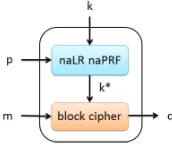
The principle is as follows. From an initial secret key k and a public random value p, the PRF outputs a session key k? = F(k, p) that is further used by the block cipher for a single block encryption. Figure 1 illustrates this process. Since each block is encrypted with a different secret key, the block cipher is not expected to be resistant against differential attacks.
Fig. 1: Non-adaptive leakage-resilient encryption scheme from a naLR naPRF.
3.2 Leakage-Resilient Encryption Scheme from a weak PRF
We have proposed the construction of a naLR encryption scheme from a naLR naPRF. Now we aim to instantiate this naLR naPRF in the most efficient way. Since it is proven secure, we start with the naLR naPRF introduced in [8]. We observe that it has likeable security features but it is not optimal in terms of efficiency since among all the nodes of the binary tree, only the leaves are finally exploited. As a consequence, we propose to improve the efficiency of the whole scheme by also using the intermediate nodes in a suitable order.
A solution to benefit from the intermediate nodes is to slightly change the inherent wPRF. In [8], this wPRF outputs 2n-bit values fromn-bit inputs. In this paper, we refer to asφthe wPRF we use to computen-bit values fromn-bit values and as φ2 (resp. φ3) the concatenation of two (resp. three) invocations of φ. Instead of deriving two keys generally from two random public values of same size, we could directly use the wPRF φ3 to derive three keys using one more random value. Among these three keys, two would still be used to derive the subsequent tree keys while the third one would be processed in the block cipher. Although this solution exploits the intermediate nodes, it requires a more expensive derivation since the intermediate wPRF is expected to generate one more key with an additional amount of randomness.
A more efficient option is to maintain the binary tree construction with the wPRFφ2 and to use directly the intermediate keys in the block cipher. In this case, a third random value can be used with the intermediate key and the output of the block cipher can be bitwise added to the chosen message3. However, the
re-keying scheme involved in this new construction is not a PRF anymore, since 3
an adversary could easily take advantage of its outputs to derive the following keys. One may consequently expect the encryption scheme (we refer to asSRφ,φ)
not to be secure anymore. Surprisingly, this intuition is wrong. By Theorem2 that will be proven in Sect. 4, we show that we are still able to build a naLR symmetric encryption scheme with relaxed properties on the re-keying scheme. However unlike the previous scheme, the proof we established requires the block cipher to be the same primitive than the wPRF used to derive the keys. Theorem 2. Let φbe a secure wPRF. LetRφ denote the re-keying scheme de-scribed above. ThenSRφ,φis a naLR encryption scheme. The amount of leakage
λtolerated per time step depends onφ:λ=O(log(1/φ)).
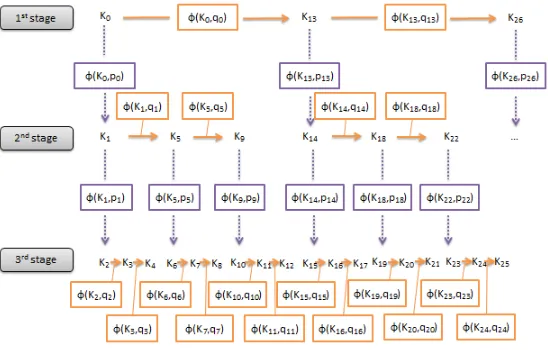
Now that we have presented the security aspects when exploiting all the nodes of the binary tree, we still have to fix a suitable order in the nodes to be as efficient as possible in the re-synchronization scenario. For this purpose, we need to define short-cuts between distant keys to avoid the expensive computation of all the intermediate keys. Inspired by the skip-list data structure introduced in [29], we suggest to organize our re-keying scheme ins stages, s>2 containing increasingly sequences of keys4. This organization in lists, illustrated in Fig.2
Fig. 2: Stage representation of our new re-keying schemeRφin the cases= 3.
with pi and qi public random values, involves a more efficient lookup with a reduction of the complexity from linear to logarithmic. Nevertheless, it is worth noticing that unlike skip-lists, this structure does not expect additional relations the public random values are known after the first encryption, the message blocks would have been chosen non-adaptively to avoid non random inputs.
4
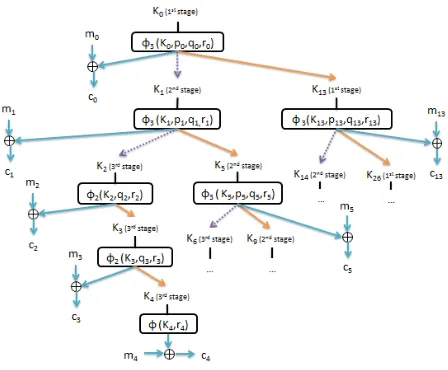
between keys. There is still one single computation path to derive each key. Figure3illustrates the whole encryption scheme usingφ3for the concatenation of the block cipher and the wPRFs used for the derivation. The values ri are the public random values used for the encryption, the values mi represent the blocks of message to encrypt and the valuesci the corresponding ciphertexts.
Fig. 3: Tree representation of our new encryption schemeSRφ,φin the cases= 3.
The very first key K0 is the entry point of the first stage. Keys from the first stage allow to generate the following first stage keys or to go down to the second stage. When going down, the index of the key increases by one whereas when computing the next key in the same stage sc, the index is increased by 1 +s+· · ·+ss−sc. Each derivation requires one public value that we refer to
as pi when going down and qi otherwise with i referring to the index of the key used for the derivation. In practice, the sender updates his own secret key after each operation, following the indices order. When he wants to perform a transaction with the receiver, he just has to relay his current transaction counter. The receiver then performs a series of operations to derive the expected session key. For this purpose, he can either decides to always start with the very first key K0or to start with another key that he already computed and that is compliant with the new index. Algorithm15 depicts the process for the first situation.
3.3 Efficient Generation of Random Values
For efficiency purpose, one tries to minimize the generation of fresh randomness in our construction. We propose several methods to distribute the public random
5
Algorithm 1 Re-keying Scheme
Require: current keyKc, indexc, stagesc, new indexi
Ensure: keyKi, indexi, stagesi
1: (K, ind, st)←(Kc, c, sc)
2: while(ind6=i)do
3: while(i > ind+
s−st
P
j=1
sj)do .Horizontal steps
4: K←φ(K, qind)
5: ind←ind+
s−st
P
j=0
sj
6: end while
7: while(i > ind) & (i6ind+
s−st
P
j=1
sj)do .Vertical steps
8: K←φ(K, pind)
9: ind←ind+ 1 10: st←st+ 1
11: end while
12: end while
13: return(K, st)
values. In a first attempt, we generate two fresh public random values pand q for the key derivation as illustrated in Fig.2 and3 and one additional random value for the input message block. Although the encryption scheme is naLR, the solution is impractical. Another solution is to follow the method from [8] and attribute two fresh random values by tree layer plus one for each block of message. This new proposal reduces the amount of randomness without loss of security since each path uses different random values for each time step.
The work of Yu and Standaert in [34] allows to reduce even more the cost of the generation of randomness. It suggests to replace the randomness by pseudo-random values generated by a PRF in counter mode from a single public seed. This solution can directly be applied to ours and results in a significant improve-ment of the performances. The global scheme can still be proven naLR in the peculiar world of minicrypt[13], that is either the scheme is secure or we can build public-key primitives from our symmetric functions, which is very unlikely.
Theorem 3. Letφbe a weak PRF andGa PRF. Then the systemSRφ,φ,G
de-scribed above is a naLR encryption scheme or we can build public-key primitives from the PRFs φandGand the related leakage functions.
4
Leakage-Resilient Security Analysis
4.1 Security Analysis of Theorem 1
In Sect. 3, Theorem 1 states the non-adaptive leakage-resilient security of an encryption scheme composed of a naLR naPRF and a block cipher, as illustrated in Fig1. The following depicts the proof.
Proof. From the granular leakage-resilient model, our scheme is split into time steps which leak independently. The attacker is allowed to choose non-adaptively a leakage function f = (f1, f2) with components for each of these time steps: f1 for the PRF and f2 for the block cipher. Then, she can submit q distinct queries to her oracles which can be divided between challenge queries and leakage queries. For each challenge query, she gets back either the real output of her query or the encryption of a random string. For each leakage query, she gets both the real output of her query and the leakage which is exactly the output of the leakage functionf she chose. Let us now show the proof that the construction is a naLR encryption scheme. As explained in [32], we organize the security proof of Theorem 1 as a sequence of games. The first one, referred to as Game 0, represents the real case, that is when the attacker gets both the leakage and the real outputs of her queries. It directly corresponds to the left-hand side probability in Definition 5 for an adversary A having access to challenge and leakage oracles:
IP K←{∗ 0,1}k
[A(SK(.), SKf(.)) = 1].
We denote byG0 the eventA(SK(.), S f
K(.)) = 1 and corresponding to Game 0. The last game GameNrepresents the random case, that is when all the challenge outputs are generated from random queries. It corresponds to the right-hand side probability in Definition 5with $ a random string in{0,1}n:
IP K←{∗ 0,1}n
[A(SK($), S f
K(.)) = 1].
Similarly, we denote by GN the event: A(SK($), S f
K(.)) = 1. We aim to show that the difference between these probabilities (which is exactly the advantage of the attacker according to Definition5) is negligible. To proceed, we go through intermediate games and we iteratively prove that the probability P(Gi) corre-sponding to Gameiis negligibly close to the probabilityP(Gi+1) corresponding to Game i+ 1 for i∈[N −1]. The difference between two successive games is expected to be very small for the needs of the proof. In the following, we will use three kinds of games transition: the transitions based on indistinguishability, the transitions based on failure events and the so-called bridging steps.
Leakage functions. The adversaryAfirst chooses a leakage functionf = (f1, f2) to observe the leakage during both the naLR naPRF and the block cipher ex-ecutions. In our security model, we impose the leakage function to be chosen non-adaptively that is before seeing any leakage or outputs.
Challenge Before everything, the challenger ofAchooses uniformly at random a key K ∈ {0,1}n for the naLR naPRF F. Subsequently,A is allowed to sub-mit adaptively to her challenger qdistinct queries whoseq0 are leakage queries M1, . . . , Mq0 andq1=q−q0 are challenge queriesM
0
1, . . . , Mq01. Then, for each leakage queryMi, i∈[q0] the challenger receives fromA, the challenger chooses uniformly at random an indexindi as input for the PRF and returns both the real outputci and the corresponding leakage:
ci←βKi(Mi) with Ki=F(K, indi) and f1(K, indi), f2(Ki, Mi).
For each challenge query Mi0, i∈ [q1], the challenger also chooses uniformly at random an indexind0i and returns toAonly the real output:
c0i←βK0
i(M
0
i) with Ki0 =F(K, ind0i).
We aim now to transform this real game into a new game that is equivalent to the computation of the adversary given an oracle access to the encryption of a random value in{0,1}n and such that the probability that b= 1 in this latter game is negligibly close toP[G0].
Game 1 [bridging step] In Game 0, the challenger chooses uniformly at random a index as input for the naLR naPRF at each leakage or challenge query. We make here a conceptual change. Instead of choosing the indices at each query, the challenger chooses now all theqindices at the very beginning, that is before receiving the first query from the attacker. Since the indices are chosen uniformly at random, it does not change anything for the attacker. However, it is mandatory to use the naLR naPRF since it expect its inputs to be chosen non-adaptively that is before seeing any leakage or output. Eventually,
P[G0] =P[G1].
Game 2 [transition based on a failure event]. In Game 1, the challenger chooses uniformly at random theqindices of the future queries. We now modify this first game so that we ensure that all the uniformly random indices chosen by the challenger are pairwise distinct. It is easy to note that Games 1 and 2 proceed identically, unless there is a collision in the set of uniformly random indices. Let us denote by E this specific event. If E does not occur, then the output of both games is exactly the same. Equivalently, the following relation is satisfied:
Then, from the common Lemma denoted by Difference Lemma in [32], we have the following result:
|P[G1]−P[G2]|6P[E].
Let us now determine the probability of event E. Theq index values of Game 0 are sampled uniformly at random. Therefore, from the birthday bound, the probability of having at least a collision is less thanq(q−1)/2n+1 ifq6n. This result gives us a bound on the difference between the probabilities of the events ofb= 1 in both games:
|P[G1]−P[G2]|6
q(q−1) 2n+1 .
Game 3 [transition based on indistinguishability]. We now make a small change to the above game. Namely, instead of computing the intermediate keys from the naLR naPRF F (for the challenge queries), we generate them using a random function:
R← Rn,n Ki0 ←R(M 0 i) c
0 i ←βK0
i(M
0
i) ∀i∈[q1] or indistinguishably
Ki0←$ c0i←βK0
i(M
0
i) ∀i∈[q1] where $ is a random string in{0,1}n.
Let us consider an adversaryAwho distinguish these two games.Ainteracts with a challengerCA as in Game 0 and gets back either outputs using random keys ifb= 1 or outputs using keys computed from the naLR naPRFF ifb= 0. A then outputs a bit b0A in view of the information she got that aims to be identical to b.
Let us now show that ifAactually exists, we are able to build a new adversary Bagainst the naLR naPRFF who usesA. The process is as follows. As above, the adversary A first chooses a leakage function f = (f1, f2) but this time sends it to the adversary B who transmitsf1 to her own challengerCB. Then, as the challenger of adversary A in previous games, CB chooses q uniformly randomdistinct indices and a uniformly random keyK that he submits to the naLR naPRF leakage and challenge oracles with the leakage function f1. The challenger then gets back from the leakage oracle and transmits toB both the leakage during the execution of this naLR naPRF:
f1(K, indi) ∀i∈[q0] and the keys corresponding to the leakage queries:
K1, . . . , Kq0.
1). Once these data collected, B is ready to answer the adaptive leakage and challenge queries of A. For each leakage query Mi, B computes βKi(Mi) and
f2(Ki, Mi) and with the oracle previous replies sends back toA: f1(K, indi) f2(Ki, Mi) ci=βKi(Mi).
For each challenge query Mi0, i ∈ [q1], B directly uses the key Ki0 given by its challenge oracle and sends back toAaccording to the bitb:
b=0: c0i=βK0
i(M
0
i) with K 0
i ←F(K, ind 0 i) b=1: c0i=βK0
i(M
0
i) with K 0 i ←$.
Eventually,A got the leakage outputs corresponding to its leakage queries and the outputs of the encryption scheme with its challenge queries either with the real keys ifb= 0 or with uniformly random keys ifb= 1. This situation perfectly simulates Game 0 with the real keys (whenb= 0) and Game 1 with the uniformly random keys (whenb= 1). As a result, the bitb0B given by adversaryBafter its challenge on the naLR naPRF F is exactly the same than the bitb0A given by adversaryAto distinguish both Games.
Consequently, an adversary who aims to distinguish both games has the same advantage an adversary who aims to break the security of the naLR naPRF F. This is bounded by the naLR naPRF advantage F. Eventually, we have: |P(G2)−P(G3)|=F.
Game 4 [transition based on a failure event]. We now modify Game 3 so that in addition to be uniformly random, the keys we use are also pairwise distinct.
Ki0 ←$ s.t. Ki06=Kj0 ifi6=j c0i←βK0
i(M
0
i) ∀i, j∈[q1]. It is worth noticing that Games 3 and 4 proceed identically, unless there is a collision in the set of uniformly random keys. Let us denote byE this specific event. IfE does not occur, then the output of both games is exactly the same. As detailed in [32] with the Difference Lemma and since the following relation is satisfied:
G3∧E⇔G4∧E,
we have
|P[G3]−P[G4]|6P(E).
We now determine the probability of eventE. Theq1 key values of Game 1 are sampled independently and at random. Therefore, from the birthday bound, the probability of a collision is less than (q1(q1−1))(2n+1) ifq16
√
Game 5.0 [bridging step]. We now make a purely conceptual change to Game 4. In this game, the challenge outputs are computed from uniformly random keys without any intervention of the naLR naPRF:
Ki0←$ s.t. Ki0 6=Kj0 ∀i, j∈[q1], i6=j c0i ←βK0
i(M
0
i) ∀i∈[q1]
Since the keys are now uniformly random and pairwise distinct, the invocations to the block cipher are completely independent from each other. So we can now consider them separately. Let us say that in this game, zero challenge query is computed from a random function and theq1 others using the block cipherβ. Clearly,
P[G4] =P[G5.0].
Game 5.t [transition based on indistinguishability]. We now modify Game 5.0 by replacing thet first invocations of the block cipherβ for the chal-lenge queries by invocations of a truly random functionR← Rn,n:
Ki0←$ s.t. Ki0 6=Kj0 ∀i, j∈[q1], i6=j c0i←R(Mi0) ∀i∈[t] and c0i←βK0
i(M
0
i) ∀i∈t+ 1, . . . , q1. We consider an adversaryAwho aims to distinguish Games 5.0 and 5.t. A first chooses a leakage function f = (f1, f2) (respectively related to F and β) and sends it to her challenger. For each leakage queryMi, i∈[q0] she makes,A gets back:
f1(K, indi) f2(Ki, Mi) ci=SF,β(Mi) =βKi(Mi)
withKuniformly generated at random by the challenger. For thetfirst challenge queries M0
1, . . . , Mt0 sent to her challenge oracle, A gets back according to the game:
Game 5.0: c0i=βK0
i(M
0
i) ∀i∈[t]
Game 5.t: c0i=R(Mi0), R← Rn,n ∀i∈[t].
The other challenge queries are equivalent to Game 5.0. Eventually from these data,Aoutput a bitb0A indicating which game is played.
Now, let us show that if such an adversaryAexists, we can build an adversary B against the block cipher β that uses A. B proceeds as follows. B gets from A the leakage function f = (f1, f2) and transmits it to her challenger CB. CB generates the masterK and the indices uniformly at random and uses them to compute the leakage of F and the intermediate keys. For each leakage query Mi, i∈[q0] fromA, CB directly computes the leakage of the whole encryption. Bgets back the corresponding leakage and outputs and sends toA:
For each of thetfirst challenge queries fromA,Bsends both the query and the corresponding intermediate key to her challenge oracle. According to the bitb, Bgets back and returns toA:
b=0: c0i=βK0
i(M
0 i) b=1: c0i= $.
The other challenge queries are directly computed byBand sent back toA. Eventually, this experience perfectly simulates Games 5.0 when b = 0 and 5.twhenb= 1. The adversaryBfaces the same challenge to distinguish the real output of the block cipher and a random string thanAto distinguish both games. Their output bits b0B and b0A are perfectly equal which allows us to conclude that the difference between probabilities of events of both games whenb= 1 is directly based on the security parameter of the block cipher as a PRF for each invocation:
|P[G5.0]−P[G5.t]|=|P[G5.0]−P[G5.1] +P[G5.1]− · · · −P[G5.t]| 6|P[G5.0]−P[G5.1]|+· · ·+|P[G5.t−1]−P[G5.t]| 6t·β.
from the triangular inequality.
Game 6 [SYM-RANDOM]. In this game, the invocations of the block cipher corresponding to all theqth
1 query are replaced by the invocations of uniformly random functions.
Ki0←$ s.t. Ki06=Kj0 ∀i, j∈[q1], i6=j c0i←R(Mi0) ∀i∈[q1]
or equivalently
Ki0←$ s.t. Ki0 6=Kj0 ∀i, j∈[q1], i6=j c0i ← $ ∀i∈[q1].
As explained in this introduction, this last game represents the right-hand side of the advantage of the attacker in Definition 5. Let us now compute the difference of the probability ofG0 corresponding to Game 0 and the probability ofG6 corresponding to this last game:
|P[G0]−P[G5]|=|P[G0]−P[G1] +P[G1]−P[G2] +P[G2]−P[G3] +P[G3]−P[G4.0] +P[G4.0]−P[G4.t] +P[G4.t]−P[G5]|. From the triangular inequality, we obtain:
|P[G0]−P[G5]|6|P[G0]−P[G1]|+|P[G1]−P[G2]|+|P[G2]−P[G3]| +|P[G3]−P[G4.0]|+|P[G4.0]−P[G4.t]|+|P[G4.t]−P[G5]| 6q(2qn+1−1)+F+
q1(q1−1)
Eventually the advantage of an attacker against the encryption scheme described in Theorem1is bounded by:
q(q−1) +q1(q1−1)
2n+1 +F +q1·β which is negligible.
4.2 Security Analysis of Theorem 2
Unfortunately, our new re-keying scheme is not a PRF since the adversary could easily take advantage of the outputs of the intermediate nodes to recover the following keys. However we prove hereafter that instantiated with a specific wPRF, it still yields a naLR encryption scheme.
Proof. To prove Theorem2, we first prove the security of the independent time steps in the new re-keying scheme. Let us consider an intermediate node of the re-keying scheme. If a challenge or a leakage query is defined on this node, the related operation will be the concatenationφ3 of three wPRFs: two for the derivation of the next keys and one for the encryption. In the case no query is defined on this node, the concatenationφ2of only two wPRFs is required. As a result, we prove that the concatenation of two or three invocations of the wPRF φusing the same key (two for the derivation and in some cases one for the block cipher) still forms a secure wPRF.
Proposition 1. Letφ:{0,1}n× {0,1}n→ {0,1}n be a(, s,3q)-secure wPRF. φ3:{0,1}n× {0,1}3n → {0,1}3n
(k, p, q)7→(φ(k, p)kφ(k, q)) is then a(0, s, q)-secure weak PRF with063q(3q2n+1−1)+
6.
Proof (Proof of Proposition1).As done in the previous section, we organize this proof as a sequence of games. But this time, we aim to show the security of a function as a weak PRF in the sense of Definition1. We start with Game 0 which represents the real game in which the attacker gets exclusively the real outputs of her queries.
Game 0 [SYM-REAL]. As briefly mentioned, in this game the attacker gets the real outputs of her queries. Contrary to the previous proof, there is no leakage here so we only consider challenge queries.
6
Challenge As usual, we consider an attacker A and her challenger CA. The attacker A asks her challenger for q queries. The challenger CA then chooses uniformly at random an initial key K ∈ {0,1}n and q queries M
1, . . . , Mq ∈ {0,1}3n and returns toAboth the queries and their real outputs:
(Mi, φ3(K, Mi)) = ((pi, qi, ri),(φ(K, pi)||φ(K, qi)||φ(K, ri))), ∀i∈[q]. We will now slightly transform this game until we reach the random game in which the adversary only gets random values in answer to her challenge queries. At each step, we show that the probability of b= 1 is negligibly close between consecutive games.
Game 1 [transition based on a failure event]. In Game 0, the challenger choosesqrandom and distinct challenge queries (pi||qi||ri)16i6q. We now slightly modify this game to ensure that the intermediate queries (pi), (qi) and (ri) for i ∈ [q] are all pairwise distinct. From the birthday bound and the Difference Lemma in [32], we obtain a bound on the difference between the probabilities of the events ofb= 1 in both games:
|P[G0]−P[G1]|6
3q(3q−1) 2n+1 .
Game 2 [transition based on indistinguishability]. Game 1 is different from the original game since all the intermediate parts of theqqueries are pair-wise distinct. Let us now consider instead of the weak PRFφ3, three invocations of a random function in{0,1}n.
We consider an adversaryA3who is able to distinguish both games. We show now that we are able to build a new adversaryAagainst the weak PRFφwho usesA3. The process is as follows. The challengerCAof the adversaryAreplaces the challenger of A3 to generate the initial keyK and the random queries. He then submits to his challenge oracleOφ this initial key and the 3q distinct and uniformly random intermediate queries. According to the random bit b, he gets back and gives toAeither the real outputs of the weak PRFφor random values. Thus,Areturns toA3:
b= 0 : (Mi, φ3(K, Mi)) = ((pi, qi, ri),(φ(K, pi)||φ(K, qi)||φ(K, ri))) b= 1 : ((pi, qi, ri),(R(pi)||R(qi)||R(ri))).
with Ra random function in{0,1}n. Eventually, this situation perfectly simu-lates Game 1 with the real outputs (b= 0) and Game 2 with the random ones (b= 1). The adversaryAfaces the same challenge in distinguishing the real and random outputs thanA3to distinguish Games 1 and 2. Consequently, we have
Game 3 [transition based on a failure event]. In Game 1, we modified the inputs to ensure the absence of collision between the intermediate values. Now we switched to random functions, we can come back to the initial random values in order to reach the final game according to Definition1. The difference of probabilities between these two games is straightforwardly the same than between Game 0 and 1:
|P[G2]−P[G3]|63q(3q−1) 2n+1 .
Game 4 [SYM-REAL]. For the security definition to be perfectly verified, we conceptually modify Game 3 to only consider one invocation of a random function in{0,1}3ninstead of three in a smaller range. Both games are equivalent and we can observe that this new one represents exactly the right-hand side of Definition1. As a result, we obtain:
|P[G0]−P[G3]|=|P[G0]−P[G1] +P[G1]−P[G2] +P[G2]−P[G3] +P[G3]−P[G4]| 63q(3q−1)
2n +φ which concludes the security proof.
Now we have independent time steps, we can build the proof on the security model previously established. The attacker is still allowed to choose a global leakage function f = (f1, f2) but this time f1 related to the invocations of weak PRF φ2 during the re-keying Rφ and f2 to the final encryption. Then, she submits q0 distinct leakage queries and q1 =q−q0 different and pairwise distinct challenge queries. For each leakage query, the adversary gets the leakage of the intermediate nodes computed with function phi2 and both the leakage and the output of the last node computed with functionφ3. For each challenge query, she receives either the real output or the encryption of a random string of the input’s size. Let us now give the proof organised as a sequence of games as proposed by Shoup in [32]. As detailed in Subsection4.1, the first game refers to the left-hand side probability of Definition5whereas the last game refers to the right-hand side probability in the same definition. By showing that the games are negligibly close, we prove that the advantage of the attacker in distinguishing them is negligible and as a result that the scheme is leakage-resilient secure. Game 0 [SYM-REAL]. In this game, the attacker gets from her challenger both the leakage and the real outputs of her leakage and challenge queries. Below we formally describe the process.
Challenge. In this game, the challenger of A chooses uniformly at random an initial keyK ∈ {0,1}n. Then, for each leakage queryM
i, i∈[q0] chosen byA, the challenger chooses uniformly at random an indexindi for the naLR naPRF and returns the real output and the corresponding leakage:
ci←φ(Ki, ri)⊕Mi and f1(K, indi) and f2(Ki, Mi) with
ri ?
← {0,1}n and Ki←Rφ(K, indi).
For each challenge query Mi0, i∈[q1], he also chooses uniformly at random an indexind0
i and only returns the real output:
c0i←φ(Ki0, r0i)⊕Mi0 with ri0 ← {? 0,1}n and Ki0 ←Rφ(K, ind0i). We denote this first game by Game 0 and the related event byG0. We will now transform this real game into a new one whose probability will be negligibly close.
Game 1 [bridging step]. In Game 0, the indices for the PRF are chosen by the challenger at each query. In this game, we make a conceptual change consisting in choosing all the indices before the first query. Since they are chosen uniformly at random, it does not change the advantage of the attacker. However, it is mandatory for the use the naLR naPRF which requires non-adaptive inputs. We have:
P[G0] =P[G1].
Game 2 [transition based on indistinguishability]. In this game, we mod-ify all the nodes involved in leakage queries included the intermediate ones. Since the related keys leak, we replace all the invocations of the related weak PRFs φ2 andφ3by truly random functions: R← Rn,n:
Kj0 ←$ for all keys generated from low keys ci0 ←φ(Ki0, ri0) ⊕Mi0 with ri0
?
← {0,1}n and K0
i←(φ◦R)?(K, ind0i) with (φ◦R)? representing the combination of invocations of function φ and random function according to the nodes involved in leakage queries. To perform the reduction we use a lemma from [26] that we recall here.
Lemma 1 (Lemma 2 from [26]). For anyα >0 andt∈N: If F :{0,1}n× {0,1}n → {0,1}n is a (, s, q)-secure wPRF (for uniform keys), then it is a (0, s0, q0)- secure wPRF withα-low keys if the following holds:
q>q0.t
Now we consider an adversaryAwho aims to distinguish Games 1 and 2.Afirst chooses a leakage functionf = (f1, f2) and sends it to her challengerC. For each leakage query Mi,i∈[q0]Asubmits, she gets back:
f1(K, indi) f2(Ki, Mi) ci =φ(Ki, ri)⊕Mi with ri
?
← {0,1}n and K
i←Rφ(K, indi).
For each challenge queryMi0,i∈[q1],Agets back according to the game: Game 1 :c0i=φ(Ki0, r0i)⊕Mi0 with r0i
?
← {0,1}n and K0
i←Rφ(K, ind0i) Game 2 :c0i=φ(Ki0, r0i)⊕Mi0 with r0i← {? 0,1}n and K0
i←(φ◦R)
?(K, ind0 i). Now let us demonstrate that if such an adversaryAexists, we are able to build an adversaryBagainst the weak PRF that usesAas follows.Bgets fromAthe leakage functionf = (f1, f2) and transmits it to her challengerD. Dgenerates the master key K andq0 indices (for each leakage query) uniformly at random and uses them to compute the leakage and the intermediate keys. Then for each leakage query Mi0 submitted byA, he sends the results toBwho returns to A:
f1(K, indi) and f2(Ki, Mi) ci=φ(Ki, ri)⊕Mi with ri
?
← {0,1}n and Ki ←Rφ(K, indi). For each challenge queryMisubmitted byAand transmitted byB,Dcomputes the derivations for all the nodes not involved in the transformation and sends the data to her challenge oracle for the others. According to the bit brepresenting the choice of her oracle, Bgets back the results, computes the encryptions and returns toA:
b= 0 :c0
i=φ(Ki0, ri0)⊕Mi0 with ri0 ?
← {0,1}n and Ki0←Rφ(K, ind0i) b= 1 :c0i=φ(Ki0, ri0)⊕Mi0 with ri0
?
← {0,1}n and K0
i←(φ◦R)?(K, ind0i). Eventually, this experience perfectly simulates Game 1 whenb= 0 and Game 2 whenb= 1. Indeed, the adversaryBfaces the same challenge to distinguish the real output of the weak PRF and a random string than Ato distinguish both games. We can conclude from this reduction that the probabilities related to both games are negligibly close. The difference directly comes from the Lemma 2 in [26] and the number of nodes involved in leakage queries.
|P[G1]−P[G2]|623λ+1(φ2+q 2
0/2n+1+ 2 exp(−2φ2/8))·(v0−q0) + 23λ+1(φ3+q
2 0/2
n+1+ 2 exp(−2
φ3/8))·q0
withv0the number of nodes involved in leakage queries. Note that the presence of two terms is related to the use of functionφ2for keys derivation only andφ3 at the last node of the query for also an encryption.
children of a node at the upper stage)7. We consider the worst case, that is
when we always start from the initial key without storing any node, when no node is used in several leakage queries and we take the average index 2n−1.
v0< q0( 2n−1 Ps−1
j=0lj +s.l)
invocations of weak PRFs. Choosing s = n and l = 2 gives us the following bound:
v0< q0( 2n−1
2n−1 + 2n)< q0(1 + 2n).
Game 3 [transition based on indistinguishability]. In this game, we mod-ify all the nodes involved in challenge queries except those involved in leakage queries and already transformed. We replace the weak PRFs instantiated with the corresponding keys by random functionsR← Rn,n:
Kj0 ←$ for all keys involved in queries c0i←$⊕Mi0.
Let us consider an attackerAwho is able to distinguish Game 3 from Game 2.A first chooses a leakage functionf and sends it to her challenger. For each leakage query Mi,i∈[q0]Asubmits, she gets back:
f1(K, indi) f2(Ki, Mi)
ci =φ(Ki, ri)⊕Mi with ri ?
← {0,1}n and K
i←Rφ(K, indi).
For each challenge queryM0
i,i∈[q1],Agets back according to the game: Game 2 :c0i=φ(Ki0, r0i)⊕Mi0 with r0i← {? 0,1}n and K0
i ←(φ◦R)
?(K, ind0 i) Game 3 : $⊕Mi0.
with (φ◦R)? the combination of invocations φand random functions (for the node involved in leakage queries) corresponding to Game 2.
We now show that if such an attacker exists, we can build an attackerBwho is able to break the weak PRFsφ2,φ3usingA. The process is as follows.Afirst chooses a leakage functionf and submits it toB. Bsends it to her challenger. The latter generates the master keyKand theq0indices for the leakage queries uniformly at random. He then computes both the leakage and the intermediate keys. Then for each leakage query Mi that Asubmits to B, she transmits it to her challenger who computes and returns the following results:
f1(K, indi) and f2(Ki, Mi) ci=φ(Ki, ri)⊕Mi with ri
?
← {0,1}n and Ki ←Rφ(K, indi). 7
Then, for each challenge queryMi0 thatAsubmits,Bsends it to her challenger. The challenger sends the indices toB’s challenge oracle andBgets back according to the bitbthe real outputs of the weak PRFs or random values. She sends back toA:
b= 0 :c0i=φ(Ki0, ri0)⊕Mi0 with ri0 ← {? 0,1}n and K0
i←(φ◦R) ?
b= 1 : $⊕m= $.
This experience perfectly simulates Game 2 whenb= 0 and Game 3 whenb= 1. So if the adversaryAexists, we can build an adversary Bwho is able to break the previous weak PRF. As a result, we obtain the following equality:
|P[G2]−P[G3]|6(v1−q1)·φ2+q1·φ3
with v1 the number of nodes involved in challenge queries. We apply the same computation than in Game 2 to bound this value:
v16q1( 2n−1 Ps−1
j=0lj +sl). Still instantiatingsbynandl by 2, we obtain:
v16q1( 2n−1
2n−1 + 2n)< q1(1 + 2n).
Game 4 [SYM-RANDOM]. In this last Game, all the nodes involved in challenge queries have been replaced by random functions. Hence, this game represents exactly the right-hand side probability in Definition5. From the above sequence of games, we are able to compute a bound on the advantage of an attacker against this non-adaptive leakage-resilient encryption scheme.
|P[G0]−P[G4]|=|P[G0]−P[G1] +P[G1]−P[G2] +P[G2]−P[G3] +P[G3]−P[G4] 6|P[G0]−P[G1]|+|P[G1]−P[G2]| +|P[G2]−P[G3]|+|P[G3]−P[G4]| 623λ+1(φ2+q
2 0/2
n+1+ 2 exp(−2
φ2/8))·(v0−q0) + 23λ+1(φ3+q
2 0/2
n+1+ 2 exp(−2
φ3/8))·q0 + (v1−q1)φ2+q1φ3.
4.3 Security Analysis of Theorem 3
In 1995, Impagliazzo defined five complexity worlds [13]:algorithmicain which P =N P with all the amazing consequences,heuristicaworld in which on the contrary N P-complete problems are hard in the worst-case (P 6= N P) but are efficiently solvable on average and the three worlds on the existence of the cryptographic functions. In the pessilandworld, there exist average-case N P -complete problems but one-way functions do not exist, which implies that we cannot generate hard instances of N P-complete problem with known solution. In the minicryptworld, one-way functions exist but public-key cryptographic schemes are impossible and finally in thecryptomaniaworld, public-key crypto-graphic schemes exist and secure communication is possible. These worlds have been used positively to establish security proofs in many papers [25,27,34].
In this section, we follow the work of Yu and Standaert who show in [34] how to improve the efficiency of our re-keying scheme, maintaining its leakage-resilient security in theminicryptworld. In fact, our new construction currently requires a large amount of fresh randomness since we need to generate a new fresh random value for each new session key. Yu and Standaert show that tweaking a similar design to use only a small amount of randomness can still be leakage-resilient in the world of minicrypt. That is, either the new design is leakage-resilient or it becomes possible to build public-key primitives from the involved symmetric-key blocks and the related leakage functions, which is very unlikely. Their technique directly applies to our symmetric encryption scheme and only requires a public seedsthat is randomly chosen. Instead of being randomly generated, our public valuespi’s andqi’s are now computed from a PRFGin counter mode.
Proof of Theorem3from [34]. The scheme is trivially secure if the seed is secret since it is like replacing the outputs of the PRF G by a true random values. Let us now prove the leakage-resilience security when the seed is public. For this purpose, we assume by contradiction that there exists an adversaryAagainst our scheme. If the scheme is not a naLR encryption scheme, there exists an adversary able to distinguish with a significant advantage the encryption of a real query from the encryption of a random string with the same size given the previous leakage and outputs. Let us now consider a protocol between two parties which we refer to as Aliceand Bobwho want to communicate over an authenticated channel. The protocol is a secure bit-agreement if an adversary, refer to asEve, cannot recover the output bit of Alice. We construct it as follows:
1. Bobgenerates a random initial key for the re-keying scheme.
2. Alicegenerates the public random seedsand compute the required amount of public values using the PRFG. She sends these values to Bob.
3. Bobencrypts the message using the random values in the encryption scheme. He obtains the ciphertextc. He then generates a random bit bB and sends to Aliceeither c ifbB = 0 or the encryption of a random value otherwise and in both cases the current view containing the leakage.
As Eve only has access to the communication, she only gets knowledge of the intermediate public value (but not the seed), the current view and the correct or false result of the encryption. Hence she cannot guess the bit bA without breaking the scheme with secret seed. From the non negligible advantage of the adversaryA, the bit agreement we established achieves correlation (IP[bA=bB] is greater than 1/2). As a consequence, this protocol is equivalent to a bit-PKE in which the secret key corresponds to the seed generated by Alice and the public key to the intermediate public values.
5
Practical Aspects
In previous sections, we have shown that our construction instantiated with a weak PRFφand combined with a PRFGyields a non-adaptive leakage-resilient encryption scheme. We now focus on the practical aspects.
5.1 Instantiation
Our encryption scheme requires two primitives: a weak PRFφfor the derivation and the block cipher and a PRFGfor the generation of random values.
Weak PRF φ The concatenation of invocations of the weak PRFφwith ran-dom inputs is a suitable solution for the key derivation and the block cipher. Such a weak PRF can be built from any secure block cipher, like AES. Hence, inspired by [26], we propose the constructionsφ2(k, p) = AES(k, pk0)kAES(k, pk1), for the key derivation andφ3(k, p, r) =φ2(k, p)kAES(k, r),for also the encryption which benefit from the reuse of one public random input.
PRF G Following [34], we instantiate G with a secure block cipher, e.g. the AES. Since the AES is already implemented for the weak PRF φ, this choice benefits from the feature of limiting the code size. As proved in [34], only log(1/) bits of fresh pseudo-randomness are required for each public value, with the security parameter of the weak PRF φ (e.g. AES). As a consequence, we only need one additional call of the AES everybn/log(1/)cinvocations of φ.
5.2 Complexity Evaluation
block encryption. Furthermore, we will start with the initial key K0 without loss of generality since what counts is the distance between the current index and the targeted one. We recall that the distance between two keys indices from the same stage sc is equal to 1 +s+· · ·+ss−sc. We denote by Ns this distance which is also the number of children of a key from the same stage plus one. As a result, the number of AES executions N required to reach the key Ki is bounded as follows: Ni
1 6 N ≤ i
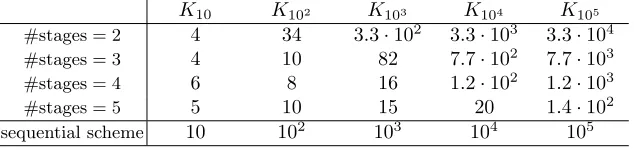
N1 +s(s−1) with s(s−1) the maximum number of executions needed to reach a child from a first stage key. These bounds can be squeezed with the parameters related to the other stages. Table1presents the number of AES executions required to re-synchronize from K0 to keys with increasing indices. For comparison purpose, when the keys are
Table 1: Number of AES executions to derive a key fromK0 given its index K10 K102 K103 K104 K105 #stages = 2 4 34 3.3·102 3.3·103 3.3·104 #stages = 3 4 10 82 7.7·102 7.7·103 #stages = 4 6 8 16 1.2·102 1.2·103 #stages = 5 5 10 15 20 1.4·102 sequential scheme 10 102 103 104 105
updated sequentially, 10,000 invocations of the re-keying primitives are required to compute K104 from K0. When using our construction with five stages, only N = 20 invocations are necessary that is five hundred times less. In the general case, one also needs to consider the generation of random values. Since the generation is also performed with the AES, the complexity of encrypting a n -block message is:C= (2N+ 4n−2)τAES if we consider one invocation ofGfor each key derivation and each block encryption. From [34] we could reduce the number of invocations of the generator until one everybn/log(1/)cinvocations ofφwithout loss of security:
C=
N+ 2n−1 + N+ 2n−1 bn/log(1/)c
τAES.
6
Conclusion
of security for its re-keying scheme. In fact, we have introduced a new re-keying process with relaxed security properties but which still yields a secure encryption scheme. Furthermore, it benefits the feature of being much more efficient than a sequential scheme when both parts of the symmetric communication need to re-synchronize. We have both proven the security based on this new re-keying scheme and evaluated the global complexity.
This work shows that it is possible to use the security of the mode of op-erations in order to construct leakage-resilient encryption scheme. The previous approach in this area tries to construct leakage-resilient block ciphers but it turns out that they are very inefficient. One of the main drawback of this scheme is that we need to compute the keyschedule algorithm for each message block. One interesting idea would be to avoid it by using a more secure mode of operations such as OCB. Indeed, this mode is interesting since the adversary cannot know what is the real input of the block cipher and consequently classical DPA attack are thwarted. However, the security proof of this mode is a real challenge.
References
1. Michel Abdalla and Mihir Bellare. Increasing the Lifetime of a Key: A Comparative Analysis of the Security of Re-keying Techniques. InASIACRYPT, pages 546–559, 2000.
2. Mihir Bellare, Anand Desai, E. Jokipii, and Phillip Rogaway. A Concrete Security Treatment of Symmetric Encryption. InFOCS, pages 394–403, 1997.
3. Daniel J. Bernstein. Implementing ”Practical leakage-resilient symmetric cryp-tography”. CHES ’12 rump session, 2012. Available athttp://cr.yp.to/talks/ 2012.09.10/slides.pdf.
4. Alex Biryukov and Dmitry Khovratovich. Two New Techniques of Side-Channel Cryptanalysis. In Paillier and Verbauwhede [24], pages 195–208.
5. Suresh Chari, Charanjit S. Jutla, Josyula R. Rao, and Pankaj Rohatgi. Towards Sound Approaches to Counteract Power-Analysis Attacks. In CRYPTO, pages 398–412, 1999.
6. Yevgeniy Dodis and Krzysztof Pietrzak. Leakage-Resilient Pseudorandom Func-tions and Side-Channel Attacks on Feistel Networks. In CRYPTO, pages 21–40, 2010.
7. Stefan Dziembowski and Krzysztof Pietrzak. Leakage-Resilient Cryptography. In FOCS, pages 293–302, 2008.
8. Sebastian Faust, Krzysztof Pietrzak, and Joachim Schipper. Practical Leakage-Resilient Symmetric Cryptography. InCHES, pages 213–232, 2012.
9. Benoˆıt G´erard and Fran¸cois-Xavier Standaert. Unified and Optimized Linear Col-lision Attacks and Their Application in a Non-profiled Setting. In Prouff and Schaumont [28], pages 175–192.
10. Oded Goldreich, Shafi Goldwasser, and Silvio Micali. How to construct random functions. J. ACM, 33(4):792–807, 1986.
11. Louis Goubin and Jacques Patarin. DES and Differential Power Analysis (The ”Duplication” Method). InCHES, pages 158–172, 1999.
13. Russell Impagliazzo. A Personal View of Average-Case Complexity. InStructure in Complexity Theory Conference, pages 134–147, 1995.
14. Yuval Ishai, Amit Sahai, and David Wagner. Private Circuits: Securing Hardware against Probing Attacks. InCRYPTO, pages 463–481, 2003.
15. Joshua Jaffe. A first-order dpa attack against aes in counter mode with unknown initial counter. In Paillier and Verbauwhede [24], pages 1–13.
16. Paul C. Kocher. Leak-resistant cryptographic indexed key update. Patent, 03 2003. US 6539092.
17. Paul C. Kocher, Joshua Jaffe, and Benjamin Jun. Differential Power Analysis. In CRYPTO, pages 388–397, 1999.
18. Marcel Medwed, Fran¸cois-Xavier Standaert, Johann Großsch¨adl, and Francesco Regazzoni. Fresh Re-keying: Security against Side-Channel and Fault Attacks for Low-Cost Devices. InAFRICACRYPT, pages 279–296, 2010.
19. Marcel Medwed, Fran¸cois-Xavier Standaert, and Antoine Joux. Towards Super-Exponential Side-Channel Security with Efficient Leakage-Resilient PRFs. In Prouff and Schaumont [28], pages 193–212.
20. Thomas S. Messerges. Using Second-Order Power Analysis to Attack DPA Resis-tant Software. InCHES, pages 238–251, 2000.
21. Silvio Micali and Leonid Reyzin. Physically Observable Cryptography (Extended Abstract). InTCC, pages 278–296, 2004.
22. Amir Moradi. Statistical Tools Flavor Side-Channel Collision Attacks. In David Pointcheval and Thomas Johansson, editors,EUROCRYPT, volume 7237 of Lec-ture Notes in Computer Science, pages 428–445. Springer, 2012.
23. Amir Moradi, Oliver Mischke, and Thomas Eisenbarth. Correlation-Enhanced Power Analysis Collision Attack. In Stefan Mangard and Fran¸cois-Xavier Stan-daert, editors, CHES, volume 6225 of Lecture Notes in Computer Science, pages 125–139. Springer, 2010.
24. Pascal Paillier and Ingrid Verbauwhede, editors. Cryptographic Hardware and Embedded Systems - CHES 2007, 9th International Workshop, Vienna, Austria, September 10-13, 2007, Proceedings, volume 4727 of Lecture Notes in Computer Science. Springer, 2007.
25. Krzysztof Pietrzak. Composition implies adaptive security in minicrypt. In Serge Vaudenay, editor,EUROCRYPT, volume 4004 ofLecture Notes in Computer Sci-ence, pages 328–338. Springer, 2006.
26. Krzysztof Pietrzak. A Leakage-Resilient Mode of Operation. In EUROCRYPT, pages 462–482, 2009.
27. Krzysztof Pietrzak and Johan Sj¨odin. Weak pseudorandom functions in minicrypt. In Luca Aceto, Ivan Damg˚ard, Leslie Ann Goldberg, Magn´us M. Halld´orsson, Anna Ing´olfsd´ottir, and Igor Walukiewicz, editors, ICALP (2), volume 5126 ofLecture Notes in Computer Science, pages 423–436. Springer, 2008.
28. Emmanuel Prouff and Patrick Schaumont, editors. Cryptographic Hardware and Embedded Systems - CHES 2012 - 14th International Workshop, Leuven, Belgium, September 9-12, 2012. Proceedings, volume 7428 of Lecture Notes in Computer Science. Springer, 2012.
29. William Pugh. Skip Lists: A Probabilistic Alternative to Balanced Trees. InWADS, pages 437–449, 1989.
30. Matthieu Rivain and Emmanuel Prouff. Provably Secure Higher-Order Masking of AES. InCHES, pages 413–427, 2010.
and Jean-Jacques Quisquater, editors, CHES, volume 3156 of Lecture Notes in Computer Science, pages 163–175. Springer, 2004.
32. Victor Shoup. Sequences of games: a tool for taming complexity in security proofs. IACR Cryptology ePrint Archive, 2004:332, 2004.
33. Fran¸cois-Xavier Standaert, Olivier Pereira, Yu Yu, Jean-Jacques Quisquater, Moti Yung, and Elisabeth Oswald. Leakage Resilient Cryptography in Practice.Towards Hardware-Intrinsic Security, Information Security and Cryptography, pages 99– 134, 2010.