
Oblivious Polynomial Evaluation and Secure
Set-Intersection from Algebraic PRFs
∗Carmit Hazay†
Abstract
In this paper we study the two fundamental functionalitiesoblivious polynomial evaluation in the exponentandset-intersection, and introduce a new technique for designing efficient secure protocols for these problems (and others). Our starting point is the [BGV11] technique (CRYPTO 2011) for verifiable delegation of polynomial evaluations, usingalgebraic PRFs. We use this tool, that is useful to achieveverifiabilityin theoutsourced setting, in order to achieveprivacyin thestandard two-party setting. Our results imply new simple and efficient oblivious polynomial evaluation (OPE) protocols. We further show that our OPE protocols are readily used for secure set-intersection, implying much simpler protocols in the plain model. As a side result, we demonstrate the usefulness of algebraic PRFs for various search functionalities, such as keyword search and oblivious transfer with adaptive queries. Our protocols are secure under full simulation-based definitions in the presence of malicious adversaries.
Keywords: Efficient Secure Computation, Oblivious Polynomial Evaluation, Secure Set-Intersection, Committed Oblivious PRF
∗A preliminary version of this paper appeared in the proceedings of TCC 2015 [Haz15].
†Faculty of Engineering, Bar-Ilan University, Israel. Email: carmit.hazay@biu.ac.il. Research partially supported by a
1
Introduction
Efficient secure two-party computation. Secure two-party computation enables two parties to mutually run a protocol that computes some functionf on their private inputs, while preserving a number of security properties. Two of the most important properties are privacy and correctness. The former implies data confi-dentiality, namely, nothing leaks by the protocol execution but the computed output. The latter requirement implies that the protocol enforces the integrity of the computations made by the parties, namely, honest parties learn the correct output. Feasibility results are well established [Yao86, GMW87, MR91, Bea91], proving that any efficient functionality can be securely computed under full simulation-based definitions (following the ideal/real paradigm). Security is typically proven with respect to two adversarial models: the semi-honest model (where the adversary follows the instructions of the protocol but tries to learn more than it should from the protocol transcript), and the malicious model (where the adversary follows an arbitrary polynomial-time strategy), and feasibility holds in the presence of both types of attacks.
Following these works, many constructions focused on improving the efficiencyof the computational and communication costs. Conceptually, this line of works can be split into two sub-lines: (1) Improved generic protocols that compute any boolean/arithmetic circuit; see [ST04, IPS08, NO09, LOP11, LP11, BDOZ11, DPSZ12, NNOB12] for just a few examples. (2) Protocols for concrete functionalities. In the latter approach attention is given to constructing efficient protocols for specific functions while exploiting their internal structure. This approach has been proven useful for many different functions in both the semi-honest and malicious settings. Notable examples are calculating thekth ranked element [AMP04], pattern matching and related search problems [HT10, Ver11], set-intersection [JL09, HN12] and oblivious pseudorandom function (PRF) evaluation [FIPR05].
In this paper we study the two fundamental functionalities oblivious polynomial evaluation in the ex-ponentandset-intersectionand introduce a new technique for designing efficient secure protocols for these problems in the presence of semi-honest and malicious attacks with simulation-based security proofs. We further demonstrate that our technique is useful for various search functionalities.
Algebraic PRFs. Informally, an algebraic pseudorandom function (PRF) is a PRF with a range that forms an Abelian group such that group operations are efficiently computable. In addition, certain algebraic op-erations on these outputs can be computed significantly more efficiently if one possesses the key of the pseudorandom function that was used to generate them. This property is denoted byclosed form efficiency
and allows to compute a batch oflPRF values much more efficiently than by computing thelvalues sep-arately and then combing them. Algebraic PRFs were exploited in [BGV11] to achieve faster verifiable polynomial evaluations (in the exponent). Specifically, in their setting, a client outsources ad-degree poly-nomial to an untrusted server together with some authenticating information, while the client stores a short secret key. Next, when the client provides an input for this polynomial the server computes the result and an authentication message that allows the client to verify this computation in sub-linear time ind.
More concretely, letQ(·) = (q0, . . . , qd)be the polynomial stored on the server in the clear. Then the
client additionally stores a vector of group elements{gaqi+ri}d
i=0 wherea←Zpandpis a prime, andriis
theith coefficient of a polynomialR(·)of the same degree asQ(·). Then for every client’s inputtthe server returnsy=Q(t)andu=gaQ(t)+R(t)and the client acceptsuif and only ifu=gay+R(t). Interestingly, in casegri =PRF
K(i), wherePRFis an algebraic PRF, the closed form efficiency property enables the client
to compute the valuegR(t) in sub-linear time ind. Stated differently, verifiability is achieved by viewing
gaqi+ri as a (one-time) message authentication code (MAC) forgqi where batch verification of multiple MACs can be computed more efficiently than verifying each MAC separately.
PRFs so that instead of achievingverifiabilityin theoutsourced setting, we achieveprivacyin thestandard two-partysetting. It is worth noting that although the main focus of [BGV11] is correctness, they do discuss how to achieve one-sided privacy by encrypting the coefficients of the polynomial. Nevertheless, it is not clear how to maintain the privacy of the input to the polynomial. In this work, we use algebraic PRFs to mask the polynomial in a different way that does not allow the verifiability of the polynomial evaluation but allows the extractability of the polynomial more easily, and demonstrate an alternative way to achieve correctness. We focus our attention on theplain modelwhere no trusted setup is required.
Oblivious polynomial evaluation. The oblivious polynomial evaluation (OPE) functionality is an im-portant functionality in the field of secure two-party computation. It considers a setting where partyP0
holds a polynomialQ(·)and party P1 holds an elementt, and the goal is thatP1 obtains Q(t) and
noth-ing else while P0 learns nothing. OPE has proven to be a useful building block and can be used to
solve numerous cryptographic problems; e.g., secure equality of strings, set-intersection, approximation of a Taylor series, RSA key generation, oblivious keyword search, set membership, data entanglement and more [Gil99, LP02, FNP04, FIPR05, NP06, ADDV12].
Despite its broad applicability the study of OPE was demonstrated using only few concrete secure proto-cols, initiated in [NP99] and further continued in [CL05, ZB05, HL09]. In particular, the only protocol with a complete simulation-based proof in the presence of malicious attacks is the protocol in [HL09]. This proto-col evaluates ad-degree polynomial over a composite order groupZN withO(sd)modular exponentiations,
whereN is an RSA composite andsis a statistical security parameter.
When relying on general protocols for securely realizing the OPE functionality, the (currently most practical) approach of [DPSZ12, DKL+13] for arithmetic circuits follows the preprocessing model: in an offline phase some shared randomness is generated independently of the function and the inputs; in an online phase the actual secure computation is performed. One of the main advantages of these protocols is that the basic operations are almost as cheap as those used in the passively secure protocols. To get good performance, these protocols use the somewhat-homomorphic SIMD approach that handles many values in parallel in a single ciphertext, and thus more applicable for large degree polynomials. Similarly, protocols for Boolean circuits apply the cut-and-choose technique which requires to repeat the computationstimes in order to prevent cheating except with probability2−s[Lin13].
In some applications such as password-based authenticate key exchange protocols or when sampling an element from ad-wise independence space, the polynomial degree is typically small and even a constant. In these cases, our protocols have clear benefits since they are much simpler, efficient and easily implementable.
Secure set-intersection. In the set-intersection problem partiesP0, P1, holding input setsX, Y of sizes mX andmY, respectively, wish to computeX∩Y. This problem has been intensively studied by researchers
in the last few years mainly due to its potential applications for dating services, datamining, recommendation systems, law enforcement and more; see [FNP04, KS05, DSMRY09, JL09, JL10, HL10a, HN12] for a few examples. For instance, consider two security agencies that wish to compare their lists of suspects without revealing their contents, or an airline company that would like to check its list of passengers against the list of people that are not allowed to go abroad.
Two common approaches are known to solve this problem securely in the plain model: (1) oblivious polynomial evaluation and (2) committed oblivious PRF evaluation. In the former approach partyP0
com-putes a polynomial Q(·) such thatQ(x) = 0for all x ∈ X. This polynomial is then encrypted using homomorphic encryption and sent toP1, that computes the encryption ofry·Q(y) +yfor ally ∈ Y, and
using fresh randomnessry. Upon receiving these ciphertexts,P0decrypts them and outputs the intersection
To move towards malicious security, Hazay and Nissim modified this protocol so that the payload informa-tion obtained byP1 is a random string rather thany. The main challenge in their protocol is with ensuring
consistency between the correct payload information and the corresponding input element.
The second approach uses a secure implementation of oblivious pseudorandom function evaluation. Namely, P0 chooses a PRF key K and computes the set PRFX = {PRFK(x)}x∈X. The parties then
execute an oblivious PRF protocol where P0 inputs K, whereas P1 inputs the set Y and learns the set
PRFY ={PRFK(y)}y∈Y. Finally,P0 sends the setPRFX toP1that computesPRFX∩PRFY and extracts
the actual intersection. This idea was introduced in [FIPR05] and further used in [HL10a, JL09, JL10]. Other solutions in the random oracle model [CT10, CKT10, ACT10, DCW13, PSSZ15] take a different approach by applying the random oracle on (one of) the sets members or apply oblivious transfer extension. In a recent result [PSZ14], Pinkas et al. compare the overhead of exiting solutions for set-intersection in the semi-honest setting. One of their conclusions is that OPE-based protocols are inferior to protocols that rely on oblivious-transfer extension.
To the best of our knowledge, the most efficient protocol in the malicious plain model that does not require a trusted setup or rely on non-standard assumptions is the protocol of [HN12] that incurs computation ofO(mX+mY log(mX +mY))modular exponentiations. A more efficient protocol withO(mX +mY)
communication and computational costs was introduced by [JL09] in the common reference string (CRS) model (where the CRS includes a safe RSA composite that determines the group order and implies high overhead when produced using a secure two-party protocol). Another drawback of this protocol is that its security proof runs an exhaustive search on the input domain of the PRF in order to extractP0’s input. This
implies that the proof only works for small domain PRFs and that the complexity of the simulator grows linearly with the size of the PRF’s input domain.
Committed oblivious PRF evaluation. The oblivious PRF evaluation functionalityFPRFthatobliviously
evaluates a PRF is defined by(K, x)7→ (−,PRFK(x)). This functionality is very important in the context
of secure computation since it essentially implements a random oracle. That is, the party with the PRF key, sayP0, mimics the random oracle role via interaction. Therefore, if the protocol that realizesFPRF
is simulation-based secure then both desirable properties of a random oracle,programmabilityand observ-ability, can be achieved by this protocol. First, since the simulator can force any output for a corrupted
P1, it essentially programs the function’s output. In addition, it can also observe (via extraction) the input
to the functionality. Nevertheless, the usefulness of oblivious PRF evaluation is reflected via an additional property of a committed key that implies that thesame keyis used for multiple PRF evaluations.
Committed oblivious PRF (CPRF) evaluation has been used to compute secure set-intersection [JL09, HL10a], oblivious transfer with adaptive queries [FIPR05], keyword search [FIPR05], pattern matching [HL10a, FHV13] and more. It is therefore highly important to design efficient protocols for this function-ality. Current implementations of the [NR97] algebraic PRF, discussed in this paper, employ an oblivious transfer protocol for each input bit [FIPR05, HL10a] and are only secure for a single PRF evaluation. Con-sequently, the protocol of [HL10a] does not achieve full security against malicious adversaries. In addition, the protocol from [JL09] (that implements a variant of the [DY05] PRF) requires a trusted setup of a safe RSA composite and suffers from the drawbacks specified above.
1.1 Our Results
Hardness Overhead Reference Assumption (Number of Exp.)
[HL09] DCR O(sd), where s is stat. parameter
This Work d-strong DDH 2d+O(1) In the exponent
This Work DDH 2d+O(logd) In the exponenet
Table 1: Comparisons with a prior OPE construction, where dis the polynomial degree and DCR is the underlying hardness assumption for the Paillier encryption scheme [Pai99].
Oblivious polynomial evaluation (Section 3). Our first construction realizes in the plain model the OPE functionalityin the exponent, with simulation-based security against semi-honest and malicious attacks. In more details, we use algebraic PRFs to build simple two-phases OPE protocols as follows. In the first phase partyP0, holding the polynomial gQ(·), publishes its masked polynomial gQ(·)+R(·)where the set gR(·) is
determined by an algebraic PRF. Next,P1 locally computesgQ(t)+R(t) and the parties run an unmasking
phase for obliviously evaluatinggR(t) forP1, where the overhead of the latter phase is dominated by the
overhead of the closed form efficiency property of the specific PRF; see Table 1.
In this work, we consider two PRF implementations used by [BGV11]: (1) a PRF with security under the strong-DDH assumption.1 (2) The Naor-Reingold PRF [NR97] with security under the DDH assumption. More concretely, the efficiency of our protocols is onlyd+ 1 modular exponentiations for the first phase of sending the masked polynomial, and d+ 1 + O(1)(resp. O(logd)) modular exponentiations for the second phase of obliviously evaluating the pseudorandom polynomial under the strong-DDH (resp. DDH) assumption. For simplicity, we only consider univariate polynomials. Nevertheless, our technique can be applied to multivariate polynomials as well (with total degreedor of degreedin each variable); see [BGV11] for further details. To the best of our knowledge, our protocols are the first to obliviously evaluate both univariate and multivariate polynomials that efficiently. Finally, we stress that evaluating a polynomial in the exponent as we demonstrate in this work, has strong applicability in the context of set membership, where the goal is to privately verify membership in some secret set, as well as achievingd-wise independence.
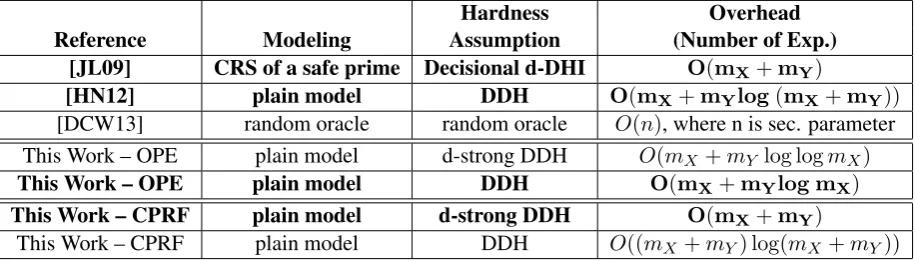
Secure set-intersection (Section 4). Next, we demonstrate that algebraic PRFs are useful for designing new and simple protocols for set-intersection according to both approaches of OPE and committed oblivious PRF considered above. We first show that our protocols for OPE readily induce new protocols for set-intersection. That is, P0 first encodes the setX by a polynomialgQ(·) as specified above, and masks it.
Next, for eachy∈Y partyP1verifies whether the masked polynomial evaluation ofyequals the evaluation gR(y), and concludes whether the element is in the intersection. We note that our approach greatly simplifies the use of OPE for set-intersection protocols, as now no payload is transferred back toP0. Note also that
this naive approach requires a multiplicative overhead (in the sets sizes) since for each element in its input
Y,P1needs to evaluate a polynomial of degreemX. To reduce the computational overhead we additionally
employ various hash functions schemes that split the elements into smaller bins. In this case, the elements mapped byP0to a certain bin must only be compared to those mapped byP1to the same bin. This approach
was taken by Freedman et al. in [FNP04] in the semi-honest, and further extended to the malicious setting by Hazay and Nissim [HN12], which introduced a fairly complicated protocol, as it requires the combination of both approaches of OPE and oblivious PRF evaluation.
We introduce the hashing technique into our constructions and provide a generic description that can be
1
Where the dynamicd-strong assumption asserts, informally speaking, that it is hard to distinguish a tuple(gx, gx2, . . . , gxd)
from(gx1, gx2, . . . , gxd)for random choices ofx, x
Hardness Overhead
Reference Modeling Assumption (Number of Exp.)
[JL09] CRS of a safe prime Decisional d-DHI O(mX+mY)
[HN12] plain model DDH O(mX+mYlog(mX+mY))
[DCW13] random oracle random oracle O(n), where n is sec. parameter
This Work – OPE plain model d-strong DDH O(mX +mY log logmX)
This Work – OPE plain model DDH O(mX+mYlog mX)
This Work – CPRF plain model d-strong DDH O(mX+mY)
This Work – CPRF plain model DDH O((mX+mY) log(mX +mY))
Table 2: Comparisons with prior set-intersection constructions, where mX (resp. mY) is the size ofP0’s
(resp.P1’s) inputX(resp.Y). We highlight the protocols with the best performance under each assumption.
instantiated with different hash functions. Our protocols are far less complicated and maintain a modular description. Specifically, we devise an alternative zero-knowledge proof for verifying the correctness of the hashed polynomials while exploiting the algebraic properties of the PRF. Under the strong-DDH assump-tion our protocol matches the communicaassump-tion overhead of the protocol from [JL09] (that also relies on a dynamic hardness assumption) and implies the computation ofO(mX +mY log logmX)exponentiations,
with the benefits that it operates over prime order groups and it does not require a trusted setup. Under the DDH assumption our protocol, using hash functions implies the computation ofO(mX +mY logmX)
exponentiations. We note that this overhead does not asymptotically improve the overhead of [HN12] but greatly simplifies its description by, for instance, avoiding using costly PRF evaluations.
Next, we show that algebraic PRFs are useful for applications that rely on committed oblivious PRF evaluation. Our results for set-intersection are summarized in Table 2.
Committed oblivious PRF evaluation (Section 5). Observing that the batch computation forlPRF val-ues PRF′K(x) = ∏li=0[PRFK(i)]x
i
is a PRF as well,2 we derive new PRF constructions in prime order groups and more interestingly, simple committed oblivious PRF evaluation protocols. Our strong-DDH based PRF requires constant overhead, and our DDH-based protocol is the simplest committed oblivious PRF implementation for the [NR97] function; see table 3.
We use our new protocols to realize set-intersection, considering the second approach of committed oblivious PRF evaluation. Plugging-in our protocols for committed oblivious PRF evaluation in the proto-cols cited above requires some adjustments, but implies malicious security fairly immediately. Specifically, a subtle point arises asP0 must generate its PRF keyindependentlyof the inputs, since otherwise it may
enforce collisions on elements fromXandY, causing the simulation to fail. We note that this subtlety does not arise in [JL09] due to the fact that the PRF is only defined on a specific bounded domain. Our protocols using committed oblivious PRF imply set-intersection protocols withO(mX+mY)costs under the
strong-DDH assumption and((mX+mY) log(mX+mY))communication and computation costs under the DDH
assumption, where the former analysis matches the overhead from [JL09].
2
Hardness Overhead
Reference Modeling Assumption (Number of Exp.)
O(t)
[FIPR05, HL10a] plain model DDH prime order groups
CRS O(1)
[JL09] (committed) of a safe RSA composite q-DHI composite order groups
O(t)
This Work (committed) plain model DDH prime order groups
O(1)
This Work (committed) plain model d-strong DDH prime order groups
Table 3: Comparisons with prior (committed) oblivious PRF constructions, wheretis the input bit-length. Furthermore, the [JL09] proof employs an exhaustive search on the input domain.
2
Preliminaries
2.1 Basic Notations
We denote the security parameter byn. We say that a functionµ:N→Nisnegligibleif for every positive polynomialp(·)and all sufficiently largenit holds thatµ(n)< p(1n). We use the abbreviation PPT to denote probabilistic polynomial-time. We further denote bya ←Athe random sampling ofafrom a distribution
A, by[d]the set of elements(1, . . . , d)and by[0, d]the set of elements(0, . . . , d). We now specify the definition of computationally indistinguishable.
Definition 2.1 LetX = {X(a, n)}a∈{0,1}∗,n∈N and Y = {Y(a, n)}a∈{0,1}∗,n∈N be two distribution
en-sembles. We say thatX andY are computationally indistinguishable, denoted X ≈c Y, if for every PPT machineD, everya∈ {0,1}∗, every positive polynomialp(·)and all sufficiently largen:
Pr [D(X(a, n),1n) = 1]−Pr [D(Y(a, n),1n) = 1]< 1 p(n).
We define ad-degree polynomialQ(·)by its set of coefficients(q0, . . . , qd), or simply writeQ(x) =q0+ q1x+. . . qdxd. Typically, these coefficients will be picked fromZpfor a primep. We further writegQ(·)to
denote the coefficients ofQ(·)in the exponent of a generatorgof a multiplicative groupGof prime orderp.
2.2 Hardness Assumptions
All our constructions rely on the following hardness assumptions.
DECISIONALDIFFIE-HELLMAN. The decisional Diffie-Hellman assumption is stated as follows.
Definition 2.2 (DDH) We say thatthe decisional Diffie-Hellman (DDH) problem is hard relative toG, if for any PPT distinguisherDthere exists a negligible functionneglsuch that
Pr [D(G, p, g, gx, gy, gz) = 1]−Pr [D(G, p, g, gx, gy, gxy) = 1]≤negl(n),
STRONGDIFFIE-HELLMAN. The strong Diffie-Hellman family of assumptions is parameterized by a pa-rameter d, and states that any PPT distinguisher cannot distinguish elements g, gx, gx2, . . . , gxd from a
sequence of random elements in a prime order groupG. More formally,
Definition 2.3 (d-SDDH) We say thatthed-strong Diffie-Hellman problem is hard relative toG if for any PPT distinguisherDthere exists a negligible functionneglsuch that
Pr
[
D(G, p, g, gx, gx2, . . . , gxd) = 1 ]
−Pr [D(G, p, g, gx1, gx2, . . . , gxd) = 1]≤negl(n),
where(G, p, g)← G(1n)and the probabilities are taken over the choices ofx, x1, . . . , xd←RZp.
We refer the reader to [BGV11] for further discussions and related work regarding the strong Diffie-Hellman assumption. Fixing the parameterdappropriately enables [BGV11] to evaluate a special class of polyno-mials of degreedin constant time. Specifically, there is a tight correlation between the value ofdand the efficiency of their construction; the stronger the assumption is, the larger the class of polynomials that can be evaluated in constant time. In what follows, we also fix the parameterdin this assumption according to the degree of evaluated polynomial.
2.3 Public Key Encryption (PKE)
We specify the definitions of public key encryption and IND-CPA.
Definition 2.4 (PKE) We say thatΠ = (Gen,Enc,Dec)is apublic key encryption schemeifGen,Enc,Dec are polynomial-time algorithms specified as follows:
• Gen, given a security parametern(in unary), outputs keys(PK,SK), wherePKis a public key and
SKis a secret key. We denote this by(PK,SK)←Gen(1n).
• Enc, given the public key PKand a plaintext messagem, outputs a ciphertextc encryptingm. We denote this by c ← EncPK(m); and when emphasizing the randomness r used for encryption, we
denote this byc←EncPK(m;r).
• Dec, given the public key PK, secret key SK and a ciphertextc, outputs a plaintext messagem s.t. there exists randomnessr for whichc = EncPK(m;r)(or⊥if no such message exists). We denote
this bym←DecPK,SK(c).
For a public key encryption schemeΠ = (Gen,Enc,Dec)and a non-uniform adversaryA= (A1,A2),
we consider the followingIND-CPA game:
(PK,SK)←Gen(1n).
(m0, m1, history)← A1(PK), s.t.|m0|=|m1|.
c←EncPK(mb), whereb←R{0,1}.
b′ ← A2(c, history).
Awins ifb′ =b.
Denote byAdvΠ,A(n)the probability thatAwins the IND-CPA game.
2.3.1 Additively Homomorphic PKE
A public key encryption scheme is additively homomorphic if given two ciphertextsc1 =EncPK(m1)and c2 = EncPK(m2) it is possible to efficiently computeEncPK(m1 +m2;r)without the knowledge of the
secret key. Clearly, this assumes that the plaintext message space is a group; we actually assume that both the plaintext and ciphertext spaces are groups (with respective group operations + or·). We abuse notation and useEncPK(m)to denote the random variable induced byEncPK(m;r)wherer is chosen uniformly at
random. We have the following formal definition,
Definition 2.6 (Homomorphic PKE) We say that a public key encryption scheme(Gen,Enc,Dec) is ho-momorphic if for all k and all (PK,SK) output by Gen(1n), it is possible to define groups M,C such that:
• The plaintext space isM, and all ciphertexts output byEncPK(·)are elements ofC.3 • For everym1, m2 ∈ Mit holds that
DecSK
(
EncPK(m1)·EncPK(m2)
)
=m1+m1
with overwhelming probability, where the group operations are carried out inCandM, respectively.
Note that any such a scheme supports a multiplication of a plaintext by a scalar.
2.4 The El Gamal PKE
A useful implementation of homomorphic PKE is the El Gamal [Gam85] scheme that has two variations of additive and multiplicative definitions (where the former is only useful for small domains plaintexts). In this paper we exploit the additive variation. LetGbe a group of prime orderpin which DDH is hard. Then the public key is a tuple PK=⟨G, p, g, h⟩and the corresponding secret key is SK=s, s.t.gs=h. Encryption is performed by choosingr ←Zpand computingEncPK(m;r) =⟨gr, hr·gm⟩. Decryption of a ciphertext
C=⟨c1, c2⟩is performed by computinggm =c2·c−1sand then findingmby running an exhaustive search.
2.4.1 Distributed El Gamal
In a distributed scheme, the parties hold shares of the secret key so that the combined key remains a secret. In order to decrypt, each party uses its share to generate an intermediate computation which are eventually combined into the decrypted plaintext. We consider two functionalities: One for securely generating a secret key while keeping it a secret from both parties, whereas the second functionality jointly decrypts a given ciphertext. We denote the key generation functionality byFKEY, which is defined as follows,
(1n,1n)7→ (
(PK,SK1),(PK,SK2)
)
where(PK,SK) ← Gen(1n), and SK1 and SK2 are random shares of SK. The decryption functionality
FDECis defined by,
(c,PK)7→ (
(m:c=EncPK(m)),−
)
.
In El Gamal the parties first agree on a groupGof orderpand a generatorg. Then, each partyPipicks
si ←Zpand sendshi =gsito the other. Finally, the parties computeh =h1h2and set PK =⟨G, p, g, h⟩.
3
Clearly, the secret keys=s1+s2 associated with this public key is correctly shared amongst the parties.
In order to ensure correct behavior, the parties must prove knowledge of theirsiby running on(g, hi)the
zero-knowledge proofπDL, specified in Section 2.5. To ensure simulation based security,P1must commit to
its share first and decommit this commitment afterP2 sends its share. Moreover, decryption of a ciphertext c = ⟨c1, c2⟩ follows by computingc2 ·(cx11·c
x2
1 )− 1
, where each party sendsci to the power of its share
together with a proof. We denote these protocols by πKEY and πDEC, respectively, and assume that they
can be carried out with simulation-based security in the presence of malicious attacks. A variation ofπDEC
allows the parties to learn whether a ciphertextc=⟨c1, c2⟩encrypts zero or not, but nothing more. This can
be carried out as follows. Each party first raisescto a random non-zero power and rerandomizes the result (proving correctness using a zero-knowledge proof). They then decrypt the final ciphertext and conclude thatm= 0if and only if the masked plaintext was0. We denote this protocol byπDEC0.
2.5 Zero-Knowledge Proofs
To prevent malicious behavior, the parties must demonstrate that they are well-behaved. To achieve this, our protocols utilize zero-knowledge (ZK) proofs of knowledge. Our proofs areΣ-protocols with a constant overhead. A generic efficient technique that enables to transform anyΣ-protocol into a zero-knowledge proof of knowledge can be found in [HL10b]. This transformation requires additional 6 exponentiations.
1. πDL, for demonstrating the knowledge of a solutionxto a discrete logarithm problem [Sch89].
RDL={((G, g, h), x)|h=gx}.
2. π2DL, for demonstrating the knowledge of a solutionx, yto a discrete logarithm problem [Oka92].
R2DL ={((G, g, h, z),(x, y))|z=gxhy}.
3. πDDH, for demonstrating that an El Gamal ciphertext is an encryption of zero [CP92].
RDDH ={((G, g, h, g1, h1), x)|g1 =gx∧h1=hx}.
4. πEq−Exp, for proving that two ciphertexts under two different public-keys encrypt the same plaintext,
where the plaintext lies in the exponent of two different groups. This boils down to proving equality of exponentiations over the integers, without utilizing the group description.
REq−Exp=
{
((PK1,PK2, c1, c2),(α, r1, r2))|c1=EncPK(α)∧c2 =Enc′PK′(α) }
.
In our case, we need to prove consistency between El Gamal PKE and an additively homomorphic encryption scheme (e.g., Paillier). A discussion about this proof can be found in [HMRT12].
5. πMULT, for proving that a ciphertextc2encrypts a product of two plaintexts values. Namely,
RMULT=
{
((G,PK, c0, c1, c2),(a0, a1, r0, r1, r2,))|
ci=EncPK(ai;ri)fori∈ {0,1} ∧
c2=EncPK(a0·a1;r2)
}
6. πEQ, for demonstrating equality of two exponentiations in the same group. Namely,
REQ=
{
((PK, c1, c′1, c2, c′2),(m, r1, r2))|c′1 =cm1 ·EncPK(0;r1)∧c2′ =cm2 ·EncPK(0;r2)
}
.
A variant of this zero-knowledge proof was presented and discussed in [HMRT12] for Paillier encryp-tion scheme and can be easily extended for this relaencryp-tion as well. We specify the details of this proof for the El Gamal encryption scheme (in a honest verifier format).
Protocol 1 (Zero-knowledge proof of knowledge forREQ):
• Joint statement:Public keyPKand ciphertexts(c1, c′1, c2, c′2)over groupGof prime orderp.
• Auxiliary input for the prover:Elements(m, r1, r2)such that the conditions withinREQare met.
• The protocol:
(a) P chooses at randomt, s1, s2 ←Zp and setsc˜1 =ct1·EncPK(0;s1)andc˜2 =ct2·EncPK(0;s2).
That is, letc1 =⟨c11, c21⟩andc2 = ⟨c12, c22⟩, thenc˜1 = ⟨(c11)t·gs1,(c21)t·hs1⟩and˜c2 =⟨(c12)t·
gs2,(c2
2)t·hs2⟩.PsendsV the values˜c1=⟨˜c11,˜c21⟩,c˜2=⟨c˜12,˜c22⟩.
(b) V choosesc←Zpat random and sends it toP. (c) Presponds withcm+t,cr1+s1andcr2+s2.
(d) Upon receivingz1, z2andz3,V accepts if
– ⟨(c1
1)z1·gz2,(c21)z1·hz2⟩=⟨(c1′1)c·˜c11,(c1′2)c·˜c21⟩and
– ⟨(c1
2)z1·gz3,(c22)z1·hz3⟩=⟨(c2′1)c·˜c12,(c2′2)c·˜c22⟩,
wherec′1=⟨c′1
1, c′12⟩andc′2=⟨c′21, c′22⟩.
Proposition 2.1 Protocol1is a zero-knowledge honest verifier proof forREQ.
Proof: Completeness is easy to verify since the conditions that the verifier checks are always met. Next, we prove zero-knowledge by designing a simulatorSEQas follows. SEQfixes the last message
z1, z2, z3 ←Zpat random and sets
˜
c11 = (c11)z1 ·gz2/(c′1
1)c, c˜21= (c21)z1 ·hz2/(c′12)c
˜
c12 = (c12)z1 ·gz3/(c′1
2)c, c˜22 = (c22)z1 ·hz3/(c′22)c.
Note that the simulated˜c11equals(c11)z1−mc·gz2−r1csincec′1
1 = (c11)m·gr1. A similar argument can
be made forc˜21 andc˜2. Finally, soundness holds due to the fact that the proof is a proof of knowledge
as well, where two views with the same pair of messages(˜c1,˜c2) and two challengesc, c′ enable to
extractm, r1, r2.
3
Protocols for Oblivious Polynomial Evaluation
In this section we introduce our new constructions for oblivious polynomial evaluation (OPE) in the expo-nent, implementing functionalityFOPE : (gQ(·), t)7→ (−, gQ(t))forQ(·) = (q0, . . . , qd). In particular, we
assume common knowledge of the public parameters: a multiplicative groupGof orderpand a generator
gforG, and that the polynomial coefficients are inZp. In our solution, partyP0 generates these parameters
and publishes its masked polynomialgQ(·)+R(·), where the set of valuesgR(·)is determined by an algebraic PRF that has a closed form efficient computation for univariate polynomials (see Section 3.1). Next,P1
computesgQ(t)+R(t)and the parties run an unmasking secure computation for obliviously evaluatinggR(t)
for P1. Importantly, the closed form efficiency property of the PRF allows the parties to mutually
3.1 Algebraic Pseudorandom Functions [BGV11]
Algebraic PRFs are PRFs with two additional algebraic properties. First, they map their inputs into some Abelian group, where certain algebraic operations on these outputs can be computed signicantly faster if one possesses the PRF key. These properties were exploited in [BGV11] to achieve faster polynomial evaluations (in the exponent), where the coefficients of these polynomials lie in the PRF range. Several constructions, implying different overheads, were introduced in [BGV11]; we focus our attention on their constructions for univariate polynomials. Our protocols can be applied for multivariate polynomials as well (with total degreedor of degreedin each variable). We begin with the formal definition of algebraic PRFs.
Definition 3.1 (Algebraic PRFs) We say that PRF = (KeyGen,PRF,CFEval), is an algebraic PRF if KeyGen,PRFare polynomial-time algorithms specified as follows:
• KeyGen, given a security parameter1n, and a parameterm ∈Nthat determines the domain size of the PRF, outputs a pair(K, param)← Kn, whereKnis the key space for a security parametern.K
is the secret key of the PRF, andparamencodes the public parameters.
• PRF, given a key K, public parametersparam, and an inputx ∈ {0,1}m, outputs a valuey ∈ Y, whereY is some set determined byparam.
• In addition, the following properties hold:
Pseudorandomness. We say thatPRFis pseudorandom if for every PPT adversary A, and every polynomialm=m(n), there exists a negligible functionneglsuch that
|Pr[APRFK(·)(1n, param) = 1]−Pr[Afn(·)(1n, param) = 1]| ≤negl(n),
where(K, param)←KeyGen(1n, m)andfn:{0,1}m 7→Y is a random function.
Algebraic. We say thatPRFis algebraic if the rangeY ofPRFK(·)for everyn∈Nand(K, param)←
Kn forms an Abelian multiplicative group. We require that the group operation on Y be
effi-ciently computable givenparam.
Closed form efficiency. LetN be the order of the range sets ofPRF for security parametern. Let z = (z1, . . . , zl) ∈({0,1}m)l,k∈ N, and efficiently computableh :ZkN 7→ ZlN withh(x) =
⟨h1(x), . . . , hl(x)⟩. We say that(h, z)is closed form efficient for PRF if there exists an algorithm
CFEvalh,zsuch that for everyx∈ZkN,
CFEvalh,z(x, K) = l
∏
i=1
[PRFK(zi)]hi(x)
and the running time ofCFEvalis polynomial inn, m, kbut sublinear inl.
The last property is very important for our purposes since it allows to run certain computations very fast when the secret key is known. We next describe two implementations for algebraic PRFs introduced in [BGV11].
3.1.1 Algebraic PRFs From Strong DDH
LetGbe a computational group scheme. The following constructionPRF1 is an algebraic PRF with
KeyGen(1n, m): Generate a group description(G, p, g)← G(1n). Choosek0, k1 ←Zp. Outputparam=
(m, p, g,G), K = (k0, k1).
PRFK(x): Interpretxas an integer in{0, . . . , D= 2m}whereDis polynomial inn. Compute and output
gk0kx1.
Closed form efficiency for polynomials of degreed. We now show an efficient closed form forPRF1 for
polynomials of the form (where evaluation is computed in the exponent)
Q(x) =PRFK(0)·PRFK(1)x·. . .·PRFK(d)x
d
=
d
∏
i=0
PRFK(i)x
i
whered ≤ D. Leth : Zp 7→ Zdp+1, be defined ash(x)
def
= (1, x, . . . , xd)and(z0, . . . , zd) = (0, . . . , d).
Then, we can define
CFEvalh(x, K)
def
= g
k0(kd1+1xd+1−1) k1x−1 .
Specifically, we write
d
∏
1=0
[PRFK(zi)]hi(x)= d
∏
i=0
[gk0ki1]xi =gk0∑di=0ki1xi.
Correctness ofCFEvalfollows by the identity∑di=0k0ki1xi =
k0((k1x)d+1−1) k1x−1 .
Theorem 3.2 ([BGV11]) Suppose that the D-Strong DDH assumption holds. Then,PRF1is a pseudoran-dom function.
3.1.2 Algebraic PRFs From DDH
LetGbe a computational group scheme. DefinePRF2 as follows.
KeyGen(1n, m): Generate a group description(p, g,G) ← G(1n). Choosek0, k1, . . . , km ← Zp. Output
param= (m, p, g,G), K = (k0, k1, . . . km).
PRFK(x): Interpretx= (x1, . . . , xm)as anm-bit string. Compute and outputgk0
∏m i=1kixi.
This function is known by the Naor-Reingold function [NR97].
Closed form for polynomials of degreed. We describe an efficient closed form forPRF2 for computing
polynomials of the same form as above. That is,
Q(x) =PRFK(0)·PRFK(1)x·. . .·PRFK(d)x
d
=
d
∏
i=0
PRFK(i)x
i
.
Leth:Zp 7→Zdp+1, defined ash(x) = (1, x, . . . , xd)and letz= (z1, . . . , zl) = (0, . . . , d)then
CFEvalh,z(x, K)
def
= gk0(1+k1x)(1+k2x2)...(1+kmx2 m
)
withm=⌈logd⌉(clearly,dmust be a power of 2).
Theorem 3.3 ([NR97]) Suppose that the DDH assumption holds. Then,PRF2is a pseudorandom function.
3.2 Our OPE Constructions
We describe our protocol for oblivious polynomial evaluation in the FMaskPoly-hybrid setting, where the
parties have access to a trusted party that computes functionalityFMaskPoly : (K, t) 7→ (−, gR(t)) relative
to some prime order groupGand generatorgthat are picked byP0, forgR(·) =
(
gr0, . . . , grd) andgri =
PRFK(i)for alli. For simplicity, we first describe a semi-honest variant of our protocol and then show how
to enhance its security into the malicious setting. Formally, letPRF = ⟨KeyGen,PRF,CFEval⟩denote an algebraic PRF with a range groupG(cf. Definition 3.1), then our semi-honest protocol follows.
Protocol 2 (ProtocolπOPEwith semi-honest security.)
• Input: Party P0 is given a d-degree polynomialgQ(·) = (gq0, . . . , gqd)with coefficientsqi’s fromZp with respect to prime order groupGand generatorg. PartyP1is given an elementtfromZp. Both parties are given a security parameter1n, group descriptionG, pandg.
• The protocol:
1. Masking the polynomial. P0 invokes(K, param) ← KeyGen(1n,⌈logd⌉)whereparamincludes a
group descriptionGof prime orderpand a generatorg. It next defines a sequence ofdelementsRe(·) = (˜r0, . . . ,r˜d)overGwherer˜i=PRFK(i)for alli.
P0 sends P1 paramand the masked polynomial C(·) =
(
gq0r˜
0, . . . , gqd˜rd )
, where multiplication is implemented (componentwise) inG.
2. Unmasking the result.Upon receiving the masked polynomialC(·) = (c0, . . . , cd), partyP1computes
the polynomial evaluationC(t) =∏di=0(ci)t i
. I.e.,C(·)is evaluatedin the exponent. Next, the parties invoke an ideal execution ofFMaskPolywhere the input ofP0isKand the input ofP1ist. LetZdenote
the output ofP1from this ideal call, thenP1’s output isC(t)/Zwhere division in implemented inG.
Note first that correctness holds since partyP1computes in Step 2 the polynomial evaluation
C(t) =
d
∏
i=0
(ci)t
i
=
d
∏
i=0
(gqir˜
i)t
i
=
d
∏
i=0
(gqigr′i)ti =gQ(t)+R(t)
and then “fixes” its computation by dividing outZ = gR(t). In addition, privacy holds due to the pseudo-randomness ofPRFthat hides the coefficients ofQ(·). We prove the following theorem,
Theorem 3.4 AssumePRF =⟨KeyGen,PRF,CFEval⟩is an algebraic PRF, then Protocol 2 securely real-izes functionalityFOPEin the presence of semi-honest adversaries in theFMaskPoly-hybrid model.
Proof: We prove security for each corruption case separately.
P0is corrupted. LetAbe a PPT adversary corrupting partyP0, we design a PPT simulatorSthat invokes
Aby playing the role of the honestP1 and generating a view that is indistinguishable from a hybrid view.
More concretely,
1. Given input (1n, gQ(·), z), S invokesAon this input and receivesA’s first message,(G, p, g)and a
d-degree polynomialC(·)(wheredis also the degree ofQ(·)).
2. S emulates the ideal calls of FMaskPoly, playing the role of the trusted party that receives fromA a
PRF keyK.
We prove the following claim,
Claim 3.1 For any tuple of inputs(t, gQ(·))and auxiliary inputz,
{IDEALF
OPE,S(z)(n,(t, g Q(·)))}
n∈N≡ {HYBRIDπFMaskPoly,A(z)(n,(t, g Q(·)))}
n∈N.
Proof: It is trivial to verify thatA’s view in the hybrid execution is identically distributed to its view in the ideal execution, since it does not receive any message in the hybrid execution. Now, since correctness holds due to the above argument, then the joint output distribution of both parties is identical in both executions.
P1is corrupted. LetAbe a PPT adversary corrupting partyP1, we design a PPT simulatorSthat invokes
Aby playing the role of the honestP0 and generating a view that is indistinguishable from a hybrid view.
More concretely,
1. Given input(1n, t, gQ(t), z),S invokesAon(1n, t, z)and continues as follows.
2. Sinvokes first(G, p, g)←KeyGen(1n,⌈logd⌉). It then picks a randomd-degree polynomialS(·) = gS′(·)inG(we assume thatdis part ofA’s auxiliary input, alternatively,dcan be part ofP1’s output
withinFOPE), and sends it toA.
3. Sthen emulates the ideal call ofFMaskPolyby playing the role of the trusted party that receivestfrom A.Sreplies withgS′(t)/gQ(t).
4. Soutputs whateverAdoes.
We prove the following claim,
Claim 3.2 For any tuple of inputs(t, gQ(·))and auxiliary inputz,
{IDEALFOPE,S(z)(n,(t, gQ(·)))}n∈N
c
≈ {HYBRIDπFMaskPoly,A(z)(n,(t, g Q(·)))}
n∈N.
Proof: We now prove that the adversary’s view in both hybrid and ideal executions is computationally indistinguishable by a reduction to the security of PRF. Consider a hybrid execution Hyb, for which a simulatorSHybgeneratesA’s view as follows. Assume that there is no trusted party and thatSHybknows
the polynomial in the exponentgQ(·), thenSHybfirst picks a truly randomd-degree polynomialT(·)inZp
and sendsAthe coefficients of the masked polynomialgQ(·)+T(·). Later, it handsAthe valuegT(t)within
FMaskPoly. More formally, we mark in bold the underlying differences from the simulation.
1. Given input(1n,gQ(·), t, gQ(t), z),SHybinvokesAon(1n, t, z)and continues as follows.
2. SHyb invokes first(G, p, g) ← KeyGen(1n,⌈logd⌉). It then picks a randomd-degree polynomial
T(·)inZpand sendsAthe coefficients of the masked polynomialgQ(·)+T(·).
3. SHybthen emulates the ideal call ofFMaskPoly by playing the role of the trusted party that receivest
fromA.SHybreplies withgT(t).
4. SHyboutputs whateverAdoes.
SubClaim 3.3 For any tuple of inputs(t, gQ(·))and auxiliary inputz,
{IDEALFOPE,S(z)(n,(t, gQ(·)))}n∈N≡ {HybπFMaskPoly,A(z)(n,(t, g Q(·)))}
n∈N.
Proof: We claim thatA’s view in gameHybwithS′ is identical to its view in the simulation withS. This is because the random polynomial S(·) = gS′(·) is distributed identically to gT(·)+Q(·) for some polyno-mial T(·) inZp. Therefore, the message gS
′(t)
/gQ(t) sent by simulator S withinFMaskPoly, is identically
distributed togT(t)+Q(t)/gQ(t)=gT(t).
Next, we prove that the adversary’s view in gameHyband in the hybrid executionHYBRIDis compu-tationally indistinguishable, relying on the pseudorandomness ofPRF.
SubClaim 3.4 For any tuple of inputs(t, gQ(·))and auxiliary inputz,
{HybπFMaskPoly,A(z)(n,(t, g Q(·)))}
n∈N
c
≈ {HYBRIDπFMaskPoly,A(z)(n,(t, g Q(·)))}
n∈N.
Proof: More specifically, assume by contradiction the existence of an adversary A and a distinguisher
DOPEthat distinguishesA’s views for infinitely manyn’s, construct a distinguisherDF that distinguishes
F from a truly random function f that maps{0,1}m to G, for infinitely many n’s. Namely, upon given access to an oracleOthat implements eitherF orf, and auxiliary input(1n, gQ(·), t, z),DF invokesAon
1n, t, z. It then computes the first message of protocol ΠOPE as follows. It first invokes its oracle on the
set (0, . . . , d); let f0, . . . , fd be the oracle’s responses. DF then sendsA the coefficients {gqifi}di=0, for gQ(·) = (gq0, . . . , gqd). Next,D
F emulates the trusted party forFMaskPoly, receiving a valuetfromAand
replying with∏di=0fiti. Finally,DF invokesDOPEonA’s view and outputs whateverDOPEdoes. Note that
if oracleOimplements functionF, thenA’s view distributes as in the hybrid execution. On the other hand, ifOimplementsf thenA’s view distributes as in the simulation. Therefore, any gap in distinguishing these two views is immediately translated into a gap distinguishingF fromf. This concludes the proof.
Efficiency. In the first phase P0 computes d+ 1 modular exponentiations as it can first compute the
PRF evaluations inZp (using the PRF key K) and then raise the outcomes to the power of g. Next, P0
multiplies each PRF evaluationPRFK(i)withgqi(where these computations can be combined into a single
exponentiation per indexi). Efficiency of the second phase is dominated by the degree of Q(·) and the implementation of functionalityFMaskPoly. In Section 3.3 we discuss several ways to realizeFMaskPoly. (1)
Assuming the strong-DDH assumption, our protocol requires a constant number of modular exponentiations. (2) Assuming the DDH assumption our protocol requiresO(logd)modular exponentiations. Therefore, the overall cost is2(d+ 1) +O(1)(resp.O(logd)exponentiations.
Extension for a reactive OPE functionality. In a more realistic setting, we may consider a reactive variant of the OPE functionality whereP0 first commits to its polynomial once, similarly to the first message in πOPE, and then receives multiple requests for polynomial evaluations. These requests can be adaptively sent
by either a single or distinct parties. In this case, the amortized work ofP0 would beO(1)(resp. O(logd))
3.2.1 Security in the Presence of Malicious Adversaries
We next prove the security of Protocol 2 in the presence of malicious attacks. We observe that if the protocol that implementsFMaskPolyis secure in the presence of malicious corruptions then the entire protocol is secure
against malicious attacks as well. Intuitively, security against a corruptedP1 is immediately implied since
a corruptedP1 does not learn anything beyondgR(t
′)
, wheret′ isP1’s input toFMaskPoly. More concretely,
in the security proof the simulator publishes a random polynomialSe(·) =gS(·)first, and then extractsP1’s
inputt′toπMaskPoly. Finally, the simulator forcesP1’s output withinπMaskPolyto begS(t
′) /gQ(t′).
In caseP0is corrupted we need to demonstrate how to extract the coefficients ofgQ(·). This is achieved
by the fact thatP0 is committed to the PRF keyKwithinFMaskPoly. Specifically, extraction is obtained by
first calculating the sequence of valuesRe(·)usingK, and then dividing them out (component-wise) from the polynomialC(·)sent byP0within the first message. The technical part is to prove thatP1indeed learns
the same value in both ideal and real executions. Intuitively, by the correctness of the ideal execution for functionalityFMaskPolywe are ensured thatP1learnsgR(t)such thatRe(x) =gR(x) = ˜r0·r˜1x·. . .·r˜x
d
d where
˜
ri = PRFK(i) for alliandK is the PRF key as above. This implies thatP1 outputsC(t)/gR(t), which
corresponds to a polynomial evaluation with the same coefficients as defined above by the simulator. To conclude, in order to obtain malicious security the only modification we need to consider with respect toπOPE is to employ a maliciously secure implementation of functionalityFMaskPoly. In the hybrid setting
this does not make a difference for the protocol description. In Section 3.3 we discuss secure implementa-tions of functionalityFMaskPoly. The proof for the following theorem formalizes the intuition above.
Theorem 3.5 AssumePRF =⟨KeyGen,PRF,CFEval⟩is an algebraic PRF, then Protocol 2 securely real-izes functionalityFOPEin the presence of malicious adversaries in theFMaskPoly-hybrid model.
Proof: We prove security for each corruption case separately.
P0is corrupted. LetAbe a PPT adversary corrupting partyP0, we design a PPT simulatorSthat extracts
the coefficients ofA’s input polynomial in the exponent of some generatorg, and sends them to the trusted party. We prove that the joint output distribution in both ideal and hybrid executions is computationally indistinguishable.
1. Given input (1n, gQ(·), z), S invokesAon this input and receivesA’s first message,(G, p, g)and a
d-degree polynomialC(·) = (c0, . . . , cd).
2. S emulates the ideal calls of FMaskPoly, playing the role of the trusted party that receives fromA a
PRF keyK.
3. Sdefines polynomialgQ′(·)with the following set of coefficients. Namely,Sfixesgqi′ =ci/r˜ifor all
0≤i≤dwherer˜i =PRFK(i).S sends the trusted party the set{gq
′
i}i.
4. Soutputs whateverAdoes.
Note that Areceives no messages in the hybrid version of our protocol. Therefore security is implied by correctness of the closed form efficiency property that implies that the coefficients defined by the simulator implies a polynomial evaluation that is consistent with the real result.
P1is corrupted. LetAbe a PPT adversary corrupting partyP1, we design a PPT simulatorSthat
gener-ates the view ofAas in the semi-honest case with the following difference.SinvokesA(1n, t, z)and sends it (G, p, g) and a random polynomialSe(·) = gS(·). Upon receiving the adversary’s inputt′ toF
S forwards it to the trusted party forFOPE. Let Z denotes the output returned by the trusted party, then S completes the simulation, forcing the output ofFMaskPoly to begS(t
′)
/Z. We note that security follows exactly as in the semi-honest proof sinceAsees the same message distribution.
3.3 Malicious Security ofπMaskPoly
For completeness, we describe a concrete protocol that implements functionality FMaskPoly : (K, t) 7→
(−, gR(t)), used as a subprotocol within our main protocolπOPE for oblivious polynomial evaluation from
Section 3.2. This computation corresponds to the polynomial evaluationRe(x) =PRFK(0)·PRFK(1)x·. . .·
PRFK(d)x
d
with respect to functionPRF. In what follows, we discuss a detailed secure implementation for
PRF1that is described in Section 3.1.1 and then briefly discuss how to implement functionPRF2, formally
described in Section 3.1.2, using similar ideas. Alternative suggestions based on general-purpose protocols or somewhat homomorphic encryption scheme that supports a limited number of multiplications, as we require for our PRFs.
We recall that when implementing functionalityFMaskPolyrelative toPRF1the parties compute the value
g∑di=0k0k1ixi = k0((k1t)
d+1−1)
k1t−1
= k0(k1t)
d+1
k1t−1 − k0 k1t−1
= k0k
d+1 1 td+1 k1t−1 −
k0 k1t−1
,
so thatP0 enters a PRF keyK = (k0, k1)and learns nothing andP1 entersx =tand learns this outcome.
This simple computation requires a constant number of exponentiations and can be easily implemented securely. Achieving malicious security requires to ensure correctness of computations which we obtain using simple zero-knowledge proofs of knowledge. Loosely speaking, the parties first generate a joint public key for the additive El Gamal PKE such that no party knows the secret key (this protocol is discussed in Section 2.4.1). Next, each party commits to its input and the parties jointly computek1t. In order to
compute the inverse ofk1t−1the parties additionally use an additively homomorphic encryption scheme
(such as Paillier [Pai99]). Formally, our protocol uses the following tools:
1. Distributed additive El Gamal; see Section 2.4 for the details of these schemes. We denote this scheme byΠ = (πKeyGen,Enc, πDEC).
2. Additively homomorphic encryption schemeΠ′ = (Gen′,Enc′,Dec′).
3. Zero-knowledge proofs of knowledge:πDLfor proving a discrete logarithm andπEQ, πEq−Expfor
prov-ing consistency of exponents, which are formally stated in Section 2.5. For simplicity, we implicitly assume that the parties continue to the next step only if all the proofs were verified correctly thus far.
Finally, we implicity assume that a party rerandomizes its homomorphic computations on the cipher-texts. Such that rerandomization is carried out by multiplying the outcome with a random encryption of zero. We now describe our protocol is details.
Protocol 3 (ProtocolπMaskPolywith malicious security.)
• Input: PartyP0is given a PRF keyK = (k0, k1). PartyP1 is given an elementt. Both parties are given a
security parameter1n, a polynomial degreedand(G, p, g)for a group descriptionGof prime orderpand a generatorg.
• The protocol:
1. Distributed key generation.P0andP1run the protocolπKeyGen(1n,1n)in order to generate an additive El Gamal public keyPK = ⟨G, p, g, h⟩for which the corresponding shares of the secret keySK are
![Table 1: Comparisons with a prior OPE construction, where d is the polynomial degree and DCR is theunderlying hardness assumption for the Paillier encryption scheme [Pai99].](https://thumb-us.123doks.com/thumbv2/123dok_us/7949612.1319332/5.595.117.496.71.145/comparisons-construction-polynomial-theunderlying-hardness-assumption-paillier-encryption.webp)
![Table 3: Comparisons with prior (committed) oblivious PRF constructions, where t is the input bit-length.Furthermore, the [JL09] proof employs an exhaustive search on the input domain.](https://thumb-us.123doks.com/thumbv2/123dok_us/7949612.1319332/7.595.91.522.71.214/table-comparisons-committed-oblivious-constructions-furthermore-employs-exhaustive.webp)
