_____________________________________________________________________________________________________ www.sciencedomain.org
The Relation between the Nine Types Temperament
Model and the Five Factor Personality Model in a
Turkish Sample Group
Enver Demirel Yılmaz
1*, Özge Ünal
2, Mehmet Palancı
3, Ali Görkem Gençer
4,
Alp Örek
5, Arkun Tatar
6, Ziya Selçuk
7and Ömer Aydemir
81
Hatay Dörtyol State Hospital, Hatay, Turkey. 2
Self Employed, Istanbul, Turkey. 3
Karadeniz Technical University, Trabzon, Turkey. 4
Başakşehir State Hospital, Istanbul, Turkey. 5
Istanbul Training and Research Hospital, Istanbul, Turkey. 6
Fatih Sultan Mehmet Foundation University, Istanbul, Turkey. 7
Gazi University, Ankara, Turkey. 8
Celal Bayar University, Manisa, Turkey.
Authors’ contributions
This work was carried out in collaboration between all authors. Author EDY contributed to design the study and manuscript preparation. Authors ÖÜ, MP, AÖ and AT were responsible for data collection, data analysis and manuscript preparation. Authors AGG, ZS and ÖA contributed to manuscript preparation and revision as well as study design. All authors read and approved the final manuscript.
Article Information
DOI: 10.9734/BJMMR/2016/20303 Editor(s): (1)Crispim Cerutti Junior, Department of Social Medicine, Federal University of Espirito Santo, Brazil. Reviewers: (1) Maria Rosa Avila Costa, National Autonomous University of Mexico, Mexico. (2)Filiz Izci, Erenkoy Training and Research Hospital for Psychiatry, Istanbul. (3)Lisa Wright, University of Missouri, USA. (4)Francesca Cuzzocrea, University of Messina, Italy. Complete Peer review History:http://sciencedomain.org/review-history/11522
Received 21st July 2015 Accepted 11th September 2015 Published 23rd September 2015
ABSTRACT
Aims: In this study, the probable relationships between the types and factors of the Five Factor
Model of Personality (FFM), which is a contemporary personality model, and the Nine Types Temperament Model (NTTM), which is a new temperament model, were investigated. Separately, the power of some of the types of NTTM to predict the dimensions of FFM was evaluated, as well.
Study Design: Cross-sectional survey.
Place and Duration of Study: Bezmialem Vakıf University (BVU) Psychiatry Outpatient Clinic
(Turkey) between June 2013 and January 2014.
Methodology: The sampling of the research consists of 247 healthy volunteers. Materials of the
research include the Five-Factor Personality Inventory (FFPI) and The Nine Type Temperament Scale (NTTS).
Results: All types of NTTM showed a significant correlation along with at least one of the FFPI
factors at the level of 0.40 and above. Furthermore, the types of NTTM were determined to have predicted the dimensions of the FFPI by 34% and above.
Conclusion: Significant correlations were found between the types of NTTM and the FFM factors.
The results are discussed in regards to how the differences in the conceptual approach can be understood and the area of use between NTTM and FFM.
Keywords: Temperament; personality; nine types temperament model; big five personality model.
1. INTRODUCTION
Quite important in describing human behaviour, the concepts of temperament and personality have been dealt with in terms of approach and method by researchers within the frame of several different perspectives and models. Researchers like Eysenck and Gray argue that defining temperament and personality separately from one another is unnecessary [1]. Costa and McCrae [2], on the other hand, advocate the idea that temperament and personality, though not literally overlapping, are isomorphic concepts. According to Strelau [1], who argued that temperament and personality must be separately identified, temperament can be defined as the tendencies of biological basis that form the innate aspects of personality, whereas personality can be defined as a broader spectrum involving both the innate-unlearned and learned behaviours. Allport [3] defines temperament as the concept concerned with the hereditary aspects of the emotional nature of an individual. On the other hand, he propounds that personality is the dynamic organization of psychophysical systems that determines an individual’s adaptation to their environment, unique to them [4]. According to Kagan and Snidman [5], temperament rather contributes to the emotional aspect of public personality, determining the basic roadmap of individual development. Composed of certain traits, personality is a pattern determined by a combination of temperament, personal experiences and the contents of daily life events. Besides, it is known that temperament constitutes the core of personality, expressing itself through apparent biological differences starting from birth, and that it has a direct and enduring effect on behaviours, also remaining stable throughout the timespan of life [6].
The lexical studies started by Galton [7] and the discovery of the terms that describe personality in terms of scientific ways have been the major starting point for researchers wishing to determine the traits that constitute personality. As a result of the factor analysis studies by Allport and Odbert [8], Thurstone [9], Norman [10], Catell [11] and Costa and McCrae [12], a number of factors constituting personality have been determined. One of the latest models put forward through factor analysis is the Big Five Model (BFM). The personality factors put forth through BFM are: extraversion, conscientiousness, agreeableness, neuroticism and openness. Along with this, there remains still some debate regarding some of the factors in this model [e.g., 13]. On the other hand, there are also personality models empirically put forward with a categorical approach to describe personality, one of which is the personality types set forth by C.G. Jung. The personality types put forward by Jung both theoretically and hypothetically, have been the subject of much scientific research beginning with the Myers Briggs Inventory (MBTI). In addition, Kagan and Snidman, during an 11-year longitudinal study, determined that the personality types set forth by Jung were associated with temperament and that they had objective neurobiological considerations [5,14].
and method. Bringing a new perspective to describe the relationships of the concepts of temperament, character and personality with one another, along with their definitions, limits and scope, NTTM is a model providing a holistic approach from what is normal to what is psychopathological in understanding the relationships among these three concepts [18,20-22]. The presence of these nine types of temperament, put forth a priori, was supported through the use of the Nine Types Temperament Scale (NTTS) developed by Yılmaz et al. Following this, the relationships among the current models, including Cloninger’s Psychobiological Model of Personality (PPM) and Akiskal’s Affective Temperament Model (ATM), as well as NTTM were analysed and significant results were achieved [17,20]. Separately, the Nine Types Temperament Scale – Adolescent Form (NTTS-A), which is the adolescent version of the NTTS, was developed, and the presence of nine types of temperament was also supported through adolescent sampling [22]. Apart from the studies regarding scale development and the relationship of NTTM with some other current models, there are also those that study the relationship between temperament and personality, as well as the conceptual-theoretical approaches to them, with respect to psychotherapy [e.g. 20,21].
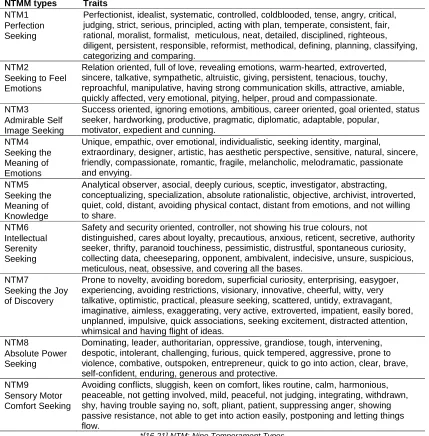
Adcock advocates the idea that temperament represents the differences originating from the time of birth (innate trait), which underlie personality [1]. Buss and Plomin [23], on the other hand, suggest that temperament is transferred through hereditary means, that it remains unchanged and that it is the determinant of a future personality profile. In NTTM, however, it is propounded that temperament is an innate core composed of unchanging traits/ characteristics with a motivation unique to the individual and having priority as to quest and perception, thus, forming the constituent of the personality that will reveal itself in the future [18,20,21]. Goldsmith et al. [24] are of the opinion that temperament represents a group formed by more than one trait instead of a single trait. In NTTM, it is claimed that each temperament type consists of a fundamental quest (existential position) that is the main cause of the behaviours of the individuals of that type of temperament, and also comprises all the traits connected with this fundamental quest [18]. The fundamental quests and traits for the types of temperament in NTTM are shown in Table 1.
NTTM promotes the opinion that temperament occurs as the result of the interaction between the internal/innate factors on which we are unable to have any influence (intelligence, gender, genetic structure, age, biological characteristics, etc.) and the external factors on which we have only partial influence (family, education, social environment, experiences, culture, beliefs, etc.) [16-20]. In other words, temperament, as also stated by Rothbart, Ahadi and Evans [25], bears the structural/natural program of personality, on the basis of which personality develops [18,19]. According to NTTM, temperament stands for the innate overall traits that remain unchanged throughout lifetime, whereas personality is a dynamic and changeable structure, developing over the natural/structural and static characteristics of temperament [16,18,19].
The purpose of this study is to deal with the conceptual viewpoint of NTTM, including the approach, regarding the categories of temperament in NTTM, as well as the dimensions of personality in FFM. In addition, we propose to determine the predictive level of FFM factors on the types of NTTM. We also aim to evaluate the relationship between temperament and personality from the perspective of NTTM, and present a new perspective, using a temperamental basis, on the efforts of FFM to describe personality.
2. MATERIALS AND METHODS
2.1 Participants
Participants were selected using a cluster sampling method from healthy volunteer relatives of patients who applied to the Bezmialem Vakıf University (BVU) Psychiatry Outpatient Clinic. Inclusion criteria included participants who had no lifetime history of psychiatric treatment or chronic disease. The age of participants varied between 18–62 years (average = 36.06±10.75)
Table 1. Traits of Ntmm types
NTMM types Traits
NTM1 Perfection Seeking
Perfectionist, idealist, systematic, controlled, coldblooded, tense, angry, critical, judging, strict, serious, principled, acting with plan, temperate, consistent, fair, rational, moralist, formalist, meticulous, neat, detailed, disciplined, righteous, diligent, persistent, responsible, reformist, methodical, defining, planning, classifying, categorizing and comparing.
NTM2
Seeking to Feel Emotions
Relation oriented, full of love, revealing emotions, warm-hearted, extroverted, sincere, talkative, sympathetic, altruistic, giving, persistent, tenacious, touchy, reproachful, manipulative, having strong communication skills, attractive, amiable, quickly affected, very emotional, pitying, helper, proud and compassionate. NTM3
Admirable Self Image Seeking
Success oriented, ignoring emotions, ambitious, career oriented, goal oriented, status seeker, hardworking, productive, pragmatic, diplomatic, adaptable, popular,
motivator, expedient and cunning. NTM4
Seeking the Meaning of Emotions
Unique, empathic, over emotional, individualistic, seeking identity, marginal,
extraordinary, designer, artistic, has aesthetic perspective, sensitive, natural, sincere, friendly, compassionate, romantic, fragile, melancholic, melodramatic, passionate and envying.
NTM5 Seeking the Meaning of Knowledge
Analytical observer, asocial, deeply curious, sceptic, investigator, abstracting, conceptualizing, specialization, absolute rationalistic, objective, archivist, introverted, quiet, cold, distant, avoiding physical contact, distant from emotions, and not willing to share.
NTM6 Intellectual Serenity Seeking
Safety and security oriented, controller, not showing his true colours, not
distinguished, cares about loyalty, precautious, anxious, reticent, secretive, authority seeker, thrifty, paranoid touchiness, pessimistic, distrustful, spontaneous curiosity, collecting data, cheeseparing, opponent, ambivalent, indecisive, unsure, suspicious, meticulous, neat, obsessive, and covering all the bases.
NTM7
Seeking the Joy of Discovery
Prone to novelty, avoiding boredom, superficial curiosity, enterprising, easygoer, experiencing, avoiding restrictions, visionary, innovative, cheerful, witty, very talkative, optimistic, practical, pleasure seeking, scattered, untidy, extravagant, imaginative, aimless, exaggerating, very active, extroverted, impatient, easily bored, unplanned, impulsive, quick associations, seeking excitement, distracted attention, whimsical and having flight of ideas.
NTM8
Absolute Power Seeking
Dominating, leader, authoritarian, oppressive, grandiose, tough, intervening, despotic, intolerant, challenging, furious, quick tempered, aggressive, prone to violence, combative, outspoken, entrepreneur, quick to go into action, clear, brave, self-confident, enduring, generous and protective.
NTM9
Sensory Motor Comfort Seeking
Avoiding conflicts, sluggish, keen on comfort, likes routine, calm, harmonious, peaceable, not getting involved, mild, peaceful, not judging, integrating, withdrawn, shy, having trouble saying no, soft, pliant, patient, suppressing anger, showing passive resistance, not able to get into action easily, postponing and letting things flow.
and the participants consisted of 125 women (50.6%) and 122 men (49.4%). Education levels of the participants were: 12% primary school,of the participants were: 12% primary school, 43% high school and 44% university. The ethical approval of our study was obtained from the BVU Faculty of Medicine, Clinical Studies Ethical Board.
2.2 Measures
2.2.1 The five factor personality inventory
The Five Factor Personality Inventory (FFPI), developed by Somer et al. [28,29], evaluates five basic factors and seventeen sub-dimensions. The scale was formulated for a Turkish sample by applying item and factor analyses to the 924 Turkish-translated items taken from the International Personality Item Pool (IPIP). The FFPI is a self-report scale with 220 items that are scored using a Likert scale with five values ranging between “completely appropriate” and “not appropriate at all”. Cronbach alpha values of the basic factors vary between 0.84–0.91 and of sub-dimensions vary between 0.61–0.89.
2.2.2 The nine types temperament scale
The Nine Types Temperament Scale (NTTS), developed by Yılmaz et al. [17], in regard to the Turkish sample, evaluates nine temperament categories identified by NTTM. The NTTS is a self-report scale with 91 items that are scored using a Likert scale with three values: “yes”, “sometimes” and “no”. The NTTS’s Comparative Fit Index (CFI) is 0.88, Goodness of Fit Index (GFI) is 0.845, Incremental Fit Index (IFI) is 0.88 and Root Mean Square Error of Approximation (RMSEA) is 0.054. The Cronbach alpha value for the complete scale is 0.75 and for each of the nine types is 0.77, 0.79, 0.68, 0.71, 0.80, 0.74, 0.71, 0.83, 0.77, respectively.
2.3 Procedures
There were 251 volunteers who accepted to participate in the study from 259 people that applied. An informed consent form, a socio-demographic information form, the FFPI and the NTTS were given. In order to avoid a possible order effect, the order of giving the FFPI and the NTTS were changed randomly. Due to improper filling out of the form, four participants were not included in the study from the 251 participants that were accepted. All data were analysed using SPSS 20.0.
3. RESULTS
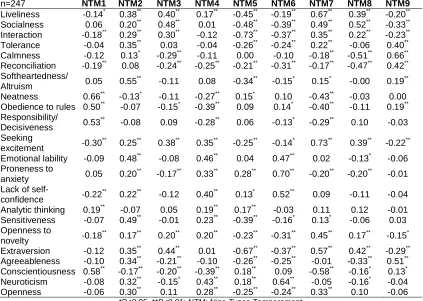
In this study, first Pearson Correlation Coefficients were calculated between factors and sub-dimensions of the FFPI and the nine temperament types of the NTTS. Results of correlation analyses are given in Table 2.
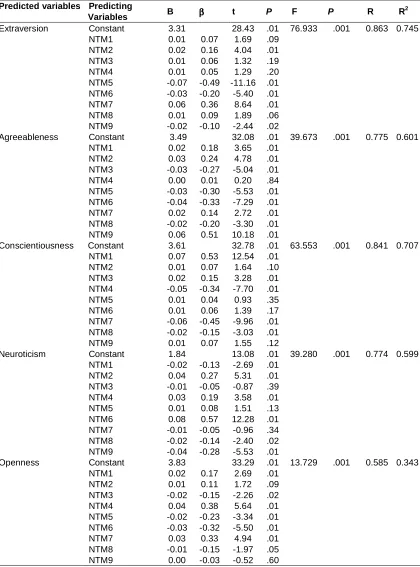
Next, linear multiple regression analysis was applied in order to predict factor scores of the FFPI, which is taken as a dependent variable to be predicted, with the nine temperament types of the NTTS, which are taken as independent variables. Among the results of the analyses in Table 3, the following are worth noting.
From the established models, R2 was calculated as 0.71 in the model analysis between NTM1 and C, and the model is statistically significant (F=63.55, P < 0.001). In this model, it was found out that NTM1 predicts factor C (β=0.53; P <0.001). In the model analysis between NTM5 and E, R2 was calculated as 0.75 and the model is statistically significant (F=76.93, P <0.001). In this model, it was found out that NTM5 predicts factor E (β =-0.49; P <0.001). In the model analysis between NTM6 and N, R2 was calculated as 0.60, and this model is statistically significant (F=39.28, P <0.001). In this model, it was found out that NTM6 predicts factor N (β = 0.57; P <0.001). In the model analysis between NTM7 and C, R2 was calculated as 0.71, and this model is statistically significant (F=63.55, P <0.001). In this model, it was found out that NTM7 predicts factor C (β = -0.45; P <0.001). In the model analysis between NTM7 and E, R2 was calculated as 0.75, and this model is statistically significant (F=76.93, P <0.001). It was found out that NTM7 predicts factor E (β = 0.36; P <0.001). In the model analysis between NTM9 and A, R2 was calculated as 0.60, and this model is statistically significant (F = 39.67, P <0.001). In this model, it was found out that NTM9 predicts factor A (β = 0.51; P <0.001).
Table 2. Correlation coefficients between total factor and sub-dimension scores of the five factor personality inventory and the nine temperament types of the nine types temperament
scale
n=247 NTM1 NTM2 NTM3 NTM4 NTM5 NTM6 NTM7 NTM8 NTM9
Liveliness -0.14* 0.38** 0.40** 0.17** -0.45** -0.19** 0.67** 0.39** -0.20** Socialness 0.06 0.20** 0.48** 0.01 -0.48** -0.39** 0.49** 0.52** -0.33** Interaction -0.18** 0.29** 0.30** -0.12 -0.73** -0.37** 0.35** 0.22** -0.23** Tolerance -0.04 0.35** 0.03 -0.04 -0.26** -0.24** 0.22** -0.06 0.40** Calmness -0.12 0.13* -0.29** -0.11 0.00 -0.10 -0.18** -0.51** 0.66** Reconciliation -0.19** 0.08 -0.24** -0.25** -0.21** -0.31** -0.17** -0.47** 0.42**
Softheartedness/
Altruism 0.05 0.55
**
-0.11 0.08 -0.34** -0.15* 0.15* -0.00 0.19**
Neatness 0.66** -0.13* -0.11 -0.27** 0.15* 0.10 -0.43** -0.03 0.00 Obedience to rules 0.50** -0.07 -0.15* -0.39** 0.09 0.14* -0.40** -0.11 0.19** Responsibility/
Decisiveness 0.53
**
-0.08 0.09 -0.28** 0.06 -0.13* -0.29** 0.10 -0.03
Seeking
excitement -0.30
**
0.25** 0.38** 0.35** -0.25** -0.14* 0.73** 0.39** -0.22**
Emotional lability -0.09 0.48** -0.08 0.46** 0.04 0.47** 0.02 -0.13* -0.06
Proneness to
anxiety 0.05 0.20
**
-0.17** 0.33** 0.28** 0.70** -0.20** -0.20** -0.01
Lack of
self-confidence -0.22
**
0.22** -0.12 0.40** 0.13* 0.52** 0.09 -0.11 -0.04
Analytic thinking 0.19** -0.07 0.05 0.19** 0.17** -0.03 0.11 0.12 -0.01 Sensitiveness -0.07 0.49** -0.01 0.23** -0.39** -0.16* 0.13* -0.06 0.03 Openness to
novelty -0.18
**
0.17** 0.20** 0.20** -0.23** -0.31** 0.45** 0.17** -0.15*
Extraversion -0.12 0.35** 0.44** 0.01 -0.67** -0.37** 0.57** 0.42** -0.29** Agreeableness -0.10 0.34** -0.21** -0.10 -0.26** -0.25** -0.01 -0.33** 0.51** Conscientiousness 0.58** -0.17** -0.20** -0.39** 0.18** 0.09 -0.58** -0.16* 0.13* Neuroticism -0.08 0.32** -0.15* 0.43** 0.18** 0.64** -0.05 -0.16* -0.04 Openness -0.06 0.30** 0.11 0.28** -0.25** -0.24** 0.33** 0.10 -0.06
*P<0.05, **P<0.01; NTM: Nine Types Temperament
4. DISCUSSION
The results of our study indicate that there is significant correlation and predictability between types and factors of both models. However, these findings should be evaluated while taking into account the differences of the conceptual approaches between the models. That is to say, McCrae and Costa [30] argue that personality factors stay unchanged throughout adulthood. Among the 1,600 individuals they observed for 12 years, Mroczek and Spiro [31] investigated whether N and E dimensions change over time. The findings have proven that the E dimension does not change with age, while the N dimension shows a decline. In a four-year study by Allemand et al. [32] conducted with 445 middle-aged and 420 elderly participants, it was established that the N dimension shows a decline in both age groups. Roberts et al. [33] determined that the E, O and A dimensions show a significant change with age. Donnellan and Lucas [34] established that as age increases the E and O dimensions show a decline, while A dimension shows an
increase. Therefore, it can be stated that FFM is limited in determining the traits of an individual that remain unchanged throughout a lifetime. According to NTTM, the traits of an individual that remain unchanged throughout his lifetime are temperament traits, not personality. Personality can change throughout a lifetime [18,20, 21]. Thus, the NTTM approach can evaluate the traits of an individual that are unchanging and changing (static and dynamic) throughout the lifetime from a new and wider perspective [20].
FFPI and NTM7’s traits, such as being very energetic and lively, sociable, cheerful, fun-loving, highly active, seeking excitement and establishing relations quickly [15,22], a high correlation is determined. In addition, NTM3’s traits, such as being ambitious, energetic and quick to establish social relations, caring too much about image and outlook, NTM8’s traits, such as being a leader, entrepreneur, energetic, quick to get into action and protecting the people around, and NTM2’s traits, such as being full of love, warm-hearted, sincere, amiable and having strong communication skills [16-18,39] can explain these temperaments’ positive correlations with the E factor of the FFPI. NTM5 is the most introverted among the temperament types. Negative correlation with the E factor of the FFPI and NMT5’s traits, such as being introverted, observatory, quiet, little talking, cold, distant, asocial, avoiding physical contact and not willing to share [15,19], is an expected result. Also, it is an expected result that NTM6’s traits, such as not making a move in their relationships, testing, being controlled, cautious, not showing true colours, not catching attention, reticent, indecisive and pessimistic, and NTM9’s traits, such as being calm, sluggish, routine-loving, not getting involved, shy and disliking to be in the spot light [16-18] have negative correlation with the E factor of the FFPI.
Individuals with high scores on the FFPI’s A factor are sensitive, compassionate, easy-going, calm, avoid conflicts, trust people, are open to cooperation, honest, altruistic and humble. Those who have low scores on this factor have high self-esteem and low tolerance; they are arrogant, short-tempered, reactive, furious, vengeful, hard-headed, independent, combative, suspicious, cautious and not trusting of people [12,40-43]. It is an expected result that there is a high correlation between the A factor of the FFPI and the traits of NTM9, such as avoiding conflicts, harmonious, peaceable, mild, integrating in relations, soft, pliant and patient [17,18,39]. In addition, NTM2’s traits, such as being very loyal and sensitive to relations, sincere, sympathetic, altruistic, giving, humble and compassionate [15,19,44], can explain the positive correlation. NTM8 is the most aggressive temperament type. The traits of NTM8, such as being authoritarian, oppressive, dominating, grandiose, tough, intervening, intolerant, challenging, independent, combative, quick tempered and aggressive [15,17,22] can explain the negative correlation. The traits of NTM5, such as being distant, quiet,
cold, sceptical, distant from emotions, unwilling to share and avoiding physical contact, and the traits of NTM6, such as not trusting easily, testing relations, being anxious, thrifty and opponent [16-18] can explain the negative correlation with the A factor of the FFPI.
Individuals with high scores on the FFPI’s C factor are neat, planned, aimed, determined, decisive, meticulous, perfectionist, precautious, responsible, self-disciplined, tough, and conservative. Those who have low scores of this factor are practical, pliant, unplanned, extravagant, aimless, impulsive, quickly bored, and do not abide by the rules [37,45-47]. It is an expected result that this factor has a strong positive correlation with the traits of NTM1, such as being a perfectionist, systematical, controlled, critical, judging, strict, principled, planned, formalist, detailed, disciplined, diligent, persistent and responsible [19-21], and strong negative relations with the traits of NTM7, such as getting bored easily, avoiding being restricted, having difficulty abiding by the rules, being practical, scattered, untidy, extravagant, aimless, impatient, unplanned, impulsive and easily distracted [18,20]. In addition, NTM4’s traits, such as being flexible, individual, marginal, rebellious, impulsive and not caring about rules and order [17,21] can explain the negative correlation.
Table 3. Multiple linear regression analysis results for predicting factor scores of the five factor personality inventory with nine temperament categories of the nine types
temperament scale
Predicted variables Predicting
Variables B ββββ t P F P R R
2
Extraversion Constant 3.31 28.43 .01 76.933 .001 0.863 0.745 NTM1 0.01 0.07 1.69 .09
NTM2 0.02 0.16 4.04 .01 NTM3 0.01 0.06 1.32 .19 NTM4 0.01 0.05 1.29 .20 NTM5 -0.07 -0.49 -11.16 .01 NTM6 -0.03 -0.20 -5.40 .01 NTM7 0.06 0.36 8.64 .01 NTM8 0.01 0.09 1.89 .06 NTM9 -0.02 -0.10 -2.44 .02
Agreeableness Constant 3.49 32.08 .01 39.673 .001 0.775 0.601 NTM1 0.02 0.18 3.65 .01
NTM2 0.03 0.24 4.78 .01 NTM3 -0.03 -0.27 -5.04 .01 NTM4 0.00 0.01 0.20 .84 NTM5 -0.03 -0.30 -5.53 .01 NTM6 -0.04 -0.33 -7.29 .01 NTM7 0.02 0.14 2.72 .01 NTM8 -0.02 -0.20 -3.30 .01 NTM9 0.06 0.51 10.18 .01
Conscientiousness Constant 3.61 32.78 .01 63.553 .001 0.841 0.707 NTM1 0.07 0.53 12.54 .01
NTM2 0.01 0.07 1.64 .10 NTM3 0.02 0.15 3.28 .01 NTM4 -0.05 -0.34 -7.70 .01 NTM5 0.01 0.04 0.93 .35 NTM6 0.01 0.06 1.39 .17 NTM7 -0.06 -0.45 -9.96 .01 NTM8 -0.02 -0.15 -3.03 .01 NTM9 0.01 0.07 1.55 .12
Neuroticism Constant 1.84 13.08 .01 39.280 .001 0.774 0.599 NTM1 -0.02 -0.13 -2.69 .01
NTM2 0.04 0.27 5.31 .01 NTM3 -0.01 -0.05 -0.87 .39 NTM4 0.03 0.19 3.58 .01 NTM5 0.01 0.08 1.51 .13 NTM6 0.08 0.57 12.28 .01 NTM7 -0.01 -0.05 -0.96 .34 NTM8 -0.02 -0.14 -2.40 .02 NTM9 -0.04 -0.28 -5.53 .01
Openness Constant 3.83 33.29 .01 13.729 .001 0.585 0.343 NTM1 0.02 0.17 2.69 .01
NTM2 0.01 0.11 1.72 .09 NTM3 -0.02 -0.15 -2.26 .02 NTM4 0.04 0.38 5.64 .01 NTM5 -0.02 -0.23 -3.34 .01 NTM6 -0.03 -0.32 -5.50 .01 NTM7 0.03 0.33 4.94 .01 NTM8 -0.01 -0.15 -1.97 .05 NTM9 0.00 -0.03 -0.52 .60
Individuals with high scores on the FFPI’s O factor are analytic thinking, investigating, abstracting, gentle, sensitive to art and aesthetics, kind, empathic, curious, creative, have a strong imagination, a wide range of interests and like changes. In addition, they are open to novelties, new experiences, open minded, unconventional and independent. Those who have low scores on this factor are concrete thinking, objective, do not decide with emotions, are resistant to new ideas, loyal to authority, conservative and have low empathy; they dislike new experiences and changes [49,51-54]. Traits of NTM7, such as being open to novelties, superficially curious, experiential, visionary, innovative, and dreamer/imaginative, and traits of NMT4, such as being unique, emphatic, a designer, extraordinary, artistic, having aesthetic perspective, being kind, sensitive, romantic and a dreamer [19-22] can explain the positive correlation. Although there is a positive correlation with NTM2, according to this study, there is no positive or negative relation with this factor and NTM2. The traits of NTM5, such as being abstractive, analytical, deeply curious and investigating have common features with the analytic thinking sub-dimension of the O factor. Sub-dimension analysis results show a weak positive correlation (0.17). However, NTM5 shows negative correlation with sub-dimensions of the O factor (-0.39, -0.23), which can be explained with traits, such as being absolutely rational, objective, cold, distant from emotions and disliking changes. Traits of NTM6, such as being a material thinker, objective, conservative, resistant to new experiences and surrendering to authority [15,19-21] can explain the negative correlation.
5. CONCLUSION
In this study, the sample group, which consisted of patients’ relatives, can be evaluated as a limitation. Although individuals with acute/chronic psychiatric disease were not enrolled in this study, their family members have psychiatric diseases. From this perspective, further studies conducted on larger sample groups that represent the society better, will contribute to the evaluation of the relations between these two models. In the future, studies on different sample groups comprised of different ages and social qualities, conducted using advanced statistical methods, can test the proposal of NTTM, stating that temperament is the core of personality traits. Studies between NTTM, which considers temperament as the basic structural core of
personality development, and different personality models can help to conduct cause and affect analyses in the wide and rich field of personality study. In this way, it will be possible to determine the variables and the critical development factors which assist in the formulation of the temperament predispositions/ traits as positive and negative personalities. In addition, longitudinal studies can contribute to the testing of the argument of NTTM, which states that temperament is unchanging while personality is changing, and FFM, which states that personality is unchanging during adulthood.
CONSENT
All authors declare that ‘written informed consent was obtained from the participant’s publication of this cross sectional study and accompanying data analysis. The names and identity of the participants were kept confidential.
ETHICAL APPROVAL
All authors hereby declare that all experiments have been examined and approved by the appropriate ethics committee and have therefore been performed in accordance with the ethical standards laid down in the 1964 Declaration of Helsinki.
COMPETING INTERESTS
Authors have declared that no competing interests exist.
REFERENCES
1. Strelau J. Temperament A Psychological Perspective. New York: Kluwer Academic Publishers; 2002.
2. Costa PT, McCrae RR. A theoretical context for adult temperament. In: Wachs TD, McCrae RR, Kohnstamm GA, editors. Temperament in context New Jersey London: Lawrence Erlbaum Associates Psychology Press; 2001.
3. Allport GW. Concepts of trait and perso-nality. Psychol Bull. 1927;24(5):284-293. DOI: 10.1037/h0073629.
5. Kagan J, Snidman N. The long shadow of temperament. Harvard University Press; 2004.
6. Thompson RA. Twenty-first century
temperament. Journal of Applied Develop-mental Psychology. 2012;33:269–271. 7. Galton F. Measurement of character.
Fortnightly Review. 1884;36:179-185.
8. Allport GW, Odbert HS. Trait-names: A
psycho-lexical study. Psychological
Monographs. 1936;47(1).
9. Thurstone LL. The vectors of
mind. Psychol Rev. 1934;41(1):1.
10. Norman WX. 2800 personality trait descriptors: Normative operating characteristics for a university population. Ann Arbor: University of Michigan, Department of Psychology; 1967.
11. Cattell RB. The description of personality: Basic traits resolved into clusters. The
Journal of Abnormal and Social
Psychology. 1943;38(4):476.
12. Costa PT, McCrae RR. From catalog to classification: Murray’s needs and five-factor model. J Pers Soc Psychol. 1988; 55(2):258-265.
13. Zuckerman M, Kuhlman DM, Joireman J,
Teta P, Kraft M. A comparison of three structural models for personality: The Big Three, the Big Five, and the Alternative Five. J Pers Soc Psychol. 1993;65(4):757.
14. Blandin K. Temperament and
typo-logy. Journal of Analytical Psychotypo-logy. 2013;58(1):118-136.
15. Yılmaz ED. Personality and character development of children according to nine types temperament model. 5th ed. Istanbul: Hayat Publishing; 2010. Turkish.
16. Yılmaz ED, Gençer AG, Aydemir Ö. Evolution of a historical system to a new temperament model: Nine types temperament model. Anatolian Journal of Psychiatry. 2011;12(2):165-166.
17. Yılmaz ED, Gençer AG, Aydemir Ö, Yılmaz A, Kesebir S, Ünal Ö et.al. Reliability and validity of nine type’s temperament scale. Education and Science. 2014a;39(171):115-137.
18. Yılmaz ED, Gençer AG, Ünal Ö, Aydemir Ö. From enneagram to nine types temperament model: A proposal. Education and Science. 2014b;39(173): 393-415.
19. Yılmaz ED, Gençer AG, Ünal Ö, Örek A, Aydemir Ö, Deveci E et.al. The relationship between nine types temperament model with psychobiological personality model
and affective temperament model. Anatolian Journal of Psychiatry. 2015a; 16(2):95-103.
DOI:10.5455/apd.164248. (Turkish) 20. Yılmaz ED, Unal O, Gencer AG, Aydemir
O, Selcuk Z. Static/Unchangeable and Dynamic/Changeable Nature of personality according to the nine types temperament model: A proposal. International Journal of Emergency Mental Health and Human Resilience. 2015b;17(1):298-303.
21. Yılmaz ED, Unal O, Gencer AG, Aydemir O, Selcuk Z. Is Individual temperament centered psychotherapy possible: A proposal based on nine types temperament model. International Journal of Emergency Mental Health and Human Resilience. 2015c;17(2):378-388.
22. Yılmaz ED, Unal O, Palancı M, Kandemir M, Orek A, Akkın G et.al. Validity-reliability of nine types temperament scale adolescent form (NTTS-A) and relationship between temperament types and attention deficit hyperactivity disorder. Education and Science. 2015d;40(179):361-381.
23. Buss AH, Plomin R, Willerman L. The
inheritance of temperaments. J Pers. 1973; 41(4):513-524.
24. Goldsmith HH, Buss AH, Plomin R, Rothbart MK, Thomas A, Chess S et.al. Roundtable: What is temperament? Four approaches. Child Dev. 1987;58(2):505-529.
25. Rothbart MK, Ahadi SA, Evans DE. Temperament and personality: Origins and outcomes. J Pers Soc Psychol . 2000;78(1):122-135.
DOI:10.1037/0022-3514.78.1.122.
26. Dumont F. A history of personality
psychology: Theory, science, and research from hellenism to the twenty-first century. Cambridge University Press; 2010.
27. Chess S, Thomas A. Temperamental
individuality from childhood to adole-scence. Journal of the American Academy of Child Psychiatry. 1977;16(2):218-226. 28. Somer O, Korkmaz M, Tatar A.
Development of five factor personality inventory I: Consruction of scale and subscales. Turkish Journal of Psychology. 2002;17(49):21-33.
30. Mc Crae RR, Costa PT. The stability of personality: Observations and evaluations. Current Directions in Psychological Science. 1994;3(6):173-175.
31. Mroczek DK, Spiro A. Modeling intraindividual change in personality traits: Findings from the normative aging study. Journal of Gerontology. 2003;58B:153-165.
32. Allemand M, Zimprich D, Hertzog C. Cross-sectional age differences and longitudinal age changes of personality in middle adulthood and old age. J Pers. 2007;75(2):323–358.
33. Roberts RW, Viechtbauer W, Walton KE, Patterns of mean-level change in personality traits across the life course: A meta-analysis of longitudinal studies. Psychol Bull. 2006;132(1):1–25.
34. Donnellan MB, Lucas RE. Age differences in the big five across the life span: Evidence from two national samples. Psychol Aging. 2008;23(3):558-566. DOI: 10.1037/a0012897.
35. Goldberg LR. The development of markers for the big-five factor structure. Psycho-logical Assessment. 1992;4(1):26-42. 36. Goldberg LR. The structure of phenotypic
personality traits. Am Psychol. 1993;48(1): 26-34.
37. Johnson JA, Ostendorf F. Clarification of the five-factor model with the abridged big-five dimensional circumplex. J Pers Soc Psychol. 1993;65(3):563-576.
38. McAdams DP. What do we know when we know a person. J Pers. 1995;63(3):364-396.
39. Bland AM. The Enneagram: A review of the empirical and transformational litera-ture. Journal of Humanıstıc Counseling, Education And Development. 2010;49:16-31.
40. Mac Donald K. Evolution, the five-factor model and levels of personality. J Pers. 1995;63(3):525-567.
41. McCrae RR. Moderated analyses of longitudional personalty stability. J Pers Soc Psychol. 1993;65(3):577-585.
42. McCrae RR, Costa PT. The structure of interpersonal traits: Wigginn’s circumplex and the five factor model. J Pers Soc Psychol. 1989c;56(4):586-595.
43. McCrae RR, Costa PT. Personality trait structure as a human universal. Am Psychol. 1997;52:509-516.
44. Levine J. Know your parenting personality. New Jersey: Wiley; 2003.
45. Conley JJ. Longitudinal stability of personality traits: A multitrait-multimethod - multioccasion analyses. J Pers Soc Psychol. 1985;49(5):1266-1282.
46. McCrae RR, Costa PT. Validation of the five-factor model of personality across instruments and observers. J Pers Soc Psychol. 1987;52(1):81-90.
47. Paunonen SV, Jackson DG, Forsterling F, Trezebinski J. Personality structure across cultures: A multimethod evaluation. J Pers Soc Psychol. 1992;62(3):447-456.
48. Barrick MR, Mount MK. The big five personality dimensions and job performance: A meta-analysis. Personel Psychology. 1991;44:1-26.
49. Costa PT, McCrae RR. Domains and facets: Hierachical personality assessment using the revised NEO personality inven-tory. J Pers Assess. 1995a;64(1):21-50. 50. McCrae RR, Costa PT. The NEO
personality inventory: Using the five factor model in counseling. Journal of Counseling and Development. 1991b;69(4):367-372. 51. McCrae RR, John OP. An introduction to
the five-factor model and its applications. J Pers. 1992;60(2):175-215.
52. Costa PT, McCrae RR, Dye DA. Facet scales for agreeableness and conscienti-ousness; a revision of the NEO personality inventory. Personality and Individual Differences. 1991;9(12):887-898.
53. Peabody D, Goldberg LR. Some determinants of factor structures from personalty-trait descripters. J Pers Soc Psychol. 1989;57(3):552-567.
54. Trapnell PD, Wiggins JS. Extension of the interpersonal adjective scales to include the big-five dimensions of personality. J Pers Soc Psychol. 1990;59(4):781-790.
© 2016 Yılmaz et al.; This is an Open Access article distributed under the terms of the Creative Commons Attribution License (http://creativecommons.org/licenses/by/4.0), which permits unrestricted use, distribution, and reproduction in any medium, provided the original work is properly cited.
Peer-review history: