Parallel Chains: Improving Throughput and Latency of
Blockchain Protocols via Parallel Composition
Matthias Fitzi?, Peter Gaˇzi??, Aggelos Kiayias? ? ?, and Alexander Russell†
November 30, 2018
Abstract. Two of the most significant challenges in the design of blockchain protocols is increasing their transaction processing throughput and minimising latency in terms of transaction settlement. In this work we put forth for the first time a formal execution model that enables to express transac-tion throughput while supporting formal security arguments regarding safety and liveness. We then introduceparallel-chains, a simple yet powerful non-black-box composition technique for blockchain protocols. We showcase our technique by providing two parallel-chains protocol variants, one for the PoS and one for PoW setting, that exhibit optimal throughput under adaptive fail-stop corruptions while they retain their resiliency in the face of Byzantine adversity assuming honest majority of stake or computational power, respectively. We also apply our parallel-chains composition method to improve settlement latency; combining parallel composition with a novel transaction weighing mechanism we show that it is possible to scale down the time required for a transaction to settle by any given constant while maintaining the same level of security.
1
Introduction
Blockchain protocols exhibit an inherent speed-security trade-off that depends on the latency of the under-lying communication network. This was first formally illustrated in [18] by expressing how block production per round of message-passing, denotedf, needs to be relatively small for security theorems to be meaningful. This was further refined in [33] where block production per unit of time was similarly restricted with respect to 1/∆, where∆is the delay of the network, while for arbitrary delays a generic attack was formulated. The main conclusion of these theoretical analyses is that in order to achieve safety, a blockchain protocol must be operated at a relatively slow pace with respect to network latency. It is frequently observed (e.g., [18]), that Bitcoin’s actual parameterisation sets the block production rate conservatively to be once every 30 (or so) rounds of message passing.
This state of affairs severely impacts two critical performance characteristics of a distributed ledger that is implemented via a blockchain protocol; specifically, (i) itsthroughput, since long periods of silence between blocks result in an underutilisation of the available network bandwidth, and (ii) itssettlement time, since blockchain protocols provide transaction safety with an exponential error in the number of blocks accumulated beyond the block that registers the transaction.
Rectifying the above two performance issues lead to a number of developments in protocol design that adopted one of two possible strategies. The first one took a hybrid approach, using a blockchain protocol as a secure “back-end” while leaving transaction processing to a less secure or less decentralised “front-end” that, using more standard cryptographic techniques, provides better throughput and settlement times (at least in optimistic environments). This is exemplified by works such as Hybrid Consensus [34], Bitcoin-NG [16] and Thunderella [36]. The second approach redefines the underlying blockchain protocol, frequently radically deviating from the original blockchain protocol structure. This is exemplified by numerous Block-“Tree” or
?
[email protected]. ? ? ?
University of Edinburgh and [email protected].. This research was partially supported by H2020 project PRIVILEDGE # 780477.
†
“DAG” protocol proposals such as GHOST [39], Spectre [38], Phantom [41], GraphChain [8], Tangle [37], Conflux [27], and Swirlds [3].
Despite the above developments the current state of the art is still lacking in terms of both a thorough modeling of transaction throughput and latency as well as a provable answer to the fundamental questions posed above, namely whether it is possible to provably achieve permissionless ledger consensus with honest majority that has optimal throughput and settlement time.
Our results. We study a simple yet, as we show, very powerful composition operator over blockchain protocols: parallel composition. Our parallel-chains protocol composition technique is described as follows: given an underlying blockchain protocol, either in the proof-of-work (PoW) or the proof-of-stake (PoS) setting, we executeminstances of it in parallel, while ensuring that the same mining, or staking respectively, operation can be used across all theminstances. At any given moment, a combine algorithm can be invoked that processes the contents of them blockchains in the view of an honest party and organises them into a single ledger. Our results are summarised as follows.
A theoretical framework for optimistic throughput.We put forth a new formal model that formally captures for the first time a concept of throughput for distributed ledger protocols. This is achieved by a novel fine-grained network diffusion functionality that reflects network communication with far greater precision compared to previous work. Specifically, our network functionality abstracts the uplink, transit queue as well as the downlink of each single party in the network. Whenever a message is transmitted, it is placed via a party’s uplink into the transit queue for all recipients. The uplink for each party is by definition one message per unit of time (we use the term “slot”) while the transit queue for each recipient can be arbitrarily manipulated by the adversary (for simplicity the parties in our model are symmetric). Messages in our setting are restricted to a fixed packet length and as such may be insufficient to carry all the transactions that are available in a party’s pool of pending transactions. At any given moment, messages may be placed by the adversary in a party’s downlink and become available to the party subject to a restriction that sets an upper bound on the number of messages that may be accessed from the downlink per slot. Using this network abstraction we introduce the following notion for block-based distributed-ledger protocol throughput: it is the ratio of blocks added in the common prefix of all honest parties divided by the number of slots – during any slot interval of some minimal length within the protocol execution. Armed with our framework, we analyse some standard proposals for scaling Bitcoin’s throughput. These proposals call for increasing the block production rate, increasing the block size, or letting the most recent block producer continuously process new transactions (a proposal that is embodied by Bitcoin-NG [16]). We illustrate that with the first two of these proposals it is impossible to bring the protocol’s throughput close to 1, a finding that formally affirms the folklore understanding that the Bitcoin blockchain protocol is inherently limited in terms of scaling its transaction processing capability and highlights the value of our formal framework as a yardstick for determining a protocol’s ability to achieve high throughput.1 Finally, Bitcoin-NG is capable of achieving near-optimal throughput assuming all parties are honest, nevertheless, its throughput becomes effectively zero in the setting of adaptive fail-stop corruptions; the reason stems from the fact that the protocol achieves its high throughput via centralising processing to block producers; an adaptive fail-stop adversary can simply shut down the servers once they are selected and thus effectively zero the throughput. Given this, the main question we ask is whether it is possible to achieve Byzantine resilience in the setting of honest majority, while simultaneously achieve (near) optimal throughput for fail-stop corruptions.
A near optimal throughput PoS-based distributed ledger. We employ the parallel composition technique on a PoS blockchain. Each protocol participant proceeds in parallel across all m blockchains utilising the total stake that exists for PoS block production. Note that multiple blocks may be emitted in each round depending on how many blocks have been found to extend the underlying blockchains. Parsing the m blockchains into a single ledger is achieved by ordering transactions lexicographically according to the index of the block and the rank of the blockchain it belongs to (from 1 tom). We demonstrate that the
1
protocol achieves near optimal throughput, that can be made arbitrarily close to 1, while enjoying the same security guarantees as the underlying blockchain protocol. We make our construction explicit by applying the parallel composition mechanism on the Ouroboros-Praos PoS protocol [13].
A near optimal throughput PoW-based distributed ledger. We employ the parallel composition technique on a PoW blockchain. As with the PoS case, participants maintainmblockchains, attempting to mine blocks simultaneously for all of them. Mining simultaneously for allmchains requires to pack all possible ways to extend the blockchains, storing them in a Merkle root, and then revealing the appropriate path once the blockchain to be extended is discovered. An additional complication arises in the PoW setting as blocks do not carry a verifiable time-stamp (that, in the PoS setting, is provided for “free” by our construction). This prohibits the use of the same simple blockchain combine algorithm used in the PoS setting. Instead, we use the following mechanism: we identify one of the mblockchains as the synchronisation chain and we have every block refer to a block of that chain which will play the role of a timestamp. Subsequently, roughly speaking, a block is stabilised as soon as both itself and its stabilisation block are confirmed with respect to their respective blockchains. For stable blocks, a total ordering of blocks can now easily be extracted. As in the PoS setting, we prove that our protocol achieves optimal throughput while enjoying essentially the same security guarantees as the underlying PoW-based blockchain protocol. Furthermore, composingm blockchain protocols with full independence requires a PoW composition method; in order to achieve this (as required by our amplification technique) we generalize the 2-for-1 POWs technique introduced in [18] using a hash chain (or, alternatively, a PRG), yielding an m-for-1 POW primitive that may be of independent interest.
A settlement-time amplification technique. We finally employ the parallel composition technique to improve settlement time. Our technique applies to both the PoW and the PoS setting. Given as a starting point a blockchain protocol with exponentially small persistence error in a security parameterdthat expresses the time required to wait for a transaction to be settled, we show how the m-fold parallel composition of the protocol can achieve a wait time d/m for any constant m for (roughly) the same level of safety error. This is achieved by a novel weighing mechanism that evaluates whether a transaction has been stabilised by combining depth information from all the blockchains that include the transactions. The transaction weighing mechanism combines via an exponential sum the weights of the transaction in each individual blockchain into a single cross-blockchain weight; subsequently settlement is determined via the difference of this weight with respect to the maximum weight that exists in the ledger for any transaction.
Transaction sharding.As in all DAG-type proposals for distributed ledgers, the same transaction may be processed by multiple nodes during distributed ledger maintenance when the parallel-composition operator is applied. While this may be beneficial (as illustrated by our amplification techniques for settlement time), it may not be desirable in settings where we wish to avoid double processing of transactions to maximise throughput. In order to reduce overall network traffic in favor of higher throughput, we use a transaction sharding mechanism that partitions the set of possible transactions and assigns each respective subset to a different chain who will be responsible for mining the respective transactions. This has the desirable side-effect that a blockchain user may follow only one of the chains if they are interested in addresses that are clustered in that chain hence reducing the total amount of data that are required to be handled for keeping up to date.
As a final note, in this paper we focus on the case where the number of chainsmis carefully selected at the onset as a parameter of the protocol and is constant throughout the execution. It is conceivable though that parallel chain composition could be adjusted to vary the number of active chains according to the evolving throughput needs (somewhat akin to the Bitcoin difficulty adjustment). We leave investigating this more general variant to future work.
Generalizing the chain structure of [32] to more general graphs was first considered by Sompolinsky et al. [40] and Lerner [25]. The former generalization (GHOST) still extracts a single chain to represent the ledger but the blocks of the complete block tree (including all forks) remain to contribute to this selection process in an attempt to preserve the PoW of the blocks outside the main chain. The latter suggests to organize the blocks in a directed acyclic graph (DAG) whereas a single block references multiple previous blocks. The first DAG protocols involving some type of formal analysis were proposed by Boyen et al. [8], Sompolinsky et al. [38,41] and Bentov et al. [5]. However, these proposals only involve qualitative arguments of eventual transaction safety without giving a full formal model for arguing about both safety, liveness and throughput. Other examples of DAG protocols are described by Popov [37] (IOTA) and Baird [3] (Hashgraph) — both not thoroughly analysed in the Byzantine permissionless setting. In [27], Li et al. proposed the first DAG protocol that directly allows for a detailed analysis. As their protocol is basically an extension of the GHOST rule that additionally allows for the inclusion of the transactions of the off-chain blocks, maximal respective throughput is limited by the conditions under which the GHOST protocol can safely operate.
Sharding in context of distributed ledgers was first suggested by Danezis et al. [12], and by Croman et al. [11]. In the protocol by Gencer et al. [20] each miner operates over the full set of transactions whereas user nodes only need to observe shards of their interest as each shard maintains its own chain. In contrast, the protocol by Luu et al. [28] divides mining with respect to the different shards to different committees but still maintains one single chain such that user nodes must follow the complete history of the ledger. Kokoris-Kogias et al. [24] and Zamani et al. [42] proposed protocols where sharding is achieved with respect to miner and user by maintaining one dedicated chain per transaction class and also dividing mining respectively.
Martino et al. [29] proposed to maintain a set of parallel chains wherein blocks permanently cross-reference blocks of some other chains based on special chain-neighborship properties, claiming to achieve better throughput than in the single-chain case — without giving a detailed analysis. Kiffer et al. [22] analysed the clique special case of [29] where each chain cross-references all other chains, and demonstrated its security when operated under the same overall block-generation rate as the single-chain case; whereas throughput under increased block-generation rate is not analysed. Similarly to the clique case above, Forestier et al. [17] suggest to maintain a set of parallel chains where each block cross-references the most recent block of every chain. Whereas, for PoS, they state that mining can be randomly assigned to the different chains, they propose no respective solution for PoW. No rigorous analysis of the protocol is given.
We recently learned of concurrent, independent work by Bagaria et al. [2] achieving near-optimal trans-action throughput and settlement times for proof-of-work blockchains. We defer a full comparison to their work to the next version of this paper.
Organisation. In Section 2 we present preliminaries, definitions of standard security properties and notations. We then proceed to Section 3 to introduce our new and refined network model as well as our modeling of transaction throughput. After a warm-up investigation of the basic Bitcoin-scaling proposals in Section 4, in Section 5 we put forth our PoS parallel-composition method and apply it on Ouroboros Praos PoS. In Section 6 we apply the parallel-composition method to PoW-based blockchains. Finally, in Section 7 we present our settlement-time acceleration method via parallel composition.
2
Preliminaries
Basic Notation. For n ∈ Nwe use the notation [n] to refer to the set {1, . . . , n}. For brevity, we often write{xi}n
i=1 and (xi)
n
i=1 to denote the set{x1, . . . , xn} and the tuple (x1, . . . , xn), respectively.
Execution Model. We divide time into discrete units called slots. Parties are equipped with (roughly) synchronized clocks that indicate the current slot: we assume that any clock drift is subsumed in the slot length. Each slot is indexed by an integer t ∈ {1,2, . . .}. For an interval of slots I = [t1, t2] we denote its
length as|I|,t2−t1+ 1.
communication), and an adversaryA. All these entities are interactive algorithms. The environment controls the execution by activating parties via inputs it provides to them. The parties, unless corrupted, respond to such activations by following the protocolΠ and invoking the available functionalities as needed. We denote byExec(Π,A,Z) the random variable containing the full transcript of an execution of the protocolΠ with adversaryAand environmentZ.
Adaptive Corruptions. The adversary influences the protocol execution by interacting with the available functionalities, and by corrupting parties. To corrupt a party, the adversary has to first ask the environment
Z for a permission. If the corruption is approved by Z (via a special message fromZ toA), the adversary corrupts Pi immediately. We distinguish two types of corruption, Byzantine and fail-stop. A Byzantine corrupted partyPiwill relinquish its entire state toA; from this point on, the adversary will be activated in place of the partyPi. A fail-stop corrupted party, on the other hand, will simply stop executing its program and, whenever activated, will return an empty message⊥. We denote byAfs the class of adversaries that
only perform fail-stop corruptions, and byAbthose that also use Byzantine corruptions.
Semi-synchronous Communication. Our model allows for semi-synchronous communication among hon-est parties, where messages are guaranteed to be delivered within∆slots. This is formally captured by the functionalityFdiff that also models bandwidth-restricted communication, we describe it in Section 3. Note
that the value∆is unknown to the protocol itself.
Blockchains and Ledgers. Ablockchain (or achain) (denoted e.g. C) is a sequence of blocks where each block is connected to the previous one by containing its hash. The first block of a chainCis called agenesis block and denoted by G. The last block ofC is denoted byhead(C). By Cdk we denote Cwhere the last k blocks have been removed. We denote the extension of a chainCby a block Bas C0=CkB. For simplicity, we writeB∈CiffCcontains block B. Bylen(C) we denote the number of blocks inC.
Aledger (denoted in bold-face, e.g.,L) is a mechanism for maintaining a sequence of transactions, often stored in the form of a blockchain. We slightly abuse the language by lettingL(without further qualifiers) interchangeably refer to the algorithms used to maintain the sequence, and all the views of the participants of the state of these algorithms when being executed. For example, the (existing) ledger Bitcoin consists of the set of all transactions that ever took place in the Bitcoin network, the current UTXO set, as well as the local views of all the participants.
In contrast, we call a ledger state a concrete sequence of transactions tx1,tx2, . . . stored in the stable
part of a ledger L, typically as viewed by a particular party. Hence, in every blockchain-based ledger L, every fixed chainCdefines a concrete ledger state by applying the interpretation rules given as a part of the description ofL(for example, the ledger state is obtained from the blockchain by dropping the lastkblocks and serializing the valid transactions in the remaining blocks). We maintain the typographic convention that a ledger state (e.g.L) always belongs to the bold-face ledger of the same name (e.g.L). We denote byLP[t] the ledger state of a ledger L as viewed by a partyP at the end of a time slot t. We say that a partyP
reports a transaction tx asstable during time slottiff tx∈LP[t]. In contrast, ˜LP[t] denotes the ledger that contains additionally any transactions that are valid but still pending according to the view of partyP. For anyt,Pit holds thatLP[t]L˜P[t] wheredenotes the prefix relation.
Finally, we introduce a specific class of transaction-ledger protocols that have the following structure: transactions are grouped into blocks, and the stable ledger state is determined by the protocol at any timet by selecting which of the blocks seen so far arestable, ordering them according to some protocol-specific rule, interpreting them as a sequence of the transactions they contain, and sequentially removing all transactions from this sequence that would not be valid with respect to the remaining transactions that are preceeding them. We call such transaction ledger protocolsblock-based and remark that all protocols considered in this paper are block-based. Note that for a block-based ledger protocol L, it is well-defined to treat a ledger stateLP[t] as the sequence of the stable blocks that form it, allowing for notational shorthands such as for
example|LP[t]|denoting the number of stable blocks forPat time t, and B∈LP[t] to indicate thatB is a
Recall the definitions of persistence and liveness of a robust public transaction ledger adapted from the most recent version of [18]:
Definition 1. A protocol Π implements a robust transaction ledger (with respect to parameter u) iff it organizes the ledger as a sequence of transactions by satisfying the following properties:
Persistence. For any two honest parties P1,P2 and time slotst1≤t2, it holds that LP1[t1]L˜P2[t2]. Liveness. If all honest parties in the system attempt to include a transaction then, at any slottafteruslots
(called the liveness parameter), any honest party P, if queried, will report tx∈LP[t].
When a ledger is implemented by a single blockchain, each partyPat timetholds a single chainCas its state. If we want to makePandt explicit, we denote this chain as CP[t]. For such blockchain-based ledger protocols, robustness is known to be implied by the following blockchain properties:
Common Prefix (CP). A blockchain protocol achievescommon-prefix with parameterk∈Nif for any pair of honest partiesP0,P1 and time slotst0, t1such thatt0≤t1, it holds thatCP0[t0]
dk
CP1[t 1].
Chain Growth (CG). A blockchain protocol achieveschain growth with parametersτ∈Rands∈Nif for any honest party P, for slots t1, t2such thatt1+s≤t2≤tthe chainCP[t] contains at leastτ·sblocks
from the time interval (t1, t2].
Chain Quality (CQ). A blockchain protocol achieveschain quality with parametersµ∈Rand`∈Nif for any honest party Pand any time slot t, it holds that among any` consecutive blocks inCP[t] the ratio of adversarial blocks is at most 1−µ.
3
Modeling Bandwidth Limitations
Our communication model is based on the model from [13], but extends it to capture bandwidth limitations of the protocol participants and the efficiency of the protocol in terms of throughput. The network model is formally captured by the “diffuse” functionalityFdiff given in Figure 1.
We start by fixing a block sizeband defining aslot to be the time interval in which a party can “push” a block of this size to the network, given its bandwidth (we assume the bandwidth limitations to be uniform for all parties).
We now allow parties to diffuse messages to all other parties at the maximum rate of one block per slot. If a party attempts to diffuse more than one block in a given slot, these blocks are queued locally and sent one by one. After being sent, the messages are delayed arbitrarily (and independently for each recipient) by the adversary, and upon delivery they are pushed into the recipient’s inbox queue, from which they can be fetched by the recipient at the maximum speed ofµ∈Nblocks per slot. Hereµis thebandwidth-asymmetry
parameter of our model and unless stated otherwise, we will consider the symmetric caseµ= 1.
The adversary is also allowed to submit arbitrary additional messages for diffusion. These messages do not suffer from the initial queuing (we assume the adversary has unlimited uplink available), but will also queue on the recipients’ side. Importantly, the adversarially-diffused messages are also sent to all participating parties– this reflects the nature of peer-to-peer gossip protocols, where even adversarial messages, once entering the system, are propagated to all participants. Note that in line with the UC communication model we also allow the adversary to send direct messages to parties, but as parties can see that these messages were not received viaFdiff, they drop them as no such messages are expected by the protocol. This again reflects the
behavior of peer-to-peer gossip networks underlying existing blockchain protocols.
Fig. 1. FunctionalityFdiff.
The functionalityFdiff is parameterized byµ∈N. It keeps rounds, executing one round per slot.Fdiff interacts
with the environmentZ, stakeholdersP1, . . . ,Pnand an adversaryA, working as follows for each round: 1. Fdiff maintains three lists of messages for each partyPithat participates:outboxi,delayedi andinboxi, and
one message listoutboxAfor the adversary; initially all empty. Eachoutboxiandinboxifori6=Aoperate as queues, keeping the messages in the order in which they were added.
2. In each round, for each party Pi at most one message is marked aspending, and retains this status until the end of round: Ifoutboxi is non-empty at the beginning of the round then the first message it contains is marked as pending, otherwise it is the first messagePisubmits for diffusion (see Item 3) in this round. 3. Whenever activated, a partyPiis allowed to submit for diffusion a sequence of messages of size up tobbits,
each. Each message is assigned a unique message identifiermid. These messages are appended tooutboxi in the order of submission.
4. When the adversaryAis activated, it is allowed to:
– Read all listsdelayediandinboxiand all pending messages, with correspondingmidvalues.
– Create arbitrary messages and submit them for diffusion, these messages are put intooutboxA. This list is not a queue, all messages in it are immediately considered to be pending.
– For anyj∈ {1, . . . , n,A}and any pending messagemidstill inoutboxj,Acan remove the corresponding messageM fromoutboxjand put it intodelayedifor alli∈[n].
– For any partyPi,Acan remove any message from the listdelayedi and push it to the queueinboxi. 5. At the end of each round, the functionality ensures that every pending message still present inoutboxj for
j∈ {1, . . . , n,A}is removed fromoutboxjand pushed intodelayedifor alli∈[n].
6. A party is once per round (if activated) allowed to pop at mostµoldest messages frominboxi. These messages are given toPiand removed frominboxi.
Definition 2 (MaxDelay∆). For a protocolΠ, an adversaryA, and an environmentZ, we define the event MaxDelay∆(Π,A,Z)(or justMaxDelay∆ for brevity) to be the event that maxdelay(Exec(Π,A,Z))≤∆.
Looking ahead, our security analysis will provide meaningful guarantees in adversarial settings where the probability of the event ¬MaxDelay∆ remains negligible for some∆ (which may not be necessarily known explicitly to the participants).
However, note that since our model bounds the downlink throughput of the parties, some protocols may induce message delays even when operating in a non-adversarial environment. Definition 3 captures this; to present it we first need to formalize such non-adversarial executions. To this end, we denote by A⊥ the
dummy adversary that does not corrupt any parties, and does not delay or inject any messages, i.e., the adversary pushes pending outbox messages directly in theinboxi of partyPi for alli.
Definition 3 (κ-Boundedness). A protocol Π is (κ, ε)-bounded if for the adversary A⊥ and for any
environmentZ we have Pr[¬MaxDelayκ(Π,A,Z)]≤ε.
For a protocol Π being κ-bound means that assuming the network suffers of no additional (adversary-induced) delays, the protocol itself does not cause a delay beyondκ.
Finally, we describe how to quantify the throughput of a block-based transaction ledger protocol in this model. Our definition is akin to the standard definition of the chain growth property, applied to a ledger instead of a single blockchain.
Definition 4 (Throughput (TP)). A block-based transaction-ledger protocol achieves (θ, L0)-throughput for parametersL0∈Nandθ∈[0,1]if for any honest partyP, for slots t1, t2 such thatt1+L0≤t2≤t the ledgerLP[t]contains at leastθ·(t
2−t1)blocks from the time interval (t1, t2].
4
Assessing Bitcoin Scaling Proposals
Plain Bitcoin. First, let us consider Bitcoin with blocks of size b, i.e., such that a block can be submitted for diffusion by a party in a single slot. In a typical Bitcoin execution without adversarial interference, a successful miner of a block B spends a single slot diffusing B, this block is then delivered within ∆ slots to the future miner of the next block (along with all other miners), and finally this miner spends d slots mining for the successor ofB. During these∆+dslots, the “available bandwidth” is not used productively, contributing to the rather unsatisfactory throughput of ≈ 1/(1 +∆+d) with 1 ∆ d. If a block is considered stable after k blocks are mined on top of it, the expected confirmation time (latency) of this protocol is≈k·(1 +∆+d).
Larger Blocks. Consider the Bitcoin protocol with each “logical” block consisting ofsnetwork-level blocks, i.e., a block that can be submitted for diffusion in s slots (we neglect the details of the mechanism for splitting the block into parts). As above, we arrive at an expected throughput of≈s/(s+∆+d) and latency
≈k·(s+∆+d). However, note that s+∆dis still necessary to maintain a low forking rate even in the non-adversarial setting, limiting the achievable throughput.
Shorter Block Intervals. As above, the effect of shortening block intervals+∆+d(by lowering the mining difficulty and henced) is limited due to the conditions+∆dnecessary to prevent accidental forks.
Bitcoin-NG. This proposal exploits a part of the available throughput between the diffusion of (“key”) blocks to produce and diffuse so-called microblocks created by the miner of the last key block. Therefore, out of the 1 +∆+dslots that represent the time interval between two consecutive key blocks, only the bandwidth of the last ∆ slots are wasted, as the microblocks produced in these slots will not be received in time by the miner of the next key block. This results in a throughput of ≈ (1 +d)/(1 +∆+d), with a latency of ≈k·(1 +∆+d). Hence, increasing d improves throughput but hurts latency. Also, increasing d leads to greater centralization (due to less frequent key blocks and hence more variance in rewards) and weaker adaptive security guarantees (each leader is a target for corruption—such as a DoS attack—until the next key block is selected).
5
PoS Parallel Chains
5.1 Ouroboros Praos
We present our construction using Ouroboros Praos [13] as our underlying proof-of-stake blockchain protocol. Nonetheless, note that other similar protocols (e.g. [21,6,1]) could be easily used instead. We now provide a brief overview of Ouroboros Praos to serve as a reference for our exposition.
The protocol operates (and was analyzed) in the semi-synchronous model with fully adaptive corruptions, described in Section 2. We will denote it here asΠPraos. In each slot, each of the parties can determine whether
she qualifies as a so-called slot leader for this slot. The event of a particular party becoming a slot leader occurs with a probability roughly proportional to the stake controlled by that party and is independent for two different slots and two different parties. More concretely, each party for each slot locally evaluates a verifiable random function (VRF, [15]) using the secret key associated with their stake, and providing as inputs to the VRF both the slot index and so-calledepoch randomness (we will discuss shortly where this randomness comes from). If the VRF output is below a certain threshold that depends on the party’s stake, then the party is an eligible slot leader and is allowed to create, sign, and broadcast a block for that slot (containing transactions that move stake among stakeholders). Each leader then includes into the block it creates also the VRF output and a proof of its validity to certify her eligibility to act as a slot leader. Note that the local nature of the leader election implies that there will inevitably be some slots with no, or several, slot leaders.
More precisely, the threshold Tij for a partyPi to become a slot leader in a fixed slot of epochj is Tij,2`VRFφf(αj
for a stakeholder Pi for epoch ej, whereαji is the relative stake of stakeholderPi in the stake distribution Sj,`VRF denotes the output length of Fvrf, f ∈(0,1) is the so-called active slots coefficient, and φf is the
mapping
φf(α),1−(1−f)α.
Parties participating in the protocol are collecting such valid blocks and always update their current state to reflect the longest chain they have seen so far that did not fork from their previous state by too many blocks into the past (as captured by proceduremaxvalidin Fig. 3).
Multiple slots are collected intoepochs, each of which containsR∈Nslots. Each epoch is indexed by an indexj∈N. During an epochj, the stake distribution that is used for slot leader election corresponds to the distribution recorded in the ledger up to the last block of epochj−2. Additionally, the epoch randomness
for epochj is derived as a hash of additional VRF-values that were included into blocks from the first two thirds of epochj−1 for this purpose by the respective slot leaders.
Finally, the protocol uses key-evolving signatures (KES) for block signing, and in each slot the honest parties are mandated to update their private key, contributing to their resilience to adaptive corruptions.
As mandated by the protocol operation, every block in the Ouroboros Praos blockchain has the format B= (st, d, sl, πB, ρ, σ). Herestis the hash of the previous block;ddenotes the transaction-carrying data; and slis the index of the slot this block belongs to.πB is a triple (Pi, y, π) where (y, π) is the VRF output-proof pair certifying thatPi is an eligible slot leader for slot sl; ρ= (yρ, πρ) is an independent VRF output-proof pair used for randomness generation. Finally,σis a key-evolving signature of the block by its creator.
We now note the security statement about ΠPraos from [13], expressed in our model. Here honest stake ratio denotes the stake (as recorded in the current view of the ledger) controlled by uncorrupted parties as a proportion of the total stake. Moreover, stake shift between two slots t1 < t2 denotes the statistical
distance of the stake distributions corresponding tot1andt2. Since the stake distribution used for sampling
slot leaders in ΠPraos is at most 2 epochs old, in all statements below it is necessary to consider αH−ν as
the lower bound on effective honest stake ratio, see [21,13] for a more detailed treatment.
Theorem 1 ([13]). Fix parametersk, R, ∆, L∈N;ξ1, ν ∈(0,1). LetR= 24k/f be the epoch length, let L denote the total lifetime of the system. Let A ∈Ab be a Byzantine-corruption adversary, letαH be a lower
bound on the honest stake ratio throughout the execution. Letν andqbe upper bounds on the maximum stake shift over2R slots, and the number of adversarial random oracle queries, respectively. If
(αH−ν)(1−f)∆≥(1 +ξ1)/2
thenΠPraos implements a robust transaction ledger againstAwith liveness parameteruPraos= 8k/f through-out a period ofL slots except with probabilityεPraos= exp (lnL+∆−Ω(k−logqk)) + Pr [¬MaxDelay∆].
5.2 The Construction
We denote our protocolΠpc-posm , wherepcstands for “parallel chains” andposdenotes the proof-of-stake case.
On a high level, the protocol Πpc-posm consists of running m copies of a slightly adapted Ouroboros Praos
protocol in parallel, such that these copies together maintain a joint ledger (describing a joint distribution of stake). We sometimes omitmfrom the notation and simply writeΠpc-pos. The protocolΠpc-posis spelled out
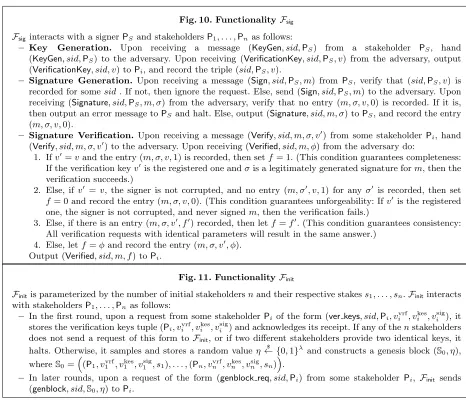
in Figure 2, we now focus on describing the differences from a single-chain execution of Ouroboros Praos. The protocol assumes the availability of functionalitiesFinit,Fdiff,Fvrf,Fsig,Fkes,Froas described in [13] and
surveyed in Appendix B for completeness. We treat it in the symmetric-bandwidth model withµ = 1 (cf. Section 3), a different bandwidth profile (with better downlink bandwidthµ >1) could be handled similarly and would lead to an increase in the number of chainsm.
In Πpc-pos we extend the block format ofΠPraos to also contain the index of a chainc ∈[m] as the first
Fig. 2. ProtocolΠpc-posm
The protocolΠpc-posis run by stakeholders, initially equal toP1, . . . ,Pn, interacting among themselves and with ideal functionalitiesFinit,Fdiff,Fvrf,Fsig,Fkes,Fro over a sequence ofL=ERslotsS= (sl1, . . . , slL) consisting ofE epochs withRslots each. DefineTijas in (1). ThenΠpc-posproceeds as follows for each stakeholderPi:
1. Initialization.
(a) Pisends (KeyGen, sid,Pi) toFvrf,FkesandFsig; receiving (VerificationKey, sid, vi) forvi∈ {vvrfi , v
kes
i , v
sig
i }, respectively. If this is the first round,Pisends (ver keys, sid,Pi, vvrfi , vikes, v
sig
i ) toFinitto claim stake from
the genesis block. In any case, it terminates the round by returning (Pi, vvrfi , vikes, vsigi ) toZ.
(b) In the next round,Pisends (genblock req, sid,Pi) toFinit, receiving (genblock, sid,S0, η). IfPiis initialized in the first round, it sets the local blockchains C = (Cc)mc=1 toCc :=G ,(S0, η). otherwise it receives the local blockchainsC= (Cc)mc=1from the environment.
After initialization, in each slotsl∗∈S(of epochej∗),Pi performs the following:
2. Epoch Update.If a new epochej∗ withj∗≥2 has started,Pi computesSj∗andηj∗ as follows:
(a) Sj∗ is the stake distribution recorded in the state GetValidTX
C|tj∗ −2
where C|tj∗ −2 ,
C|tj∗ −2
c m
c=1
are the currently held chains truncated up to slottj∗−2, which denotes the last slot of epochj∗−2.
(b) To computeηj∗, collect the blocksB= (c, st, d, sl, πB, ρ, σ)∈Ccbelonging to epochej∗−1up to the slot
with timestamp (j∗−2)R+ 2R/3 in any of the currently heldc-chainsCcforc∈[m], concatenate the valuesyρ(from eachρ) into a valuevin some fixed predetermined order, and letηj∗=H(ηj∗−1kj∗kv).
3. Chains Update.For allc∈[m],Pi performs the following steps:
(a) Pi collects all c-blocks newly received via diffusion, and collects all new c-chains that can be con-structed (respecting the previous-block hashes st) from these and past c-blocks into a set Cc, prun-ing blocks belongprun-ing to future slots and verifyprun-ing that for every chain C0c ∈ Cc and every block
B = (c, st, d, sl, πB, ρ, σ) ∈ C0c where sl belongs to epochej, parsingπB as (Ps, y, π) for some s and
ρas (yρ, πρ), it holds that: (i) y < Tsj;
(ii) Fvrf responds to (Verify, sid, ηjkckslkTEST, y, π, vsvrf) by (Verified, sid, ηjkckslkTEST, y, π,1); (iii) Fvrfresponds to (Verify, sid, ηjkckslkNONCE, yρ, πρ, vvrfs ) by (Verified, sid, ηjkckslkNONCE, yρ, πρ,1); (iv) Fkes responds to (Verify, sid,(c, st, d, sl, πB, ρ), sl, σ, vskes) by (Verified, sid,(c, st, d, sl, πB, ρ), sl,1). (b) PicomputesCc:=maxvalid(Cc,Cc), and updatesC= (Cc)mc=1.
4. Chains Extension.Pireceives from the environment the transaction datad∗∈ {0,1}∗to be inserted into the ledger. For allc∈[m],Pi performs the following steps:
(a) Send (EvalProve, sid, ηjkcksl∗kNONCE) toFvrf, get (Evaluated, sid, yρc, πcρ). (b) Send (EvalProve, sid, ηjkcksl∗kTEST) toFvrf, get (Evaluated, sid, yc, πc).
(c) Pi checks whether yc < Tij. If yes, it chooses a maximal sequence d 0
of c-transactions ind∗ that can be appended to GetValidTX(C) without invalidating it, and attempts to included0 into Cc as follows: It generates a new block B = (c, stc, d0, sl∗, πB, ρ, σ) where stc = H(head(Cc)), πB = (Pi, yc, πc),
ρ = (ycρ, πρc) and σ is a signature obtained by sending (USign, sid,Pi,(c, stc, d0, sl∗, πB, ρ), sl∗) to Fkes
and receiving (Signature, sid,(c, stc, d0, sl∗, πB, ρ), sl∗, σ).Pi computesCc:=CckB, setsCc as the new localc-chain and diffusesB.
5. Signing Transactions.Upon receiving (sign tx, sid0, tx) from the environment,Pi sends (Sign, sid,Pi, tx) toFsig, receiving (Signature, sid, tx, σ). Then,Pi sends (signed tx, sid0, tx, σ) back to the environment.
Fig. 3. Procedure maxvalid(C,C).
1. Drop all chains C0 from C that fork fromC more than k blocks (i.e., more than k blocks of C would be discarded ifC0was adopted).
2. Return the longest of the remaining chains. If multiple such chains remain, return eitherCif this is one of them, or return the one that is listed first inC.
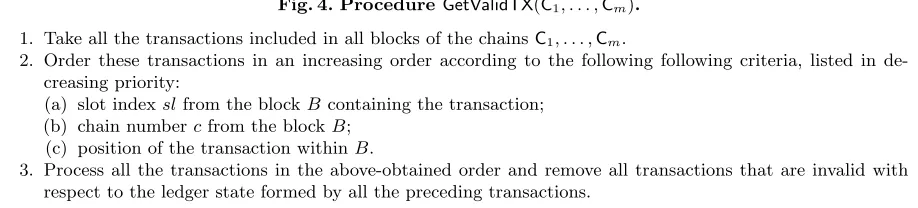
Fig. 4. Procedure GetValidTX(C1, . . . ,Cm). 1. Take all the transactions included in all blocks of the chainsC1, . . . ,Cm.
2. Order these transactions in an increasing order according to the following following criteria, listed in de-creasing priority:
(a) slot indexslfrom the blockB containing the transaction; (b) chain numbercfrom the blockB;
(c) position of the transaction withinB.
3. Process all the transactions in the above-obtained order and remove all transactions that are invalid with respect to the ledger state formed by all the preceding transactions.
Each party Pi executing Πpc-pos starts by requesting its verification keys for a VRF, a KES, and an
ordinary signature scheme, just like in the single-chain protocol. She claims its stake in the genesis blockG
(if she participates from the first round) and initializes allmchains to either consist ofG only (if this is the first round), or adopts chains received from the environment.
The sequences of transactions stored in the m individual blockchains are merged using the procedure
GetValidTX given in Figure 4. Any party Pi obtains the ledger state LPi[t] containing the transactions considered stable at timetas follows: given its current view of chainsC1, . . . ,Cm, she computeststableas the
maximum slot up to which allmchains are stable, i.e., the minimum slot index of ak-blocks-deep block in any of the chains.LPi[t] is then computed by merging the chains up to this slot usingGetValidTX. Formally,
tstable, min
c∈[m]slot
headCdkc and LPi[t]
,GetValidTXC|tstable
c
m
c=1
.
The stake distribution Sj and epoch randomnessηj for determining slot leaders in epoch j are derived in conceptually the same way as in the single-chain case. Namely, the stake distribution used is taken from the end of epochj−2, by looking at all chains up to that point and merging them using GetValidTX. The randomness ηj is obtained by hashing together all the yρ values included in all m chains in all blocks in epochj−1 up to its slot 2R/3. Slot leadership is determined independently for each party, each slot,and each chain, via the same VRF-based threshold mechanism as in Ouroboros Praos, and verified in the same way. Eligible slot leaders (for a particular chain Cc) simply create a block for this chain, and include all pendingc-transactions that are consistent with the current view of the chains.
Validity of a chain received from the network is determined as in the single-chain case, except that the transactions themselves are not validated at this point. Their validity can only be determined based on the state of the other chains.
5.3 Analysis
Robustness. We first establish the security ofΠpc-posm by proving that it implements a robust transaction
ledger against Byzantine adversaries with the same liveness asΠPraos and the error probability scaled by the
number of chainsm.
Theorem 2 (Robustness). Fix parametersk, ∆∈N;ξ1∈(0,1); let f denote the active slot coefficient in
Πpc-posm , let R = 24k/f be the epoch length, let L denote the total lifetime of the system. Let A ∈ Ab be a Byzantine-corruption adversary, letαH be a lower bound on the honest stake ratio throughout the execution. Letνandqbe upper bounds on the maximum stake shift over2Rslots, and the number of adversarial random oracle queries, respectively. Let uPraos andεPraos be as in Theorem 1. If
(αH−ν)(1−f)∆≥(1 +ξ1)/2
then the protocol Πpc-posm implements a robust transaction ledger with liveness parameter uPraos against A except with error probability at mostεrob=m·εPraos+ Pr [¬MaxDelay∆].
Proof (sketch). Observe that each of them chains produced during the execution ofΠm
pc-pos can be seen as
– the stake distributionSj taken from the state of all m chains at the end of epochj−2;
– the epoch randomnessηj derived from VRF-valuesyρ collected from appropriate blocks ofall mchains.
An analysis of the robustness argument for single-chain ΠPraos given in [13] shows that the argument is
not violated by these changes, the error probability merely needs to be adjusted by an additional factor m to account for a union bound over the failure probability for each of the chains. Since the analysis in [13] is performed in a model where all message delays are bounded by ∆, an additional additive term Pr [¬MaxDelay∆] accounts for the occurrence of longer delays in our model.
More concretely, the robustness of the single-chainΠPraosis derived from the simpler chain-specific
prop-erties of common prefix (CP), chain growth (CG), and chain quality (CQ), as defined in Section 2. First,CP,
CGandCQare established for a single-epoch execution of the protocol with a static-corruption adversary. As these arguments assume a fixed stake distribution and perfect epoch randomness, they can also be directly applied to a single-epoch execution of each of them chains of Πm
pc-pos under these assumptions. Second, it
is shown that any adaptive adversary is dominated by a particular static adversary, hence extending the single-epoch guarantees to adaptive adversaries as well: this argument can also be applied toΠpc-poswithout
modification. Finally, the analysis is extended to multiple epochs by analyzing the subprotocol for updating the stake distribution and randomness used for leader sampling. This analysis relies on the single-epoch bounds on CP, CG and CQ violations obtained above. Since inΠpc-posm this subprotocol depends on all m chains, we need to assume that single-epochCP,CGandCQare maintained on each of them, leading to the
additional factormin the final security bound. ut
Remark 1. Theorems 1 and 2 contain an error term Pr [¬MaxDelay∆] that, rougly speaking, restricts our security claims to adversaries that only induce∆-limited message delays. However, note that for very small∆, this probability may be non-negligible simply because the protocol itself (without adversarial interference) induces ∆-exceeding message delays due to message queuing in the recipients’ mailboxes. To understand the security guarantees provided for such small ∆, observe that both theorems hold in our model for an arbitrary value ofµ∈N. Considering the execution for higher values ofµ(thanµ= 1 for which the protocol is designed) decreases queuing times of the honest protocol messages, and asµ→ ∞, the probability of violating Pr [¬MaxDelay∆] purely by non-adversarial queuing delays becomes zero also for arbitrarily small ∆. This moves our model towards the throughput-unaware model of [13] and provides the best possible guarantees also for such small∆.
κ-Boundedness. We now investigate the delays caused by non-adversarial message queuing for our con-struction. Namely, we show thatΠm
pc-pos isκ-bounded except with probability negligible inκ, as long as the
number of chains m does not exceed a particular threshold. Intuitively, exceeding it would cause a block creation rate in the system to go too close to (or exceed) 1 and hence overload the recipients’ bandwidth.
First, we establish a general queuing lemma that will be used in our argument.
Lemma 1. Assume an L-slot execution of m≥1 queues each with service rate 1 per slot wherein, during any r slots, at most r overall messages get added to the queues. Then there is no slot where, at its very beginning, all queues together contain r+ 1 or more messages.
Proof. Consider the single-queue case — whereas the multi-queue case directly follows as the overall service is at least as large as in the single-queue case. For the sake of contradiction, consider the first slottwhere the queue contains at leastr+ 1 messages at its very beginning. Consider the oldest one of theser+ 1 messages and consider the first slott0 where this message was present at the beginning of the slot. It must hold that t0 ≥t−r+ 1 as, otherwise, there werer+ 1 messages in the queue at the beginning of slott0 < twheretis assumed to be the first such slot. This implies that allr+ 1 messages must have arrived within ther slots t−r, . . . , t−1, in contradiction to the assumption. ut
Lemma 2. Let κ∈N andξ2∈(0,1/2), letf denote the active slot coefficient inΠpc-posm . For any
m≤(1−ξ2)(1−f)/f , (2)
the probability that during an L-slot execution of Πm
pc-pos with A⊥ there is a slot where all parties’ outbox
queues together contain at leastξ2κ/3 blocks at the beginning of the slot is bounded by
Pout ≤L·exp
−ξ
2
2(ξ2κ−3)
9
.
Proof. For any fixed slot, let (αi)ni=1 denote the relative stakes of all currently participating parties, as
recorded in the stake distribution used for determining slot leaders for this slot. We first note that the expected number of blocks created in this slot (by all parties on all chains) is
m·
n
X
i=1
φf(αi) =m·
n
X
i=1
(1−(1−f)αi)
(a)
≤m·ln 1
1−f ≤m· f
1−f ≤1−ξ2,
where the inequality (a) follows from Jensen inequality and the observations thatg(n),n 1−(1−f)1/n
is increasing and converges to−ln(1−f) forn→ ∞.
Moreover, block-generation can be viewed as elementary independent experiments (one per slot, party, and chain) with respect to an indicator random variable Xi ∈ {0,1} where Xi = 1 denotes the respective success. Thus, the probabilityPoutthat, during any`out =ξ2κ/3−1 rounds, at least`outblocks are generated,
can be estimated by the Chernoff bound of Theorem 10 withµ= (1−ξ2)`outandδ=ξ2/(1−ξ2). The lemma
now follows by a union bound over the length of the execution and Lemma 1. ut
Lemma 3. Letκ∈Nandξ2∈(0,1/2), letf denote the active slot coefficient inΠpc-posm and letmsatisfy (2).
Consider an L-round execution of Πm
pc-pos with A⊥. Given that there is no round where all outbox queues
together contain at leastξ2κ/3blocks at the beginning of the round, the probability that there is a round where a party’sinbox queue contains at least(1−ξ2/3)κblocks at the beginning of the round is bounded by
Pin≤L·exp
−ξ
2 2
3
κ− 1
1−ξ2
.
Proof. Note that underA⊥, all parties’ inboxes behave identically. Along the lines of Lemma 2, we observe that the probabilityPin that, during any`in = (1−2ξ2/3)k−1 rounds, at least`in blocks are generated, is
upper bounded as above by the Chernoff bound (µ= (1−ξ2)`in andδ=ξ2/(1−ξ2)) and the union bound.
Additionally, at mostξ2κ/3 blocks that were already present in theoutboxqueues might get added to each inboxduring these`inrounds. We can hence conclude by Lemma 1 that the inbox never contains (1−ξ2/3)κ
blocks at the beginning of a round — except for the above probability. ut
The above lemmas allow us to establish theκ-boundedness of the protocolΠm
pc-pos.
Theorem 3 (κ-Boundedness). Let κ ∈ N and ξ2 ∈ (0,1/2), let f denote the active slot coefficient in
Πm
pc-pos and letmsatisfy (2). The probability that, during an L-round execution ofΠpc-posm withA⊥, there is
a block that incurs a delay of at leastκrounds, is bounded by
εκ≤Pout+ (1−Pout)Pin≤2L·exp
−ξ
2
2(ξ2κ−3)
9
.
Hence, the protocol Πpc-posm executed over a period ofLslots is(κ, εκ)-bounded.
Proof. Assume that some block has delay at leastκ= tout+tin spending tout rounds in the outboxqueue
andtin rounds in the inbox queue. Thus,tout ≥ξ2κ/3 or tin ≥(1−ξ2/3)κ. The respective probabilities are
Throughput. Now we focus on the throughput achieved by Πpc-posm , and express it as a parameter of the
number of chainsm.
Theorem 4 (Throughput). Fix parameters k, ∆ ∈N, ξ3 ∈(0,1/2], let f ∈(0,1) denote the active slot coefficient inΠm
pc-pos, assume that(1−f)∆≥1/2, and letfb,f(1−f)∆. LetA ∈Afsbe a fail-stop adversary, let αH ∈ [0,1] be a lower bound on the honest stake ratio throughout the execution, let ν be upper bound
on the maximum stake shift over 2R slots, and assume αcH , αH−ν > 0. The protocol Πpc-posm achieves (θ, L0)-throughput for anyL0≥(2k+ 3∆)/((1−ξ3)2αcHfb)and for
θ= (1−ξ3)2· 1−
k+ 4∆ (1−ξ3)2αcHf Lb 0
!
·αcH·fb·m (3)
against Aexcept with error probabilityεtp,4·m·exp −ξ32αcHf k/4
+ Pr [¬MaxDelay∆].
Before we prove Theorem 4, a brief discussion of the bound (3) is in order. Intuitively, the expected optimal throughput ofΠm
pc-posis roughlyαcH·f·m, as each of themchains contains a block with at least one
slot leader on expectation once in 1/f slots, and with probability at leastαcH this leader is not corrupted. There are three factors that separate the bound (3) from this optimum: First, the term 1−ξ3 allows us
to use a concentration bound (twice) and can be made arbitrarily small at the expense of increasing the minimum duration L0 to achieve the promised throughput. Second, the term 1−(k+ 4∆)/(cL0) pays for
the fact that the lastk blocks in each chain are not stable and hence if the investigated interval is at the end of the execution, these blocks don’t contribute towards the throughput. This term also diminishes with increasing L0. Finally, f is replaced by fbto account for possible occurrence of forks that are caused by
the probabilistic leader selection in ΠPraos in combination with message delays. Note that the assumption
(1−f)∆≥1/2 is natural: we are not interested in a parametrization that does not satisfy it, as (3) would result in a throughput below 1/2 anyway.
Finally, note that the observation from Remark 1 applies to Theorem 4 as well.
Proof (of Theorem 4). Consider an environment Z, let T ←$ Exec(Π,A,Z), and letI be a slot interval of length|I|=L≥L0. We will split the interval I into a prefix interval Ipref consisting of its firstLpref slots
of I (for Lpref given below), and a suffix interval Isuf of Lsuf = L−Lpref slots. We then argue that with
overwhelming probability:
(i) each chain contains at least (1−ξ3)2·αcH·fb·Lpref−2∆ blocks inIpref;
(ii) all m chains produced by Πm
pc-pos contain at least k blocks in Isuf, hence all blocks contained in all m
chains inIpref are stable.
Both parts will rely on establishing a lower bound on the chain growth of a single Ouroboros Praos chain in the presence of a fail-stop adversaryA, assuming message delays bounded by∆.
We will consider, along the lines of [19,13],∆-right isolated succcessful slots: these are slots that have at least one (uncorrupted) slot leader and the following∆slots do not have any leaders at all. We will call these slotsgood for brevity and denote bygood(t) a function that returns 1 iftis good and 0 otherwise. Moreover, letIpref0 ,[t1, t2] denote the intervalIprefwithout its first∆slots and letL0pref,|Ipref0 |=|Ipref|−∆=t2−t1+1.
For simplicity, we first consider the case without any fail-stop corruptions. Observe that in this case, the growth corresponding to the interval Ipref in a chain held by any party at the end of the execution is
lower-bounded by the number of good slots appearing inIpref0 . This is because any slot leaderPi of the first good slot ofIpref0 must have already seen all blocks in the chains held by all parties before the start ofIpref,
Let us now consider the effect of adaptive fail-stop corruptions. For a fixed chain c ∈[m], letWt(c) be a random variable that takes the value 0 if the slot t has at least one (uncorrupted) slot leader, and ⊥
otherwise (the symbols are chosen for consistency with [1]). Given the slot-leader selection rules of ΠPraos
(andΠpc-pos) described in Section 5.1, the probability that a particular slot has at least one slot leader for
chain c is exactlyf. Thanks to the local nature of the VRF-based leader-selection, Ahas no advantage in predicting a slot leader until he acts, and henceαcHf ≤Pr [Wt= 0]≤f.
To lower-bound the number of good slots inIpref0 , we will rely on a concentration bound for this quantity derived in [1] and detailed in Appendix C. More concretely, observe that the sequence of random variables Wt(1c), . . . , W
(c)
t2 corresponding to the interval I
0
pref satisfies the (f,1)-characteristic condition according to
Definition 7 and we can invoke Lemma 8 withγ = 1 anda=αHfc to bound the probability of having too few good slots by
ppref,Pr
X
t∈I0 pref
good(t)≤(1−ξ3)2·αcH·fb·L0pref−∆
≤2 exp −
ξ2 3·αcH
2
·f2·L0
pref
4
!
.
SinceL0pref=Lpref−∆and (1−ξ3)2·αcH·fb≤1, this establishes (i).
We now consider the intervalIsuf forLsuf ,(k+∆)/(1−ξ3)2αcHfb+∆, and similarly as before, we define
Isuf0 to denote the interval ofLsuf−∆ slots obtained when removing the first∆slots fromIsuf. By the same
argument as above, we observe thatIsuf0 will contain at leastkgood slots with an uncorrupted leader (and henceIsuf will contain at leastkblocks) except with errorpsuf ,2 exp −ξ23αcHf k/4
, establishing (ii). Hence we can conclude that for Lsuf given above andLpref ,L−Lsuf, the intervalIpref contains at least
(1−ξ3)2·αcH·fb·m·L
0
pref−∆stableblocks in allmchains except with probabilitym·(ppref+psuf), resulting in
the throughput parameterθin (3). Under the assumptionL0≥(2k+3∆)/((1−ξ3)2αHcfb) we haveppref≤psuf
and the bound onεtpin the theorem statement follows. ut
Finally, we instantiate the result of Theorem 4 with the maximum number of chainsmthat still guarantees κ-boundedness of the resulting protocolΠpc-posm according to Theorem 3.
Corollary 1. Under the notation and assumptions introduced in Theorems 3 and 4. the protocol Πpc-posm
for m = (1−ξ2)(1−f)/f is (κ, εκ)-bounded for any κ and achieves (θ, L0)-throughput against fail-stop adversaries for any L0≥(2k+ 3∆)/((1−ξ3)2αHcfb)and
θ= (1−ξ2)·(1−ξ3)2·(1−f)∆+1· 1−
k+ 4∆ (1−ξ3)2αHcf Lb 0
!
·αcH
except with error probabilityεtp.
Remark 2. Note that, above, throughput optimality was only demonstrated in presence of a fail-stop ad-versary. In [2], with respect to PoW, the important observation was made that separating transaction (or fruit) mining from the mining of structural blockchain blocks (called proposer blocks in [2]) along the lines of [18,35] not only gives you fairness but can also be applied in order to optimize throughput in presence of a Byzantine adversary. This is basically achieved by having the transaction blocks mined at a fast rate to make full use of the network bandwidth while having the proposer blocks still mined at a small rate to guarantee robustness of the ledger, and by additionally applying randomized transaction sharding.
We note that, along the same lines, also our PoS parallel-chains construction can be adapted in order to achieve throughput optimality in presence of a Byzantine adversary. For this, we can apply the input-endorser construction of [21] to every individual chain where a party is randomly elected to be either a slot leader or an input endorser. Note that, as a main difference to [2], endorser and leader election will both still run at the same (slow) rate while bandwidth utilization is optimized by chain parallelism.
anticipated orphan blocks, and by adding those respective transactions to the ledger as well. Note that, opposite to the previously mentioned DAG protocols (e.g. [27]), this has no degrading effect on liveness, as the per-chain block rate is not accelerated but kept at a safe level.
6
PoW Parallel Chains Without Synchronized Clocks
We now turn our attention to the proof-of-work setting. We first remark that if parties are assumed to have access to (roughly) synchronized clocks, one can construct a parallel-chains protocol fully analogous to Πpc-pos given in Section 5, where slot indices are replaced by timestamps.
Namely, each block will contain the local timestamp of the miner at the time of composing the block. A party adopts a block added to a particular chain Cc only if the block’s timestamp is larger than the timestamp of its predecessor, and, if its timestamp lies in the past of the local time. Finally, to produce the ledger state, the blocks of all chains get sorted primarily by timestamp and secondarily by the chain index, and most recent blocks are again dropped. The assumed bound on local clock skew (together with the single-chain propertiesCP,CG, andCQfrom Section 2) will then ensure that blocks of sufficient depth in their local chains will be guaranteed to have a lower timestamp than any block that will be accepted in the future.
Although the assumption of roughly synchronized clocks is standard in the PoS literature, it is known that the PoW-based consensus can be (in the setting with constant difficulty) achieved also without this assumption (cf. the consensus protocols in [18]). Therefore, we refrain from discussing further details of this construction; instead, in this section we present a more elaborate construction for the PoW setting that does not rely on the synchronized clocks assumption (but does assume constant difficulty).
6.1 Elements of Bitcoin
We describe an abstraction of the Bitcoin blockchain along the lines of [19]. The Bitcoin blockchain C
consists of blocks B = hhr, xi, ctri where r is a reference to the predecessor block of B, x is the block payload containing the transactions, andctris a counter. The protocol involves a cryptographic hash function H :{0,1}∗→ {0,1}κ used for referencing a block from within another block, and used for generating proofs of work. We modelH as a random oracle [4]. The chainCis a sequence ofnblocks (Bi)n
i=1such thatB1=G,
and, for i >1,Bi=hyi=hri, xii, ctriisatisfies thatri =H(Bi−1),H(H(yi−1), ctri−1). The actual block
Bi−1referenced byH(Bi−1) fromBi is denoted byR(Bi). Additionally, for some predefined number`∈N, a non-genesis blockB must satisfy that the valueH(B) contains` leading zeroes, i.e.,H(B)< M ,2κ−`. We callp= 2−` themining-hardness parameter.
In order to mine a new block containing payloadx, a party must assemble his blockB=hy=hr, xi, ctri
such thatr=H(head(C)) whereas the valuectris initialized to some value and incremented untilH(B)< M — constituting the proof of work. Once such a block has been found it can be published to be included in the other parties’ views of the blockchain.
A block is valid if it is composed as described above and the payload is well-formed and semantically self-consistent.2 A blockchain isvalidif it is composed as described above, and all involved blocks are valid
whereas their payloads do not contradict each other. The ledgerLas a sequence of transactions is extracted from the longest observed valid chain Cby listing all transactions ofCdk in order of appearance wherek is a protocol parameter. Along the lines of stable transactions, a blockB ∈Cdk is called stable.
We assume that there arenmining parties in the protocol, all having equal hashing power, whereas we assumet of them to be controlled by the adversary. The protocol proceeds in rounds whereas each round corresponds to a time slot as defined in Section 2. For the argumentation from a global view, we still assign each round a unique slot number. Note, however, that the parties do not have synchronized clocks, and thus, this global slot number is not known to the parties. Along the lines of [19], during a single round, every party executes q∈N queries to the PoW instance in an attempt to mine a new block whereasq is the maximal
2
number of queries executable within the time bounds of one slot.3 At the end of the round, the party is instructed to execute the diffusion of all successfully mined blocks.
6.2 The Construction
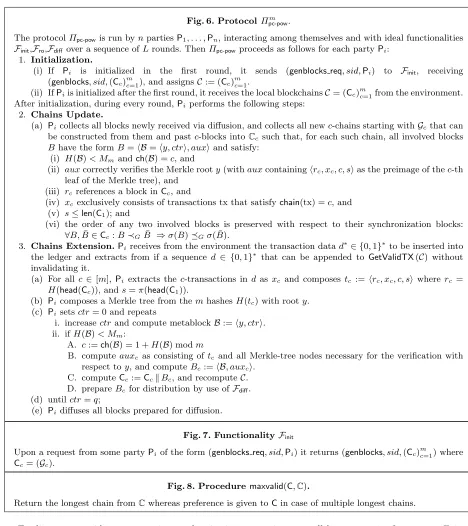
We start with a brief overview of the construction. Our protocol Πpc-powm involves a tuple C = (Cc) m c=1
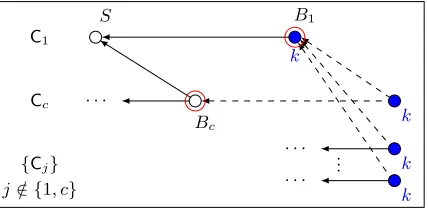
of individual Bitcoin chains that are operated in parallel involving transaction sharding whereas only c -transactions are allowed to be part of chainCcas in Section 5.2. In order to mine a block, the miner prepares a metablockBto simultaneously represent a blockBcconsisting ofc-transactions for every single one of the m chains. The miner then computes his PoW on the metablock whereas the PoW may be successful with respect to at most one of the chains. If the PoW on the metablock has been successful with respect to chain indexc, the miner extracts the respective blockBc, appends it to his local chainCc, and diffuses the block to the network. As a substitute for missing synchronized clocks, we make use of a dedicated synchronization chain that gets loosely cross-referenced from blocks of the remaining chains.
For simplicity, we assume m = 2z for some z ∈
N. Each chain Cc is initialized with a genesis block
Gc. The first chain, C1, is called synchronization chain. A block in the synchronization chain is called a synchronization block. Each block extends exactly one chain — the index of the chain a blockB extends is denoted bych(B)∈[m]. For a blockB∈Cch(B), we denote its height byπ(B) whereasπ(Gc) = 1.
Similar to Bitcoin, a block can be viewed as having the structure B =hy=hr, x, c, si, ctr, auxiwhereas r is a reference-by-hash to the predecessor block ofB in Cch(B), xis the payload, c =ch(B), and ctr is a
counter as above. In order to facilitate transaction sharding,yis in fact only a hash value whereashr, x, c, si
is to be recovered fromy together with the auxiliary information inaux— the respective details as well as the definition of the metablock are given later. We denote byR(B) the predecessor block referenced fromB in chainCch(B) by means ofr.
Entry s(also denoted by s(B) in the following context) is to contain the length of the synchronization chain that was observed by the party mining the block at the point it was mined. The reference is used as a variable reference fromB to a block in the synchronization chain that is robust against block pruning (as opposed to using a hash reference). We definethe synchronization block ofB as
σ(B) =
R(B) ifB ∈C1,
B1 ifB 6∈C1 and∃B1∈C1, such thatπ(B1) =s(B),
⊥ otherwise.
Note thatσ(B) is well-defined, as the block B1, if it exists, is unique.
Extending our set notation, we writeB∈ C iff there is an indexjsuch thatB∈Cj. ByCdk we denoteC where the lastkblocks of each involved chain have been removed: Cdk=Cdk
c
m
c=1.
Proof-of-work makes use of the same hash function as the underlying single-chain protocol,H :{0,1}∗→
{0,1}κ (modeled as an RO) with the goal that PoW not only tells a miner whether he is allowed to add a block but also which chain the block has to be appended to. We set `m ,`−log(m), Mm ,2κ−`m, and
thereby adjust the (overall) mining hardness topm=mp. PoW now uniformly assigns successes over all m chains as follows — yielding the same per-chain mining hardness as in Bitcoin.4 For genesis blocks we define
ch(Gc) :=cwhereas, for a non-genesis blockB (represented by a metablockBwithH(B)< Mm), we define
ch(B) := 1 +H(B) modm. ModelingH as an RO makes this assignment uniformly random, and known to the miner only after the PoW has been completed (with overwhelming probability).
To summarize, a block is eligible to be mined for chainCc iff its metablockBsatisfiesch(B) =cwhereas, as given by the involved RO, the value ofch(B) is random and becomes known to the miner only after the
3
Note that, in order to facilitate our analysis in context of network-bandwidth limitations, we deviate from the
∆-bound model of [19] by defining one round by the length of the time slot required to send a block to the network (cf. Section 3) — instead of the time required to perform one single PoW query. Along the lines of theirsynchronous model, we thus allow each party to perform someq∈Nqueries per round.
4 Note that we can safely assume that`≥logmas the opposite is ruled out by our Bound (5) onmunder which