Securing Vehicular Ad Hoc Networks from
Sybil Attack
Priya Agrawal1, Dushyant Singh2
M. Tech Scholar, Chandravati Group of Institutions, Bharatpur, Rajasthan, India1
Assistant Professor, Department of CSE, Chandravati Group of Institutions, Bharatpur, Rajasthan, India2
ABSTRACT: There are various attacks that can hamper the efficiency of VANET major of them is Sybil attack. In Sybil attack the attacking node creates multiple forge identities in order to gain a generously large influence. In this paper Extended Genetic Algorithm is applied to remove Sybil attacks in VANET. In the proposed work Extended Genetic Algorithm will be applied with fitness function optimization. In this paper Genetic Algorithm is applied to mitigate Sybil attacks in VANET. In starting, the K-mean for clustering the VANET nodes have been utilized according to their distances among them. Next, the intelligent CH election utilizing soft computing methods that involves sequential hybrid Fuzzy-Genetic controller for this decision making have also been used. Proposed approach is able to locate Sybil nodes quickly without the requirement of secret information exchange and special hardware support. We evaluate our proposed approach on the realistic traffic scenario. Experiment results demonstrate that detection rate increases when optimal numbers of Sybil nodes are forged by the attacker.In this, we also compare our results with previous existing technique to show the enhancement we have done through our paper. The results are being evaluated on the basis of throughput; the whole stimulation model takes place in OPNET environment.
KEYWORDS: VANET, Security, Genetic Optimization Algorithm, Fuzzy-Genetic Controller, AODV, Clustered-AODV.
I. INTRODUCTION
Vehicular Ad-hoc Network (VANET) is a part of an ad hoc network. Vehicle in VANET interact with close vehicle or road side unit(RSU) that are fitted on vehicle or at the intersection and parking lots.[1] In VANET, two kinds of com-munication is done: vehicle to vehicle (V2V) and Vehicle to infrastructure(V2I). In V2V comcom-munication close vehicles transfer or obtain data utilizing short range communication facilities i.e. Wi-Fi and WAVE. Vehicle has a particular electronic gadget that permits them to obtain or relay messages. In V2I, vehicle interact with nearby rode infrastructure unit (RSU) by utilizing Wi-Fi hotspots or long range wireless communication techniques to transfer the data.[2][3]In VANET, Some applications need group interaction Services. Thus Multicast routing is the most effective technique, overcoming the broadcast and unicast routing. The quick change in the network configuration, the nodes high speed and other VANET characteristics, build the multicast routing a major challenge in vehicular scenarios. Thus, a Proficient protocol to manage a good performance in the transmission/reception of multicast packets is needed. In VANET network for transmitting data whole mobile nodes acts as router involving source and destination nodes transferring data the whole mobile nodes act as a router as well as source and destination node.
many routing protocols and cluster based protocols have been introduced for VANET and famous among them are AODV and DSR [8].
II. INTELLIGENT CLUSTER MANAGEMENT
The clustering methods present network scalability and to yield more effective usage of network equipments. It can be utilized for routing, resource management and location management for decreasing communications, unessential flooding RREQ packets and calculation overhead. In this section, intelligent cluster head election, cluster structure and communication techniques have been shown.
At the starting of the implementation and before the nodes movement (when time equal to zero), the setup stage requires to be started. In this state, every network node is allocated with particular information as follows:
The current geographical position within the particular region.
The transmission speed node (mobility).
The battery power (0-1.4)
The speed limit 0-10 m/sec with pause time 20 sec.
The next geographical location after movement.
Random way point mobility mode has been utilized by defining the current and next position arbitrarily. With presentation that every node move from its current position in straight direction to the next position at the particular speed.
After allocating the properties of the network and the nodes in setup stage, the distance matrix is computed to describe the nodes connectivity and the distances among them. This process needs the usage of the Euclidean equation depending on the position coordinate of every node with its neighbouring nodes.
Fig 1: The K-mean Clustering Algorithm
Intelligent Cluster Head Election: The challenge task in the design is the intelligent head nodes election. This phase utilizes soft computing methods (Fuzzy system and Genetic algorithm) to choose the optimal head nodes that are capable to send the data through network in flexible way. There are several algorithms shown for cluster head election in network community. The introduced intelligent cluster head election design should pass via two phases: the genetic algorithm, and the fuzzy system. This consideration is made to assure that the combination of these two tools will support to obtain the advantages of both methods.
Clustered-AODV-based Routing Stage: In this phase changes in AODV protocol has been performed to be in line with intelligent clustering method in prior phase. After clustering and elects CHs in intelligent manner, two kinds of routing in the cluster-AODV network have been mentioned.
Intra-Cluster Routing phase: However AODV is a reactive routing protocol, the source and target nodes are mentioned first then the routing process will start. If the source and destination positioned in one cluster only, the AODV routing algorithm will perform inside this cluster without broadcasting the RREQ packets outside for searching the route. This is performed by selecting the shortest path between the source and target node in normal way.
Inter-Cluster Routing phase (the intelligent phase): The best route among the CHs in the network is determined which shows the optimal distance (minimum distance). This route will be taken as the backbone or the highway among the clusters to interact with each other directly through it. There are two conditions in inter-cluster routing:
The first situation when the source and destination positioned in various clusters which are at distance to each other (out of transmission range of signal). The CHs of them cannot link directly due to restricted transmission range and the packet cannot be arrived. In this case the source node utilizes classical AODV routing protocol within its cluster to arrive the CH by taking it as a local destination node. And then link to the CH of the destination via the backbone route. After arriving the destination CH return to utilize classical AODV routing protocol to arrive the final destination node in the cluster. This means that the route outside the cluster behaved proactively not reactively until arrive the CH of the target node, then the packet send to the destination node by utilizing the classical AODV protocol.
The second situation when the source and destination positioned also in different clusters but in the same signal transmission range. In this case the CHs of them will be linked directly without requirement of use the backbone path of CHs. Because the CH of destination node is reachable transmission range. This yields to decrease the resource exhaustion particularly the CHs of other clusters that not participating in the interaction.
Genetic Algorithm Stage
In this phase, the introduced method of GA when used to optimize the CH election has been explained. Table (1) represents the control parameters of GA managed in the simulation.
The GA phase includes the following steps;
Chromosome Encoding step: The first step in GA design is encoding the chromosomes. In the followed design, this
will be the network CHs. Thus the length of chromosome is variable as the size of cluster. For example when the size of cluster is five the no. of genes in one chromosome is five and every gene show the ID of every CH in the network as illustrated in Fig (3). For the network size 100 node, the ID should not more than 100. In the simulation, various cluster size requires to be inquired from two clusters to twelve to view the effect of changing cluster size to the performance criteria. This means that the length of chromosome should change from two to twelve.
Fig 3: Chromosome representation when cluster size is five and network size is 100 nodes.
Fitness Evaluation step: The fitness evaluation is the significant step in the algorithm because it decides the optimization algorithm accuracy. It is detected which one of the population is the best to support to the next generation and become strong candidate to win the optimization.
The introduced algorithm utilizes an integration influencing factors that show weight metric to search dominant set. The total weight is composed by three influencing factors. These are;
i- Battery power of CHs (E) ii- Distances between CHs (D) iii- Mobility of CHs (M)
All these factors can be integrated together in one equation that shows the fitness equation.
Where w1, w2, w3 are the weighting factors for the corresponding system control parameters and Wout is the fitness output. Every influencing factor can be achieved from the node information and nature. The weighting factors will be treated in FIS phase.
Crossover and Mutation step: In the first operator, one point crossover has been utilized to create new chromosomes from old ones. Next, the population generation sorted depending on the fitness evaluation from the best to the worst candidate’s chromosomes and crossover between each pairs as illustrated in Fig (4). The mutation operation is very simple but significant to prevent the locally optimum result.
Fig 4: The one point crossover in five cluster size and 100 network size.
Selection step: This step selects which chromosome will be hold in the next generation and which one will be dropped. This procedure achieved by determining the best chromosomes in the population utilizing the following equation:
Where Fitness shows the vector of descending order from best to worse chromosomes after GA operation and pop shows the size of population of GA. The best fitness of the population shows the best CHs selected according to all the three parameters explained before. At last, the algorithm can be iterated many times to obtain the best results. This is due to the first attempt is not essentially provides optimal chromosomes. This iteration in the algorithm known as the iteration no. which requires a stop condition to be deployed in the introduced system.
Fuzzy Logic Controller Stage
The primary challenge in the optimization of CH election for VANET is to introduce a flexible algorithm that can be prepared to the broad variety of situations in any VANET atmosphere. The algorithm should behave professionally in atmosphere experience i.e. limited battery power, high nodes mobility and some wireless transmission restraints. Because it is usually hard to know which node will endure from its atmosphere and because the atmosphere can change unpredictably, the algorithm must be capable to adapt automatically. The Fuzzy Logic Controller (FLC) is a highly adaptive algorithm that can be utilized to obtain these objectives.
1. Minimum weighting factor of average distance between elected CHs.
2. Maximum weighting factor of average battery power (energy) of elected CHs. 3. Minimum weighting factor of average mobility of elected CHs.
III. PROPOSED SYSTEM SIMULATION AND EVALUATION
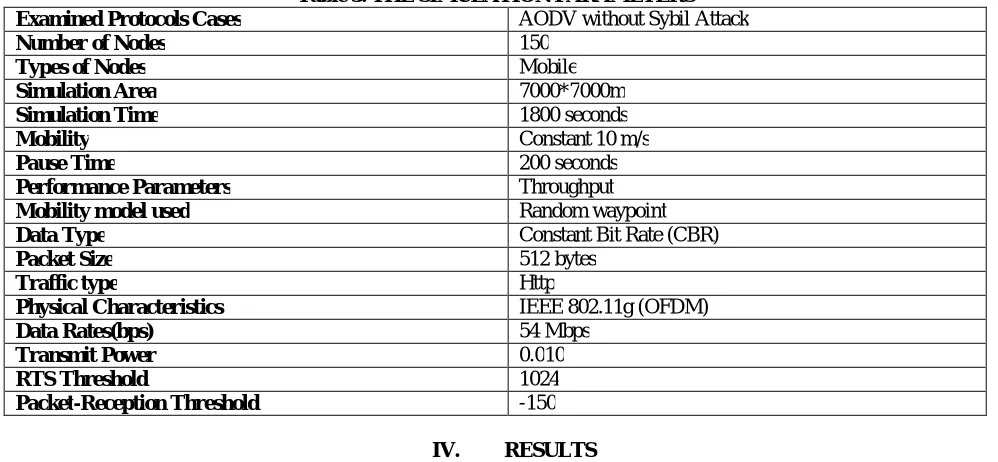
The nodes are positioned arbitrarily and move randomly in Random Way Point model. The simulation has been done by employing OPNET, a high performance language for technical computing. OPNET characterizes a family of add-on application particular solutions known as toolboxes. Very significant to most subscribers of OPNET, toolboxes permit learning and using specialized technology [11]. Table (3) represents the simulation atmosphere parameters utilized in the measurement. We take a network of nodes positioned arbitrarily in different arrangements (one source and one destination) within a 7000m X 7000 m area. The performance of intelligent CH election is measured by changing the network size (no. of nodes) ranges 20 to 100 and cluster size partitions into two groups: low clustered network (Group 1) 2 to 6 cluster and high clustered network (Group 2) 7 to 12 cluster. The introduced intelligent CH election system is checked against three parameters i.e. mobility degree, Average energy and average distance between CHs to compute the optimality and reliability of the control system.
Table 3. THE SIMULATION PARAMETERS
Examined Protocols Cases AODV without Sybil Attack
Number of Nodes 150
Types of Nodes Mobile
Simulation Area 7000*7000m
Simulation Time 1800 seconds
Mobility Constant 10 m/s
Pause Time 200 seconds
Performance Parameters Throughput
Mobility model used Random waypoint
Data Type Constant Bit Rate (CBR)
Packet Size 512 bytes
Traffic type Http
Physical Characteristics IEEE 802.11g (OFDM)
Data Rates(bps) 54 Mbps
Transmit Power 0.010
RTS Threshold 1024
Packet-Reception Threshold -150
IV. RESULTS
After presenting the basic results of all simulations carried out in both scenarios, in this chapter, we analyse and discuss all these results. The performance metrics collected and presented in our results are either based on the object statistics or global statistics of the VANET model i.e. the entire network. In representing these data, we presented the average or time average values of the results in this report. We start our discussion and analysis with the two main scenarios in which the first scenario comprises of 150 mobile nodes and the latter holds 200 mobile nodes. In each scenario, we performed two simulations of a regular network operation in VANET and a VANET a Sybil attack to be precise. All simulations i.e. both scenarios were run for a time period of 30 minutes, which ranged from 0 to 1800 seconds as shown in the result graphs. After that, we analyse and compare within each scenario and also both scenarios based on their throughput and end-to-end delay. The overall simulation performance is presented in nutshell in the following table, which indicates that the elimination of Sybil attack scenario provides the better results and try to normalize the Sybil effected network to its normal state as close as possible.
Throughput:
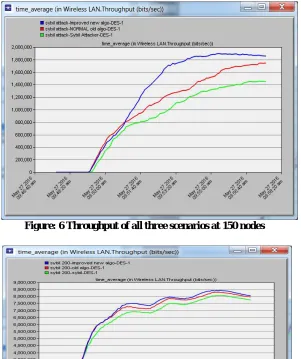
the network that is under the Sybil attack and scenario 3 represents the mitigation of Sybil attack by using our proposed approach and implementation of the proposed method.
There are some factors that affect the throughput such as; changes in topology, availability of limited bandwidth, unreliable communication between nodes and limited energy. A high throughput is absolute choice in every network. In figure the graph represents the throughput in bits per seconds. The x-axis denotes the simulation time in minutes and the y-axis denotes throughput in bits per seconds. It can be clearly seen, that the Sybil attack decreases the overall network throughput in comparison to the normal network state. However, the entire network throughput is increased once the proposed unified mechanism is implemented. In addition to this, the state of the throughput has increased more than the no attack scenario after implementing the unified security mechanism.
Figure: 6 Throughput of all three scenarios at 150 nodes
V. CONCLUSION
In this paper, a robust detection and prevention mechanism against Sybil attack in VANET is addressed. In Sybil attack, a malicious node fabricates different identities in the form of multiple nodes. These fabrications that behave like normal nodes deceive and mislead neighboring vehicles by communicating with other physical nodes and distributing false traffic information (e.g., traffic jam or accidents).
In this research work, the network performance under Sybil attack is analysing and improving by applying integrated approach of genetic algorithm and K means clustering. This genetic based integrating approach is implemented on the selected nodes on the network and deployed in the specific area i.e 7000 x 7000 m. The findings of the research clearly states that, the implementation of such genetic based integrating approach have a significant impact on the overall network through positively. On the other hand, the implementation of such mechanisms does not only mitigate the Sybil attack effects, it also increases the overall performance above the normal state of the network. The proposed mechanism satisfactorily mitigated the effects of the Sybil attack on the network and increased the overall performance of the network. The data dropped rate decrease successfully. Our scheme is simple and efficient as compared to existing detection approaches because it does not require secret information exchange and special hardware support. As a part of future work, we would like to perform the experiments with varied transmission ranges of vehicles and with different number of Sybil identities used by attacker simultaneously. We also would like to investigate the processing time, storage capacity and communication overhead of proposed approach.
REFERENCES
[1] Anjum A. Mohammed, Gihan Nagib, “Optimal Routing In Ad-Hoc Network Using Genetic Algorithm”,Int. J. Advanced Networking and Applications, vol. 03, Issue. 05, pp. 1323-1328, 2012.
[2] Ashutosh Lanjewar, Neelesh Gupta, “Optimizing Cost, Delay, Packet Loss and Network Load in AODV Routing Protocol”, (IJCSIS) International Journal of Computer Science and Information Security,Vol. 11, No. 4,April2013.
[3] P. Karthikeyan, S. Baskar, A. Alphones, “Improved genetic algorithm using different genetic operator combinations (GOCs) for multicast routing in Ad-hoc networks”, Springer, vol-17, pp. 1563-1572, 2013..
[4] Samara, Wafaa A.H. Al-Salihy, R.sures, “Ghassan Security Analysis of Vehicular Ad hoc Networks”2010 International Conference on Network Applications,Protocols and Services.
[5] Verma, K.; Hasbullah, H.; Kumar, A., "An efficient defense method against UDP spoofed flooding traffic of denial of service (DoS) attacks in VANET," Advance Computing Conference (IACC), 2013 IEEE 3rd International , vol., no., pp.550,555, 22-23 Feb. 2013
[6] Grzybek, A.; Seredynski, M.; Danoy, G.; Bouvry, P., "Aspects and trends in realistic VANET simulations, Wireless, Mobile and Multimedia Network, 2012 IEEE International Symposium on a , vol., no., pp.1,6, 25-28 June 2012
[7] Jie Li, Huang Lu, “ACPN: A Novel Authentication Framework with Conditional Privacy-Preservation and Non-Repudiation for VANETs” , IEEE Transactions on Parallel and Distributed Systems, 2012
[8] Chim, T.W.; Yiu, S.M.; Hui, L.C.K.; Li, V.O.K., "VSPN: VANET-Based Secure and Privacy-Preserving Navigation," Computers, IEEE Transactions on , vol.63, no.2, pp.510,524, Feb. 2014[9] Yen-Wen Lin; Guo-Tang Huang, "Optimal next hop selection for VANET routing," Communications and Networking in China (CHINACOM), 2012 7th International ICST Conference on , vol., no., pp.611,615, 8-10 Aug. 2012
[10] Dalbir Singh and Manjot Kaur, “Mitigation of Sybil Attack Using Location Aware Nodes in VANET”, International Journal of Science and Research (IJSR), Volume 4 Issue 11, November 2015
[11 ]Jaydip Kamani and Dhaval Parikh, “A Review on Sybil Attack Detection Techniques”, Journal for Research, Volume 01, Issue 01, March 2015 [12] Kewei Sha, Shinan Wang and Weisong Shi, “RD4: Role-Differentiated Cooperative Deceptive Data Detection and Filtering in VANETs”, International Journal of Network Security & its Applications(IJNSA), Vol 3, No.6, 2010.
[13] Hamieh, A.; Ben-othman, J.; Mokdad, L., "Detection of Radio Interference Attacks in VANET," Global Telecommunications Conference, 2009. GLOBECOM 2009. IEEE , vol., no., pp.1,5, Nov. 30 2009-Dec. 4 2009
[14] Lyamin, N.; Vinel, A.; Jonsson, M.; Loo, J., "Real-Time Detection of Denial-of-Service Attacks in IEEE 802.11p Vehicular Networks," Communications Letters, IEEE , vol.18, no.1, pp.110,113, January 2014
[15] Yeongkwun Kim; Injoo Kim; Shim, C.Y., "A taxonomy for DOS attacks in VANET," Communications and Information Technologies (ISCIT), 2014 14th International Symposium on , vol., no., pp.26,27, 24-26 Sept. 2014
[16] Verma, K.; Hasbullah, H.; Kumar, A., "An efficient defense method against UDP spoofed flooding traffic of denial of service (DoS) attacks in VANET," Advance Computing Conference (IACC), 2013 IEEE 3rd International , vol., no., pp.550,555, 22-23 Feb. 2013
[17] Li He; Wen Tao Zhu, "Mitigating DoS attacks against signature-based authentication in VANETs," Computer Science and Automation Engineering (CSAE), 2012 IEEE International Conference on , vol.3, no., pp.261,265, 25-27 May 2012
[18] Pooja, B.; Manohara Pai, M.M.; Pai, R.M.; Ajam, N.; Mouzna, J., "Mitigation of insider and outsider DoS attack against signature based authentication in VANETs," Computer Aided System Engineering (APCASE), 2014 Asia-Pacific Conference on , vol., no., pp.152,157, 10-12 Feb. 2014
[20] Nafi, N.S.; Khan, R.H.; Khan, J.Y.; Gregory, M., "A predictive road traffic management system based on vehicular ad-hoc network," Telecommunication Networks and Applications Conference (ATNAC), 2014 Australasian , vol., no., pp.135,140, 26-28 Nov. 2014 [21] Kumar, A.; Sinha, M., "Overview on vehicular ad hoc network and its security issues," Computing for Sustainable Global Development (INDIACom), 2014 International Conference on , vol., no., pp.792,797, 5-7 March 2014
[22] Mehta, K.; Malik, L.G.; Bajaj, P., "VANET: Challenges, Issues and Solutions," Emerging Trends in Engineering and Technology (ICETET), 2013 6th International Conference on , vol., no., pp.78,79, 16-18 Dec. 2013
[23] Nafi, N.S.; Khan, J.Y., "A VANET based Intelligent Road Traffic Signalling System," Telecommunication Networks and Applications Conference (ATNAC), 2012 Australasian , vol., no., pp.1,6, 7-9 Nov. 2012
[24]Performance Comparison Of AODV and DSDV Routing Protocols in Mobile Ad Hoc Networks, Aditi Sharma,Sonal Rana, Leena Kalia, International Journal of Emerging Research in Management and Technology, ISSN:2278-9359 Volume-3, Issue-7, July 2014.
[25] Ait Ali, K.; Baala, O.; Caminada, A., "Routing Mechanisms Analysis in Vehicular City Environment," Vehicular Technology Conference, 2011 IEEE 73rd , vol., no., pp.1,5, 15-18 May 2011
[26] Bhoi, S.K.; Khilar, P.M., "A secure routing protocol for Vehicular Ad Hoc Network to provide ITS services," Communications and Signal Processing (ICCSP), 2013 International Conference on , vol., no., pp.1170,1174, 3-5 April 2013