R E S E A R C H
Open Access
Robust constrained waveform design for
MIMO radar with uncertain steering vectors
Xianxiang Yu
1, Guolong Cui
1*, Marco Piezzo
2, Salvatore Iommelli
3and Lingjiang Kong
1Abstract
This paper considers the robust waveform design of multiple-input multiple-output (MIMO) radar to enhance targets detection in the presence of signal-dependent interferences assuming the knowledge of steering vectors is imprecise. Specifically, resorting to semidefinite programming (SDP)-related technique, we first maximize the worst-case
signal-to-interference-plus-noise ratio (SINR) over uncertain region to optimize waveform covariance matrix forcing a uniform elemental power requirement. Then, based on least square (LS) approach, we devise the waveform
accounting for constant modulus and similarity constraints by the obtained waveform covariance matrix using cyclic algorithm (CA). Finally, we assess the effectiveness of the proposed technique through numerical simulations in terms of non-uniform point-like clutter and uniform clutter.
Keywords: Robust waveform design, Multiple-input multiple-output (MIMO), Signal-dependent interferences, Signal-to-interference-plus-noise ratio (SINR), Waveform covariance matrix, Constant modulus and similarity constraints
1 Introduction
Recently, some advances in radar technology including digital arbitrary waveform generators, solid state trans-mitters, and high-speed and off-the-shelf processors [1–3] have been greatly developed, making possible for modern radar systems to adaptively adjust the synthesized trans-mit waveform to detect environment. This adjustment of transmit waveform can be used to significantly enhance its ability of target detection, identification, and classifi-cation. Nevertheless, usually, these techniques suffer from inaccuracies on the knowledge of the actual target/clutter processes, which is necessary to ensure an effective adaptation.
Robust waveform design to resist uncertainty sets of target or clutter parameters (i.e., Doppler frequency, angle) has received considerable attention during the last decades [4–19]. According to the structure of radar sys-tems, these works can be classified into two categories. The first one focuses on the robust design for mono-static radar systems. Specifically, in [4], the design of robust radar code under energy and similarity constraints
*Correspondence: [email protected]
1School of Electronic Engineering, University of Electronic Science and Technology of China, 2006 Xi Yuan Ave, West Hi-tech Zone, Chengdu, China Full list of author information is available at the end of the article
is investigated to improve the worst-case signal-to-noise ratio (SNR) over the possible target Doppler frequencies by using semidefinite programming (SDP)-related tech-nique. In [5], the robust approach based on SDP and randomization with respect to the target Doppler is pro-posed to synthesize the radar waveform accounting for a peak-to-average-power ratio (PAR) and an energy con-straint in order to the improvement of the worst-case SNR. For the detection problem of the extended tar-get with the uncertain set on tartar-get impulse response (TIR), the robust transmit waveform accounting for con-stant modulus constraint and receiving filter have been designed jointly. In [6], considering worst-case SINR as the performance measure and assuming an interval of target Doppler shift are available, the robust design of transmit sequence and receive filter under energy and similarity constraints has been considered by exploiting related SDP relaxation. Considering the same criteria, the uncertain set, and waveform constraints, the related generalized Dinkelbach’s procedure [7] is developed to optimize radar waveform and doppler filter bank. For extended targets considering the uncertainties on the TIR and using the PAR and energy as signal constraints, in [8], a design procedure, based on SDP relaxation and random-ization technique, is proposed to devise robust transmit
code and receive filter aiming to improve the worst-case SINR. Assuming as figure of merit worst-case SINR, in [9], a max-min approach against the uncertainly sets of TIR for extended targets and the second-order statistics of the interference, is exploited to devise the waveform considering energy constraint.
The second category focuses on the robust wave-form design for MIMO radar systems. Precisely, in [10], based on the criteria of the mutual information (MI) and minimum mean-square error (MMSE) estimation, the minimax robust waveform design has been addressed by leveraging the a priori knowledge of target power spectral density lying in an uncertainty class of spectra-bounded and signal-independent interference statistics. In [11], assuming as figure of merit the cumulated power of probing signal, the worst-case scenario against the uncertain sets of targets locations have been considered to design the waveform covariance matrix forcing a uni-form elemental power constraint into each transmitting antenna. In [13], a robust approach against uncertain-ties on steering vectors is proposed to design the robust transmit beampattern so as to minimize beampattern sidelobes considering power constraint and 3 dB main-beam width constraint. In [14], using the imperfect clut-ter prior knowledge, the robust waveform design has been addressed for maximizing the worst-case SINR. The robust joint design problem of the space-time transmit code (STTC) and the space-time receive filter (STRF) for a moving point-like target is considered in [15] assum-ing as figure of merit the worst-case SINR over the actual and signal-dependent clutter statistics and con-sidering both energy and similarity constraints on the sought code. In order to improve the worst-case output SINR over the unknown angle of the target of interest, the robust design problem of transmit waveform satisfy-ing energy constraint and the receive filter is investigated under signal-dependent interferences [16]. In particular, we here note that the signal-dependent interferences are from the terrain and the objects of no tactical importance within the illuminated area, generated by the reflections of the signal and transmitted by the radar of interest [17]. In other words, this is a kind of self-induced radar interference, usually referred to as the reverberation phe-nomenon, owing to the interaction of the transmitted waveform with the scattering environment. These inter-ferences would severely impair the target detectability of radar systems. In [18], based on the worst-case SNR over the uncertain on steering vector, an iterative algo-rithm is presented to optimize the waveform covariance matrix under a power constraint. In [19], assuming either the peak sidelobe level (PSL) or the integrated sidelobe level (ISL) as figure of merit, the robust waveform covari-ance matrixes design has been addressed for the purpose of optimizing the worst-case transmit beampattern over
steering mismatches accounting for power constraint and 3 dB main-beam width constraint.
In this paper, we still focus on the robust wave-form design of MIMO radar considering practical con-straints for enhancing target detectability in the presence of signal-dependent interferences. Precisely, in order to improve the worst-case SINR over the uncertain sets of the steering vectors, we first synthesize waveform covari-ance matrix accounting for a uniform power constraint by resorting to SDP-related technique. Then, based on least square (LS) approach, we exploit cyclic algorithm (CA) to design waveform under constant modulus and similarity constraints so as to approximate the obtained waveform covariance matrix. Finally, at the analysis stage, we con-sider two scenarios of non-uniform point-like clutter and uniform clutter to evaluate the performance of the pro-posed devise procedure. Results exhibit that the propro-posed algorithm has the capability of ensuring an improved worst-case performance.
The remainder of the paper is organized as follows. In Section 2, we show the system model. In Section 3, we consider the robust design of waveform covariance matrix. In Section 4, we consider the waveform synthesis under some practical constraints. In Section 5, we eval-uate the performance of the proposed procedure. Finally, in Section 6, we provide concluding remarks and possible future research tracks.
1.1 Notation
We adopt the notation of using boldface for vectors a (lower case) and matrices A (upper case). A denotes the two-norm of A. The transpose, the conjugate, and the conjugate transpose operators are denoted by the symbols(·)T,(·)∗, and(·)†respectively. tr(·)denotes the trace of square matric. IN denotesN × N-dimensional identity matrix.CN and HN are respectively the sets of N-dimensional vectors of complex numbers and N×N Hermitian matrices. The curled inequality symbol(and its strict form ) is used to denote generalized matrix inequality: for anyA∈HN,A0means thatAis a posi-tive semidefinite matrix (A0for positive definiteness).
The vec (A) denotes the column vector obtained by stacking the columns of A. The letter j represents the imaginary unit (i.e.,j = √−1). For any complex number x, we use(x)respectively the real part ofx. In addition,
|x|and arg(x)represent respectively the modulus and the argument ofx.E[·] denotes statistical expectation.
2 System model
Let us denote bys(n)=[s1(n),s2(n),· · ·,sNT(n)]T∈CNT,
the nth sample of the NT waveforms. At each receiver, the received waveform is down-converted to baseband, undergoes a pulse-matched filtering operation, and then is sampled. Hence, the observations of the nth sample for a far-field target at the azimuth angle θ0 can be
expressed as
x(n)=α0A(θ0)s(n)+d(n)+v(n), (1)
where
• α0is a complex parameter accounting for the target
radar cross section (RCS), channel propagation effects, and other terms involved into the radar range equation.
• A(θ)=a∗r(θ)at†(θ), in which for the azimuth angle
θ,at(θ)andar(θ)denote, respectively, the transmit spatial steering vector and the receive spatial steering vector. In particular, for the uniform linear arrays (ULAs), they are given by
at(θ)=
withdTanddR, respectively, the array inter-element spacing of the transmitter and the receiver.
• d(n)∈CNR,n=1, 2,· · ·,M, accounts forK
signal-dependent uncorrelated point-like interfering scatterers. Specifically, considering thek th
interfering source located atθk,k=1, 2,· · ·,K, the received interfering vectord(n)can be expressed as the superposition of the returns fromK interference sources, i.e.,
withρkbeing the complex amplitude of themth interferences.
• v(n)∈CNR,n=1, 2,· · ·,M, denotes additive noise,
modeled as independent and identically distributed (i.i.d.) complex circular zero-mean Gaussian random vector, i.e.,v(n)∼CN(0,σv2INR).
3 Robust waveform covariance matrix design
In this section, we formalize the problem of the design of robust waveform covariance matrix in order to maxi-mize the worst-case output SINR criterion under specific practical constraints. Finally, we provide the related SDP technique to solve the considered problem.
3.1 Output SINR
In this subsection, for signal-independent interferences, we derive the expression of SINR with respect to wave-form covariance matrix R. Specifically, according to the signal model (1), the received useful power can be com-puted as form covariance matrix. Similarly, since the scatterers are uncorrelated, the received disturbance power is given by
1
Interestingly, inspection of (3) and (4) exhibits that the receiving steer vectors have no effect on the useful power as well as the interfering power. In addition, we also observe that the useful power functionally depends on waveform covariance matrixRso does the clutter power.
Finally, on the basis of the above equations, the SINR can be defined as
ρ(R)= δ0at We notice that the objective function ρ(R) requires the explicit knowledge of the steer vectors at(θk),k = 0, 1,· · ·,K. However, from a practical point of view, the exact knowledge of at(θk) can not be available. Hence, in the next subsection, some practical constraints are considered to overcome this drawback.
3.2 Uncertain sets of steering vectors and power constraint
constraints into ak,k = 0, 1,· · ·,K, (where we write generalized similarity and conical and norm constraints are the special cases of (6). In particular, the detailed illumination of these constraints can be obtained in [19].
Furthermore, to control the amount of transmitted power, we force a uniform power constraint in each trans-mitting antenna, i.e.,
Ru= {R∈HNT|R≥0,R(i,i)=c,i=1, 2,· · ·,NT}, (7)
wherecis the transmitted power of each emitter.
3.3 Waveform covariance matrix design problem
Based on the aforementioned discussion, the robust design problem of waveform covariance matrixRto opti-mize the worst-case SINR over mismatching steer vectors can be summarized as follows:
max has no closed-form solution.
3.4 Waveform covariance matrix design algorithm In this subsection, we focus on studying the solution of (8) by using SDR-related technique. Before proceeding further, we first transform (8) as follows:
max
Interestingly, we observe that (9) can be solved by exploiting SDR technique [19]. Specifically, after the same
line of reasoning as [19], this problem is tantamount to SDP problem given by
⎧
optimal solution to (10), where
¯
0. Conversely, assuming that (R¯∗,t∗,t1∗) is an optimal solution to (10), R∗/t∗ is an optimal solution to (9).
Finally, it is worth pointing out that, for the case of no steering vector mismatches, the optimization problem (8) can be recast as
max
which can be efficiently computed by related SDP tech-nique [20].
4 Constrained waveform design with knownR In this section, we consider the waveform design prob-lem by minimizing approximation error accounting for constant modulus and similarity constraints. Finally, we provide CA [21] to design the transmit waveform by exploiting the obtainedR.
4.1 Constant modulus and similarity constraints
here enforce the modulus of each element of sn, n = 1, 2,· · ·,NT to be constant, i.e., |sn(m)| = √c, n=1, 2,. . .,NT,m=1, 2,· · ·,M.
Additionally, we enforce NT different similarity con-straints on the emitting waveforms, which employs a known code as a benchmark allowing the designed code to enjoy some good ambiguity characteristics of the known code, namely
sn−sn0∞ ≤ξn,n=1, 2,· · ·,NT, (13) wheresn0∈CMis the reference sequence vector at the
n-th transmission interval andξnis a real parameter ruling the extent of the similarity. Without loss of generality, we assume the same similarity parameterξ (i.e.,ξ = ξ1 = · · · =ξNT) [20, 22, 23], on the sought transmit waveform.
4.2 Constrained waveform design problem
In order to approximate a desired waveform covariance matrixRcomputed by (9), based on LS approach, thus the waveform synthesis problem under constant modulus and similarity constraints can be expressed as,
⎧
4.3 Waveform synthesis algorithm
In this subsection, we study the design procedure of trans-mit signal. Specifically, after some algebraic manipulations about similarity constraint [22] and according to [21], the waveform synthesis problem can be equivalent to
⎧ the designedsnis identical to knowns0n, whereas the sim-ilarity constraint boils down to only the constant modulus constraint whenξ =2.
In particular, here we resort to CA to solve (15). Pre-cisely, given aS, the closed-form solution to (15) isU = UlU†r, where bothUl ∈ CNT×NT andUr ∈ CM×NT are unitary matrixes demanding √MR12S = UlU†r with
∈HNTbeing a diagonal matrix. The detailed derivation
can be found in [21]. Exploiting the estimatedU, we can
find the nearest matrix to approximate√MR12U. Specifi-cally, with given aU, (15) associated to themth variables ofsnis expressed as algebraic manipulations, (16) can be transformed as
⎧
Further, the above problem is equivalent to tively. Hence, the optimization solution of (18) can be obtained by
ϕ∗nm= −ϕc,−ϕc∈[γnm,γnm+δn] ; (19) otherwise, the optimal solutionϕnm∗ is given
ϕ∗nm=
γnm+δn cos(ϕc+γnm+δn)≥cos(ϕc+γnm)
γnm cos(ϕc+γnm+δn) <cos(ϕc+γnm). (20)
Based on the above discussion, we can perform the same procedure to obtain the remaining variables among S. Finally, the CA procedure involved in designingSandUis summarized as Algorithm 1. It is worth pointing out that the total computational complexity of CA is related with the iteration number, the size ofS. In particular, each iter-ation requires to handle a singular value decomposition (SVD) ofNT ×Mdimension matrix with corresponding to computational complexityO(MNT2+NT3)[24].
5 Numerical results
Algorithm 1: CA for optimizingS Require: R,ξn;
Ensure: An optimal solutionS∗;
1: Constructγnm,δn,n=1, 2,· · ·,NT,m=1, 2,· · ·,M. 2: Initializeρ(0) =0 andU(0)whose elements are
inde-pendent and identically distributed with zero-mean and standard deviation 1;
3: Compute all elements among S(0) by using (19) and Otherwise, repeat step 4 until convergence.
noise variance toσ2
v = 0 dB. The nominal ULA steering direction is given by
¯
problem (10), we resort to the CVX toolbox [25]. Finally, we consider the exit conditionκ =10−4for Algorithm 1, i.e.,
|ρ(n)−ρ(n−1)| ≤10−4. (22)
Hereafter, for any fixed waveform covariance matrixR, the worst-case SINRρwrcan be obtained by
ρwr =
where the numerator and denominator of (23) can be effi-ciently computed by related SDP technique [19], respec-tively.
5.1 Non-uniform point-like clutter
In this subsection, we consider a non-uniform point-like clutter scenario where the angles and corresponding pow-ers of seven interfering sources are reported in Table 1.
Figure 1 shows the worst-case SINR behavior versus uncertain parameter considering the non-robust and robust design of waveform covariance matrix, respec-tively. Note that the curve of non-robust case is plotted
Table 1The angles and corresponding powers of seven interfering sources
Angle (deg) −20 5 35 60 70 −30 −15
Power (dB) 20 20 30 25 28 30 10
based on the obtainedRaccording to (8) when no steer-ing vector mismatches are foreseen at the design stage. These curves both decrease as the uncertain parameter grows up, implying that the steering vector mismatches indeed impair the detection performance. Interestingly, the robust design exhibits an improvement gain of SINR than that of non-robust design. In particular, the higher
, the gap of SINR between robust design and non-robust design becomes larger and larger.
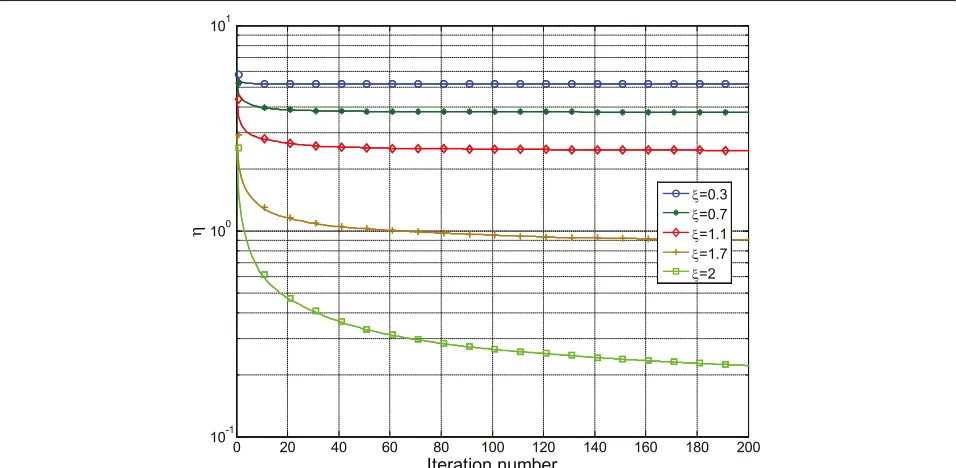
In the following, based on the R computed by SDP-related technique, we will focus on the waveform synthesis under constant modulus and similarity constraints by exploiting Algorithm 1. Specifically, we fix the uncertainly parameter =0.04 for the following simulations. In addi-tion, the approximation errorηbetween the obtainedRˆ using Algorithm 1 andRis computed by
η= ˆR−R. (24) Figure 2 depicts the approximation error η behavior versus iteration number considering different similarity levels for M = 20. Notice that these obtained curves are averaged results of 100 statistic independent trials. As expected, theηdecreases with the increasing iteration number. Besides, the higher similarity levelξ, the lowerη is achieved due to the feasible set of optimization problem (15) becomes larger and larger.
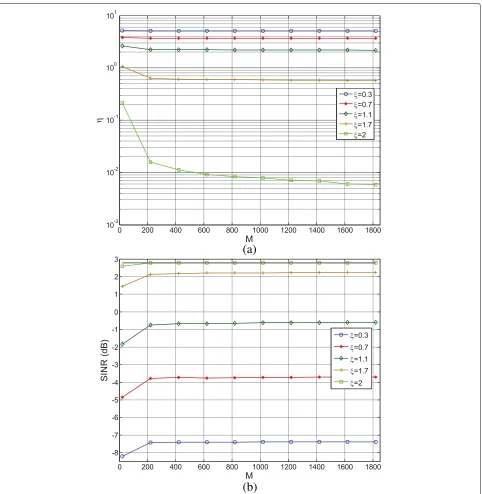
Next, we analyze the impact of similarity parameters
and sample length M on the approximation error η
Fig. 1The worst-case SINR (dB) behavior versus uncertain parameterin non-uniform clutter environment considering the non-robust and robust design of waveform covariance matrix
an increasing trend for SINR and a reducing trend forη show unremarkable in Fig. 3b. This performance behavior provides a foundation for how to chooseMat waveform design stage. Finally, it is worth highlighting that a trade-off should be considered between similarity level, sample length, and SINR.
5.2 Uniform clutter
In this subsection, we consider a uniform clutter scenario where we select [−10◦, 50◦] as clutter region which is uni-formly discretized with a grid size 1◦. In particular, for each azimuth clutter bin, we consider a clutter-to-noise ratio (CNR) of 30 dB.
(b)
(a)
Fig. 3The approximation errorηand SINR (dB) behaviors versus sample lengthMconsideringξ=0.3, 0.7, 1.1, 1.7, 2 in non-uniform point-like clutter environment, theblack linerepresenting the theoretical value of SINR,aη,bSINR
In Fig. 4, the worst-case SINR behavior considering the non-robust and robust design of waveform covari-ance matrix is plotted versus uncertain parameter. The similar observation as Fig. 1 can be obtained. Indeed, the increasing, both the non-robust design and robust design experience worse and worse SINR values due to the enlargement of mismatches between actual steer-ing vectors and nominal ones. Again, it can be found that the robust design ensures a enhanced worst case
performance in comparison with that of non-robust design. Finally, it is also interesting to notice that the gap between curves of non-robust design and robust design becomes larger and larger with the improvement of.
Fig. 4The worst-case SINR (dB) behavior versus uncertain parameterin uniform clutter environment considering the non-robust and robust design of waveform covariance matrix
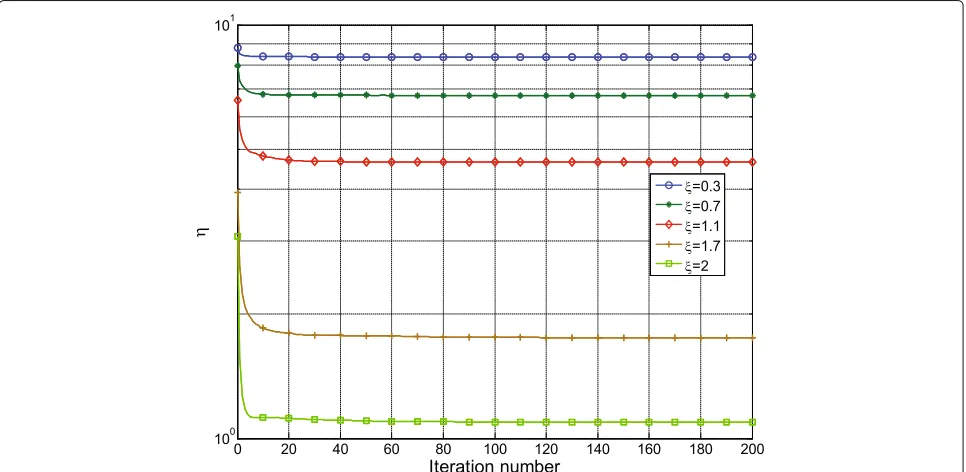
iteration number andξ, revealing the better approxima-tion betweenRˆ andR.
In Fig. 6, the approximation error η and SINR (dB) behaviors are plotted versus sample lengthMconsidering
ξ =0.3, 0.7, 1.1, 1.7, 2. Notice that the obtained curves are averaged results of 100 independent trials of Algorithm 1 and the black line in Fig. 6b stands for the theoretical value without the synthetic loss of SINR. Again, we observe that the higherξ, the lowerηand the better SINR can be
reached since the enlargement of the feasible sets of (15). In particular, we also find that both constant modulus and similarity constraints result in a loss of SINR. Specifically, we see the theoretical value of SINR is about−8.7 dB from the black line in Fig. 6b, whereas it becomes about−9.9 and−9.4 dB forξ =1.7 and 2, respectively. Besides, both an increasing trend for SINR and an opposite trend forη can be obtained asMincreases, whereas these trends are not apparent for largeM. As a consequence, in practice,
Fig. 6The approximation errorηand SINR (dB) behaviors versus sample lengthMconsideringξ=0.3, 0.7, 1.1, 1.7, 2 in uniform clutter environment, theblack linerepresenting the theoretical value of SINR,aη,bSINR
we should reasonably consider the selection of sample length as well as the similarity parameter.
6 Conclusions
In this paper, we have considered the robust design of MIMO radar waveform under practical constraints for enhancing the targets delectability in the presence of signal-dependent interferences. Summarizing,
• We have optimized the waveform covariance matrix to improve the worst-case SINR against the uncertain
sets of steering vector under a uniform power constraint through SDP-related technique. Based on LS approach, we have designed the MIMO waveform to approximate the desired waveform covariance matrix by using CA accounting for constant modulus and similarity constraints.
also observed that the approximation error decreases with the improvement of similarity level and sample length. As a consequence, we should choose reasonably the parameters of similarity level and sample length according to practical requirements.
Possible future research tracks might concern the exten-sion of the proposed framework to account for both uncertain sets of angle and Doppler frequency of targets and interferes [15, 26], as well as the joint design of the transmit signal and receive filter for MIMO radar [20].
Acknowledgements
This work was supported by the National Natural Science Foundation of China under Grants 61201276, 61178068, and 61301266, the Fundamental Research Funds of Central Universities under Grants ZYGX2012Z001, ZYGX2013J012, ZYGX2014J013, and ZYGX2014Z005, the Chinese Postdoctoral Science Foundation under Grant 2014M550465, and by the Program for New Century Excellent Talents in University under Grant A1098524023901001063.
Competing interests
The authors declare that they have no competing interests.
Author details
1School of Electronic Engineering, University of Electronic Science and
Technology of China, 2006 Xi Yuan Ave, West Hi-tech Zone, Chengdu, China.
2Elettronica S.p.A., Via Tiburtina Valeria km 13,700, 00131, Roma, Italy.3Ente di
Formazione Professionale Maxwell, via G. A. Campano, 103/105, I-80145, Napoli, Italy.
Received: 1 August 2016 Accepted: 16 December 2016
References
1. MI Skolnik,Radar Handbook, 2nd Edition, (New York: McGraw-Hill, 1991) 2. SP Sira, Y Li, A Papandreou-Suppappola, D Morrell, D Cochran, M
Rangaswamy, Waveform-agile sensing for tracking. IEEE Signal Process. Mag.26(1), 53–64 (2009)
3. ZQ Luo, WK Ma, AC So, Y Ye, S Zhang, Semidefinite relaxation of quadratic optimization problems. IEEE Signal Process. Mag.27(3), 20–34 (2010) 4. A De Maio, Y Huang, M Piezzo, A Doppler robust max-min approach to
radar code design. IEEE Trans. Signal Process.58(9), 4943–4947 (2010) 5. A De Maio, Y Huang, M Piezzo, S Zhang, F Alfonso, Design of optimized
radar codes with a peak to average power ratio constraint. IEEE Trans. Signal Process.59(6), 2683–2697 (2011)
6. MM Naghsh, M Soltanalian, P Stoica, M Modarres-Hashemi, A De Maio, A Aubry, A Doppler robust design of transmit sequence and receive filter in the presence of signal-dependent interference. IEEE Trans. Signal Process.62(4), 772–785 (2014)
7. A Aubry, A De Maio, MM Naghsh, Optimizing radar waveform and Doppler filter bank via generalized fractional programming. IEEE J. Sel. Topics Signal Process.9(8), 1387–1399 (2015)
8. SM Karbasi, A Aubry, A De Maio, HM Bastani, Robust transmit code and receive filter design for extended targets in clutter. IEEE Trans. Signal Process.63(8), 1965–1976 (2015)
9. B Tang, J Tang, in2016 IEEE International Conference on Acoustics, Speech and Signal Processing (ICASSP). Robust waveform design of wideband cognitive radar for extended target detection, (Shanghai, 2016), pp. 3096–3100
10. Y Yang, RS Blum, Minimax robust MIMO radar waveform design. IEEE J. Sel. Topics Signal Process.1(1), 147–155 (2007)
11. P Stoica, J Li, Y Xie, On probing signal design for MIMO radar. IEEE Trans. Signal Process.55(8), 4151–4161 (2007)
12. B Jiu, H Liu, D Feng, Z Liu, Minimax robust transmission waveform and receiving filter design for extended target detection with imprecise prior knowledge. Signal Process.92(1), 210–218 (2012)
13. N Shariati, D Zachariah, M Bengtsson, in2014 IEEE International Conference on Acoustics, Speech and Signal Processing (ICASSP). Minimum sidelobe
beampattern design for MIMO radar systems: a robust approach, (Florence, 2014), pp. 5312–5316
14. H Wang, B Pei, Y Bai, inSignal Processing, Communications and Computing (ICSPCC) 2014 IEEE International Conference on. Robust waveform design for MIMO-STAP with imperfect clutter prior knowledge, (Guilin, 2014), pp. 578–581
15. SM Karbasi, A Aubry, V Carotenuto, MM Naghsh, HM Bastani,
Knowledge-based design of space-time transmit code and receive filter for a multiple-input-multiple-output radar in signal-dependent interference. IET Radar Sonar Navig.9(8), 1124–1135 (2015)
16. W Zhu, J Tang, Robust design of transmit waveform and receive filter for colocated MIMO radar. IEEE Signal Process. Lett.22(11), 2112–2116 (2015) 17. A Aubry, A De Maio, A Farina, M Wicks, Knowledge-aided (potentially
cognitive) transmit signal and receive filter design in signal-dependent clutter. IEEE Trans. Aerosp. Electron. Syst.49(1), 93–117 (2013) 18. H Wang, G Liao, J Li, W Guo, Robust waveform design for MIMO-STAP to
improve the worst-case detection performance. EURASIP J. Adv. Signal Process.2013(1), 1 (2013)
19. A Aubry, A De Maio, Y Huang, MIMO Radar beampattern design via PSL/ISL optimization. IEEE Trans. Signal Process.64(15), 3955–3967 (2016) 20. G Cui, H Li, M Rangaswamy, MIMO radar waveform design with constant
modulus and similarity constraints. IEEE Trans. Signal Process.62(2), 343–353 (2014)
21. P Stoica, J Li, X Zhu, Waveform synthesis for diversity-based transmit beampattern design. IEEE Trans. Signal Process.56(6), 2593–2598 (2008) 22. A De Maio, S De Nicola, Y Huang, Z Luo, S Zhang, Design of phase codes for radar performance optimization with a similarity constraint. IEEE Trans. Signal Process.57(2), 610–621 (2009)
23. A Aubry, A De Maio, M Piezzo, A Farina, M Wicks, Cognitive design of the receive filter and transmitted phase code in reverberating environment. IET Radar Sonar Navig.6(9), 822–833 (2012)
24. GH Golub, CFW Loan,Matrix Computations, 4rd Edition. (MD: The Johns Hopkins University Press, Baltimore, 2013)
25. M Grant, S Boyd, CVX package . http://www.cvxr.com/cvx.r, Accessed Feb 2012
26. X Yu, G Cui, L Kong, V Carotenuto, in2016 IEEE Radar Conference. Space-time transmit code and receive filter design for colocated MIMO radar, (Philadelphia, 2016), pp. 1–6
Submit your manuscript to a
journal and benefi t from:
7Convenient online submission 7Rigorous peer review
7Immediate publication on acceptance 7Open access: articles freely available online 7High visibility within the fi eld
7Retaining the copyright to your article