
A Secure Re- Encryption Scheme of Data
Sharing for Dynamic Group in the Cloud
Bhagyashri Harel, Prof. Nilesh Sable
Department of Computer Science, JSPM College Wagholi, Pune India.
ABSTRACT: Continuous changes in the membership of data sharing giving security and privacy preservation are still challenging issues, especially for untruth cloud due to collusion attack. It is based on the secure key distribution without assuming any secure communication channel. Our System Propose a secure re encryption scheme of data sharing scheme without assuming secure communication channel for dynamic group in cloud. It also prevents access of client after their revocation and Protect after from collusion attacks. In Our System Provide guarantee for secure sharing of data files when they are outsourced with double encryption. Our System is able to support the Dynamic groups when user join the in the group or user revoked from group, the private Key of other user compulsory recomputed and updated.
KEYWORDS: Access control, privacy-preserving, Key Distribution and cloud Computing.
I. INTRODUCTION
Cloud computing provides on demand service and processingresources to the Users or devices. It is dynamiccomputing style in which dynamically scalable and usuallyvirtualization resources are provided as a service over theinternet. Fundamental service offered by cloud providers isdata storage. Cloud servers managed by cloud providers whichare not fully trusted. Users may store data files on cloudwhich may be sensitive and confidential, like business plans.To preserve data privacy, a basic solution is to encrypt datafiles, and then upload the encrypted data into the cloud. One ofthe most significant difficulties is identity privacy for the widedeployment of cloud computing. Several security schemesfor data sharing untrusted servers have been proposed. Inthese approaches, data owners store the encrypted data files inentrusted storage and distribute the corresponding decryption.Users may not be willing to join in cloud computing systemswithout the guarantee of identity privacy, because their realidentities could be easily disclosed to cloud providers andattackers. Identity privacy may incur the sabotage of privacy.For example, a misbehaved staff can deceive others in the companyby sharing false files without being traceable. Therefore,traceability, which enables the group manager to track overthe real identity of a user, is also highly desirable. Highlyrecommended for any member in a group should be able tofully access stored data and sharing services provided by thecloud, which could be defined as the multiple-owner manner.More broadly, each user in the group is able to not only readdata, but also modify their part of data in the entire data file.Finally, groups are normally dynamic in practice. Changes inmembership makes secure data sharing extremely difficult. Onthe other side, the various system challenges granted fromnew users to learn the content of data files stored beforetheir participation, because it is impossible for new approvedusers to contact with anonymous data owners, and obtain thecorresponding decryption keys. An appropriate membershiprevocation mechanism without updating the secret keys of theremaining users is also desired to minimize the complexity ofkey management.
MOTIVATION
OBJECTIVES
The primary goal of this work is to save the cloud Data from unauthorized user when user revoke from that particular group and that group is dynamically generated by Group Manger.
II. REVIEW OF LITERATURE
On the security of public key protocol Proposes public key encryption protocol, describes the various techniques to encrypt the public key[1].First complete group key management scheme which can supports all these functions yet preserves efficiency. The proposed scheme is based on the new concept of access control polynomial (ACP) that efficiently and effectively support full dynamics, flexible access control with fine-tuned granularity, and concealment .New scheme is protected from various attacks from both external and internal malicious parties[2].Achieving secure role based control on encrypted data in cloud achieved through RBAC. RBE scheme allows RBAC policies to be apply for the encrypted data stored in public clouds. RBE-based hybrid cloud storage architecture provides facility of an organization to store data securely in a public cloud, while maintaining the sensitive information related to the organization’s structure in a private cloud[3].One approach to encrypt documents satisfying different policies with different keys using a public key cryptosystem such as attribute-based encryption, and proxy re-encryption is calledbroadcast group key management (BGKM), and then give a secure construction of a BGKM scheme called ACVBGKM. Major advantage of the BGKM scheme is that adding users/revoking users can be performed efficiently by updating only some public information. BGKM used for an efficient approach for fine-grained encryption-based access control for documents stored in an untrusted cloud file storage [4].MONA proposed a new secure multi-owner data sharing scheme, for multiple groups in the cloud. They applied the group signature. and dynamic broadcast encryption techniques, any cloud user can secretly share data with others. The storage overhead and encryption computation cost of our scheme are independent with the number of revoked users. Also they analyze the security of scheme with difficult proofs, and demonstratethe efficiency of scheme in experiments[5].we introduce a new fine-grained two-factor authentication (2FA) access control system for web-based cloud computing services. Specifically, in our proposed 2FA access control system, an attribute-based access control mechanism is implemented with the necessity of both a user secret key and a lightweight security device. As a user cannot access the system if they do not hold both, the mechanism can enhance the security of the system, especially in those scenarios where many users share the same computer for web-based cloud services. In addition, attribute-based control in the system also enables the cloud server to restrict the access to those users with the same set of attributes while preserving user privacy, i.e., the cloud server only knows that the user fulfills the required predicate, but has no idea on the exact identity of the user. Finally, we also carry out a simulation to demonstrate the practicability of our proposed 2FA system.[6] Data distribution in cloud infrastructure provides an effective approach called Secure-Split-Merge (SSM) is introduced for the security of data. The proposed SSM scheme was it uses unique mechanism for performing splitting of data using AES 128 bit encryption key. The chunks of encrypted splits are being maintained on various group servers of different types of cloud zones. The comparative analysis shows that the proposedsystem gives effective outcomes as compared to various existing and traditional security standards[7].Security achieves against chosen-plaintext attacks using the k-multi linear Decisional Diffie-Hellman assumption[8]. Fine-grained two-factor authentication (2FA) access control system for cloud services. proposed 2FA access control system, it was an attribute based access control mechanism implemented with the necessity of both a user secret key and a lightweight security device[9].Efficient and secure re-encryption scheme has been proposed for data sharing in unreliable cloud environment. This scheme is built on top of Cipher text-Policy Attribute- Based Encryption (CPABE), fine-grained access control to share data. That scheme can achieve user revocation without whole cipher texts re-encryption and key re-distributions also, re-encryption is not performed until a user requests for that data, which reduces overheads. Further, it does not need any clock synchronization [10].
III. SYSTEM OVERVIEW/ SYSTEM ARCHITECTURE
for assigning the permission data encryption. The Users can securely obtain there Private key from group Manger with Certificate authorities for verification scheme. The System can achieve the fine grained access control. Hybrid cloud is used for efficient use of cloud. Our System used for data sharing can be protected from collusion attack. The Revoked user not gets the original data access once when they revoked from particular even if they tried with untruth cloud. System supports the dynamic group efficiently when user joins the group or revoked from group their private key are compulsory update and recomputed.
PROPOSED SYSTEM ARCHITECTURE
EXPLANATION: Dynamic Groups:
The Main Concepts of Dynamic Group users select the Particular group when user Register with Group. Groups are created by the Group Manger.
User Revoked or User Join:
When new user joins or revoked from particular group then the Private Key of particular user and other user of same group their private key compulsory update and recomputed.
Group Manger:
Group Manger is created the Groups. And Manger decided space of group and Dynamical efficiently used space.
IV. MATHEMATICAL MODEL
S={s, e, X, Y, } Where,
s = Start of the program. 1. Log in with webpage.
2. Load Files on cloud. e = End of the program.
Retrieve the file from cloud storage system. X = Input of the program.
Input should be File. Y = Output of the program.
File will be first uploaded then search and send key and download the file X, Y ∈ U
Let U be the Set of System. U= {GM,GU, S, G, D}
Where GM,GU , F, S, T, M, D are the elements of the set. GM=Group Manager
GU=Group User
S=Search keyword G=Get key from user D=Download file using key Bilinear Maps:
Let G1 and G2 be additive cyclic groups of the same prime order q.
Let e :G1 *G2G2 denote a bilinear map constructed with the following properties: G1, Z*q and P,Q a, b
1. Bilinear: a,b Z* and P,Q G1 , e( aP,bQ) = e(P,Q)ah 2. Non generate: There exists a point Q such that e(Q.Q)≠ 1.
3. Computable: There is an efficient algorithm to compute e(P,Q) for any P,Q G1
Mathematical Equations of Notation IDiThe Identity of user i
IDdataThe Identity of data
Pk the public key of user that needs to be negotiated with group manager Sk the corresponding private key to Pk
KEY=(xi,Ai,Bi) the Private key which is distributed to the user from the group manager and used for data sharing Enck() Symmetric encryption algorithms used the encryption key k
UL group User List DL Data List P Public cloud PP private cloud
M Original content read by GM in File. Y result of Encryption algorithms Equations:
IDi,pk,ac,vi(1)
U,R (2)
R.e(v1.F(pk||ac||IDi).P,W)=e(U,P) (3)
IDi,V2,AENCsk(IDi,,V1,ac) (4)
AENCpk(KEY,V2) (5)
e(W,f1(UL))=e(P,sig(UL)) ENCB1(IDdata,C1,C2,C,tdata) (6)
{DF=(IDgroup,IDdata,CE,EK,tdata,),σDF} C1=K.Y€G1 (7)
C2=K.P €G1 (8)
K=Zk€G2 (9)
C=ENCk(M) (10) EK={Kr,.W0,……….Wm} CE={C1,C2,C}Kr
(ID group ,IDdata,CE,EK,tdata,σ)DL e(W,f1(DF))=e(P,σDF)
e(W,f1(DF))=e(P,sig(DL))
V. ALGORITHM
Blowfish Algorithms
1. Initialize first the P-array and then the four S-boxes, in order, with a fixed string. This string consists of the hexadecimal digits of pi (less the initial 3): P1 = 0x243f6a88, P2 = 0x85a308d3, P3 = 0x13198a2e, P4 = 0x03707344, etc.
2. XOR P1 with the first 32 bits of the key, XOR P2 with the second 32-bits of the key, and so on for all bits of the key (possibly up to P14). Repeatedly cycle through the key bits until the entire P-array has been XORed with key bits. (For every short key, there is at least one equivalent longer key; for example, if A is a 64-bit key, then AA, AAA, etc., are equivalent keys.)
3. Encrypt the all-zero string with the Blowfish algorithm, using the data file described in steps (1) and (2). 4. Replace P1 and P2 with the output of step (3).
5. Encrypt the output of step (3) using the Blowfish algorithm with the modified data 6. Replace P3 and P4 with the output of step (5).
Key Generation RSA (Ron Rivest, Adi Shamir and Leonard Adelman)
1. Choose p = 3 and q = 11
2. Compute n = p * q = 3 * 11 = 33
3. Compute φ(n) = (p - 1) * (q - 1) = 2 * 10 = 20
4. Choose e such that 1 < e <φ(n) and e and n are co-prime. Let e = 7
5. Compute a value for d such that (d * e) % φ(n) = 1. One solution is d = 3 [(3 * 7) % 20 = 1] 6. Public key is (e, n) => (7, 33)
7. Private key is (d, n) => (3, 33)
VI. RESULT
We Expect the comparison of some Security parameter OBBE,Mona and Our Scheme. It is obviously observed that computation cost for members in our scheme is irrelevant to number of revoked users.
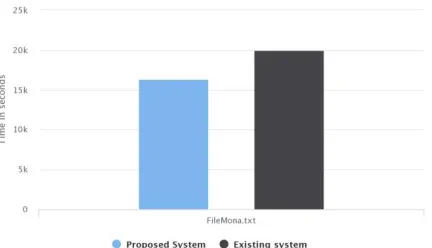
Fig 1 Comparison Uploading Time with Proposed System and Exiting System
User uploads the Data in Anti Collusion while uploading how much time to get the uploading and encryption the Data internally with previous system.
Fig 2 Comparison Downloading Time with Proposed System and Exiting System
User Search the Data From particular Group when while downloading the data or file from cloud when data is internally decryption is possible.
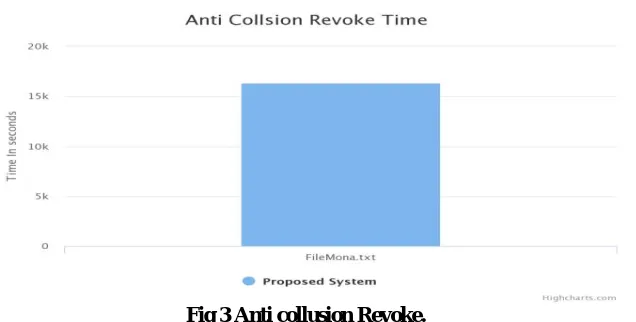
Fig 3 Anti collusion Revoke.
VII. CONCLUSION
This system is design for secure data sharing scheme,for dynamic groups in an untruth cloud. A new typeauthentication system, which is highly secure, has beenproposed in this system. User is able to share data with othersin the group without disclose identity privacy to the cloud. Italso supports efficient user revocation and new user joining.User revocation can be done through a public revocation listwithout updating the private keys of the remaining users, andnew users can directly decrypt files stored in the cloud beforetheir participation. System also provides the new doubleencryption technique for data security. New re-encryptionprovides tight authentication.
REFERENCES
[1] D. Dole and A. C. Yao, On the security of public key protocols,IEEETrans. Inf. Theory, vol. IT-29, no. 2, pp. 198208, Mar. 1983.
[2]X. Zoo, Y.-S. Dai, and E. Bettino, A practical and flexible key managementmechanism for trusted collaborative computing, in Proc. IEEE Conf.Compute. Common.2008, pp. 12111219.
[3] L. Zhou, V. Varadharajan, and M. Hitchens, Achieving secure role-based
access control on encrypted data in cloud storage, IEEE Trans. Inf.Forensics Security, vol. 8, no. 12, pp. 19471960, Dec. 2013.
[4] M. Nabeel, N. Shang, and E. Bertino, Privacy preserving policy basedcontent sharing in public clouds, IEEE Trans. Know. Data Eng., vol. 25,no. 11, pp. 26022614, Nov. 2013.
[5] X. Liu, Y. Zhang, B. Wang, and J. Yang, Mona: Secure multiowner datasharing for dynamic groups in the cloud, IEEE Trans. Parallel Distrib.Syst., vol. 24, no. 6, pp. 11821191, Jun. 2013.
[6] Z. Zhu, Z. Jiang, and R. Jiang, The attack on Mona: Secure multiownerdata sharing for dynamic groups in the cloud, in Proc. Int.Conf. Inf. Sci.Cloud Compute., Dec. 7, 2013, pp. 185189
[7] BurhanUl Islam Khan, Rashidah F. Olanrewaju SSM: Secure-Split-MergeData Distribution in Cloud Infrastructure, in 2015 IEEE Conference onOpen Systems (ICOS), August 24-26, 2015, Melaka, Malaysia
[8] JieXu, Qiaoyan Wen, Wenmin Li, and Zhengping Jin, Circuit Ciphertext-Policy Attribute-Based Hybrid Encryption with Verifiable Delegationin Cloud Computing IEEE Trans. Parallel Distrib.Syst., vol. 24, no. 6, pp. 11821191, Jun. 2013.
[9] Joseph K. Liu, Member, IEEE, Man Ho Au, Member, IEEE, Xinyi Huang,
Rongxing Lu, Senior Member, IEEE, and Jin Li, Fine-Grained Two-Factor Access Control for Web-Based Cloud Computing Services, IEEE Trans. Parallel Distrib.Syst., vol. 24, no. 6, pp. 11821191, March 2013.
![Tandem palladium and isothiourea relay catalysis : enantioselective synthesis of α amino acid derivatives via allylic amination and [2,3] sigmatropic rearrangement](data:image/gif;base64,R0lGODlhAQABAIAAAP///wAAACH5BAEAAAAALAAAAAABAAEAAAICRAEAOw==)