University of Windsor University of Windsor
Scholarship at UWindsor
Scholarship at UWindsor
Electronic Theses and Dissertations Theses, Dissertations, and Major Papers
2011
Efficient channel equalization algorithms for multicarrier
Efficient channel equalization algorithms for multicarrier
communication systems
communication systems
Ishaq Gul MuhammadUniversity of Windsor
Follow this and additional works at: https://scholar.uwindsor.ca/etd
Recommended Citation Recommended Citation
Gul Muhammad, Ishaq, "Efficient channel equalization algorithms for multicarrier communication systems" (2011). Electronic Theses and Dissertations. 7939.
https://scholar.uwindsor.ca/etd/7939
EFFICIENT CHANNEL EQUALIZATION ALGORITHMS FOR
MULTICARRIER COMMUNICATION SYSTEMS
by
Ishaq Gul Muhammad
A Dissertation
Submitted to the Faculty of Graduate Studies
through the Department of Electrical and Computer Engineering
in Partial Fulfillment of the Requirements for
the Degree of Doctor of Philosophy at the
University of Windsor
Windsor, Ontario, Canada
2011
1*1
Library and Archives CanadaPublished Heritage Branch
395 Wellington Street Ottawa ON K1A 0N4 Canada
Bibliotheque et Archives Canada
Direction du
Patrimoine de I'edition
395, rue Wellington OttawaONK1A0N4 Canada
Your file Votre reference ISBN: 978-0-494-80241-0 Our file Notre r&f6rence ISBN: 978-0-494-80241-0
NOTICE: AVIS:
The author has granted a
non-exclusive license allowing Library and Archives Canada to reproduce, publish, archive, preserve, conserve, communicate to the public by
telecommunication or on the Internet, loan, distribute and sell theses
worldwide, for commercial or non-commercial purposes, in microform, paper, electronic and/or any other formats.
L'auteur a accorde une licence non exclusive permettant a la Bibliotheque et Archives Canada de reproduire, publier, archiver, sauvegarder, conserver, transmettre au public par telecommunication ou par I'lnternet, preter, distribuer et vendre des theses partout dans le monde, a des fins commerciales ou autres, sur support microforme, papier, electronique et/ou autres formats.
The author retains copyright ownership and moral rights in this thesis. Neither the thesis nor substantial extracts from it may be printed or otherwise reproduced without the author's permission.
L'auteur conserve la propriete du droit d'auteur et des droits moraux qui protege cette these. Ni la these ni des extraits substantiels de celle-ci ne doivent etre imprimes ou autrement
reproduits sans son autorisation.
In compliance with the Canadian Privacy Act some supporting forms may have been removed from this thesis.
Conformement a la lot canadienne sur la protection de la vie privee, quelques formulaires secondaires ont ete enleves de cette these.
While these forms may be included in the document page count, their removal does not represent any loss of content from the thesis.
Bien que ces formulaires aient inclus dans la pagination, il n'y aura aucun contenu manquant.
1*1
Author's Declaration of Originality
I hereby certify that I am the sole author of this thesis and that no part of this thesis has been published or submitted for publication.
I certify that, to the best of my knowledge, my thesis does not infringe upon anyone's copyright nor violate any proprietary rights and that any ideas, techniques, quotations, or any other material from the work of other people included in my thesis, published or otherwise, are fully acknowledged in accordance with the standard referencing practices. Furthermore, to the extent that I have included copyrighted material that surpasses the bounds of fair dealing within the meaning of the Canada Copyright Act, I certify that I have obtained a written permission from the copyright owner(s) to include such material(s) in my thesis and have included copies of such copyright clearances to my appendix.
Abstract
Blind adaptive algorithm that updates time-domain equalizer (TEQ) coefficients by
Adjacent Lag Auto-correlation Minimization (ALAM) is proposed to shorten the
channel for multicarrier modulation (MCM) systems. ALAM is an addition to the
family of several existing correlation based algorithms that can achieve similar or
better performance to existing algorithms with lower complexity. This is achieved
by designing a cost function without the sum-square and utilizing symmetrical-TEQ
property to reduce the complexity of adaptation of TEQ to half of the existing one.
Furthermore, to avoid the limitations of lower unstable bit rate and high complexity,
an adaptive TEQ using equal-taps constraints (ETC) is introduced to maximize the
bit rate with the lowest complexity. An IP core is developed for the low-complexity
ALAM (LALAM) algorithm to be implemented on an FPGA. This implementation
is extended to include the implementation of the moving average (MA) estimate for
the ALAM algorithm referred as ALAM-MA. Unit-tap constraint (UTC) is used
in-stead of unit-norm constraint (UNC) while updating the adaptive algorithm to avoid
all zero solution for the TEQ taps. The IP core is implemented on Xilinx Vertix II
Pro XC2VP7-FF672-5 for ADSL receivers and the gate level simulation guaranteed
successful operation at a maximum frequency of 27 MHz and 38 MHz for ALAM-MA
and LALAM algorithm, respectively. FEQ equalizer is used, after channel shortening
using TEQ, to recover distorted QAM signals due to channel effects. A new analytical
learning based framework is proposed to jointly solve equalization and symbol
QAM signals. The framework utilizes extreme learning machine (ELM) to achieve fast
training, high performance, and low error rates. The proposed framework performs in
real-domain by transforming a complex signal into a single 2—tuple real-valued vector.
Such transformation offers equalization in real domain with minimum computational
load and high accuracy. Simulation results show that the proposed framework
out-performs other learning based equalizers in terms of symbol error rates and training
to my
Acknowledgements
First of all, thanks to almighty ALLAH for his unending blessings and bounties on me. I would like to express my deep-felt appreciation to my advisors, Dr. Kemal E. Tepe and Dr. Esam Abdel-Raheem for their continuous support and guidance thorough out my research at the University of Windsor. I wish to extend my thanks to PhD committee members Dr. Murat Uysal, Dr. Walid Abdul-Kader, Dr. Jonathan Wu, and Dr. Huapeng Wu for their valuable suggestions and comments on my thesis. Also, my sincere gratitude to former teachers who restlessly contributed towards my education since the day I started learning how to read and write. Especially, my eldest sister, Ameera who was my earliest teacher, my brother Abdul-Rahman as my mentor for mathematics in high school, and all teachers from grade one till today.
It is worth acknowledging my friends for their perpetual support during moiling hours of research to help me concentrate far beyond current impediments at different times. I would like to thank staff and my group fellows at department of ECE for all their hard work and dedication, providing the means to achieve my long-dreamt objective.
who always offered strong affection and support for their youngest brother. Finally,
it is an honor for me to dedicate this degree to my mother: Aisha, and father: Gul
Muhammad, who are the reason behind each and every accomplishment I ever made,
Table of Contents
Page
Author's Declaration of Originality iii
Abstract iv
Dedication vi
Acknowledgements vii
List of Tables xii
List of Figures xiii
List of Abbreviations xvi
1 Introduction 1
1.1 Overview of Multicarrier Modulation Systems 1
1.2 Channel Equalization in MCM 4
1.2.1 Time-Domain Equalizer (TEQ) 4
1.2.2 Frequency-Domain Equalizer (FEQ) 5
1.3 Neural Networks 6
1.3.1 Architectures of Neural Networks 6
1.3.2 Learning Processes 7
1.3.3 Applications of ANNs 8
1.4 Research Objectives 9
1.5 Research Contributions 9
2 Blind Adaptive T i m e - D o m a i n Equalizer Algorithm for A D S L
S y s t e m s by Adjacent Lag Auto-correlation Minimization ( A L A M ) 13
2.1 Introduction 13 2.2 Preliminaries 15
2.2.1 System Model 15 2.2.2 Conventional Autocorrelation Based Algorithms 16
2.3 Proposed Low Complexity Algorithm 18
2.4 Simulation Results 21 2.4.1 Validation of ALAM Approach 22
2.4.2 ALAM-DSS 24
2.5 Conclusions 26
3 Efficient Blind Adaptive T E Q Designs 27
3.1 Introduction 27 3.2 Proposed Low Complexity Algorithms 28
3.2.1 Low-complexity ALAM, SAM, and SLAM 28
3.2.2 Exploiting Symmetrical T E Q 30 3.2.3 Adaptive Algorithm for TEQ Using Equal-Taps Constraint (ETC) 32
3.3 Simulation Results 33 3.3.1 Validation of LALAM Algorithm 33
3.3.2 Symmetrical TEQ Taps Design 35 3.3.3 Equal-Taps TEQ Design 37
3.4 Conclusions 37
4 F P G A Implementation of a Low Complexity Time D o m a i n
Equal-izer for A D S L Systems 41
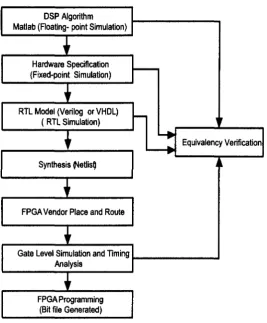
4.1 Introduction 41 4.2 Standard FPGA Design Flow 42
4.3 TEQ Design and Objectives 44
4.5 FPGA Implementation of ALAM 48 4.5.1 Weight Update Block 48 4.5.2 Calculation of Expectation-Term Block 50
4.6 Implementation Results 52
4.7 Conclusion 56
5 Q A M Equalization and Symbol D e t e c t i o n in O F D M Systems
us-ing E x t r e m e Learnus-ing Machine 60
5.1 Introduction 60 5.2 Preliminaries 62
5.2.1 OFDM System Model 62 5.2.2 Extreme Learning Machine 64
5.3 Proposed Algorithm 67 5.4 Results and Discussion 70
5.4.1 Optimal Parameter Selection 71 5.4.2 Varying Packet Length and Doppler Frequency 77
5.4.3 Performance Analysis of 4-, 16-, and 64-QAM 77
5.4.4 Computational Comparison 81
5.5 Conclusions 82
6 Conclusion and Future Work 84
6.1 Concluding Remarks 84
6.2 Future Work 86
References 87
List of Tables
1 Complexity comparison in terras of number of multiplications and
ad-dition per TEQ update 31
1 Virtex implementation (post-layout) results for clock frequency and area 56
1 Simulation parameters 71
2 Complexity time comparison of training and testing for different
List of Figures
1.1 Basic multicarrier transmitter 1 1.2 MCM transceiver architecture 2 1.3 MCM symbol with cyclic prefix 3
1.4 Learning of ANN 6 1.5 Feedforward neural network model 7
1.6 Feedback neural network model 8
2.1 System model for blind adaptive T E Q algorithm for M C M system. . 15
2.2 Effective (shortened) channel impulse response using MA method 23
2.3 T E Q taps obtained using MA method 23 2.4 Achievable bitrate vs. iteration number using MA method 25
2.5 Achievable bitrate vs. SNR using MA and instantaneous estimates 25
3.1 Effective (shortened) channel impulse response using instantaneous method. 34
3.2 T E Q taps obtained using instantaneous method 34 3.3 Achievable bitrate vs. iteration number using instantaneous method. . . . 36
3.4 Achievable bitrate vs. SNR using MA and instantaneous estimates 36 3.5 Effective (shortened) channel impulse response for symmetrical ALAM, SAM,
and SLAM 38 3.6 Achievable bitrate vs. iteration number using symmetrical TEQs 38
3.8 Achievable bitrate vs. iteration number using Equal-taps constrained ALAM,
SAM, and SLAM 39 3.9 Achievable bitrate vs. SNR using symmetrical TEQs and equal-taps
con-strained 40 4.1 FPGA design flow 43
4.2 Fixed-point representation 45 4.3 Impact of the I/O WL on the performance using 14-bit WL for internal
signals 47 4.4 Impact of the internal signals WL on the performance using 10-bit WL
for I / O signals 47 4.5 Shortened channel using LALAM Fixed-point simulations 49
4.6 TEQ taps using LALAM Fixed-point simulations 49 4.7 Achievable bit rate using LALAM Fixed-point simulations 50
4.8 Realization of adaptive equalizer using ALAM algorithm 51 4.9 Realization of update equation using ALAM algorithm 51 4.10 Realization of calculating the gradient of the cost function using (a) MA
estimate (b) Instantaneous estimate 52 4.11 TEQ taps using LALAM RTL simulations 53
4.12 Achievable bit rate using LALAM RTL simulations 53 4.13 TEQ taps using ALAM-MA RTL simulations 54 4.14 Achievable bit rate using ALAM-MA RTL simulations 54
4.15 TEQ taps using LALAM gate-level simulations 57 4.16 Achievable bit rate using LALAM gate-level simulations 57
4.17 TEQ taps using ALAM-MA gate-level simulations 58 4.18 Achievable bit rate using ALAM-MA gate-level simulations 58
5.3 Proposed block diagram of OFDM system for joint equalization and symbol
detection using ELM 68 5.4 Equalization and symbol detection using ELM for 4-QAM 69
5.5 4 and 16 QAM quadrant distribution 70 5.6 Performance analysis for 4-QAM for different activation functions using the
proposed scheme and C-ELM 73 5.7 Performance analysis for 4-QAM for varying percentage of training data
using proposed framework 73 5.8 Performance analysis for varying number of hidden neurons of ELM in the
proposed framework using 4-QAM 74 5.9 Performance analysis for varying number of hidden neurons of ELM in the
proposed framework using 16-QAM 75 5.10 SER vs. Doppler frequency using packet length of 200 symbols 4-QAM. . 78
5.11 SER vs packet length using 500 Hz Doppler frequency for 4-QAM 78
List of Abbreviations
A D S L
A L A M
A L A M - D S S
A N N
A R
A W G N
B E R
C B P
C E L M
CLB
C M A
C M R A N
C P
C S A
D A B
D F T
D M T
D V B
Asymmetric Digital Subscriber Line
Adjacent Lag Autocorrelation Minimization ALAM- Decaying Step Size
Artificial Neural Network Auto Regressive
Additive White Gaussian Noise Bit Error Rate
Complex Back-Propagation
Complex Extreme Learning Machine Configurable Logic Block
Constant Modulus Algorithm
Complex Minimal Resource Allocation Network Cyclic Prefix
Carrier Serving Area Digital Audio Broadcasting Discrete Fourier Transform Discrete Multi-Tone
DD-LMS
DSL
DUT
ELM
ETC
FDM
FIR
FFT
FNN
FPGA
FWL
ICI
iid
I/O
IP
ISI
IWL
k-NN
Decision Directed-LMS
Digital Subscriber Line
Design Under Test
Extreme Learning Machine
Equal Taps Constraint
Frequency Division Multiplexing
Finite Impulse Response
Fast Fourier Transform
Feedforward Neural Network
Field Programmable Gate Array
Fractional Word Length
Inter-Carrier Interference
Independent and Identically Distributed
' Input-Output
Intellectual Property
Inter-Symbol Interference
Integer Word Length
LALAM
LE
LMS
LS
LSAM
LSLAM
MA
MAC
MCM
MERRY
MFB
MLP
MMSE
MSB
MSSNR
OFDM
PAR
PLC
Low-complexity ALAM
Logic Element
Least Mean Square
Least Square
Low-complexity SAM
Low-complexity SLAM
Moving Average
Multiply Accumulate
Multi-Carrier Modulation
Multicarrier Equalization by Restoration of Redundancy
Matched Filter Bound
MultiLayer Perceptron
Minimum Mean Square Error
Most Significant Bit
Maximum Shortening Signal-to-Noise Ratio
Orthogonal Frequency Division Multiplexing
Place-And-Route
QAM
QPSK
RBF
RLS
RLS
RNN
SAAM
SAM
SG-Boosting
SLAM
SLFNN
SNR
SOM
TEQ
UTC
WLAN
WL
WSS
ZF
Quadrature Amplitude Modulation
Quadrature Phase Shift Keying
Radial Basis Function
Recursive Least Square
Recursive Least Square
Recurrent Neural Network
Sum-Absolute Autocorrelation Minimization
Sum-squared Autocorrelation Minimization
Stochastic Gradient Boosting
Single Lag Autocorrelation Minimization
Single-hidden Layer Feedforward Neural Network
Signal-to-Noise Ratio
Self-Organizing Map
Time-domain EQualizer
Unit Tap Constraint
Wireless Local Area Network
Word Length
Wide Sense Stationary
Chapter 1
Introduction
1.1 Overview of Multicarrier Modulation Systems
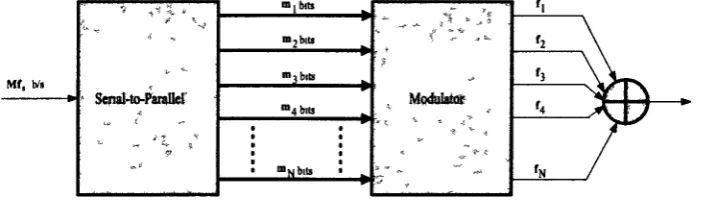
Multicarrier modulation (MCM) technique was first introduced in late 1950s [1], [2]; it is a novel approach to design high bandwidth communication system in the pres-ence of channel distortion. The basic idea of MCM is to split the transmitting data into several parallel data to be transmitted on subcarriers, instead of single carriers [3]. The basic multicarrier based transmitter is shown in Fig. 1.1. For example, given
• Senai-to-Paralld
n>l bits
m j bite
m ^ bits
m4 b t t s
• " N b i t o ' ?
Modulator
'i
, \
, \
f4
'N /
Figure 1.1: Basic multicarrier transmitter.
(ISI) caused by frequency selective channel. Although MCM is a form of frequency
division multiplexing (FDM), it has the additional feature of overlapping subchannels
to maximize the spectral efficiency. In order to avoid interchannel interference (ICI)
between adjacent overlapping subcarriers, precise orthogonality between subcarriers
is required. The spacing between each subcarriers has to be equal to A / , otherwise
ICI is introduced which causes a severe degradation in performance. This property
can be obtained using discrete Fourier transform (DFT) [4]. The nth MCM input
symbol x
nis modulated so that there are N subcarriers which are orthogonal to
each other. Furthermore, with the existence of modern digital signal processors to
implement efficient fast Fourier transform, DFT became a standard used in MCM
techniques [5]. Orthogonal frequency division multiplexing (OFDM) and discrete
multitone (DMT) are two types of MCM techniques that are used in several
wire-less systems and Asymmetric Digital Subscriber Line (ADSL) systems, respectively.
Examples include digital video broadcast (DVB), digital audio broadcast (DAB),
wireless local area networks (WLAN), digital subscriber line (DSL), and power line
communications (PLC). Fig. 1.2 shows a standard MCM transceiver architecture. In
I TRANSMITTER
Bits}
S/P •
•
t
modulator • •
N Subchannels
MIFFT •
• add cyclic prefix • • • P/S 1 RECEI\ Bits) I P/S •
•
/ER
Demoduator •
• • frequency domain equalizer /VSubcha •
• /V-FFT
nne • • • Is S/P remove cyclic prefix channel Time domain equalizer [FIR filter;
order to transmit data, regrouping of bit sequence is performed to form blocks of size
N by serial-to-parallel converter. Each block forms in fact an OFDM or DMT symbol
that consists of, for example, quadrature phase shift keying (QPSK) signal modulated
using QPSK modulator. Higher quadrature amplitude modulations (QAM) are used
for higher data rate applications. The MCM symbols are then processed using inverse
fast Fourier transform (IFFT) to transmit each modulated signal over an orthogonal
subcarrier. Cyclic prefix (CP) is added as a guard interval between MCM symbols
to avoid ISI and ICI [6]. As shown in Fig. 1.3, CP is a copy of the last portion
Copy
< Cyclic prefix ^
<
MCM symbol
Cyclic prefix + MCM symbol
Figure 1.3: MCM symbol with cyclic prefix.
of the MCM symbol. The length of the CP is directly dependent on the length of
the channel impulse response. Therefore, in order to combat interference caused by
multipath fading, a sufficient CP length is required, (i.e., CP length has to be larger
than the delay spread of the channel to achieve no ISI). The MCM symbol with CP is
a time-domain signal created using the IFFT block. This signal is converted to serial
data using parallel-to-serial converter to be transmitted over the wireless or
wire-line channel. The received signal, at the receiver, is passed through a time-domain
equalizer (TEQ) to reduce the length of the effective channel so that its length is less
than the CP data. This filter was first introduced in 1990's for multicarrier systems
[7]. In traditional MCM transceivers, TEQ is not used. However, when larger delay
spread of the channel is present such as in ADSL channel, TEQ is used at the front
reduced. Hence, reduction in the CP maximizes the throughput using the relation
N
+
Cp [8]. After the TEQ operations, CP is removed and serial-to-parallel converter is
used to convert the sequence data to parallel. The parallel data are then fed into the
FFT block that reconstructs the QAM symbols. Following the demodulation using
FFT, the effects of the channels on the modulated signals are equalized using 1-tap
frequency domain equalizers (FEQ). Finally, using a demodulator the modulated
sig-nals are mapped to bits and are converted from parallel to serial. Since the objective
of this thesis is channel equalization in MCM systems we provide an overview of
channel equalization in the next Section.
1.2 Channel Equalization in MCM
Equalization in MCM system is divided in two parts: (i) TEQ is used to shorten
the effective channel to a length less than the CP length, and (ii) single tap FEQ is
used to compensate for the magnitude and phase distortion in each subchannel. TEQ
is often used when there is a large delay spread, such as in ADSL lines, to shorten
the channel impulse response while maximizing the transmitting bit rate at a fixed
bit error rate. Once the shortening is fullfilled, then point wise equalization can be
achieved using a bank of complex scalars, (i.e., single tap-FEQs).
1.2.1 Time-Domain Equalizer (TEQ)
Several algorithms have been proposed in literature using trained data to shorten the
channel such as minimum mean square error (MMSE) design [9], [10], [11] , maximum
shortening signal-to-noise ratio (MSSNR) design [12], and others evaluated in [13].
These TEQ designs are non-blind algorithms where channel need to be estimated or
it is known in advance. In non-blind equalization techniques, training data reduces
the throughput of the system. For that reason, blind, adaptive channel shortening
system. These algorithms exploit the existing property of the multicarrier modula-tion systems to build the equalizer taps. Some of the properties includes: presence of the cyclic prefix, presence of null tones, constant modulus signals, etc. Some of the algorithms that exploit such properties are: Multicarrier equalization by restoration of redundancy (MERRY) [14], [15] algorithm which exploits the presence of cyclic prefix to blindly update the TEQ. MERRY algorithm updates the TEQ every MCM symbol which is slow in convergence that makes it not suitable for fast time varying channel [14], [15]. A faster convergence algorithm called sum squared autocorrelation minimization (SAM) algorithm [16], which exploits autocorrelation shortening prop-erty of the channel was proposed. Further detailed discussions of SAM and several other algorithms are reviewed in Chapter 2.
1.2.2 Frequency-Domain Equalizer (FEQ)
[23].
1.3 Neural Networks
Neural networks consisting of interconnecting artificial neurons is called artificial
neu-ral network (ANN). ANN is basically a geneneu-ralized mathematical model of human
neural system. It processes information using appropriate connection between
neu-rons over connected links. The signal transmitted through a link is multiplied by an
associated weight to this link. Activation function is applied to the sum of weighted
inputs to calculate the output signals. ANN has an ability to learn the relationship
between input and output in linear and non-linear system which makes it a very
powerful tool. The training of ANN weights is performed adaptively, as shown in
Fig. 1.4, until a criterion is met, (i.e., when output signal is close to a desired
out-put). Once the learning phase is completed, testing data can be processed using the
learned model [23].
Output f ^ \ Desired output
Error- to adjust weights
Figure 1.4: Learning of ANN.
1.3.1 Architectures of Neural Networks
Feedforward Networks
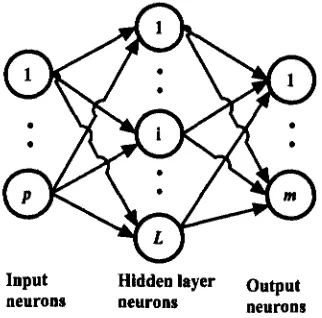
A feedforward neural network, as shown in Fig. 1.5, allows the signal to propagate
This type of neural network is straight forward and is used normally in applications of pattern recognition.
Figure 1.5: Feedforward neural network model.
Feedback Networks
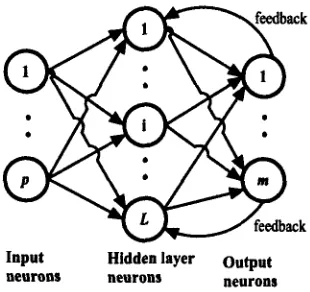
A feedback neural network shown in Fig. 1.6 allows the signal to propagate in both directions. This type of network are very powerful and complicated as it is dynamic until reaching an equilibrium state. It stays in the equilibrium state until the input changes and the network becomes dynamic again to find a new equilibrium. This type of ANN is also called recurrent neural network.
1.3.2 Learning Processes
Input Hidden layer neurons neurons
Figure 1.6: Feedback neural network model.
the neural network parameters. One of the methods used to minimize the error in supervised learning to obtain convergence is the least mean square (LMS) algorithm [26]. On the other hand, unsupervised learning are not based on training data but instead, it uses local information to train the neural networks. Self-organizing map (SOM) [27], is an example of unsupervised neural networks that uses its properties to map input and output.
1.3.3 Applications of A N N s
Since ANNs have the ability to solve linear and non-linear problem based on the training data provided, therefore, it is used in various object recognition applica-tions such as recognition of signatures, shapes, words, face, color, etc [23]. ANNs has capability of forming nonlinear decision boundaries that helps in solving complex classification tasks [28] - [31]. Recently, ANN have been also used in modeling nonlin-ear phenomenon of channel equalizations in wireless communication systems. In the literature, different type of feedforward neural network based equalizers are used like backpropagation [32], radial basis functions [33] - [35], complex minimal resource allo-cation network (CMRAN) [36], [37], and complex extreme learning machine (CELM)
[38] - [40].
1.4 Research Objectives
• The main objective of this thesis is to design new algorithms for channel
equal-ization in multicarrier modulation system. New algorithms are designed to
obtain optimum performance with lower complexities than the existing
algo-rithms. Blind adaptive TEQ algorithms designed for ADSL systems are used to
achieve the shortening of the effective channel to a length shorter than the cyclic
prefix. With this main objective, several other sub-objectives are required to
be optimized such as: maximizing the bit rate, maintain low complexity in
de-signing the TEQ, suitability for fast time varying channel, and fast convergence
rate.
• Investigate, develop and implement an IP core for the ALAM algorithm on
Xilinx Verix II Pro FPGA.
• Use of analytical schemes that jointly solve the problem of equalization and
symbol detection in orthogonal frequency division multiplexing (OFDM)
sys-tems with QAM signals to achieve fast training, high performance, and low
error rates.
1.5 Research Contributions
This section briefly describes the contributions developed to design new algorithms
for channel equalization that are efficient in terms of performance and complexity.
• New approach to adapt the TEQ blindly by minimizing the adjacent-lag
au-tocorrelation, without sum-squared as in SAM, to lower the complexity of the
adaptive algorithm.
• A decaying step size approach is used, in the proposed ALAM and in the existing
rates after reaching the maximum bit rates.
• Low complexity instantaneous estimated approach to estimate the correlation
estimated in the adaptive algorithm. With this approach fast convergence is
obtained and the TEQ updates every sample which makes it suitable for fast
time varying channels.
• Symmetrical property is exploited to reduce the complexity of the proposed
ALAM and the existing SAM and SLAM algorithms to half of the original
algorithms.
• Equal taps constraint (ETC) is enforced while adapting the algorithms to achieve
higher bit rates without the drop down in bit rate once reached its maximum.
• An IP core is developed to implement the low-complexity ALAM algorithm on
Xilinx Verix II Pro FPGA for ADSL receivers.
• Unit tap constraint (UTC) approach is implemented in the adaptive algorithm
instead of UNC constraint that is very expensive in terms of hardware
imple-mentation.
• A new learning based framework to jointly solve equalization and symbol
detec-tion problems in orthogonal frequency division multiplexing (OFDM) systems
with QAM signals.
• Fully real-valued processing scheme is used to obtain fast convergence and low
computational complexity. This is achieved by transforming QAM constellation
points to a real-valued vector of 2—tuple, which are labeled with integer values
(i.e., class number) as an output. In addition, higher accuracy is attained by
as-sociating a 2—tuple pattern to one of the M possible classes, which corresponds
1.6 Organization of Dissertation
The remainder of this dissertation consists of 5 chapters which are organized as
fol-lows:
• Chapter 2. Covers an introduction of channel shortening algorithms and the
background of the existing algorithms for the TEQ. A new low complexity
cost function is derived based on the new approach of minimizing adjacent lag
autocorrelation minimization to achieve the optimum TEQ taps. In order to
avoid the drop in bit rate, a decaying step size is used in ALAM algorithm
to achieve stable high bit rates. Both algorithm are validated and results are
compared with the existing algorithms.
• Chapter 3. An improvement to the proposed ALAM and the existing SAM
and SLAM algorithms in terms of low complexity and suitability to fast time
varying channel is achieved. Furthermore, symmetrical property of the TEQ
is exploited to reduce the complexity of the original algorithms to half of the
non-symmetrical based algorithms. ETC is used while adapting the algorithms
to improve the bit rate performance and avoid drop in bit rate with minimum
computational complexity. The validation of the proposed approaches used in
this chapter are validated and comparative results are obtained and shown in
the simulation section of this chapter.
• Chapter 4. Details the design and implementation of the IP core for ALAM
algorithm on a Xilinx Vertix II Pro FPGA. For comparison, ALAM algorithm
is implemented on FPGA using MA method [16] and the low-complexity
in-stantaneous estimate. Physical synthesis report is generated that confirms the
complexity reduction of the proposed method. Simulation results are shown at
all stages of the design flow from floating-point simulation to Gate-level
• Chapter 5. In this chapter, a review of existing schemes for equalization and
symbol detection using neural networks are discussed. An analytical learning
based framework using extreme learning machine is proposed that solves jointly
the problem of equalization and symbol detection in OFDM receivers.
Ex-periments are performed to show the significant improvement of the proposed
framework over the exiting approaches in terms of SER and computational
complexity.
• Chapter 6. In this chapter, conclusions of the proposed research in this thesis
Chapter 2
Blind Adaptive Time-Domain Equalizer
Algorithm for ADSL Systems by Adjacent
Lag Auto-correlation Minimization
(ALAM)
2.1 Introduction
In the literature, there are several TEQ designs that are either based on a training
data or a blind approach [13] with high complexity. Trained methods require
addi-tional overhead that reduces the throughput of the system whereas blind methods
do not require additional data; moreover it uses the property of MCM such as the
presence of CP, null tones, constant modulus of signals, etc [41]. Several researchers
have developed non-blind/non-adaptive TEQ design methods with high
computa-tional complexity such as maximum shortening signal-to-noise ratio (MSSNR) [12],
minimum mean-square error (MMSE) [7], and several other methods which are
sum-marized and evaluated in [13]. In comparison with non-blind methods, there are
limited numbers of blind channel shortening methods for TEQ design in the
Among the existing blind TEQ algorithms in the literature, there are: Sum-squared autocorrelation minimization (SAM) [16], sum-absolute autocorrelation minimization (SAAM) [42], single lag autocorrelation minimization (SLAM) [43], [44], multicarrier equalization by restoration of redundancy (MERRY) [14], the algorithms in [45], and the recent algorithm in [46].
MERRY is a low computational complexity algorithm, but has a very slow con-vergence rate because it updates the TEQ coefficients once per symbol, therefore, it is not suitable for fast time varying environments. On the other hand, SAM, SAAM, and SLAM are high complexity algorithms due to the use of minimizing the squared-autocorrelation and moving average (MA) methods to estimate expectation. Minimizing the squared-autocorrelation produces more than one product terms that increases the complexity of the algorithms. This complexity is obvious when tak-ing gradient of the squared cost function that results in a high complexity adaptive algorithm to update the TEQ coefficients. SAAM [42] on the other hand which is an extensions of SAM, is based on minimizing the sum of absolute values instead of sum squared values as in SAM. This algorithm uses signum function in its adaptive algorithm, that is why it has lower complexity than SAM. These algorithms share the same drawback of drop down in bitrate which can be treated by freezing the TEQ once it reaches the maximum shortening SNR as in SLAM [44]. However, freezing the TEQ makes the algorithm non-adaptive and that makes it not suitable for fast time varying environments.
x„-
Equalizerw
m
Adaptive algorithm
Figure 2.1: System model for blind adaptive TEQ algorithm for MCM system. SLAM, the gradient function is a single product term of the correlation between the TEQ's input and output. Therefore, the complexity of ALAM adaptive algorithm is reduced without the degradation in performance. Unit-norm constraint (UNC) is implemented on the adaptive algorithm as in SAM and SLAM to avoid all zero solution on the TEQ taps [16]. In order to validate the proposed ALAM algorithm, MA method used in SAM [43] is implemented on ALAM to calculate the correlation estimates. A comparative simulations for ALAM, SAM, and SLAM are performed to show effectiveness of the low complexity proposed algorithms. The algorithms using MA estimate are referred in this thesis as ALAM-MA, SAM-MA, and SLAM-MA. All of those algorithms have the drawback of drop in bitrate once the bitrate reaches its maximum. In order to treat such a problem, a decaying step size is used to control the convergence and achieve steady bitrate performance.
2.2 Preliminaries
2.2.1 System Model
Figure 2.1 illustrates the system model used to shorten the effective channel in
multicarrier systems. The source sequence x(n) contains M + v number of samples
(bins) and v here is length of the cyclic prefix. These x(n) samples are uncorrelated
to each other and are produced using IFFT of the QAM symbol data Xk- The signal
x(n) is transmitted through linear finite-impulse-response (FIR) channel of length
Lh + l taps. Those bins form a random process which is white, wide sense stationary
(WSS), and real with zero-mean and unit variance [16].
The received sequence r(n) is described by
Lh
r(n) = ^2h(k)x(n-k) + v(n)
tC
2-
1)
fc=0
where n is the sample index and v (n) is a zero-mean AWGN sequence, uncorrelated
with the source sequence and has a variance a^. The sequence r(n) is fed to the TEQ
of length L
w+ \ taps. The effective channel is a discrete time convolution between
the channel h and equalizer tap vector w, i.e., c = h * w, where the length of the
effective channel is L
c4-1, where L
c= Lh + L
w. The output sequence of the TEQ is
given by
y{n) = 5 2 w{k)r(n - k) = w
Tr
n, (2.2)
fc=0
where w =
[WQ W\W2 . . .
WLW]Tand the TEQ filter input regressor vector r
n=
[r(n) r{n - 1) r(n - 2) . . . r(n - L
W)]
T.
2.2.2 Conventional Autocorrelation Based Algorithms
The conventional correlation based blind adaptive channel-shortening algorithms are
SAM [16] and SLAM [43], [44]. Both use received signals to adapt the TEQ coefficient,
SAM cost function is designed by minimizing the sum-squared autocorrelation of the
received signal defined by
i c - l
J
v+1= J2 I
Rcdl) |
2> (2-3)
where i?
cc(/) = Ry
y{l) under noiseless scenario [16]. The SAM adaptive algorithm
over the cost function defined in Equation (2.3) is defined as
w ^
1= ™
k-»Zt
v+1V
w(E[y(n)y(n-l)])
2= w* - 2
liJ2fl
v+1{E]3f(n)y(n - Z)]}{£[y(n)r
n_, + y(n - l)r
n]},
and the implementation of the above adaptive algorithm is performed using MA or
auto regressive (AR) estimators. The coefficient update equation of the TEQ using
SAM algorithm with MA method to estimate the expectation is given by
(k+l)N-l f_^ ,_ n} ( (k+l)N-l
l=v+l
Wf c + 1
+
v ^ y(n)y(n - /) 1 f V ^ y(n)r
n-t + y(n - l)r
n1
/=WV J I l=kN J
l=kN(2.5)
where N is the design parameter that defines the window size of samples
(averag-ing block) to estimate the expectation, larger N gives better estimate but higher
complexity since the complexity is directly proportional to N. SAM adaptive
algo-rithm is based on estimating the correlation between the equalizer outputs and the
received samples using MA estimator. The estimator can also be implemented using
AR method [16] which is faster in convergence however AR method depends depends
on previous estimated values, and hence its only good for slow varying channels. A
simplified version of SAM was proposed by Nawaz and Chambers called SLAM [43],
[44]. SLAM also used MA and AR estimator and has similar performance as SAM
at a lower complexity. The coefficient update equation of the TEQ using SLAM
algorithm with MA method to estimate the expectation is given by
(fc+l)AT-l . . . . "J f (JM-l)iV-l
wf c + l _ wf c _ ^
•((k+l)N-l , w . )
((k+l)N-f j , j((k+l)N-fcOt((k+l)N-fpOl((k+l)N-f
E
V. l=kN J [. l=kN
y{n)r
n_i + y(n - l)r
nN
J
(2.6)
Another extensions of SAM reported in [42] called SAAM is based on minimizing the
sum of absolute values instead of sum-squared values as in SAM. This algorithm uses
signum function in its adaptive algorithm and that is why it has lower complexity
2.3 Proposed Low Complexity Algorithm
Since the channel input, x{n) sequence excluding the cyclic prefix data, is white with zero-mean, therefore the covariance matrix E[xn^] is equal to the correlation matrix
which is defined as
£[x«x£] =
R(0) R(l) R{2)... R(M) R{1) R(Q) R(l)... :
R(2) R(l) R(0)... R(l) (2.7)
R{M) .. R(l)... R{0)
where i?(0) is the unity variance and all other non diagonal elements, R(l), -R(2), ..R(M), being zero due to the the independent and identically distributed (i.i.d.) assumption that the output of IFFT produces output samples that are uncorrelated in MCM system. The correlation with lag I is defined by
72(0 - R{l + M)
E[*nXl-l\ (2.8)
R{l-M) ... R(l)
This correlation model is a Toelpitz matrix, with only one diagonal of nonzero entries and depending on the lag value /, the diagonal vector shifts up or down. The shifting matrix is a consequence of the i.i.d. assumption about the channel input sequences,
x(n). In an MCM system, x(n) becomes non i.i.d. due to the the existence of cyclic
prefix data. However, the shifting structure can still be present if and only if the correlating samples are within the M consecutive samples which means that the lag
I is within the value defined by
l<M-Lh-i, (2.9)
correlation between transmitted data and the cyclic prefix data. Since SAM uses a range of I in estimating the autocorrelation, the violation probability of the condition in Equation (2.9) would be higher if the the length of the channel Lh is large. The proposed approach utilizes only adjacent lag to estimate the correlation, this is why the condition in Equation (2.9) can be easily met. One of the lags to optimize the TEQ is sufficient and i?(l) is the adjacent lag autocorrelation intended to minimize at the receiver to optimize the TEQ coefficients, which is used to formulate the proposed cost function and is defined by
J = Ryy(l) = E[y(n)y(n - 1)], n € 1, 2 , . . . , M + v, (2.10)
where n is the sample number of the MCM symbol. As shown in the proposed cost function in Equation (2.10), the sum and square is removed from the cost function to reduce the complexity of the proposed algorithm without any loss in performance which is shown in our simulation studies in Section 2.4. The optimization problem for the proposed algorithm is defined as
w^* = arg^ min J l|w|ii=i
, where a unit norm constraint is applied to avoid non-zero solution. The cost function is derived similarly as [16] and [44] but with only adjacent lag and without sum squared autocorrelation
J = Ryy(l) = E[y(n)y(n-1)}
= E [ ( cTxn + wrvn) ( x ^1c + v ^1w ) ] (2.11)
= Rcc(l) + CvRww(l),
sequence which is equal to the autocorrelation of adjacent lag of the effective channel,
i.e., Ryy(l) « -Rcc(l), therefore the final cost function is simplified as
J = E[y(n)y(n - 1)]. (2.12)
The effect of removing the sum and square in our proposed algorithm as
com-pared to SAM is investigated in Section 2.4 and in the adaptive algorithm for the
proposed TEQ using the steepest gradient-descend algorithm to update the equalizer
coefficients given by
w ^
1= w * - / i V
w% ( n ) i / ( n - l ) ]
= w* - 2^£7[y(n)p
n_i],
where k = 0 , 1 , . . . , L
w— 1, n = 1,2,..., M + v, n is the step size, and for
simpli-fication the delayed TEQ input regressor vector r„_i « r
n(This approximation is
used throughout in the thesis while implementing the proposed adaptive algorithms).
As shown from the derived gradient of the cost function in Equation (2.12) which is
used in the proposed adaptive algorithm in Equation (2.13), the update depends on
estimating the correlations between the received samples and equalizer output. Note
that, SAM algorithm in Equation (2.4) has additional terms that are formed due
to the squared autocorrelation in the cost function of Equation (2.3), where as the
proposed algorithm has only single correlation term. A proper step size in the ALAM
adaptive algorithm can compensate for additional terms in SAM, furthermore, the
performance of the simplified proposed approach is investigated and compared with
SAM performance in Section 2.4.
A stochastic gradient descent update has been implemented using moving average
(MA) or auto-regressive (AR) estimate in [16] and [44]. MA method is defined by
where AT here is user defined window to perform averaging. On the other hand, AR
estimate is defined by
E[y(n)y(n - 1)]
4« (1 - a)E[y(n)y(n - 1 ) ] ^ + ay(n)y(n - 1), (2.15)
where i and i — 1 are current and previous estimates, respectively.
According to [16], AR estimate is less complex, however, it depends on previous
estimate which makes it unsuitable for fast time varying environments, where as
MA estimate performs the estimate over a predefined window of size N samples
where each update is performed every N samples. Both MA and AR implementation
methods have been used in the literature to estimate the expectation. In [16] MA
and AR methods have been used with a complexity of 4NL
W(L
c— v) and 4L
W(L
c— v)
multiplications/additions in each update, respectively. Thus, AR method has about
N times lower complexity than MA method, however, the AR method depends on the
previous estimates which makes it unsuitable for fast time variation environments [16].
SLAM, on the other, has complexity equal to 3NL
W[43] using MA method and equal
to 4L
W[44] using AR method. However, SLAM has the drawback of being dependable
on the previous estimate which makes it unsuitable for fast time varying channel. In
the proposed TEQ algorithm, the expectation is implemented by MA estimate which
has a complexity of 2NL
Wmultiplications/additions per update. The implementation
of our proposed ALAM using MA method validates the approximation in Equation
(3.2) as shown by simulation in Section 2.4.
2.4 Simulation Results
In this Section, the low complexity ALAM algorithm using MA estimate is simulated
and compared with the original SAM and SLAM algorithms. In our simulation 75
used are: FFT size M = 512, v = 32 for CP, 16 taps for the TEQ, and 40 dB for
a
*v . ADSL performance metric is the achievable bitrate, Rb, given at a fixed bit
error rate (BER) which is determined by
R
b= J2 ^ (1 + ^ ) , (2.16)
i
where SNRi is the SNR for each subcarrier i, and T is a parameter that depends on
9.8-dB SNR gap, 6-dB margin and 4.2-dB coding gain [13]. The simulation of the
proposed algorithm and the modifications to exiting algorithms are written in Matlab
using the standard carrier serving area (CSA) loop 1 available in [47] and integrated
with the Matlab code in [48] and the design tool box in [47].
To test the performance of the proposed blind adaptive algorithms, TEQ is
ini-tialized with single center spike and the step sizes used for the algorithms are 0.15,
5, and 600 for ALAM-MA, SAM-MA, and SLAM-MA, respectively.
2.4.1 Validation of ALAM Approach.
The proposed ALAM algorithm is validated by comparing it with the conventional
SAM in [16], SLAM in [43], MSSNR solution, and the matched filter bound (MFB).
The metric used to validate our results are bitrates, TEQ taps, and shortened channel.
To validate the ALAM approach of adapting TEQ using adjacent lag autocorrelation
without sum-square, ALAM adaptive algorithm of Equation (2.13) is implemented
using MA method used in SAM [16] to estimate the expectation. Fig. 2.2, Fig. 2.3
and Fig. 2.4 show the simulation using MA method to estimate the expectation.
Simulation results show that the algorithms are slow in convergence because the
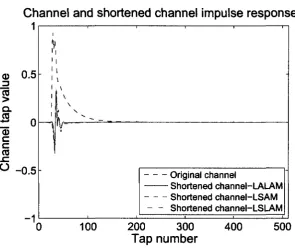
up-dating of TEQ is performed every block. Fig. 2.2 shows that ALAM algorithm using
MA methods shortens the channel to a length similar to SAM and SLAM.
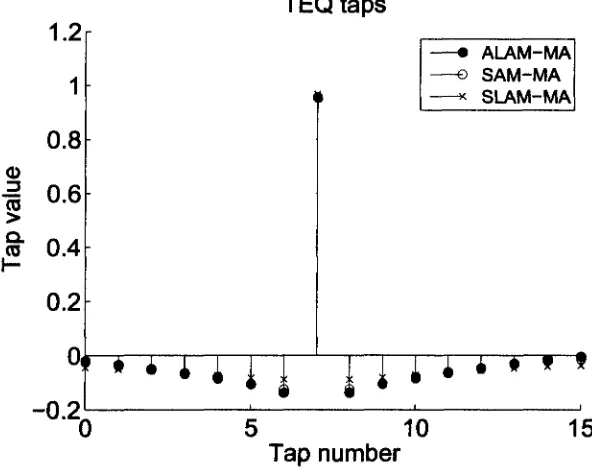
Further-more, the optimized TEQ taps after convergence using the proposed ALAM-MA are
Channel and shortened channel impulse responses
_2
CO > Q.
S
0)
c
c
COo _,
200 300 Tap number
500
Figure 2.2: Effective (shortened) channel impulse response using MA method.
TEQ taps 1.2
1
0.8
0)
>
<o 0.4
0.2
-0.2
0,
> * 1 1 i I
ALAM-MA SAM-MA SLAM-MA
| i 1 A ^
#
' '
0 5 10
Tap number
15
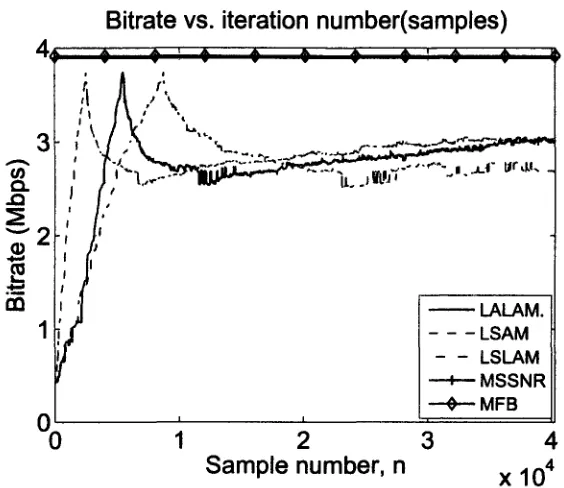
algorithms. The achievable bitrate vs. the iteration number (average blocks) is shown in Fig. 2.4. This figure is simulated using MA estimate where each averaging block
N = 32 samples which shows that the convergence for ALAM-MA, SAM-MA and
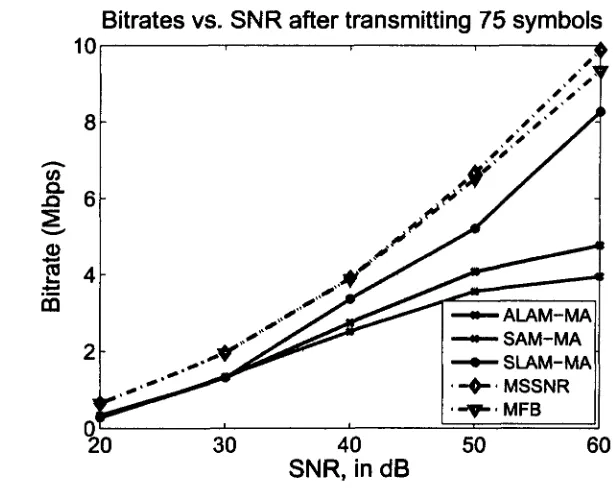
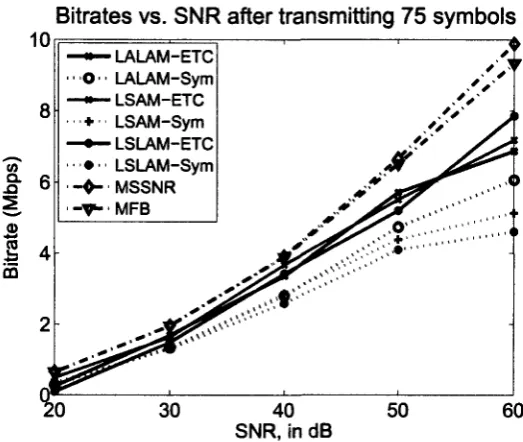
SLAM-MA is achieved at approximately 320, 260, and 1000 blocks, respectively, (i.e., in terms of DMT symbols the convergence is achieved at approximately 18, 15, and 58 symbols, respectively). These figures validates the proposed approach of adjacent lag autocorrelation minimization that shows that the channel shortening is achieved with lower complexity algorithm. Fig. 2.5 shows the achievable bitrate versus SNR for MSSNR, SAM-MA, SLAM-MA and the proposed algorithm ALAM-MA. The bitrate at each SNR is obtained after transmitting 75 symbols. Observe that ALAM-MA and SAM-MA achieve almost similar results but SLAM-MA outperforms both of them. Note that SLAM in this case is outperforming because the achieved bitrate is recorded after transmitting 75 symbols, (i.e., after transmitting 1200 blocks), which is high as shown in Fig. 2.4. However, as shown in this figure that at 75 symbols it is still in the process of decaying and eventually at steady state it will be the same as the ALAM-MA and SAM-MA.
2.4.2 ALAM-DSS.
Bitrate vs. iteration number(ave. blocks)
0 200 400 600 800 1000 1200
Averaging block number, k
Figure 2.4: Achievable bitrate vs. iteration number using MA method.
Bitrates vs. SNR after transmitting 75 symbols
40
SNR, in dB
slight decrease in bitrate for not using a threshold based criterion. This technique can be used in the proposed algorithms and the existing SAM and SLAM. But to avoid redundancy, only ALAM-DSS is simulated and the bitrate versus iteration numbers are shown in Fig. 2.4. In this figure as observed, the convergence with initial step size of 0.5 is achieved at around 400 block number, which is the 23rd DMT symbol. Note that the bitrate after the convergence becomes almost constant which means that the adaptive algorithm have stopped adapting, i.e., the TEQ algorithm entered a freezing state.
2.5 Conclusions
C h a p t e r 3
Efficient Blind Adaptive T E Q Designs
3.1 Introduction
The new algorithms developed in Chapter 2 and the existing algorithms SAM [16] and
SLAM [43] have some common limitations. These algorithms are slow in convergence
as they update every block and are not suitable for fast time varying channels. This
is due to the nature of the MA method used in those algorithms to estimate the
correlation that would slow down the update of the adaptive algorithm. In addition,
those algorithms require high computational complexity as they require an averaging
over a window of samples for each update. In order to achieve fast convergence and
low complexity, AR method is used to update the adaptive algorithms. However, this
update depends on previous estimate while estimating the autocorrelation. Because
of this, AR method it only suitable for slow time varying channels [16]. Moreover,
the algorithms in Chapter 2 and in [16],[44] share the same drawback of drop down
in bitrate which can be treated by freezing the TEQ, using stopping criterion, once
it reaches the maximum shortening SNR as in SLAM [44]. Hence, they are not
suitable for fast time varying environments. Another approach in Chapter 2 was
proposed where the freezing of the TEQ taps is achieved using variable step size.
setting and saves some amount of computations required for examining the TEQ
taps while adapting. However, this approach also becomes only suitable for time
invariant channel due to the freezing of the TEQ taps.
In order to minimize complexity, several researchers have used TEQ filter
proper-ties to reduce the amount of computation cost of the channel shortening algorithms.
Symmetrical property of the TEQ filter have been exploited in non-correlating based
algorithms [50], such as in MSSNR, MMSE and MERRY. In this Chapter, the
pro-posed algorithms are focused on reducing the complexity while achieving performance
similar or better than SAM-MA and SLAM-MA. The contributions of this Chapter
are as follows: (i) propose low complexity algorithms that use computational efficient
method for fast time varying channel to estimate the expectation to replace the MA
or AR method used in SAM and SLAM algorithms [16], [43], [44], (ii) exploit the
symmetrical property of TEQ [50] to reduce the amount of computation by 50% in
ALAM, SAM, and SLAM algorithms with slight decrease in convergence time, and
in) a TEQ design is proposed that enforces equal TEQ taps while adapting to achieve
maximum stable bitrate, this allows the algorithms to avoid the limitations of drop
down in bitrate in ALAM, SAM, and SLAM.
3.2 Proposed Low Complexity Algorithms
3.2.1 Low-complexity ALAM, SAM, and SLAM
Recall from chapter 2, a stochastic gradient descent update is implemented using MA
or AR estimate in [16] and [44]. Our focus in this Chapter is to simplify the MA
method to reduce the complexity and update the adaptive algorithm every sample to
achieve faster convergence. The MA method is defined by [16]
where N here is user defined window to perform averaging. This MA method
per-forms the estimate over a predefined window of size N samples that leads to a slow
convergence and update the adaptive algorithm every N samples. Our approach for
calculating the expectation, on the other hand, is based on a simplified version of
MA estimate. It is assumed that the output of IFFT is a stationary process due to
the WSS Gaussian process as per the central limit theorem [51]. For this reason, the
simplified low complexity, instantaneous estimate, is used in the adaptive algorithm
which is approximated as
E[y(n)y(n - 1)] « y(n)y(n - 1), (3.2)
This approximation is equal to the MA estimate. If E[y(n)y(n — I)] = Ry
y(l) for all
n, for a stationary process, then
E[y(n)y(n - 1)] = 1 AT y(n)y(n - 1) = y(n)y(n - 1). (3.3)
In addition to the above, the justification for this approximation comes from the
fact that this expectation is estimated using the stochastic gradient algorithm that
performs a two-fold way of averaging [52]. If we use the MA method in the stochastic
gradient algorithm as in Equations (2.5) and (2.6) of SAM and SLAM respectively,
then it looks like a redundant procedure is being done by performing an average of
averages. For more details about this approximation see Section 2.5 of [52].
Both MA and AR implementation methods have been used in the literature to
estimate the expectation. In [16] MA and AR methods have been used with a
com-plexity of ANL
W(L
C— v) and 4L
W(L
C— v) multiplications/additions in each update,
respectively. Thus, AR method is lower in complexity by N times compare to MA
method. However, the AR method depends on the previous estimates which makes
it unsuitable for fast time variation environments [16]. SLAM, on the other hand,
respectively. However, SLAM has the drawback of being dependent on the previous estimate which makes it suitable for slow time varying channel.
In the proposed TEQ algorithm, the expectation is implemented by instantaneous and MA estimates with complexities of 2LW and 2NLW multiplications/additions per
update, respectively. The coefficient update equation for the proposed low-complexity ALAM (LALAM) blind adaptive algorithm using instantaneous estimate implemen-tation of Equation (3.2) is given by
wfc+1 = wfc - 2/x{y(n)rn_1}. (3.4)
The proposed method of instantaneous estimate is also implemented on SAM-MA and SLAM-MA to lower their complexity by a factor of N. The coefficient update equation for the low-complexity SAM (LSAM) is given by
LC
w*+ 1 = w k - 2 / i J {y(n)y(n - Z)}{y(n)rn_i + y(n - Z)rn}, (3.5)
and for the low-complexity SLAM (LSLAM) is given by
w*+ 1 = wfc - 2fi{y(n)y(n - l)}{y(n)rn-i + y{n - l)rn}. (3.6)
The proposed LALAM, LSAM, and LSLAM algorithms are of low complexity and they update every sample which makes them depend on the current settings; making them suitable for fast time varying channels. The complexity comparisons of the algorithms using MA estimate and the low complexity instantaneous estimate are shown in Table. 3.1.
3.2.2 Exploiting Symmetrical T E Q
Table 3.1: Complexity comparison in terms of number of multiplications and ad-dition per TEQ update
Algorithms
SAM
SLAM
ALAM
MA estimate
4NL
W{L
C- v)
ZNL
W2NL
WInst, estimate
4L
W(L
C- v)
oLw1LW
it has been shown that the optimum TEQ taps become symmetrical as the length of the TEQ tends to infinity [53], [54], [55]. Several researchers have utilized this property to force the TEQ to be perfectly symmetric in the case of a finite length T E Q in non-correlating based TEQ algorithms [50] to reduce the complexity by 50% compare to the conventional TEQ design. TEQ length can be even or odd, and it is noted that when the length is even the enforcing of symmetry is described by
w
r=[f ( i
ct n
while when the TEQ length is odd, symmetry it is enforced by
w
T= [f
7(I
cff].
(3.7)
(3.8)
where 7 is a scalar initialized as 1, f = [WQ WI W2 . . . W[LW/2\]T where [.J is the floor
function, and Ic is the cross diagonal identity matrix defined as
Ic =
0 0
0 0
0 1
1 0
0
. . .. . . 1
1 0
0 0
0 0
(3.9)
reduced by 50% for Sym-LALAM, Sym-LSAM, and Sym-LSLAM where the
adap-tation of TEQ is performed only for L
w/2 taps and symmetry is enforced to form
w. Without loss of generality, we only show the odd symmetrical LALAM coefficient
update equation which is described by
i*
x= 1<- 2/.{y(n)r
n_
1}. (3.10)
w
r= [f 7 (I
cff]. (3.11)
The proposed algorithms using symmetrical TEQ design reduces the complexity
while maintaining similar bitrate performance compare to SAM and SLAM in [16]
and [43] with slight decrease in convergence rate.
3.2.3 Adaptive Algorithm for T E Q Using Equal-Taps
Con-straint (ETC)
A new approach for adapting the TEQ algorithm using equal-taps constraint (ETC)
is introduced. This approach avoids the limitations in the above proposed and
exist-ing algorithms which are the drop down in bitrate and choosexist-ing bad minima while
converging blindly. An extensive research has been done by Balakrishnan, et al. [16],
in which an investigation has been carried out and conclusion was drawn that blind
channel shortening algorithms produce multiple minima and the cost function is
in-variant to the operation of flipping the TEQ taps w. Theorem I in [16] states that
whenever there is a good minima at w
0, there is also another minima at the flipped
w
0but this does not mean that flipped one is the best minima. Therefore, it is clear
that there are multiple minima and to achieve the best minima in order to maximize
the bitrate, a global search technique is needed. Toker and Altin [56] proposed a
genetic algorithm to search for the global minima to select the best minima. The
use of genetic algorithm is very costly, in terms of complexity and searching time,
as it requires to search all the combinations of TEQ taps to reach the best minima.
will produce an equal taps for a single update which reduces the complexity of the proposed algorithms by Lw. Using this approach we can achieve a suitable minima
that gives higher stable bitrate than the existing algorithms which is demonstrated by experiments in Section 3.3.
The scalar adaptive algorithm using the equal-taps constraints for LALAM (ETC-LALAM) can be formulated as
/f e + 1 = /f c- 2/x {2 /( n ) rn_1} , (3.12)
and the equal TEQ taps are enforced in the above adaptive algorithm by the vector wT = [/ / ] of length Lw.
Similarly, the ETC approach is applied in LSAM and LSLAM algorithms to re-duce their complexity and achieve better stable bitrates, the resulting algorithms are labeled as ETC-LSAM and ETC-LSLAM, respectively.
3.3 Simulation Results
In this Section the simulation setup/parameters of Chapter 2 are used to test the performance of the proposed efficient algorithms. The step sizes chosen based on ex-tensive simulation are 0.01, 0.05, and 7 for LALAM, LSAM, and LSLAM, respectively.