2011
Human Face Recognition
Human Face Recognition
Amirhosein Nabatchian
University of Windsor
Follow this and additional works at: https://scholar.uwindsor.ca/etd
Recommended Citation Recommended Citation
Nabatchian, Amirhosein, "Human Face Recognition" (2011). Electronic Theses and Dissertations. 437. https://scholar.uwindsor.ca/etd/437
Human Face Recognition
by
Amirhosein Nabatchian
A Dissertation
Submitted to the Faculty of Graduate Studies through the
Department of Electrical and Computer Engineering in Partial Fulfillment of the Requirements for the Degree of Doctor of Philosophy at the
University of Windsor
© 2011 Amirhosein Nabatchian
Declaration of Co-Authorship and Previous Publication
I. Co-Authorship Declaration
I hereby declare that this thesis incorporates material that is result of joint research with Dr. Majid Ahmadi and Dr. Esam Abdel-Rahem and under their supervision. I am aware of the University of Windsor Senate Policy on Authorship and I certify that I have properly acknowledged the contribution of other researchers to my thesis, and have obtained written permission from each of the co-authors to include the above materials in my thesis.
I certify that, with the above qualification, this thesis, and the research to which it refers, is the product of my own work.
II. Declaration of Previous Publication
Thesis Chapter Publication title and full citation Publication Status
Chapter 3 A. Nabatchian, E. Abdel-Raheem, M. Ahmadi, Human Face Recognition in Presence of Noise and Misalignment in the Detected Faces, Digital Signal Processing.
Submitted
Chapter 4 and Chapter 5
A. Nabatchian, E. Abdel-Raheem, M. Ahmadi, Illumination Invariant Feature Extraction and Mutual-Information-based Local Matching for Face Recognition under Illumination Variation and Occlusion, Pattern Recognition.
Submitted
Chapter 3 A. Nabatchian, E. Abdel-Raheem, M. Ahmadi, Human Face Recognition Using Different Moment Invariants: A Comparative Study, Image and Signal Processing, 2008. CISP '08. Congress on, 27‐30 May 2008, China
Published
Chapter 3 A. Nabatchian, I. Makaremi, E. Abdel‐Raheem, M. Ahmadi, Pseudo Zernike Moment Invariants for Recognition of Faces Using Different Classifiers in FERET Database, Convergence and Hybrid Information Technology, 2008. ICCIT '08. Third International Conference on, 11‐13 Nov. 2008, Busan, Korea.
Published
Chapter 4 A. Nabatchian, E. Abdel-Raheem, M. Ahmadi, An efficient method for face recognition under illumination variations, High Performance Computing and Simulation (HPCS), 2010 International Conference on, June 28 ‐July 2, 2010, Caen, France.
Published
Chapter 4 and Chapter 5
A. Nabatchian, E. Abdel-Raheem, M. Ahmadi, A Weighted Voting Scheme for Recognition of Faces with Illumination Variation, Control, Automation, Robotics and Vision, ICARCV 2010, 11th International
Conference on, 7‐10 December 2010, Singapore.
include the above published materials in my thesis. I certify that the above material describes work completed during my registration as graduate student at the University of Windsor.
I declare that, to the best of my knowledge, my thesis does not infringe upon anyone’s copyright nor violate any proprietary rights and that any ideas, techniques, quotations, or any other material from the work of other people included in my thesis, published or otherwise, are fully acknowledged in accordance with the standard referencing practices. Furthermore, to the extent that I have included copyrighted material that surpasses the bounds of fair dealing within the meaning of the Canada Copyright Act, I certify that I have obtained a written permission from the copyright owners to include such materials in my thesis.
Abstract
Face recognition, as the main biometric used by human beings, has become more
popular for the last twenty years. Automatic recognition of human faces has many
commercial and security applications in identity validation and recognition and has
become one of the hottest topics in the area of image processing and pattern recognition
since 1990. Availability of feasible technologies as well as the increasing request for
reliable security systems in today’s world has been a motivation for many researchers to
develop new methods for face recognition.
In automatic face recognition we desire to either identify or verify one or more
persons in still or video images of a scene by means of a stored database of faces. One of
the important features of face recognition is its non-intrusive and non-contact property
that distinguishes it from other biometrics like iris or finger print recognition that require
been proposed and some major advances have been achieved. As a result, the
performance of face recognition systems under controlled conditions has now reached a
satisfactory level. These systems, however, face some challenges in environments with
variations in illumination, pose, expression, etc. The objective of this research is designing a reliable automated face recognition system which is robust under varying
conditions of noise level, illumination and occlusion. A new method for illumination
invariant feature extraction based on the illumination-reflectance model is proposed
which is computationally efficient and does not require any prior information about the
face model or illumination. A weighted voting scheme is also proposed to enhance the
performance under illumination variations and also cancel occlusions. The proposed
method uses mutual information and entropy of the images to generate different weights
for a group of ensemble classifiers based on the input image quality. The method yields
outstanding results by reducing the effect of both illumination and occlusion variations in
To my love, my life and my inspiration, To my wife and my best friend,
Behjat,
Contents
Declaration of Co-Authorship and Previous Publication ……….
Abstract …..……….………...……..
Dedication ………
List of Figures ………...
List of Tables ………...
List of Abbreviations ………...
1. Introduction
1.1. Face Recognition ………...
1.2. Identification vs. Verification ………
1.3. Applications ………...
1.4. Challenges ……….
1.4.1.Illumination ………
1.4.2.Head Pose ………..
1.4.3.Facial Expressions ……….
1.4.4.Occlusion ………...
1.4.5.Inter-Class Similarities ……….. iv
vii
ix
xiv
xvii
xix
1
2
3
4
5
5
6
6
7
1.6. Outline of the Thesis ………..
2. Face recognition Methods
2.1. A Face Recognition System ………..
2.2. Preprocessing ……….
2.3. Face Detection ………...
2.4. Feature Extraction ………..
2.4.1.Correlation ……….
2.4.2.Principal Component Analysis ………..
2.4.3.Linear Discriminant Analysis ………...
2.4.4.Independent Component Analysis ……….
2.4.5.Kernel Principal Component Analysis ………..
2.4.6.Wavelets ………
2.5. Classification ……….
2.5.1.k Nearest Neighbors ………...
2.5.2.Neural Networks ………
2.5.3.Support Vector Machines ………..
2.5.4.Hidden Markov Model ………..
2.6. Databases ………...
2.6.1.The AT&T Database ………..
2.6.2.The FERET Database ………
2.6.3.The Yale B Database ……….
2.6.4.The Extended Yale B Database ……….
2.6.5.The CMU-PIE Database ………
3. Moment Invariants for Human Face Recognition
3.1. Moment Invariants ……….
3.1.1.Regular Moment Invariants ………...
3.1.2.Hu Moment Invariants ………...
3.1.3.Bamieh Moment Invariants ………...
3.1.4.Zernike Moment Invariants ………...
3.1.5.Pseudo Zernike Moment Invariants ………...
3.1.6.Teague - Zernike Moment Invariants ………
3.1.7.Normalized Zernike and pseudo Zernike Moment Invariants ………...
3.1.8.Legendre Zernike ………...
3.2. Locating the Face ………...
3.3. Experimental Results ……….
3.3.1.Comparing Different Moment Invariants ………..
3.3.2.Performance of Different Classifiers ……….
3.3.3.Effect of Misalignment ………..
3.3.4.Robustness to Noise ………...
3.4. Conclusion ……….
4. Illumination Invariant Feature Extraction
4.1. Illumination Invariant Methods ……….
4.2. Illumination Invariants ………..
4.2.1.The Illumination Model ……….
4.2.2.The Maximum Filter ………..
4.2.3.The Proposed Algorithm ………
4.4. Conclusion ……….
5. Local Matching and Voting Systems
5.1. Democratic Voting Scheme ………...
5.2. Weighted Voting Scheme ………..
5.2.1.Mean Grayscale Level ………...
5.2.2.Image Entropy ………...
5.2.3.Mutual Information between Corresponding Sub-Images ………
5.3. Adaptive Weight Generator ………...
5.4. Experimental Results ……….
5.4.1.Face recognition ……….
5.4.2.Face Verification and ROC Analysis ………
5.4.3.Effect of Reducing the Training Samples ………..
5.4.4.Effect of Partial Image Occlusion ………..
5.4.5.Effect of a Larger Database ………...
5.5. Conclusion ……….
6. Concluding Remarks
6.1. Summary of Contributions ………
6.2. Conclusion ……….
6.3. Future Work ………...
References ………...
VITA AUCTORIS ……….. 88
89
90
94
94
96
97
98
100
101
104
107
109
115
116
118
118
119
122
123
List of Figures
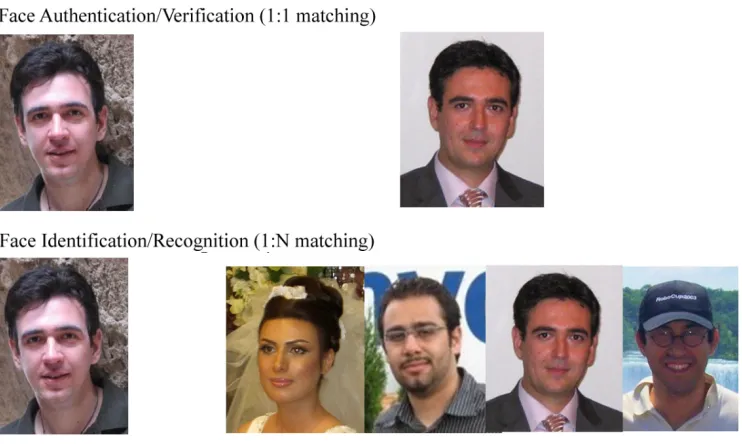
1.1 An example of authentication vs. identification ………...……... 4
1.2 Bad illumination can cause between-class similarities overcome the inter-class similarities. Images in each row belong to the same subject but with different illumination
6
2.1 Flow diagram of face recognition process ………..…… 12
2.2 PCA maps the samples to the direction with maximum variation where LDA finds the direction with maximum between-class variation to within-class variation
18
2.3 Three layer perceptron ………..…... 22
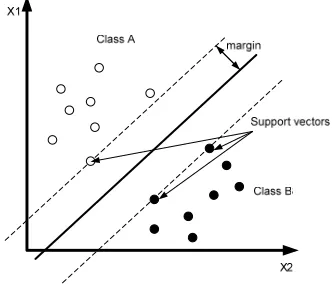
2.4 Maximum-margin hyperplane for a SVM classifier. Samples on the margin are called the support vectors
23
2.5 Sample images of two subjects the in the AT&T database ………. 24
2.6 One of the samples of the FERET database in frontal position ……….…. 25
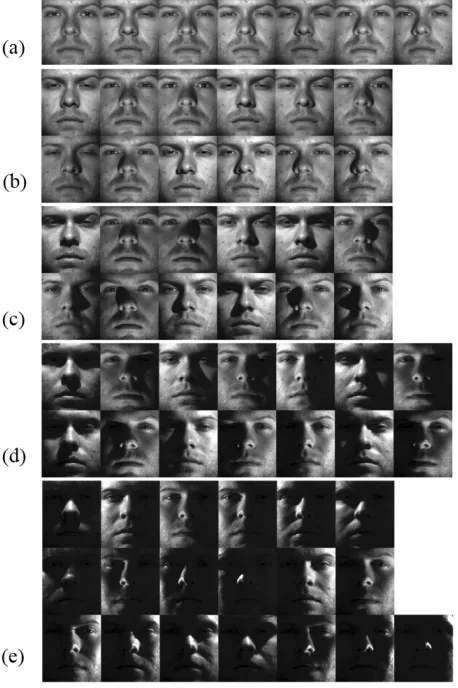
2.7 One of the subjects in the Extended Yale B database with its 5 subsets …. 26
2.8 One of the samples in CMU-PIE database (a) lights-off group (b) lights-on group
27
3.1 Two of the samples in the database and the result of applying face localization on them
36
3.2 Some wrong detections using Viola-Jones face detector on FERET database
50
3.3 (a) Some samples from FERET database. (b) The result of the Viola-Jones face detection. (c) Images in (b) after histogram equalization
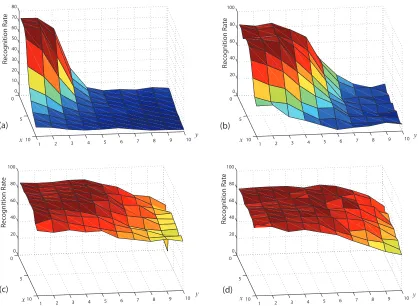
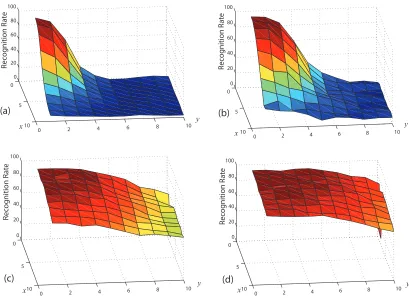
methods: (a) PCA (b) FLD (c) ZMI (d) LMI. The algorithms were trained with half of the database without any translations and tested with the other half with the translation
3.5 Effect of translation on images in the extended Yale B database using 4 different methods: (a) PCA (b) FLD (c) ZMI (d) LMI. The algorithms were trained with the first subset without translation and tested with the second subset with shifting
55
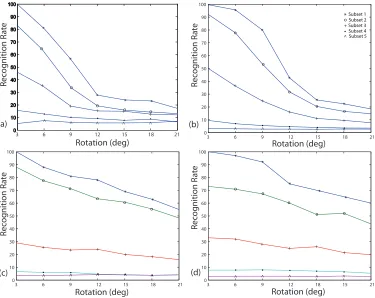
3.6 Effect of rotation θ degrees on images in the extended Yale B database using 4 different methods: (a) PCA (b) FLD (c) ZMI (d) LMI. The algorithms were trained with the first subset without translation and tested with the translated subsets
56
3.7 Effect of rotation with the maximum of θ degrees on images in the extended Yale B database using 4 different methods: (a) PCA (b) FLD (c) ZMI (d) LMI. The algorithms were trained with the first subset without translation and tested with the translated subsets
57
3.8 Result of the rotation test for the FERET database using 4 methods (a) effect of rotation (b) effect of random rotation with maximum of θ degrees
57
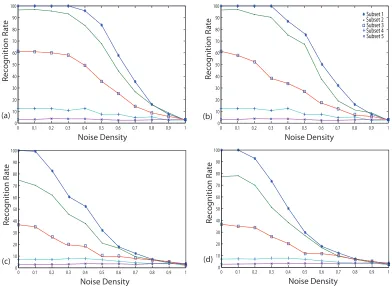
3.9 Effect of Gaussian Noise on images in the Yale B database using 4 different methods: (a) PCA (b) FLD (c) ZMI (d) LMI. The algorithms were trained with the first subset without Noise and tested with all the subsets after adding noise
59
3.10 Effect of Salt & Pepper Noise on images in the Yale B database using 4 different methods: (a) PCA (b) FLD (c) ZMI (d) LMI. The algorithms were trained with the first subset without Noise and tested with all the subsets after adding noise
60
3.11 Result of the noise test for the FERET database using 4 methods (a) effect of Gaussian noise (b) effect of Salt and Pepper noise
60
4.1 Bad illumination can cause between class similarities overcome the inter-class similarities. Images in each row belong to the same subject but with different illumination
65
4.2 Extracting the illumination invariants based on the illumination-reflection model by applying a HPF on the logarithm of the image
69
4.3 Extracting the illumination invariants by using LPFs (maximum filter) … 70
4.4 Recognition results using different lowpass and highpass filters in the two structures. (Extended Yale B database is used with PCA as feature extractor and SVM for classification)
70
4.5 The results of applying 3×3 and 5×5 maximum filters on Lena image ….. 71
4.6 Illumination invariants achieved by different lowpass and highpass filters 73
4.8 Different steps in extracting the illumination invariants ………. 75
4.9 One of the subjects in the Yale B database with 5 corresponding subsets and the illumination invariants generated using the proposed method: (a) subset 1 (θ upto 12˚) (b) subset 2 (θ upto 25˚) (c) subset 3 (θ upto 50˚) (d) subset 4 (θ upto 77˚)
83
4.10 One of the samples in CMU-PIE database and its illumination invariants (a) lights-off group (b) lights-on group (c) and (d) are the corresponding illumination invariants to (a) and (b)
84
5.1 Samples of images with different angle between the light source and camera axes, θ, (a): θ = 0˚, (b) θ = 40˚ (c) θ = 90˚, (d), (e) and (f) are corresponding illumination invariant images, respectively
90
5.2 Democratic Voting Scheme (DVS) ……….……… 93
5.3 The Weighted Voting Scheme (WVS) ……….……... 95
5.4 ROC curve for face verification where different methods of WVS, DVS and mPCA are compared. 5×5 grids are used for all methods
105
5.5 Performance of different methods with different number of samples of subset 1 in train set varying from 1 to 7 and different subsets as test probes. (a) subset 2 (b) subset 3 (c) subset 4 (d) subset 5. Extended Yale B database is used with SVM classifiers
108
5.6 Occluded images and their illumination invariants. Input images are occluded with a pair of sunglasses, striped and black scarves, wall, another face and back of another person’s head
110
5.7 Images in different subsets of Yale B database occluded using random circles and their corresponding illumination invariants
112
5.8 Performance of different recognition methods under varing amount of oclusion. (a) back of head (b) another face (c) wall overlapping from left and right (d) wall overlapping from top and bottom
List of Tables
3.1 Bamieh Moment Invariants ………...…….……. 31
3.2 Classification parameters for different moment invariants ……….… 40
3.3 Recognition time for different methods ………..…… 41
3.4 Recognition Accuracy for PZMI method using different orders of the moment invariants
42
3.5 Classification results for different classifiers ……….…..………... 47
4.1 A comparison between different filters. Values show the average Euclidian distance between the images with illumination variations and the image with frontal lightning. Maximum filter shows to have the best results.
74
4.2 Recognition rates for different filters and SVM as classifier ……….……. 76
4.3 Recognition rates for different filters and kNN with k =1 as classifier …... 77
4.4 Recognition rates for different filters and kNN with k =3 as classifier …... 78
4.5 Recognition rates for different filters and kNN with k =5 as classifier …... 79
4.6 Recognition rates for different filters and fuzzy kNN with k =1 as classifier 80
4.7 Recognition rates for different filters and fuzzy kNN with k =3 as classifier 81
4.8 Recognition rates for different filters and fuzzy kNN with k =5 as classifier 82
4.9 Recognition results for 200 simulations on CMU-PIE database …………. 86
subjects)
4.12 Recognition rates using the Extended Yale B database (38 subjects) ……. 87
5.1 Recognition rates using different methods for Yale B database (10 subjects)
103
5.2 Recognition rates using the Extended Yale B database (38 subjects) ……. 103
5.3 Recognition rates using different methods for CMU-PIE database ……… 103
5.4 Threshold values and verification rates for different FAR and FRR conditions
106
5.5 Recognition rate vs. number of training samples from light on and off groups for CMU-PIE database
107
5.6 Recognition rates for images occluded with sunglasses, striped scarf and black scarf
112
5.7 Effect of occlusion on recognition results using different methods for Ext Yale B database (38 subjects)
114
5.8 Recognition results for combination of Ext. Yale B and CMU-PIE databases
List of Abbreviations
2D Two Dimensional
3D Two Dimensional
HE Histogram Equalization
GIC Gamma Intensity Correction PCA Principal Component Analysis LDA Linear Discriminant Analysis FLD Fisher’s Linear Discriminant ICA Independent Component Analysis
LS-ICA Locally Salient Independent Component Analysis KPCA Kernel Principal Component Analysis
KFD Kernel Fisher’s Discriminant HMI Hu Moment Invariant RMI Regular Moment Invariant BMI Bamieh Moment Invariant ZMI Zernike Moment Invariant
PZMI Pseudo Zernike Moment Invariant TZMI Teague Zernike Moment Invariant NZMI Normalized Zernike Moment Invariant
NPZMI Normalized Pseudo Zernike Moment Invariant LMI Legendre Moment Invariant
ANN Artificial Neural Networks kNN K Nearest Neighbors RBF Radial Basis Function SVM Support Vector Machine
HMM Hidden Markov Model
FV Feature Vector
VJ Viola and Jones face detector
II Illumination Invariants
QI Quotient Image
QIR Quotient Illumination Relighting
SQI Self-Quotient Image
MQI Morphological Quotient Image
mPCA Modular PCA
mLDA Modular LDA
DVS Democratic Voting Scheme
WVS Weighted Voting Scheme AWG Adaptive Weight Generator ROC Receiver Operating Characteristic
FAR False Accept Ratio
Chapter 1
Introduction
Among all biometric methods for human recognition and human authentication, the
fingerprint and face recognition have been used more frequently. Finger print recognition
is very old and has been used for long, but face recognition has become more popular for
the last twenty years. Face recognition is the main biometric used by human beings.
When two people meet each other, their brains run a variety of biometrics based on
height, age, hair color and style, skin color, etc. However, the final decision of the other person’s identity is made based on his/her face; hence face is assumed to be the part of
the body that carries more information than other parts.
Automatic face recognition has many commercial and security applications in identity
processing and pattern recognition since 1990. Availability of feasible technologies as
well as the increasing request for reliable security systems in today’s world has been a
motivation for many researchers to develop new methods for face recognition. Automatic
recognition of human faces continues to attract researchers from different areas such as
computer vision, image processing, pattern recognition, neural networks, computer
graphics, and psychology and also has been increasingly accepted by the general public
to be used in authentication, security and law enforcement.
1.1
Face Recognition
In January 2001 police in Tampa Bay, Florida, used a face recognition software at
Super Bowl XXXV to search for potential criminals and terrorists attending the event [1].
The system found 19 people with pending arrest warrants. This is a practical example of
using a face recognition system in security applications. In automatic face recognition we
desire to either identify or verify one or more persons in still or video images of a scene
by means of a stored database of faces [2]. One of the important features of face
recognition is its non-intrusive and non-contact property that distinguishes it from other
biometrics like iris or finger print recognition that require subjects’ participation.
An automatic face recognition system is usually a procedure of four main stages. In
most cases these four stages or blocks are namely: pre-processing, face detection, feature
extraction and finally classification. The input images obtained from image acquisition
color, and fix the illumination. Then we must find the face in the image. Some face
detection algorithms are presented in chapter 2 of this thesis. Next step would be to
extract some predefined features in order to make a feature vector. These features must
include distinctive information about each person in the database to enable the
recognition of the individual based on these features. Finally, the last stage is the
classifier where we intend to recognize an unknown sample by assigning a class to its
feature vector based on the database of features that we have gathered from previously
seen samples.
1.2
Identification vs. Verification
Biometric methods are used for either one of two functions, identification or
verification. The selection and implementation of the technology are closely related to
this objective. In identification the goal is to identify an individual based on comparison
of features collected against a database of previously collected samples. In other words,
systems which are designed for the purpose of identification will answer the question:
“Who the subject is?” (Figure 1.1). In the verification applications, on the other hand, we
desire to verify whether the subject is the person that they claim to be. This is done by
validating the collected features against a previously collected feature sample for the
individual in our library. Biometric methods designed for verification purposes answer
Figure 1.1: An example of authentication vs. identification.
1.3
Applications
Today’s technologies have made face recognition a possible reliable solution in
applications like driver’s license, passport or national ID verification or security access to
ATM machines, database or medical records [2]. Some of the applications of automatic
face recognition can be categorized as follows.
Entertainment: Video games, virtual reality, training programs, human robot
interaction, human computer interaction
Smart cards: Drivers’ licenses, entitlement programs, immigration, national ID,
passports, voter registration, welfare fraud
Information security: TV parental control, personal device logon, desktop logon,
application security, database security, file encryption, intranet security, internet access,
Law enforcement and surveillance: Advanced video surveillance, CCTV control,
portal control, post event analysis, shoplifting, suspect tracking and investigation
1.4
Challenges
During the last two decades several face recognition algorithms and systems have
been proposed and some major advances have been achieved. As a result, the
performance of face recognition systems under controlled conditions has now reached a
satisfactory level. These systems, however, face some challenges in environments with
variations in illumination, pose, expression, etc. The performance of a face recognition system is directly related to the amount of variation observed in face images. The better a
system can eliminate the effect of these variations, it yields better recognition results and
hence it would be a more reliable system. The major variations that challenge the face
recognition algorithms are as follows.
1.4.1
Illumination
Whether the face is indoor or outdoor or under certain illumination condition, it has
been observed that changes in lighting condition shape different shading and shadows on
the face due to the 3D shape of human faces. This may weaken some face features or may
result in too bright or too dark parts in images. These variations can be larger than the
Figure 1.2: Bad illumination can cause between-class similarities overcome the inter-class similarities. Images in each row belong to the same subject but with different illumination.
1.4.2
Head Pose
In most cases, the face recognition systems are trained with a group of images under
supervised conditions. One of these conditions would be the angle between the axis of
camera and the orientation of the face which we desire to be minimum or zero. In other
words we desire the face images to be taken in frontal pose where the person is looking at
the camera. In this position maximum information of the face is present, therefore, a
better recognition rate is expected. This ideal head position would be a valid assumption
in applications like access to a specific facility, but not in a subway surveillance system.
The three dimensional structure of human faces will occlude some features resulting an
information loss which leads to classification errors in the face recognition system.
1.4.3
Facial Expressions
As it was mentioned, most face recognition algorithms are trained with normal and
also emotional expressions like laughing, smiling or frowning will change some of the
features in the face and might affect the result of the classification. An ideal automated
face recognition system is desired to overcome this problem, for example, by proper
feature selection.
1.4.4
Occlusion
Generally human beings are able to recognize another person even if they are wearing
sunglasses or a scarf. This is a challenge for the automatic face recognition systems that
are designed to replace human brains. Partial occlusion by another object, another
person’s face, sunglasses or scarves is a common problem in many face recognition
applications. These occlusions will affect some of the face features due to covering parts
of the face image and might degrade the recognition performance. Many methods tend to
solve this problem by segmenting the occluded parts of the image and disregarding their
corresponding features.
1.4.5
Inter-Class Similarities
Distinguishing between two identical twins is not impossible but still sometimes a
hard job even for their parents. So inter-class similarities are not only a challenge for
biometrics technologies, but they also confront human brains. It is the problem of
differentiating between two different subjects that have very similar features. In many
cases multi-biometric methods like combining face and fingerprint recognition will
1.5
Research Objective and Contributions
The objective of this research is designing a reliable automated face recognition
system which is robust under varying conditions of noise level, illumination and
occlusion. This work’s original contribution is in unique combination of illumination
invariant feature extraction and weighted local matching to achieve promising
recognition results in presence of both illumination variations and occlusions.
A new method for illumination invariant feature extraction is proposed and the results
are compared to similar algorithms. The proposed technique is computationally efficient
and does not require any prior information about the face model or illumination. Unlike
many methods in the literature, our method does not need many training samples to
achieve illumination invariants and can be applied on each single image to obtain the
illumination invariants.
A weighted voting scheme is proposed to enhance the performance under
illumination variations and also cancel occlusions. The proposed method uses mutual
information and entropy of the images to generate different weights for a group of
ensemble classifiers based on the input image quality. The method yields outstanding
results by reducing the effect of both illumination and occlusion variations in the input
face images.
1.6
Outline of the Thesis
Different building blocks of an automated face recognition system as well as a brief
of the thesis. Many different face image databases have been developed by researchers in
the area. Each of these databases accentuates one or more of the condition variations.
Some of these databases are also introduced in this chapter.
Moment invariants are pattern sensitive features and are used in pattern recognition
applications. In the third chapter different moment invariants are used to extract features
from human face images. A comparison of the performance of different moment
invariants with different classifiers and databases is presented in this chapter. The effect
of noise and misalignment in the detected faces is also studied.
An efficient illumination invariant feature extraction method is proposed in chapter 4
of this thesis and its recognition results are compared with similar methods for cancelling
illumination available in the literature.
In chapter 5 a new weighted voting scheme based on mutual information and image
entropy is proposed. The proposed method makes a decision based on the different parts
of the face image and disregards the features corresponding to occluded or poorly
illuminated parts.
Chapter 2
Face Recognition Methods
While we are almost sure that most of the human skills for face perception do not
exist in babies, there are studies showing an instinctive affinity to pay attention to faces
from birth [3]. This is the first step towards the development of visual perception skills
such as identifying friendly others and pre-verbal communications. As the person grows
up, understanding faces develops from basic understanding of sensory information to
receive age, gender details about the individual, to the ability to remember significant
information such as their name or past familiarity with the person. Face perception plays
an important role in the human perception system and is an ordinary task for human
brains, but designing a comparable fully automated computer system is still an open
vision, image processing, pattern recognition, neural networks, computer graphics, and
psychology and several methods and techniques have been proposed to fulfill this task.
2.1
A Face Recognition System
An automatic face recognition system is usually a procedure of four main stages. In
most cases these four stages or blocks are namely: pre-processing, face detection, feature
extraction and finally classification. The flow diagram of a face recognition system is
presented in Figure 2.1. The input images obtained from image acquisition devices e.g. cameras, might not be suitable for recognition due to noise or illumination conditions.
Therefore, first step is the preprocessing stage to remove noise, fix the illumination and
normalize the color. Then faces should be located and segmented in input images. Some
face detection algorithms are presented in this chapter. Next step would be to extract
some predefined features in order to make a feature vector. These features must include
distinctive information about each person in the database so we can recognize the
individual based on these features. And finally the last stage is the classifier where we
intend to recognize an unknown sample by assigning a class to its feature vector based on
Figure 2.1: Flow diagram of face recognition process.
2.2
Preprocessing
The first step in most face recognition systems as well as many other computer vision
applications is preprocessing or image quality enhancement. The input images acquired
via still or video cameras might suffer from noise, bad illumination or unrealistic color.
Therefore, noise removal might be a necessary block in some cases. Histogram
equalization is the most common method used for image enhancement when images have
illumination variations [4]. Even for images under controlled illumination, histogram
equalization improves the recognition results by flattening the histogram of pixel
intensities of the images. Shan et al. proposed Gamma intensity correction method in [5] and used it for illumination normalization along with histogram equalization. They also
presented a region-based method for equalizing histogram and gamma locally in small
portions of an image in their work.
Image Acquisition
Pre‐Processing
Face Detection
Feature Extraction
Classification
Image Acquisition
Pre‐Processing
Face Detection
Feature Extraction
Feature Database
Training (offline)
2.3
Face Detection
Another step in face recognition process is to locate the face in an input image. This
requires the algorithm to locate a single face with a known scale and orientation [2]. Face
detection at frame rate is an impressive goal that has an apparent application to practical
face tracking and real time face recognition. Papageorgiou et al. [6] proposed a general object detection scheme which uses a wavelet representation and statistical learning
techniques. Osuna et al. apply Vapnik's support vector machine technique to face detection in [7], and Romdhani et al. improved it by creating reduced training vector sets for their classifier [8]. Schneiderman and Kanade's statistical method considered profile
detection [9], but their method considered only three face orientations, and each
orientation is treated as a different object, Rowley and Kanade used neural network-based
filters [10], while Fleuret and Geman attempted a coarse-to-fine approach to face
detection, focusing on minimizing computation in their approach [11]. Viola and Jones
[12] used the concept of an integral image, along with a rectangular feature representation
and a boosting algorithm as its learning method. They obtained good result of detecting
faces at 15 frames per second. Their method minimized computation time while
achieving high detection accuracy and is approximately 15 times faster than previous
approaches based on similarity functions.
2.4
Feature Extraction
Extraction of applicable features from the human face images is an important part of
a face recognition system with high recognition rate. There are two main approaches for
the feature extraction problem [2]. The first one is based on extracting geometrical and
structural facial features like the shapes of the eyes, nose, mouth and the distance
between these. These methods are not affected by irrelevant information in the images,
but are sensitive to unpredictability of face appearance and environmental conditions. In
the second method which is the holistic approach, features from the whole image are
extracted. Since the features are global in the whole image, irrelevant elements like
background and hair might affect the feature vectors and cause erroneous recognition
results.
Eigenfaces method by Turk and Pentland [13] and Fisherfaces method by Belhumeur
et al. [14] are the most referred algorithms among appearance-based holistic approaches and have proven to be effective in experiments with large databases. The basic idea
behind these algorithms is the principal component analysis that can be used to decrease
the feature space dimension while keeping the characteristics of the images. In principal
component analysis (PCA), the mean of the training images is calculated and is
subtracted from the whole training set, and then eigenvalues of the covariance matrix are
calculated. n eigenvectors regarding n greatest eigenvalues are calculated and called eigenfaces. Any image in the image space will be projected on those n basic eigenfaces. Those directions or eigenfaces are assumed to be the directions or planes with the
maximum data scattering. In Fisher’s Linear Discriminant [14] however, the goal is to
find directions with the maximum ratio of between-class scatter to within-class scatter.
between-class scattering and within-between-class scattering matrices. Images are projected on the
calculated hyperplanes called fisherfaces, which leads to better classification and higher
recognition rates in most of the experiments. Independent component analysis (ICA) is a
computational method for separating a multivariate signal into additive subcomponents
by assuming the mutual statistical independence of the non-Gaussian source signals. This
technique has been proposed by Liu and Wechsler [15] to minimize both second-order
and higher-order dependencies and also reduce dimensionality. Kim et al. proposed an effective part-based local representation method named locally salient ICA (LS-ICA)
method for face recognition that is robust to partial occlusion. LS-ICA only employs
locally salient information from important facial parts in order to maximize the benefit of
applying the idea of recognition by parts [16].
The face manifold in subspace is not restricted to be linear. Kernel methods [17-19]
can be applied to extract features from images with large variations. This is based on
non-linear mapping of the input image, transferring it from the input space to a higher
dimensional feature space and applying the PCA, ICA or linear discriminant analysis
method in the feature space. Bach and Jordan [20] use contrast functions based on
canonical correlations in a reproducing kernel Hilbert space for ICA. Kernel PCA
(KPCA) is developed by Scholkopf [17], and Kernel Fisherfaces (KFD) is later proposed
by Mika [18] and Baudat [19]. Mika's work is mainly focused on two-class problems,
while Baudat's algorithm is applicable for multi-class problems. Lu et al [21] use kernel direct discriminant analysis as the nonlinear substitute for Fisherface method. Yang
with FLD in [23]. Wiskott et al. [24] used a feature-based graph matching approach which is quite successful.
Compared to holistic approaches, feature-based methods are assumed to be less
sensitive to variations in illumination and viewpoint as well as inaccuracy in face
localization. However, finding a proper feature extraction technique needed for this type
of approach is crucial because some methods might not be as reliable or accurate for our
application [2]. Most eye localization techniques for example, assume some geometric
and textural models and do not work if the eye is closed.
An image moment in general is a particular weighted average of the image pixels'
intensities that can be used to describe the image based on its properties. Moment
features are invariant under scaling, translation rotation and reflection. Moment invariants
have been proven to be useful in pattern recognition applications due to their sensitivity
to the pattern features. In 1961 Hu [25] introduced the first set of algebraic moment
invariants (HMI). Regular moment invariants (RMI) [26] are the simplest and perhaps the
most famous moment invariants. Bamieh and De Figueiredo [27] derived Bamieh
moment invariants (BMI) which have small feature vectors so that they are
computationally efficient. Zernike and pseudo Zernike orthogonal polynomials [28] are
the basis of the Zernike moment invariant (ZMI) [29] and pseudo Zernike moment
invariant (PZMI) [30]. Teague-Zernike moment invariants (TZMI) [31] were proposed
by Teauge et al. as a method for calculating ZMIs. Orthogonal moments like Legendre moments (LMI) [32] and ZMI can be used to represent an image with the minimum
network classifier for face recognition. A comparative study on different moment
invariants in face recognition is presented in [34]. Rashidy Kanan et al. proposed a novel face recognition approach based on adaptively weighted patch pseudo Zernike moment
array (AWPPZMA) when only one exemplar image per person is available [35]. Details
of some of the approaches are described in the following.
2.4.1
Correlation
Correlation-based recognition is one of the simplest methods for identifying face
images. Assuming that the unknown input image and all the gallery images are perfectly
aligned, the class that maximizes the normalized correlation between the input and
gallery images will be assigned to the subject. It can also be used as a face detector where
the cropped gallery image will be shifted as a small window over the test image and the
maximum normalized correlation is calculated. This works best where faces in the test
and train images have equal sizes and head pose, illumination and facial expressions are
similar during test and train.
2.4.2
Principal Component Analysis
PCA is used for reducing the dimensionality of the feature space by transforming a
number of possibly correlated variables into a smaller number of uncorrelated variables
called principal components. It is based on the assumption that most of the information
about classes is in the directions along which the variations or scatterings are maximum.
..., N). Then the covariance matrix, C, is calculated as:
1
2.1
For M largest eigenvalues of C we have:
1, … , 2.2
where, Ti’s are the eigenvectors or eigenfaces. Input images are projected on the direction
of eigenfaces and then classified based on minimum distance or support vector machines.
Figure 2.2: PCA maps the samples to the direction with maximum variation where LDA finds the direction with maximum between-class variation to within-class variation.
2.4.3
Linear Discriminant Analysis
In PCA we emphasize on directions related to large eigenvalues or in other words
large variation. In some cases, some of the important information might be in directions
with small variation. What Fisher linear discriminant (FLD) does is maximizing this
objective (Figure 2.2). as it can be seen in Figure 2.2 both classes are scattered in the
maximum between-class scattering, hence better result is achieved.
2.3
where, SB is the between-classes scatter matrix and SW is the within-classes scatter matrix:
2.4
2.5
where, χi is the ith class and Ni is the number of samples in it.
2.4.4
Independent Component Analysis
Independent component analysis (ICA) can be viewed as a generalization of PCA.
Given a multivariate signal of statistical independent non-Gaussian sources, ICA can be
used to separate the input signal into its additive subcomponents. As mentioned before,
PCA tries to minimize the training covariance. In the test set this is done by mapping the
samples by an orthogonal transformation. ICA is not satisfied with orthogonality of the
outputs and transforms the data into a set of statistically independent signals. The
advantage of ICA is its ability to minimize both second order and higher order
dependencies in the input, while PCA can decorrelate data only based on second-order
2.4.5
Kernel Principal Component Analysis
Kernel principal component analysis (KPCA) is a nonlinear extension of PCA that
aims to extract the nonlinear manifolds in feature space by using kernel methods. In a d -dimensional feature space N points cannot be linearly separated in general where d<N, while they can almost always be linearly separated in d>N dimensions by creating a hyperplane that divides the points into different clusters. In kernel PCA, we make a
kernel which represents the mapping into higher dimension and coming back to the
original dimension, only we do not calculate the mapping function. KPCA computes not
the principal components themselves, but the projections of the input data onto those
component directions.
2.4.6
Wavelets
Jones and Palmer [36] showed that the real part of the complex Gabor function is
similar to the receptive fields of simple cells found in a cat's cortex. This biological
motivation as well as its ability to yield distortion tolerant feature spaces has made Gabor
wavelet popular solution in pattern recognition applications such as fingerprint
recognition, handwritten recognition andtexture segmentation [37-39]. The Gabor space
is very useful in image processing tasks due to its optimized resolution in both the spatial
and frequency domains.
Gabor wavelets were used for face recognition first as in dynamic link architecture
called Gabor jets. Elastic Bunch Graph Matching (EBGM) is an extension of DLA
proposed by Wiskott et al. [24]. In EBGM graph nodes are located at some facial landmarks. Gabor wavelets have also been used as holistic feature extractors for face
recognition [41-43] where the wavelet is applied on the whole image for feature
representation.
2.5
Classification
Having the feature vectors for all the samples in the train and test sets, the next step
would be to design a classifier. Many different classifiers have been used in face
recognition systems. Here we have a brief look at some of the most popular ones.
2.5.1
k
-Nearest Neighbors
The k-nearest neighbors algorithm is one of the simplest machine learning algorithms used by many researchers as the classifier in their face recognition systems. A new object
is classified and assigned to a class by a majority vote of its k nearest neighbors, where k is a typically small positive integer. If k = 1, then the object is simply assigned to the class of its nearest neighbor. Euclidian distance is usually the measure calculated in order
to classify the new object. A comparison of different distance measures for PCA based
face recognition is available in [44].
2.5.2
Neural Networks
Inspired by the structure of biological neural networks, artificial neural networks
and are very common in face recognition systems. In an artificial neural network, a group
of artificial neurons are connected together and form a network of neurons imitating the
biological neural networks. Many different architectures for neural networks have been
proposed by researchers such as multilayer perceptrons, back propagation, radial basis
function (RBF) neural networks and etc. Dynamic link architecture (DLA) is one of the most common methods based on neural networks that is applied on the features extracted
from face images to dynamically group the neurons to higher order and results in more
robust face recognition against environment variations [40,45].
Figure 2.3: Three layer perceptron
2.5.3
Support Vector Machines
Support vector machines (SVM) simultaneously minimize the classification error and
maximize the geometric margin; so they are known as maximum margin classifiers [46].
An SVM makes a separating hyperplane in the feature space which maximizes the
margin between the data sets. Two parallel hyperplanes are constructed to calculate the
margin, one on each side of the separating one. These hyperplanes are pushed up against
largest distance to the neighboring support vectors of both classes (Figure 2.4). The larger
the margin or distance between these parallel hyperplanes is, the larger is the probability
that unknown samples are classified correctly [47].
Figure 2.4: Maximum-margin hyperplane for a SVM classifier. Samples on the margin are called the support vectors.
2.5.4
Hidden Markov Model
The hidden Markov model as a double stochastic process can efficiently model the
generation of sequential data. HMM has successfully been used in speech, face and
handwritten recognition. There are basically two different approaches in using HMM as a
classifier. In the first approach, a single HMM models all classes and based on the
different paths, classes are distinguished. In the second one, known as model discriminant
approach, a separate HMM is used for each class. 2D embedded HMM proposed by
Nefian [48] contains a set of super states and each super state is related to a set of
embedded states. Super states represent main facial regions and embedded states within
each super state describe more detail about their corresponding facial region. The
belonging to a class. Each HMM produces a conditional probability, and the HMM with
the highest probability decides the class that the person belongs to.
2.6
Databases
Several face image databases have been produced by researchers in the field. Each of
these databases emphasizes on some of the factors that exist in real application situations.
Some of the databases that have been used in our work are described in this section.
2.6.1
The AT&T Database
The AT&T face image database (formerly known as the ORL database) contains a set
of face images taken between April 1992 and April 1994 from 40 people [49]. There are
10 different images of each person taken at different times. Some of the images have
varying illumination, facial expressions like open or closed eyes or glasses, or have
different emotion expressions like smiling or frowning. Some of the images may also
have rotations up to 20 degrees. All of the images have a dark homogeneous background
and the subjects are in an upright, frontal position. The size of each image is 92×112
pixels, with 256 grey levels per pixel. Some samples of the images in this database are
shown in Figure 2.5.
Figure 2.5: Sample images of two subjects the in the AT&T database.
2.6.2
The FERET Database
The FERET database of images [50] includes a large number of images and subjects
with different variations. The FERET program ran from 1993 through 1997 to develop
automatic face recognition capabilities that could be employed to assist security,
intelligence and law enforcement personnel in the performance of their duties. The
FERET database of images consists of 14051 eight bit grayscale images of human heads
with views ranging from frontal to left and right profiles. The size of the pictures is
256×384 pixels. The pictures are from 1209 people, taken at different time, illuminations,
and facial expressions.
Figure 2.6: One of the samples of the FERET database in frontal position.
2.6.3
The Yale B Database
The Yale B Face database [51] contains 5760 images from 10 individuals. Each
subject has been pictured under 576 viewing conditions which are nine poses and 64
illuminations per pose. Single light sources have been used in different angles for the
Figure 2.7: One of the subjects in the Extended Yale B database with its 5 subsets.
2.6.4
Extended Yale B Database
The Extended Yale B database [52] is an expanded version of the Yale B Database
with 28 more subjects and contains 21888 single light source images of 38 subjects each
seen under 576 viewing conditions similar to the Yale B database. For every subject in a
particular pose, an image with background illumination was also captured. Both Yale B
angle between the light source direction and the camera axis. The five subsets for one of
the subjects in the database are presented in Figure 2.7.
2.6.5
CMU-PIE Database
The CMU Pose, Illumination, and Expression (CMU-PIE) database [53] consists of
41368 images of 68 people. Each person has been imaged under 13 different poses, 43
different illumination conditions with lights ON and lights OFF, and with 4 different
expressions.
Chapter 3
Moment Invariants for Human Face Recognition
Moment Invariants are pattern sensitive features and are used in pattern recognition
applications. In this chapter different moment invariants have been used to extract
features from human face images for recognition application. Moment invariants of Hu
(HMI), Bamieh (BMI), Zernike (ZMI), Pseudo Zernike (PZMI), Teague-Zernike (TZMI),
Normalized Zernike (NZMI), Normalized Pseudo Zernike (NPZMI), Legendre (LMI)
and also regular Moment Invariant (RMI) have been applied to different face databases
and the results have been compared.
3.1
Moment Invariants
Moment features are invariant under scaling, translation rotation and reflection.
to their sensitivity to the pattern features. Some of the most famous moment invariants
are briefly described in this section.
3.1.1
Regular Moment Invariants
RMI [26] is defined as:
( , ) p q
pq
M +∞ +∞x y f x y dxdy
−∞ −∞
=
∫ ∫
(3.1)where f(x,y) is the image and Mpq is its two dimensional moment of order (p+q). The
center of an image can be located using first order moments as:
10 01 00 00 , M M x y M M
= = (3.2)
Central moment is defined as:
(
) (
p) ( , )
q pqM
+∞ +∞x x
y y f x y dxdy
−∞ −∞
=
∫ ∫
−
−
(3.3)
If we divide Mpq by [M20+M02]γ it would be invariant to changing in the size or scaling.
γ is [p+q+2]/4. Therefore, we can write scale-invariant moments as:
20 02
1
( ) (p )q ( , )
pq x x y y f x y dxdy
M M γ
μ +∞ +∞
−∞ −∞
= − −
+
⎡ ⎤
⎣ ⎦
∫ ∫
(3.4)In order to make µpqinvariant under rotation and reflection we estimate the angle under
which the image has been rotated using second order moments as:
1 11 20 02 2 1 tan 2 M M M θ = − ⎡ ⎤ ⎢ − ⎥
⎣ ⎦ (3.5)
(
)
(
)
( ) ( )0 0
,
( ) ( 1) cos
cos
j k
j r s k s
jk
r s
k r s
j k r s r s j k
RMI
r s θ
θ μ − + − = = + − + − − + ⎛ ⎞⎛ ⎞ = − ⎜ ⎟⎜ ⎟ ⎝ ⎠⎝ ⎠ ×
∑∑
(3.6)where µpq is the scale invariant central moment and θ is the rotation angle.
3.1.2
Hu Moment Invariants
Hu [25] derived the following set of moment polynomials using algebraic invariants
theory:
, 2 ,2
0 0
2 ( )
2 0, 1
r r
l
p r r p k l k l
l k
p l r
I j
l k
p r j
μ − − − + = = − ⎡ ⎤ ⎡ ⎤ = − ⎢ ⎥ ⎢ ⎥ ⎣ ⎦ ⎣ ⎦
− > = −
∑
∑
(3.7)or
,
, , p r r
j
p r r p r r
I I eϕ −
− = − (3.8)
where
(
)
(
)
1 , Re , tan Im ,p r r
Ip r r Ip r r
ϕ −
−
⎛ − ⎞
= ⎜⎜ ⎟⎟
−
⎝ ⎠ (3.9)
HMIs can be defined as:
2
0 0
(HMI) = Ip (3.10)
2 ,
(HMI)r = Ip r r− ,r=1, 2,3,....,p−2r (3.11)
3.1.3
Bamieh Moment Invariants
Another set of algebraic moment invariants are Bamieh moment invariants presented
faster. BMIs are based on moment tensors as following where i,j,k can take the values of 1 or 2:
(
1 2)
1 2... ,
ijk i j k
M +∞ +∞x x x f x x dx dx
−∞ −∞
=
∫ ∫
(3.12)The BMIs are then calculated based on these moment tensors. BMIs up to 4th order are
listed in table 1 using scale-invariant moments µpq.
Table 3.1: Bamieh Moment Invariants
2nd order (BMI)1=μ μ20 02−μ112
3rd order
(
)
(
)
(
)(
)
2 30 03 12 21 2
2 2
03 12 21 21 30 12
4
BMI μ μ μ μ
μ μ μ μ μ μ
= −
− − −
4th order
( ) 2
40 04 13 31 22
3 4 3
BMI =μ μ − μ μ + μ
(
)
4 40 22 04 13 22 312 2 3
13 40 04 31 22
2
BMI μ μ μ μ μ μ
μ μ μ μ μ
= −
− − −
3.1.4
Zernike Moment Invariants
Zernike moment invariants [29] are based on Zernike polynomials [28]. These
polynomials are set of complex valued polynomials that can be written as:
( )
,(
cos , sin)
( )
jLnL nL nL
V x y =V r ϕ r ϕ =R r e ϕ (3.13)
where x2+y2=1 and n is the degree of the polynomial and L is the angular dependence. r and φare the scale and rotation in a cylinder representation. Zernike moments defined as:
(
)
( )
2
0 0
1
cos , sin jL
nL nL
n
A π f r ϕ r ϕ R r e ϕrdrdϕ
π
∞ −
+
where RnL
( )
r can be written as:( )
n knL nLk
k L
R r B r
=
=
∑
(3.15)and
( )
1 2 ! 2! ! !
2 2 2
n k
nLk
n k
B
n k L k k L
− ⎛ + ⎞ − ×⎜ ⎟ ⎝ ⎠ = − + − ⎛ ⎞ ⎛× ⎞ ⎛× ⎞ ⎜ ⎟ ⎜ ⎟ ⎜ ⎟ ⎝ ⎠ ⎝ ⎠ ⎝ ⎠ (3.16)
3.1.5
Pseudo Zernike Moment Invariants
Pseudo Zernike polynomials [30] can be defined as:
( )
,( )
, tan 1 y jmx
nm nm
V x y R x y e
−⎛ ⎞ ⎜ ⎟ ⎝ ⎠
= (3.17)
where
2 2 1, 0,
x +y ≤ n≥ m ≤n (3.18) and
( )
(
2 2)
2 , ,0 ,
n m n s
nm n m s
s
R x y D x y
− −
=
=
∑
+ (3.19)and
( ) (
)
(
) (
)
, ,
1 2 1 !
! ! 1 !
s n m s
n s
D
s n m s n m s
− × + −
=
× − − × − − + (3.20)
If we assume
( 2) / 2 00
pq
pq p q
CM M
μ
+ +
and
( )
$ $ $2 $2( 2) / 2 00
, p q
x y
pq p q
f x y x y x y
RM
M + +
+
=
∑ ∑
(3.22)wherex$= −x x y0,$= −y y0, and by assuming k=
(
n s m− −)
/ 2, d =(
n s m− − +1 / 2)
, then we can compute pseudo Zernike moment invariants (PZMI) as:( )
( )
( )( )
, , 02 2 ,2
0 0
, , 0
2 2 ,2
0 0
1
1 nm
n m
n m s s
n m s even
k m
b
k m a b a b
a b
n m
n m s s
n m s odd
d m
b
d m a b a b
a b PZMI n D k m j CM a b n D d m j RM a b π π − = − − + − − + = = − = − − + − − + = = = + ⎛ ⎞⎛ ⎞ × ⎜ ⎟⎜ ⎟ − ⎝ ⎠⎝ ⎠ + + ⎛ ⎞⎛ ⎞ × ⎜ ⎟⎜ ⎟ − ⎝ ⎠⎝ ⎠
∑
∑∑
∑
∑∑
(3.23)3.1.6
Teague-Zernike Moment Invariants
Teague-Zernike Moment Invariants (TZMI) [31] are a set of invariants based on the
Zernike moment invariants. TZMIs can be written as:
0 0 2 * * * ( ) ( ) ( ) ( ) ( ) n n nl nl p p
nz nl mh nl mh
TZMI A
TZMI A
TZMI A A A A
= = ⎡ ⎤ ⎡ ⎤ =⎣ ⎦ ⎣+ ⎦ (3.24) where
, / , 1
mod 0,
h l p l h p
l h z p l h
≤ = ≥
3.1.7
Normalized Zernike and Pseudo Zernike Moment Invariants
Normalizing Zernike and pseudo Zernike moment invariants will reduce the dynamic
range of the invariants. NZMIs and NPZMIs can be defined as:
2, 2, 2, , 0 , 0 nl
nl n l
n l
nl nl n l
A
NZMI l n A
A
NZMI A l n or A
− −
−
= < ≠
= = = (3.26) and 2, 1, 2, , 0 , 0 nl
nl n l
n l
nl nl n l
PZMI
NPZMI l n A
PZMI
NPZMI PZMI l n or A
− −
−
= < ≠
= = =
(3.27)
3.1.8
Legendre Moment Invariants
The Legendre moments [32] of order (n+m) with image intensity function f(x,y) are defined as
, 3.28
where Legendre polynomial of order n, is given by:
1 1
2
!
2 ! · 2 ! · !
3.29
and the normalizing constant is as follows:
2 1 2 1
where N and M are width and height of the image. xi and yj are the normalized pixel
coordinates in the range of [-1,1] :
1, 1 (3.30)
3.2
Locating the Face
In order to locate the face in the image, we use second order moment invariants. We
can locate the face with an ellipse around the face with the center of (x0,y0) which is the
centroid, and the major and minor axes of 2α and 2β [55]. The orientation of the face according to the major axis would be θ where x0, y0 and θ are calculated by equations
(3.2) and (3.5). α and β are defined as:
1 1
1 1
3 8 3 8
4 max 4 min
min max I I 4 4 , I I α β π π ⎛ ⎞ ⎛ ⎞ ⎛ ⎞ ⎛ ⎞ =⎜ ⎟ ⎜⎜ ⎟⎟ =⎜ ⎟ ⎜⎜ ⎟⎟
⎝ ⎠ ⎝ ⎠ ⎝ ⎠ ⎝ ⎠ (3.32)
where
(
)
(
)
(
)
(
)
2
min 0 0
2
max 0 0
I cos sin
I sin cos
x y
x y
x x y y
x x y y
θ θ θ θ ⎡ ⎤ = ⎣ − − − ⎦ ⎡ ⎤ = ⎣ − − − ⎦
∑∑
∑∑
(3.33)We can eliminate the background by superimposing this ellipse on the image and
setting pixels outside the ellipse to zero. It would be better if we modify the ellipse in a
way that it can also omit some of the facial features like hair or beard that can change
with time. We use the parameter ρtoadjust the ellipse as:
. , .
where 2A and 2B are the axes of the new ellipse and ρ varies between 0 and 1. The new ellipse will have the same orientation as the best fit ellipse calculated using equations
(3.32) and (3.33) but with shorter axes. This will eliminate the unnecessary information
from the face image. Our experiments show that the optimum value for ρ is 0.7 for the
AT & T database.
Figure 3.1: Two of the samples in the database and the result of applying face localization on them.
3.3
Experimental Results
3.3.1
Comparing Different Moment Invariants
Extraction of applicable features from the human face images is an important part of
the recognition. Therefore choosing the proper feature extractor is very crucial when
designing a face recognition system with high recognition rate. In this section different
moment invariants have been used as feature extractor and the performance of these
methods has been compared. The AT&T database of images is used which contains 400