Department of the Environment
Environment & Heritage Service
BPEO - Decision Makers' Guide
Prepared by Environmental Resources Management Ltd
in conjunction with the Environment & Heritage Service
E
N
VIRONMENT AND HERITAGE SERVIC
BPEO - Decision Makers' Guide
Prepared by Environmental Resources Management Ltd (ERM)
in conjunction with the Environment & Heritage Service (EHS)
ERM Dr David Wilson Simon Aumonier Simon Gandy EHS Dr Roy Ramsay Stephen Aston Pamela Patterson
Foreword
The management of wastes entails a range of activities, from collection, through transport, treatment and recovery to the ultimate disposal of residues. There are likely to be a number of alternative means of conducting any one of these activities. In practice, an integrated approach to waste management is likely to be adopted, in order to provide flexibility and to ensure that all waste streams can be managed reliably. Nevertheless, there will be a great many potential integrated 'options' that will allow wastes to be managed effectively. These will differ in, inter alia, the type of collection employed, the specific materials recovered, the recycling rate targeted, the dominant disposal route and the broad location of waste
management sites.
Each integrated waste management option will have a range of impacts on the economic, environmental and social objectives that comprise the concept of sustainable development. The preferred option is that which provides the most benefit, and/or least damage, overall, a concept which is captured as the Best Practicable Environmental Option (BPEO). In practice, the options available are likely to have different advantages and disadvantages, and the preferred option will not be readily apparent. Identification and justification of BPEO will therefore require a transparent analysis of option performance, as well as articulation of the relative significance of the criteria employed to assess the options.
The BPEO approach implicitly recognises that the preferred option may differ from location to location because of variation in local needs, resources, impacts and in the relative significance of criteria. Nevertheless, because of the nature of the analysis required, the concept is not sufficiently precise to be used to justify the selection of specific sites, but is appropriate to use in conjunction with broad areas of search. Local impacts should be addressed through Environmental Impact Assessment (EIA) once the BPEO has been identified and specific sites are being sought, with alternative sites addressed through the comparison of alternatives in EIA.
There has been much discussion regarding the relation of BPEO and Best Value. BPEO is used, within a Waste Management Plan (WMP), to select to the best 'potential' option. This then needs to be tested at the local level, through the planning, EIA and competitive tendering processes, to determine the best 'practicable' option which delivers best value.
Two examples serve to illustrate how the Department sees this working in practice:
Example 1: for a 'built' facility, where different developers could compete to build their facility on a given site, the following sequence might be
appropriate: (i) indicate one or more facilities/sites as representing BPEO in the plan; (ii) select a specific site (and acquire it if appropriate); (iii) go to tender for provision of a facility meeting a defined set of performance criteria on this site; and (iv) support the successful contractor in applying for planning permission.
Example 2: for a facility that is integral to the specific site (e.g. a landfill), where the WMP might identify within the BPEO the need (inter alia) for landfill in a particular geographical area, using site X as one option or site Y via a transfer station as another. In the subsequent Best Value competition, other landfill sites could also compete, provided that they can demonstrate that they also fulfil the BPEO criteria.
As indicated in the Waste Management Strategy, the Department of the
Environment collaborated with Scottish Environment Protection Agency (SEPA), under the auspices of Scottish and Northern Ireland Forum for Environmental Research (SNIFFER), to develop BPEO decision making guidance for use in waste management planning (September 2000).
This guidance has been completed following an evaluation of the provisional Waste Management Plans, submitted in June 2001. It complements the previous guidance but can also be used independently.
The main body of the document is a decision makers' guide, designed to explain the process to those who might attend the workshops and others with a general interest in the process.
Annexes AandBpresent support data for the stakeholders involved in selecting Decision Criteria, developing integrated waste management options and evaluating those options. The main text refers to these two annexes as appropriate.
Annex Cprovides the additional information required by the BPEO practitioners, focussing on how to run the recommended workshops and the mathematics of the calculations.
ENVIRONMENT & HERITAGE SERVICE
3
BPEO - DECISION MAKERS’ GUIDE
BPEO - DECISION MAKERS’ GUIDE
STRUCTURE OF BPEO PROCESS/CONTENTS
Plus:
Annex A Decision Criteria
Annex B Waste Management Methods Annex C BPEO - Practitioners’ Guide
W4 W3
W5
W# W1
Step 8: Sensitivity Analysis
Step 1: Define Objectives
Step 2: Identify Decision Criteria
Step 3: Develop Options
Step 4: Apply Constraints
Step 5: Evaluate Options
Step 6: Weight Decision Criteria
Step 7: Generate Final Option Scores
Step 10: Identify BPEO
Step 9: Create Shortlist / Iterate
2.1 2.2 2.3 2.4 2.5 2.6 2.7 2.8 2.9 2.10 W2 Key
Description
Section PageWorkshop Number
7 8 9 11 12 13 13 15 16 141.1 EXECUTIVE SUMMARY
District Councils are facing ever-increasing pressure to change the arrangements they make for managing waste arisings. There is a need to respond to targets for recycling and composting waste, to address the demands of the Landfill Directive - in particular, the diversion requirements of Article 5 - and to pursue the economic, environmental and social objectives of which sustainable development is comprised. This context was set out in the Northern Ireland Waste Management Strategy (2000).
The Strategy embraces Best Practicable Environmental Option - BPEO - as one of the key principles to guide progress towards more sustainable waste management practice. BPEO as a concept was the basis of the Integrated Pollution Control regime during the 1990s, and originates from the fifth (1976) and twelfth (1988) reports of the Royal Commission on Environmental Pollution. It entails a systematic and balanced assessment of options, in order to identify which one provides the maximum environmental, economic and social benefits, as well as meeting legislative and practicability constraints. The BPEO concept is thus clearly consistent with the objectives of sustainable development.
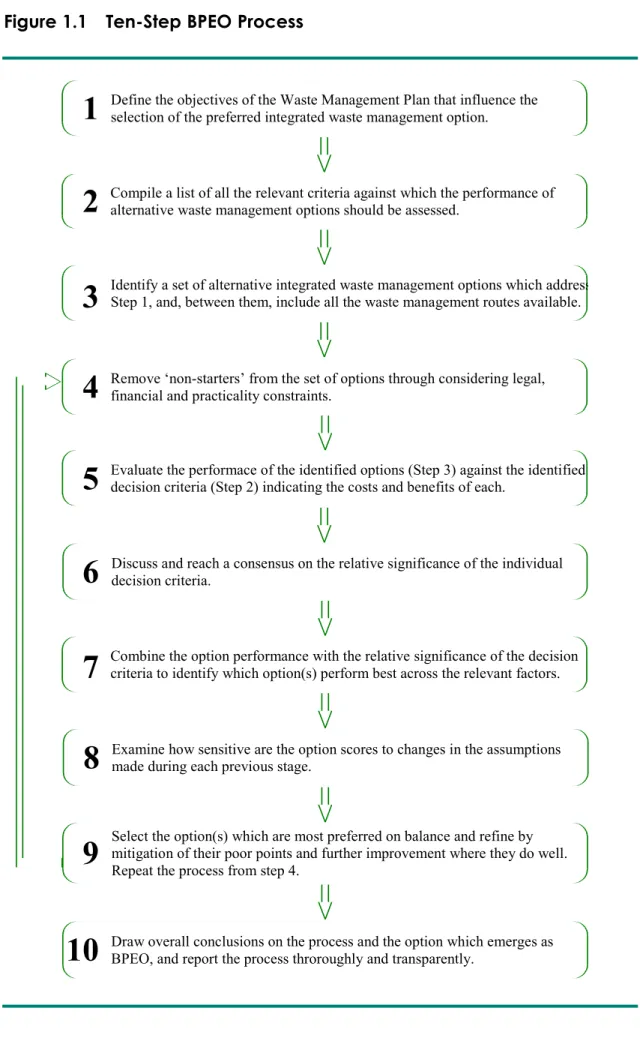
This document provides guidance to the Northern Ireland district councils on the use of BPEO as a means of assessing integrated waste management options for their Waste Management Plans. The BPEO process is broken down into ten simple steps, which start by defining the objectives of the work. The basic tasks of each step are summarised in Figure 1.1, overleaf. Each step is explained in the main body of the document, and further guidance for practitioners is provided in the Annexes.
The criteria that are used to rate the possible waste management options include aspects of cost, natural heritage and social implications. The BPEO process thereby ensures that the right choices are made concerning (among other things) Best Value, protection for the environment and equal opportunities across the community.
The process requires that a great deal of data is collected and analysed by technical officers in the course of determining BPEO. There is also an important role for stakeholders, in contributing to the assessment of waste management options against qualitative criteria and the evaluation of the relative significance of criteria. The guidance recommends the use of a series of workshops to fully engage the stakeholders in the process, and ensure accountability to them.
BPEO is a transparent methodology, showing how conclusions were reached. Using sensitivity analysis, BPEO demonstrates the robustness of the option to changes in the assumptions and to other inputs upon which it is based. This openness will secure public confidence, and should facilitate the procurement of new waste management facilities in due course.
ENVIRONMENT & HERITAGE SERVICE
5
BPEO - DECISION MAKERS’ GUIDE
Draw overall conclusions on the process and the option which emerges as BPEO, and report the process throroughly and transparently.
10
Evaluate the performace of the identified options (Step 3) against the identified decision criteria (Step 2) indicating the costs and benefits of each.
5
Discuss and reach a consensus on the relative significance of the individual decision criteria.
6
Combine the option performance with the relative significance of the decision criteria to identify which option(s) perform best across the relevant factors.
7
Examine how sensitive are the option scores to changes in the assumptions made during each previous stage.
8
Select the option(s) which are most preferred on balance and refine by mitigation of their poor points and further improvement where they do well. Repeat the process from step 4.
9
Define the objectives of the Waste Management Plan that influence the selection of the preferred integrated waste management option.
1
Compile a list of all the relevant criteria against which the performance of alternative waste management options should be assessed.
2
Identify a set of alternative integrated waste management options which address Step 1, and, between them, include all the waste management routes available.
3
Remove ‘non-starters’ from the set of options through considering legal, financial and practicality constraints.
4
BPEO - DECISION MAKERS’ GUIDE
1.2 PURPOSE
A guidance document on decision making for Best Practicable Environmental Option (BPEO) was published by SNIFFER in September 2000. (1) This guidance document provides a stand-alone methodology to district councils in Northern Ireland for determining BPEO, but may also be used as a complement to the SNIFFER guidance. Furthermore, there may be other approaches to identifying BPEO that the councils might choose to adopt. However, these approaches must clearly demonstrate that they adhere to the basic tenets of the concept - namely that:
a full set of options is compared;
performances are assessed against all relevant criteria; the relative significance of criteria is addressed explicitly;
sensitivity analysis is conducted to demonstrate the robustness of the methodology; and
the process of determining BPEO is transparent.
1.3 INTRODUCTION TO THE BEST PRACTICABLE ENVIRONMENTAL OPTION
The BPEO concept was first outlined in the Fifth Report of the Royal Commission on Environmental Pollution (RCEP), in 1976, where, for a given waste stream, the concept was defined as:
‘...the optimum combination of available methods of disposal so as to limit damage to the environment to the greatest extent achievable for a reasonable and acceptable total combined cost to industry and the public purse.’
The RCEP’s Twelfth Report (1988), elaborated on the concept, and defined it as: ‘...the outcome of a systematic and consultative decision-making procedure which emphasises the protection and conservation of the environment across land, air and water. The BPEO procedure establishes, for a given set of objectives, the option that provides the most benefits or the least damage to the environment as a whole, at acceptable cost, in the long-term as well as the short-term.’
This highlights the need for BPEO to involve the analysis of alternatives. A preferred option is chosen which, for a given objective, provides the optimum balance in terms of emissions and discharges to land, air and water, so as to minimise harm and ensure the protection of the environment, taking account of what is affordable and practicable.
(1) National Waste Strategy: Scotland - Best Practicable Environmental Option Decision Making Guidance, from SNIFFER and SEPA, available on the internet at http://www.sepa.org.uk/publications/environmental_reports/nws/nws_best_ practicable_environmental_option.pdf [19Jul 01 at 10:00]
ENVIRONMENT & HERITAGE SERVICE
The concept was introduced into UK legislation through Part I of the Environmental Protection Act 1990, specifically for prescribed processes regulated under Integrated Pollution Control (IPC). BPEO, as used in IPC, was applied to pollutant emissions from sites, and was closely related to the concept of Best Available Techniques Not Entailing Excessive Cost (BATNEEC). Although not applied to waste management strategiesunder IPC, BPEO in this context was a practical demonstration of the need to articulate a trade-off between one consequence of an activity and another in order to arrive at a compromise that maximises benefits. IPC has subsequently (1999) been superseded by Integrated Pollution Prevention and Control (IPPC), which does not employ the term BPEO. With regard to the application of BPEO to strategies for the management of wastes, the concept is explicitly a key policy imperative in the draft PPS11 Planning and Waste Management document (2001).
BPEO has been a fundamental part of UK government policy towards the strategic management of waste streams since this point. It is identified in the Northern Ireland Waste Management Strategy(henceforth the ‘Strategy’) as one of six key concepts of particular importance to the implementation of the Order (1). The Strategy states that:
‘The Department will encourage waste reduction and integrated waste management systems in Northern Ireland founded on the principle of the hierarchy of options emphasising reduction, reuse, recycling and recovery. The choice of waste management technique in particular circumstances will be informed by assessment of the BPEO.’
Identifying the BPEO is a complex task in the context of integrated waste management systems. It requires assessing the performance of options against a number of objectives, and resolving the conflicts between these objectives by making appropriate trade-offs. The Strategy states that:
‘In evaluating BPEO presented in sub-regional Waste Management Plans, the Department will seek to ensure that:
1. objectives are clearly stated;
2. data and information used has a sound basis; 3. all available options have been identified; 4. analysis of options is systematic;
5. economic, social and environmental considerations (including transport) have been taken into account;
6. the process of determining BPEO is transparent; and
7. concerns and preferences of the community have been taken into account.’
The above principles have been embodied in the guidance presented in this document.
7
BPEO - DECISION MAKERS’ GUIDE
(1) The Waste and Contaminated Land (Northern Ireland) Order 1997, available on the internet at http://www.hmso.gov.uk/si/si1997/1972778.htm [24Jul01 at 09:27]
1.4 THIS GUIDANCE DOCUMENT
In the absence of this guidance, the advice from the Environment and Heritage Service was to follow the BPEO guidance document developed by SNIFFER. This document follows the approach of the SNIFFER work extensively, and large parts of the process are borrowed directly from it.
However, as the draft plans did not adequately carry out the BPEO process as outlined by SNIFFER, the guidance has been reviewed, and some changes made, in the hope of improving the understanding of all involved. The process itself is broken down into ten basic steps, depicted in the flowchart contents list on page 1.
1.4.1 Terminology
The use of the phrases ‘methods’ and ‘options’ can become confusing in discussing BPEO work. This guidance adopts the following convention:
Amethodis a particular technique of waste management, such as windrow composting, separate kerbside collection of dry recyclables, or gasification.
A WMP will not simply adopt one method for the management of all its waste arisings. Rather, a particular combination of methods will be chosen, that together present an integratedoptionfor managing the waste. It is the options that will be compared to seek the BPEO.
1.4.2 Workshops
Mention is made during this text of the use of workshops. Although this is not compulsory, it is felt that workshops provide an excellent forum for the open discussion and review of plans, and transparency is a key requirement of the BPEO process. It is therefore strongly recommended that the workshop structure be adopted. During the course of completing a first pass through the process (and the areas will almost certainly need to run at least one iteration), a total of four workshop sessions are recommended. These sessions open up the decision making process to the relevant stakeholders, and thereby increase the accountability of the plans developed.
A fifth workshop is suggested at the end of the process, to share the principles behind the final BPEO selection and to seek stakeholder commitment to the option chosen.
ENVIRONMENT & HERITAGE SERVICE
2 THE BPEO PROCESS
2.1 STEP 1: DEFINE STUDY OBJECTIVES
The final result of applying the BPEO process will be a set of sub-regional Waste Management Plans (WMPs) covering all the district councils within Northern Ireland, that represent the best practicable options for each region, taking into account
environmental, social and economic considerations.
This perspective leads to two fundamental objectives that the studies must encompass. Firstly, in order to identify the BPEO for waste management, it is necessary to consider all waste streams. The Order makes clear that this means addressing all of the following: household waste;
commercial and industrial waste; construction and demolition waste; hazardous and special waste; and
specific requirements for priority waste streams, such as tyres, packaging, Waste Electrical and Electronic Equipment (WEEE) Directive and End of Life Vehicles (ELVs) Directive. (1)
Secondly, the plans must look to long-term targets, while nevertheless accounting for intermediate objectives. Planning, construction and operating times for installations run into tens of years. To account for this, it seems inevitable that the WMPs should be based on timelines of 20 years or more. However, the plans must also meet targets from, for example, the Landfill Directive, in 2010, 2013 and 2020.
The sub-regional BPEOs that are developed at this stage will be compared by the
Department, to confirm consistency. For example, a capital investment in one area may be used by another area as part of their BPEO. To facilitate this, the regions should make provisions to ensure some compatibilitybetween the plans, and incorporate neighbouring facilities in the consideration of their own BPEOs.
2.2 STEP 2: IDENTIFY DECISION CRITERIA
The objectives developed in Step 1 are likely to be generic and qualitative. After this section, Step 3 will address the question of how to develop integrated waste management options to meet those objectives. Those options will inevitably have advantages and disadvantages over each other, making it complex to assess which is the most preferred. The BPEO process uses Decision Criteria(DC) as a means to perform that assessment.
9
BPEO - DECISION MAKERS’ GUIDE
(1) NB Agricultural waste is omitted from this list, as it is not included in the definition of 'controlled waste'. Nevertheless, councils would do well to consider possible synergies with this waste stream as well, because it is expected that the definition of controlled waste will alter to include agricultural waste in the near future.
The DC are the set of factors that have to be taken into account when assessing the options. The criteria presented in this guidance as a starting point are those developed by SNIFFER(1), following extensive stakeholder consultation, and are grouped into sections such as ‘Environmental’ and ‘Economic’.Because the DC will have such a strong bearing on the choice of the final BPEO, they should be identified before the options, so that the temptation to fit criteria to options is diminished.
However, the process does not stop at identification. It is also necessary to agree a suitable means of scoring the performance of the options against those criteria, that embraces the stakeholders’ perceptions of what each criterion represents. In Step 6, the criteria will be assessed against one another, so that their relative importances are quantified.
2.2.1 Identifying Relevant Decision Criteria
Annex Apresents the recommended list of DC from the SNIFFER guidance document. The first step in this part of the process is to review the DC for local relevance. While none of the criteria should be removed, it might be that there are other local factors that have not been suitably covered. In this instance, it is acceptable for criteria to be added to the list. Particular consideration should be given to the fact that the SNIFFER DC do not take into account non-municipal waste arisings.
At the same time as agreeing whatDC should be used to rate the options, it is worthwhile consideringhowto assess the options against those DC. Could a life cycle assessment tool such as WISARD(2)be used, or is a qualitative score from one to a hundred based on expert judgement appropriate? Again, Annex Aprovides some ideas on various ways to score the options against the DC.
This work is analogous to Stage 2of the SNIFFER process, and, as in SNIFFER’s guidance, it is recommended that it is completed by means of a workshop session.
2.3 STEP 3: DEVELOP OPTIONS
This step develops a set of integrated options, which will be assessed for their suitability in delivering the objectives identified in Step 1. This process follows that outlined by Stage 3andWorkshop 2of the SNIFFER guidance.
At one end of the spectrum is the ‘Do Nothing’ option. This represents a projection of what will happen with no intervention, continuing with business as usual. This option is a very useful baseline against which to compare the others, although it will almost certainly not meet the basis targets set out in the objectives.
At the other extreme is the ‘Do Everything’ option. It is a combination of all of the possible interventions, at their maximum levels (eg don’t just commission a gasification plant, but commission the biggest that might possibly be required). Developing the plausible set of options that fall between the two extremes can be done by Option Mapping, as recommended by the SNIFFER Guidance.
(1) See Annex A of the SNIFFER Guidance
ENVIRONMENT & HERITAGE SERVICE
2.3.1 Option Mapping
Option Mapping is a visual methodology that can be used to facilitate the selection of sets of methods, to develop integrated waste management options.
The first task is to define a suitable list of waste management methods. Annex Bpresents a number of methods under each of seven headings, and lists some points to consider against each. At least two methods should be selected under each heading, with consideration given to all controlled wastes.
The next step is to select compatible combinations of methods, to develop complete and integrated waste management options. These must include methods of waste
collection/transfer and final disposal as a minimum, but may also include various combinations of the other techniques.
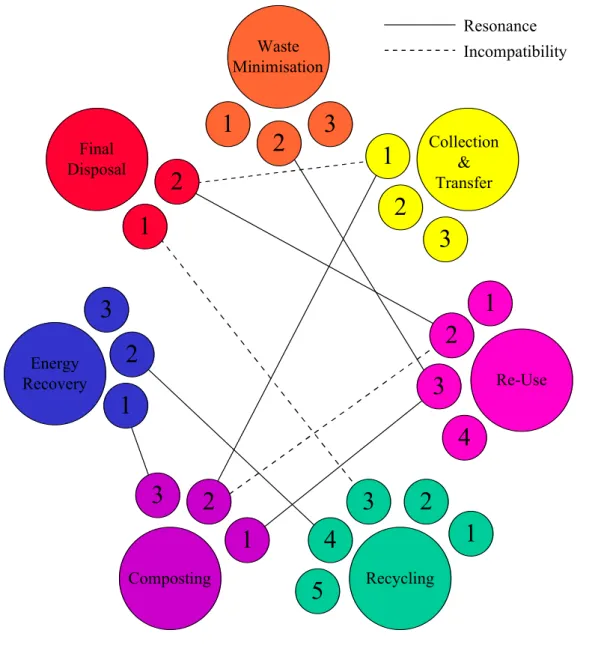
To use Option Mapping to help with this process, draw up seven well spaced and large circles - to represent the seven categories. Next to the large circles, draw smaller circles to represent each of the methods in that category. Where methods are compatible, indicate that resonanceby drawing a solid line between the small circles. Where methods clash, mark that incompatibilitywith dotted lines.
11
Figure 2.1 Option Mapping Diagram
Figure 2.1indicates schematically such a process. Method 1in the Collection & Transfer category might be ‘Kerbside collection of green waste’, with Method 2of ‘Composting’ being ‘Open cell composting’. Clearly there is a synergy between these methods, so a solid line is drawn between them. Conversely, if Method 2of Final Disposal is ‘Landfill’, this is less compatible with ‘Kerbside collection of green waste’ (why separately collect green waste and then landfill it?), so a dotted line is drawn between them. Representing such relationships diagramatically is obviously not compulsory, but it does make it simpler to picture the methods and understand how they might be combined to generated integrated options.
The complete process of option development, together with the application of constraints, lends itself well to a workshop session.
2
3
1
Waste Minimisation2
1
3
Collection & Transfer2
1
3
Re-Use4
3
1
4
Recycling2
5
2
1
3
Energy Recovery1
2
3
Composting2
1
Final Disposal Resonance IncompatibilityENVIRONMENT & HERITAGE SERVICE
2.4 STEP 4: APPLY CONSTRAINTS
2.4.1 Constraints
The consideration of constraints is covered implicitly in Stage 3of the SNIFFER guide. This revised process treats constraints in a more formalised fashion, so that their role is clearer.
Step 3develops a set of integrated options to be assessed against each other and against the objectives of the study. Before proceeding to this assessment, it is worth considering whether there are any constraints that must be applied, which the options cannot meet. Are there any absolute cost limits that cannot be exceeded? Does any option break national or EC law? Are relevant targets met? If an option does not satisfy one of the identified constraints, it may well be appropriate to drop the option at this stage, before a complete evaluation is undertaken. It is likely that ‘Do Nothing’ will fall foul of the Landfill Directive, while ‘Do Everything’ may well exceed cost limits, but these options are usually worth pursuing, in order to present boundaries for the other options.
For other options that do not meet one or more of the constraints, there is likely to be less value in assessing them further. The decision may therefore be taken at this juncture to drop the option entirely, or perform a first round of iteration, to refine the option so that it does not breach the constraints. This process should be included as part of the procedure for Workshop 2.
2.4.2 Summarise Options
With the completion of the work on the constraints, the options are ready for evaluation. Before this takes place, it is worthwhile (though not obligatory) to summarise them in their current format. This can be done by drawing up a flow diagram for each option, showing how the waste moves from sources to treatment and disposal, with information on the number and size of new installations.
2.5 STEP 5: EVALUATE OPTIONS
The remaining options must now be evaluated against each DC (this is covered in the SNIFFER guide in Stage 4). Workshop 1 identified which DC would be used, and also how the options should be evaluated against those criteria. For some DC, a software tool such as WISARD might be required, while for others, a qualitative assessment will be the only possibility. It is crucial that, whichever method is used, the process is transparent, so that, when it comes to performing the sensitivity analysis, it is clear where the adjustments might be most usefully made.
The district council should go through each DC, assessing whether the agreed assessment methodology is quantitative or qualitative. The former can be evaluated outside a
discussion forum, but the latter should be assessed during a third workshop.
13
2.5.1 Quantitative Decision Criteria
For some DC, absolute scores may be assigned, such as tonnes of CO2 generated, average waste collection distance or expected cost to build a new installation. These figures can be generated outside a workshop session, since there should be no necessity to discuss the figures, other than to consider their accuracy, and this is done during the sensitivity analysis (Step 8).
2.5.2 Qualitative Decision Criteria
For other DC, such as ‘Cultural Heritage’, no such absolute scoring is possible. For these cases, it is really the differencein performance that should be ranked rather than the absolute impacts. By using a workshop forum of appropriate stakeholders, the whole spectrum of opinions can be heard, and decisions taken that are significantly more transparent and defensible.
The preferred technique is to give the stakeholders a set total number of points for each DC. These points must be distributed between the options, with the most important options getting more points than the others, depending on how much more important they are perceived to be. The number of points awarded to each option is open to debate among the stakeholders, and consensus decisions must be reached.
This approach forces the stakeholders to talk about their opinions on the relative performance of each option as judged against the DC. This open technique should facilitate the sharing of thoughts and further the group understanding of how various stakeholders perceive both the options and the DC.
2.6 STEP 6: WEIGHT DECISION CRITERIA
With scores assigned to all the options against all the DC, it is time to weight the relative importance of the DC against each other. This is done now because the assessors have information regarding the nature of each DC, how the options were rated against each one, and the range of scores. In order to fully assess the importance of each DC, it is necessary to consider not only the absolute importance of the DC, but also the significance of the difference between the highest and lowest rated options.
The judgement of the relative importance of the DC is only considered implicitly in the SNIFFER guidance, being incorporated into the discussed assessment of the relative merits of options under the ‘Pairwise Comparison’ technique (1). The technique
recommended below is designed to make the process more transparent, by encouraging the participants to explicitly ‘value’ the criteria against one another.
2.6.1 Dividing Points Between the Decision Criteria
The favoured method of weighting the DC is exactly analogous to the scoring of the options against qualitative DC, presented above. The stakeholders are given a set total number of points to distribute between the DC, and agree by consensus. Again, this approach forces the stakeholders to talk about the DC, and should clarify any misunderstandings on the meanings of the DC.
ENVIRONMENT & HERITAGE SERVICE
2.7 STEP 7: GENERATE FINAL OPTION SCORES
In order to compare the performance of the options on an even basis, the range of scores assigned must now be normalised (1), and then scaled by their importance, as dictated by the weighting of the Decision Criteria.
This process generates Final Option Scores, rating the options between zero (worst on all counts) and one (best on all counts). This step is also covered under Stage 4 of the SNIFFER guidance. By generating numbers to quantify the rating of the options, the technique presented here again makes the process more transparent.
Because this step is simply a mathematical manipulation of the previously assigned figures, further discussion is reserved for the Practitioners’ BPEO guidance, in Annex C.
2.8 STEP 8: SENSITIVITY ANALYSIS
Step 7will most likely identify one or a few options as ‘lead options’, and others as less desirable. This should allow the selection of two or three options for the shortlist, at the expense of the others.
However, before the shortlist is finalised, it is crucial to check that the basis on which those options were chosen is robust. This is done through sensitivity analysis.
Sensitivity analysis is an absolutely critical part of the BPEO process, and one which is too frequently treated with insufficient rigour. Its essence is to investigate how susceptible the Final Option Scores are to the ratings assigned along the way - in particular, those ratings that are least robust.
Sensitivity analysis is done by examining, where options score are least certain, or DC weightings least concordant, whether changes in those ratings have a large effect on the Final Option Scores. If they do, it is important to flag in the overall record of the process that the decisions made are sensitive to changes in those variables.
During the first round of option assessment, sensitivity analysis should focus on the clear winners and losers, to confirm that their Final Option Scores are robust.
The details of how to perform sensitivity analysis are again reserved for the Practitioners’ BPEO guidance, in Annex C.
2.9 STEP 9: CREATE SHORTLIST/ITERATE
2.9.1 Initial Shortlisting of Options
The above work will have generated a list of integrated waste management options, each with a Final Option Score and some idea of how robust that score is to changes in the underlying data and assumptions, from the sensitivity analysis. Any options that are clear losers (ie which score poorly yet have a robust score) can now be dropped from
consideration. It is quite likely that the ‘Do Nothing’ and ‘Do Everything’ options might both fall at this stage.
15
BPEO - DECISION MAKERS’ GUIDE
(1) Normalisation is a simple mathematical process, whereby a set of numbers are scaled, so that the lowest becomes zero, the highest one, and the rest fall proportionately between these two extremes.
2.9.2 Refine Shortlist
The initial shortlisting will have generated a list of options that includes the lead options and a few others ‘in the middle’, which are rated similarly and/or which are susceptible to changes in the data. The purpose of this stage is (if necessary) to combine the best parts of the options available, to generate one or more lead options for an iterative evaluation. It therefore makes sense to start with the current lead option, and look at how it is rated against each DC. Where it performs poorly, are there other options that fare better? If there are, can relevant aspects from any of those options be beneficially incorporated into the lead option? Conversely, if the lead option performs well for a DC, could that
performance be magnified by doing ‘more of the same’? For example, if windrowing proves to be expedient, how about considering in-vessel systems?
Without knowing specific circumstances, it is impossible to recommend how these
hybridisations may take place. However, the users should seek to identify two or three lead options for iterative evaluation. If the sensitivity analysis revealed a particular sensitivity to one or more of the DC Weightings, or the data used to generate the option scores, it may also be worthwhile to revisit these matters, and consider alternative methodologies. Having iterated the new lead options, a clear winner may emerge, or the systems may perform comparably well, within the accuracy of the method as shown by the sensitivity analysis. If the latter is the case, a further iteration of a new hybrid may be necessary, in order to determine the final best combination.
2.10 STEP 10: IDENTIFY THE BPEO
The outcome of all the work above, which will probably involve at least one iteration of the evaluation process, is a plan for the management of waste in the local area that can be demonstrated to be the overall Best Practicable Environmental Option.
At the end of Step 9, the few remaining lead options will have been evaluated. Either there will be an apparent BPEO, or there will be two or more options that could be adopted. To endorse the apparent BPEO, or to select from the lead options, a final workshop should be held with a large range of stakeholders, to discuss the final BPEO.
Following this, the district councils have three more tasks to perform. The first is to report the entire process in their WMP, in particular making transparent the assumptions and value judgements that are inherent in BPEO evaluations. This may leave the report open to criticism, but this is exactly the sort of debate that should be encouraged, to further understand how to rate the Decision Criteria and the performance of the options against those criteria. If the final workshop is run well, there should be few surprises in the responses to the report.
The second task is to commit to (and, in time, perform) repeat analyses in future years, to confirm that the option chosen is still BPEO. Opinions, data and technologies change and evolve with time, and the option chosen now may not reflect BPEO in years to come. Therefore check-steps must be built in, to keep the process on track and in the right direction.
The third task, to implement the WMPs, almost goes without saying, but is, of course, the most important of all.
Annex A
Northern Ireland BPEO -
Decision Criteria
A1 NORTHERN IRELAND BPEO - DECISION CRITERIA
This Annex presents the Decision Criteria (DC) identified by the SEPA BPEO Guidance, and suggests means of allocating scores to the developed options for the criteria.
A1.1 BACKGROUND TO THE DEVELOPMENT OF THE CRITERIA
SEPA developed its national DC via a five stage process, which is described in their BPEO Guidance thus:
1. Four specific stakeholder groups (the waste industry, regulators and public agencies, NGOs and experts) were identified and facilitated workshops were held, attended by between 12-16 representatives of each group. The workshops were designed to identify all the issues which the group considered were important in planning waste management in Scotland. Participants in the stakeholder process are listed at the end of this Annex.
2. The results from the four specific groups were brought together into a “long list” of potential DC grouped under five main headings. These headings were:
economic, environmental, social, practicability and fit with policy.
3. The “long list” was presented to a further multi-stakeholder workshop and a “short list” of twenty proposed DC was agreed.
4. The “short list” was presented to three further stakeholder groups in the form of a questionnaire seeking their views on:
whether all the relevant issues were covered;
how important each criterion was to decision making on waste management.
The three further groups whose views were obtained by this route were community councils (representing the general public), industry associations (representing industrial waste producers) and Members of the Scottish Parliament (MSPs). The responses from the questionnaire are presented in Box AA1.1.
5. In the final stage the results of the surveys were integrated with the earlier work to create the final set of National Decision Criteria.
ENVIRONMENT & HERITAGE SERVICE
Box AA1.1 SEPA Survey Results Rating the National Decision Criteria
Having identified 20 national Decision Criteria (DC), SEPA conducted a postal survey to assess the relative importance of the DC. 292 Community Councils, 61 Industry
Associations and 129 Members of the Scottish Parliament, together with all the previous stakeholders, were asked to rate the importance of each DC on a scale of zero to five. 96 responses were received and averaged, resulting in the following scores:
Considered separately, all four groups rated ‘air, land and aquatic environment’as the most important DC, apart from the MSPs, who ranked ‘making producers responsible’the highest.
The following sections provides detailed guidance, based upon that in the SEPA Guide, on each Decision Criterion, in terms of:
a brief introduction to the issue and its relationship with waste management; examples of the sorts of questions users should or could ask in appraising an
option against the criterion;
information on some of the tools available for appraisal of each criterion and sources of information that may be useful when undertaking the appraisal.
18
BPEO - DECISION MAKERS’ GUIDE
96 responses Average Score
Air, land and aquatic environment 4.7
Global climage change 4.3
Making producers responsible 4.3
Local amenity 4.2
Accidental Risks 4.1
Flexibility 4.1
Natural heritage 4.0
Practical deliverability 4.0
Non-renewable resource use 3.9
Public acceptability 3.7
Technical feasibility 3.6
Making best use of existing facilities and expertise 3.6
Compliance with other policies 3.5
Impact on local economy 3.4
Cultural heritage 3.4
Employment 3.3
Social implications (poverty, exclusion and access) 3.3
Cost 3.3
Financeability/affordability 3.1
A2 ENVIRONMENT
A2.1 AIR, LAND AND AQUATIC ENVIRONMENT A2.1.1 Air
When assessing waste management system options in terms of air quality the following questions can be asked:
will the management system option result in increased or decreased emissions of pollutants to air (ie will there be a change from the current situation) from waste combustion, fuel combustion in stationary plant or vehicles, or other sources (eg waste storage or processing)?
what pollutants will be emitted and in what quantities? how hazardous are these pollutants?
how will these emissions affect air quality, increasing concentrations of pollutants in the atmosphere?
what are the current levels of emissions and air pollution in the area?
what are the expected impacts of predicted changes in air quality on human health and natural systems?
will there be other effects, such as increased dust or odour, which might cause local nuisances?
are there any particular air quality problems in the local environment which could be exacerbated by the option?
are there any particularly vulnerable receptors in the local area which could be affected by changes in emissions (eg vulnerable populations or habitats sensitive to air pollution)?
The following information sources may be useful in determining current and future levels of air quality, areas with pollution problems or particular sensitivities, and the types of pollutant which are of most concern to the planning and environmental authorities. The UK National Air Quality Strategy for England, Scotland, Wales and Northern
Ireland, published in 2000, by DETR provides a framework on air quality issues in the UK and identifies those pollutants of particular concern for air quality now and in the future.
The document can be downloaded from the DETR website
(http://www.environment.detr.government.uk/consult/ air quality). SEPA has also recently published a review of air quality in Scotland called ‘State of the
Environment -Air Quality’ (http://www.sepa.orguk/publications/air-report/index.htm).
Research reports and information on local air quality, and the air quality
monitoring network across the UK can also be obtained from the DETR’s National Air Quality Archive (http://www.aeat.co.uk/netcen/airqual/).
ENVIRONMENT & HERITAGE SERVICE
The DETR’s Nationl Atmospheric Emissions Inventory
(http://www.aeat.co.uk/netcen/airqual/) provides estimates of the amount of many atmospheric pollutants emitted from a range of sources including waste management.
Information on the health effects of air pollution can be found in the publications of the DETR’s Expert Panel on Air Quality Standards (EPAQS)
(http://www.environment.detr.gov.uk/ airq/aqs/index), the Department of
Health’s air pollution pages on http://www.doh.gov.uk/hef/airpol/airpolh.htm) and the Department of Health Committee on the Medical Effects of Air Pollution (http://www.doh.gov.uk/comeap/ index.htm). Information on air quality standards for each pollutant is also provided by EPAQS.
The WISARD model can be applied to the appraisal of air quality impacts for municipal waste options or systems. WISARD will allow the following outputs to be modelled: acidification;
stratospheric ozone depletion; photochemical smog formation; and human toxicity for selected emissions.
For other waste streams an assumed waste composition could be used to allow WISARD to calculate impacts. However, WISARD requires the inputting of a data about waste types, logistics and proposed recycling/recovery systems. Such data may not always be complete for other waste streams therefore the model should be used with care (and consistency across options), particularly if the default parameters in the data input stages are selected by the user. For a fuller description of WISARD please refer to the SEPA Guidance on Area Waste Plans.
A2.1.2 Land and Aquatic Environment
Water is essential for life and plays an important part in the economy. Rivers, estuaries, coastal waters and groundwater are all integral parts of the natural environment. Water also provides important habitats for wild plants and animals. We use water in agriculture and industry, for leisure activities, for transport - and of course for drinking.
Soil is an important resource which supports a variety of ecological, agricultural, economic and cultural functions. Development can have an adverse effect on both the biological and physical properties of soil and can limit its future use.
When assessing a waste management system option in terms of its impact on land and water the following question can be asked:
will the management system option result in an increase or decrease in releases to or contamination of, surface water, groundwater or soil from deposits or processing of waste?
if so, which elements of the option are predicted to cause the pollution? what pollutants will be released to which media and in what quantities?
20
how hazardous are the pollutants?
what impact will they have on soil or water quality?
what is the current quality of surface water, groundwater and soil in the area? what are the expected impacts of changes in soil or water quality on environmental
resources, human health and the economic value of the resource?
will there be any other effects, for example on quantities or flows of water or erosion of soils, as a result of the option?
A variety of information and data on existing water and soil quality, key pressures on these resources and their vulnerability to pollution/development is available, to assist in assessing the likely effects of waste options on land and the aquatic environment. Key sources are listed below.
Information on the quality of surface water under the Scottish River Classification Scheme is available from SEPA (http://www.sepa.org.uk/). This updates the previous Scottish Office Water Quality Survey of Scotland, published in 1992. Improving Scotland’s Water Environment. SEPA Report, September 1999. Annual reports from the three SEPA Regions and the annual report on ‘Scottish
Environment Statistics’ published by the Scottish Executive.
A classification of aquifers, provided in published hydrogeological maps. Drift and solid geology can be determined from British Geological Survey maps eg the 1990 BGS map ‘Hydrogeology of Scotland’.
Critical load maps for Scottish soils have been produced by the Macaulay Land Research Institute and Aberdeen University. These maps show the sensitivity of soils to acid deposition and the areas where critical levels have been exceeded. The Institute has also produced a digitised 1:250,000 soil map for Scotland and a national soil database.
The 1994 Scottish Vacant and Derelict Land Survey identifies around 14,100 hectares of vacant and derelict land across 6,000 sites, many of which are
contaminated. Local authorities across Scotland have new duties under Part IIA of the Environmental Protection Act 1990 to identify contaminated land in their areas.
Current trigger levels for contamination in soil are provided in a publication by the Interdepartmental Committee on the Redevelopment of Contaminated Land (1987) available from the DETR (Guidance on the Assessment and Redevelopment of Contaminated Land: ICRCL 59/83). The Dutch guidelines are often used in
conjunction with the ICRCL trigger levels as they provide guidelines for additional contaminants and for contaminants in groundwater. The latest guidelines can be found on http://www.contaminatedland.co.uk/std-guid/dutch-l.htm.
For municipal solid waste, the WISARD model can predict releases to land and water. For other waste streams an assumed waste composition could be used to allow WISARD to calculate impacts.
ENVIRONMENT & HERITAGE SERVICE
A2.2 GLOBAL CLIMATE CHANGE
Climate change is predicted to occur as a result of emissions of various gases to the atmosphere. The principal sources of so-called greenhouse gases from waste management include CO2from fossil fuel combustion and CH4and CO2from waste decomposition. Climate changes could include temperature increases, sea level rise, an increase in extreme weather conditions, drought and flooding. Climate change also poses significant risks to public health, property, society and biodiversity. Due to the greenhouse gases that have already accumulated in the atmosphere from burning of fossil fuels and agricultural activities some human-induced climate change is now expected to be inevitable. But the worst effects of climate change may be avoided if action is taken now to reduce emissions and stabilise levels of greenhouse gases in the atmosphere.
Any option employed for waste management will lead directly or indirectly to emissions of greenhouse gases contributing to climate change. The main sources of these gases will include:
CO2emissions from vehicles used to collect and transport waste; CO2emissions from energy used to power waste facilities; CH4emissions from waste decomposition;
CO2emissions from composting operations; CO2emissions from burning waste; and CO2emissions from burning landfill gas.
For each management option the production of global warming gases should be considered by asking the following questions:
will the waste management option require an increase or decrease in fossil fuels used for transport and processing?
will the management option result in an increase or decrease in emissions of greenhouse gases?
what greenhouse gases will be emitted and in what quantities? what will be the impact of these gases in terms of CO2equivalents?
how will this change the level of greenhouse gas emissions in the area and from the waste industry?
will landfill gas recovery and combustion convert CH4to less potent CO2and reduce greenhouse gas emissions?
will increased re-use or recycling reduce greenhouse gas emissions from use of primary raw materials?
will energy recovery from waste substitute for fossil fuel use?
22
Information on greenhouse gas emissions and climate change can be obtained from the recently published draft UK Climate Change Programme
(http://www.environment.detr.government.uk/climatechange/ index.htm). This document sets out the policy framework for reducing greenhouse gas emissions in the UK in line with international and domestic targets, together with appropriate actions in key sectors of the economy. In March 2000 a Draft Scottish Climate Change Programme was published by the Scottish Executive for consultation.
A scoping study of the implications of climate change in Scotland, prepared by the Centre for the Study of Environmental Change and Sustainability at the University of
Edinburgh, was published in 1999 by the Scottish Executive (http://www.scotland.government.uk/news/1999/12/se1559.asp).
Work has recently been undertaken for the DETR on disaggregation of national
greenhouse gas emission inventories, including an inventory and emissions projections for Scotland. Further details can be obtained from the DETR’s Global Atmospheric Division (020 7890 3000).
The life-cycle assessment (LCA) software WISARD can be used to estimate the quantities of greenhouse gases that will be generated by municipal waste options. Waste streams other than municipal solid waste can be dealt with by WISARD by creating an assumed waste stream composition, paying particular regard to the composition of organic materials.
A2.3 LOCAL AMENITY
Low noise levels, as well as low levels of traffic, dust and odour, attractive buildings, streets and green spaces are important aspects of local amenity. Waste management options will have differing potential to impact on these and other aspects of local amenity. When considering a waste management system option in terms of its likely effect on local amenity the following questions should be asked:
will the waste management option impact on levels of odour and noise?
what is the expected impact of the option on vehicle kilometres travelled, traffic levels, congestion, risk of accidents etc?
are there opportunities to transport waste by rail or sea?
will new infrastructure have the potential for adverse visual impacts and are there areas of landscape or visual sensitivity in the area which should be avoided? will it be difficult to find locations for new infrastructure which are not sensitive in
landscape and visual terms?
Amenity issues such as existing noise climate, traffic flows and congestion and quality of open space and the general landscape are largely within the remit of local authorities who will be represented on the Waste Strategy Area (WSA) Groups. The Scottish Executive maintains a database of traffic in Scotland, the Scottish Road Traffic Database. The significance of visual impacts will vary depending on the existing visual character of the surrounding landscape. In this appraisal, the generic impact on amenity of any new facility will need to be qualitatively assessed since its precise location may not be known. This might be presented as the potential for significant landscape or visual impacts within
ENVIRONMENT & HERITAGE SERVICE
different parts of the planning area (eg lowlands and coastal areas may result in greater visibility; upland areas may have landscape designations which increase the significance of the impact of the development in these areas).
A number of sources of guidance which may be consulted when considering amenity issues are identified below.
Guidance on the environmental effects of changes in road traffic has been published by the Institute of Environmental Assessment (Guidelines for the Environmental Assessment of Road Traffic).
Various National Planning Policy Guidance Notes (NPPGs) and Planning Advice Notes from the Scottish Executive including:
- NPPG10: Planning and Waste Management
- NPPG11: Sport, Physical Recreation and Open Space - NPPG15: Rural Development
- NPPG17: Transport and Planning
- PAN51: Planning and Environmental Protection - PAN56: Planning and Noise
Guidance on Landscape and Visual Impact Assessment has been published by the Institute of Environmental Assessment and the Landscape Institute.
A2.4 NATURAL HERITAGE
Potential impacts on natural heritage which could arise from the development of waste management options include impacts on habitats and species, predominantly from the development and operation of new waste management infrastructure and transport operations.
Specifically, these impacts may include loss of habitats or species of flora and fauna, disturbance to or displacement of species, fragmentation of habitats or severance of ecological corridors. Features which may be of nature conservation interest could include natural water bodies, woodlands, hedges, wetlands, moor and heath, unimproved grassland and scrub. There may also be opportunities for creation of new habitat and introduction of species as a result of restoration works and landscaping.
Questions to ask when appraising management system options for impacts on natural heritage are presented below.
Is the management system option likely to involve new infrastructure development?
If so, are sites likely to be available on previously developed land so that disturbance of nature conservation interests is minimised?
If building on undeveloped land is likely to be necessary, are there particular areas of nature conservation and biodiversity importance which could be affected?
24
How likely is it that a site or sites can be found in the area which will avoid areas or features of nature conservation interest?
What are the expected impacts on ecological resources if development in such areas is likely to be unavoidable?
Is the option likely to offer opportunities for habitat creation e.g. from restoration of landfill sites in the short or long term?
Are there any other aspects of the management option which could provide benefit or have an adverse effect on nature conservation interests?
If development is necessary as part of an option (eg a large new materials reclamation facility, landfill or energy-from-waste plant) the impact will be greatest if a greenfield site, on or near sites of ecological importance, is developed. Although site-specific information for such facilities is unlikely to be available at the strategic appraisal stage, the likelihood of development in areas of national ecological significance (eg Sites of Special Scientific Interest (SSSIs)) or local importance for conservation should be considered. For example certain facilities will be very constrained in location due to factors such as road, rail or water access, size of site, geotechnical conditions etc making the likelihood of significant ecological impacts easier to assess. Nevertheless, a qualitative approach to appraisal of each option is envisaged.
Initial information on the ecological significance of the area can be gathered from
information sources including Development Plans, local biodiversity action plans and state of the environment reports. Local Authority biodiversity officers and Scottish Natural Heritage (SNH) as well as non-statutory agencies such as the Scottish Wildlife Trust and local conservation groups can also provide information on baseline conditions, important areas, habitats and species under threat or of conservation importance and key sources of impact in the local area.
A2.5 CULTURAL HERITAGE
Cultural heritage may be defined as the resource encompassed by the stock of archaeological remains (both known and potential) and historic sites and buildings including monuments, listed buildings, Conservation Areas, and historic gardens and landscapes. Cultural resources provide an educational, recreational, historic and cultural resource which is non-renewable. Impacts on cultural heritage could arise from waste management options which involve developments directly or indirectly affecting cultural features or their setting.
Questions to ask when appraising the effects of waste management options on cultural heritage include:
is the management system option likely to involve new infrastructure involving new development or earth works?
if so, are sites likely to be available in previously developed (brownfield) land so that disturbance to cultural heritage features can be minimised?
if building on undeveloped land is likely to be necessary, approximately how much land is likely to be required (compared with other management options)?
how likely is it that a site or sites may be found in an area which will avoid areas or features of cultural heritage?
ENVIRONMENT & HERITAGE SERVICE
does the area generally have a high known or potential importance for cultural heritage and are there locations where new development should be specifically avoided?
are there any aspects of the option that are likely to offer opportunities to enhance preservation and/or public access to areas of cultural heritage?
An option requiring new build on a greenfield site is more likely to impact on cultural heritage than one that uses existing and brownfield sites. At the strategic appraisal stage, however, it is unlikely that specific development locations for waste facilities will be known. Instead, the appraisal should focus in a qualitative manner on the historic significance of the area and seek to assess whether the option is likely to result in unavoidable impacts to the cultural heritage, taking account of sensitive areas (such as broad designations like Conservation Areas) and the likelihood of new waste facilities being required.
Baseline information on key archaeological and built heritage features can usually be identified from the proposals maps of Development Plans prepared by local planning authorities. These documents will also contain policies relating to the protection of such features and typically provide an outline of the cultural heritage resource in the area. Consultation with statutory and non-statutory consultees will give a more detailed indication of areas of known and potential cultural heritage significance. Key contacts include:
Archaeologists, who can advise on cultural heritage issues and who may be able to provide further documentation of the resource in each area;
Historic Scotland, the national agency responsible for protection and preservation of historical and cultural resources;
the Royal Commission of Ancient and Historic Monuments of Scotland (RCAHMS) which maintains a register of archaeological sites and features. Key sources of policy and guidance on cultural heritage and development affecting it in Scotland are listed below.
National Policy and Planning Guidance (NPPG) 5, Archaeology and Planning; and Planning Advice Note (PAN) 18, Planning and the Historic Environment.
A2.6 NON-RENEWABLE RESOURCE USE
The prudent use of finite natural resources is a key objective of sustainable development. Non-renewable resources such as fossil fuels or mineral ores should be used efficiently. The choice of waste management system option can have a significant influence on the
consumption of finite resources. For instance, an option involving reuse and recovery of materials should result in a reduction in the consumption of primary raw materials. A management system option involving recovery of energy from waste should result in a reduction in the use of fossil fuels.
When considering the performance of a management system option in terms of use of non-renewable resources the questions set out below should be asked.
Will the option require use of non-renewable resources for construction and operation of waste infrastructure?
26
Will the option result in a change in the quantity of non-renewable resources used through reuse, recycling or recovery?
Which non-renewable resources will be affected and how much more or less will be used?
What is the current accessibility to second-hand goods in the area eg refurbished white goods?
Will the option encourage reduction and re-use of materials in the area? Will the option increase or reduce the percentages of materials recycled?
Will the waste option increase the recovery of unwanted but re-usable goods and materials?
will the option lead to recycling of particularly scarce resources?
For municipal waste, the appraisal may be carried out using WISARD. For waste streams other than municipal solid waste an assumed waste stream composition may be used to allow WISARD to calculate the impacts. WISARD can estimate consumption of all resources individually and provide two indexes of non-renewable resource use based on resource depletion (% of resource remaining) and consumption rate (% of current consumption rate).
A2.7 RISK OF ACCIDENTS
A safe and healthy environment for employees and the public in the waste management industry is required by health and safety law and employers are required to take necessary measures to comply with the legal requirements. However, some risk may be associated with certain tasks, for example, for workers using heavy and mechanical plant, handling of hazardous wastes and waste transportation.
Probably the greatest risk involved in a waste management system option will be the risk of road traffic accidents. A waste management system option concentrating on local solutions to waste arisings will involve less transport and thus reduce the risk of accident from this source. A hand picked materials reclamation facility or kerbside waste collection system could involve a risk to employees as a result of working in close proximity to machinery with moving parts. Data on operator risks from these activities should be identified and compared with the risks from alternative waste management systems and with the current arrangements.
When considering the safety performance of a waste management system option the following should therefore be addressed.
What are the risks of accidents to people (workers and public) from this management option e.g. on the roads, accidental releases of pollutants, risk of explosions or fire etc?
Have the safest possible technologies and systems been adopted or specified for the option?
ENVIRONMENT & HERITAGE SERVICE
How safe has been the waste management industry in the area to date? Are there any sectors where risks have been assessed as being unacceptably high or where accident frequencies are high?
Detailed and quantitative risk assessment will be difficult to undertake at the strategic appraisal stage. Some information on relative risks of the different measures and technologies should be available however. Sources of information on risks include the Health and Safety Executive, and waste management industry bodies and institutes. Relative risks of road traffic accidents may be appraised for each option by referring to road traffic accident data for the routes used by waste management vehicles and assessing the effect on future accidents from information on the traffic generation of the new option (ie an increase in vehicle kilometres compared with the present situation suggests that accidents would increase, all other things being equal). Data on road traffic accidents are maintained by local authority transport/road safety units which can be used to reveal routes with the highest frequency of accidents involving fatal, severe and slight injuries. Data on road accident casualty rates may also be available from the Scottish Executive Development Department which is responsible for national road safety issues.
DETR have also produced guidance on the economic value of accident reductions which could be useful (http://www.roads.detr.gov.uk/roadsafety/rvs/appendix.htm)
28
A3 ECONOMY
A3.1 COST
Waste management options will include a combination of measures, including avoidance, minimisation, reuse, recycling, recovery and disposal. Developing the best package of measures to reduce waste going for final disposal will depend on both technical and economic factors. From an economic perspective, the objective is to satisfy waste
management objectives at the least overall cost to society. This does not necessarily mean least cost to the waste management authority, as there may be activities that it could undertake more efficiently than other parties, or which only it is able to implement. Least economic cost also does not mean least short-term financial cost as some actions, such as recycling, might appear more expensive but might yield big savings in raw materials or even the future cost of landfill provision. Management system options can therefore be compared using a number of different measures of cost such as:
capital costs of infrastructure and equipment;
operating costs per year for waste collection, handling, processing and disposal; annualised capital and operating costs over the longer term (say 20-30 years); costs per tonne of waste handled;
decommissioning costs;
revenues from recycled materials and energy recovery;
degree of uncertainty about future costs (certainty about costs can be important for planning).
The cost and revenue streams for each option should be analysed, and if possible a net present value (NPV) calculated. The most attractive options in economic terms, are those that have the lowest NPVs. At the first stage of appraisal, many of the cost and revenue items will not be available, and so estimates will be necessary based on generic industry costs.
Sources of information on waste costs include:
Wastewatch (2000). Beyond the Bin - The Economics of Waste Management Options (http://www.wastewatch.org.uk/publicat/beyondbin.htm)
Accounts Commission (2000) Benchmarking Refuse Collection, A Review of Councils’ Refuse Collection Services. Published by Audit Scotland, April 2000. (http://www.audit-scotland.gov.uk/publications/ pdf/00l01ac.pdf).
Coopers & Lybrand (1996) Cost-benefit analysis of the different municipal solid waste management systems: objectives and instruments for the year 2000. Sofres (1996) Elements for a cost-effective plastic waste management in the
European Union: objectives and instruments for the year 2000.
PIRA/IVM (1999) Development of a combined methodology to evaluate recycling processes based on life cycle assessment (LCA) and economic valuation analysis