Department of Learning, Informatics, Management and Ethics
Karolinska Institutet, Stockholm, Sweden
THE ROLE OF
INFORMATION TECHNOLOGY ON
DOCUMENTATION AND SECURITY OF
MEDICAL DATA
Faramarz Pourasghar
All previously published papers were reproduced with permission from the publishers.
Published by Karolinska Institutet. Printed by Laserics Digital Print AB © Faramarz Pourasghar, 2009
ABSTRACT
Information technology (IT) is increasingly used in medicine, mainly for processing medical data. Understanding how IT affects the documentation and security of medical data and how users adapt IT systems can help to improve the quality of medical data and consequently the quality of medical care.
Aim: The aim of this thesis was to explore the impact of IT on the documentation and the security of medical data in a middle-income country, in order to identify influencing factors on the quality of medical data.
Method: In study I, a set of 300 randomly selected paper-based medical records
(PBMR) was evaluated for the completeness of data (quantitative). Additionally ten physicians and ten nurses were interviewed for their opinions on the quality and the use of PBMR at a university hospital (qualitative). In study II we used similar approach to analyse the quality of medical data after an electronic medical record (EMR) system had replaced the PBMR system. The completeness of data was explored in 300 randomly selected EMR (quantitative) and then the opinion of medical staff (ten physicians and ten nurses) on the quality of data and potential barriers for using EMR was sought (qualitative). Study III was an interventional study which investigated the impact of a computer-generated physician-oriented reminder system on the quality of documentation in two randomly selected
intervention (n=188) and control (n=188) groups of EMR. In study IV the security of medical data in EMR in six university hospitals was explored by observing users interaction with hospital information systems (HIS), analysing the databases and log files in HIS and four representatives of four HIS developing companies for technical details (quantitative) and interviewing six computer network administrators
(qualitative). Descriptive analysis for quantitative materials and content analysis for qualitative materials were applied in the studies.
Results: All PBMR investigated were incomplete in terms of medical data. The
quality of data varied among different fields of the PBMR, with the lowest
percentage of documentation of demographical and administrative information and highest percentage of documentation of diagnostic and treatment information and also care providers identity information. Illegible handwriting, missing sheets, high workload and insufficient quality control for documentation of medical data were prominent influencing factors that were highlighted by the interviewees (study I).
Findings in study II indicated that after introducing EMR, the documentation of medical data was improved in some fields, especially where nurses documented the data, but physicians’ involvement in documentation of medical data in the EMR was low. Neglecting physicians in the development and implementation phases of the EMR and their concerns about security of medical data influenced their acceptance of the EMR system. High workload, shortage of bedside hardware and lack of software specification to identify incompleteness of medical records were other negatively influencing factors on documentation of medical data in the EMR. The results of study III showed that an automatic physician-oriented reminder system has the potential to improve documentation of medical data in EMR in a high
documented completely (X2 = 75.6, p < 0.0001). In the control group only 91 (48%) of EMR were completely documented.
The findings of study IV underlined that the security mechanisms for protecting medical data in the HIS environment were inadequate. All six HIS investigated suffered from lack of policy for information security, weak authentication techniques, absence of functions for managing users and log files.
Conclusions: EMR is a good substitute for PBMR. However, in order to
successfully transfer from PBMR to EMR and to have comprehensive documentation of medical data, some requirements have to be met. Establishing organizational policy for both documentation and security of medical data is fundamental. Involving medical staff in the development and implementation phases can facilitate staff’s acceptance of the new system. EMR needs to have functions to identify and remind users of incomplete records. Concerning the security of medical data, HIS and EMR systems should implement all up-to-date information security services, including strong authentication techniques, data encryption and digital signature.
LIST OF PUBLICATIONS
I. Pourasghar F, Malekafzali H, Kazemi A, Ellenius J, Fors U.
What they fill in today, may not be useful tomorrow: Lessons learned from studying medical records at the Women hospital in Tabriz, Iran.
BMC Public Health. 2008, 8:139.
II. Pourasghar F, Malekafzali H, Koch S, Fors U.
Factors influencing the quality of medical documentation when a paper-based medical records system is replaced with an electronic medical records
system: An Iranian case study.
International Journal of Technology Assessment in Health Care. 2008, 24:4,
445–451.
III. Pourasghar F, Malekafzali H, Koch S, Fors U.
The impact of automatic reminders on the completeness of documentation in the electronic medical record. In Manuscript.
IV. Pourasghar F, Malekafzali H, Koch S, Fors U.
Exploring the security of medical data when an Electronic Medical Record System replaces the Paper-based Medical Record System. In Manuscript.
TABLE OF CONTENTS
1 INTRODUCTION ...1
2 BACKGROUND...3
2.1 MEDICALRECORD ...3
2.2 MEDICALRECORDSINIRAN...5
2.2.1 THE STANDARD MEDICAL RECORD IN IRAN ...5
2.2.2 ELECTRONIC MEDICAL RECORDS IN IRAN...7
3 AIM OF THE THESIS ...9
3.1 GENERALAIMOFSTUDY...9
3.2 SPECIFICAIMS ...9
4 MATERIALS AND METHODS ...10
4.1 STUDYCONTEXT ...10 4.2 STUDYDESIGN ...11 4.2.1 STUDY I ...12 4.2.2 STUDY II...13 4.2.3 STUDY III ...13 4.2.4 STUDY IV...14 4.3 DATAANALYSIS...15 4.4 ETHICALCONSIDERATIONS ...15 5 RESULTS ...16 5.1 STUDYI ...16 5.1.1 AVAILABILITY ...16 5.1.2 COMPLETENESS...16
5.1.3 EASE OF USE AND GENERAL ISSUES...18
5.1.4 DOCUMENTATION...18 5.1.5 INFORMATION RETRIEVAL ...18 5.1.6 MAIN PROBLEMS ...18 5.1.7 POTENTIAL SOLUTIONS ...19 5.2 STUDYII...19 5.2.1 COMPLETENESS...19
5.2.2 EASE OF USE AND GENERAL ISSUES...21
5.2.3 DOCUMENTATION...21
5.2.4 INFORMATION RETRIEVAL ...21
5.2.5 ACCURACY ...22
5.2.6 QUALITY OF THE MEDICAL CARE ...22
5.2.7 BARRIERS...22 5.3 STUDYIII ...22 5.4 STUDYIV ...23 5.4.1 MANAGEMENT...25 5.4.2 SECURITY SERVICES ...25 6 DISCUSSION...27 6.1 STUDYDESIGN ...27 6.2 RATIONALE...27 6.3 GENERALDISCUSSION ...28
6.3.1 QUALITY OF MEDICAL DATA (STUDY I, II)...28
6.3.2 EMR WITH REMINDER (STUDY III) ...32
6.3.3 DATA SECURITY IN EMR (STUDY IV)...32
7 CONCLUSIONS...35
8 FUTURE WORK ...36
9 ACKNOWLEDGEMENT ...37
LIST OF ABBREVIATIONS
DSS Decision Supporting System
EMR Electronic Medical Record
HIS Hospital Information System
IT Information Technology
PBMR Paper-based Medical Record
LIST OF DEFINITIONS
Accountability Ability to trace a performed action to a person Authentication The process of verifying the identity of a user Authority The user’s right to access resources in the system Availability Accessibility of information at request of authorized
person
Completeness Presence of all required data and necessary elements Confidentiality Ensuring that only authorized people have access to the
information
Electronic Medical A collection of a patient’s medical information in digital Record forms that are handled electronically and can be processed
and viewed on a computer
Integrity Protecting data against undesired change
Medical Record The repository of information about a single patient which is generated by health care professionals as a direct result of interaction with a patient
Non-repudiation Ensuring that an action is not deniable and to guarantee the authenticity of a document
Paper-based Medical A collection of a patient’s medical information registered Record on paper sheets by medical care providers
1 INTRODUCTION
Information plays a central and vital role in medicine and, in this regard, the medical record is an important medium for providing information for the medical staff. Medical records act as a communicational tool and the medical staff, by registering information in the records, share their knowledge for the benefit of treating patients [1-3].
The data in the medical record is primarily used for patient care. However, the data in the records can also be used for other purposes which include education (training medical students, nursery students, residents, etc), research (including various research studies in the medical field), regulation (studying cost-effectiveness,
assessing compliance with standards, accrediting professionals and hospitals), policy making (allocating resources, strategic planning, public health surveillance and institutional strategies for the future), and law (for defending patient and medical staff rights). Medical records are also used for financial purposes, reimbursing medical fees and proving information for third parties (such as insurance companies) which are indirect consumers of the data in medical records [4]. Therefore, the aim of documentation of medical data in the records is not just for archiving purposes, but also for a broader use of the information [5].
The quality of every medical record directly depends on the quality of registered information on its forms and thus missing or omitting the documentation of requested information directly affects the quality of the medical record and consequently the quality of medical care services [6].
Advances in information technology (IT) and consequently the availability of computers have brought new opportunities for processing data faster and more reliably. Many medical care systems, mostly in high-income countries, have already started implementing computerized information systems, some of which date back to the 1960s. Inside the medical care systems, the financial departments have usually been ahead to use computers for processing financial data, but similar to high-income countries, the medical sector in the middle-income countries seem to be much behind in implementing computerized information systems in clinical settings[7].
Medical record systems have relatively been often the subject of studies, but there is still a lack of knowledge about how medical staff document medical records in different circumstances and how they think about the documentation task itself [8]. The latter is very important in low- and middle-income countries where, on the one hand, the number of studies on the quality of documentation of medical records is quite low and, on the other hand, the use of IT is not widespread and many sectors, including the medical care sector, have just recently been introduced to IT solutions. This thesis aims to contribute to the knowledge of documentation of the medical records both in paper-based and electronic format and also to explore potential solutions for improving the quality of medical data when an electronic medical record system (EMR) replaces a paper-based medical record system (PBMR), with a special emphasis on the situation in a middle-income country.
2 BACKGROUND
2.1 MEDICAL RECORD
The history of the medical record is almost in parallel with the history of medicine. There is no consensus about where and when medicine came into existence, but carvings and reliefs dating back to the Stone Age indicate that medicine has a very long history [9]. Many archaeologists believe that the Egyptian Imhotep (3500–2500 BC) was the first physician to start recording the medical history of his patients. There are many records on papyrus from Egyptian physicians where descriptions of diseases, diagnoses, medical and surgical treatments are documented [10]. Although early medical records were very simple and primitive, they were serving the same purposes as the current medical records serve for medical care providers: “providing
reliable medical information” [11]
With advances in medicine, the volume of medical data has increased dramatically. This is, on the one hand, because of new diagnostic and treatment procedures, but on the other hand, because of the need for high quality medical data for different stake holders. The quality of the recorded data is an important factor for improving medical care standards and also has a determinant effect on financing the health care service. Thus high quality medical care services are dependent on comprehensive information in the medical records [12]. Therefore, medical records have
transformed from simple notes to very complex repositories of medical information. Today’s medical records usually contain numerous details including identifying (demographical) information (i.e. name, family name, age, sex, address, phone number), patient profile (i.e. occupation, education, marital status, etc.), chief complaint, past medical history, current health status, physical examination results, diagnostic tests, diagnosis and medical or surgical interventions [13].These data are complex and contain a lot of details, and are usually registered on specifically structured paper sheets which all together comprise the PBMR for a patient. PBMR has some advantages. All staff are familiar with it, therefore it requires little training time. It is very portable (can easily be taken to the point of care) and users have more freedom to document data in free text. PBMR, however, suffers from a number of weaknesses including missing sheets and forms, illegible handwriting and bulkiness (in cases where there is a long history of illness) [14-16]. Saving and retrieving information from paper-based records is a time-consuming process and it needs a longer time to produce a summary of the record [17]. Paper records are not always available, especially when patient are admitted to different medical centres from where their original records are kept, thus information is not continuous and integrated. Sometimes misfiling of the record at the same medical center also makes the record unavailable [18-19].
These problems might lead to delay in treatment or wrong treatment [20-22]. Moreover, incomplete records can lead to additional payments, by insurance
companies or patients, for a test that has to be repeated, as the doctor does not know if a patient has already had a test done, if the medical record is not available. Finally there is no alert mechanism in the PBMR if there are data errors or mistakes.
The growth and development of medical information systems have been in parallel with organizational changes in the medical care organizations. Early hospital information systems (HIS) were developed already during the 1960s and1970s [23]. The advantages of using of information technology in medicine have been suggested as, among other things, the following features [12, 24-27]:
• Empowering medical staff to provide better and faster medical services
• Access to the medical records by multiple medical staff simultaneously
• Improving the quality of medical data
• Possibility of presenting data in different formats
• Possibility of quality control over the data because of using alerting and reminding functions
• Decreasing the risk of missing records or data compared with PBMR
• Improved readability of data
• Supporting decision making
• Possibility of tracking records for follow-up procedures
• Quality control on archiving and retrieving information
• Providing aggregated data for research
Thus, the final goal of information systems in medicine is not just to gather information, but to provide opportunities for improving the quality of care [28]. Information systems in health care are designed with the aim of producing information affecting the decisions of authorities in medical care systems for improving and organizing different levels of the health system[29].
Although more than five decades have passed since the first computer was
introduced to the medical sector, there is no consensus on the HIS and its standards. In fact, every country has developed its own version of medical records, even though clinical information is still more or less similar. Further, even if the aim of
introducing EMR have been to improve a high number of tasks, there are still many problems left to solve, and especially in low- and middle-income countries with limited experience, know-how and resources. Therefore, these issues need to be sorted out before the introduction of EMR will be as beneficial for health care as its potential seems to be.
2.2 MEDICAL RECORDS IN IRAN
In Iran, the history of medical records dates back to 900 AC when Razi, the
discoverer of Alcohol, developed a registering system for documenting the medical history of his patients in a way very similar to today’s medical records. After him, Avicenna (980 -1037 AC), another famous Iranian physician, further developed the medical documentation system and collected all the medical information of his patients, in particular rare and interesting medical cases. Since the early days, the medical records in Iran have been in evolution. Earlier medical records were very simple and mostly a translation of medical records which were brought by physicians who had studied abroad. The modern medical recording system, used today in Iran, was introduced after establishing the higher education system in medicine [30].
2.2.1 THE STANDARD MEDICAL RECORD IN IRAN
The office of medical records at the Ministry of Health and Medical Education of Iran (MoHME) regulates the shape, format and content of the medical records in the university hospitals all over the country. MoHME has created a standard for medical records in Iran [31]. A typical medical record is comprised of several sheets which are categorized in two groups: general forms and special forms. The general forms are further divided into two subgroups: essential forms, which are mandatory in every medical records, and optional forms, which are added to the record based on the medical conditions and necessities. Figure 1 presents the general charts in the medical records in Iran.
The essential sheets are: The optional sheets are:
• Admission and discharge
• Medical history and physical exam
• Physician’s order
• Progress note
• Laboratory report
• Vital signs
• Composite graphic chart
• Unit summary
• Radiology report
• Electrocardiogram attachment
• Consultant request
• Fluid balance (24 hours)
• Pre-operation care
• Anesthesia record
• Operation report
Until the year 2000, almost all hospitals and medical care centres in Iran used PBMR as the primary source of medical information [32]. The importance of comprehensive medical records in terms of medical data had always been highlighted by authorities at the medical universities and also third parties who used information from the medical records (i.e. insurance companies). However, they often reported a lack of information in the medical records they had evaluated from hospital records [33]. Some studies have already been conducted for assessing the quality of medical data from different points of view. For instance, a study on mechanisms of statistical information production in all university hospitals in Tehran (the capital city of Iran) in 1996 showed that only 57% of the requested information was registered on admission sheets (which were limited to demographical information) and also that the possibility of retrieving statistical information from medical records was very low [34]. Most of the studies were limited to the quantitative analysis of some sheets in the medical records and none of them have seen the problem from providers’ point of view.
According to the rules governing medical hospitals in Iran, physicians are
responsible for the content of the medical records [30]; therefore they have to sign all records and by doing that, they take the scientific, medical and legal responsibility [10]. As the physicians and nurses are the only documenters of the medical records, their opinions on the underlying causes of missing information in the medical records are very valuable, therefore, a part of the present thesis explores the opinions of these stakeholders.
2.2.2 ELECTRONIC MEDICAL RECORDS IN IRAN
It was in the 1970s that computers started to appear in the hospitals in Iran.
Managing financial data and accounting was the main purpose of using computers in the hospitals at that time. The most prominent example was a computer system installed at the main general hospital in Tehran for printing staff salary lists and preparing accounting documents [24]. Gradually, computer-based information systems expanded to other hospitals in Iran but were still limited to accounting, admission and discharge units [35].
There was no additional use of computers for the next 20 years, until the early 1990s when some hospitals began implementing computer systems for admission,
laboratory test reporting and out patient clinics. After 2000, there was a rapid growth in the use of computer and information systems in Iran. Since then, an increasing number of hospitals and medical care centres have implemented computerized systems, including clinical information systems, in daily practice.
Several countries, mainly high-income countries, have already implemented EMR in their medical care systems. The quality of documentation of medical data, the attitude of medical staff towards EMR, and also the quality of medical care have been the subject of many researches. Some of these studies have shown an
improvement in the quality of documentation when EMR systems were introduced [36-37].
The general view about information systems in Iran was that by using such systems, a lot of problems with paper-based information systems would be solved. In this regard it was recommended to implement those information systems which were compliant with international standards, and had been developed by using up-to-date programming languages, could provide surveillance on staff performance for management purposes, and also were capable of recording medical data without losing its integrity [24].
For such systems the following advantages had been proposed:
• These systems will reduce cost and will increase income
• Reduce patient stay at the hospital (bed occupation)
• Facilitate calculation of the budget
• Provide access to patient information.
Interestingly, it seems to be managers who are more interested in implementing information systems in the hospitals. Upper-level managers and policy makers of public health system deal with a lot of information and in order to facilitate these tasks, they need to have access to high quality and reliable data [38]. With an increasing volume of information and the resultant complexity of processing data, the need is felt for advanced tools for controlling data flow and taking advantage of information for better decision making, particularly for hospital managers[39]. Previous studies have shown that 60% of medical staff’s working time is expended on exchanging data and follow-up tasks and only 40% of the time remains for taking care of their patients[38]. IT facilitates access to information and thus helps staff to save time for better care of the patients which consequently improves the quality and quantity of medical care services [40-41].
3 AIM OF THE THESIS
Information technology systems are new for the medical sector in many middle-income countries, in particular in hospitals with high workload environments. The aim of this thesis was to contribute to the knowledge about using advanced IT systems in such environments for handling medical data.
3.1 GENERAL AIM OF STUDY
The general aim of this thesis was to study the effects of replacing PBMR systems with EMR systems from the point of view of the documentation and security of medical data in university hospitals in Iran
3.2 SPECIFIC AIMS
• To explore the quality of paper-based medical records in terms of
documentation of medical data and medical staff’s view on the PBMR, its accuracy, usability and ease of use (Study I).
• To investigate the impact of implementing EMR system in terms of documentation of medical data and influencing factors on physicians and nurses’ acceptance of the new system (Study II).
• To evaluate the role of reminders on the physicians’ interaction with the EMR system and its effect on the documentation of medical data (Study III).
• To identify potential threats to the security of medical data after
4 MATERIALS
AND
METHODS
4.1 STUDY CONTEXT
In the hierarchical structure of the medical care system in Iran, the Ministry of Health and Medical Education is the highest authority for management, education and public health services. The Minster of Health and the deputy ministers, including the deputy for health, are responsible for establishing rules and regulations for the health care system in Iran[42].
At the third level of this hierarchy are the universities of medical sciences, one for every province (overall 37 medical universities), which run public university hospitals at the provincial level. The number of university hospitals varies from one province to another. University hospitals are public and generally provide a variety of medical services and are also the main venues for teaching medical students [43-44].
In parallel to the university hospitals, there are some hospitals that run by the social insurance organization. These hospitals are located in the large cities and provide medical services for workers and those who are under coverage of social insurance. Additionally, there are also a large number of private hospitals run by private sector physicians and are mainly concentrated on capitals of the provinces.
University hospitals are sought by many patients, because the variety of medical services and specialties provided by university hospitals are much more than other hospitals. The number of university hospitals and consequently the number of beds for patients is higher than for other hospitals and they are available in large, medium and small cities. A higher number of physicians and nurses work in the university hospitals. As the result, the university hospitals are usually crowded.
Different insurance companies are active in Iran and cover almost all of the population. Patients can choose where they want to receive their medical services. Large parts of the medical expenses are covered by insurance companies and in some hospitals (i.e. social insurance hospitals) the medical services are completely free of charge for the population covered
Tabriz University of medical sciences (where this study was conducted) is one the oldest universities in Iran and is categorized as a type I medical university. It runs all university hospitals in Tabriz, the capital city of Eastern Azerbaijan province.
4.2 STUDY DESIGN
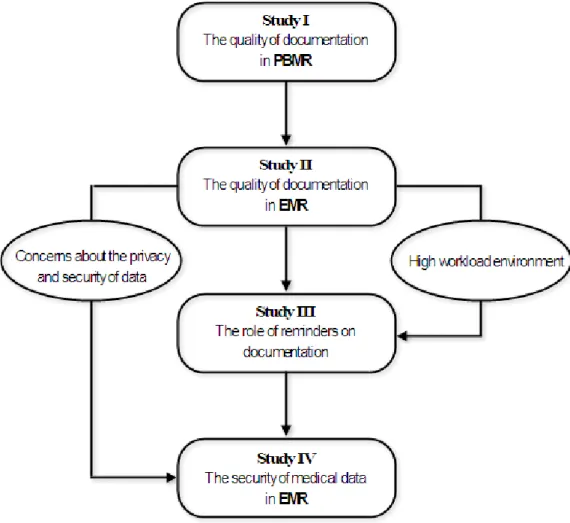
This thesis is comprised of four sub-studies which have been conducted sequentially from 2005 to 2008. Figure 2 gives an overview of the design of the studies.
Study I was a qualitative-quantitative study aiming to draw a general picture of the
quality of medical data in the PBMR system. In this study we did a quantitative analysis of the degree of completeness of medical data in the PBMR and used a qualitative approach for exploring medical staff’s opinions on the quality and usage of PBMR.
Figure 2 – Overview design of the studies
Study II was conducted one year after the introduction of an EMR system which
replaced the former PBMR system in the same hospital. We conducted this study to evaluate the quality of medical data in the EMR. The first phase of this study (quantitative) was designed to assess the completeness of the documentation of data
and the second phase (qualitative) was designed to explore users’ opinions on the factor influencing acceptance of the EMR.
The findings of the study II highlighted the effect of work environment on the
completeness of the documentation of medical data by physicians (high workload and lack of access to hardware). Therefore we designed a pure quantitative study (study III) for evaluating the effect of a computer-generated physician-oriented
reminder system on improving the quality of medical documentation.
Another important finding of study II (i.e. physicians’ concerns about the security of
medical data) guided us to explore potential security threats to medical data in the EMR systems. This study (study IV) consists of two phases: assessing computer
network security features plus observing users’ interaction with EMR (quantitative) and interviews with computer network administrators (qualitative).
4.2.1 STUDY I
The aim of this study was to measure the level of completeness of PBMRs in a university hospital and also to gather medical staff’s opinions on the quality of data in the PBMR system. The data was gathered through direct evaluation of 300 randomly selected PBMR. Different variables including demographical information, medical and surgical data, date-time and signature were evaluated. In this study we defined “quality” as completeness and availability of medical data in the medical records.
In the first phase, the availability of medical records and completeness of the content of each sheet were studied. The presence or absence of any required sheet was determined per patient as a simple test on availability. Every selected medical record was checked to see if the essential sheets were present, and when the clinical
condition of the patient indicated the use of additional sheets, we examined if those sheets existed in the medical record.
A set of 16 checklists was designed for evaluating the content of records in terms of compatibility with the recommended standard format, completeness of medical information, date, time, name and signature of documenter. If the requested information was registered correctly in the sheets, a check mark was consequently placed in the checklist for that specific item. Generally the requested information on each sheet included identification information of patient, physician and ward, the result of medical or surgical interventions and/or laboratory and radiological tests and finally date, time and signature of the care provider.
In the second phase of the study, ten physicians and ten nurses were interviewed using two separate semi-structured interview guidelines. The ease of use and supplementary information including factors influencing the quality of medical data in the PBMR were discussed in the interviews. Based on the consent of the
interviewee, the interview sessions were recorded and then transcribed for content analysis.
4.2.2 STUDY II
The purpose of this study was to evaluate the impact of the introduction of an EMR system on the quality of documentation of medical data, usability and acceptance among medical care providers and also exploring potential barriers for it.
One year after introducing a domestically developed EMR system in the same
university hospital, as in the first study, we assessed the quality of medical data in the newly introduced EMR environment.
Among the 19,900 patients who were admitted to the hospital during the period form November 2004 to the end of September 2005, a set of 300 EMR was selected. Eleven checklists based on national standards for the content of medical records were designed and every EMR was evaluated against these checklists in terms of
documentation of patients and care-providers’ identification information, medical and laboratory exam results, medical and surgical interventions.
After collecting and analysing the data, to obtain the opinions of care-providers regarding the EMR system, we also arranged interviews (guided by the results of the analysis of the data) with ten physicians and ten nurses who were using the EMR system in daily practice at the hospital. Most of the interviews were recorded (with the consent of the interviewee) and later transcribed for analysis. Interviewees were asked about availability of information and ease of use of the EMR system. They were also asked for their opinion regarding the accuracy of the EMR system in comparison with the PBMR system.
4.2.3 STUDY III
The findings of study II showed that environmental factors (i.e. a high workload)
influence the quality of documentation of medical records in a negative way. In the third study, we therefore examined a computer-generated physician-oriented
reminder system as potential solution for improving quality of documentation of the medical records in a high workload environment.
We designed this study based on a prediction that using reminders might make an improvement of 10 to 15% on the documentation process. By considering a study power of 0.8 and 10% attrition, a set of 376 EMR were prospectively selected and divided into two equal groups; an intervention group where a reminder system was used and a control group without the reminder system.
A reminder system was installed in parallel with the EMR system. After a physician logged-in to the EMR system, if there was an incomplete medical record related to that physician, a reminder dialog box appeared on the monitor screen and reminded the user of incompleteness of the record. The reminder system was designed in such a way that the reminder message did not force the physician to take action
immediately, as it was possible that the record belonged to an emergency case and time was limited for detailed documentation. The reminder messages continued to
the patient was discharged. At any stage of the medical care, if the documentation was completed, the reminder messages ceased to pop up. In the control group, no reminder was sent to the physicians. All the staff were unaware of the study, randomization and reminder design.
In order to validate the reminder system, we conducted a limited study with 30 EMR at the same hospital.
4.2.4 STUDY IV
Study II indicated that the security of medical data was an important factor
influencing physicians’ attitudes towards the EMR system. This study was, therefore designed to investigate potential threats to the information security and the nature of such threats if they existed.
By mid 2008, six university hospitals in Tabriz were using four domestically-developed HIS including EMR. The focus of this study was on information security management and security services in the HIS. Quantitative data was gathered through an observational checklist for collecting information about how users interact with the HIS, including how they login and logout from the system and how they access different information inside the HIS.
Next, the information security characteristics of the HIS including authority (right to access resources), authentication (checking user identification), availability (ability to access information at request of authorized person), confidentiality (protecting data from unauthorized access), integrity (protecting data against undesired changes), accountability (ability to trace a performed action to a person) and non-repudiation were explored.
Data were gathered from:
• The HIS itself: how a user is defined in the HIS (authority) and how a user is granted access to the information (authentication, availability)
• EMR databases: whether data is encrypted (confidentiality) and intact (integrity)
• Log files: whether the log files existed and whether they include detailed information about interactions (accountability and non-repudiation)
• Interviews with six computer network administrators and four representatives of four HIS developing companies for technical details including presence or absence of encryption algorithms, hash functions and digital signing features. For the information security management assessment, the policies and security-oriented educations were in focus. Therefore, based on the information gathered about the security features of the HIS and computer networks, we interviewed six computer network administrators at each hospital using a semi-structured interview
4.3 DATA ANALYSIS
In study I, we used descriptive statistics for data analysis. We also applied qualitative
content analysis for analysing data gathered from interviews in the study. First all audio-taped interviews transcribed into text and handwritten notes from sessions without tape recorder were added to them. All the text was read and meaning units (i.e. words or sentences with close relation or meanings) were identified and then condensed under a single label and finally gathered in main themes and categories.
In study II and IV, where quantitative and qualitative data were for analysed, we
used a similar approach as in study I; first descriptive analysis for quantitative data
and then content analysis for qualitative data. After transcription of all audio-tapes, session notes were also added to them. Then meaning condensation technique was applied on them for extracting and condensing related words and sentences until the main themes were shaped.
In study III, quantitative data was analysed with descriptive statistics. Chi square test
was used to calculate p value related to the control and intervention groups, where p < 0.05 was considered statistically significant.
4.4 ETHICAL CONSIDERATIONS
The research ethics board at the Ministry of Health and Medical Education of Iran has reviewed and approved all studies included in this thesis.
All participants in the studies were informed about the purpose of the study and informed consent was obtained from them. All individual data was kept unidentified.
5 RESULTS
5.1 STUDY I
This study revealed that several factors influence the quality of medical data in PBMR and most of these factors have negative effects on the documentation of data. First, the result of evaluation of 300 PBMR is presented and then followed by key findings from the interview with physicians and nurses. The results of the evaluation of medical records are categorised in three main groups; availability, completeness and ease of use.
5.1.1 AVAILABILITY
This section explored availability of the medical records and its sheets. Table 1 summarizes the results. Some of the sheets were missing; of these the progress note sheets had the highest number of missing sheets.
5.1.2 COMPLETENESS
All sheets in the medical records were expected to be documented in terms of required information as indicated by the MoHME standard. Because each sheet of the medical record contains different informational elements, and in order to facilitate the interpretation of the results, we categorised them into four groups:
A. Demographic information (including unit number, patient's name and family name, father’s name, date of birth, location of birth, address and phone number)
B. Administrative information – admission information (including date of admission, admitting physician, ward, room and bed number)
C. Diagnostic and treatment information (including physical examination, laboratory and radiological tests, medical orders and surgical interventions) D. Identification information of diagnosis and treatment provider (name and
family name of physician and nurse, signature, seal, date and time)
In group A, the unit summary sheet had the highest value of documentation (99%) and the fluid balance chart had the lowest value of documentation (52%).
In group B, where information is important for accessing the patient’s record, almost all records had low documentation, with highest value of documentation on the admission and discharge sheet (78%).
T a b le 1 . T h e res u lt s o f ev a lu a ti o n of 300 m e d ic a l rec ord s i n t e r m s o f a v a il a b il it y an d c o m p le te n e ss Sh ee ts Nu m be r o f ex is ti ng sh ee ts E xp ect ed n um be r of s he et s G rou p A * (% ) G rou p B † (% ) G rou p C ‡ (% ) Gro up D § (% ) A dm is sio n an d d is ch ar ge s um m ar y 30 0 30 0 71 78 88 81 M edi ca l h is tor y an d ph ys ic al ex am in at ion 30 0 30 0 67 73 91 10 0 Ph ys ic ia n’ s o rd er 29 9 30 0 54 72 98 10 0 Pr og re ss n ot e 26 9 30 0 54 74 99 10 0 L ab or at or y r ep or t a tta ch m en t 28 9 30 0 56 72 10 0 10 0 R adi ol og y r epo rt 19 19 57 24 53 95 E lec tr oc ar di og ra m at ta chme nt 23 23 65 72 39 15 C on su lta ti on r eq ues t 47 47 64 63 98 56 V it al s ign s 29 0 30 0 59 57 89 10 0 C om pos it e g ra ph ic c har t 29 2 30 0 57 57 51 N/ A ¶ Fl ui d b al anc e ch ar t 85 85 52 57 90 N/ A ¶ Pr e-op er at io n c ar e 12 3 12 8 67 71 56 94 A ne st he si a r ec or d 12 7 12 8 97 61 50 99 O pe ra ti on r epo rt 12 8 12 8 94 60 69 98 Pa th ol og y r ep or t 50 50 95 56 51 22 U ni t s um m ar y 30 0 30 0 99 61 87 98 * Pe rc en tag e of th e do cu m en tat io n o f dem og rap hi c in fo rm atio n: U nit n um ber , P at ie nt ’s N am e an d Fa m ily n am e, F ath er N am e, D ate o f B ir th , L oc at io n o f Bi rt h, Ad dr es s an d ph one num be r † P er cen tag e of th e do cu m en tat io n o f ad m in is tr at iv e in fo rm atio n: D ate o f a dm is si on , a dm itt in g P hy sic ian , W ar d, Ro om a nd B ed n um be r ‡ P er ce nt ag e of th e do cu m ent at io n o f di agno st ic a nd t re at m en t pr oc ed ure s: P hys ic al e xa m in at ion, L abo ra to ry a nd Ra di ol ogi ca l e xa m s, o rd er s, m ed ic al an d s ur gical in te rv en tio ns § P er ce nt ag e of th e do cu m ent at io n o f Id en ti fi ca tio n i nfor m at ion of di ag nos is a nd tr ea tm en t pr ovi de r: N am e and Fa m il y na m e of P hy sic ian an d N ur se , S igna tu re , S eal , Da te a nd T im e ¶ It is n ot re qu ir ed to do cu m en t i den tif ica tio n in fo rm atio n o f c ar e p ro vi de rs o n th es e sh ee ts .
In group C, where most of medical and surgical interactions are registered, almost all sheets that were filled in by physicians had a high value of documentations.
Group D had the highest value of documentation of information requested, mainly those pages which were documented by physicians.
5.1.3 EASE OF USE AND GENERAL ISSUES
In order to obtain opinions of the medical care providers on the PBMR and its quality of data, we arranged interviews with ten physicians comprising obstetricians and gynecologists, anesthesiologist and pediatricians and ten nurses who were involved in documentation of the evaluated medical records. We used two separate semi-structured guidelines for the interviews.
The average work experience of the interviewed physician group at the hospital was 13.4 years and in the nurses group it was 16.9 years. The average amount of time that physicians spent on documentation was 1 hour and 45 minutes of a working shift (8 hours). The nurses expressed that most of their working hours were spent on documentation, an average of 15 minutes for each record.
5.1.4 DOCUMENTATION
Six out of ten physicians interviewed responded that they had only documented some parts of the medical records and four of ten physicians said that they have
documented all informational elements on the charts. Among the nurse group, six out of ten nurses documented all informational elements mainly because of requests from insurance companies that forced them to complete all requested information, but the rest of the nurses interviewed documented medical records partially. They mentioned that high workload was the main reason for omitting documentation, mainly in the afternoon and night shifts when clerical staff were not at the wards.
5.1.5 INFORMATION RETRIEVAL
For six of the ten physicians the retrieval of information from PBMR was
experienced as difficult and for the rest (four physicians) it was experienced as easy. Eight of ten nurses believed that retrieval of information from PBMR was difficult, and in contrast, for two nurses it was easy to retrieve information.
5.1.6 MAIN PROBLEMS
Illegible handwriting was one of the main causes which limited the usefulness of PBMR. Nine of ten physicians and all ten nurses interviewed believed that poor handwriting is an important obstacle with retrieval of information from PBMR.
Missing of sheets was another potential problem with PBMR reported by both physicians and nurses.
During the interview physicians mentioned that PBMR are not always available. All physicians interviewed had experienced failing to access their patient’s previous medical records, especially when the records were archived at other medical centres.
5.1.7 POTENTIAL SOLUTIONS
Changing the documentation approach was suggested by both physicians and nurses. Five out of ten physicians and two of ten nurses interviewed believed that if the forms in the PBMR would have been designed in a way that they only needed to be filled in by check marks, it might improve both the documentation and information retrieval processes.
Nine out of ten physicians and eight out of ten nurses interviewed highlighted the role of education for better documentation of medical records for medical and nursery students at college and workshops for graduate physicians.
The legal aspects of completed information on some charts of PBMR was a positively influencing factor that forced all physicians to pay more attention to specific fields of the charts and document them completely, such as date, time and signature on physical exams and physicians’ order sheets.
5.2 STUDY II
The findings of this study confirmed that EMR is a good substitute for the PBMR but simply replacing the PBMR system with an EMR system without considering
influential factors would negatively affect the documentation of medical data.
In this study two main areas were explored; completeness of EMR and users’ opinion on the EMR
5.2.1 COMPLETENESS
All 300 selected EMR were evaluated for the completeness of documentation of requested information. We used a similar approach to the first study (see section 4.2.1) for interpretation of the results and grouped them into four categories: Group A (demographic information), Group B (administrative information), Group C (medical information) and Group D (care-provider’s information). Table 2 summarizes the results.
In group A, the percentage of documentation was high for the different parts of the EMR and in comparison with the previous study on PBMR, EMR showed an improvement in the documentation. This partly is because that demographical
T a b le2 . T h e r e su lt s of eva lu a ti o n o f 3 0 0 E le c tr o n ic M e d ica l R e cor d s (s e c ti o n A ) a n d P a p e r B a sed M e d ic a l R e c o rd s (s e c ti o n B ) at t h e A lz a hr a ho sp it al , T a br iz , I r a n S ec tion A S ec tion B S hee ts E xp ect ed she ets Ex is te d she et s G rou p A * (%) G rou p B † (%) G roup C ‡ (%) G roup D § (%) G roup A * (%) G roup B † (%) G rou p C ‡ (%) G roup D § (%) A dm issi on 300 300 10 0 100 NA ¶ 100 71 78 88 81 Me dic al hist or y a nd p hy sic al ex am in at io n 300 300 10 0 48 46 37 67 73 91 100 P hy si cia n’ s o rde r 300 300 10 0 48 46 37 54 72 98 100 P rog re ss note 300 300 10 0 48 46 37 54 74 99 100 L abor at or y r epor t 188 188 10 0 98 98 98 56 72 100 100 R ad iolog y re por t 65 65 10 0 98 98 98 57 24 53 95 Vita l s ig ns 300 300 10 0 100 10 0 100 59 57 89 100 N urs e rep ort 300 300 10 0 100 10 0 100 NA ** NA ** NA ** NA ** Op er at io n re po rt 71 71 10 0 100 10 0 100 94 60 69 98 P atholog y re por t 12 12 10 0 100 10 0 100 95 56 51 22 U nit su m m ar y 300 300 10 0 100 10 0 100 99 61 87 98 * P er ce nt ag e o f d oc um enta ti on of pa ti en t’ s ide nti fi ca ti on inf or m ation: U nit nu m be r, P atie nt’ s N am e an d F am ily na m e, F athe r N am e, Da te o f B ir th, L oc at io n of B ir th, A dd re ss a nd phone num be r † P er ce nt ag e o f d oc um enta ti on of intr a hosp ita l a dm is sion inf or m at io n: D at e of a dm ission, a dm it ti ng P hy sic ia n, W ar d, R oo m a nd B ed nu m be r ‡ P er ce nt ag e o f d oc um enta ti on of dia gno stic a nd t re at m en t P roc edur es : P hy si ca l e xa m in ation, L abor at or y and R adiolog ic al e xa m s, o rde rs , m ed ic al a nd sur gi ca l in te rv en ti on s § P er ce nt ag e o f d oc um enta ti on of I de nti fi ca ti on inf or m at ion of di ag no si s a nd tr ea tm ent pr ov ide r: N am e a nd F am il y n am e of P hy sic ia n and N ur se , S ig na tu re , S eal , Dat e a nd T im e ¶ (N /A ) It is not r equir ed to doc um en t ide ntif ic at ion inf or m at ion of c ar e-pr ov id er s on the se she et s. ** ( N /A )T he nu rs e r epo rt she et w as not inc lude d i n t he pa pe r-ba se d m edic al r ec or ds s ys te m .
information is registered once upon admission and is then distributed in the EMR system. Documentation of data in group B varied and on those charts related to the physicians, the percentage of documentation was low. Group C, where data about medical interactions are registered, had the lowest percentage of completeness of documentation, but in PBMR the pattern was reversed, almost all information being fully completed by physicians. Documentation of information in group D was near complete on charts filled in by physicians.
5.2.2 EASE OF USE AND GENERAL ISSUES
Ten physicians and ten nurses who were using EMR in the hospital were invited to interview. Two separate semi-structured guidelines were used. In the interview the user’s opinion regarding documentation, data retrieval, ease of use, accuracy, barriers and general issues with EMR were discussed.
In the physicians’ group the average of working experience in the medical profession was 8.5 years and for nurses’ group it was 10 years. Seven out of ten physicians had previous experience of working with EMR systems, mainly abroad. Two nurses had used EMR before. Both groups rated their computer skills as moderate to good.
5.2.3 DOCUMENTATION
Four out of ten physicians interviewed had used EMR to enter data but six of them depended on nurses to enter data or were still using PBMR at the bedside. In contrast, all the nurses were using EMR to enter data. The average time they spent entering data was 2.5 hours per working shift, mainly for documenting nursing reports, transferring patients between wards and follow up of laboratory and radiology reports.
5.2.4 INFORMATION RETRIEVAL
All physicians interviewed were using EMR to retrieve information and the time spent varied from fifteen minutes to two hours in every working shift, depending on the number of the patients, but in average 30 minutes per working shift. The nurses interviewed spent 1 hour in average on retrieving information from EMR on each working shift.
All the physicians interviewed believed that EMR was easy to use, particularly for retrieving information. For seven of ten physicians, retrieval of information was easy or very easy, particularly laboratory and radiology reports. The remaining three interviewed physicians had found the EMR system difficult to use and preferred PBMR. Nine out of ten nurses interviewed believed that using the EMR and retrieving information from it was easier than with PBMR.
5.2.5 ACCURACY
Six of ten physicians interviewed believed that EMR provided 100 percent accurate information; while four physicians highlighted incompleteness of information in the EMR and for them EMR has provided accurate information in 60 percent of cases. Laboratory, radiology and ultrasound reports were the most satisfactory data from the EMR for the interviewed physicians. Nine of ten interviewed nurses rated the accuracy of the EMR system as good to very good.
5.2.6 QUALITY OF THE MEDICAL CARE
For all the physicians interviewed, the introduction of the EMR had changed their performance positively, especially in emergency situations which needed prompt action. In such cases, the EMR provided information faster than PBMR and it helped them to make faster and better informed decisions than before. Among them five physicians believed that the quality of care of the whole hospital had improved after implementation of the EMR system, but three physicians were unsatisfied with the quality of care. They mentioned that most of the nurses’ time is spent on data entry and they had little time for taking care of the patients and therefore the quality of care in the hospital worsened.
The nurses interviewed shared the view that the quality of their performance has improved and, according to nine of ten nurses, by using EMR they had saved time for better care of their patients, because EMR facilitated searching information, follow up and reporting tasks.
5.2.7 BARRIERS
Data entering process and the time spent on that was the main point of argument for all physicians. They believed that the workload at the hospital is very high and therefore they don’t have enough time for entering data into the EMR.
Shortage of hardware and lack of access to computer workstations was another factor negatively influencing physicians’ view towards replacing EMR with PBMR.
Physicians argued that computer workstations are usually occupied by nurses and they face a queue for using the EMR.
Nevertheless nine of ten physicians and also nine of ten nurses interviewed were satisfied with EMR despite the shortcomings in hardware and difficulties with data entry. Some nurses suggested that predefined charts and template-based data entry might facilitate the data entry process.
5.3 STUDY III
The outcome of this study strongly supported the hypothesis that computer-generated reminders have the potential to improve the quality of documentation in EMR.
Two equally sized groups of EMR, with 188 records in each group, were randomly selected. In the intervention group the sum of the length of hospitalization was 647 days (mean 3.44 days per patient) and overall 861 reminders were sent out to the physicians. Table 3 summarizes the characteristics of the groups.
Table 3. Characteristics of the control and intervention groups
Intervention Group
Control Group Number of electronic medical records 188 188
Emergency hospitalization 18 20
Elective hospitalization 170 168
Mean of hospitalization days 3.44 3.46 Number of logins to the hospital information system 924 930 Three sections of the EMR, where physicians documented data, comprised of medical history and physical exam, progress note and physicians’ order chart were evaluated for completeness of medical data. Table 4 gives a summary of the results.
Table 4. Documentation in the intervention and control groups
Intervention Group
Control Group Number of completely documented records at discharge 165 91 Number of incomplete electronic medical records 18 97 Number of documented records without reminder 5 - Medical data were documented in 88% of EMR in the intervention group (Χ2 = 75.6, p < 0.0001), while this figure was 48% in the control group. Five medical records in the intervention group had been documented completely immediately after admitting patients and therefore no reminders were sent out for them.
Most of the records in the intervention group (n = 101) were completely documented with only between one and three reminders and 83 EMR were completed with four to six reminders, of which 10 records belonged to emergency admitted patients.
5.4 STUDY IV
This study explored potential security threats to the medical data in the EMR environment. Findings unveiled that replacing PBMR with an EMR system without considering security mechanisms for the information system not only risk medical data but also negatively affects users’ acceptance of EMR.
The results of this study were categorized under two main categories; management of information security and security services of the computer networks. Table 5
T ab le 5. S um m ar y o f n et w or k s ec ur ity f ea tu re s in s ix u ni ve rs ity h os pita ls in T ab riz , I ra n M ana ge m ent N et w or k S ecu ri ty Po li ci es E du ca tio n A ut he nt ic at io n A ut ho rit y A va ila bili ty C on fi de nt ia lit y In te gr it y A cc ou nta bilit y No n-Re pu di at io n H os pita l A N . A . S. T . U N /P W G L R . B. R. B . N o E nc ry ptio n N o ha sh L og N . D . S . H os pita l B N . A . S. T . U N /P W G L R . B. R. B . N o E nc ry ptio n N o ha sh L og N . D . S . H os pita l C N . A . S. T . U N /P W R . B. R. B . N o E nc ry ptio n N o ha sh L og N . D . S . H os pita l D N . A . S. T . U N /P W R . B. R. B . N o E nc ry ptio n N o ha sh L og N . D . S . H os pita l E N . A . S. T . U N /P W R . B. R. B . N o E nc ry ptio n N o h as h L og N . D . S . H os pita l F N . A . S. T . U N /P W G L R . B. R. B . N o E nc ry ptio n N o h as h L og N . D . S . N . A . Po li ci es dec id ed by ne tw or k admi ni st ra to r S. T . - S ho rt t ra in in g fo r u si ng th e el ec tr on ic m ed ic al re co rd s (i nc lu di ng s ec ur ity ) U N /P W U ser na m e an d Pa ss w or d G L G ro up lo gi n R . B . R ole B as ed N . D . S . N o d ig ita l s ig na tu re
5.4.1 MANAGEMENT
Lack of an information security policy was the prominent finding in all six
investigated hospitals. Local computer network administrators have established a set of regulations for managing computer networks, none of which were documented. New employees were, in general, receiving only a short introductory training in which the education for information security was limited to information about passwords, how to keep them and how to change them.
5.4.2 SECURITY SERVICES
Each HIS system was evaluated against seven security characteristics for information systems, comprising authority, authentication, availability, confidentiality, integrity, accountability, non-repudiation.
5.4.2.1 AUTHORITY – AUTHENTICATION – AVAILABILITY
Users (medical staff and clerical staff) were, in general, granted access to the HIS after they were qualified by the hospital managers, then a unique user name and password was given to the new user. Based on their role in the hospital, users had access to different information through functions in the HIS systems. These features, however, were flawed. In three hospitals, non-medical staff had access to medical data inside EMR.
Only username and password were used for authentication of the users. In three hospitals, medical staff was using group login schemes, despite the fact that they were each given a unique password. Non-medical staff had to use a unique username and password. They were not allowed to use group login, particularly staff of the financial departments. In five of the hospitals, passwords were saved in clear text alongside medical and non-medical data on the same server.
5.4.2.2 CONFIDENTIALITY – INTEGRITY
Although the HIS vendors had assured that all data are encrypted, our investigation revealed that none of the medical data was in fact encrypted. Database tables on the servers could be uploaded and reviewed in clear text and it was even possible to make modifications to the content. There was no application-specific hash function in any of the HIS investigated for data integrity check. All HIS relied on built-in integrity check of the databases and computer networks.
5.4.2.3 ACCOUNTABILITY – NON-REPUDIATION
All the HIS investigated were equipped with logging functions and all users’ interactions with HIS were logged, but none of these log files had ever been
reviewed, the reason for this was that network administrators believed that “there has not been any security event in the network so far”. Log files were kept on the same servers on which medical data were saved.
Username and password were considered as a working electronic signing process in the HIS. Having a username and password and a successful login to the HIS was thus considered as a signature and the only available mechanism for claiming and
proving. After successful login to the hospital network, all interactions and orders were seen as signed.
Our study revealed that there was no digital signing process at all in any of the EMR systems investigated.
6 DISCUSSION
6.1 STUDY DESIGN
PBMR have been used for many years, but EMR systems are relatively new,
especially in low- and middle-income countries. Therefore the impact of using EMR in the clinical setting needs to be assessed thoroughly. In this thesis we used both quantitative and qualitative methodologies to try to draw a holistic view of situations where EMR replaces PBMR in terms of the documentation of medical data.
We used a triangulation technique for enhancing the validity of the results and evaluated the impact of the transition to EMR from different angles. In study I, we
used triangulation of data sources by first evaluating PBMR against checklists and then interviewing physicians and nurses. We used the same approach for the validity of data sources in study II.
In study IV, triangulation of data sources included observational checklist of users’
interaction with the HIS, analysing HIS databases and log files and interviews with computer network administrators and representatives of HIS developing companies.
6.2 RATIONALE
The primary rationale for focusing on documentation and security in a new EMR environment was that medical centres are ready to embrace advanced IT systems and major resources are allocated for implementing these systems, with the ideal goal of achieving higher standards of medical care. However, before such systems can be effective in clinical settings, it is necessary that the first step (i.e. data entry or documentation) is taken appropriately. A high quality of data is important for many reasons. From the medical care perspective it is required for providing effective medical care and reducing the risk of inappropriate treatments, while from a strategic planning and management point of view, reliable data is needed for allocating and distributing resources and also for financing the medical care system. External collaborations with third parties (i.e. insurance companies) and also surveillance over the public health status require precise and comprehensive medical data.
It is, therefore, necessary to understand the possible weaknesses of the established manual systems in terms of documentation of medical data (study I) and then
examine if the newly introduced IT solutions have addressed the problems with the manual system (study II). This approach is even more important in middle-income
countries where domestically developed applications are usually among the first choices.
After introducing any new system, the acceptance of that system by users is an influencing factor on the success of implementation and therefore users’ opinions need to be explored regarding new situations (study II).
The result of study II helped us to understand better the influencing factors on the
quality of documentation and in particular environmental factors and led us to investigate the role of reminder as a potential solution for boosting the
documentation of medical records in a high workload environment (study III).
The next step that comes immediately after documentation is how to keep data in a safe and secure way without losing its integrity. Does the new system pose a threat to the data? Moreover, documenters’ concern about their privacy is another factor influencing acceptance of IT systems (study IV).
6.3 GENERAL DISCUSSION
6.3.1 QUALITY OF MEDICAL DATA (STUDY I, II)
The findings of studies I and II indicate that the quality of medical data both in
PBMR and EMR is influenced by factors including characteristics of the media (i.e. paper or electronic), work environment, staff attitudes towards documentation, education, regulations and management policies.
6.3.1.1 PBMR
Intrinsic characteristics of PBMR make it prone to flaws. For example, due to the fact that everything is done manually, mistakes are inevitable. Study I showed that
illegible handwriting (which is common, especially among physicians) and omitting documentation of requested fields on the records directly affect the quality of medical data [6]. Further on, there is no automatic reminder in PBMR system and thus errors and mistakes often remain hidden.
In study I, medical staff approached the documentation of PBMR differently.
Physicians mostly stressed the importance of documentation of pure medical data (i.e. medical history and exam, orders, progress notes) and skipped documentation of non-medical data, but where legal aspects of documentation were important (i.e. signing records, date, time and name of the physician) almost all medical records were documented very well.
Nurses are expected to document a large amount of information regarding the care provided to patients. Nurses in these studies believed that most of their working hours were spent on documentation, and on some days when workload was high, they felt obliged to skip the documentation [45]. Nurses, like physicians, paid attention to the legal aspects of documentation and tried not to skip those parts of medical records that had legal implications.
External consumers of data from medical records, such as insurance companies had positive effects on the documentation of medical records indirectly. For example, the nurses in study I mentioned that they were forced to document medical records
Staff attitudes toward PBMR were a combination of satisfaction and dissatisfaction. Traditionally, a signature and seal on paper is an established legal way of proving or rejecting a certain action. For that purpose, most medical staff seem to prefer PBMR over other kinds of documentation systems (i.e. EMR), and they try to document them carefully[46].
PBMR is highly portable and medical staff are used to it during education and in contrast to other information systems (i.e. EMR) PBMR does not require an additional skill (i.e. typing skill for entry of data in EMR), thus some medical staff prefer PBMR.
On the other hand, when it comes to using PBMR as a source of information for decision making, especially in emergency situations, physicians in these studies reported that they were dissatisfied with PBMR, because it does not provide quick access to the information and also that the PBMR are not available everywhere. They are usually archived in the place where the patient was hospitalized last time, and as the findings in study I indicated, most of the time, physicians did not have access to
the records on time. This can be seen from a different perspective too. When PBMR are located in a single place, a limited number of staff is allowed to access them, and therefore it satisfies the privacy of both patients and medical staff.
PBMR very soon become bulky, especially when a patient is hospitalized for a longer time. The physicians in study I complained that retrieving information from
PBMR is slow and in bulky medical records it is even slower and when other problems with PBMR also existed (i.e. illegible handwriting or missing sheets), it was sometimes impossible to retrieve useful information from PBMR [47].
Another influencing factor on the quality of documentation is the role of the hospital management and authorities at the medical records department [48]. In our study setting, the medical records department had established a routine for evaluating medical records in terms of the documentation of requested information and availability of all sheets. Such a policy needs to be revised and improved, as the results of the study I showed that almost all PBMR suffer from low quality of
documentation.
Continuous education of medical staff after graduation might be an effective way for improving the documentation of medical records. The results of study I highlighted
that there was a gap between what staff learnt and how they acted in practice. Therefore, if an established PBMR system is replaced with an EMR and staff do not pay enough attention to the documentation of the requested data, the problems experienced with PBMR will continue with the EMR [49-50].
6.3.1.2 EMR
Our findings confirmed that introducing an EMR system has a positive effect on the quality of documentation of medical records. These findings are also supported by other studies which have shown improvement in the documentation of medical records [51]. On the other hand, the findings in study II also suggest that introducing