DigitalCommons@University of Nebraska - Lincoln
DigitalCommons@University of Nebraska - Lincoln
Computer Science and Engineering: Theses,
Dissertations, and Student Research Computer Science and Engineering, Department of
Fall 12-4-2019
Advanced Security Analysis for Emergent Software Platforms
Advanced Security Analysis for Emergent Software Platforms
Mohannad AlhanahnahUniversity of Nebraska - Lincoln, [email protected]
Follow this and additional works at: https://digitalcommons.unl.edu/computerscidiss
Part of the Computer Engineering Commons, Information Security Commons, and the Software Engineering Commons
Alhanahnah, Mohannad, "Advanced Security Analysis for Emergent Software Platforms" (2019). Computer Science and Engineering: Theses, Dissertations, and Student Research. 182.
https://digitalcommons.unl.edu/computerscidiss/182
This Article is brought to you for free and open access by the Computer Science and Engineering, Department of at DigitalCommons@University of Nebraska - Lincoln. It has been accepted for inclusion in Computer Science and Engineering: Theses, Dissertations, and Student Research by an authorized administrator of
by
Mohannad Alhanahnah
A DISSERTATION
Presented to the Faculty of
The Graduate College at the University of Nebraska In Partial Fulfillment of Requirements
For the Degree of Doctor of Philosophy
Major: Engineering
(Computer Engineering-Computer Science)
Under the Supervision of Professors Hamid Bagheri and Qiben Yan
Lincoln, Nebraska December,2019
Mohannad Alhanahnah, Ph. D. University of Nebraska, 2019
Advisers: Hamid Bagheri and Qiben Yan
Emergent software ecosystems, boomed by the advent of smartphones and the Internet of Things (IoT) platforms, are perpetually sophisticated, deployed into highly dynamic environments, and facilitating interactions across heterogeneous domains. Accordingly, assessing the security thereof is a pressing need, yet requires high levels of scalability and reliability to handle the dynamism involved in such volatile ecosystems.
This dissertation seeks to enhance conventional security detection methods to cope with the emergent features of contemporary software ecosystems. In particular, it analyzes the security of Android and IoT ecosystems by developing rigorous vulnerability detection methods. A critical aspect of this work is the focus on detecting vulnerable and unsafe interactions between applications that share common components and devices. Contributions of this work include novel insights and methods for: (1) detecting vulnerable interactions between Android
applications that leverage dynamic loading features for concealing the interactions; (2) identifying unsafe interactions between smart home applications by considering
physical and cyber channels; (3) detecting malicious IoT applications that are
developed to target numerous IoT devices; (4) detecting insecure patterns of
emergent security APIs that are reused from open-source software. In all of the four research thrusts, we present thorough security analysis and extensive evaluations based on real-world applications. Our results demonstrate that the
DEDICATION
To my parents Jamal Alhanahnah and Salha Alnajdawi, my in-laws Raid and Evelyn Elhamawi,
ACKNOWLEDGMENTS
I am exceedingly thankful to my advisers, Dr. Qiben Yan and Dr. Hamid Bagheri who encouraged me to wok on cutting edge problems, which allowed me to have a unique combination between cybersecurity and software engineering. Indeed, no words can ever fully express my gratitude for their invaluable guidance and amazing mentorship.
Special thanks to my supervisory committee, Professors Witawas Srisa-an, ThanhVu Nguyen and Hamid Sharif for their support, guidance and helpful suggestions. I am especially thankful to Dr. Witawas Srisa-an for his unlimited support at all stages of my journey. I indeed enjoyed all of my discussions with him. I am also very grateful to Dr. ThanhVu Nguyen for sharing his expertise in the Software Verification class, and appreciate his support to attend the Ninth Summer School on Formal Techniques.
I thank my colleagues at THINK and ESQuaReD labs, especially Clay Stevens, Niloofar Mansoor, Bruno Silva, Nikolay Ivanov, Qicheng Lin, Qi Xia and Boyang Hu, who made my graduate studies a wonderful academic experience. I am thankful to my friends and colleagues at the CSE department, Najeeb Najeeb, Abdul Salam, Sara El Alaoui, Zahmeeth Sakkaff, and Jared Soundy. I am also grateful to my Jordanian friends in Lincoln, Mohammad Alhowaidi, Mohammad Bawaneh and Mahmoud Masa’deh and his family who made me feel comfortable in a place that is new to me.
I would like to express my immense gratitude to my parents, siblings and my wife for their encouragement and patience throughout this journey.
I’m deeply and humbly grateful to Allah for being able to complete this dissertation. I would like to thank Allah Almighty who enabled me to research this
topic. It was God’s power and blessing that enabled me to get through this fruitful experience. I ask God for good deeds that are accepted, for beneficial knowledge, kindness, success, and inspiration throughout the duration of completing my Ph.D.
Table of Contents
List of Figures xi
List of Tables xiv
1 Introduction 1
1.1 Emergent Software Platforms . . . 1
1.2 Security Challenges in Emergent Platforms . . . 3
1.2.1 Feature Interaction (FI) . . . 3
1.2.2 Cross-Architecture Malware . . . 7
1.2.3 Code Reuse . . . 8
1.3 Research Contributions . . . 9
1.4 Organization . . . 11
2 Related Work 12 2.1 Android Inter-app Communication . . . 12
2.2 Smart home safety and security . . . 14
2.3 IoT Malware Detection . . . 15
2.4 Insecure SSL/TLS implementation Detection . . . 17
3 Dina: Detecting Hidden Android Inter-App Communication in
3.1 Background and Challenges . . . 19
3.2 Motivating Example . . . 21
3.3 Threat Model . . . 25
3.4 DINA System Design . . . 26
3.4.1 Collective Static Analysis . . . 26
3.4.2 Incremental Dynamic Analysis . . . 28
3.4.3 Path Construction . . . 29
3.4.4 IAC Vulnerability Analysis . . . 31
3.5 DINA Implementation . . . 33
3.5.1 Class Loading Implementation . . . 34
3.5.2 IAC Analyzer Implementation . . . 34
3.5.3 Dynamic Analyzer Implementation . . . 35
3.6 Evaluation . . . 37
3.6.1 How accurate is Dina? . . . 37
3.6.2 How robust is Dina? . . . 41
3.6.3 How effective is Dina? . . . 43
3.6.4 How efficient is Dina? . . . 47
3.7 Discussion . . . 49
3.8 Summary . . . 50
4 IotCom: Compositional Safety and Security Analysis of IoT Systems 52 4.1 Background . . . 53
4.2 Illustrative Example . . . 55
4.3 Safety Goals for IoT App Interactions . . . 56
4.4 Approach Overview . . . 58
4.5.1 Building ICFG . . . 60
4.5.2 Generating Behavioral Rule Graph . . . 64
4.5.3 Generating Rule Models . . . 66
4.6 Formal Analyzer . . . 68
4.6.1 Smart Home Model . . . 68
4.6.2 Extracted Behavioral Rule Models . . . 70
4.6.3 Safety/Security Properties . . . 71
4.7 Evaluation . . . 73
4.7.1 Results for RQ1(Accuracy) . . . 74
4.7.2 Results for RQ2(IotComand Real-World Apps) . . . 77
4.7.3 Results for RQ3(Performance and Timing) . . . 81
4.8 Discussion . . . 84
4.9 Summary . . . 85
5 Efficient Signature Generation for Classifying Cross-Architecture IoT Malware 86 5.1 Motivation . . . 87
5.2 Signature Generation of IoT Malware . . . 90
5.2.1 System Overview . . . 91
5.2.2 Clustering IoT Malware . . . 91
5.2.3 Cluster Merging . . . 95
5.2.4 Signature Generation and Online Detection/Classification . . 97
5.3 Evaluation . . . 99
5.3.1 Selecting Parameters K and N . . . 100
5.3.2 Evaluating Malware Clustering . . . 102
5.3.4 Evaluating Runtime Performance . . . 106
5.4 Discussion . . . 106
5.5 Summary . . . 107
6 Towards Best Secure Coding Practice for Implementing SSL/TLS 109 6.1 Background . . . 110
6.2 Insecure SSL/TLS Patterns . . . 112
6.3 Proposed PMD Rulesets . . . 114
6.3.1 PMD Rulesets and Rules . . . 114
6.4 Evaluation . . . 120
6.4.1 Results for RQ1 . . . 121
6.4.2 Results for RQ2 . . . 123
6.5 Discussions . . . 123
6.6 Summary . . . 124
7 Conclusion and Future Research 126 7.1 Research Summary . . . 126
7.2 Future Research Directions . . . 128
7.2.1 Cross-platforms interactions . . . 129
7.2.2 Smelling the Vulnerability in Open Source Android Applica-tions . . . 130
7.2.3 Feature Interaction in Robotics Ecosystem . . . 133
7.2.4 Enforcement of Safe Interactions . . . 135
List of Figures
1.1 Dissertation Road-map . . . 3
3.1 A typical reflective call used to defeat static analyzers. . . 20
3.2 Malicious app downloads code at runtime, and then uses it for leaking
sensitive information. . . 21 3.3 Architecture of DINA . . . 27
3.4 A simplified sensitive path example: the dashed method and paths can
be captured during DINA’s dynamic analysis phase. . . 32 3.5 Instruction Graph for the method onCreate(Listing 3.5) that includes
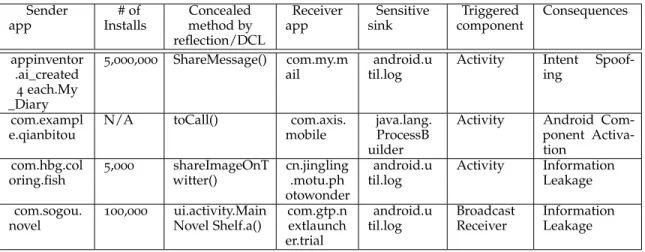
both control-flow and data-flow. . . 36 3.6 (a). Activity 1 of sender app; (b). Activity 2 of sender app initiated
through reflection; (c). Activity3represents the activity of receiver app
invoked by IAC; (d). Inject malicious email address in the sender app to launch attack via IAC. . . 44 3.7 (a). Activity 1 of sender app; (b). Activity 2 of sender app initiated
through reflection; (c). Activity3represents the activity of receiver app
invoked by IAC; (d). Captured log confirms the IAC. . . 47 3.8 Static analysis time. . . 48
3.10 Runtime performance comparison. . . 49
4.1 Smart Home Automation Model. . . 53
4.2 An example of malicious IoT apps interaction. . . 56
4.3 IotComSystem Overview. . . 59
4.4 Extracted models forMaliciousApp, described in Listing1, at different steps of analysis. . . 64
4.5 Counterexample from Alloy for running example. . . 71
4.6 Example violation of G1 (No unintended behavior): Lights continually turn off and on. The violation occurs via the luminancephysical channel. 78 4.7 Example violation of(G2) No unpredictable behavior: Both “on” and “off” commands sent to the same light due to the same event. The violation happens via the luminancephysical channel. . . 79
4.8 Example violation of (G3) No unsafe behavior: Cyber coordination be-tween apps may leave the door unlocked when no one is home. The first rule is guarded by a condition that the home owner not be present. 80 4.9 Distribution of detection violations across three goals (cf. Section 4.3). . 81
4.10 Scatter plot representing analysis time for behavioral rule extraction of IoT apps using IotCom. . . 82
4.11 Average time required to analyze all properties related to each goal by number of rules in the analyzed bundle. . . 82
4.12 Verification time by IotCom and IoTSAN to perform the same safety violation detection in a logarithmic scale. . . 83
5.1 IoT malware distribution based on CPU types . . . 89
5.2 Detection system architecture . . . 90
5.4 Inter-cluster and Intra-cluster string similarity with different K values
(N =4) . . . 101 5.5 Daviesâ ˘A¸SBouldin index for evaluating the number of coarse-grained
clusters . . . 102 5.6 Distribution of cluster cohesion . . . 104
6.1 Insecure SSL/TLS implementation patterns . . . 112
6.2 PMD architecture and the proposed PMD rulesets (SSL_Vuln_Ruleset) . 115
6.3 PMD ruleset structure . . . 115
6.4 PMD analysis results on Eclipse after adding a new rule . . . 118
6.5 Distribution of vulnerability detection using proposed PMD rulesets . . 121
6.6 Detection results according to the types of SSL/TLS Vulnerabilities . . . 122
List of Tables
3.1 A non-exhaustive list of Intent APIs. . . 19
3.2 IAC detection performance comparison between DroidRA+SEALANT
and Dina. True Positive (TP), False Positive (FP), and False Negative
(FN) are denoted by symbols2,4, 2, respectively. (X#) represents the number # of detected instances for the corresponding symbol X. Also note that IccTA did not detect any vulnerable paths. . . 40 3.3 Dynamic analysis of real-world apps. . . 42
3.4 Intent sending and receiving capabilities of activated ref/DCL classes. . 42
3.5 Top sensitive sources in the activated reflection and DCL classes. . . 43
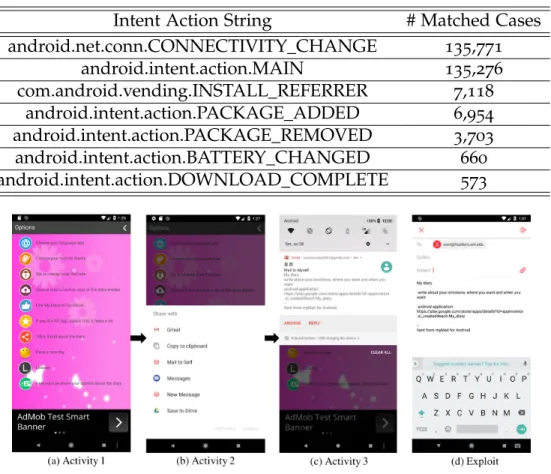
3.6 Number of matched cases of the top-7matched Intent action strings. . . 44
3.7 Risky vulnerabilities have been uncovered by Dinain real-world apps. 45
4.1 Safety and Security Properties . . . 75
4.2 Safety violation detection performance comparison between SOTERIA,
IoTSAN and IotCom. True Positive (TP), False Positive (FP), and False
Negative (FN) are denoted by symbols 2, 4, 2, respectively. (X#) represents the number # of detected instances for the corresponding symbol X. . . 76 5.1 Number of instructions for benign and malicious binaries . . . 89
5.2 Inter-cluster string similarity with different N values (K=100) . . . 101
5.3 Summary of Clustering Results. The number of samples that have
been used for performing the clustering is2000 files (training dataset).
Therefore, all clustering and processing time measurements are based on the training dataset . . . 103 5.4 Statistical similarity of new benign/malicious samples with clusters’
statistical signature and detection rate based on string signatures . . . . 105 5.5 Performance comparison . . . 105
1
Introduction
Emergent software platforms have a tremendous impact on different aspects of modern society, including economic growth, human relationships, entertainment, scientific development, and education. These contemporary applications run at a high level of dynamism and often interact over complex infrastructures. This era of emergent software is driven by the increasing market and the rapid usage of mobile and smart devices. This chapter discusses the unique characteristics of con-temporary software platforms, describes the consequent security challenges, and presents our methods to address the challenges by summarizing the contributions of this dissertation.
1
.
1
Emergent Software Platforms
Conventional software leverages stringent development chains, in which individ-uals/companies develop software and in many cases distributed it themselves. On the other hand, emergent software ecosystems involve a chain of actors who is responsible for the distribution of software, which is more loosely coupled in contrast to conventional development chains. Moreover, software development is becoming increasingly complex these days [1,2], because applications, in the
emer-gent platforms, are moving beyond inexpensive recreational applications to more business-centric usage [1]. Indeed, over the last decade, the emergent software
imposes intrinsic changes in the way software is produced and consumed and how users interact with mobile and smart devices [3]. Subsequently, contemporary
software introduces emergent characteristics in comparison with conventional software.
Emergent software platforms are built from reusable units of software be-haviour [4], unlike conventional apps that are self-contained. This trend encourages
emergent software platforms to share features through inter-component communi-cation (ICC) in Android platform [5] and IoT apps interactions manifested through
the coordination between sensors and actuators in smart home [6]. This practice of
sharing functionalities represents the first characteristic of emergent software, we formalize this attribute as feature interaction.
Emergent software platforms are deployed into highly dynamic environments and often interact over highly heterogeneous platforms [7, 8, 3]. This imposes
the demand for cross-architecture implementation that allows delivering the func-tionality of an application over various hardware platforms (i.e. MIPS and ARM) and software platforms (i.e. Android and iOS) [9,10]. This direction introduces
cross-architecture implementation, the second attribute of emergent software.
Emergent software ecosystems provide programming frameworks for third-party developers to build apps to manage a single or even several smart devices at the same time to realize more advanced and automated control [11]. This motivates
emergent software community to support open-source software that involves code reuse to achieve multi-vendor integration [12]. To this end,code reuse is considered
as the third characteristic of emergent software.
The attributes of emergent software applications lead to unique security chal-lenges, as illustrated in Figure1.1. The first layer includes the three attributes of
introduces the security challenges corresponding to each attribute, these challenges are discussed in detail in the Section 1.2. Finally, the third layer represents the
emergent platform wherein we address the security challenges and lists the chapter that presents the solution.
Android Apps Emergent Software Feature Interaction Code Reuse IoT Apps Android Apps Software Attributes Section 1.1 Android Apps Emergent Software Platforms IoT Malware Cross Architecture Unsafe Interactions Insecure Patterns Security Challenges Section 1.2 Cross-architecture IoT Malware
Chapter 3 Chapter 4 Chapter 5 Chapter 6
Figure1.1: Dissertation Road-map
1
.
2
Security Challenges in Emergent Platforms
After introducing emergent software and its attributes in the previous section, this section discusses the security challenges related to these attributes and highlights the requirements to handle the challenges.
1
.
2
.
1
Feature Interaction (FI)
The interoperability in the emergent software era implies the ability of applications to interact and exchange information. This interaction can be perceived in the
Android platform through inter-app communication [13] and interactions between
sensors and actuators in the trigger/action ecosystem [14]. The interaction between
different components of the ecosystem is known asFeature Interaction, where the behavior of one feature is influenced by the presence of another feature (or a set of other features) [15,16,17, 18]. As a result, the feature interaction concept
provides value-added services and thus contributes to rich the user’s experience. For example, an IoT app can provide energy-saving service by integrating an air-conditioner, a ventilator, and thermometers [19]. Furthermore, applying the
concept of feature-interaction also reduces the developers’ burden and promotes functionality reuse. For instance, in the context of the Android platform, the ability to share pictures from one app with another [20], and a restaurant review
applica-tion can ask other applicaapplica-tions to display the restaurantâ ˘A ´Zs website, provide a map with the restaurantâ ˘A ´Zs location, and call the restaurant[21]. Nevertheless,
feature interaction is challenging traditional security analysis frameworks. First, the number of interactions can be potentially exponential based on the number of features [22]. Second, interactions cannot be deduced easily from the behaviors of
individual features. Third, the interaction introduces a new set of vulnerabilities and safety issues such as resource contention, where features compete for resources and loops in the communication among features [23]. Therefore, scalability aspect
should be handled efficiently in the proposed methods. The following subsection discusses the feature interaction concept in the context of the Android and smart home platforms.
1.2.1.1 Feature Interaction in the Android platform
The Android platform provides intent APIs to facilitate the interaction between components within the app, which is known as Inter-Component
Communica-tion (ICC) or across-apps, known as Inter-app communicaCommunica-tion (IAC). Although IAC improving users’ experience and reducing programming burden, it can be exploited to perform collusive attacks [24]. To conceal this exploit, dynamic java
programming features such as Reflection and Dynamic Class Loading (DCL), can be employed. The usage of dynamic programming features is justifiable because its usage is expected to be growing in the appified era [2]. Java reflection
mecha-nism is extensively used in Android apps for maintaining backward compatibility, accessing hidden/internal application program interface (API), providing external library support, and reinforcing app security [25,26]. But the use of the reflection
mechanism renders the security analysis approaches designed to analyze and detect malicious apps ineffective [27]. As the malicious code is not part of the apps’
bytecode, rather is loaded at runtime using the dynamic class loading (DCL). The current state-of-the-art security mechanisms, both static and dynamic analysis approaches, are insufficient for detecting the increasingly sophisticated security attacks.
Static analysis approaches [28,29,30,31] can be easily bypassed by apps that
covertly invoke malicious IAC using reflection or DCL. On the other hand, dynamic analysis approaches, such as TamiFlex[32], StaDyna[26], and DyDroid [33], suffer
from false negatives largely due to the reachability challenges, where vulnerabilities are missed because of inputs that fail to reach the vulnerable code; they thus do not detect malicious IACs concealed behind reflective and DCL calls. In Chapter3,
we present a hybrid analysis approach for detecting such sophisticated behavior.
1.2.1.2 Feature Interaction in Smart Home Platform
In a smart home environment, the same set of sensors and actuators can be con-trolled from different IoT platforms (i.e. SmartThings Groovy and SmartThings
IFTTT). This can lead to the race to configure, control, and monitor these de-vices [34]. These platforms allow users to install third-party software appsthat
automate the devices in their homes. Through their control of physical devices in a system, software apps installed by the user can interact in both physical as well as cyberspaces, allowing complex and varied automation. While enhancing the user’s experience by delivering many options for automating their home, such diversity at the same time escalates the attack surface for safety and security threats. Interaction between smart home apps and devices can go beyond affecting cyberspace to influencing the physical space, which might lead to severe safety and security violations. Hence, identifying risky interactions is a pressing need. This entails performing precise analysis that can assess the severity of interactions. For instance, a door control app can be triggered to unlock the door when the user arrives home, which is the desired behavior, but if the door unlocked while the user is not present, this constitutes a serious hazard. This undesired behavior can occur accidentally, or through unforeseen coordination between apps.
In this context, several techniques have been proposed in recent research to identify possible safety and security violations in the IoT domain. However, existing techniques provide an incomplete picture of the overall landscape of IoT app interactions. In particular, the state-of-the-art techniques target only certain types of inter-app attacks [34, 35,11], do not take into account physical channels
through which apps can interact (such as temperature or moisture levels) [36],
which can underpin risky interactions, lackcross-platform analysis capability [34, 35],
which is necessary to analyze diverse systems that can interoperate in the same IoT environment (e.g., Samsung SmartThings [37] and IFTTT [38]), and require
manual specification of the initial system configuration, which may lead to missing potential unsafe behavior if it appears from different configurations [34]. Moreover,
these analyses have been shown to experience scalability problems when applied on large numbers of IoT apps [34,11,35]. In Chapter4, we present a compositional
analysis approach that can detect unsafe interaction threats in a given bundle of cyber and physical components co-located in an IoT environment.
1
.
2
.
2
Cross-Architecture Malware
Interoperability in emergent software era is underpinned by developing cross-architecture applications and firmwares [7,8], which support various CPU
archi-tectures of IoT devices. This involves the ability to program across-architecture IoT devices with a single compiler [9] and thus facilitating heterogeneous firmware
update instead of using monolithic binary updates. Moreover, promoting cross-architecture implies the code base will be compiled with different compilers using various configurations (e.g., different optimization levels). Cross-compile execution will impose significant changes in the representation of the generated binaries [39].
In the IoT malware domain, Mirai malware was developed to infect differ-ent architectures of IoT devices, as security researchers found binaries for the common architecturesâ ˘AˇTMIPS32-bit, ARM 32-bit, and x86 32-bit belong to this
malware [40]. Mirai caused a major Internet service breakdown for a few hours
due to this cross-architecture capability, which supported the Mirai’s actor to infect a large-scale of IoT devices [41]. Therefore, IoT devices have become enticing
targets for cyber-attackers. Since IoT devices are fully integrated into our daily life, compromised devices can cause unprecedented damages. Even worse, IoT devices are usually resource-constrained with low-profile processors, which prevents the deployment of sophisticated host-based defenses as we commonly use on personal computers (PCs). Consequently, the attackers endeavor to recruit vulnerable IoT
devices to build alarge-scalebot army to launch the attack, and the number of IoT malware has more than doubled in2017 [42]. Therefore, in Chapter5, we design a
lightweight cross-architecturesignature generation scheme for detecting/classifying IoT malware.
1
.
2
.
3
Code Reuse
Open-source application is a key aspect to facilitate the integration between the heterogeneous systems in which emergent software platforms are deployed [43, 2, 44,45]. Therefore, the software communities open-source the software
develop-ment [46], because open-source implementations support achieving multi-vendor
interoperability [12, 44, 45]. So that 91% of IoT developers adopt open-source
software at least one part of their development stack [2,47].
However, this usage of others’ implementations can lead to the propagation of security vulnerabilities [48, 44] because of weak programming practices [49]. The
code reuse is observed between open source software and online programming discussion platforms (e.g., Stack Overflow) [50, 51, 52]. Several works showed that
insecure code patterns propagated in production software [53, 54, 55]. To mitigate
this issue, developers should be supported through a detection mechanism that can identify insecure implementations at the early stage of a software implementation, which consequently will promote the development of secure code. In Chapter 6
we identify insecure patterns of Secure Socket Layer/Transport Layer Security (SSL/TLS) in the context of Android and develop detection rules that can be used within the IDE.
This section discussed the security challenges that are considered in this dis-sertation, which shows the complexity and the demand for reliable methods.
Therefore, conducting rigorous security analysis for addressing the implications of these attributes requires: (1) performing a holistic analysis, (2) resolving scalability
aspects, and (3) modeling different elements of the applications that will impact
applications’ behavior. All these requirements represent a severe demand for high levels of reliability and scalability in the proposed solutions. Section 1.3
summarizes our solutions to address these security challenges.
1
.
3
Research Contributions
In this dissertation, we proposefour security analysis frameworksfor addressing the challenges discussed in the previous sections and illustrated in Figure1.1. Each
project considers a specific challenge in the context of one of the emergent software ecosystems. We make the following contributions in this dissertation:
1. FI in Android Platform: We analyze feature interactions in the context of
An-droid that manifested through inter-app communication (IAC). In this work, we expose a new attack that leverages reflection and dynamic class loading features in conjunction with inter-app communication to conceal malicious attacks to bypass existing security mechanisms. we also show the interaction between apps can lead to privacy leakage and spoofing attacks resulted from the interactions of Android applications. To identify such vulnerabilities, we design, develop and implement Dynamic INter-App Communication Tool (Dina), a novel hybrid analysis approach for identifying malicious IAC
behaviors concealed within dynamically loaded code through reflective/DCL calls. Dina appends reflection and DCL invocations to control-flow graphs
and continuously performs incremental dynamic analysis to detect the mis-use of reflection and DCL that obfuscates Intent communications to hide
malicious IAC activities. Dinautilizes string analysis and inter-procedural
analysis to resolve hidden IAC and achieves superior detection performance. This component of the dissertation is published in [56].
2. FI in smart home platform: we design and implement IotCom, a formal
method tool to identify safety and security violations that can occur in the interactions between IoT apps in smart home environments. IotCom is
a compositional approach that empowers end-users to safeguard a given bundle of cyber and physical components co-located in an IoT environment. It automatically discovers such complicated interaction threats. IotCom
combines static analysis with lightweight formal methods to automatically infer relevant specifications of IoT apps in an analyzable formal specification language, taking into consideration the mapping between cyber and physical channels. IotCom then checks the extracted specifications as a whole for
interaction threats.
3. Detecting Cross-architecture IoT Malware: we propose a data-driven
sig-nature generation method for detecting IoT malware, which generates dis-tinguishable signatures based on high-level structural, statistical and string feature vectors, as high-level features are more robust against code variations across different architectures. The generated signatures for each malware family can be used for developing lightweight malware detection tools to secure IoT devices. The signature generation scheme extracts a reliable and easily extractable string and statistical features. The string feature is ex-tracted using N-gram text analysis, while the statistical feature contains the code-level statistics. This work is published in [57]
4. Insecure implementation of SSL/TLS:this work aims to support developers
in detecting insecure SSL/TLS implementation in their codes in the context of Android, whether this implementation is imported from other projects or other platforms such Stack Overflow. Our approach utilizes a low-cost cross-languagestatic analysis tool called PMD. In the end, two insecure im-plementations of SSL/TLS have been identified, and subsequently, a new PMD ruleset is created. This ruleset consists of three rules for addressing hostname validation vulnerability and certificate validation vulnerability. This work is published in [58].
1
.
4
Organization
The rest of this dissertation is organized as follows: Chapter2presents the related
work of this work and puts it in the context of describing the limitations of prior work. Chapter 3 presents our security analysis framework (namely Dina) for
detecting vulnerable Android Inter-App Communication in dynamically loaded code. In Chapter 4, we introduce our formal method approach for detecting
unsafe interactions in the context of a smart home. In Chapter5, we discuss our
approach for analyzing IoT malware and describe the data-driven framework for cross-architecture signature generation. Chapter 6 describes our approach for
detecting code reuse in the context of StackOverflow. Finally, Chapter 7concludes
2
Related Work
In this chapter, we discuss research related to the work presented in this dissertation and describes the limitation in prior work.
2
.
1
Android Inter-app Communication
This section discusses research efforts in the area of Android Inter-App Communi-cation (IAC) and Inter-Component CommuniCommuni-cation (ICC). It then highlights the lim-itations of the related solutions. Numerous techniques have been proposed to ana-lyze inter-component communication vulnerabilities [59, 60, 61,62, 63,64, 31, 65].
Among others, IccTA [60] and its successor [62] leverage an Intent resolution
scheme to identify inter-component privacy leaks. However, their approach relies on a preprocessing step connecting Android components through code instrumen-tation, which can lead to scalability issues [31,28]. Separ[29] andsealant [31]
perform compositional security analysis at a higher level of abstraction. While these research efforts are concerned with security analysis of component interac-tions between Android apps, DINA’s analysis enables reflection and DCL-aware assessment of the overall security posture of a system, greatly increasing the scope of potential ICC-based misbehavior analysis.
With respect to reflection and DCL, there have been several research efforts that attempt to improve the soundness of static analysis in the presence of dynamically
loaded code through Java reflection. Livshits et al. [66] propose a static analysis
algorithm that can approximate reflection targets using points-to information. Felt et al. [67] discuss the challenges of handling reflection in Android applications and
then attempt to address them using Stowaway, a static analysis tool that is capable
of identifying reflective calls and tracking reflection targets by performing flow-sensitive analysis. More recent static analysis approaches aim to improve precision. These approaches include DroidRA [25] and Sparta [68]. DroidRA adapts
TamiFlex [32] to statically analyze Android apps for dynamically loaded code.
Unlike TamiFlex, DroidRA does not execute apps; instead, it uses a constraint
solver to resolve reflection targets. It also uses its own version of Booster to manipulate Jimple, an immediate representation used by Sootdirectly. TamiFlex,
on the other hand, manipulates Java bytecode. Spartaimplements annotations
in the Checker framework to track information flow and a type inference system to trace reflective calls. Spartaalso operates at the source code level and not the
bytecode or dexcode level. However, these static analysis approaches can work only in cases in which reflection targets can be identified from the source code. For the most up-to-date and comprehensive review of static analysis approaches for handling reflection, see Landman et al. [27]. Our approach however detects
reflection targets and captures dynamically loaded code using dynamic analysis. There have also been several research efforts to perform dynamic analysis to detect reflection/DCL targets. Davis et al. [69] provide an app rewriting framework
named RetroSkeleton that is capable of intercepting reflections at runtime; however, this approach does not work with custom classloaders. Sawin et al. [70] propose
an approach that combines static string analysis with dynamic information to resolve dynamic class loading via Java reflection. This approach operates only on the standard Java library. ExecuteThis! [71] is a dynamic analysis approach that
relies on an Android VM modification to detect reflection calls. It first logs runtime events and then performs static analysis off-line. StaDynA [26] also performs
dynamic analysis in two phases. Our approach, on the other hand, performs analysis continuously.
2
.
2
Smart home safety and security
This section discusses the stateof-the-art works that address the safety and securtiy of smart home. IoT safety and security has been broadly studied recently [72,11,
73, 74, 75, 76,77, 35,34, 36,78, 79,80, 81,82, 83,84, 85, 86, 87, 88,89, 90,91, 92,
93, 94, 95, 96, 97]. Many of these studies focus on data security issues such as
permission overprivilege [72, 98], or sensitive information leakage [74,11, 73, 99].
ContextIoT [11] and SmartAuth [73] both detect and enforce authorization policies
at runtime to prevent such attacks. ProvThings [75] examines data security by
determining data provenance in IoT systems, and can log interactions between IoT apps. However, these approaches primarily aim to protect sensitive data, and do not detect safety and security violations arising from interactions of apps in the physical world.
Soteria [35] reports violations either within a single app or between pairs of
apps, indicating a possible cap on its scalability. IoTSAN [34] detects violations
in bundles of more than two apps. However, the initial configuration of those apps and their connected devices must be provided manually for each analysis. Also, it must first translate the Groovy code of the SmartThings apps to Java, limiting its analysis to just less than half (27 of 65) of the devices supported by SmartThings [100]. In contrast, IotComdirectly analyzes Groovy code, supports
To the best of our knowledge, none of these approaches can detect violations mediated by physical channels—a key feature of IotCom.
IoTMON [36] is a pure static analysis technique that analyzes rules based solely
on triggers, neglecting the conditions for specific actions. In contrast, IotCom
validates the safety of app interactions with more precision by effectively capturing logical conditions influencing the execution of app rules through a precise control flow analysis. Moreover, IoTMON does no analysis to detect potential safety and security issues, which is conducted in a formally rigorous manner in IotCom.
Other researchers have evaluated the security of IFTTT applets [98,76,101,102].
Fernandes et al. [98] studied OAuth security in IFTTT, while Bastys et al. [76] used
information flow analysis to highlight possible privacy, integrity, and availability threats. However, none of the studies examined the aforementioned IoT safety and security properties. In contrast, IotCom performs large scale safety and
security analysis, examining interactions between tens of IFTTT smart home applets. IotComalso analyses bundles comprising both SmartThings Classic apps
and IFTTT applets, demonstrating its unique cross-platform analytical capability.
2
.
3
IoT Malware Detection
In this section, we focus on reviewing malware analysis approaches that aim at classifying malware families and generating signatures for effective detection. Malware Classification: Recently, Alazab [103] proposes a Windows malware
(in PE format) classification method based on features extracted dynamically and statically from the malware files, including windows API sequences and their frequencies of appearance. But the API calls are different across different architectures, and can be easily forged or modified by attackers to disguise their
malicious activities. Santos et al.[104] present a malware classification method
based on the frequency of opcode sequences, but opcode sequences can also be easily disrupted by simple code variations resulted from different compilation options. Zynamics Bindiff [105] and BinSlayer [106] measure binary similarities
based on graph isomorphism between CFGs. BinSlayer further improves the binary comparison accuracy of BinDiff by incorporating graph edit distances, but also brings considerable overhead. Both Shabtai et al. and Hu et al. [107, 108] use
static analysis to examine the effectiveness of malware detection using OpCode N-gram analysis. Kong et al. [109] map malware instances to their corresponding
malware family using structural features of function call graph and statistical features including lists of API calls and opcodes with their respective frequencies. Malware Signature Generation: High level string features and statistical features extracted from file size and file content have been used to classify firmware images of embedded devices [110]. Besides our different goals (known firmware
classi-fication versus unknown malware classiclassi-fication), they use a simple intersection method on string features to identify firmware images, while our N-gram string features can extract more representative features for each malware family. We also consider statistical features by counting instructions and functions at the assembly code level, which have finer granularity. Perdisc et al. [111] propose a multi-stage
clustering approach for generating malware signatures using the network traffic generated by malware samples. FIRMA [112] also utilizes network traffic to
gener-ate behavioral signatures for malware detection. Unlike [111], FIRMA generates
network signatures for each network behavior regardless of traffic types, the format of which follow popular signature-matching IDS. While the previous work deals with generic PC malware, we focus on the newly emerging IoT malware.
2
.
4
Insecure SSL/TLS implementation Detection
In this section, we review related work that consider the insecure implementa-tion of cryptograpy. FixDroid plug-in for Android studio has been developed in [113], which addresses several limitations in Android Lint tool. It is used for
helping App developers in improving the quality of their code including insecure implementations. FixDroid attempts to address the insecure implementations of SSL/TLS. However, FixDroid only considers a single pattern, which is Im-proper HostNameVerifier, while in our solution we consider three most commonly observed patterns.
Another plug-in called CogniCrypt is developed for assisting developers in generating secure implementation of crypto APIs [114]. This plug-in automatically
generates secure implementation instead of detecting insecure patterns using static analysis technique. Although SSL API implementation is covered by the plug-in, it does not show details about the type of SSL implementations that have been covered.
HVLearn is a blackbox testing tool for verifying hostname ins SSL/TLS imple-mentations based on automata learning algorithms [115]. However, developers do
not actually need blackbox testing techniques for detecting insecure implementa-tion, as the source code is available. Also, HVLearn focuses only on detecting one aspect of insecure SSL/TLS patterns.
Other solutions have been developed to detected insecure implementation of SSL/TLS [116, 117]. However, these solutions intended to analyze released
applications and not to assist developers in detecting insecure patterns while implementing SSL/TLS APIs.
3
Dina: Detecting Hidden Android Inter-App
Communication in Dynamic Loaded Code
Java reflection and dynamic class loading (DCL) are effective features for enhancing the functionalities of Android apps. However, these features can be abused by sophisticated malware to bypass detection schemes. Advanced malware can utilize reflection and DCL in conjunction with Android Inter-App Communication (IAC) to launch collusion attacks using two or more apps. Such dynamically revealed malicious behaviors enable a new type of stealthy, collusive attacks, bypassing all existing detection mechanisms. In this chapter, we present DINA, a novel hybrid analysis approach for identifying malicious IAC behaviors concealed within dynamically loaded code through reflective/DCL calls. DINA continuously appends reflection and DCL invocations to control-flow graphs; it then performs incremental dynamic analysis on such augmented graphs to detect the misuse of reflection and DCL that may lead to malicious, yet concealed, IAC activities. Our extensive evaluation on3,000real-world Android apps and 14,000malicious apps
corroborates the prevalent usage of reflection and DCL, and reveals previously unknown and potentially harmful, hidden IAC behaviors in real-world apps.
3
.
1
Background and Challenges
Android Apps: comprise different types of components, namelyactivities,services, broadcast receivers, andcontent providers1
. These components communicate through a specific type of event messages calledIntent, which can be either explicit, when its recipient component is specified, or implicit, when no specific recipient component is declared.
Inter-App Communication (IAC): Android apps typically use Inter-Component Communication (ICC), a message passing mechanism (i.e. intent), to exchange data. Components within or between apps use ICC to communicate with each other via explicit or implicit Intents, depending on whether the target component name is specified. The Android Intent is resolved at runtime based on the fields ofIntentFilterdeclared in the apps’ manifest files and the attributes of implicit Intents, includingaction,category, and data. Intents can be sent through three types of components (i.e., activities, services, receivers). Table3.1 lists relevant Intent
sending and receiving APIs, categorized based on their corresponding component types.
Components Intent-sending APIs Intent-receiving APIs Receivers sendBroadcast() sendOrderedBroadcast() sendStickyBroadcast() sendStickyOrderedBroadcast() onReceive() Activities startActivity() startActivityForResult() onCreate() Services startService() bindService() onStartCommand()
Table3.1: A non-exhaustive list of Intent APIs.
Reflection and Dynamic code loading (DCL):DCL allows Android apps to load and execute code that is not part of their initial code bases at runtime. DCL is used to overcome some restrictions (i.e. 64K maximum method references in a
1
dex file) and extend the app’s functionality [26]. Java reflection is a language
feature that provides developers with the ability to inspect and determine program characteristics, such as classes, methods and attributes, at runtime. Reflection is used for maintaining backward compatibility, accessing hidden/internal applica-tion program interface (API), providing external library support, and reinforcing app security [25,26]. Therefore, reflection and DCL have been used to enhance
functionalities of Android applications for legitimate purposes. But reflection and DCL can also be used to hinder static analysis tools because they are resolved at runtime. Fig.3.1 illustrates a reflective call where the actual reflection targets (i.e.,
Classes B, CandD) cannot be resolved by static analysis tools as the malicious code is not part of the apps’ bytescode, rather is loaded at runtime using the dynamic class loading (DCL).
Class A Reflection API
Class B Class C Class D ... ... Method.invoke(...) Reflected Object ? ? ?
Figure3.1: A typical reflective call used to defeat static analyzers.
Challenges: Analyzing the interactions among apps is a challenging task. The obfuscation techniques such as reflection and DCL impose additional challenges. We lay out the specific challenges in details below.
• The collaborative nature of Android apps indicates that the analyst needs to be able to analyze a large collection of apps that can potentially interact, and observe their collective runtime behaviors. Most existing program analysis approaches cannot support such needs, because they tend to operate in a close-world fashion (i.e., any change to the program under analysis requires
the entire analysis process to be rerun [118, 119]), require off-line processing
to generate analysis results, and can only analyze one app at a time.
• Reflection implies missing nodes and edges in the call graph, and thus the control-flow and data-flow graphs regarding these missed nodes will not be generated. Therefore, it is critical for the analyzers to have the capability of resolving reflection and dynamically updating call graphs.
• DCL involves new codes that will be downloaded and executed at runtime. The analyzers need to capture the newly downloaded code and then update the call graph, control-flow and data-flow graphs at runtime.
3
.
2
Motivating Example
In this section, we present motivating examples to show how Intent can be used as an attack vector to launch information leakage through hidden (dynamically loaded) code, and to conceal method invocations through reflection.
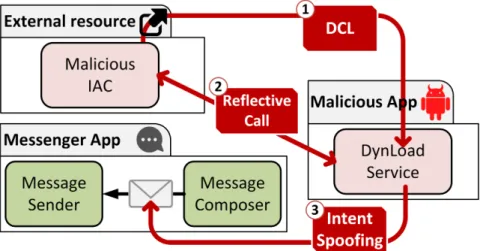
Figure3.2: Malicious app downloads code at runtime, and then uses it for leaking
1 public c l a s s DynLoadService extends S e r v i c e { 2 public i n t onStartCommand ( I n t e n t i n t e n t ) { [ . . . ] 3 loadCode ( ) ;
4 }
5 public void loadCode ( ) {
6 // Read a j a r f i l e t h a t c o n t a i n s c l a s s e s . dex f i l e
7 S t r i n g j a r P a t h =Environment . g e t E x t e r n a l S t o r a g e D i r e c t o r y ( ) . g e t A b s o l u t e P a t h ( )
,→ +"/dynamicCode.jar"; 8 // Load t h e code
9 DexClassLoader mDexClassLoader = new DexClassLoader ( j a r P a t h , g e t D i r ("dex",
,→ MODE_PRIVATE) . g e t A b s o l u t e P a t h ( ) ) ;
10 // Use r e f l e c t i o n t o load a c l a s s and c a l l i t s method 11 Class <?> l o a d e d C l a s s = mDexClassLoader . l o a d C l a s s ("MalIAC") ;
12 Method methodGetIntent = l o a d e d C l a s s . getMethod ("getIntent", android .
,→ c o n t e n t . Context .c l a s s) ;
13 O b j e c t o b j e c t = l o a d e d C l a s s . newInstance ( ) ;
14 I n t e n t i n t e n t = ( I n t e n t ) methodGetIntent . invoke ( o b j e c t , DynamicService .
,→ t h i s) ;
15 s t a r t S e r v i c e ( i n t e n t ) ; } }
Listing3.1: DynLoadService component resides in the malicious app and
performs DCL and reflection to hide its malicious behavior.
Fig.3.2presents a bundle of two apps, where a malicious IAC is initiated within
a dynamically loaded component from an external source to leak sensitive infor-mation through theMessengerapp. TheDynLoadServicecomponent dynamically loads a malicious class from an external JAR file placed at the location specified on line7of Listing 3.1. It then instantiates aDexClassLoaderobject, and uses it to load
the DEX (Dalvik Executable) file contained in the JAR file. Using Java reflection at line 12, the mDexClassLoader object loads a class called MalIAC and invokes
its getIntent method at line 14. This method returns an implicit Intent, which
DynLoadServiceuses to communicate with the Messenger Sender(line15). Note that
MYSTIQUE-S [120] uses the same invocations in lines9,11-13 of Listing 3.1 for
constructing the attack template that loads the malicious payload on the fly. Listing 3.2depicts the hidden malicious class aiming at stealing users’ sensitive
information. On lines3-4,getIntentobtains the sensitive banking information, and
then creates animplicit Intent with a phone number and the banking information as the extra payload of the Intent (lines 5-8). This code is pre-compiled into
DEX format and archived to a JAR file. The JAR file could be downloaded by the malicious app after installation. TheMessenger app, as shown in Listing3.3,
receives the Intent and sends a text message using the Intent payload, effectively leaking sensitive data.
1 public c l a s s MalIAC {
2 public I n t e n t g e t I n t e n t ( Context c o n t e x t ) {
3 S t r i n g account = getBankAccount (" Bank_Account ") ; 4 S t r i n g b a l a n c e = getBankBalance (" Balance_USD ") ; 5 I n t e n t i = new I n t e n t ("SEND_SMS") ; 6 i . p u t E x t r a ("PHONE_NUM", phoneNumber ) ; 7 i . p u t E x t r a (" Bank_Account ", account ) ; 8 i . p u t E x t r a (" Balance_USD ", b a l a n c e ) ; 9 r e t u r n i ; } }
Listing3.2: Malicious IAC component is concealed as external code and
loaded at runtime after app installation.
1 public c l a s s MessageSender extends S e r v i c e { 2 public void onStartCommand ( I n t e n t i n t e n t ) {
3 S t r i n g number= i n t e n t . g e t S t r i n g E x t r a ("PHONE_NUM") ; 4 S t r i n g message= i n t e n t . g e t S t r i n g E x t r a ("TEXT_MSG") ; 5 sendTextMessage ( number , message ) ;
6 }
7 void sendTextMessage ( S t r i n g num, S t r i n g msg ) { 8 SmsManager mngr = SmsManager . g e t D e f a u l t ( ) ;
9 mngr . sendTextMessage (num,null, msg ,null,n u l l) ; } }
Listing3.3: MessageSender resides in a benign app to receive Intents and send
text messages.
Listing 3.4 presents an abbreviated code snippet from a real-world app (i.e.,
com.example.qianbitou) that uses reflection to conceal IAC behavior. The method instantiatein the classFragment(line2) calls the reflection methodnewInstance()(line 4). This reflective call will initialize the constructor of the class_03_UserFragment
(line 6), and execute the methodonClick()that invokestoCall(), which defines an
implicit Intent for making a phone call to a hard-coded number between 8am
and10pm. The suspicious methodtoCall() is a private method concealed behind
1 public c l a s s Fragment {
2 public s t a t i c Fragment i n s t a n t i a t e ( ) { 3 // R e f l e c t i o n c a l l s i t e
4 paramContext = ( Fragment ) l o c a l C l a s s1. newInstance ( ) ; } 5 }
6 public c l a s s _0 3_UserFragment extends Fragment { 7 public onClick ( ) {
8 t o C a l l ( ) ; 9 }
10 // The method invoked through t h e r e f l e c t i v e c a l l a t l i n e 4 11 p r i v a t e void t o C a l l ( ) {
12 i n t i = Calendar . g e t I n s t a n c e ( ) . g e t ( ) ; 13 i f ( ( i <= 2 2) || ( i >= 8) ) {
14 s t a r t A c t i v i t y (new I n t e n t (" android . i n t e n t . a c t i o n . DIAL", Uri . p a r s e (" t e l
,→ :4 0 0 0−8 8 8−6 2 0") ) ) ; } } }
Listing3.4: Reflection is used to conceal IAC behavior in a real-world app
In order to detect the suspicious behaviors in the motivating examples, a systematic approach is needed to resolve reflection/DCL and update the method graphs dynamically. specifically, the proposed approach should1) load the class
MalIAC in the DCL (Listing3.2), 2) append the methodgetIntent(Listing3.2) to
the method graph after resolving reflection, and3) analyze the control-flow graphs
of loadCode (Listing 3.1) and getIntent to perform IAC analysis for detecting
suspicious IACs.
DINA is designed to load and resolve the reflective calls in Listings 3.1 and 3.4at runtime. DINA’s dynamic analyzer automatically and incrementally
aug-ments both the control-flow and data-flow graphs with the newly loaded code and resolved reflective calls. In tandem with the graph augmentation, DINA’s vulnerability analyzer identifies potential malicious IAC activities on the fly. As a result, DINA has the capability to precisely and efficiently detect the malicious IAC behavior in the motivating examples although it is concealed by reflection.
3
.
3
Threat Model
This section describes the categories of suspicious inter-app communication behav-iors that are considered in this work. The goal of the attacker considered in this work is to launch stealthy inter-app attacks without being detected. Such stealthy behavior can be manifested by different types ofcollusive attacks [121], where an
attacker uses the DCL and reflection mechanisms to obfuscate IAC behaviors of the sender app and launch malicious behaviors, e.g., leaking sensitive information, via another receiver app.
Our security analysis is centered around identifying the vulnerable IAC activities that result in three types of serious threats: Information leakage, Intent spoofing, and Android component activation, described as follows:
1. Information leakagehappens when a receiver app exfiltrates the sensitive data
obtained through IAC communications from other apps and transmits it to an external destination.
2. Intent spoofing is a security attack where the sender app forges Intents to
mislead receiver apps [21].
3. Android component activation happens when a malicious app intercepts an
implicit Intent by declaring an Intent filter matching the Intent, since the Intent is not properly protected by permission restrictions [21].
We consider both explicit and implicit Intent. A malicious componentrefers to a component that uses Intent sending/receiving APIs to help transfer malicious Intents that contain sensitive information for data leakage, are forged for Intent spoofing, or are received in an unauthorized manner. The data leaks are initiated by a malicious component. Intent spoofing involves a path between two components
when the sender component ismalicious, while unauthorized Intent receipt involves a path between two components when the receiver component ismalicious. DINA is designed to detect all three types of security threats. Moreover, we consider the IAC communication that involves more than two apps, i.e., DINA will be able to capture collusive attacks concealed in atransitive ICC path through multiple apps.
3
.
4
DINA System Design
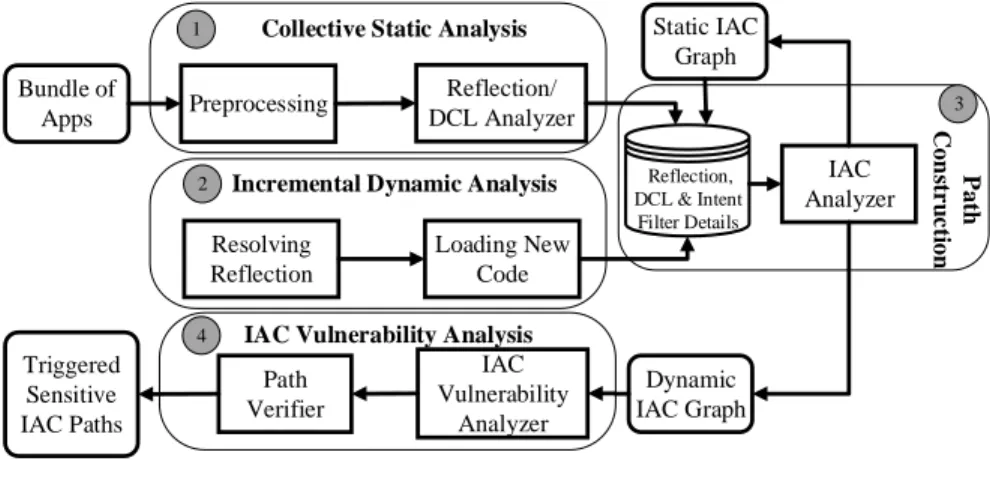
This section presents DINA, a hybrid analysis tool for identifying sensitive IAC paths that concealed through DCL and reflection. Fig. 3.3 illustrates DINA’s
architecture. DINA is agraph-centered hybrid analysis system that consists of three main modules: 1) thecollective static analysismodule that simultaneously analyzes
multiple apps to automatically elicit DCL and reflection call sites within the apps. The identified DCL and reflection call sites become the execution targets for dynamic analysis;2) the incremental dynamic analysismodule that systematically
capturing new nodes and edges that are loaded at runtime by DCL and reflection;
3) thepath constructionmodule that generates the dynamic IAC graph that includes
all potential paths among the apps in the bundle. Specifically, it first generates the static IAC graph, and then augments the static IAC graphs after receiving the incremental updates;4) the IAC vulnerability analysismodule utilizes real-time IAC
graphs to identify potentially vulnerable paths.
3
.
4
.
1
Collective Static Analysis
The collective static analysis of DINA aims to statically identify the reflection, DCL and IAC capabilities of each app in the app bundle, by analyzing multiple apps at the same time. We generate two different types of graphs for each app, the
Preprocessing Resolving Reflection Bundle of Apps Reflection/ DCL Analyzer 1 IAC Vulnerability Analyzer
Collective Static Analysis
2
4
Incremental Dynamic Analysis
IAC Vulnerability Analysis
Triggered Sensitive IAC Paths Loading New Code IAC Analyzer Reflection, DCL & Intent Filter Details Dynamic IAC Graph P ath C on str u c ti on 3 Static IAC Graph Path Verifier
Figure3.3: Architecture of DINA
method call graph (MCG) and instruction graph(IG). The MCG maintains the call relationships among the methods defined within the analyzed apps in the bundle, while the IG includes detailed control-flow and data-flow information for a certain method. DINA works on the bytecode level of the target application, and the analysis focuses on the app’s Dalvik bytecode.
Algorithm 1 outlines the collective static analysis process, which consists of
two major steps:
Preprocessing. We first decompile APKs in the collective app bundle to generate the bytecode of each app and extract its manifest file. Intent filter information for each app is then extracted from the manifest file. This step also involves the generation of MCG for each app and the IG for each method in the MCG. All extracted information and the generated graphs are stored in a database for fast access.
Reflection/DCL analyzer. We then identify DCL and reflective calls using the MCG of each app by detecting DCL and reflection APIs, such as invoke(),
newInstance(), and getMethod(). The list of reflection and DCL APIs (i.e.,
which mainly includes APIs of dynamic class loading. We extend that list to include additional reflection APIs involving method invocations [25]. As a
re-sult, this step identifies the apps that need to be executed in the incremental dynamic analysis module. We further extract the class and method names (call sites) implementing these APIs.
Finally, all the extracted information that is stored in the database will be leveraged for generating a Static IAC Graph, which contains all the potentially sensitive paths that have been constructed through thePath Constructioncomponent (see Section3.4.3).
Algorithm 1Collective Static Analysis
INPUT:Bundle of Apps: B,Re f_DCL_API_List
OUTPUT:static_I AC,Intent_Filter_Appi,Re f_Details
// Preprocessing
1: static_I AC←CreateNodes(|B|)
2: Intent_Filter_App
i←{} // initialize Intent filter list
3: for eachApp
i∈Bdo 4: Decompile(App i) 5: parse_manifest(App i) 6: update(Intent_Filter_App
i)←{(Appi, class-name, intent-action-string)}
7: end for
8: for eachAppi∈Bdo 9: GenerateMCG(Appi)
// Reflection analyzer
10: for eachmethod∈MCG(Appi)do
11: ifmethodj∈Re f_DCL_API_Listthen
12: update(Re f_Details)←{(App
i, class-name, method-name)}
13: end if
14: GenerateIG(method
j)
// Generating Static IAC Graph
15: static_I AC←IAC_Analyzer(IG(methodj),Appi) 16: end for
17: end for
3
.
4
.
2
Incremental Dynamic Analysis
DINA performs incremental dynamic analysis for each app that contains reflective or DCL calls. The dynamic analysis is capable of capturing and loading code in various formats (i.e. APK, ZIP, JAR, DEX), resolving reflection, and performing
IAC analysis incrementally with progressive augmentation of graphs. We modified Android framework for resolving reflective calls and capturing newly loaded codes at runtime. The incremental dynamic analysis consists of two major steps as described below (see Algorithm2).
Resolving reflection and loading new codes. Every app implementing reflection and DCL will be executed on a real Android device or an emulator. This step aims to capture the dynamic behaviors of the app. To reach the components that implement reflection, we use the reflection details extracted and stored in the database, which includes the component name and the corresponding method name that implement reflection and DCL in each app. These methods/components of an app, regarded as method of interest (MoI), will be exercised in the dynamic analysis for resolving reflection and DCL call sites, which will augment the control-flow and data-control-flow graphs dynamically.
We utilize a fuzzing approach to trigger the components that contain reflection and DCL call sites. In the end, the static IAC graph will be refined by the IAC analyzer to include all the IAC detected inside the dynamically loaded codes after resolving reflection. New edges pertaining to the identified IAC are added to the graph at runtime.
3
.
4
.
3
Path Construction
This component is used to generate the Static IAC Graph after performing the collective static analysis, and it is also used to generate the Dynamic IAC Graph by augmenting the Static IAC Graph after adding dynamic information that is extracted through theIncremental Dynamic Analysis. Specifically, the IAC analyzer
Algorithm 2Incremental Dynamic Analysis
INPUT:static_I AC,Re f_Details,Intent_Filter_Appi
OUTPUT:dynamic_I AC
1: dynamic_I AC←static_I AC
// Resolving Reflection and Loading new code
2: for eachAppido 3: Install(Appi) 4: Launch(Appi)
5: Pull newly loaded code
6: for eachComponent∈Re f_Details(Appi)do 7: Find method of interest (MoI)
8: for eachMethod∈MoI(App
i)do
9: Execute the component using Monkey (if failed, execute the whole app using Monkey), and
incre-mentally generateIG(methodj)
// Generating Dynamic IAC Graph
10: dynamic_I AC←IAC_Analyzer(IG(method j),Appi) 11: end for 12: end for 13: uninstall(Appi) 14: end for
updates theStatic IAC Graphby attaching new nodes and edges that are loaded at runtime by DCL and reflection.
Algorithm 3describes the operations performed by the IAC analyzerfor
con-structing the potential paths among the apps in the bundle. The IAC analyzer first identifies explicit Intent APIs (i.e. setClassName, setComponent) by iterating over the nodes in the IG. The IAC analyzer then extracts the name of the receiver component, finds the details of the receiver component in the Intent filter list, and finally creates an edge between the sender and receiver components in the IAC graph. Otherwise, if the node containssetAction, it indicates IAC uses an implicit Intent. Therefore, the IAC analyzer extracts the Intent action string and then finds potential recipient components in the Intent filter list.
The component name (Algorithm3, line3) and Intent action string (Algorithm3,
line 8) are extracted using data-flow analysis based on the IGs. Note that the
Algorithm 3Path Construction
INPUT:IG(methodj),Appi,Intent_Filter, Explicit_APIs
OUTPUT:I AC_Graph // Identify Intent Type
1: for eachnode∈IG(method
j)do
// Explicit Intent
2: ifmethodName∈Explicit_APIsthen
3: componentName = extractCompName(node)
4: ifcomponentName ==Intent_Filter_Appr.componentthen
5: I AC_graph←addEdge(Appi,Appr)
6: end if
// Implicit Intent
7: else ifmethodName==setActionthen 8: stringAction == extractStrAction(node)
9: ifstringAction∈Intent_Filter_Appr.intent-action-stringthen
10: I AC_graph←addEdge(App
i, Appr)
11: end if 12: end if 13: end for
3
.
4
.
4
IAC Vulnerability Analysis
Algorithm 4depicts the process of IAC vulnerability analysis, which consists of
two components including: 1) IAC vulnerability analyzer that marks sensitive
paths in the dynamic IAC graph, and 2) path verifier that automates the path
triggering process by installing the apps involved in the identified sensitive paths and then triggering the corresponding APIs.
IAC vulnerability analyzer identifies whether the nodes in the dynamic IAC graph constitute a vulnerable path that reveals sensitive information. IAC vulnera-bility analyzer performs its analysis over all identified IAC paths in the dynamic IAC graph. Then for each path, every node is analyzed, by identifying whether it is a sender or receiver node, and then depth-first search (DFS) is conducted to find if this node can reach a sensitive source method in case of sender node, or can reach a sensitive sink in case the node is receiver. We leverage a sensitive API list that simplifies the widely used SuSi list [122] to identify these sensitive APIs.
An inverted DFS searches from the recorded MoI (identified in Algorithm 2) to
at the receiver (line12in Algorithm4) to look for sensitive sinks. Finally, it marks
the complete sensitive paths from the sensitive source to the sensitive sink across multiple apps. Fig.3.4represents a typical sensitive path that links sensitive source
API to a sensitive sink through IAC after resolving the reflection/DCL calls. Note that these paths are stealthy and difficult to find, as they only appear after loading dynamic codes and resolving reflection calls, but they can be captured by DINA efficiently.
Path verifiertries to automatically trigger the sensitive paths in the dynamic IAC graph. A sensitive path contains a sensitive source and a sensitive sink node (cf. Fig. 3.4, Algorithm 4, line 28). After identifying the sensitive path, the pather
verifier checks the type of reflection/DCL call site class. If the type is an activity, the sender and receiver apps will be installed on our tablet device. We use adb utility to execute the activity component and record the generated log usinglogcat utility. Finally, the path will be considered as a triggered path if the log contains the exercised activity, the Intent string action, and the name of the receiver app.
Sensitive Source Reflection/DCL Calls Intent Sending Method Intent Receiving Component Sensitive Sink invoke
Sender App Receiver App
IAC
Figure3.4: A simplified sensitive path example: the dashed method and paths can
Algorithm 4IAC Vulnerability Analysis
INPUT:dynamic_I AC,Sensitive_API_List
OUTPUT:nodei.sensitive, triggeredSensitiveIAC_list
//1) IAC vulnerability Analyzer
1: for eachnode ofAppm∈dynamic_I ACdo
//1.1) Identify sensitive methods in the sender node
2: ifnodeiis senderthen
3: for eachmethod∈DFS(nodei.method-name)do
4: ifmethodj∈Sensitive_API_Listthen
5: nodei.sensitive= True 6: else
7: nodei.sensitive= False 8: end if
9: end for
//1.2) Identify sensitive methods in the receiver node
10: else ifnode
iis receiverthen
11: for eachmethod∈MG(Appm)do<