Vom Fachbereich Informatik der Technischen Universit¨at Kaiserslautern zur Verleihung des akademischen Grades Doktor der Naturwissenschaften (Dr. rer. nat.) genehmigte Dissertation. Datum der wissenschaftlichen Aussprache: 02.05.2012
Information Extraction
on the Semantic Web
Utilizing the Resource Description Framework in Information Extraction
Benjamin Adrian
June 17, 2012
Promotionskommittee:
Prof. Dr. Andreas Dengel, Technische Universit¨at Kaiserslautern, Erstgutachter
Prof. Dr. Philipp Cimiano, Universit¨at Bielefeld, Zweitgutachter
Prof. Dr. Arnd Poetzsch-Heffter, Technische Universit¨at Kaiserslautern, Vorsitzender, Dekan
In January 11, 2012, this document was submitted as doctoral thesis to the Department of Computer Science, University of Kaiserslautern. In May 02, 2012, this dissertation was defended successfully by Benjamin Adrian.
This document was set in Times New Roman by the author using KOMA - Script and LATEX. c Benjamin Adrian Hauptstr. 42, D-67731 Otterbach, Germany [email protected]
Acknowledgments
Although by nature a doctoral thesis has to be performed by the author on his own, he would never bring it to success without the help of others.
Fortunately, while investigating on “Information Extraction on the Semantic Web” I had the opportunity to collaborate with a number of outstanding and supporting colleagues and researchers.
First, I want to thank my adviser Andreas Dengel. Since the beginning of my research, he confirmed me the importance of the topic of this work and encouraged me to proceed. Andreas made it possible for me to discuss and present emerging research objectives and results at international conferences. This comprised the doctoral consortium at the International Semantic Web Conference 2009 in Washington DC. There, I had the chance to meet Tim-Berners Lee, James Hendler, Ivan Herman, and all the other folks of the Semantic Web community. Andreas also enabled me contributing to two working groups of the World Wide Consortium, namely the RDFa WG and the RDF Web application WG. These activities helped a lot in understanding the research gap between Information Extraction and the Semantic Web. Especially in the beginning of my research, my close collaboration with Andreas laid the foundation of my career as researcher.
I would like to say a big thank you to Marcus Liwicki. Writing my thesis, Marcus supported me with excellent remarks and hints on structuring and editing this document. His thoroughness in willingness for understanding every bit of this work was a real support for me.
I want to thank my office mate J¨orn Hees for his patience. J¨orn always had the time for brainstorming and discussing topics and problems. He also has the talent to ask the right questions at the right time.
I like to thank Thomas Roth-Berghofer for his excellent advises. During my work time at DFKI, Thomas has become a very good friend of mine.
I had the chance to work with excellent students on topics of this thesis, namely Sebas-tian Ebert and SebasSebas-tian Sperber. Collaborating with them was always very inspiring.
In general, thank you Knowledge Management Group at DFKI. It was great fun working with you for the last five years.
Last but definitely not least, I am deeply grateful to my wife Denise, my children Emma and Max, and my family. They were a great support in recent years. Without them it would not have been possible to finishing this doctoral thesis successfully.
Abstract
Dealing with information in modern times involves users to cope with hundreds of thou-sands of documents, such as articles, emails, Web pages, or News feeds. Above all information sources, the World Wide Web presents information seekers with great chal-lenges. It offers more text in natural language than one is capable to read.
The key idea for this research intends to provide users with adaptable filtering tech-niques, supporting them in filtering out the specific information items they need. Its realization focuses on developing an Information Extraction system, which adapts to a domain of concern, by interpreting the contained formalized knowledge.
Utilizing the Resource Description Framework (RDF), which is the Semantic Web’s formal language for exchanging information, allows extending information extractors to incorporate the given domain knowledge. Because of this, formal information items from the RDF source can be recognized in the text. The application of RDF allows a further investigation of operations on recognized information items, such as disambiguating and rating the relevance of these. Switching between different RDF sources allows changing the application scope of the Information Extraction system from one domain of concern to another. An RDF-based Information Extraction system can be triggered to extract specific kinds of information entities by providing it with formal RDF queries in terms of the SPARQL query language. Representing extracted information in RDF extends the coverage of the Semantic Web’s information degree and provides a formal view on a text from the perspective of the RDF source.
In detail, this work presents the extension of existing Information Extraction ap-proaches by incorporating the graph-based nature of RDF. Hereby, the pre-processing of RDF sources allows extracting statistical information models dedicated to support specific information extractors. These information extractors refine standard extraction tasks, such as the Named Entity Recognition, by using the information provided by the pre-processed models. The post-processing of extracted information items enables rep-resenting these results in RDF format or lists, which can now be ranked or filtered by relevance. Post-processing also comprises the enrichment of originating natural language text sources with extracted information items by using annotations in RDFa format.
The results of this research extend the state-of-the-art of the Semantic Web. This work contributes approaches for computing customizable and adaptable RDF views on the natural language content of Web pages. Finally, due to the formal nature of RDF, machines can interpret these views allowing developers to process the contained infor-mation in a variety of applications.
About the author
Personal Data
Benjamin Adrian
Education
2006 German Diplom in Computer Science 2001 - 2006 Studied Applied Computer Science at University of Kaiserslautern, Germany 1991 - 2000 Helmholtz-Gymnasium,
66482 Zweibr¨ucken, Germany
Experience
2006 - 2011 Researcher, German Research Center for Artificial Intelligence (DFKI GmbH), Kaiserslautern, Germany
2010 - 2011 Member of the RDFa Working Group, World Wide Web Consortium (W3C) 2005 - 2006 Undergraduate research assistant,
German Research Center for Artificial Intelligence (DFKI GmbH), Kaiserslautern, Germany
2005 6 month internship at SAP, St. Ingbert, Germany 2004 - 2005 Undergraduate research assistant,
University of Kaiserslautern,
Dept. Database and Information Systems, Kaiserslautern, Germany
2001 - 2003 Undergraduate student assistant,
Business and Innovation Center (BIC GmbH), Kaiserslautern, Germany
List of Abbreviations
AI Artificial Intelligence CBD Concise Bound Description
ConLL Conference on Computational Natural Language Learning CRF Conditional Random Field
EBNF Extended Bachus-Naur-Form FSM Finite-state Machine
FOAF Friend of a Friend
HTML Hypertext Markup Language HTTP Hypertext Transfer Protocol IE Information Extraction IR Information Retrieval LOD Linking Open Data
MUC Message Understanding Conference NER Named Entity Recognition
NLP Natural Language Processing
OBIE Ontology-based Information Extraction OWL Web Ontology Language
PCA Principle Component Analysis POS Part-of-speech
RDFa RDF in Attributes
RDF Resource Description Framework RDFS RDF Vocabulary Description Language
SCOOBIE Service Ontology-based Information Extraction SGML Standard Generalized Markup Language SPARQL SPARQL Query Language
SQL Structured Query Language URI Uniform Resource Identifier URL Unique Resource Locator W3C World Wide Web Consortium WWW World Wide Web
XHTML Extensible Hypertext Markup Language XML Extensible Markup Language
Contents
1 Introduction 21 1.1 Motivation . . . 22 1.2 Hypotheses . . . 23 1.3 Contributions . . . 24 1.4 Prerequisites . . . 25 1.5 Terminology . . . 26 1.6 Outline . . . 272 Computation on natural language 29 2.1 Processing natural language . . . 30
2.1.1 Syntactics . . . 31 2.1.2 Semantics . . . 32 2.1.3 Pragmatics . . . 33 2.2 Information Extraction . . . 33 2.2.1 Historic outline . . . 35 2.2.2 State-of-the-Art . . . 38
2.3 Unsolved and emerging challenges . . . 48
2.4 Contributions . . . 50
3 Representing knowledge on the Web 51 3.1 Computing with semantics in the Semantic Web . . . 52
3.2 Resource Description Framework . . . 53
3.3 Representing instance knowledge . . . 55
3.4 Representing properties . . . 56
3.5 Representing classes . . . 57
3.6 Representing multiple RDF graphs . . . 58
3.7 Vocabularies . . . 58
3.8 Querying with SPARQL . . . 59
3.9 Utilizing RDF from the Web . . . 61
3.10 Unsolved and emerging challenges . . . 62
3.11 Contributions . . . 63
4 Ontology-based Information Extraction 65 4.1 Ontologies in Information Extraction . . . 66
Contents
4.2 Ontology-based Information Extraction Systems . . . 69
4.3 Extraction ontologies . . . 70
4.4 Unsolved and emerging challenges . . . 72
4.5 Contributions . . . 72
5 Foundations for utilizing RDF in Information Extraction 75 5.1 Linking URIs and textual references . . . 76
5.2 RDF components . . . 77 5.2.1 Literals . . . 77 5.2.2 Datatype properties . . . 77 5.2.3 Types . . . 79 5.2.4 Instances . . . 80 5.2.5 Object properties . . . 81
5.3 Semantic entity recognition process . . . 81
5.4 Required technological fundamentals . . . 85
5.4.1 Suffix arrays . . . 85
5.4.2 Matrix computations . . . 86
5.4.3 Hierarchical clustering . . . 87
5.4.4 Descriptive statistics . . . 88
5.4.5 Principle component analysis . . . 90
5.4.6 Link analysis in graphs . . . 91
5.4.7 Maximum entropy models . . . 93
5.4.8 Conditional Random Field . . . 94
5.5 Summary and Conclusion . . . 95
5.5.1 Summary . . . 95
5.5.2 Conclusion . . . 96
6 Preprocessing feature descriptions from text and RDF graphs 97 6.1 Features in Information Extraction . . . 98
6.2 A relational model of RDF data . . . 99
6.3 Clustering correlating classes in RDF graphs . . . 102
6.3.1 Hierarchical clustering . . . 105
6.3.2 Principle Component Analysis . . . 108
6.4 RDF graph statistics . . . 109
6.4.1 Usage statistics of datatype properties . . . 109
6.4.2 Estimating cardinalities . . . 111
6.4.3 Estimating characteristic relations between classes . . . 113
6.5 Text corpus statistics . . . 114
6.5.1 Term and document frequencies . . . 114
6.5.2 Combining text corpus with RDF graph statistics . . . 115
Contents
6.7 Aligning datatype properties with regular expressions . . . 117
6.8 Automatically labeling a text corpus with classes . . . 118
6.9 Experiments and evaluations . . . 118
6.9.1 Datasets . . . 118
6.9.2 Clustering classes in DBpedia . . . 120
6.9.3 Proper name mining in DBpedia . . . 125
6.9.4 Learning a Markov chain from DBpedia . . . 128
6.9.5 Matching regular expressions with DBpedia literals . . . 129
6.9.6 Labeling the ConLL 2003 Corpus . . . 131
6.10 Summary and conclusion . . . 131
6.10.1 Summary . . . 131
6.10.2 Conclusion . . . 132
7 Processing the Semantic Entity Recognition 133 7.1 Information Extractors . . . 134
7.2 Filtering text for proper names . . . 135
7.3 Spotting text for datatype property values . . . 137
7.4 Linking named entities to formal instances . . . 140
7.5 Resolving ambiguous semantic entities . . . 142
7.6 Rating relevance of semantic entities in text . . . 146
7.7 Classifying semantic entities . . . 149
7.8 Predicting object properties between semantic entities . . . 150
7.9 Experiments . . . 155
7.9.1 Test Corpora . . . 156
7.9.2 Evaluation metrics . . . 157
7.9.3 Accelerating the recognition of semantic entities . . . 159
7.9.4 Naive recognition of semantic entities . . . 162
7.9.5 Filtering entity recognition by datatype properties . . . 163
7.9.6 Graph-based disambiguation . . . 166
7.9.7 Entity classification on automatically generated training data . . . 168
7.9.8 Classification-based disambiguation . . . 179
7.9.9 Ranking extraction results by relevance . . . 180
7.9.10 Predicting object properties . . . 185
7.10 Summary and Conclusion . . . 186
7.10.1 Summary . . . 186
7.10.2 Conclusion . . . 188
8 Incorporating SPARQL and RDF serializations into Information Extraction 189 8.1 Post-processing IE results . . . 190
8.2 Ranking IE results . . . 191
Contents
8.4 Annotating IE results in Web pages . . . 195
8.5 Filtering IE results by specifying templates in SPARQL . . . 196
8.5.1 Extracting Filtering Statements from SPARQL templates . . . 197
8.5.2 Inferring Filtering Statements from SPARQL templates . . . 198
8.6 Summary and Conclusion . . . 199
8.6.1 Summary . . . 199
8.6.2 Conclusion . . . 200
9 Applications of RDF-based Information Extraction 201 9.1 RDF-based Information Extraction Systems . . . 202
9.1.1 SCOOBIE . . . 202
9.1.2 A comparative view on Semantic Entity Recognition systems . . . 205
9.1.3 Epiphany . . . 206
9.1.4 Sterntaler . . . 208
9.2 Additional applications and experiments . . . 209
9.2.1 Labeling a digital document image . . . 209
9.2.2 Semantic Desktop . . . 210
9.2.3 Explanations . . . 211
9.2.4 Textual case-based reasoning . . . 212
9.3 Summary and Conclusion . . . 212
9.3.1 Semantic content enrichment . . . 212
9.3.2 Position . . . 214
9.3.3 Conclusion . . . 215
10 Concluding Information Extraction on the Semantic Web 217 10.1 Summary . . . 218 10.2 Discussion . . . 218 10.3 Lessons-learned . . . 219 10.4 Conclusion . . . 220 10.5 Future Work . . . 221 10.5.1 Short-term investigations . . . 221 10.5.2 Long-term investigations . . . 223 10.6 Acknowledgments . . . 224 Bibliography 225
List of Figures
1.1 Degrees of formalism. . . 23
2.1 Two parse tree alternatives. . . 32
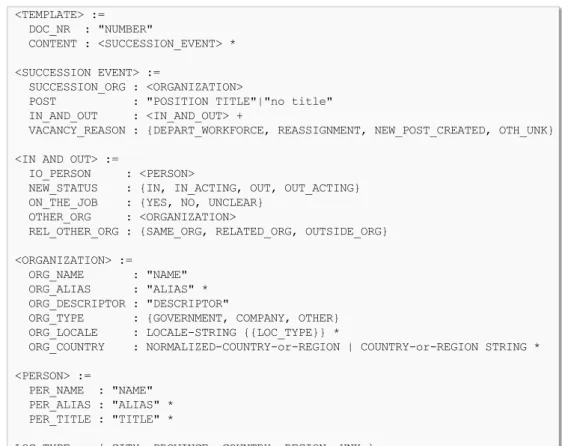
2.2 Information Extraction template. . . 36
2.3 A simple extract of a finite-state machine. . . 39
2.4 General architecture of IE systems. . . 40
2.5 Components used for recognizing entities in text. . . 42
2.6 Feature types used for representing named entities. . . 44
3.1 The Semantic Web layer cake (W3C, 2007). . . 52
3.2 RDF graph in TURTLE syntax. . . 54
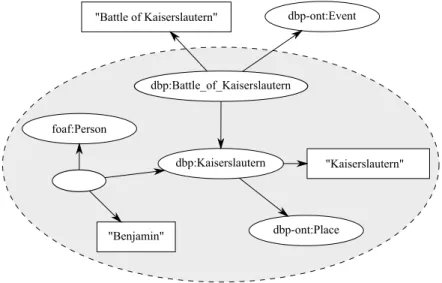
3.3 Graph visualization of RDF data about the “Battle of Kaiserslautern”. . . 54
3.4 Symmetric Concise Bound Description of dbp:Kaiserslautern. . . 55
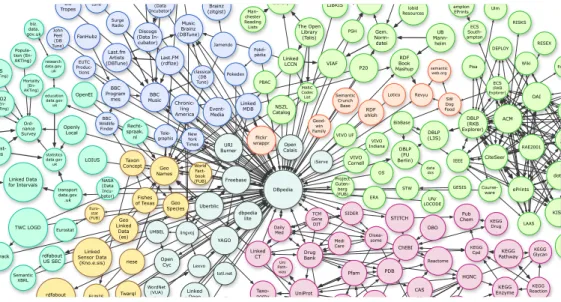
3.5 LOD cloud diagram. . . 61
3.6 Extended Semantic Web layer cake . . . 63
4.1 Ontology learning stack, by Cimiano [2006]. . . 67
4.2 The OBIE system, byWimalasuriya and Dou [2010]. . . 68
4.3 Extraction ontology. . . 71
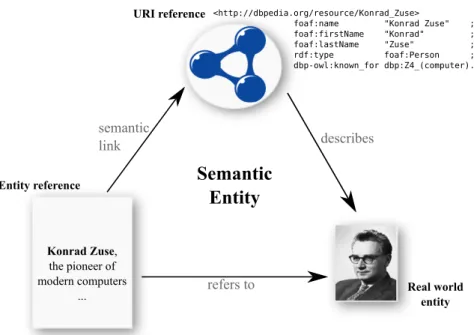
5.1 Triadic co-relation between entity references and URI references. . . 76
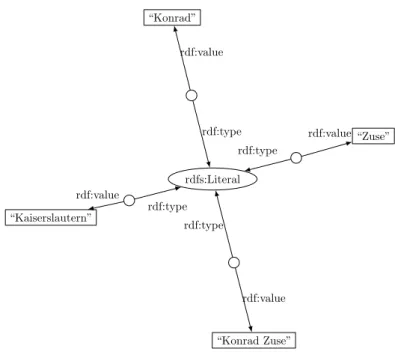
5.2 Markup text segments as formal literal values of an RDF graph. . . 78
5.3 Assign RDF datatype properties to recognized entities. . . 79
5.4 Disambiguating word senses by explicitrdf:type statements. . . 80
5.5 Semantic link between a named entity and a URI reference. . . 81
5.6 RDF resources are interlinked with object properties. . . 82
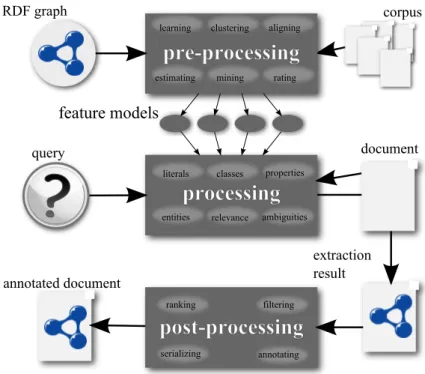
5.7 RDF-based Information Extraction architecture. . . 83
5.8 Correlation values between variables in a 2-dimensional space. . . 90
6.1 Model creation by pre-processing RDF and corpus data. . . 98
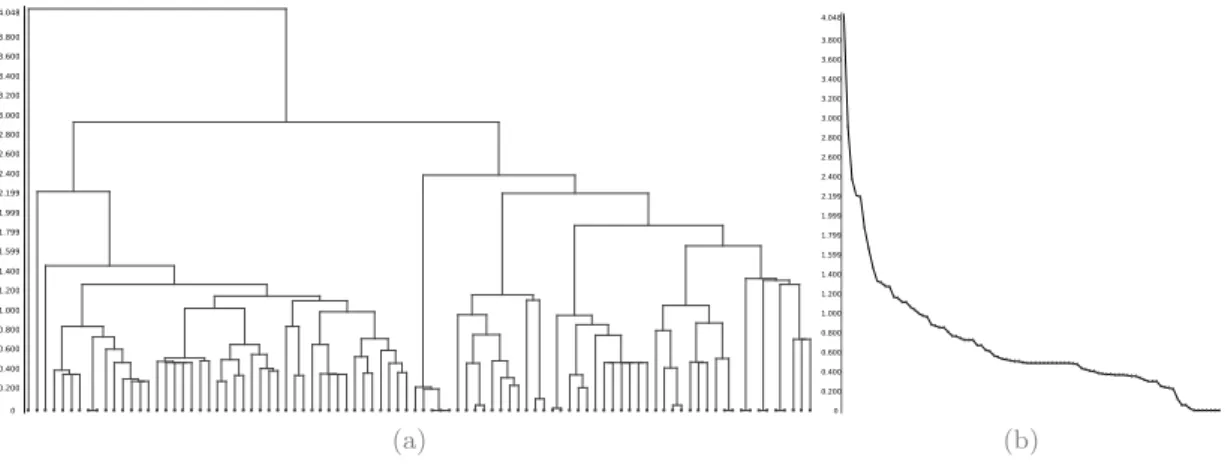
6.2 Dendrogram. . . 106
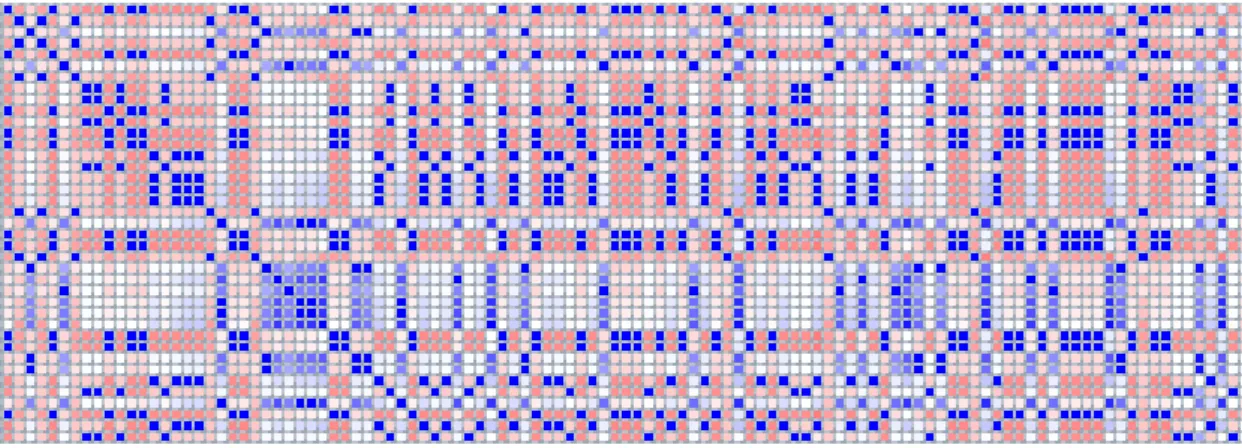
6.3 Colored extract of a correlation matrix. . . 120
6.4 Taxonomic precision ratios of PCA and hierarchical clusterings. . . 122
List of Figures
6.6 Hierarchical clustering based generated clustering of DBpedia classes. . . 124
6.7 Histograms of proper name ratings. . . 126
6.8 Markov chains on object properties. . . 127
7.1 Processing steps. . . 134
7.2 Filtering plain text for noun phrases. . . 136
7.3 Like dictionaries in linguistics, datatype properties subsume literal values. 137 7.4 Algorithm for matching text with datatype property values. . . 138
7.5 Linking named entities in text to instances in RDF graphs. . . 141
7.6 Relations between recognized instances indicate resolutions to ambiguities. 143 7.7 Some recognized semantic entities are more relevant than others. . . 147
7.8 Instance/predicate-object matrix of triples in Example 7.10. . . 152
7.9 Similarity values for matrix in Figure 7.8. . . 153
7.10 Predicted values for matrix in Figure 7.8. . . 154
7.11 Sets of relevant and recognized instances. . . 158
7.12 Histogram of length of literals in DBpedia. . . 160
7.13 Count of query results in terms of prefix lengths. . . 161
7.14 Processing times needed for querying and comparing literals. . . 163
7.15 Histograms of ambiguity ratios of datatype properties. . . 164
7.16 Histograms of ambiguity ratios of datatype properties. . . 165
7.17 Accuracy of classification results on ConLL2003 test data. . . 170
7.18 Accuracy of classification results in a 10-fold cross validation. . . 171
7.19 Comparison of window lengths andn-gram conjunctions. . . 172
7.20 Comparison between content and context features. . . 173
7.21 Learning curves of maximum entropy models. . . 173
7.22 Impact of known semantic entities on context features. . . 174
7.23 Correlation between threshold and classification accuracies. . . 175
7.24 Pascal ontology of workshops and conferences. . . 176
7.25 Classifier’s accuracies of predicted properties (a) and types (b). . . 177
7.26 Correlation between threshold and classification accuracies. . . 178
7.27 Precision ratios of an ideal type classifier on ambiguous entities. . . 179
7.28 Ranking correlations between the five test corpora. . . 182
7.29 Correlation heat maps between rankings. . . 184
8.1 The architecture of an RDF based IE system. . . 190
8.2 Cycle between extracting information and annotating formal knowledge. . 191
8.3 A list of recognized instances sorted by relevance. . . 192
9.1 Extended Semantic Web layer cake. . . 202
9.2 The Epiphany RDFa annotator. . . 207
List of Figures 9.4 Rendering recognized semantic entities on top of a document image. . . . 209 9.5 The Nepomuk DropBox. . . 210 9.6 Explanations on IE results. . . 211
List of Tables
6.1 Correlation matrix about ambiguity, coverage, and idf. . . 126
6.2 Proper name ratings for common classes in DBpedia. . . 128
6.3 Outgoing transitions by object properties of dbp-ont:Building. . . 129
7.1 Comparison of frequencies between noun phrases and other words in text. 160 7.2 Response times of string or integer based hash values. . . 162
7.3 Recognized rates of longest match and all matches strategies. . . 162
7.4 Instance recognition results. . . 163
7.5 Rankings of the top three datatype properties. . . 166
7.6 Comparison of graph-based disambiguation algorithms. . . 167
7.7 DBpedia classes corresponding with ConLL2003 labels. . . 168
7.8 Coverage of datatype properties used classes of the DBpedia. . . 169
7.9 Pearson correlation coefficient matrix. . . 169
7.10 Confusion matrices listing two types of context features. . . 175
7.11 Mean average precision ratios of ranking metrics on each corpus. . . 181
7.12 Best rankings from all kinds of combinations of metrics. . . 183
7.13 Leave one out evaluation results of fact predictors. . . 185
1 Introduction
It’s Not Information Overload. It’s Filter Failure.
(Clay Shirky, 2008)
Google’s software engineers Alpert and Hajaj [2008] stated that in 2008, their systems hit a milestone of handling one trillion (as in 1 000 000 000 000) Unique Resource Loca-tors (URLs) on the Web at once. With respect to this incredi-ble amount of published information, an information overload resulting in disorientation and lack of responsiveness may be assumed at worst. The answer of Shirky [2008], a US writer and consultant, to the social and economic effects of mas-sive information on Web technologies is very clear: “It’s Not Information Overload. It’s Filter Failure”. He states that efficient information management bases on efficient filtering techniques. Unfortunately, these information-filtering tech-niques are still immature. In this work, we are following Clay Shirky’s general assumption that information indepen-dent from its amount is a blessing. It investigates the appli-cation of knowledge representation techniques from the Web to creating semantic filters that will prevent users from being overloaded with information.
This chapter outlines the motivation, the hypotheses, and the main contributions of this work. In Section 1.1, Web tech-nologies are motivated for developing efficient information fil-tering and extraction facilities. Section 1.2 addresses the re-search objective by claiming three rere-search hypotheses. Main contributions to the Semantic Web and Information Extrac-tion are given in SecExtrac-tion 1.3. SecExtrac-tion 1.4 lists necessary back-ground to understand the scope of this work. Editorial con-ventions and the used terminology is outlined in Section 1.5. Finally, Section 1.6 summarizes the structure of this work.
1 Introduction
1.1 Motivation
In 1990, Tim Berners-Lee encouraged users to publish and distribute information on a world embracing software system called the World Wide Web (WWW). The Web is spanned between distributed, independent Web servers running at sites all over the world. On such a Web server, we can deploy any kind of resource, from text documents, videos, audios, to files. To address a published resource on the Web, a Uniform Resource Identifier (URI) has to be assigned. All threads in the World Wide Web base on such URIs. They are implemented as hyperlinks that associate an originating Web resource with a target resource by referring to its URI. The Hypertext Transfer Protocol (HTTP) allows requesting URIs from within a Web browser on a client machine, which results in a transfer of information from the Web server to the browser.
By nature, the WWW is a web of documents. Its design focuses on the use of hypertext [Jacobs and Walsh, 2004]. When querying a standard Web search engine, the common stereotype of a returned Web resource is most likely a Web page whose structure and layout is specified in Hypertext Markup Language (HTML). However, the use cases behind HTML did not cover computers interpreting the information in published Web content.
Hence, it is not overstating to say that, initially, the design of the Web was intended to serve human needs. In consequence, even people without background in computer science are part of the Web community when maintaining homepages, sharing thoughts on blogs, or editing open encyclopedias in Wiki systems. Nevertheless, the incredible number of billions of published Web resources may confuse users. Because the WWW as such requires the use of computers for consuming information on the Web, the following question should be raised:
Why do computers provide users with so little assistance on consuming in-formation on the Web?
Berners-Lee et al. [2001] published the idea of the Semantic Web, which extends the WWW by a formal and therefore machine interpretable layer. Here, computers can be told about the information content of a Web resource by describing it formally in the Resource Description Framework (RDF) [Manola et al., 2004]. Web pages of world’s largest information providers such as the New York Times, the British Broadcasting Corporation, the White House, the German National Library, and Wikipedia show the great success when adding RDF data as machine-interpretable hints to published infor-mation. Actually, by using RDF in Attributes (RDFa) markup it is possible to embed RDF data directly within a Web page’s HTML model [Adida et al.,2011].
Figure 1.1 presents the formal value of information on the Web along two axes that represent degrees of underlying syntax and semantics in formalisms. Basic operations on information, such as structured questions or reasoning, require formally represented
1.2 Hypotheses
information as provided by knowledge representation languages, such as RDF, the RDF Vocabulary Description Language (RDFS), and the Web Ontology Language (OWL).
syntactical structuring of content
for m al sem ant ic s i n st ruct ur e plain text OWL RDF RDF Schema Relational Algebra HTML XML Microdata/ Microformats RDFa
unstructured well structured
well f or m ali ze d weakl y f or m ali ze d form al r easo ning stru ctur ed quer ies term sta tist ics
Figure 1.1: Increasing the degree of formalism in specifying syntax and semantics of information results in an increase of the value and the usability of
information.
In fact, Web content management systems, such as Drupal or Wordpress support the creation of RDF and RDFa data along publishing processes in Web pages. Nevertheless, most Web pages do not contain any structured information, yet. Still, plain text is of major use in news, education, entertainment, or science. Even those Web pages that do contain RDF data will most likely contain passages of plain text without any machine-interpretable hints. Hence, the following question remains:
Who creates RDF(a) data for existing and unstructured Web content and text, respectively?
1.2 Hypotheses
In Computational Linguistics, the algorithmic process of extracting structured informa-tion from unstructured text is referred to as Informainforma-tion Extracinforma-tion (IE). This work
1 Introduction
investigates methods that extend the state-of-the-art in IE by integrating formally rep-resented Semantic Web data into the architecture, the interfaces, and the information extractors of IE systems. This raises the following three research hypotheses:
The utilization of RDF in IE approaches . . .
H.1 . . . enhances the IE process: Providing Information Extraction (IE)-systems with formal Semantic Web data in RDF enables the investigation of enhanced IE-algorithms that add new opportunities to implementing IE tasks, such as the recognition of entities, the disambiguation of word senses, and the extraction of relations.
H.2 . . . facilitates design of IE-interfaces: In IE, templates specify and represent structure and content of information items, which should be extracted from the natural language text. Formal data of the Semantic Web comprises the use of vo-cabularies to specify the tokens of a certain domain in terms of classes, properties, and relationships of and between individual information items. The incorpora-tion of such vocabularies for defining an informaincorpora-tion demand on RDF sources in the SPARQL Query Language (SPARQL) facilitates the specification of IE tem-plates. Providing the formal nature of extracted information in RDF facilitates the utilization of extracted results by subsequent applications.
H.3 . . . involves domain adaptability: Traditional IE- systems suffer from being specialized on single IE templates and domains of concern. The utilization of RDF-represented information as well as the RDF-represented IE results facilitates the domain independent usage of IE systems. The incorporation of exchangeable formal information involves an increasing flexibility in adapting IE-systems to a new domain of concern.
Each of these research hypotheses are referred to especially from Chapter 5 to 8 covering the main research objectives.
1.3 Contributions
The research activities performed in this work result in the following main contributions. They refer to each of the upper defined research hypotheses.
C.1 Incorporating RDF into IE enables information extractors to utilize additional background knowledge. This work contributes insights on how to pre-process raw RDF data by combining statistical graph and corpus analyzes to compile statistical models that cover single aspects of knowledge patterns. Please refer to Chapters 5 and 6 for more information on pre-processing RDF data.
1.4 Prerequisites C.2 Incorporating RDF into IE involves the extension of the traditional Named En-tity Recognition (NER). This results in the specification of the Semantic EnEn-tity Recognition process, which extends the traditional recognition of named entities with the consumption of formal knowledge provided by RDF graphs. Chapters 5 and 7 provide foundations and detailed information on extracting semantic entities from text.
C.3 By utilizing terms from the formal vocabularies, which are used in RDF data sets, SPARQL queries are applied for specifying IE templates that describe which types of information the IE-system should extract from text. Chapter 8 explains the application of SPARQL to IE.
C.4 In order to deploy the application of RDF-enhanced Information Extraction (IE) into the general architecture of the Semantic Web, this work presents the formal-ization of IE results in RDF. This also comprises the ability to integrate formal extraction results back into originating Web pages by automatically generating a copy of it enriched with RDF in Attributes (RDFa) markup. Chapter 8 provides detailed information on this topic.
C.5 The state-of-the-art of NER depends on the existence of training data, which is expensive to create. This work proposes a method, which uses the knowledge of an RDF graph to automatically label a text corpus. A labeled corpus is used to train entity classifiers in terms of the domain of concern of the underlying RDF graph. This allows a more general adaption of IE systems to specific application domains. Chapter 6 provides detailed information on the automatic creation of training data.
C.6 Due to the Linking Open Data (LOD) community, a large variety of domains have been published in recent years using RDF data. The evaluations of methods and applications that were developed in this work (see Chapters 6, 7, and 8) were conducted on the data of different RDF graphs. This confirms the general value of an application of RDF to Information Extraction (IE) independently of the underlying domain.
1.4 Prerequisites
The reader should be familiar with general Web technologies including the Hypertext Transfer Protocol (HTTP), the Unique Resource Locator (URL), and its generalized form, the Uniform Resource Identifier (URI). Jacobs and Walsh[2004],Berners-Lee and Fischetti [1999] provide a comprise summary of these technologies.
The author recommends referring toJurafsky and Martin[2008] for details on Natural Language Processing (NLP), which is applied in Chapter 2 and Chapter 7.
1 Introduction
A background in Semantic Web technologies like it is summarized by Hitzler et al. [2009] is helpful to understand its application and utilization in Chapters 3, 5, and 8.
The application of statistics and probabilities in Chapters 5 and 6 requires a basic un-derstanding in these fields of mathematics. Here, knowledge about statistics in machine learning is helpful to understand the computation of models. Duda et al. [2001] and Jurafsky and Martin[2008] provide a comprehensive overview on used machine-learning approaches.
1.5 Terminology
Within this document, references to scientific literature are referring to by keys consisting of the authors’ last names and the date of publication. At the end of this document, a literature list provides more citation information about these references. Because some literature is only available online, these references are recorded as standard literature but also consist of a persistent URL. Informative background information related to current topics is referred to by using footnotes.
Within examples and data excerpts of experimental results, RDF graphs are printed in TURTLE syntax Beckett and Berners-Lee [2007]. Here, the following prefixes and namespaces are used to provide a compact illustration:
rdf RDF Vocabularyhttp://www.w3.org/1999/02/22-rdf-syntax-ns#
rdfs RDF Schema Vocabulary http://www.w3.org/2000/01/rdf-schema#
owl Web Ontology Languagehttp://www.w3.org/2002/07/owl#
foaf Friend-of-a-Friend vocabulary http://xmlns.com/foaf/0.1/
dc Dublin core metadata vocabularyhttp://purl.org/dc/elements/1.1/
mo Music Ontology http://purl.org/ontology/mo/
dbp DBpedia’s resources http://dbpedia.org/resource/
dbp-ont DBpedia’s ontology http://dbpedia.org/ontology/
yago YAGO knowledge base, derived from Wikipedia. http://dbpedia.org/class/ yago/
geo A vocabulary for representing latitude, longitude and altitude information. http: //www.w3.org/2003/01/geo/
1.6 Outline
1.6 Outline
The structure of this document is divided into six parts:
Introduction: Chapter 1 motivates further investigations on IE approaches on the
Se-mantic Web. It exposes three research objectives in Section 1.2 and summarizes the resulting contributions of this research in Section 1.3.
State-of-the-Art / Related Work: The next two chapters outline the state-of-the-art
in IE and Semantic Web technologies this work is building upon. Each chapter ex-poses open issues this work contributes to. More specifically, Chapter 2 outlines the history of recurring problems in IE research from the early beginnings until now. Chapter 3 presents knowledge representation techniques of the Semantic Web for exchanging information in RDF. Finally, the foundations are completed by listing related work on Ontology-based Information Extraction (OBIE) in Chapter 4.
Concept: This part covers the general concept for incorporating RDF for enhancing
the implementation of IE tasks. Chapter 5 describes the extension of a named entity with a semantic link associating it with an RDF source. It defines semantic entities and specifies a Semantic Entity Recognition process. Moreover, it outlines formal computation approaches for programming with semantic entities and RDF sources.
Realization: The remainder four chapters describe activities spent on the core research
objectives. Chapters 6 and 7 detail on how RDF supports different kinds of infor-mation extractors. Each chapter is self-contained in terms of approach, relevant related work, experimental evaluation, and final conclusion. Chapter 6 figures out the preprocessing of textual and formal background knowledge to create models that support the development of concrete information extractors. Within the scope of a general Semantic Entity Recognition process, these tasks are introduced and outlined in Chapter 7. Chapter 8 explains the application of RDF and SPARQL in the input and the output interfaces of an IE system. It describes RDF serial-ization of extracted information and outlines the use of SPARQL for filtering the information that has to be extracted from text.
Application: Chapter 9 outlines IE software systems and prototypes, which were
de-veloped based on RDF-based IE. It describes the implemented RDF-based IE system Service Ontology-based Information Extraction (SCOOBIE), the annota-tion of Web pages with IE results in Epiphany and finally a Web search extension called Sterntaler.
Conclusion and Outlook: Chapter 10 summarizes, discusses, and concludes the research
2 Computation on natural language
Language is the fabric of the Web.
(Hans Uszkoreit, What is Computer Linguistics?,
http: // www. coli. uni-saarland. de/ ~ hansu/ what_ is_ cl. html, 2000)
A vast amount of information in the Web is represented in unstructured natural language text. In order to extract from text relevant information for users, this work investigates al-gorithmic approaches processing the natural language in text. In the following chapter, the field of Computational Linguis-tics is introduced. The necessary foundation of a computa-tional processing of natural language is outlined. Information Extraction (IE) as an application of Computational Linguis-tics approaches is described in more details. In the remainder chapters, IE techniques will be extended by incorporating for-mal Semantic Web knowledge.
This chapterintroduces the field of Computational Linguis-tics by focusing on IE tasks that are extended by the research of this work. First, Section 2.1 addresses challenges and vi-sions of Computational Linguistics as a subfield of Artificial Intelligence (AI). Providing a background for the investiga-tions of NLP, Section 2.2 outlines a short historic summary of IE as application of Computational Linguistics and sum-marizes the state-of-the-art in IE. Subsequently, Section 2.3 summarizes the open challenges in IE. The challenges relate to the research hypotheses claimed in Section 1.2. Finally, Section 2.4 concludes the contributions to these challenges.
2 Computation on natural language
2.1 Processing natural language
Computational Linguistics is a research field, which investigates algorithmic NLP meth-ods to finally create a formal understanding of contained information. Hence, from an Artificial Intelligence (AI) point of view, a Computational Linguist’s vision is to teach machine agents on how to understand meanings in natural language and on how to apply language in conversations similar to humans.
Jurafsky and Martin [2008] separate the visions of Computational Linguistics into three fields:
• Conversational agentsthat speak and understand natural language like humans. • The machine translationof text from one language into another.
• A question answeringsystem that answers questions given in natural language. The research objectives of this work are related to the question answering. It addresses techniques for extracting structured information from natural language text.
When processing natural language, Jurafsky and Martin [2008] state that, the main challenges occur from resolving ambiguities during its interpretation. For example, the occurrence of“cook” in a sentence can be resolved as either verb or noun. In addition, by speaking of “make” in a sentence, depending on surrounding context its intended meaning may be“create” or“cook”. The resolution of language ambiguities is concerned to be a hard problem in AI. It requires formal background knowledge from conversational contexts or about real world facts (please refer to [Shapiro,1992]).
The application of Computational Linguistics to process Web content, which is in focus of this work, is described byUszkoreit [2000] as follows1:
“The rapid growth of the Internet/WWW and the emergence of the infor-mation society poses exciting new challenges to language technology. Al-though the new media combine text, graphics, sound and movies, the whole world of multimedia information can only be structured, indexed and nav-igated through language. For browsing, navigating, filtering and processing the information on the Web, we need software that can get at the contents of documents.[Uszkoreit, 2000]
Uszkoreit’s description of applying language technology for developing information filtering mechanisms matches exactly with the general intention of this work.
In general, the basic literature about NLP approaches describes a conceptual stack dividing the problem into syntactics, semantics, and pragmatics [Allen,1994, Jurafsky and Martin,2008] .
1
Uszkoreit’s definition got cited by the AI topics http://www.aaai.org/AITopics of the American Association of Artificial Intelligence (AAAI)
2.1 Processing natural language
Syntactics: Algorithms within this category address the recognition and processing of
well-defined syntactic structures of languages.
Semantics: Approaches performing semantic analysis principally ground on the
inter-pretation of known language semantics.
Pragmatics: Here, the focus is set on the application of knowledge that was interpreted
from language.
The following sections outline each of these elements. Later, in Section 2.2.2, syntac-tics, semansyntac-tics, and pragmatics are used to classify specific task topics of the state-of-the-art in processing natural language.
2.1.1 Syntactics
Syntactic knowledge about languages specifies basic language segments, such as words and sentences. Syntax rules determine how words can be combined in order to form a correct sentence. They also specify the structural roles of words within the context of a sentence and determine word sequences as phrasal units.
Computational approaches for processing syntax are, for example, grammars spec-ifying syntactic rule sets that allow the generation of valid sentences and parsers for applying these rules when processing language data. Chomsky[1956] described and for-malized the computational complexities of natural language grammars and parsers. He showed that even at the bottom of the language processing stack the syntax of natural language may be complex to a form that even the most general model of a computer, i.e., the Turing Machine, is not able to decide whether a sentence is correct according to the formal grammar rules of a language, or not. The following example shows that even the parsing of language segments requires the resolution of language ambiguities. Example 2.1 (Syntax)
Please read the following two English sentences: “Time flies like an arrow.”
“Fruit flies like a banana.”
These sentences show that dependent or not the words “Time flies” or “Fruit flies” are determined as noun phrases, an English parser is unable to return decidedly parsing results (see parse tree alternatives in Figure 2.1).
2 Computation on natural language
Time flies like an arrow
Fruit flies like a banana
NP NP N V P DT N PP VP S N N V DT N VP S NP NP " " " "
Figure 2.1: Two parse tree alternatives.
2.1.2 Semantics
Language semantics specify the required knowledge used for interpreting the meaning of language segments within the context of a sentence. The disambiguation of word senses, as well as the resolution of co-references created by speaking with pronouns is a typical application of processing language semantics.
Example 2.2 (Semantics)
Reading the following beginning of a sentence should not invoke any ambiguities. “We gave the monkeys the bananas,
But, extending the sentence with the following two options results in ambiguities while resolving the targeting reference of the pronoun “they”.
. . . because they were ripe.” . . . because they were hungry.”
Formal language semantics, for example, may add role signatures to phrasal structures. In fact, the roles of monkeys do not comprise monkeys being ripe or bananas being hungry. This enables a co-reference resolver to decide that the occurrence of they in the first case refers to the bananas, whether the occurrence of they in the second case refers to the monkeys.
2.2 Information Extraction 2.1.3 Pragmatics
The extraction of formal information is influenced by the interpretation and expectation of a sentence’s meaning. Pragmatic approaches comprise the holistic interpretation of a sentence meaning within the context of surrounding sentences as discourse. However, often world knowledge is needed to resolve language ambiguities.
Example 2.3 (Pragmatics)
Please read the following text passage carefully: I was finished and closed the pen . . .
Answer yourself the question: What is meant by the speaking of a pen? Keep this answer in mind while continuing reading the next passage to the end of the sentence.
. . . in order to get the chickens safe this night.
Asking again, about how you would interpret the meaning of pen will most likely generate a different answer. The reason is that now, the interpretation of pen differs because of the extended context, which relates pen withchickens.
2.2 Information Extraction
Jurafsky and Martin [2008] describe IE as a system-oriented application of Computa-tional Linguistics, which is related to the nature of question answering. Grishman[2002] and his team published an overall vision of IE in 2002 on the homepage of project Proteus. Proteus was a driving research project coping with IE.
Definition 2.1 (Long-term goals of Information Extraction) Our long-term goal is
1. to build systems that
2. automatically find the information
3. you’re looking for,
4. pick out the most useful bits,
5. and present itin your preferred language, 6. at theright level of detail.
2 Computation on natural language
Proteus’ definition of IE summarizes important high level goals [Grishman,2002]. The following paragraphs comment single features of this vision and outline the impact each feature has on this work.
1. In general, Grishman’s claim to building systems conforms to the overall goal of Computational Linguistics, i.e., to build systems that understand natural language. In this work, the system SCOOBIE (see Section 9.1.1) was developed as a prototypical IE system, which verifies the value of utilizing information represented in RDF in the implementations of a number of information extractors.
2. The vision states that information extractorsautomatically processnatural lan-guage sources and extract contained information items without any supervision. This includes the configuration of parameters used for adapting and applying in-formation extractors to specific RDF data without or at least by requiring only minimal human input. Hence, the goal of this work is to develop IE methods that incorporate and adapt to given RDF data without human supervision. This corresponds with the claimed Hypothesis H.3.
3. “Extracting the information the user is looking for” refers to the IE template fea-ture, which enables users to define their information demand from text. In this work, the goal is to enhance the existing IE template mechanisms by incorpo-rating the SPARQL query mechanism. This corresponds with the claim of the Hypothesis H.2.
4. The IE-system should extract or filter only those information items from text the user is currently interested in. This feature entails necessary considerations of relevance criteriato rate extracted bits of information. In consequence, this work will use passed RDF data to rate the relevance of the IE-results. This corresponds with the claim of the Hypothesis H.1.
5. The presentation of IE results in a preferred language covers translational aspects of formally representing IE-results. Consequently, IE results should be translated to formats that fit best to the user’s need for enabling her to pass IE-results to succeeding applications. This work uses RDF for representing IE results corre-sponding with the claim of the Hypothesis H.2.
6. IE-systems should not overload the user with verbose details in IE results. Gr-ishman proposes IE-systems to provide summaries about extracted information. The use of Semantic Web technology allows summarizing IE results on a technical level by providing users just URI references that point to more background infor-mation about the recognized inforinfor-mation items in text. This corresponds with the claim of the Hypothesis H.2 as the applied domain knowledge rates the relevant information in text.
2.2 Information Extraction 2.2.1 Historic outline
One of the earliest IE systems was developed in the Linguistic String Project. It was based on the application of hand crafted string grammars [Sager, 1967]. The used technology consisted of handcrafted rules and simple template population techniques [Sager,1981].
DeJong[1979,1982] proposed the FRUMP IE system. It adapted Schank’s high-level script structures for representing episodic knowledge of situations [Schank and Abelson, 1977]. He refined Scripts to what the IE community nowadays refers to as templates, e.g., a model frame with slots that represent bits of knowledge about scenarios such as job changes of top managers. The design of the FRUMP system was intended to populate slots in kind of these template structures.
With the beginning of the Message Understanding Conference (MUC)-series in 1987, a research community emerged and collaborated on developing IE-systems. Results of the MUC-series form the base of all modern IE-systems. During the MUC-decade, independent NLP-tasks, such as Named Entity Recognition, Co-reference Resolution, or Word-sense Disambiguation were defined. A pipeline architecture consisting of a series of transducers emerged as best practice for processing information on different levels and units of language. Finally, the existence of formal IE templates, which define the users’ information demand, was a major contribution of the MUC conference series.
Interestingly to see is how the MUC task definitions given to participants changed over time [Grishman and Sundheim, 1996]. Influenced by evolving political and economic interests, the choice of data and extracted content differed from extracting information from naval messages in the late 80-ies, to extract information from Japanese documents about job changes of top managers and joint ventures in the early 90-ies. Finally, the focus was set on the extraction of terror-related information from Arabic texts in the late 90-ies.
The following summary of activities in the MUC-series rests upon “A Brief History of MUC” byGrishman and Sundheim [1996] and surveying work written byCowie and Lehnert[1996] as well asWilks [1997].
In the first MUC in 1987, neither a predefined format was given for recording extracted information, nor was a formal evaluation conducted. As result, it was hard to compare the qualities of different systems.
By MUC-2 in 1989, template filling had crystallized as a determining task topic. Developers received a description of a class of events to be identified in the text; for each of the events one had to fill a template with information about the event. IE templates were frame-like structures with slots representing information about a thing which was concerned as an event on these conference call. Ten slots covered information about the event’s type, the agent, the time and place, the effect, etc. Precision and Recall measures were used to rate the quality of populated template slots (see Section 7.9.2).
2 Computation on natural language
at MUC-4 in 1992.
At MUC-5 in 1993, the extraction had to be solved in two languages, English and Japanese. The reason was the increasing influence of Japan in US economy. Here, joint ventures should be extracted from text. This task required 11 templates with a total of 47 slots. The task documentation was over 40 pages long.
Figure 2.2: Nested IE template in EBNF syntax specifying entities with slots for describing manager successions.
One innovation of MUC-5 was the use of nested template structures. In earlier MUCs, each event had been represented as a single template in effect, a single record in a database, with a large number of attributes. This format proved awkward when an event had several participants (e.g., several victims of a terrorist attack) and one wanted to record a set of facts about each participant. Figure 2.2 contains the Extended Bachus-Naur-Form (EBNF)2 notation such a template definition.
2
2.2 Information Extraction At MUC-5,Hobbs[1993] presented a first technical view on a generic IE architecture: Definition 2.2 (Hobb’s generic IE architecture)
An Information Extraction system is a cascade of transducers or modules that at each step add structure and often lose information, hopefully irrelevant, by applying rules that are acquired manually and/or automatically.
[Hobbs,1993]
One year after MUC-5,Hobbs and Israel[1994] elaborate on knowledge representation techniques for designing templates. The authors were the first to mention ontology in an IE context, i.e., ontology about representing extracted entities.
By MUC-6 in 1995, several goals were defined for specifying the nature of desired in-formation extractors. One goal was to identify task independent component technologies of IE systems.
Named Entity Recognition (NER), for example, was defined as IE task to identify persons, locations, organizations, time expressions, currency, and percentage values in text.
Example 2.4 (Named entities)
The example below shows how the Standard Generalized Markup Language (SGML) was used to represent labeled entities in text.
The <ENAMEX TYPE=”LOCATION”>U .K.</ENAMEX> s a t e l l i t e t e l e v i s i o n b r o a d c a s t e r s a i d i t s s u b s c r i b e r b a s e grew
<NUMEX TYPE=”PERCENT”>17.5 p e r c e n t</NUMEX> d u r i n g
<TIMEX TYPE=”DATE”>t h e p a s t y e a r</TIMEX> t o 5 . 3 5 m i l l i o n .
Furthermore, three “Deep Understanding” IE tasks were proposed:
Co-reference: The IE system has to mark co-referential noun phrases in text passages.
Interestingly, Grishman remarked that the initial specification of co-reference ana-lyzes envisioned marking even set-subset; and part-whole relations, in addition to identity relations.
Word-sense Disambiguation: For each open class word (noun, verb, adjective, and
ad-verb) in the text, the IE-system would have to determine its sense (in terms of linguistic semantics). The classification system of the Wordnet thesaurus defining hyponyms and synonyms for English words was used for accomplishing this task [Stark and Riesenfeld,1998].
Predicate-argument structure By using deep parsing methods, the system would have
to create a tree interrelating the constituents of the sentence, using some set of grammatical functional relations.
2 Computation on natural language
Up to MUC-6, IE-systems were developed for single domains-of-concerns with special-ized extraction tasks. Now, portability was defined as the ability to rapidly re-target a system to extract information about a different class of events. The correct wording of Grishman and Sundheim[1996] speaking about portability in IE was:
“The committee felt that it was important to demonstrate that useful extrac-tion systems could be created in a few weeks.”
The MUC-7 in 1997 was the last conference of the MUC-series. Systems working on NER in English produced near-human performance. The best system scored 93.39% of f-measure. Compared to this, human annotators scored 97.60%.3
From 2000–2008 the Automatic Content Extraction (ACE) competition started eval-uating IE-systems. The primary ACE research objectives were viewed as the detection and classification of Entities, Relations, and Events in text. In 2009, ACE became a track in the Text Analysis Conference (TAC).
One year later a new IE task called Knowledge Base Population emerged at the TAC 2010. Knowledge Base Population means to use extracted information from text for populating any kind of knowledge base. It was the first IE task being categorized as Ontology-based Information Extraction (OBIE) (see Chapter 4).
2.2.2 State-of-the-Art
Appelt and Israel[1999] provide a tutorial about NLP techniques and IE systems that built on them. Despite the advanced age of this tutorial, it still provides a comprehensive overview about the general architecture most IE systems follow. Jurafsky and Martin [2008] describe IE as the compilation of a series of NLP techniques.
Finite state transducer
A stable architecture pattern implemented in IE systems is to wrap information extrac-tors by a transducer concept such as Finite-state Machines (FSMs) (see Appelt et al. [1993],Kushmerick[2002],McCallum[2002],Bontcheva et al.[2004],Nadeau and Sekine [2007],Adrian and Dengel [2008],Jurafsky and Martin [2008]).
The modeling of FSMs is a well-known technique for processing textual input streams. It is based on states, transitions, and actions. Two groups of FSMs exist, namely recognizers and transducers. Recognizing machines accept certain tokens with a function
λ that maps read tokens into the Boolean token set O := {f alse, true}. Transducing machines (called finite-state transducer) read tokens and create a new formal language withλand an output alphabet O as shown in Figure 2.3.
3
Further readings about MUC-7 results is available under http://www-nlpir.nist.gov/related_
2.2 Information Extraction
Figure 2.3: A simple extract of a finite-state machine.
According to Chomsky’s hierarchy of grammars, a finite-state transducer is capable to implement parsers for regular languages, which is the simplest form of complexity [Chomsky, 1956]. Nevertheless the majority of IE-tasks that are implemented by using this simplistic concept produce sufficient quality. Hence, in this work IE is implemented by means of the system SCOOBIE, built upon this architecture (please refer to Sec-tion 9.1.1).
We set the focus on a special type of FSTs called Moore Machines. The basic nature of a Moore Machine is the fact that it generates output based on its current state. Thus, transitions to other states depend on the input.
Definition 2.3 (Moore Machine)
We describe a Moore Machine as a 6-tuple (S, S0, I, O, σ, λ) with: S as finite set of states and S0∈S as initial state,
I as input alphabet, and
O as output alphabet,
σ:S×I →S as transition function, and finally
λ:S→O as output function.
Figure 2.3 outlines a Moore machine between a token input stream I and output stream O. The theory of FST allows composing a series of FSTs to finite-state cascades [Allauzen and Mohri,2009].
The FSM framework is applied to each of the information extractors in SCOOBIE. The first application of finite-state cascaded within SCOOBIE’s pipeline architecture was published in [Adrian and Dengel,2008]. There, the extension of FSTs with a belief function was proposed adding weights to elements of transducers’ input and output alphabets, which are referred to as hypotheses. Within a finite state cascade, this paper describes a combination function with a converging feature that enables transducers to consume multiple weighted hypotheses to finally produce one weighted hypothesis. Later on, the implementation of SCOOBIE’s pipeline architecture is restricted to interpret,
2 Computation on natural language
weight, and combine only relevance ratings. Calculations on relevance ratings are based on stochastic operations using statistical distributions of these relevance values.
Language identification
Language identification refers to the problem of determining which natural language a text is written in. A common approach is based on the usage of statistics on character
n-grams in languages [Dunning,1994,Cole,1997]. A typical classifier is then trained on the distribution of a language’s charactern-grams of length 1≤n≤5.
An existing implementation, which provides character n-gram distributions for com-mon languages is used in SCOOBIE (please refer to Section 9.1.1)4. Figure 2.4 outlines common tasks of IE systems separated by the general categories syntax, semantic, and pragmatic of Computational Linguistics.
named entity recognition word sense disambiguation co-reference resolution
Semantic Analyses
Syntactic Analyses Pragmatic Analyses
relation extraction text segmentation
part-of-speech tagging text chunking
Figure 2.4: General architecture of IE systems.
Text segmentation
Text segmentation describes the problem of segmenting running text into words and sentences [Jurafsky and Martin,2008]. In European languages, a simple word tokenizer can be implemented by interpreting space characters as delimiters and applying rules that determine the interpretation of existing punctuations for example in abbreviations or sentence boundaries (“e.g.”, “i.e.”). The segmentation of text into sentences is generally based on the interpretation of punctuations. Certain kinds of punctuations such as “!? :” tend to mark sentence boundaries. Others (e.g., “The 1st Int. Workshop on Text Processing”) have to be handled by using abbreviation lists and lexical rules or training classifiers on ground truth data. Finite-state transducers of the Java programming language API are used as word and sentence tokenizers in SCOOBIE (please refer to
4
The Nutch library provides an open source implementation of a language identifier. Seehttp://wiki.
2.2 Information Extraction Section 9.1.1)5
Part of speech tagging
In Computational Linguistics, Part-of-speech (POS) tagging, is also referred to as word-category disambiguation. It describes the problem of labeling words in a text to cor-respond to a particular part of speech. A simplified form of a POS analysis is the identification of words as nouns (NN), verbs (VB), determiners (DT), etc.
Example 2.5 (POS tagging)
The following sentence is labeled with part of speech tags:
RDF is a graphical knowledge representation format .
NN VB DT JJ NN NN NN .
In English, POS tag sets are defined by the Brown corpus [Greene and Rubin., 1981] or the Penn Treebank6. For German, the Tiger corpus provides annotated corpus data Brants et al. [2002].
In this work, POS tagging models for the German and English language provided by the Open NLP library7 are used. This implementation is based on maximum entropy classifiers [Nigam et al., 1999b]. In Section 7.2 and 7.7, POS tags are used as feature functions that determine a word’s meaning in a sentence.
Text chunking
Text chunking describes the problem of classifying words to be part of a phrasal structure. The example below lists a result of a phrase chunking sequence tagger. The labels are specified in theI−O−B notation. B denotes a word to be the beginning of a phrase,
I denotes a word to be within a phrasal sequence, and O denotes a word to be outside any phrasal structures. The postfix of I−O−B tags describes the type of phrase. N P
denotes a noun phrase. V P denotes a verb phrase. Example 2.6 (Text chunking)
The following sentence is labeled with phrase tags inI −O−B notation.
RDF is a graphical knowledge representation format . B-NP B-VP O B-NP I-NP I-NP I-NP O
For implementing a text chunker, the shared task on text chunking of the Conference on Computational Natural Language Learning (ConLL) in 2000 provides a data set8
5
http://download.oracle.com/javase/6/docs/api/java/text/BreakIterator.html
6
The data set is available at: http://www.cis.upenn.edu/~treebank/ 7
http://incubator.apache.org/opennlp/
8
2 Computation on natural language
annotated with phrase labels. Tjong Kim Sang and Buchholz [2000] present a general overview of the systems that have taken part in the shared task and briefly discuss their performance.
One goal in IE is to detect names in text that refer to real world concepts. In this context, a further investigation on the use of nouns in text is needed: Nouns are tradi-tionally grouped into proper nouns and common nouns. Proper nouns, like Regina, Colorado, and IBM, are names of specific persons or entities. They are also referred to as proper names. Common nouns are divided into count nouns and mass nouns. Count nounsare those that allow grammatical enumeration; that is, they can occur in both the singular and the plural (goat/goats, relationship/relationships) and they can be counted (one goat, two goats). Mass nouns are used when something is conceptu-alized as homogeneous group. Therefore, words like snow, salt, and communism are not counted [Jurafsky and Martin,2008].
In this work, text chunking, for example, is applied to identify noun phrases in text (refer to Section 7.2). These syntactic language segments are considered to be candidates for proper names and therefore provide a good starting point for a subsequent semantic analysis such as the recognition of named entities.
formal
representation
named
entity
extraction
logic
text
interpretes referred fromdescribes
named entity
spotsrecognition
Figure 2.5: Components used for recognizing entities in text.
Named Entity Recognition
In contrast to just formally analyzing the syntax of proper names, NER refers to the problem of labeling word sequences as proper names and classifying the type of entity they refer to. The MUC series defined a fixed set of types IE-system should recognize in text mainly consisting of person, location, organization, and event.
The general architecture for building a named entity recognizer is given by Figure 2.5. First, a machine understandable representation for describing the types of entities is needed. Such representation often depends on large lists of known names and values of
2.2 Information Extraction
these types. In literature, these lists are often referred to as dictionary or gazetteer. Rule-based approaches model finite-state automaton on these lists for spotting their entries in text. For example, the GATE framework provides such an implementation [Cunningham et al.,2002]. GATE also provides the JAPE language [Cunningham et al., 2000] for specifying lexical rules that enable domain experts to create entity represen-tation by combining values of gazetteers. JAPE also allows the specification of regular expressions for a more generalized definition on possible entity values.
The state-of-the-art in NER applies machine-learning models to train sequence tag-gers. In general, these supervised machine-learning techniques require a corpus of ex-amples to exist. These exex-amples are labeled with entity classes that should be learned and finally predicted by the sequence tagger. Sequence taggers analyze statistical distri-butions on word co-occurrences for each label in the corpus. These distridistri-butions create discriminating evidences for labeling a word sequence correctly. Freitag[1998,2000] pro-posed the application of such supervised machine learning techniques to NER and IE in general. Commonly used machine-learning models for NER are Hidden Markov Models [Todorovic et al.,2008] or Conditional Random Fields (CRFs) [Finkel et al.,2005] (see Section 5.4.8).
Existing corpora are provided by the shared task on language-independent NER at ConLL 20039 challenge. Tjong Kim Sang and De Meulder [2003] presented a general overview of the systems that have taken part in the shared task and briefly discuss their performance.
With the series of Pascal challenges, Ireson et al. [2005] organized a challenge on evaluating machine-learning approaches for IE and therefore provided a corpus. In this work both corpora are used to train sequence taggers and rate the quality of their labeling results.
Indicator functions form the elementary features for describing the representation of entities in statistical distributions. These functions are binary functions returning one if for example a certain word exists within the observed context of a possible entity candidate. In general, such features can be categorized as describing either the context or the content of an entity. Figure 2.6 lists different implementations of both categories. A popular approach for representing entities content-based is to use plain lists of possible values. In their survey on NER,Nadeau and Sekine[2007] describe the usage of name lists as privileged. They conclude that most supervised machine-learning methods read large annotated corpora and memorize these large lists of entities. They also state that most list-based approaches require candidate words to match at least one element of a pre-existing list.
9
2 Computation on natural language
text windows grammars
content based syntax patterns context based Hearst patterns representing entities gazetteers
Figure 2.6: Feature types used for representing named entities.
Example 2.7 (Name lists)
The following word lists contain different kind of entity names.
person first names = Horst, Harald, Konrad person family names = Zuse, Finke, Merkel company suffixes = GmbH, Inc., AG, Holding
The disadvantage of the list-based approach is that it is hardly possible to collect all possible values of an entity type within a list. In consequence, these lists turn out to be very large and in terms of family names carry millions of entries. Because of polysemy, the same word often occurs in more than a single list (for example, my family name Adrian may likely occur in a list of first names. Mercedes may name a girl or a car.). Hence, disambiguation rules have to be created for these names.
In cases where entity values possess an underlying syntax structure, the disadvantage of gazetteers can be overcome by formalizing this structure with syntax patterns. Entities of this category are also referred to as structured entities. A simple formal description of a structured entity like a date can be defined in a regular expression.
Example 2.8 (Regular expression)
The following regular expression defines a simple shape of a date expression.
([1-9][0-9]^{3})-([0-1][0-9])-([0-3][0-9])
It is written in Perl syntax and describes a date as three groups of digits separated by a dash. The first group represents the year by four digits and is restricted to hold values in a range from 1000 to9999. The second group represents a month by two digits. In order to keep it simple, the representation of months is a bit underspecified, as it allows values in a range from01to19. The last group represents a day by two digits in a range from00 to39, which is again a bit underspecified.
2.2 Information Extraction More general syntactic patterns descriptions regarding cases, morphologies, punctua-tions, and digits within entity values are given in [Nadeau and Sekine,2007].
Apart from describing the lexical content of an entity, it is possible to describe infor-mation about the linguistic context surrounding an entity in text. The following example gives an impression about handling linguistic context.
Example 2.9 (Linguistic context)
The following sentence contains a role relation between multiple entity references. Situated in Silicon Valley, Mountain Viewis home to many high
technology companies.
The named entity of type city “Mountain View” occurs nearby another named entity “Silicon Valley” of type location.
The role signatures of “is home to many high technology companies” and “situated in” classify “Mountain View” as location.
Common descriptions of a linguistic context are either based on grammars and parsers consisting of hand-crafted language rules [Nadeau and Sekine, 2007], on statistical or probabilistic distributions on word n-grams in sliding text windows [Todorovic et al., 2008], or they are based on lexical rules (also described as local text grammars) called Hearst patterns [Hearst,1992].
Rule-based approaches formalize signatures of verb, adjective and adverb usages in grammars for inferring the type of a named entity. Disadvantages are the high costs for creating and maintaining these rules. Rules are hardly adaptable to other domains of concerns or languages. Machine-learning-based approaches built models that learn dependencies between co-occurring entity types and surrounding words from annotated text corpora. Hearst patterns are a method for the automatic acquisition of the hy-ponymy lexical relation from text. They are based on simple lexico-syntactic patterns as shown in the following example:
2 Computation on natural language Example 2.10 (Hearst pattern)
This Hearst pattern will extract two facts from this text snippet:
“a machine learning model, such as Maximum Entropy or Conditional Random Fields”
1. hyponym (Maximum Entropy, machine learning model)
2. hyponym (Conditional Random Field, machine learning model)
NP0, such as NP1,NP2, . . . ,NPn−1( and|or)NPn
for all NPi,1< i < n,hyponym(N Pi, N P0)
Cimiano et al. [2004] applied Hearst patterns to populate a formal knowledge base. They fac
![Figure 4.2: The OBIE system, by Wimalasuriya and Dou [2010].](https://thumb-us.123doks.com/thumbv2/123dok_us/932496.2620896/68.892.203.771.604.943/figure-obie-wimalasuriya-dou.webp)
![Figure 4.3: Extraction ontology adding lexical pattern definitions to a conceptual modeling of a car ads domain [Embley et al., 2002].](https://thumb-us.123doks.com/thumbv2/123dok_us/932496.2620896/71.892.80.721.530.833/figure-extraction-ontology-lexical-pattern-definitions-conceptual-modeling.webp)