United States Department of Agriculture Forest Service December 2015
DRAFT Decision Notice
and Finding of No
Significant Impact
Big Flat Vegetation Management
Beaver Ranger District, Fishlake National ForestFor More Information Contact:
District Ranger Beaver Ranger District 575 South Main Street
PO Box E Beaver, Utah 84713
The U.S. Department of Agriculture (USDA) prohibits discrimination in all its programs and activities on the basis of race, color, national origin, age, disability, and where applicable, sex, marital status, familial status, parental status, religion, sexual orientation, genetic information, political beliefs, reprisal, or because all or part of an individual’s income is derived from any public assistance program. (Not all prohibited bases apply to all programs.) Persons with disabilities who require alternative means for communication of program information (Braille, large print, audiotape, etc.) should contact USDA’s TARGET Center at (202) 720-2600 (voice and TTY). To file a complaint of discrimination, write to USDA, Director, Office of Civil Rights, 1400
Independence Avenue, SW., Washington, DC 20250-9410, or call (800) 795-3272 (voice) or (202) 720-6382 (TTY). USDA is an equal opportunity provider and employer.
Table of Contents
Introduction ...1
Purpose of and Need for Action ...1
Purpose ...1
Need ...1
Location ...1
Alternatives Considered in Detail ...2
Proposed Action ...2
Commercial Timber Cutting to Meet the Primary Goal of Big Flat—Group Selection with Salvage and Sanitation ...2
Road Management to Meet the Primary Goal of Big Flat—Road Construction and Maintenance ...2
Non-commercial Forest Vegetation Treatments to Meet Secondary Goals for Big Flat ...3
Project Design Criteria ...3
Decision and Reasons for the Decision ...7
Public Involvement ...7
Scoping...7
Notice and Opportunity to Comment ...7
Response ...8
Finding of No Significant Impact ...8
Context ...8
Intensity ...8
Conclusion ...10
Findings Required By Other Laws ...11
National Forest Management Act ...11
Planning Rule ...11
Fishlake National Forest Land and Resource Management Plan ...11
Relevant Scientific Information ...11
Endangered Species Act ...12
American Antiquities Act and Historic Preservation Act ...12
Clean Water Act ...12
Clean Air Act ...12
Administrative Review Opportunities ...12
Project Approval ...13
Contact...13
List of Tables Table 1. Project Design Criteria. ...3
Introduction
The Environmental Assessment (EA) for the Big Flat Vegetation Management Project documents a proposal to treat an area within the Fishlake National Forest with group selection, sanitation and salvage, and fuels reduction. The EA provides a brief effects analysis of the proposed action. The proposed action was described in detail in a scoping and notice and comment document made available to interested parties on December 17, 2014. This DRAFT Decision Notice (DN) and the accompanying Finding of No Significant Impact (FONSI) are based on the results and findings of the EA, a review of the public comments submitted in response to scoping and notice and comment document, and the direction provided to managers in the Fishlake National Forest Land and Resource Management Plan (LRMP). The EA is available for review at the Beaver Ranger District in Beaver, Utah, and on the Fishlake National Forest website at
http://www.fs.usda.gov/projects/fishlake/landmanagement/projects
Purpose of and Need for Action
Purpose
The purpose of this proposal is to meet Congressional intent to produce forest products from timber suitable National Forest System lands for the American people as directed by the Organic Act, the Multiple Use Sustained Yield Act, and the National Forest Management Act, among others. The purpose of this proposal is to implement the Fishlake National Forest LRMP by proposing vegetation treatments designed specifically to achieve the following goals: 1) Manage the timber resources on lands suitable for production of saw timber and other Forest products. For Management Area 7A, the LRMP has a single goal: wood-fiber production and utilization of large roundwood of a size and quality suitable for sawtimber; 2) Restore and maintain
ecosystems, consistent with land uses and historic fire regimes, through wildland fire use and prescribed fire; 3) Improve the timber age class distribution and maintain species diversity, while using silvicultural tools to prevent and control insect infestation and disease.
Need
This proposal is primarily needed to allow the BRD to manage National Forest System lands to produce forest products as specifically directed by Congress and desired by the Fishlake LRMP. This proposal is needed to allow for forest vegetation management actions on the BRD designed to improve timber age class and species distribution and diversity, reduce fuel buildup, and prevent and control insect infestation and disease. Each of these needs has been identified by the BRD resource management team through comparison of specific LRMP desired conditions to the natural resources under National Forest management.
Location
The Big Flat Project is located approximately 12 miles east of Beaver, Utah, along state highway 153, from Merchant Valley to Big Flat itself. The project area is approximately 18,500 acres in size and includes about 2,900 acres of private land, most of which is associated with the Eagle Point Resort. The elevation ranges from 8,300 to 11,500 feet. The project area is located within the headwaters of four watersheds of the Fishlake National Forest. The 6th HUC watersheds are
Big Flat Vegetation Management
2
the Merchant Creek, East Fork Iant Creek-Beaver River, City Creek, and Three Creeks. Parts of two inventoried roadless areas (IRA)—City Creek and Bullion-Delano—are located within the project area, though forest management is not proposed within the IRAs at this time. The project area includes all or parts of T.28S, R.4W, Sections 19, 29, 30, 31, and 32; T.28S, R.5W, Sections 24, 25, 26, 27, 34, 35, and 36; T.29S, R.4W, Sections 5, 6, 7, 8, 17, 18, 19, 20, 30, and 31; and T.29S, R.5W, Sections 1, 2, 3, 8-17, 20-28, 35, and 36 of the Salt Lake Base Meridian.
Alternatives Considered in Detail
Proposed Action
Commercial Timber Cutting to Meet the Primary Goal of Big Flat—
Group Selection with Salvage and Sanitation
The proposed action would utilize group selection and sanitation and salvage harvest methods to remove merchantable trees in 41 forest stands throughout the project area. Group selection is an uneven aged (selection) silvicultural system designed to regenerate and maintain multi-aged structures by removing trees and establishing new age classes in small groups throughout the stand. Sanitation cutting is the removal of green trees to improve stand health by stopping or reducing the actual or anticipated spread of insects and disease. Salvage cutting is the removal of dead trees or trees damaged or dying because of injurious agents other than competition, to recover economic value that would otherwise be lost.
A commercial timber operator would accomplish the proposed treatments by cutting, skidding and hauling the trees from the sale area. Mechanized harvest would only occur on slopes less than 40 percent. Non-merchantable material at publicly accessible landings will be made available for fuel wood or biomass. Any remaining material at the landings will be piled and burned or scattered after fuel wood removal. Non-merchantable downed dead trees will be left to stabilize soils and to provide shade shelter for planted conifer seedlings. Under this proposal up to approximately 1746 acres could be treated with group selection.
Engelmann spruce, ponderosa pine, and Douglas fir seedlings would be manually planted (where appropriate) within the harvest units. Manual planting methods would include hand scalping a 2’ X 2’ area for site preparation and auger or hoedad planting of containerized seedlings. Seedling species mix will be determined prior to planting based on factors such as previous tree species composition and aspect. Planting spacing would be irregular to develop a more natural
appearance when the trees mature. Approximately 150 to 155 trees per acre would be planted, as described by the LRMP.
Road Management to Meet the Primary Goal of Big Flat—Road
Construction and Maintenance
The proposed commercial timber harvest will use a combination of designated forest roads, motorized trails, and temporary roads for transportation. Designated roads and motorized trails totaling approximately 29 miles will be used for hauling and accessing cut timber. Haul roads used during harvest activities will be maintained through regularly scheduled grading. Portions of some existing roads may be improved to meet current Fishlake National Forest standards for timber hauling. The project will also require the construction of 28.5 miles of temporary roads. All temporary roads will be closed once the project is completed.
Non-commercial Forest Vegetation Treatments to Meet Secondary
Goals for Big Flat
Non-commercial Thinning and Stand Improvement
The proposed action would utilize thinning and stand improvement methods to improve the composition and quality of desirable trees in 14 stands throughout the project area. Thinning is a cultural treatment made to reduce stand density of trees primarily to improve growth or enhance forest health. Stand improvement treatments may include improvement planting and
improvement cutting, which are designed to restock stands with native species, while removing less desirable species. While not every acre of these stands will be treated, the total stand area for these 14 stands equals approximately 2825 acres.
Non-commercial Fuel Reduction Treatments
In 20 of the 41 stands proposed for commercial timber harvest, fuel reduction treatments are also proposed for strategic locations within the treated stands. Moreover, fuel reduction treatments are proposed for an additional 10 stands where commercial timber harvest will not occur. (Thus, fuel reduction treatments may occur in a total of 30 stands.) Fuel reduction treatments may include mechanical/manual treatments such as cutting, chipping, masticating small trees or limbs; prescribed fire treatments such as pile or broadcast burning; and aspen improvement treatments such as conifer removal or conifer jackstrawing. With the intent of reducing fire behavior in and around the 2300 acres of private property at the Eagle Point Ski Resort, the stands for fuel reduction treatments are generally downslope and to the south and west of the private property— which includes dozens of homes. Because access to these stands will be limited to areas of commercial treatment, or to locations accessible by existing roads and trails, the area of fuel reduction work will not exceed 2600 acres.
Project Design Criteria
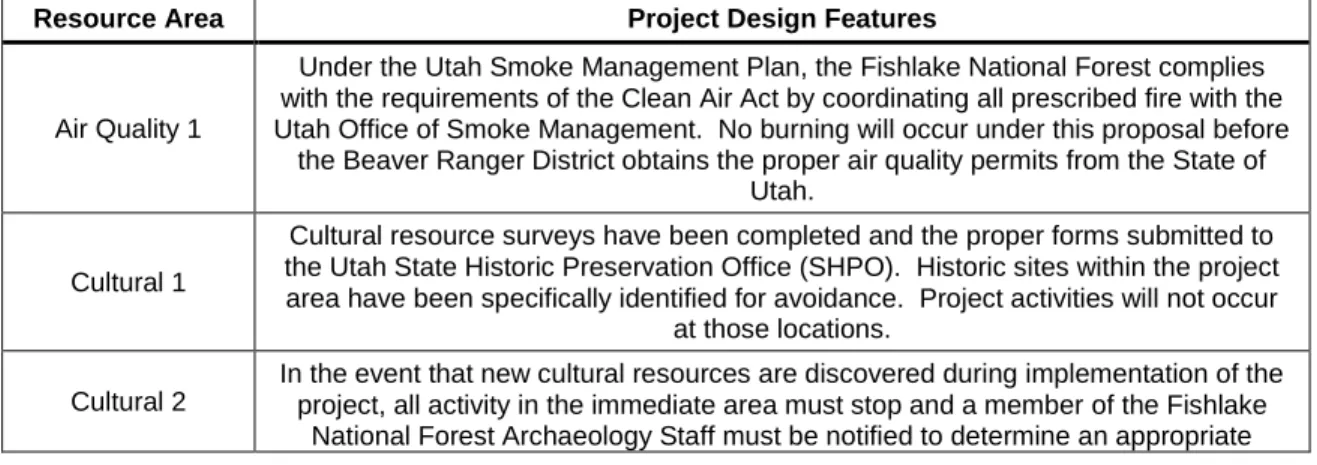
Project design criteria are listed in Table 1. These criteria were developed to avoid or eliminate adverse impacts from project activities, and are incorporated as an integrated part of all action alternatives. Project design criteria are based upon standard practices and operating procedures that have been employed and proven effective in similar circumstances and conditions: Forest Service Manual and Handbook direction, Regional Watershed Conservation Practices (FSH 2509.22 for Region 4), LRMP standards and guidelines, and other management requirements that apply to the proposed activities.
Table 1. Project Design Criteria.
Resource Area Project Design Features
Air Quality 1
Under the Utah Smoke Management Plan, the Fishlake National Forest complies with the requirements of the Clean Air Act by coordinating all prescribed fire with the Utah Office of Smoke Management. No burning will occur under this proposal before
the Beaver Ranger District obtains the proper air quality permits from the State of Utah.
Cultural 1
Cultural resource surveys have been completed and the proper forms submitted to the Utah State Historic Preservation Office (SHPO). Historic sites within the project area have been specifically identified for avoidance. Project activities will not occur
at those locations.
Cultural 2
In the event that new cultural resources are discovered during implementation of the project, all activity in the immediate area must stop and a member of the Fishlake
Big Flat Vegetation Management
4
Resource Area Project Design Features
course of action. Appropriate consultation with the SHPO, Tribal Historic Preservation Offices, and other applicable parties would take place as directed by 36
CFR 800.
Fire and Fuels 1
Reduce or otherwise treat all activity fuels so that the total loading of materials less than 6 inches in diameter is less than 25 tons/acre, or break up continuous activity
fuel concentrations exceeding the above standard into manageable units with fuel breaks or fire lanes, or provide additional protection for activity fuel areas exceeding
the above standard when such protection will not be required for more than five years.
Fire and Fuels 2 Limit use of prescribed fires on areas adjacent to riparian areas to protect riparian and aquatic values.
Forest Vegetation 1
Activities treating or affecting live forest vegetation will be conducted according to management plan standards and detailed silvicultural prescriptions prepared by a certified silviculturist, per Forest Service regional and national policy. Prescriptions will designate the trees to be cut or reserved and control other elements of forestry
operations according to a timetable for implementation that is included; these requirements will be applied by Forest Service Timber Sale Administrators and
incorporated into any contracts. Forest Vegetation
2
Utilization standards for live and dead timber: Minimum DBH is 8”; Minimum Top Diameter is 6”; Length is 8’; % Net of Gross is 33 1/3.
Forest Vegetation 3
Tree planting, along with natural regeneration, will be used to ensure a stocking rate of 150 to 155 trees per acre within five years of regeneration harvest. Under exception sub-B (LRMP IV-32), however, units treated specifically for fuel reduction
benefits will not be artificially restocked, but will be allowed to reforest naturally. Forest Vegetation
4
For other than suitable lands, commercial timber cutting is limited to salvage, sanitation, or cutting for road construction.
Forest Vegetation 5
Within conifer treatment units, protect residual trees through the designation of skid trails and landings, directional falling, restriction of skidding equipment to approved skid trails, and winching of all felled material to skidders on the skid trail prior to transfer to the landing. Designated skid trails should be located approximately 100 to
150 feet apart depending on terrain.
Forest Vegetation 6
To prevent bark beetle spread, all Engelmann spruce cut prior to September 1 shall be removed before the end of the same year and all Engelmann spruce cut after
September 1 shall be removed before the end of the following year.
Forest Vegetation 7
To prevent bark beetle spread, all Engelmann spruce felled or pushed over which exceed 14 inches in diameter and 18 inches in length shall be skidded to designated
landings.
Hydrology 1
To facilitate the control of soil erosion within acceptable tolerance: 1. Allow conventional logging equipment on slopes up to 40% where soil surveys or site-specific soil data are available to design erosion mitigation needs. 2. Utilize cable
and aerial systems on slopes over 40%.
Hydrology 2 Skid trails will be approved by the sale administrator before commencement of logging.
Hydrology 3 Reclaim disturbed areas (skid trails and decks) to protect soil and maintain road closures to minimize disturbances.
Hydrology 4
Landing locations would, where feasible, take advantage of existing openings or areas with no regeneration. Log landings and decking areas within any riparian area
is prohibited.
Hydrology 5
No harvesting will occur adjacent to or near perennial streams based on the following LRMP standard: Special protection and management will be given to floodplains, wetlands, and all land and vegetation for a minimum of 100 feet from the edge of all
perennial streams, lakes, and other bodies of water or to the outer margin of the riparian ecosystem if wider than 100 feet.
Resource Area Project Design Features
constructed stream crossings. B. Locate skid trails, landing and decking sites, and other harvest facilities outside the riparian area. C. Locate roads outside of riparian area except for stream crossings or where other feasible alternatives do not exist. D.
Select stream crossing points to minimize bank and channel disturbance.
Hydrology 7
Reduce to natural rate any erosion due to management activity through necessary mitigation measures such as water-barring and revegetation. Rehabilitation
measures will be implemented within one year of the activity.
Hydrology 8
Timber sale haul roads will be inspected annually to determine what work, if any, is needed to keep drainage functional and the road stable. Timber sale haul road ruts will be removed and drainage made functional during periods of high runoff or at least
once per year. Maintenance must protect drainage facilities and runoff patterns to insure that damage to adjacent land and resources—including meadows—is held to
a minimum.
Hydrology 9
The State of Utah and the Utah National Forests have agreed, through a 1993 Memorandum of Understanding, to use Forest Plan Standard & Guidelines and the
FSH 2509.22 SWCPs to meet the water quality protection elements of the Utah Nonpoint Source Management Plan. The SWCPs most applicable to this project are
13.02, 13.04, 13.06, 14.01, 14.02, 14.03, 14.04, 14.05, 14.06, 14.07, 14.08, 14.10, 14.11, 14.12, 14.13, 14.14, 14.15, 14.16, 14.17, 14.18, 14.20, 14.23, 15.02. 15.03, 15.04, 15.05, 15.06, 15.09, 15.10, 15.11, 15.12, 15.13, 15.14, 15.15, 15.19, 15.21, 15.22, and 15.25. These SWCPs will l be carried through to the timber sale contract
or other implementation plan.
Recreation and Visuals 1
Scenic Integrity Objectives for MA7A – Low - The landscape appears moderately altered. Deviations may be dominant, but are shaped to borrow from the natural landform and other visual dominance elements (line, form, texture, color), and are subordinate to the characteristic landscape when viewed as background. Example
treatment design feature: Harvest unit boundaries will follow natural contours i.e. drainage bottoms, ridgelines, etc.
Recreation and Visuals 2
Scenic Integrity Objectives for MA6B, MA3A, and MA2A – Moderate - The landscape appears slightly altered. Noticeable deviations are visually subordinate to the character. Example design feature: Unit boundary edges will be feathered for a
more natural appearance.
Recreation and Visuals 3
Public recreation within the project area will continue throughout implementation of treatment activities, but may require localized, temporary interruptions or restrictions limited to public safety considerations for activities such as logging, burn operations,
and the like.
Rangeland Resources 1
To minimize the spread of noxious weeds, require equipment washing prior to arrival at project area under timber sale contract provision B6.35#. In addition, where proposed activities would occur in areas infested with noxious weeds and considered
to be at high risk for spread, equipment associated with the activity will be washed before leaving the site to prevent spread of weeds to adjacent National Forest
System and private lands.
Rangeland Resources 2
Seed landings, skid trails, and log decks with approved seed mix to reduce erosion and prevent the establishment of noxious weeds. The seed mix will be selected and
approved by the FNF’s staff botanist. Rangeland
Resources 3
Where necessary, within MA7A treatment areas, protect regeneration from livestock damage.
Big Flat Vegetation Management
6
Resource Area Project Design Features
Roads 1
Roads 2
Construction and reconstruction standards for local roads:
Sensitive Plants 1
There are no known occurrences of sensitive plant species in the project area. Therefore, no related conservation measures have been proposed. If any sensitive
or federally listed plant species are identified in the project area prior to implementation of proposed treatments, the local biologist or botanist will be
contacted to ensure that proper conservation measures are established.
Wildlife 1
In compliance with guideline g of the LRMP goshawk amendment, the Big Flat Project should leave 300 snags greater than 18 inches DBH and 30 feet tall for each
100 acres treated. Snag calculations should be done at the stand level. If the minimum snags are unavailable, then the largest trees on site should be substituted.
Wildlife 2
In compliance with guideline h of the LRMP goshawk amendment, the Big Flat Project should leave 50 down logs greater than 12 inches in diameter and longer than 8 feet on each 10 acres treated. In addition, coarse woody debris greater than 3
inches in diameter should equal 100 tons per 10 acres. This CWD can included the large down logs. Down wood and CWD calculations should be done at the stand
level.
Wildlife 3
Trees designated as wildlife leave trees will be marked for retention. Removal of designated wildlife trees, or dead trees needed to meet habitat requirements, is
prohibited.
Wildlife 4
Record any new observations of threatened, endangered or sensitive wildlife species and implement appropriate management strategies in accordance with wildlife
biologist recommendations.
Wildlife 5 Control public motorized access by placing gates on temporary roads to minimize disturbance and decommission and rehab roads immediately when operations allow.
Wildlife 6
Forest vegetative manipulation is prohibited (prescribed burning, fuelwood collection, thinnings, weedings, etc.) within active nest areas during the active nesting period.
The active nesting period will normally occur between March 1st and September 30th.
Wildlife 7
Forest vegetative manipulation within active, alternate, and replacement nest areas should be designed to maintain or improve desired nest area habitat. Use the active nest area habitat characteristics as an indicator of the desired nest area habitat, and
Resource Area Project Design Features
as the best available information for nest area habitat for that cover type.
Wildlife 8
Openings created as a result of mechanical vegetative treatments should not exceed one acre in the spruce-fir cover type. Management activities should be restricted
during the active nesting period. The active nesting period will normally occur between March 1st and September 30th. Where timber harvest is prescribed to
achieve desired forest conditions, plan the transportation system to minimize disturbance to the PFAs. For example, small, permanent skid trails should be used in lieu of roads to minimize disturbance in goshawk PFAs. Variance may occur if it is determined that a combination of new permanent or temporary roads and permanent
skid trails would result in less overall disturbance to PFA habitat.
Decision and Reasons for the Decision
Based upon my review of the potential environmental consequences, I have decided to implement the proposed action. The proposed action and associated potential environmental consequences are described in detail in the Big Flat Vegetation Management EA. My decision to implement the proposed action meets the project purpose to produce wood-fiber and utilize large roundwood of a size and quality suitable for sawtimber; restore and maintain ecosystems, consistent with land uses and historic fire regimes, through wildland fire use and prescribed fire; and improve the timber age class distribution and maintain species diversity, while using silvicultural tools to prevent and control insect infestation and disease.
The vegetation treatments will be accomplished through commercial harvest and service contracts, including timber sale and stewardship contracts. Harvest operations will yield forest products. These forest products will meet the LRMP goal of providing wood fiber while maintaining or improving other resource values. Non-commercial treatments may be accomplished by Forest Service crews, or through the use of contractors, as noted above.
The EA and accompanying specialist reports included in the project record document the findings and conclusions upon which this decision is based.
Public Involvement
Scoping
Scoping is the process of obtaining public comments about proposed federal actions to determine the range of issues to be addressed. This action was originally listed as a proposal on the Fishlake National Forest Schedule of Proposed Actions (SOPA) in December 2014, and updated
periodically during the analysis. In addition, a project web page was developed, allowing any interested parties to download project information. Finally, a scoping notice, map, and proposed action document was sent to more than 70 federal, tribal, state, and local government officials, as well as special interest groups and other interested members of the public.
Notice and Opportunity to Comment
For the Big Flat project, the scoping notice also served to announce the formal Notice and Opportunity to Comment. While this project is not authorized under the Healthy Forest
Restoration Act (HFRA), it is a project implementing the Fishlake National Forest LRMP and is thus subject to the regulation at 36 CFR 218. Instead of an appeal period, there is an objection
Big Flat Vegetation Management
8
process before the final decision is made and after the final environmental document and draft decision are mailed to interested parties. On December 17, 2014, the BRD published a legal notice in the Richfield Reaper, the newspaper of record, announcing the commencement of this thirty day comment period. Both the scoping notice and the legal notice clearly stated that only those who submitted comments during the thirty day comment period would be eligible to object to the Big Flat Vegetation Management project.
Response
In response to these opportunities for public involvement, the BRD received six letters. Two of these were broadly supportive of the Big Flat proposed action: Mr. Kevin Frandsen and the Utah Governor’s Office. Two of the commenters were not supportive of the Big Flat proposed action: Mr. Dick Artley asserted that the proposal was in violation of the Organic Act, and implied that his attorneys were preparing a lawsuit to prove it. Mr. Brian Bremner, representing Garfield County, Utah, felt that the proposal’s government to government coordination, cooperating agency requirements, and local government impact analysis all failed to meet legal requirements. Finally, letters from The Hopi Tribe and The Navajo Nation were neutral as regards the proposal, but requested continued coordination should the BRD determine that Native American remains or funerary objects are present in the project area.
I considered each of these comment letters in the development of the final EA. Some of them I found to be irrelevant, not project specific, or outside the scope of the proposed action; others were used to improve the Big Flat project design. For a summary of how I considered public comments, please see the EA, Appendix B.
Finding of No Significant Impact
After considering the environmental effects described in the Big Flat Vegetation Management Project Environmental Assessment, I have determined that these actions will not have a
significant effect on the quality of the human environment considering the context and intensity of the impacts (40 CFR 1508.27). Thus, an environmental impact statement will not be prepared. I base my findings on the following:
Context
This project is limited in scope and duration. The proposed forest vegetation treatments are limited to fewer than 9,600 acres of the Fishlake National Forest—this includes non-commercial thinning, tree planting, and fuel reduction. As a result, this is a site-specific action with minor localized effects on the forest resources of the area. To put this in perspective, the Fishlake National Forest is composed of approximately 1.5 million acres of public land, almost half of which is set aside as research natural areas, inventoried roadless areas, protected watersheds, and non-motorized areas. In contrast, the Big Flat proposal includes silvicultural treatments in a managed project area that composes approximately 1/2 of 1 percent of the Forest’s areal extent. Moreover, the proposal does not result in deforestation or land use changes, which are the primary large-scale impacts to forest vegetation resources of regional or global concern.
Intensity
1) Impacts may be both beneficial and adverse. A significant effect may exist even if the Federal agency believes that on the balance the effects will be beneficial.
The result of the proposed treatments on the forest vegetation in the project area is designed to be “beneficial.” As a result, there would likely be some beneficial effects from the proposed action, but these would not generally be considered “intense” or “severe.”
2) The degree to which the proposed action affects public health or safety.
The Big Flat Vegetation Management project will not have a significant effect on public health or safety. Forest management activities will be conducted under the authority of a certified Timber Sale Administrator, and will be designed to avoid conflict with public forest users through project design (Forest Vegetation 1, Recreation and Visuals 3). Moreover, any smoke emissions
associated with prescribed fire will be approved by the State of Utah’s Smoke Management Program (Air Quality 1).
3) Unique characteristics of the geographic area such as proximity to historic or cultural resources, park lands, prime farmlands, wetlands, wild and scenic rivers, or ecologically critical areas.
No parklands, prime farmlands, wetlands, wild and scenic rivers, or ecologically critical areas are associated with the project area. The project area has been surveyed and analyzed for historical and cultural resources. Documentation of these findings is included in resource specialist reports located in the project record.
4) The degree to which the effects on the quality of the human environment are likely to be highly controversial.
The effects of any alternative on the quality of the human environment are not likely to be highly controversial. The project area is a managed forest; the proposal is limited in scope; and the project design features, including standard management requirements, are demonstrably effective in reducing impacts to national forest resources. While not all the public comments were
supportive of the proposal, I am confident that the IDT has reviewed these comments and has addressed them through project design or effects analysis in the EA. As a result, I have concluded that the proposals under the Big Flat Vegetation Management project are not highly controversial.
5) The degree to which the possible effects on the human environment are highly uncertain or involve unique or unknown risks.
The conditions present within the project area and the proposed action are similar to forest vegetation treatment projects that have been implemented on the Fishlake National Forest in the past. Potential effects from such projects are routinely considered, documented, and monitored by the Forest. The effectiveness of project design features in minimizing or eliminating risks from forest management has been demonstrated. There is no evidence of highly uncertain, unique, or unknown risks to the human environment associated with this project.
6) The degree to which the action may establish a precedent for future actions with significant effects or represents a decision in principle about a future consideration.
This proposal does not set a precedent for any other vegetation management projects that may be implemented to meet the goals and objectives of the Fishlake Forest Plan. Any decision to treat
Big Flat Vegetation Management
10
the forest vegetation in the Big Flat Vegetation Management project area applies to this project only and does not represent decisions about future actions. Thus, this action does not set a precedent for future actions or represent a decision in principle about a future consideration. Future actions will be analyzed on their own merits in compliance with NEPA.
7) Whether the action is related to other actions with individually insignificant but cumulatively significant impacts.
This analysis includes a list of potential past, ongoing and foreseeable future actions that may create cumulative effects. In general, those projects were designed, like the Big Flat Vegetation Management proposal, to have beneficial silvicultural effects to managed forests. Those incremental potential benefits are accounted for in the project record, but are unlikely to be significant.
8) The degree to which the action may adversely affect districts, sites, highways, structures, or objects listed in the National Register of Historic Places or may cause loss or
destruction of significant cultural or historical resources.
This proposal cannot affect districts, sites, highways, structures, or objects listed in or eligible for listing in the National Register of Historic Places because none exist within any proposed
treatment unit. The proposal will cause no loss or destruction of significant scientific, cultural, or historic resources. This finding has been documented in the Big Flat archeologist’s report and is supported by the State Historic Preservation Office (letter dated 5/19/15).
9) The degree to which the action may adversely affect an endangered or threatened species or its habitat that has been determined to be critical under the Endangered Species Act.
A biological assessment has been completed to document analysis of potential effects of this project on endangered and threatened species and their critical habitats. No known federally listed endangered or threatened plant or animal species occur or have the potential to occur in the project area, nor has any critical habitat been designated in the project area. The project does not remove suitable habitat or otherwise adversely affect any listed species. Documentation of these findings is included in resource specialist reports in the project record.
10) Whether the action threatens a violation of Federal, State, or local law or requirements imposed for the protection of the environment.
The proposed action would not violate Federal, State, or local laws or requirements. The action is consistent with the 1986 Fishlake National Forest Land and Resource Management Plan. The EA and the specialist reports included in the project record demonstrate compliance with, inter alia, the National Environmental Policy Act of 1969, with the National Forest Management Act of 1976, and with the Endangered Species Act of 1973.
Conclusion
After considering the environmental effects described in the EA and specialist reports, I have determined that the Big Flat proposed action will not have significant effects on the quality of the human environment considering the context and intensity of impacts (40 CFR 1508.27). Thus, an environmental impact statement will not be prepared.
Moreover, for a finding of no significant impact, “there should be only enough discussion to show why more study is not warranted” (40 CFR 1502.2(b)). As a result, this analysis and the
supporting EA are not encyclopedic, but are sufficient to show that the implementation of routine forest management practices as directed by Congress and by the Land and Resource Management Plan do not have significant effects. While the EA is not included directly in this finding, it has been attached and is hereby incorporated by reference.
Findings Required By Other Laws
National Forest Management Act
I have determined that the selected alternative is consistent with the timber harvest provisions of the National Forest Management Act. This is documented in the EA and the forest vegetation report located in the project record.
Planning Rule
On April 9, 2012 the Department of Agriculture issued a final planning rule for National Forest System land management planning (2012 Rule). None of the requirements of the 2012 Rule apply to projects and activities on the Fishlake National Forest, as the Fishlake Forest Plan was developed under a prior planning rule (36 CFR §219.17(c)). Furthermore, the 2012 Rule
explains, “[The 2012 Rule] supersedes any prior planning regulation. No obligations remain from any prior planning regulation, except those that are specifically included in a unit’s existing plan. Existing plans will remain in effect until revised” (36 CFR §219.17).
Fishlake National Forest Land and Resource Management Plan
The project was designed in conformance with the Fishlake National Forest LRMP. Under the National Forest Management Act, all activities are required to be consistent with the LRMP (16 USC 1604(i)). The LRMP provides overall guidance for management activities by specifying goals and objectives, desired future conditions, management direction, and standards and
guidelines. The relevant LRMP goals for this project are to manage the timber resources on lands suitable for production of saw timber and other Forest products; restore and maintain ecosystems, consistent with land uses and historic fire regimes, through wildland fire use and prescribed fire; and, improve the timber age class distribution and maintain species diversity, while using silvicultural tools to prevent and control insect infestation and disease. Moreover, for this analysis the resource team compared the proposal against each standard and guideline to ensure consistency. Finally, the project incorporates appropriate land and resource management plan guidelines from the general direction found on pages IV-10 through IV-48, as well as the management area direction specific to MAs 7A, 6B, 3A, and 2B.
Relevant Scientific Information
I am confident that the analysis of this project was conducted using relevant factors, including site specific data and available scientific information. My conclusion is based on a review of the record that shows my staff thoroughly researched the relevant scientific information, considered responsible opposing views, and acknowledged incomplete or unavailable information, scientific uncertainty, and risk. Please refer to the specialist reports in the project file for specific
discussions of the science and methods used for analysis and for literature reviewed and referenced.
Big Flat Vegetation Management
12
Endangered Species Act
Compliance with the Endangered Species Act is demonstrated through the documentation of the status of listed species under the Biological Assessment.
American Antiquities Act and Historic Preservation Act
Compliance with the American Antiquities Act and Historic Preservation Act is demonstrated through the documentation of compliance with the State Historic Preservation Officerequirements.
Clean Water Act
Compliance with the Clean Water Act is demonstrated through a Memorandum of Understanding, (as between the Utah and the Utah National Forests) to use Forest Plan Standard & Guidelines and the FSH 2509.22 SWCPs to meet the water quality protection elements of the Utah Nonpoint Source Management Plan.
Clean Air Act
Compliance with the Clean Air Act is demonstrated through participation in the State of Utah’s Smoke Management Plan. Prior to any prescribed fire implementation, the Beaver Ranger District obtains air quality permits through the Utah Department of Smoke Management.
Administrative Review Opportunities
This proposed decision is subject to objection pursuant to 36 CFR 218, and fits the special procedures of subpart B of the regulation. Objections will be accepted only from those who have previously submitted specific written comments regarding the proposed project either during scoping or other designated opportunity for public comment in accordance with § 218.5(a). Issues raised in objections must be based on previously submitted timely, specific written comments regarding the proposed project unless based on new information arising after designated opportunities.
The publication date of the legal notice in the newspaper of record is the exclusive means for calculating the time to file an objection (see §§ 218.26(a) and 218.32(a)), and that those wishing to object should not rely upon dates or timeframe information provided by any other source. It is the objector's responsibility to ensure timely filing of a written objection with the reviewing officer. Timeliness must be determined by the following indicators: (1) The date of the U.S. Postal Service postmark for an objection received before the close of the fifth business day after the objection filing period; (2) The agency's electronically generated posted date and time for email and facsimiles; (3) The shipping date for delivery by private carrier for an objection received before the close of the fifth business day after the objection filing period; or (4) The official agency date stamp showing receipt of hand delivery. For emailed objections, the sender should receive an automated electronic acknowledgement from the agency as confirmation of receipt. If the sender does not receive an automated acknowledgment of receipt of the objection, it is the sender's responsibility to ensure timely filing by other means.
Notice of objection must meet the requirements of 36 CFR 218.8. At a minimum, an objection must include the following: (1) Objector's name and address as defined in § 218.2, with a telephone number, if available; (2) Signature or other verification of authorship upon request (a
scanned signature for electronic mail may be filed with the objection); (3) When multiple names are listed on an objection, identification of the lead objector as defined in § 218.2. Verification of the identity of the lead objector must be provided upon request or the reviewing officer will designate a lead objector as provided in § 218.5(d); (4) The name of the proposed project, the name and title of the responsible official, and the name(s) of the national forest(s) and/or ranger district(s) on which the proposed project will be implemented; (5) A description of those aspects of the proposed project addressed by the objection, including specific issues related to the proposed project; if applicable, how the objector believes the environmental analysis or draft decision specifically violates law, regulation, or policy; suggested remedies that would resolve the objection; supporting reasons for the reviewing officer to consider; and (6) A statement that demonstrates the connection between prior specific written comments on the particular proposed project or activity and the content of the objection, unless the objection concerns an issue that arose after the designated opportunity for comment.
Objections can be submitted in several forms, but must be received within 45 days following publication date of the legal notice in the newspaper of record, Richfield Reaper. Objections may be:
1) Mailed to: Objection Reviewing Officer, Intermountain Region USFS, 324 25th Street, Ogden, Utah 84401;
2) E-mailed to: [email protected]. Please put OBJECTION and
name of project in the subject line;
3) Delivered to: Intermountain Region USFS, 324 25th Street, Ogden, Utah 84401 between the hours of 8 am and 4:30 pm, Monday through Friday, excluding holidays; or
4) Faxed to: Intermountain Region, ATTN: OBJECTIONS at 801-625-5277.
Project Approval
If no objections are filed within the 45-day time period, approval of the decision may occur on, but not before, five business days from the close of the objection filing period. It is expected that implementation will begin in 2016.
Contact
The project record is available for public review at the Beaver Ranger District office, 575 South Main, Beaver, Utah, 84713. The project record is also available on the Fishlake National Forest website at: www.fs.usda.gov/goto/fishlake/projects. For additional information concerning this decision, contact the project manager, Andrew Orlemann, at (435) 896 1035 or the District Ranger, Kathy Johnson, at (435) 896 1031.
_____________________
Kathleen Johnson Date
District Ranger