DFRWS USA 2016
d
Proceedings of the 16th Annual USA Digital Forensics Research Conference
Fingerprinting Android packaging: Generating DNAs for
malware detection
ElMouatez Billah Karbab
*, Mourad Debbabi, Djedjiga Mouheb
Computer Security Laboratory, Concordia University&NCFTA-Canada, Montreal, Quebec, Canada
Keywords: Fingerprinting Malware Mobile Android Fuzzy hashing Detection Family attribution
a b s t r a c t
Android's market experienced exponential popularity during the last few years. This blazing growth has, unfortunately, opened the door to thousands of malicious applications targeting Android devices everyday. Moreover, with the increasing sophistication of to-day's malware, the use of traditional hashing techniques for Android malware fi nger-printing becomes defenseless against polymorphic malicious applications. Inspired by fuzzy hashing techniques, we propose, in this paper, a novel and comprehensivefi nger-printing approach for Android packagingAPK. The proposedfingerprint captures, not only the binary features of theAPKfile, but also the underlying structure of the app. Further-more, we leverage thisfingerprinting technique to build ROAR, an automatic system for Android malware detection and family attribution. Our experiments show that the pro-posedfingerprint and the ROAR system achieve a precision of 95%.
©2016 The Author(s). Published by Elsevier Ltd. This is an open access article under the CC BY-NC-ND license (http://creativecommons.org/licenses/by-nc-nd/4.0/).
Introduction
In recent years, we have witnessed a phenomenal popularity and growth of Android devices. It is estimated that 2 billion devices are currently powered by Android OS (Ericsson, 2013). This trend is expected to continue to reach more than 5.6 billion devices by 2019 (Ericsson, 2013). Due to their proliferation and ubiquitousness, Android devices have become a tempting target for cyber criminals. According to aCiscoreport (Cisco, 2014), mobile malware mostly targets Android devices. In this setting, the need to develop effective and accurate forensics methods, techniques and tools for the detection and analysis of Android malware becomes a desideratum.
To address the malware variation flood, multiple defence mechanisms have been proposed by the anti-mo-bile-malwareindustry, withsignature-based detectionbeing the most adopted technique. The latter uses malware digest orsignatureto match against mobile applications in order
to detect any malicious code. Traditional cryptographic
hashing algorithms such as SHA1 and MD5 have been
widely adopted for generating malware signatures. Cryp-tographic hashing methods have the advantage of being simple and fast. They are, however, highly sensitive to even small changes, which makes these methods defenseless against malware variations. Moreover, despite its effec-tiveness, signature-based detection could be easily defea-ted by new malicious applications with only tiny modifications as is the case withpolymorphicattacks.
To overcome the drawbacks of cryptographic hashing, a new technique, namelyfuzzy hashing, has emerged in the literature. The concept of fuzzy hashing was first
intro-duced as ssdeep (Kornblum, 2006) in rsync checksum
(Tridgell and Mackerras). The main advantage of this technique over cryptographic hashing lies in its tolerance to changes. Thanks to this important property, fuzzy hashing has been widely leveraged to detect Web-based document duplication (Figuerola et al., 2011). In cyber security, fuzzy hashing has been mainly embraced in malware fi nger-printing. For instance, Virus Total has been using thessdeep
fuzzy hashing for malwarefingerprinting since 2012. There *Corresponding author.
E-mail address:[email protected](E.B. Karbab).
Contents lists available atScienceDirect
Digital Investigation
j o u r n a l h o m e p a g e : w w w . e l s e v i e r . c o m / l o c a t e / d i i n
http://dx.doi.org/10.1016/j.diin.2016.04.013
1742-2876/©2016 The Author(s). Published by Elsevier Ltd. This is an open access article under the CC BY-NC-ND license (http://creativecommons.org/ licenses/by-nc-nd/4.0/).
are several other attempts, such asmvHash-B (Breitinger et al., 2013), dcfldd (DCFL, 2016), sdhash (sdhash 2016; Roussev), and mrshv2 (Breitinger and Baier, 2013), to apply fuzzy hashing in multiple applications. In the context of malware detection, it consists of two steps: i) malware binary digest computation, ii) matching the digest against other malware samples.
Despite its effectiveness compared to cryptographic hashing, fuzzy hashing technique suffers from some lim-itations. First, it ignores the underneath structure and semantics of the malicious package. Second, fuzzy hashing
suffers from its single fingerprint bounded with a
maximum size (e.g., ssdeep (Roussev, 2010)), thus pre-venting packages with different sizes and features to be effectively compared. Other drawbacks of fuzzy hashing related to specific algorithms are presented in (Li et al., 2015) concerning mvHash-B fuzzy hash algorithm (Breitinger et al., 2013). Furthermore, the compressed nature of AndroidAPK package makes the repacking of malicious apps an easy task. Moreover, the increasing number of Android app stores and the lack of security verification in some stores increase the chance of attackers to deploy malicious applications in multiple stores. Another issue is related to native libraries (Wang and Shieh, 2015), specifically at the level of Java objects, executed on top ofDalvikmachine. It has been shown that these libraries are exploited by a significant number of Android malware, such as the well-known sophisticated
DroidKungFumalware and its many variations (Zhou and Jiang, 2012). Not analyzing the native library would make the distinction between its variations a very chal-lenging task.
Our objectives are to: i) Develop a more accurate, yet broad, fuzzyfingerprinting technique for Android OS mal-ware. The proposed fingerprint relies on a customized fuzzy hashing technique that addresses the previous limi-tations. ii) Design and implement a framework for Android malware detection and family attribution on top of the developed fuzzyfingerprint. To this end, we propose APK-DNA, a fuzzyfingerprint that captures both the structure and the semantics of theAPKfile using most AndroidAPK
features. Thisfingerprint covers: i) the underneath Android app structure, including bothDalvik machine byte-codeii) the meta-data of the Android app. Our empirical results indicate that ourfingerprinting approach is highly robust to app changes and accurate in terms offingerprint compu-tation and matching.
Moreover, we build ROAR, an automatic framework for Android malware detection, using the proposed APK-DNA. The goal is to generatefingerprints for known Android malicious apps, and then detect new malware variations using similarity computing. In ROAR framework, we pro-pose two different approaches for malware detection: i)
family-fingerprinting, and ii)peer-matching. In addition to malware detection, we aim to attribute the family lineage of the mobile malware. To this end, ROAR attributes a similarity score to each possible variation in the same malware family. We evaluate APK-DNA and ROAR using real malware samples from the Android Malware Genome Project (Android Malware Genome Project, 2015; Zhou and Jiang, 2012). We experiment with multiple Android
malware families. Our evaluation demonstrates that ROAR is highly accurate compared to state of-the-art approaches.
This paper makes the following contributions:
We propose a novel and rather comprehensivefi nger-printing technique for Android application packages (APK) based on fuzzy hashing. The proposedfingerprint considers not only the binary format ofAPKbut also its structure and semantics.
We design and implement ROAR, a framework that le-verages the proposed fingerprinting technique for Android malware detection, following two different approaches, namely peer-matching and family fi nger-print. In addition, ROAR is able to detect malware vari-ations and attribute the family of the detected malware.
We evaluate ROAR on 928 Android malware samples
from (Android Malware Genome Project, 2015; Zhou and Jiang, 2012) dataset. The evaluation results demonstrate the high accuracy of ROAR in terms of both malware detection and family attribution.
The remainder of this paper is organized as follows: Section Approach overview presents an overview of the proposed approach. SectionAPK-DNAfingerprintis
dedi-cated to the APK-DNA fingerprinting. Section ROAR
framework presents the ROAR framework. Section Experimental results details our experimental results. SectionLimitations and future workdiscusses the limita-tions of the proposed approach together with some ideas on future research. The related work is reported in Section Related work. Section Conclusion contains some concluding remarks.
Approach Overview
Current fuzzyfingerprints such asssdeepare computed against the app binary as a whole, which makes them ineffective for detecting malicious app variations. This problem gets even worst in case of Android OS because of the structure of apps packaging, which contains not only the actual compiled code but also otherfiles such as media ones. To overcome this limitation, we propose an effective and broad fuzzyfingerprint that captures, not only binary features, but also the underneath structure and semantics of theAPKpackage.
Accordingly, our approach for computing Android app fingerprints relies on decomposing the actualAPKfile into different content categories. For each category, we compute a customized fuzzy hash (sub-fingerprint). Note that for some categories, for instanceDexfile, the appli-cation of the customized fuzzy hashing on the whole category content does not capture the structure of the underlying category. In this case, we apply fuzzy hashing against a selectedN-gramsof the category content. In our context, we usebyte n-gramson binaryfiles andinstruction n-gramson assemblyfiles. Furthermore, a best practice for malwarefingerprinting is to increase the entropy of the app package content (Masud et al., 2007). To this end, we compress each category content before computing the
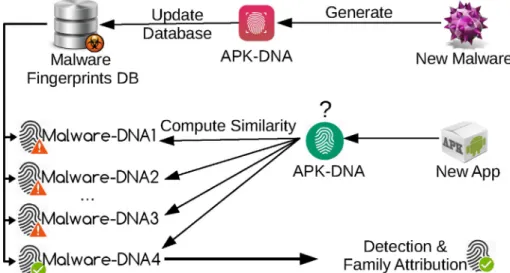
customized fuzzy hash on its N-grams. The resulting fuzzy hashes (sub-fingerprints) are then concatenated to pro-duce the final composed fuzzy fingerprint, called APK-DNA. As depicted inFig. 1, there are two main processes. First, we build a database offingerprints by generating the APK-DNA for known malware samples. To identify whether a new app is malicious or not, and to know its family in case it is malicious,first we compute its APK-DNA and match it against the existingfingerprints in the data-base. Moreover, we use the proposed APK-DNAfingerprint as a basis to design and implement ROAR, a novel frame-work for malware detection and family attribution. ROAR's first approach, namely family-fingerprinting, computes a fingerprint for each malware family. Afterwards, it uses these family fingerprints to make security decisions on new apps. In the second approach, peer-matching, ROAR uses the whole fingerprint database for detection and attribution.
APK-DNAfingerprint
In this section, we present our approach for generating Android appsfingerprints. Before presenting the details of thefingerprint generation, it is necessary to understand the structure of the AndroidAPKpackage.
Android APK format
Android application package (APK) is the official Android packaging format that is used for apps distribution and installation. By analogy, APKfiles are similar to EXE
installationfiles for Windows orRPM/DEBfiles for Linux. More precisely, APK comes as a ZIP archive file, which contains the different components of the Android App.APK
file content is organized into directories (namelylib,res, and assets) andfiles (namely AndroidManifest.xmland
classes.dex). The purpose of each item is as follows: i)
AndroidManifest.xml carries the app meta-data, e.g., name, version, required permissions, and used libraries. ii) Theclasses.dexcontains the compiled classes of the Java code. iii) The lib directory stores C/Cþþ native libraries (NDK, 2016). iv) Finally, the resources directory contains the non-source codefiles that are packaged into theAPKfile during compilation. It mostly holds media files such as video, image, and audiofiles.
APK-DNAfingerprint structure
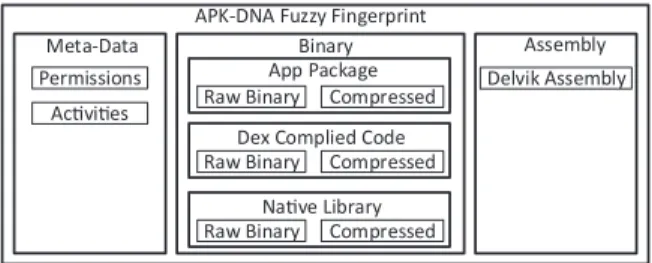
We leverage the aforementionedAPKstructure to define the most important components for fingerprinting. The design of the APK fingerprint must consider most of its important components as unique features to be able to distinguish between different malware samples. As depic-ted in Fig. 2, APK-DNA is composed of three main sub-fingerprints based on their content type: Metadata, Bi-nary, and Assembly. The Metadatasub-fingerprint
con-tains information, which is extracted from the
AndroidManifest.xml file. We particularly focus on the required permissions. The aim is to fingerprint the permission used for a specific Android malware or malware family. Our insight comes from the fact that some Android malware samples need a specific type of permission to conduct their malicious actions. For example, the malware
DroidKungFu1(Zhou and Jiang, 2012) requires access to personal data to steal sensitive information. Having Android malware without access permissions to personal data, e.g.,phone number, would suggest that this malware is most likely not part ofDroidKungFu1family. Other met-adata information could be considered for malware segre-gation, for instance,Activitylist,Servicelist, andComponent. In our current design of APK-DNA, we focus on the required access permissions.
TheBinarysub-fingerprint captures the binary repre-sentation of theAPKfile content. In other words, we aim to fingerprint the byte sequence of Android malware. In this context, we usen-grams (Masud et al., 2007) as we will present in Section APK-DNA fingerprint generation. We divide the binary sub-fingerprint into three parts: App Package,Dex Compiled Code, andNative Library. TheApp Packageconsists of theAPKfile. Thus, all the components inside the package are considered (e.g., mediafile). Along with the rawAPKpackage, we apply a compression schema
Fig. 1.Approach overview.
APK-DNA Fuzzy Fingerprint
Meta-Data Assembly
Permissions Delvik Assembly
Binary App Package
AcƟviƟes Raw Binary Compressed
Dex Complied Code
Raw Binary Compressed
NaƟve Library
Raw Binary Compressed
Fig. 2.Android packagefingerprint structure. e
on the package to increase itsentropy(Masud et al., 2007). In theDex Compiled Code, we focus on the code section of the Android malware, which is located in theclasses.dexfile of Android apps. The use of the code section for malware detection has proven its accuracy (Jang and Brumley, 2011). In the context of Android malware, we use extracted fea-tures from theclasses.dexas part of the APK-DNA. In addi-tion, we use a high-entropy version of theclasses.dexfor fingerprinting by applying the compression. The Native Librarypart of the binary sub-fingerprint captures C/Cþþ shared libraries, used by malware. Using the native library for malwarefingerprinting is essential in some cases, for example, to distinguish between two Android malware samples. For instance, if the malware uses a native library, it is more likely to beDroidKungFu2 thanDroidKungFu1
becauseDroidKungFu2malware family uses C/Cþþlibrary andDroidKungFu1uses onlyJava byte code.
In theAssemblysub-fingerprint, we focus also on the code section of the Android malware, which isclasses.dex. However, we do not consider the binary format. Instead, we use the reverse-engineered assembly code. As we will present in Section N-grams, we reverse engineered the
Dalvik byte-codein order to extract instruction sequences used in the app. The Assemblysub-fingerprint aims to distinguish malware using the unique instruction se-quences in the assemblyfile. We use the same technique as in theBinarysub-fingerprint, i.e.,n-grams. However, here we consider the assembly instructions instead of bytes. In addition to assembly instructions, we could also consider section names, call graph, etc. In the current design, we focus on the assembly instructions for fingerprinting.
APK-DNAfingerprint generation
In this section, we present the computation steps for generating the APK-DNAfingerprint. In addition, we pre-sent the main techniques adopted in the design of the fingerprint, namely,N-gramandFeature Hashing.
N-grams
TheN-gramtechnique is used for computing contiguous sequences ofNitems from a large sequence. For our pur-pose, we use N-grams to extract the sequences used by Android malware to be able to distinguish between different malware samples. To increase thefingerprint ac-curacy, we leverage two types of N-grams, namely in-struction N-gramsandbytes N-grams. As depicted inFig. 4, the instruction N-grams are the unique sequences in the disassembly ofclasses.dexfile, where the instructions are stripped from the parameters. In addition to instruction N-grams, we also use byte N-grams on different contents of the Android package.Fig. 4illustrates different N-grams on both instructions and bytes of the first portion of the
AnserverBot malware. We have experimented multiple options such asBigrams,3-g, and5-g. The latter showed the best results in the design of APK-DNAfingerprint, as we will see in the evaluation section. The result of N-grams extraction is the list of unique5-gfor each content category, i.e.,assembly instructions,classes.dex,native library, andAPK
file.
Feature hashing
Feature hashing is a machine learning preprocessing technique for compacting an arbitrary number of features into afixed-size feature vector. The feature hashing algo-rithm, described in Algorithm 1, takes as input the set of sequences generated by applying the N-grams technique and the target length of the feature vector. In the current implementation of APK-DNA, we use a bit feature vector of 16 KB but the size could be adjusted according to the needed density of the bit-feature vector to distinguish be-tween apps. For example, the size of the assembly in-struction vector could be less than the dex vector since the density produced by the instruction content is less than the dex one. Notice that in our implementation, we store only a binary value, which defines whether the N-gram exists or not. The standard feature hashing uses the frequency, i.e., the number of occurrences of a given N-gram. The output of the feature hashing algorithm is a feature-bit vector. Instead of using existing fuzzy hashing algorithms such as
ssdeep, we leverage the feature vector as our fuzzy hashing technique for implementing APK-DNAfingerprint. In the next section, we present the complete process of computing thefingerprint by using N-grams and feature hashing as basic blocks.
Fingerprint computation process
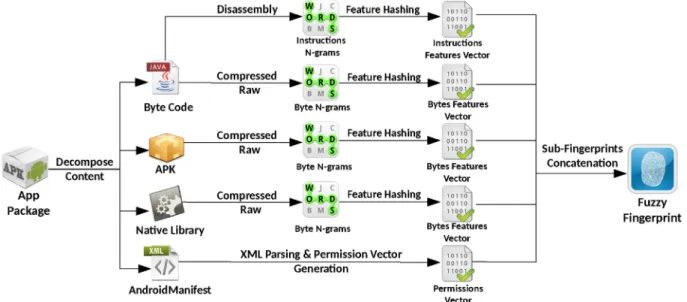
As shown inFig. 3, thefingerprint computation process starts by decomposing the Android appAPKfile into four different content categories: 1) Dalvik byte-code, 2) APK
file, 3) native libraries, and 4) AndroidManifest file. Each binary content is compressed to increase the entropy. Af-terwards, we extract the bytes N-grams from the raw and the compressed content. The resulting N-grams set is provided as input to the feature hashing function to pro-duce the customized fuzzy hashing. The size of each customized fuzzy hash is 16 KB as mentioned in Section Feature hashing. ForDalvik byte-code, wefingerprint the assembly code in addition to the binaryfingerprint. First, we reverse engineer theclasses.dexfile to produce its as-sembly code. After prepossessing the asas-sembly, we use the instruction sequence of the Android app to extract the instruction N-grams set. Afterwards, we use feature hashing to generate a 16 KB bit vectorfingerprint for the assembly code. The current design of APK-DNA uses the
feature hashingtechnique withoutfeature selectionbecause we aim to keep the maximum information on the targeted malware instance or its family. However,feature selection
could be a promising technique to explore in future APK-DNA design.
Regarding the AndroidManifestfile, wefirst convert it into a readable format, then parse it to extract the required permissions by the Android app. To use the required permission app fingerprinting, we use a bit vector of all Android permissions in a predefined order. For a given required permission, weflag the bit to 1 in the permission vector if it exists in theAndroidManifestfile. The result is a bit vector for all the permissions of the Android app. At the end of the aforementioned operations, we generatefive bit vectors. Thefinal step of the fuzzyfingerprint computation consists of concatenating all the produced digests into one fingerprint, designated as APK-DNA. It is important to mention that, for the purpose of similarity computation, we also keep track of the bits of each content vector. Notice that the content categories are mandatory for Android apps except thenative library, which may not be part of the app. Therefore, we use a bit vector of zeros for the feature vector
of thenative library. Thefinal size of APK-DNA is 16 KB for the feature vector of each content (there are 4 feature vectors: assembly, byte-code, APK, and native library). However, for the permission vectors, we use a 256-bit feature vector since Android permission system does not exceed this number.
Fingerprint similarity computation
The main reason of adopting the feature vector as a customized fuzzy hash is to make the similarity compu-tation straightforward by using Jaccard Similarity, as shown in Equation(1). Since in our case, we have a set of bit feature vectorsflagging the existence of a feature, we adoptbitwise jaccard similarity, as depicted in Equation (2).
JaccardðX;YÞ ¼jX∩Yj jX∪Yj
0JaccardðX;YÞ 1
(1)
Jaccard bitwiseðA;BÞ ¼ OnesðA$BÞ
OnesðAþBÞ
0Jaccard bitwiseðX;YÞ 1
(2)
LetAandBbe two bit-feature vectors, the union of the two vectors is given by the logical expressionAþBand its cardinality is the number of“1”bits in the resulting vector. Similarly, the cardinality of the intersection of the two vectors is the number of“1”bits inA$Bbit vector. A com-plete example of similarity computation using bit-wise Jaccard similarity is shown inFig. 5. As presented in Sec-tion Fingerprint computation process, APK-DNA fuzzy fingerprint is composed offive fuzzy hashes, which are bit-feature vectors. To compute the similarity between two Fig. 3.APK-DNA computation process.
Fig. 4.First instructions and bytes ofAnserverBotmalware.
fingerprints, we calculate the bit-wise Jaccard similarity between the bit feature vectors representing the same content. In other words, we calculate the similarity be-tween the feature vectors of the assembly, byte-code, APK, native library, and permissions. The result is a set offive similarity values.
ROAR framework
In this section, we leverage the proposed APK-DNA fingerprint for Android malware detection. More pre-cisely, we present i)family-fingerprintingapproach, where we define and use a family fingerprint, and ii) peers-matchingapproach, where we compute the similarity be-tween malwarefingerprints. Both approaches are based on
peer-fingerprint-voting mechanism to make a decision about malware detection and family attribution, as we present in the next sub-section.
Peerfingerprint voting technique
As we have seen in Section Fingerprint similarity computation, comparing two Android malware packages consists of computing similarities between their Metadata, Binary and Assembly sub-fingerprints, which gives nu-merical values on how the two packages are similar in a specific content category, as presented in Algorithm 2. In addition, we add the summation of all the similarities as a summary value of these sub-contents similarities. Note that other summary values such as the average and the maximum could also be used.
However, it is unclear how to detect the most similar packages if we compare an unknown package to known malware packages using multiple sub-fingerprints. The most obvious solution is to merge the bit-vectors of each content category into one vector, and then compute the similarity of the resulting feature vector. However, in our case, merging the bit vectors will heavily reduce the contribution of some sub-fingerprints in the similarity computation. This is especially the case for the metadata sub-fingerprint, since the number of bits of the metadata feature vector is very small compared with the assembly ones. Similarly, the density of the assembly feature vector is considerably less than the binary one. Consequently, we propose to use a composed similarity using the
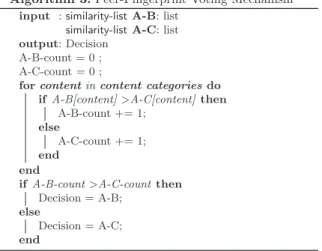
peer-fingerprint voting technique. The idea is to compare be-tween the parts (sub-fingerprints) instead of comparing the wholefingerprints, as depicted in Algorithm 3. In other words, we compare each sub-similarity pairs. The decision is made by a voting mechanism on the result of each sub-comparison. Moreover, in case of equal votes, we compare thesummationof the sub-similarities to remove the decision ambiguity. At this stage, we are able to compare different Android packages and make a decision on the most similar package to a given one. In what follows, we propose two approaches to malware detection.
Peer matching approach
In the peer-matching approach, ROAR uses the most straightforward technique to detect malware, i.e., query the fingerprints database tofind the most similarfingerprint. To detect Android malware variation, we build amalware
fingerprints database by computing APK-DNA for known Android malware. As shown in Fig. 6, for each new mal-ware, we compute its APK-DNA and add it to the database. To attribute the malware family to a new app, wefirst compute the similarity between the malware fingerprint and each entry in the database of known malwarefi nger-prints, as depicted inFig. 6. To this end, we use thebitwise Jaccard similarity, presented in Section Fingerprint similarity computation, to produce a set of sub-similarity values, i.e., composed similarity. Afterwards, to compare
A = 1011 0110 1001 0001
B = 0011 1010 1001 0000
A+B = 1011 1110 1001 0001
A.B = 0011 0010 1001 0000
Jaccard(A,B) =5 / 9
Ones(A+B) = 9
Ones(A.B) = 5
Fig. 5.Bitwise jaccard similarity computation.
betweencomposedsimilarity values, we use the previously presentedpeer-votingtechnique. The entry with the high-est similarity, in case it exceeds a threshold, determines the malware family. In the current implementation, we use a static threshold. Peer-matching is a simple approach for malware detection and family attribution. However, this simplicity comes with a cost, as we will discuss in Section Discussion.
Family-fingerprinting approach
In this approach, some extra steps are needed to build a second database for family fingerprints. The target is to reduce the number of database entries needed to compare with in order tofingerprint an Android malware (seeFig. 7). For this reason, we propose a fuzzy hashingfingerprint for a malware family. The aim is to leverage this family fingerprint for malware detection. The idea is to build a
database of familyfingerprints from known Android mal-ware samples, and use this database for similarity computation for unknown malware apps. The actual size of the family-fingerprints database is limited by the number of malware families. Notice that thefingerprint structure for a malware family is the same as for a single malware,
i.e., metadata, binary, and assembly family
sub-fingerprints. Fig. 6.Malware detection using peer-matching approach.
Fig. 7.Malware detection using family-fingerprint approach. e
Algorithm 4 depicts the computation of the family
fingerprint based on the underlying content
sub-fingerprints. First, the fingerprint is initialized to zeros (each content sub-fingerprint). Afterwards, thefingerprint is generated by implying the logicalORof the current value of the familyfingerprint with a single malwarefingerprint. Note that each content sub-fingerprint is computed sepa-rately. This operation is applied on all malware samples in the database. After computing thefingerprints from known malware samples, we store them in a family-fingerprints
database, which is used for detection and family attribu-tion. The detection process is composed of several steps. First, for a given Android package, we generate itsfi nger-print as described in Section Fingerprint similarity computation. Then, we compute the similarity between thisfingerprint and each familyfingerprint in the database. The family with the highest similarity score will be chosen as the family of the new app if the similarity value is above a defined threshold. In the current implementation, we use a static threshold, which is only applied on thesummation
part of the composed similarity.
Experimental results
In this section, we start by describing ROAR imple-mentation and the testing setup, including the dataset and the accuracy measurement techniques. Afterwards, we present the achieved results in terms of accuracy for both approaches that are adopted in ROAR framework, namely family-fingerprinting and peer-matching.
Implementation
Both ROAR approaches, namely family-fingerprinting and peer-matching, have been implemented and
evalu-ated separately. We implemented ROAR using Python
programming language andbashcommand line tools. As mentioned in Section APK-DNA fingerprint generation, we compress the content of the packages to increase the entropy. In the current implementation, Gzip compres-sion tools have been chosen. For generating binary N-grams, we usedxxdtool to convert the package content into a sequence of bytes. In addition, we use a set of command tools such asawkandgreptofilter the results. Regarding reverse engineering of theDexbyte-code, we usedexdump, a tool that comes with Android SDK. The generated assembly is filtered using the common Unix tools. To extract the permission fromAndroidManifest.xml, we first convert the binary XML to a readable format using aapt, a tool provided by Android SDK. Then, we parse the produced XML using standard Python XML parsing library.
Testing setup
Our dataset contains 928 malware samples from Android Malware Genome Project (Zhou and Jiang, 2012; Android Malware Genome Project, 2015). For the pur-pose of evaluation, we selected malware families with many samples since some malware families in Android
Malware Genome Project (Android Malware Genome Project, 2015) contain only few samples (some families have only one sample), as depicted inTable 1. Clearly, by filtering out other families that do not have enough ware samples, we may miss the detection of these mal-ware families. In our experiments, we particularly target malware variations, where the adversary repacks the original malware into different packages in order to deceive the mobile anti-malware and the evaluation pro-cess of Android app stores. For the purpose of evaluation, we decide to have the same size for each malware family so that all families will be equally represented in thefi n-gerprints database. Having a balanced malware dataset is important for the evaluation of the family-fingerprinting
approach since an unbalanced dataset could cause unbal-anced density in the generated family APK-DNA. This choice has affected the detection and malware family attribution results. As such, in each iteration of the eval-uation, we randomly sample 46 Android malware from the top families (any family with population greater than 46) in the dataset (Android Malware Genome Project, 2015) (DroidDreamLight family has the least malware in our testing dataset with 46 samples).
For each evaluation benchmark and from the balanced dataset, we randomly sample 70% of each family from the dataset to build thefingerprints database. The rest of the dataset (30%) is used for the evaluation of ROAR ap-proaches and sub-fingerprints. Notice that the random sampling is done for every benchmark evaluation. Accordingly, we repeat the evaluation three times. The final result is the average of the three evaluation results. In addition to the known malware samples, we use benign Android applications in each evaluation. These apps have been downloaded from Google play pseudo-randomly without considering the popularity of the app, as shown in Table 1. For each evaluation, we randomly sample benign apps and include them in the testing. For each benchmark, we measure the number oftrue positives(TP),
false negatives (FN), andfalse positives(FP) and compute the confusion matrix. Afterwards, we summarize the re-sults by computing the generalprecisionandrecallusing the formulas in Equations(3) and (4). Note that the highest the precision is, the fewer false positives we get in the matching. On the other hand, the highest the recall is, the fewer are thefalse negativeresults. The ideal result should have both high precision and high recall. To this end, the
F1-Scoreis generally used to have the advantages of both
Table 1
Evaluation Malware dataset.
# Malware Family/Apps Number of samples
0 AnserverBot 187 1 KMin 52 2 DroidKungFu4 96 3 GoldDream 47 4 Geinimi 69 5 BaseBridge 122 6 DroidDreamLight 46 7 DroidKungFu3 309 8 Benign Apps 100 e
precision and recall with one single value. As shown in Formula 5, theF1-scoreis theharmonic meanof the pre-cision and the recall. In addition, we compute theconfusion matrixin the benchmark to determine thefalse negatives
(FN) andfalse positivesfor a specific family.
Prescision¼ TP
TPþFP (3)
Recall¼ TP
TPþFN (4)
F1Score¼2PrecisionRecall
PrescisionþRecall (5)
ROAR evaluation results
In this section, we present the evaluation results of ROAR framework. Each approach has been separately evaluated. The results are presented usingF1-Score, Pre-cisionandRecall. The approach has been evaluated multi-ple times using different fingerprint setups, i.e., combinations of sub-fingerprints, which are used to compute the similarities using peer-voting technique. Furthermore, we present a comparison between the pro-posed peer-voting similarity technique and a merged fingerprint similarity.
Confusion matrix description
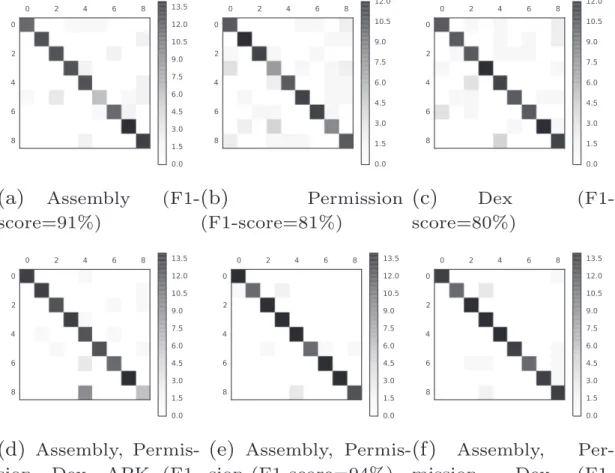
In addition to the previous evaluation metrics, we also use the confusion matrices in each evaluation, as shown in Figs. 8 and 9. Each confusion matrix is a square table, where the number of rows and columns are respectively the malware families and the benign apps following the same order as inTable 1. The columns and rows from 0 to 7 are respectively the malware families, AnserverBot, KMin, DroidKungFu4, GoldDream, Geinimi, BaseBridge, Droid-DreamLight, andDroidKungFu3, and the column and row 8 represent the benign apps. The interpretation of the confusion matrix results is related to the intensity of the color in itsdiagonal. The more the color is solid in the di-agonal, the higher and the more accurate are the results of the evaluation (true positive). The intensity of the color of a given cell in the confusion matrix represents the number of the malware/apps that have been assigned to this cell ac-cording to the color bar. However, the less solid is the color in thediagonaland the more solid in the other cells, the less accurate is the result.
False negative
For any row from 0 to 7 (i.e., malware family), there is a missed malware family attribution if we have a gray color in the other cells of the same row. Even though we missed the family attribution, we still detect the maliciousness of the app. However, a gray cell in column 8 (benign apps) means that we missed both the detection and the family attribution (detection false negative).
False positive
In the benign apps row (row number 8), a gray color in the malware cells indicates that there is afalse positive. In other words, there are benign apps that have been detected as malicious. The number of false positives could be measured using the intensity of the color according to the color bar.
Family-fingerprinting results
As depicted in Table 2, the F1-score, precision, and recall of thefamily-fingerprintingapproach vary according to the fingerprint setup. We evaluated the approach for each content type separately, i.e.,assembly,permission, and
dex files, so that we can clearly see the impact of each component in the final fingerprint. Both assembly and
permission types have shown more accurate results compared to dex type. Specifically, the permission has shown a very promising result, as shown inTable 2. This supports the impact of the metadata in Android malware detection. We believe that investigating other metadata could result in a higher accuracy. Another surprising result is APK, which has shown a poor accuracy value (under 40%). The learned lesson is that applying the fuzzy fingerprinting (including ssdeep) in the whole package could deceive the malware investigation using fuzzy matching. The confusion matrix for each setup shows a more granular view of the result, as shown inFig. 8, where the indexes are the malware families (Table 1). On the other hand, the combination setups have shown accurate results for most combinations. We depict three sub-fingerprints, which correspond to the best results. Note that the setup composed ofassembly,permission, anddex
byte-code shows the highestF1-Score.
Peer-matching results
Thepeer-matchingapproach shows a higher F1-score, precision, and recall for all the setups compared to the
family-fingerprintingone, as shown inTable 3. This can be clearly seen in the confusion matrices inFig. 9. In contrast with the previous results, thedexbyte-code shows a higher
precisionthanassemblyandpermission, but it is still lower in both recall and F1-score. The setup combination ( as-sembly,permission) has the highest accuracy in the peer-matching approach. As such, by using only two content categories, metadatapermissionand assemblyinstruction sequences, we achieved a very promising detection rate, especially that the computation of these sub-fingerprints is light and simple compared to state-of-the-artfingerprint hashing techniques.
Peer-voting vs mergedfingerprints
As presented in Section Peer fingerprint voting
technique, the most obvious technique to deal with mul-tiple sub-fingerprints is to merge all of them (merged
fingerprint). However, we proposepeer-votingtechnique to compare between multiple sub-fingerprints. To test the proposed technique, we evaluate it against the merged
fingerprintfor the samefingerprint setup. As shown inTable 4, thepeer-votingtechnique has shown a higher accuracy than the merging one. A more clear view of the result can be seen in the confusion matrix inFig. 10.
Discussion
Similarity computation based on family-fingerprinting
approach is bounded by the number of families, which is a way less than the number of malware samples. Conse-quently, this approach is more scalable compared to the
peer-matching one. However, the family-fingerprinting
approach suffers from two main drawbacks. First, its design is more complex compared topeer-matching since it re-quires an extra step to build the family-fingerprint data-base, even though we do not build the database for every new matching. Second, because of the rapid change of the malware database, we constantly need to update the family-fingerprint database with the new malwarefi nger-print features. On the contrary, thepeer-matchingapproach does not require an update since the new malwarefi nger-print is directly inserted. Regarding the peer-matching
approach, it mainly suffers from scalability issues since for each new malware, all the entries in the database need to be matched. Therefore, the query latency is related to the number of malwarefingerprints in the database. However, in terms of accuracy, thepeer-matchingapproach performs better than thefamilyfingerprintingone. Concerning APK-DNAfingerprint, the average computation of APK-DNA is 15 s with medium size APK using only one core of the CPU. Finally, regarding the detection threshold, we used afixed threshold to decide between malicious and benign apps based on our experimental results. Once an app is detected
as malicious, it is assigned to the malware class with the highest similarity.
Limitations and future work
With the current implementation of ROAR and its fingerprinting technique, we cannot detect new Android malware since our main goal is to detect variations of known malware. Naturally, if the adversary needs to develop new malware or use very sophisticated repacking techniques, this malware might not beflagged. However, this will dramatically increase the cost for the attacker to repack known malware. Moreover, as presented in Section Discussion, the latency of the peer-matching approach is higher compared to thefamily-fingerprintingapproach, and it linearly increases with the number offingerprints in the database. Furthermore, in the current implementation of the proposedfingerprint, we did not include thenative li-brary, a part of the binary sub-fingerprint. We plan to consider the native codefingerprint in future work, where we focus on Android malware that uses C/Cþþnative code.
Related work
Signature-based malware detection
Li et al., (2015) evaluated the effectiveness of fuzzy hashing for clustering malware and proposed a new block-Fig. 8.Confusion Matrices of Family-Fingerprint Approach for each Fingerprint Setup.
based distance computation algorithm. DroidMOSS (Zhou et al., 2012a) generates app-specificfingerprints to detect app modifications and computes similarity scores using edit distance. Crussell et al., (2013) proposed a system based onmin-hashingandLSHtechniques to improve the matching time.Hanna et al., (2012)proposed the use of Delvik VM assembly op-codes to compute a list of features and the similarity between inputted apps. Juxtapp (Hanna et al., 2013) uses feature hashing on the opcode sequence to determine if an app is malicious, contains copies of buggy or plagiarized code.Nayak et al., (2014)proposed a fuzzy approach to classify Android malware into: root exploit, information steal, premium SMS, trojan, and benign. Other signature-based contributions (Faruki et al., 2013, 2015; Ali-Gombe et al., 2015; Lindorfer et al., 2014a; Fig. 9.Confusion Matrices of Peer-Matching Approach for each Fingerprint Setup.
Table 2
Accuracy results of the family-fingerprinting approach (The best finger-print setup is in bold).
Fingerprint setup F1-Score Precision Recall
Assembly 69% 88% 68%
APK 33% 36% 32%
Permission 69% 84% 70%
Dex 41% 46% 43%
Assembly, Permission, Dex, APK 81% 88% 80% Assembly, Permission 82% 88% 81% Assembly, Permission, Dex 85% 89% 84% Best Fingerprint Setup 85% 89% 84%
Table 3
Accuracy result of peer-matching approach (The bestfingerprint setup is in bold).
Fingerprint setup F1-Score Precision Recall
Assembly 91% 91% 90%
Apk 46% 48% 44%
Permission 81% 82% 80%
Dex 80% 90% 84%
Assembly, Permission, Dex, APK 84% 91% 81% Assembly, Permission, Dex 93% 94% 93% Assembly, Permission 94% 95% 94% Best Fingerprint Setup 94% 95% 94%
Table 4
Accuracy result of ROAR using mergedfingerprint (The bestfingerprint setup is in bold).
Fingerprint setup F1-Score Precision Recall Merged in Family-Approach 72% 84% 72% Peer-Voting in Family-Approach 85% 89% 84% Merged in Peer-Approach 86% 87% 86% Peer-Voting in Peer-Approach 94% 95% 94%
Feng et al., 2014; Zhou et al., 2012b, 2013; Chen et al., 2015) have been proposed using different approaches. Most of these solutions consider only one content category of APK, for example, Juxtapp focuses on the assembly extracted from the DEX byte-code, (Crussell et al., 2013) considers malware'scode section, (Ali-Gombe et al., 2015) is limited to classes.dexfile, and (Crussell et al., 2013) does not consider third-party libraries. In contrast, our solution considers multiple content categories as well as the metadata, which allows APK-DNA to have much coverage on the static characteristics of the malicious apps.
Runtime-based malware detection
Vidas and al (Vidas and Christin, 2014; Vidas et al., 2014) explored various emulator and dynamic analysis techniques for Android systems based on differences in behavior, per-formance, components and system design. ANDRUBIS (Lindorfer et al., 2014b) analyzed over 1,000,000 Android apps based on extracted features and observed behaviors during runtime. Among many other runtime-based contri-butions, we can cite (Rastogi et al., 2013; Yan and Yin, 2012; Spreitzenbarth et al., 2015; Enck et al., 2014; Zhang et al., 2013; Zhang and Yin, 2014). Researchers in Ref. (Sufatrio et al., 2015) highlighted some of the challenges faced by dynamic analysis techniques on Android apps, such as, the need to simulate system events and the user's GUI re-sponses, time limit on how an app can be executed and observed, detection of the presence of Android virtualiza-tion or emulavirtualiza-tion systems by malicious applicavirtualiza-tions, in addition to scalability requirements of such detection sys-tems to evaluate an enormous amount of available apps.
Android malware classification
Peng et al., (2012)proposed a classification and proba-bilistic models for ranking risks for Android apps. DroidSIFT (Zhang et al., 2014) is a semantic-based system that classifies Android malware using dependency graphs. DroidAPIMiner (Aafer et al., 2013) extracts Android malware features at the API level and provides robust and light classifiers to mitigate
malware installations. Drebin (Arp et al., 2014) detects ma-licious applications based on Android permissions and sensitive APIs. The main difference with our work is that most existing approaches are based on machine learning techniques to generate models for malware detection and attribution. In contrast, we generate fuzzyfingerprints tofill the gap of existing signature techniques, such as MD5, ssdeep, etc. Our technique could be used in complementary to existing machine learning solutions where APK-DNA could be used as afirstfiltration phase.
Conclusion
In this paper, we have presented a comprehensive fuzzy fingerprinting approach for investigating Android malware variations. To this end, we have proposed APK-DNA, a novel fingerprint that captures not only the binary of theAPKfile, but also both its structure and semantics. This is of para-mount importance since it allowed the proposedfi nger-print to be highly resistant to app changes, which is a significant advantage compared to traditional fuzzy hash-ing techniques. Moreover, we have leveraged the proposed APK-DNA fingerprint to design and implement a novel framework for Android malware detection, following two different approaches, namely family-fingerprinting and
peer-matching. In addition to detecting malware variations, ROAR framework is also able to attribute the family of the detected malware. The evaluation of ROAR demonstrated very promising results, with high accuracy in terms of both malware detection and family attribution.
Acknowledgments
The authors would like to thank the anonymous re-viewers and Timothy Vidas for their insightful comments that allowed us to significantly improve this paper.
Appendix A. Supplementary data
Supplementary data related to this article can be found athttp://dx.doi.org/10.1016/j.diin.2016.04.013.
Fig. 10.Confusion matrices of ROAR approaches using mergedfingerprint. e
References
Aafer Y, Du W, Yin H. Droidapiminer: mining api-level features for robust malware detection in android. In: Security and privacy in communi-cation networks - 9th international ICST conference, SecureComm 2013, Sydney, NSW, Australia, September 25-28, 2013; 2013. p. 86e103. Revised Selected Papers.
Ali-Gombe A, Ahmed I, Richard III GG, Roussev V. OpSeq: android mal-warefingerprinting. In: Proceedings of the 5th program protection and reverse engineering workshop, PPREW-5, ACM, New York, NY, USA; 2015. 7:1e7:12.
Android Malware Genome Project (2015). URL http://www. malgenomeproject.org/.
Arp D, Spreitzenbarth M, Hubner M, Gascon H, Rieck K. Drebin: effective and explainable detection of android malware in your pocket. In: NDSS, the internet society; 2014.
Breitinger F, Baier H. Similarity preserving hashing: eligible properties and a new algorithm mrsh-v2. Digit Forensics Cyber Crime 2013:167e82. Breitinger F, Astebl K, Baier H, Busch C. mvHash-Bea new approach for similarity preserving hashing. In: IT security incident management and it forensics (IMF), 2013 seventh international conference on; 2013. p. 33e44.
Chen J, AlalfiMH, Dean TR, Zou Y. Detecting android malware using clone detection. J Comput Sci Technol 2015;30(5):942e56.
Cisco. Cisco 2014 annual security report. 2014. p. 1e81.http://tinyurl.com/ lfvm2ut.
Crussell J, Gibler C, Chen H. Andarwin: scalable detection of semantically similar android applications. In: Computer security - ESORICS 2013-18th European symposium on research in computer security, Egham, UK, September 9-13, 2013. Proceedings; 2013. p. 182e99.
Department of Defense Computer Forensics Lab (DCFL). dcfldd - latest version 1.3.4e1. 2016.http://dcfldd.sourceforge.net/.
Enck W, Gilbert P, Chun B, Cox LP, Jung J, McDaniel P, et al. Taintdroid: an informationflow tracking system for real-time privacy monitoring on smartphones. Commun ACM 2014;57(3):99e106.
Ericsson. Ericsson mobility report - on the pulse of the networked society. 2013. p. 4e7.http://tinyurl.com/zwoh8c6.
Faruki P, Laxmi V, Ganmoor V, Gaur MS, Bharmal A. Droidolytics: robust feature signature for repackaged android apps on official and third party android markets. In: Advanced computing, networking and security (ADCONS), 2013 2nd international conference on; 2013. p. 247e52.
Faruki P, Laxmi V, Bharmal A, Gaur MS, Ganmoor V. AndroSimilar: robust signature for detecting variants of Android malware. J Inf Secur Appl 2015;22:66e80.
Feng Y, Anand S, Dillig I, Aiken A. Apposcopy: semantics-based detection of android malware through static analysis. In: Proceedings of the 22nd ACM SIGSOFT international symposium on foundations of software engineering, (FSE-22), Hong Kong, China, november 16-22, 2014; 2014. p. 576e87.
Figuerola CG, Díaz RG, Berrocal JLA, Rodríguez AFZ. Web document duplicate detection using fuzzy hashing. In: Trends in practical ap-plications of agents and multiagent systems, 9th international con-ference on practical applications of agents and multiagent systems (PAAMS 2011) workshops; 2011. p. 117e25.
Getting Started with the NDK (2016). URLhttp://tinyurl.com/pah7pab. Hanna S, Huang L, Wu EX, Li S, Chen C, Song D. Juxtapp: a scalable system
for detecting code reuse among android applications. In: Detection of intrusions and malware, and vulnerability assessmente9th inter-national conference, DIMVA 2012, Heraklion, crete, Greece, July 26-27, 2012; 2012. p. 62e81. Revised Selected Papers.
Hanna S, Huang L, Wu E, Li S, Chen C, Song D. Juxtapp: a scalable system for detecting code reuse among android applications. In: Proceedings of the 9th international conference on detection of intrusions and malware, and vulnerability assessment, DIMVA’12. Berlin, Heidel-berg: Springer-Verlag; 2013. p. 62e81.
Jang J, Brumley D. BitShred: feature hashing malware for scalable triage and semantic analysis. Security 2011:309e20.
Kornblum JD. Identifying almost identicalfiles using context triggered piecewise hashing. Digit Investig 2006;3(Supp. 1):91e7.
Li Y, Sundaramurthy SC, Bardas AG, Ou X, Caragea D, Hu X, et al. Experimental study of fuzzy hashing in malware clustering analysis. In: Proceedings of the 8th USENIX conference on cyber security experimentation and test, CSET’15. Berkeley, CA, USA: USENIX Association; 2015. 8e8.
Lindorfer M, Volanis S, Sisto A, Neugschwandtner M, Athanasopoulos E, Maggi F, et al. Andradar: fast discovery of android applications in alternative markets. In: Detection of intrusions and malware, and vulnerability assessment - 11th international conference, DIMVA 2014, Egham, UK, July 10-11, 2014. Proceedings; 2014. p. 51e71.
Lindorfer M, Neugschw M, Weichselbaum L, Fratantonio Y, Veen VVD, Platzer C. Andrubis- 1,000,000 apps later: a view on current android malware behaviors. In: Proceedings of the 3rd international workshop on building analysis datasets and gathering experience returns for security, BADGERS 2014, Wroclaw, Poland, September 11th, 2014; 2014. Masud MM, Khan L, Thuraisingham B. A scalable multi-level feature extraction technique to detect malicious executables. In: IEEE int. Conf. Commun; 2007. p. 1443e8.
Nayak A, Yen K, Pons A. Fuzzy logic based android malware classification approach. Int J Comput Netw Secur 2014;24(1):8.
Peng H, Gates C, Sarma B, Li N, Qi Y, Potharaju R, et al. Using proba-bilistic generative models for ranking risks of android apps. In: Proceedings of the 2012 ACM conference on computer and com-munications security, CCS’12. New York, NY, USA: ACM; 2012. p. 241e52.
Rastogi V, Chen Y, Enck W. AppsPlayground: automatic security analysis of smartphone applications. In: Proceedings of the third ACM con-ference on data and application security and privacy, CODASPY’13. New York, NY, USA: ACM; 2013. p. 209e20.
A. Tridgell, P. Mackerras, The rsync algorithm, Joint Computer Science Technical Report Series TR-CS-96-0. URLhttp://tinyurl.com/zm5g5jw. V. Roussev, An evaluation of forensic similarity hashes, Digit Investig 8
(Suppl.).
Roussev V. Datafingerprinting with similarity digests. In: Advances in Digital forensics VI - sixth IFIP WG 11.9 international conference on Digital Forensics, Hong Kong, China, January 4-6, 2010; 2010. p. 207e26. Revised Selected Papers.
sdhash (2016). URLhttp://sdhash.org.
Spreitzenbarth M, Schreck T, Echtler F, Arp D, Hoffmann J. Mobile-Sandbox: combining static and dynamic analysis with machine-learning techniques. Int J Inf Sec 2015;14(2):141e53.
Sufatrio, Tan DJJ, Chua T, Thing VLL. Securing android: a survey, taxonomy, and challenges. ACM Comput Surv 2015;47(4):58.
Vidas T, Christin N. Evading android runtime analysis via sandbox detection. In: 9th ACM symposium on information, computer and communications security, ASIA CCS’14, Kyoto, Japan - June 03-06, 2014; 2014. p. 447e58.
Vidas T, Tan J, Nahata J, Tan CL, Christin N, Tague P. A5: automated analysis of adversarial android applications. In: Proceedings of the 4th ACM workshop on security and privacy in smartphones&mobile devices, SPSM@CCS 2014, Scottsdale, AZ, USA, November 03-07, 2014; 2014. p. 39e50.
Wang C, Shieh SW. DROIT: dynamic alternation of dual-level tainting for malware analysis. J Inf Sci Eng 2015;31(1):111e29.
Yan LK, Yin H. DroidScope: seamlessly reconstructing the OS and Dalvik semantic views for dynamic android malware analysis. In: Proceedings of the 21st USENIX conference on security sympo-sium, Security’12. Berkeley, CA, USA: USENIX Association; 2012. 29e29.
Zhang M, Yin H. Efficient, context-aware privacy leakage confinement for android applications withoutfirmware modding. In: 9th ACM sym-posium on information, computer and communications security, ASIA CCS’14, Kyoto, Japan - June 03-06, 2014; 2014. p. 259e70. Zhang Y, Yang M, Xu B, Yang Z, Gu G, Ning P, et al. Vetting undesirable
behaviors in android apps with permission use analysis. In: 2013 ACM SIGSAC conference on computer and communications secu-rity, CCS’13, Berlin, Germany, November 4-8, 2013; 2013. p. 611e22.
Zhang M, Duan Y, Yin H, Zhao Z. Semantics-aware android malware classification using weighted contextual api dependency graphs. In: Proceedings of the 2014 ACM SIGSAC conference on computer and communications security, CCS’14. New York, NY, USA: ACM; 2014. p. 1105e16.
Zhou Y, Jiang X. Dissecting android malware: characterization and evo-lution. In: Proc. - IEEE symposium on security and privacy (4); 2012. p. 95e109.
Zhou W, Zhou Y, Jiang X, Ning P. Detecting repackaged smartphone applications in third-party android marketplaces. In: Second ACM conference on data and application security and privacy, CODASPY 2012, San Antonio, TX, USA, February 7-9, 2012; 2012. p. 317e26. Zhou Y, Wang Z, Zhou W, Jiang X. Hey, you, get off of my market:
detecting malicious apps in official and alternative android markets. In: 19th annual network and distributed system security symposium, NDSS 2012, San Diego, California, USA, February 5-8, 2012; 2012. Zhou W, Zhou Y, Grace MC, Jiang X, Zou S. Fast, scalable detection of
piggybacked mobile applications. In: Third ACM conference on data and application security and privacy, CODASPY’13, San Antonio, TX, USA, February 18-20, 2013; 2013. p. 185e96.