Explaining and Forecasting Inflation in Turkey*
byIlker Domaç
Abstract
The growing adoption of an inflation targeting framework in emerging market economies has increased the importance of understanding inflation dynamics and forecasting its future path in these countries. This paper considers the case of Turkey and investigates the performance of models that have some theoretical foundations. To this end, the study focuses on mark up models, monetary models, and the Phillips curve. The findings suggest that the mark up models have the best in-sample performance followed by money gap models and the Phillips curve. The empirical results from out-of-sample forecasting performance for the period covering the new economic program (May 2001-December 2002), however, show that the Phillips curve and the money gap models perform better than mark-up models. These findings, in turn, imply that (i) Phillips curves augmented with the exchange rate and money models might provide complementary views in the Turkish context; and (ii) the relative importance of output gap and monetary disequilibrium in the inflation process has increased under the floating exchange rate regime. The results underscore the importance of relying on multiple models of inflation in the conduct of Turkish monetary policy.
JEL classification: E31; E37; E58; C53
World Bank Policy Research Working Paper 3287, April 2004
The Policy Research Working Paper Series disseminates the findings of work in progress to encourage the exchange of ideas about development issues. An objective of the series is to get the findings out quickly, even if the presentations are less than fully polished. The papers carry the names of the authors and should be cited accordingly. The findings, interpretations, and conclusions expressed in this paper are entirely those of the authors. They do not necessarily represent the view of the World Bank, its Executive Directors, or the countries they represent. Policy Research Working Papers are available online at http://econ.worldbank.org.
* I would like to thank Mark Griffiths and Tayyibe Gülek-Domaç for their helpful comments as well as Mustafa Eray Yücel for his valuable assistance.
Public Disclosure Authorized
Public Disclosure Authorized
Public Disclosure Authorized
Public Disclosure Authorized
1. Introduction
Why is our money ever less valuable? Perhaps it is simply that we have inflation because we expect inflation, and we expect inflation because we’ve had it.
—Robert M. Solow1
Contrary to many emerging market economies, which have experienced noticeable declines in inflation owing to a combination of relatively favorable external factors and implementation of sound domestic policies, Turkey is still attempting to curb chronic high inflation and attain price stability (Table 1). The absence of a permanent fiscal adjustment coupled with unsatisfactory progress with the implementation of key structural reforms lie at the heart of the chronic high inflation in Turkey. The experiences from a variety of approaches to stabilization adopted by emerging market economies (exchange rate-based orthodox programs and heterodox programs) also confirm that inflation does not stay permanently low in the absence of a permanent fiscal adjustment.2
Table 1. Evolution of the Inflation Rate in Selected Emerging Market Economiesa
1981-1990 1991-1995 1996-2000 2000 2001 2002 Turkey 46.3 79.3 74.1 54.9 54.4 45 Israel 118.3 12.9 6.4 1.1 1.1 5.7 South Africa 14.7 11.3 6.5 4.5 5.7 10 Korea 6.4 6.2 4.0 2.3 4.1 2.8 Malaysia 3.2 4.3 3.1 1.3 1.4 1.8 Thailand 4.4 4.8 4.3 1.5 1.7 0.6 Hungary 10.9 25.4 15.1 9.7 9.2 5.3 Chile 20.4 13.9 5.2 3.8 3.6 2.5 Mexico 69.1 18.0 19.4 9.5 6.4 5.0
a: Average inflation rates obtained from IMF WEO (2003) and the CBRT.
Evidence suggests that countries that adopted exchange rate based stabilization arrangements appear to have been more successful in bringing inflation down. This monetary regime, however, is prone to balance of payment crises as countries often fail to
implement macroeconomic policies that are consistent with the fixed exchange rate regime. Moreover, the increase in the degree of capital mobility coupled with greater financial openness and liberalization in emerging market economies has made it more difficult for central banks with finite reserves to defend a tight nominal exchange rate commitment. As a consequence, emerging market economies have been moving away from employing the exchange rate as a nominal anchor. In fact, it seems that many
emerging market economies, including Turkey, have opted for adopting inflation
targeting (IT) or some form of this monetary policy framework, in view of the success of
this regime in a number of industrial countries. The adoption of IT, however, entails that the central bank has a good understanding of inflation dynamics and is relatively successful in predicting the future path of inflation.
The vast literature on the causes of inflation includes competing models of the inflation process. To the best of my knowledge, however, there has not been any study investigating the relative performance of the main existing inflation models in Turkey. In light of the envisaged adoption of IT in Turkey, this paper attempts to fill this void by comparing the in-sample and out-of-sample performance of the models in order to shed more light on the inflation dynamics and its forecasting in Turkey. The approach of this study is to consider models that have some theoretical foundations so that models can be useful both for understanding the causes of inflation and for forecasting purposes.
Indeed, comparing the performance of several models is not only justified by the uncertainties inherent in the estimation of any particular model, but also by the approach followed by many central banks in practice. Blinder (1998, page 12) elaborates on the latter point by stating that his approach at the Federal Reserve Board when faced with
model uncertainty was to “Use a wide variety of models…My usual procedure was to
stimulate a policy on as many of these models as possible….” Judgment is then exercised
when evaluating the results from the different models. By the same token, Longworth and Freedman (2000) state that given model uncertainty and a changing environment, it is essential for central banks to rely on a variety of models in conducting policy.
The remainder of the paper is structured as follows. The next section, which focuses mainly on the empirical literature, provides a cursory discussion of the determinants of inflation in emerging market economies including Turkey. Section 3 discuses the main models of inflation. Section 4 presents in-sample estimation results of the models of interest. Section 5 summarizes the out-of-sample performance of these models. Finally, Section 6 concludes the paper.
2. A Cursory Look at the Determinants of Inflation
There is a consensus that, in the long run, inflation is a monetary phenomenon. Within the framework of developing countries, however, the nature of the mechanisms underlying the dynamics of inflation has stimulated much discussion between the monetarists and structuralists since the early 1960s. Key aspects of the debate in recent years have been the interactions—and inconsistency—between fiscal, monetary, and exchange rate policies; structural factors (such as the existence of wage and price inertia); credibility problems; and the stance of expectations regarding future policies. The following sub-sections provide a brief overview of the empirical studies focusing on emerging market economies and Turkey.
2.1 The Case of Emerging Market Economies
Studies in this strand of the literature suggest that contrary to industrial countries, where real factors emerge as the main determinants of inflation, nominal factors play a more important role in affecting the evolution of inflation in emerging market economies. For instance, the IMF (1996) shows that the output gap does not play an important role in explaining inflation in developing countries. Instead, changes in money growth and nominal exchange rates have higher explanatory power in explaining inflation. This finding does not suggest that inflation is not a function of excess demand in these countries; it simply implies that the contribution of excess demand is dominated by those of nominal shocks. More precisely, inflation in the medium term is viewed as the result of the government financing its deficit through the creation of money or through time inconsistent monetary policy.
The empirical evidence concerning the link between fiscal deficits and inflation has been rather elusive in spite of the theoretical links. At the level of any particular country, it may be difficult to establish a clear short-term link between fiscal deficits and inflation. In fact, the correlation may be even negative during extended periods of time. Evidence suggests that the existence of a positive correlation in the long-run is also not a clear-cut phenomenon (Agenor and Montiel, 1999). For instance, Fisher, Sahay, and Vegh (2001) find that the relationship between the fiscal deficit and inflation is only strong in high inflation countries—or during high inflation episodes—but they find no obvious relationship between fiscal deficits and inflation during low inflation episodes or for low-inflation countries.
A recent study by Catao and Terrones (2001), however, was successful in relating long-run inflation to the permanent component of the fiscal deficit scaled by the inflation tax base, measured as the ratio of narrow money to GDP. Their finding suggest that a 1 percent reduction in the ratio of the fiscal deficit to GDP typically lowers inflation by 1.5 to 6 percentage points depending on the size of the money supply.
One of the main focuses of the literature has been central bank independence. It is argued that a lack of central bank independence can lead to succumbing to political considerations that may lead to a monetary policy looser than optimal. For instance, if there is a perception that pursuing expansionary monetary policy can increase output, politicians could put pressure on the central bank—say during the election period—to trade off a boost to growth against higher inflation. In fact, the IMF (1996) finds that inflation performance between 1975 and 1995 in industrial countries is negatively correlated with an index of central bank independence. However, the findings of this study also suggest that the same relationship did not hold over the same period for developing countries. This conclusion may be attributed to imprecision in the
measurement of central bank independence arising from a divergence between de jure
and de facto central bank independence in these countries.3
In fact, a recent study by Gutierrez (2003) explores the relationship between inflation performance and the level of independence of the central bank entrenched in the constitution as opposed to the de jure independence established in the central bank law. Her results suggest that Latin American countries that entrench the independence of the central bank in the constitution tend to have lower inflation, even after controlling for
other factors.4 Central bank independence, however, cannot, by itself, ensure the credibility of monetary policy, which hinges on the overall stance of macroeconomic policy. For example, if the fiscal policy is deemed to be inconsistent with the inflation target, credibility is impossible to attain, even with an independent central bank.
Changes in the exchange rate are one of the key determinants of inflation in emerging market economies. The pass-through of a depreciation into domestic prices in these countries could be much larger than the share of imported goods in the consumption basket would indicate. This is because an increase in the price of imports in the face of a depreciation would also affect inflation expectations. An increase in inflation expectations, in turn, would tend to depreciate the exchange rate as agents buy foreign currency to maintain purchasing power. In view of this feedback between the exchange rate and domestic prices, a country can easily fall victim to a vicious circle of depreciation and inflation. As a consequence, many countries have adopted fixed exchange regimes in an effort to break this cycle. Although this strategy is often successful in the short-run, it is vulnerable to balance of payment difficulties later on if macroeconomic policies are not consistent with the exchange rate.
Inflation expectations are an important component of the inflation process. High and chronic inflation can engender institutional changes, thereby leading to a high degree of indexation in the areas of the labor market, financial assets, housing, and the foreign exchange. Although indexation is not an independent source of inflation, it can enhance the persistence of nominal shocks.
4 Typically constitutions are better enforced than ordinary laws in view of their superior legal rank. Furthermore,
A number of empirical investigations have attempted to shed light on the determinants of inflation in emerging market economies. Lougani and Swagel (2001) employed vector autoregressions (VARs) to study the experience of 53 developing countries between 1964 and 1998. They estimate VARs consisting of the following variables: (i) money growth and exchange rates; (ii) the output gap and a measure of the world business cycle; (iii) changes in the price of oil and non-oil commodities; and (iv) past realizations of inflation. Their findings suggest that either money growth or exchange rate movements—depending on the ordering—explain two-thirds of the variance of inflation at both short and long horizons. Their results indicate that inflation expectations also play an important role in the inflation process in developing countries: past realizations of inflation explain between 10 and 20 percent of inflation movements. Overall, their findings suggest that cost shocks or the output gap are not significant factors affecting the evolution of inflation in these countries.
By contrast, Mohanty and Klau (2001), who study the experience of 14 emerging market economies in the 1980s and 1990s, find that exogenous supply shocks—in particular those to food prices—play an important role in the inflation process. Food prices typically account for a larger percentage of the CPI in emerging market economies than in industrial countries. Furthermore, food prices tend to be very volatile owing to the influence of weather and the presence of trade restrictions. Their results suggest that demand factors, captured by the output gap and excess money, do not play a significant role in the inflation process. Wage growth and exchange rate changes, on the other hand, appear to make important contributions to inflation volatility in many countries. Their
findings also indicate that inflation persistence plays an important role in explaining both the average level of inflation and its variation.
2.2 The Case of Turkey5
The Turkish economy has been undergoing chronic high inflation since the 1970s. Indeed, starting from the 1970s, the inflation rate displayed an upward trend and reached its peak of 120 percent in 1994 in the aftermath of an exchange market crisis.6 The evolution of inflation in Turkey can be divided into four sub-periods: (i) the period during which price developments were influenced by financial liberalization and the deteriorating current account outlook (1989-1993); (ii) the 1994 currency crisis and worsening debt dynamics (1995-1999); (iii) the exchange-rate based stabilization program and its collapse (2000- February 2001); and (iv) the adoption of the floating regime in February 20001, which was followed by the inception of the Economic Program for Strengthening the Turkish Economy in May 2001.
Between 1989 and 1993, prior to the 1994 crisis, inflation rate hovered around 60 percent. After the 1994 crisis, the inflation rate moved to an upper plateau in the 80 percent range. Inflation began to fall back towards the 60 percent range at the outset of 1998 due mainly to the fiscal retrenchment along with the sharp contraction in economic activity.7
In an attempt to stabilize the Turkish economy, which was plagued by chronic high inflation and real interest rates as well as deteriorating debt dynamics, the authorities launched an exchange rate based stabilization program in January 2000. The program
5This section draws mainly upon Bahmani-Oskooee and Domaç (2003).
also included some heterodox measures in the context of public prices and new rent regulations in the housing sector in line with the targeted inflation rate with an objective to reduce consumer price inflation to 25 percent by the end of 2000.
Although there was some success in reducing inflation—the CPI inflation declined to 33.4 percent on an annual basis by February 2001—weaknesses in the banking system, the severe terms of trade shock along with the deterioration of the macroeconomic vulnerabilities all contributed to the collapse of the program. As a result, a floating exchange rate regime was adopted on February 22, 2001.
In high-inflation countries like Turkey, the question of why prices increase lies at the heart of the debate over which policies should be adopted to stabilize the price level. As was pointed out earlier, the notion that inflation is ultimately a monetary phenomenon is widely accepted. There is strong evidence that in the medium and long term, there exists a very close correlation between the rate of growth of monetary aggregates and inflation, after changes in output and velocity are taken into consideration. This correlation has been corroborated both in the international8 and the Turkish experiences (Figure 1).
At first blush, the above discussion might suggest that it would be relatively straightforward for the central bank to eliminate inflation in light of its influence on the behavior of monetary aggregates, the monetary base in particular. The close correlation between money and prices, however, does not reveal anything about the direction of causality.9
7See the Inflation Report published by the Central Bank of Turkey (CBRT) in July 2000 for more on this. 8See for instance Lucas (1996).
9In fact, the results of Granger Causality tests show that the causality runs from prices to base money (Monetary Policy
Figure 1
Base Money Growth and Inflation
20 40 60 80 100 120 140 91 92 93 94 95 96 97 98 99 00 01 02 Inflation (y-o-y)
Base money growth (y-o-y)
In this respect, consistent with the experience of other countries with high-inflation episodes—i.e., Mexico and Brazil—recent empirical evidence on Turkey suggests that exogenous movements to monetary base have not been a cause of
inflationary pressures in Turkey.10 The empirical findings show that inflationary
pressures in Turkey have their origin in the following factors: (i) the presence of external shocks that engender sharp exchange rate depreciations; (ii) changes in public sector prices; and (iii) inflationary inertia.11
10 See the Monetary Policy Report published by the CBRT in April 2002. Existing studies, see for instance Lim and
Papi (1997), Sakallıoğlu and Yeldan (1999), Özcan et. al. (2001), tend to agree upon the importance of the inertia and the exchange rate. However, there seems to be a disagreement over the importance of monetary variables.
11The above-mentioned indirect transmission channel through which shocks to exchange rates and public prices can
influence inflation expectations in Turkey can be illustrated by the following example. Let us assume that the central bank faces an exogenous shock in the form of unanticipated adjustments to administered prices that are not compatible with the central bank’s inflation target. In turn, this will generate a higher CPI, thereby raising nominal demand for money. If the central bank increases the supply of base money to match the increase in demand, the central bank would have accommodated the rise in money demand engendered by an exogenous shock to prices caused by the increase in public prices. Under normal circumstances, this would be described as once for all adjustment in the price level, which should not create further problems for the central bank. However, given Turkey’s history of high inflation, the dynamics triggered by the increase in public prices are complicated as the public might revise their inflationary
3. Models of Inflation
A quick glance at the literature points to three classes of models for inflation determination.12 The first view envisions inflation as a cost-push phenomenon in the context of a long-term constant mark-up over costs. The second view considers inflation mainly as a monetary phenomenon and links changes in monetary variables to those in prices. Finally, the third view envisages inflation as stemming from real factors, imbalances between aggregate demand and supply in particular. A review of the empirical studies suggests that the first type of model has been frequently employed in emerging market economies, while the other two have been typically—but not exclusively—used in industrial countries. The next section will provide a brief discussion of these three classes of models.
3.1 Mark-up Models
Goodfriend (1997) provides a comprehensive discussion of the theoretical underpinnings of the mark-up model. These types of models, in which the price level is determined by costs and a given mark-up, take the following form:
Pt = µt(Wt)γw(EtP*t)γe (1)
where P, µ, W, E, P* stand for the domestic level of prices, the mark-up over costs,
wages, the nominal exchange rate, and the level of foreign prices, respectively.13 The above equation arises from the maximization problem of a firm that faces a demand curve
expectations upwards, which would lead to increases in wages and non-tradeable goods prices, and thus bringing about inflation and monetary base growth.
12This section draws largely on Bailliu et al. (2002). 13EP* is a measure of foreign prices expressed in Turkish lira.
with a negative slope. Under this framework, the firm sells at a price equal to a given mark-up above marginal cost which is determined by the price of domestic inputs, captured by domestic wages, and the price of foreign inputs, reflected in the level of foreign prices.
When expressed in logarithms, the domestic price amounts to a weighted average of nominal wages and foreign prices (expressed in local currency):
pt= ln(µt) + γw wt + γe(et+p*t) + εt (2)
where lower case letters represent the variables in logarithmic form. The above estimation provides a basis for estimating a long-run relationship between prices, wages, and foreign prices under the assumption that the mark-up is constant or fluctuating randomly around a given long-run value.
In the short-run and medium-run, however, there could be significant and persistent fluctuations in the mark-up depending on the speed of adjustment of price setters to changes in wages or in foreign prices. As a result, it is important to consider more complex dynamics when working with monthly or quarterly inflation rates, which would amount to the following form:
∆pt= αp∆pt-1 +αw∆wt+αe∆(et+p*t)- δ(pt-1- γw wt-1 + γe(et-1+p*t-1)) + νt (3)
where the lagged term reflects the inflationary inertia, contemporaneous changes in wages and foreign prices are included to incorporate immediate adjustments. Finally, the above equation embodies an error correction term to capture the long-term relationship included in equation (2).
The mark-up model has been employed widely to study the inflation process in a number of emerging market economies. For instance, Perez-Lopez (1996) and Garces (1999) relied on the mark-up model to investigate the determinants of inflation in Mexico. The latter author includes additional variables such as the changes in the administered prices, a simple measure of output gap along with a cointegration term reflecting deviations from a long-run relationship among the domestic price level, the foreign price level in domestic currency, and the level of wages for the period 1985-1998. Garcia and Restrepo (2001) as well as Springer and Kfoury (2002) employ the mark-up model for Chile and Brazil, respectively. Evidence suggests that mark-up models have performed well in the case of Latin American countries in terms of their in-sample and out-of-sample fit to historical series.14
3.2 Monetary Models
Monetary models are based on the view that inflation is in essence a monetary phenomenon. Monetarist analysis indicates that a monetary disequilibrium exists if the quantity of money in the economy is greater than what the public desires to hold. Under such a situation, monetary models assert that the price level will increase to re-establish the equilibrium between supply and demand for money. As a consequence, an excess supply of money can lead to inflationary pressure in much in the same way that an excess demand for goods does. Monetary disequlibria is typically captured by using the money gap, which is the difference between the actual money supply and the estimated long-run money demand.
14 The adoption of the inflation targeting regime in Chile and Brazil, however, appears to have led to parameter
Money gap is usually specified in two different ways in empirical studies. In the case of countries for which the money demand is stable, the following partial adjustment framework can be considered:
mgapt= mst-mdt (4)
mdt= vo + v1yt –v2it – v3 mdt-1 (5)
In the above equations, mst, mdt, are the natural logarithm of demand for and supply of
money, respectively, y is the logarithm of real GDP and i are the nominal short-term interest rates. In the case of countries where a stable demand for money function does not exist, a real money gap variable is constructed by the following expression:
mgapt= mt - mTRt (6)
where the money gap is defined as the deviation of the actual real money supply from its trend value. In view of the absence of a stable money demand function for Turkey, I rely on the second approach employed by Mohanty and Klau (2001) and consider the following model: (7) α
β
∆
p
γ
moneygap
ε
∆
p
i t i t n 0 i i t i n 1 i t= +∑
= − +∑
= − +where the key variable is the money gap, which aims to capture the impact of the channel for the monetary disequilibrium on the dynamics of price changes. It should be noted that it would not be appropriate to include the exchange rate depreciation as an additional term in the money-gap model. This is because an excess demand for money should translate into higher demand for goods, generating domestic price pressures, and also higher demand for other assets such as foreign currency, leading to a depreciation of
the domestic currency. As a result, a theoretically consistent money-gap model should be able to explain change in both tradable and non-tradable goods prices.15
A number of studies have applied monetary models to industrial countries. Altmari (2001) is a recent example of such an application. He investigates the performance of a number of monetary models of inflation for the euro area over the period 1998 to 2000. His findings suggest that monetary and credit aggregates contain significant information to forecast inflation in the euro area, particularly at medium-term horizons. Using structural VAR analysis studies by Kasumovich (1996) as well as Fung and Kasumovich (1998) show that a monetary policy shock leads to a persistent money disequlibrium, which is closed as prices adjust over a number of years.16
Jonsson (1999) and Callen and Chang (1999) are examples of this strand of the empirical literature focusing on emerging market economies. The former study concludes that an increase in the money supply raises domestic prices in South Africa although this effect is somewhat compensated by an increase in domestic interest rates. The latter study considers two models of inflation in India—one based on the monetary approach and the other using the output gap. Their results suggest that monetary aggregates contain the best information about future inflation and that output gap is not a significant explanatory power.
Nevertheless, monetary models should be used with caution since financial innovations can lead to instability in the money-inflation relationship. Furthermore, in the presence of a high short-run interest elasticity of money with respect to interest rates, it may well be the case that the required interest rate increase to bring money back to its
15Moreover, if the exchange rate is partly driven by the evolution of money, the inclusion of both variables would
target is not sufficient to reduce spending and inflation. As pointed out by King (2002), however, there are good reasons for considering models based on money growth. First, although models based on monetary aggregates may not perform well in forecasting inflation, they tend to perform better as indicators of long-run inflationary pressures. Second, expansion of the monetary base may be the only way to relax monetary conditions at low rates of inflation coupled with the possibility of a liquidity trap and interest rates close to zero.
3.3 Phillips Curve
The development of contemporary inflation theory was greatly influenced by the development of the Phillips curve model. The original contribution by Phillips (1958) concluded that, on the basis of empirical observations for Great Britain, there is a negative correlation between the rate of change in money wages and the rate of unemployment and that this relationship was stable. The theoretical foundation of the Phillips curve was developed by Lipsey (1960), who derived the Phillips curve from a supply and demand system of a single labor market. In the decade or so following its inception, the Phillips curve was subject to many modifications. For example, the inverse of unemployment rate was substituted by the unemployment/output gap as the proxy for excess demand. Moreover, with Friedman’s contribution in 1968, the role of expectations in affecting wage changes was acknowledged and as a result inflation expectations were incorporated into the Phillips curve. Finally, it was converted from a wage equation to a price inflation equation.
As was pointed out by Gordon (1997), the Phillips curve summarizes the dependence of inflation on three basic factors: inertia, demand, and supply. This Phillips curve framework is often referred to as the traditional Phillips curve to separate it from the new Phillips curve.17 The new Phillips curve in spirit is similar to the traditional Phillips curve as it also links inflation positively with economic activity. However, the new Phillips curve differs from the traditional Phillips curve as it relates inflation to movements in real marginal cost in lieu of the output gap. Proponents of the new Phillips curve argue that this framework is more adequate since it is obtained from a model of staggered nominal price setting by monopolistically competitive firms, and thus has more solid theoretical foundations. Gali et al. (2001), however, show that by imposing certain restrictions on technology and labor market structure, and within a local neighborhood of the steady state, real marginal cost is proportionally related to the output gap.
The traditional Phillips curve’s popularity arises from, in part, its relative success as a forecasting tool. Stock and Watson (1999) argue that “As a tool for forecasting inflation, it is widely regarded as stable, reliable and accurate, at least compared to the alternative.” In parallel to the widespread use of the traditional Phillips curve for industrial countries, recent studies by Coe and McDermott (1999) and Simone (2000) have considered emerging market economies. The former study estimates Phillips curve based on output gaps for 13 Asian countries. Their findings indicate that the output gap is a significant determinant of inflation in 11 out of 13 countries even after controlling for other variables such as monetary disequlibria. The latter investigation estimates time varying Phillips curves for Chile. His conclusions suggest that although the model,
which includes the pre-announced inflation target, displays some autocorrelation, it outperforms the model that excludes this variable in forecasting exercises.
In this paper, I employ a specification for the traditional Phillips curve that links inflation to inflation expectations, some measure of disequilibria and a variable reflecting changes in imported prices since Turkey is a relatively open economy. Under the assumption that expectations are formed adaptively and that the relationship is linear, one can employ lagged inflation as a proxy for inflation expectations and obtain the following specification: ) 8 ( ) ( ) ( ) ( 3 2 1
π
β
β
ε
β
π
α t t t t t= + L + Lgap
+ L∆
s
+where πt is the inflation rate at time t, L is the lag operator, gapt is the output gap at time t,
and st is the nominal exchange rate.
4. In-Sample Estimation Results of the Three Models for Turkey
This section summarizes the estimation results for the three models of inflation and compares their in-sample performance. Each model is estimated using monthly data
covering the period 1990.01- 2002.12.18 Throughout the investigation, I include two
dummy variables, one for 1994.4 and the other for 2001.4, to account for the sharp increases in inflation. As Perron (1989) indicates, it is important to include dummy variables, which allow the coefficient of intercept ortrends to shift in response to large shocks. Appendix 1 presents the variables involved in the investigation and Appendix 2 depicts their evolution over the sample period.
4.1 Mark-up Model
In an attempt to investigate the short-run and the long-run properties of the mark-up model, I employ the approach known as the Autoregressive Distributed Lag (ARDL) put forth by Peseran and Shin (1997). The main advantage of this strategy is that it can be applied irrespective of whether the series are I(0) or I(1), and this avoids the pre-testing problems related with the unit roots and standard cointegration analysis. The ARDL procedure appears to perform better than the fully modified OLS approach of Phillips and Hansen (1990) in small samples. Moreover, another advantage of the ARDL model is that, in the case of first-difference stationary variables, appropriate augmentation of the order of the regressors is sufficient to simultaneously correct for residual serial correction and the endogeneity problem in the estimation of the long-run parameters.
In practice, the estimation involves two steps. The first stage of the process involves establishing the existence of a long-run relationship between the variables and is tested by considering the joint significance of the coefficients of the lagged level variables in the following equation:
(9) ) ( ) ( * 1 1 2 1 3 1 *1 1 1 1 0
θ
ζ
ϑ
δ
δ
δ
ε
α
i t i t i t t t t t n i i t i n i tw
e
p
P
w
e
p
p
= + t+ ∆ + ∆ + + + + + + ∆∑
= −∑
= − − − − − −The null hypothesis of “non-existence of the long-run relationship” defined by H0:
δ1=δ2=δ3=0 is tested against the alternative of H1: δ1≠δ2≠δ3≠0. The relevant statistic to
test the null is the familiar F-statistic. The asymptotic distribution of this F-statistic, however, is non-standard irrespective of whether the variables are I(1) or I(0). Peseran et
18This period is selected due to data availability. In particular, the monthly data for wage series in Turkey is available
al. (1986) have tabulated two sets of appropriate critical values. One set assumes that they are all I(0). This provides a band covering all possible classifications of the variables into I(1) and I(0) or even fractionally integrated. If the calculated F-statistic lies above the upper level of the band, the null is rejected, indicating co-integration. If the calculated F-statistic falls below the lower level of the band, the null cannot be rejected, supporting lack of cointegration. If the calculated F-statistic falls within the band, the result is inconclusive. Under this case, following Kremers et al. (1992), the error correction term will be a useful way of establishing cointegration.
Once we have established the existence of cointegration, we move to the second stage of the procedure, which involves estimating the error-correction model. The main objective here is to investigate the short-run dynamics.
In this paper, following Garces (1999), I also include the administered prices (ap) in the mark-up model (hereafter mark-up model II) in view of its importance in the inflation process in Turkey. In the estimations, I consider 8 lags for both versions of the
mark-up model.19 In the case of the mark-up I model, the calculated F-test is 5.16,
suggesting that variables of interest are cointegrated. The calculated value of the F-test in the mark-up model II (6.03) also exceeds the upper bound of the critical value band, thus supporting the existence of a long-run relationship among the variables involved.
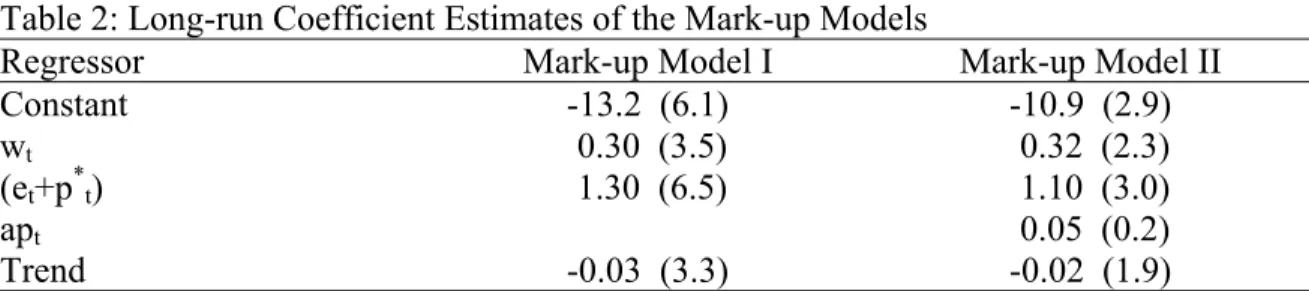
Table 2 reports the estimated long-run models of inflation using the ARDL procedure, in which Akaike’s Information Criterion (AIC) is employed to select the lag length.
Table 2: Long-run Coefficient Estimates of the Mark-up Models
Regressor Mark-up Model I Mark-up Model II
Constant -13.2 (6.1) -10.9 (2.9)
wt 0.30 (3.5) 0.32 (2.3)
(et+p*t) 1.30 (6.5) 1.10 (3.0)
apt 0.05 (0.2)
Trend -0.03 (3.3) -0.02 (1.9)
a: Numbers inside the parentheses are absolute values of the t-ratios calculated by using the asymptotic standard errors of long-run coefficients.
In the case of mark-up model I, empirical results suggest that a 1 percent rise in wages will increase the price level by 0.3 percent in the long-run. The findings indicate that the long-run impact of a rise in foreign price on the domestic price level is considerably higher: a 1 percent increase in (et+p*t) will raise the price level by 1.3
percent. These findings document the importance of the exchange rate on the evolution of the price level in Turkey. The empirical findings for the mark-up II are fairly similar to that of mark-up model I, confirming the significance of the exchange rate on the evolution of the price level in Turkey.
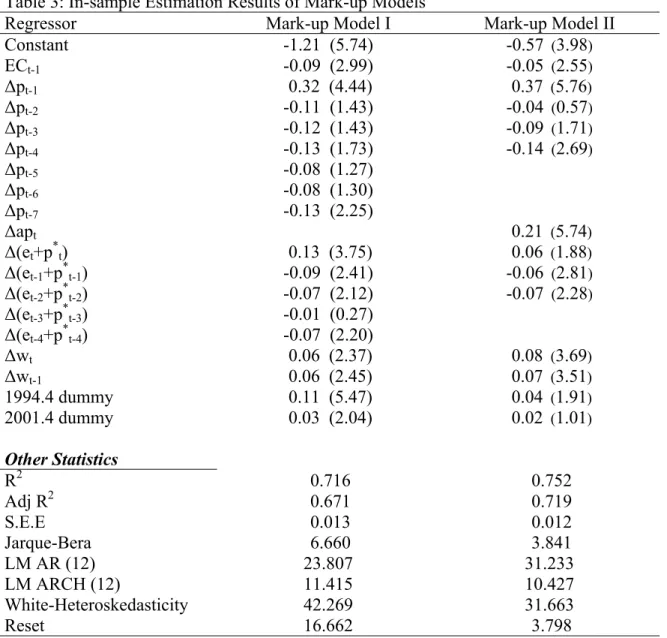
Table 3 presents the results of the corresponding error correction models to investigate the short-run dynamics. In this stage, I also rely on the AIC to select the lag length of each variable.
Table 3: In-sample Estimation Results of Mark-up Modelsa
Regressor Mark-up Model I Mark-up Model II
Constant -1.21 (5.74) -0.57 (3.98) ECt-1 -0.09 (2.99) -0.05 (2.55) ∆pt-1 0.32 (4.44) 0.37 (5.76) ∆pt-2 -0.11 (1.43) -0.04 (0.57) ∆pt-3 -0.12 (1.43) -0.09 (1.71) ∆pt-4 -0.13 (1.73) -0.14 (2.69) ∆pt-5 -0.08 (1.27) ∆pt-6 -0.08 (1.30) ∆pt-7 -0.13 (2.25) ∆apt 0.21 (5.74) ∆(et+p*t) 0.13 (3.75) 0.06 (1.88) ∆(et-1+p*t-1) -0.09 (2.41) -0.06 (2.81) ∆(et-2+p*t-2) -0.07 (2.12) -0.07 (2.28) ∆(et-3+p*t-3) -0.01 (0.27) ∆(et-4+p*t-4) -0.07 (2.20) ∆wt 0.06 (2.37) 0.08 (3.69) ∆wt-1 0.06 (2.45) 0.07 (3.51) 1994.4 dummy 0.11 (5.47) 0.04 (1.91) 2001.4 dummy 0.03 (2.04) 0.02 (1.01) Other Statistics R2 0.716 0.752 Adj R2 0.671 0.719 S.E.E 0.013 0.012 Jarque-Bera 6.660 3.841 LM AR (12) 23.807 31.233 LM ARCH (12) 11.415 10.427 White-Heteroskedasticity 42.269 31.663 Reset 16.662 3.798
a: Numbers inside the parentheses are absolute values of the t-ratios.
In the case of mark-up model I, the lagged error-correction term (ECt-1) has a size
of 0.09, which is negative and statistically significant, suggesting a relatively fast convergence to the long-run equilibrium in the face of shocks. The error-correction term in the mark-up model II also carries its correct negative sign and is statistically significant, supporting the existence of a long-run relationship among the variables involved. The ARDL error-correction term in the mark-up model II, however, has a
slightly lower coefficient (-0.05) than the mark-up model I (-0.09), suggesting a somewhat slower return to the long-run equilibrium compared with the mark-up model II.
4.2 Money-gap Model
In the case of Turkey, the money gap measure can be constructed for almost any definition of money. As a result, I consider three definitions of monetary aggregates,
namely the monetary base (mb), M1, and M2.20 I construct a real money gap variable,
measured as the proportionate deviation of the actual real money supply from its trend value, obtained using the Hodrick-Prescott (HP) filter. The corresponding money gap measures for the three monetary aggregates will be referred to as mgapmbt, mgapm1t, and
mgapm2t.
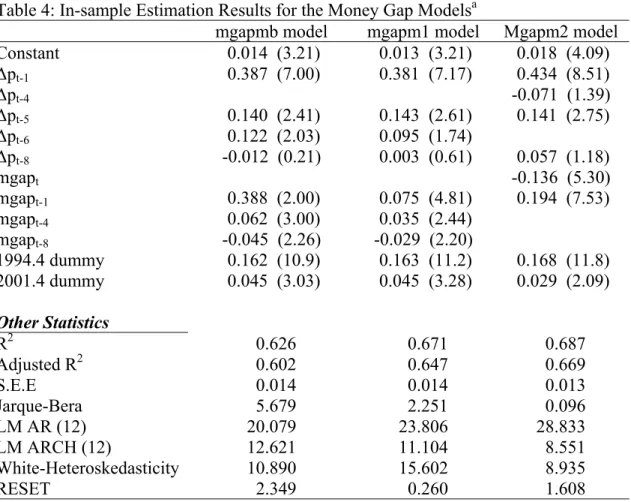
I rely on the AIC to select the appropriate lag length for each variable in estimating equation (7). In this respect, the investigation considers all possible combinations up to 8 lags and then employs the combination that minimizes the AIC.21 Given that the objective of the paper is to examine models that can be employed both to explain and forecast inflation, I decided to use the parsimonious specifications chosen by the AIC.
Table 4 reports the results of this analysis. As expected, the impact of an increase in the money gap on inflation is positive and is estimated at around 0.4 percent, 0.081 percent, and 0.11 percent (including both the lagged and contemporaneous coefficients), respectively for the monetary base, M1, and M2 based measures of money gap.
20M2Y definition of money supply, which includes foreign exchange deposits, is not considered since this aggregate is
affected by the evolution of the exchange rate.
21It should be noted that this exercise involves running 130,305 regressions. The general formula for the number of
regressions involved can be written as (2n-1)(2n+1-1)m where n and m are the number of lags considered and number of
Table 4: In-sample Estimation Results for the Money Gap Modelsa
mgapmb model mgapm1 model Mgapm2 model
Constant 0.014 (3.21) 0.013 (3.21) 0.018 (4.09) ∆pt-1 0.387 (7.00) 0.381 (7.17) 0.434 (8.51) ∆pt-4 -0.071 (1.39) ∆pt-5 0.140 (2.41) 0.143 (2.61) 0.141 (2.75) ∆pt-6 0.122 (2.03) 0.095 (1.74) ∆pt-8 -0.012 (0.21) 0.003 (0.61) 0.057 (1.18) mgapt -0.136 (5.30) mgapt-1 0.388 (2.00) 0.075 (4.81) 0.194 (7.53) mgapt-4 0.062 (3.00) 0.035 (2.44) mgapt-8 -0.045 (2.26) -0.029 (2.20) 1994.4 dummy 0.162 (10.9) 0.163 (11.2) 0.168 (11.8) 2001.4 dummy 0.045 (3.03) 0.045 (3.28) 0.029 (2.09) Other Statistics R2 0.626 0.671 0.687 Adjusted R2 0.602 0.647 0.669 S.E.E 0.014 0.014 0.013 Jarque-Bera 5.679 2.251 0.096 LM AR (12) 20.079 23.806 28.833 LM ARCH (12) 12.621 11.104 8.551 White-Heteroskedasticity 10.890 15.602 8.935 RESET 2.349 0.260 1.608
a: Figures in parentheses are the absolute value of the t-ratios.
4.3 Phillips Curve
In estimating equation (8), I use the nominal USD exchange rate and a measure of the output gap estimated by Paşaoğulları and Yurttutan (2002). Their study employs Kalman Filter methodology by following the same approach taken by Boone et al. (2002).22 In the estimation, I rely on the AIC to select the lag length of each variable. In this respect, the investigation considers all possible combinations up to 8 lags and then
22Output gap measure in original series is quarterly, which are converted into monthly frequency using RATS 5.0
distrib procedure. This procedure maintains the sum of three months equal to the value at the quarter. We have adjusted so that the average of three months, rather than the sum, is equal to the quarter value. For example, the average of output gap measure for the first three months of 2000 will be equal to the output gap at the first quarter of 2000.
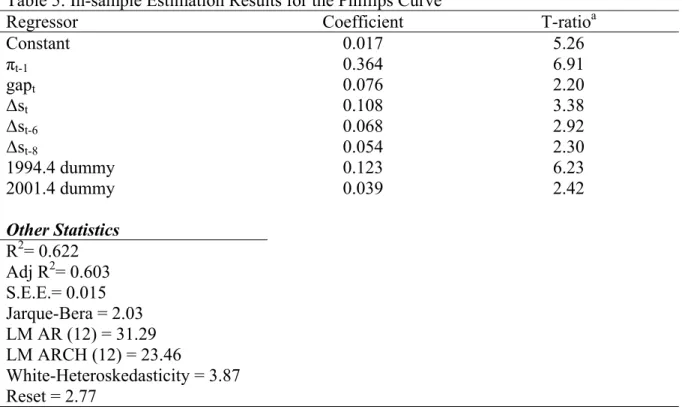
employs the combination that minimizes the AIC.23 Table 5 reports the parsimonious specification chosen by the AIC.
Table 5: In-sample Estimation Results for the Phillips Curvea
Regressor Coefficient T-ratioa
Constant 0.017 5.26 πt-1 0.364 6.91 gapt 0.076 2.20 ∆st 0.108 3.38 ∆st-6 0.068 2.92 ∆st-8 0.054 2.30 1994.4 dummy 0.123 6.23 2001.4 dummy 0.039 2.42 Other Statistics R2= 0.622 Adj R2= 0.603 S.E.E.= 0.015 Jarque-Bera = 2.03 LM AR (12) = 31.29 LM ARCH (12) = 23.46 White-Heteroskedasticity = 3.87 Reset = 2.77
a: Figures are the absolute value of the t-ratios.
The coefficient estimates of the Phillips curve are consistent with our priors. The coefficient on lagged inflation is roughly 0.4. This would imply that a 1 percent increase in inflation in a given month would translate into a 0.4 percent increase in inflation in the next month. The coefficient on the output gap is positive and equal to roughly 0.08, implying that a 1 percent rise in the output gap would increase monthly inflation by 0.08 percent. The impact of a depreciation of the nominal exchange rate on inflation is estimated at around 0.23 percent (including both the lagged and contemporaneous coefficients).
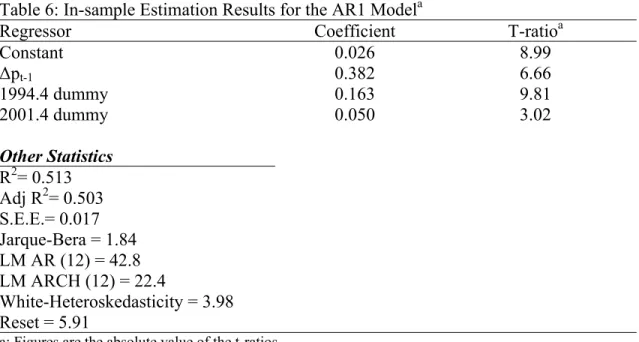
For comparison purposes, it is useful to ferret out how the above-presented in-sample results of the three models fare vis á vis an AR1. A priori, these models, to be useful in forecasting, should at minimum outperform this simple univariate specification. Table 6 reports the estimation results.
Table 6: In-sample Estimation Results for the AR1 Modela
Regressor Coefficient T-ratioa
Constant 0.026 8.99 ∆pt-1 0.382 6.66 1994.4 dummy 0.163 9.81 2001.4 dummy 0.050 3.02 Other Statistics R2= 0.513 Adj R2= 0.503 S.E.E.= 0.017 Jarque-Bera = 1.84 LM AR (12) = 42.8 LM ARCH (12) = 22.4 White-Heteroskedasticity = 3.98 Reset = 5.91
a: Figures are the absolute value of the t-ratios.
A quick glance at the adjusted R2 and the standard error of the regression (SEE) suggests that all three models, in terms of in-sample-fit, outperform the AR1 model. Among the three models, the findings indicate that the mark up models have the best in-sample performance followed by money gap models and the Phillips curve.
The results of the diagnostic tests suggest that in most cases the errors fulfill the classical assumptions. More specifically, the findings suggest that (i) the null hypothesis of normally distributed errors cannot be rejected at 1 percent significance level; (ii) the null hypothesis of no ARCH up to order 12 in the residuals cannot be rejected at 1 percent significance level; (iii) the null hypothesis of no heteroskedasticity cannot be rejected at 1 percent significance level, except for the mark-up models; and (iv) the null
hypothesis of no serial correlation up to order twelve cannot be rejected at 1 percent significance level, except for the mark-up II, the Phillips curve, and mgapm2 models.24,25 The above-presented models are estimated using Newey and West (1987) adjustment methodology to obtain corrected standard errors, which should in general lead to correct inference asymptotically. The inferences are the same when estimated variances and co-variances are corrected by using the Newey and West method (results are available upon request).26 Moreover, CUSUM stability tests, presented in Appendix 3, also indicate that the models are, by and large, stable as evidenced by the graph of the cumulative sum of squares of recursive residuals. Next, I explore the forecasting performance of the models.
5. Comparison of the Forecasts
In an attempt to examine the out-of-sample forecasting performance of the models considered in this paper, I estimate all the models using dynamic rolling regression starting with 1990.01-2001.4 as the sample period, moving up one month each time to generate a new forecast. The dynamic forecasts are true multi-step forecasts—from the start of the forecast sample—since they employ the recursively computed forecast of the lagged value of the dependent variable. These forecasts may be interpreted as the forecasts for the subsequent periods that would be computed utilizing information available at the start of the forecast sample. This exercise is conducted by using the actual values for the explanatory variables.The selection of the forecasting period was
24In the presence of serial correlation, the coefficient estimates will still be unbiased and consistent, though they will
not be the most efficient in the class of all linear unbiased estimators. This inefficiency of the estimates will manifest itself in the t-statistics generated from the coefficients, leading to dubious t-statistics.
25It should be noted that the high RESET statistic in the case of mark-up model I indicates a problem with the chosen
specification, which I did not try to solve here.
26Since it would be preferable to base our forecasts on a model with a simple error structure, I did not attempt to
motivated by the adoption of a new economic program in May 2001 with a view to shed light on the out-of-sample performance of the models under the new regime based, inter alia, on the floating exchange rate and the new Central Bank Law.
I rely on the three most commonly used measures of predictive accuracy, namely root mean square error (RMSE), mean absolute error (MAE), and Theil’s inequality coefficient. The RMSE is a better performance criterion when the variable of interest undergoes fluctuations and turning points. The RMSE penalizes models with large prediction errors more than MAE does. If the variable displays a steady trend, MAE might be preferred to RMSE since then one is concerned with how far above or below the actual data line the simulation falls. Theil’s inequality coefficient ranges between 0 and 1, with 0 indicating perfect prediction.
In addition to these forecasting measures, I also employ relative absolute error (RAE) proposed by Armstrong and Collopy (1992) as an alternative. They argue that, for the purpose of comparing time series forecasts, the RAE is more appropriate than the RMSE. The RAEs for a particular forecasting method are summarized across all the H horizons on a particular series by the following expression:
(10) , , , 1 , , , 1 ,
A
F
A
F
CumRAE
s h s h rw H h s h s h m H h s m − ∑ − ∑ = = =where H, h, s, Fm,h,s, Ah,s, and rw are the number of horizons to be forecast, the horizon
being forecast, the series being forecast, the forecast from method m for horizons h of series s, the actual value at horizon h of series s, and the random walk method, respectively.
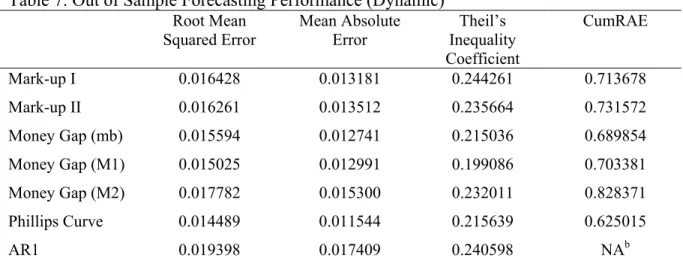
Table 7 reports the forecast errors. The results imply that the best performing model based on out-of-sample performance is the Phillips curve model. The money gap model using M1 definition is a close second followed by the money gap (mb) model, mark-up model II, mark-up model I, and money gap (M2) model. The findings indicate that all models outperform the AR1 specification.
Table 7: Out of Sample Forecasting Performance (Dynamic)a
Root Mean Squared Error Mean Absolute Error Theil’s Inequality Coefficient CumRAE Mark-up I 0.016428 0.013181 0.244261 0.713678 Mark-up II 0.016261 0.013512 0.235664 0.731572 Money Gap (mb) 0.015594 0.012741 0.215036 0.689854 Money Gap (M1) 0.015025 0.012991 0.199086 0.703381 Money Gap (M2) 0.017782 0.015300 0.232011 0.828371 Phillips Curve 0.014489 0.011544 0.215639 0.625015 AR1 0.019398 0.017409 0.240598 NAb
a: Estimation period: 1990.01-2001.04; Forecasting period: 2001.05-2002.12 b: Not applicable
6. Policy Implications and Conclusion
The successful performance of a number of industrial countries that have adopted
inflation targeting (IT) has rendered this monetary policy framework an attractive
alternative for emerging market economies (EMs). Indeed, a number of EMs have already instituted IT or some form of this monetary policy framework. The growing attraction of inflation targeting among EMs as a monetary policy framework has, in turn, increased the importance of understanding inflation dynamics and forecasting the future path of inflation in these countries.
This study considers the case of Turkey and examines the in-sample and out-of- sample performance of models for the period January 1990-December 2002. This study focuses on mark-up models, monetary models, the Phillips curve, and the simple AR1 specification. The results from the in-sample estimations suggest that mark-up models perform better than money-gap models and the Phillips curve in explaining movements in Turkish inflation during the period under consideration. The findings also indicate that all three models outperform the AR1 specification, which was selected as a benchmark.27
The empirical results from the out-of-sample forecasting performance for the period May 2001-December 2002, however, turned out to be quite different. More specifically, the findings show that the Phillips curve and money-gap models have better out-of-sample forecasting performance compared to mark-up models since the inception of the new economic program.
There are two main policy implications emerging from the thrust of the overall findings. First, the findings suggest that the Turkish economy has experienced a change in the dynamics of inflation under the new policy regime, which included, inter alia, the adoption of floating exchange rates and the new Central Bank Law. This, in turn, implies that there has been a change in the relative importance of different determinants of inflation since the introduction of the floating regime. Although the best performing model, based on in-sample results, turned out to be the mark-up models incorporating the exchange rate, wages, and the administered prices, the Philips curve and money-gap models—particularly the one based on M1 measure of the money gap—outperformed the mark-up models when out-of-sample performance was considered. As a result, it can be
27 All three models, to be useful in forecasting, should at minimum perform better than this simple univariate
argued that the relative importance of output gap and monetary disequilibrium in the inflation process in Turkey has increased under the new regime.
Second, monetary policy, by its very nature, is conducted in an environment characterized by uncertainty and change. The uncertainty is likely to be higher in a country like Turkey where the economy has been undergoing significant changes. Based on estimation and forecasting results presented in this study, it can be argued that Phillips curves augmented with the exchange rate as well as money models might provide complementary views in the Turkish context. In light of the experiences of other emerging market economies that adopted IT or some form of this monetary policy framework, it is quite possible that the relative importance of other components in the models of the inflation process is likely to increase as the volatility of the exchange rate and the pass-through decline over time. In summary, the findings highlight the importance of relying on multiple models of inflation in the conduct of Turkish monetary policy.
References
Agenor, P. and P. Montiel (1999), “Development Macroeconomics”, Princeton University Press, Princeton, New Jersey.
Altimari, S. N. (2001), “Does Money Lead Inflation in the Euro Area?”, European Central Bank Working Paper, No. 63.
Armour, J. J. Atta-Mensah, W. Engert, and S. Hendry (1996), “A Distant Early Warning Model of Inflation Based on M1 Disequilibria”, Bank of Canada Working Paper, No: 96-05.
Bahmani-Oskooee, M. I. Domaç (2003), “On the Link between Dollarization and Inflation: Evidence from Turkey", Comparative Economic Studies, vol. 45, pp. 306-328.
Bailliu, J. D. Garces, M Kruger, and M. Messmacher (2002), “Explaining and Forecasting Inflation in Emerging Markets: the Case of Mexico”, Working Paper written as part of Research Collaboration Program between the Bank of Canada and the Baco de Mexico..
Blinder, A. S. (1998), “Central Banking in Theory and Practice”, Cambridge, Mass.: MIT Press.
Boone, L., M. Juillard, D. Laxton, and P. N’Diaye (2002), “How Well Do Alternative Time-Varying Models of the NAIRU Help Policymakers Forecast Unemployment?”, Forthcoming, IMF Working Paper.
Callen, T. and Chang, D. (1999), “Modeling and Forecasting Inflation in India”, IMF Working Paper, No: WP/99/119.
CBRT, Monetary Policy Report (2002), April. _____, Inflation Report (2000), July.
Catão, L. and M. Terrones (2001), “Fiscal Deficits and Inflation: A New Look at the Emerging Market Evidence”, IMF Working Paper, No: WP/01/74.
Coe. D.T. and C.J. McDermott. (1999), “Does the Gap Model Work in Asia?”, IMF Staff Papers, vol. 44(1), pp. 59-80.
Conesa Labastida, A. (1998), “Pass-Through del Tipo de Cambio y del Salario: Teoría y Evidencia para la Industria Manufacturera en México”, Banko de México Working Paper, No: 9803.
Engert, W. and J. Selody. (1998), “Forecasting Inflation with the M1-VECM: Part Two”, Bank of Canada Working Paper, 98-6.
Fischer, S., R. Sahay and C. Vegh. (2002), “Modern Hyper- and High Inflations”, Journal of Economic Literature, Forthcoming.
Friedman, M. (1968), “The Role of Monetary Policy”, American Economic Review, vol. 58, pp. 1-17.
Fung, B.S.C. and M. Kasumovich (1998), “Monetary Shocks in the G-6 Countries: Is There a Puzzle?”, Journal of Monetary Economics, vol. 42(3), pp. 575-92.
Gali, J., M. Gertler and J.D. Lopez-Salido (2001), “European Inflation Dynamics”, European Economic Review, vol. 45(7), pp. 1237-70.
Garces Díaz, D.G. (1999), “Determinación del Nivel de Precios y la Dínamica Inflacionaria en México”, Banco de México Working Paper, No: 9907. Garcia, C. and J. Restrepo (2001), “Price Inflation and Exchange Rate Passthrough in
Chile”, Banco de Chile working Paper, No: 128.
Goodfriend, M. and R. King (1997), “The New Neoclassical Synthesis”, In NBER Macroeconomics Annual 1997, ed. By B. Bernanke and J. Rotemberg. Cambridge, Mass.: MIT Press.
Goodfriend, M. (1997), “A Framework for the Analysis of Moderate Inflations”, Journal of Monetary Economics, vol. 39(1), pp. 45-66.
Gordon, R.J. (1997), “The Time-Varying NAIRU and its Implications for Economic Policy”, Journal of Economic Perspectives, vol. 11(1), pp. 11-32.
Gutierrez, E. (2003), “Inflation Performance and Constitutional Central Bank Independence: Evidence from Latin American and the Caribbean”, IMF Working Paper, No: 53.
Haan, J. and D. Zelhorst (1990), “The Impact of Government Deficits on Money Growth in Developing Countries”, Journal of International Money and Finance, vol. 9, pp. 455-69.
Hallman, J.J., Porter, R.D. and Small, D.H. (1991), “Is the Price Level Tied to the M2 Monetary Aggregate in the Long Run?”, American Economic Review, vol.81(4), pp. 841-858.
Hendry, S. (1995), “Long-Run Demand for M1”, Bank of Canada Working Paper, 95-11. International Monetary Fund (1996), “The Rise and Fall of Inflation: Lessons from the
Postwar Experience”, World Economic Outlook, October, Chapter VI. Washington, D.C.: International Monetary Fund.
_____(2001), “The Decline of Inflation in Emerging Markets: Can it be Maintained?”, World Economic Outlook, May, Chapter IV. Washington, D.C.: International Monetary Fund.
Jonsson, G. (1999), “Inflation, Money Demand, and Purchasing Power Parity in South Africa”, IMF Working Paper, No: WP/99/122.
Kasumovich, M. (1996), “Interpreting Money-Supply and Interest-Rate Shocks as Monetary-Policy Shocks”, Bank of Canada Working Paper, No: 96-8 Kibritçioğlu, A. (2001), “Causes of Inflation in Turkey: A Literature Survey with Special
Reference to Theories of Inflation”, University of Illinois at Urbana-Champaign, Office of Research Working Paper, No: 01-0115
King, M. (2002), “No money, no inflation—the role of money in the economy”, Bank Of England Quarterly Bulletin, summer 2002.
Kremers, J., N.R Ericsson and J.J. Dolado (1992), “The Power of Cointegration Tests”, Oxford Bulletin of Economics and Statistics, vol. 54(3), pp. 325-348.
Lipsey, R. G. (1960), “The Relationship Between Unemployment and the Rate of Change of Money Rates in the U.K., 1862-1957: A Further Analysis”, Economica, vol. 27, pp. 1-32.
Longworth, D. and C. Freedman. (2000), “Models, Projections and the Conduct of Policy at the Bank of Canada”, Paper prepared for the conference “Stabilization and Monetary Policy: The International Experience,” Banco de Mexico, November 14-15.
Lougani, P. and P. Swagel (2001), “Sources of Inflation in Developing Countries”, IMF Working Paper, No: WP/01/198.
Lucas, R. (1996), “Nobel Lecture: Monetary Neutrality”, Journal of Political Economy, vol.104.
Mohanty, M.S. and M. Klau (2001), “What Determines Inflation in Emerging Market Countries?”, BIS Papers, No. 8: Modeling Aspects of the Inflation Process and Monetary Transmission Mechanism in Emerging Market Countries. Newey, W. and K. West (1987), “A Simple Positive Definite, Heteroskedasticity and
Autocorrelation Consistent Covariance Matrix”, Econometrica, vol 55, pp. 703-708.
Özcan, K. M., Berument, M. H., and Neyaptı, B. (2001), “Dynamics of Inflation and
Inflation Inertia in Turkey”, unpublished manuscript Bilkent University. Paşaoğulları, M and T. Yurttutan (2002), “Alternative Output Gap Measures: Review of
Statistical Methodologies and Applications to Turkish Data”, Mimeo, the Central Bank of the Republic of Turkey.
Perez-López, A. (1996), “Un Estudio Econométrico sobre la Inflacíon en México” Banco de México Working Paper, No: 9604.
Perron, P. (1989), “The Great Crash, the Oil Price Shock, and the Unit Root Hypothesis”, Econometrica, vol. 57, pp. 1361-401.
Pesaran, M.H. and Shin, Y. (1997), “An Autoregressive Distributed Lag Modeling Approach to Cointegration Analysis, in S. Strass, A. Holly and P. Diamond (eds.), Centennial Volume of Rangar Frisch, Econometric Society”, Cambridge University Press, Cambridge.
Pesaran, M.H., Shin, Y. and Smith, R.J. (1996), “Testing for the Existence of a Long Run Relationship”, Department of Applied Economics Working Paper, No. 9622, University of Cambridge.
Phillips, A.W. (1958), “The Relationship Between Unemployment and the Rate of Change of Money Wages in the United Kingdom, 1861-1957”, Economica, vol 25, pp. 283-299.
Phillips, A. and B. Hansen (1990), “Statistical Inference in Instrumental Variable Regression with I(1) Processes”, Review of Economic Studies, vol 57, pp. 99-125.
Sakallıoglu, U. C. and Yeldan, A. E. (1999), “Dynamics of Macroeconomic Disequilibrium and Inflation in Turkey: The State, Politics, and the Markets Under a Globalized Developing Economy”, Bilkent University Department of Economics Working Paper, No: 99-10.
Santaella, J.A. (2001), “El Traspaso inflacionario del Tipo de Cambio, la Paridad del Poder de Compra y Anexas: La Experiencia Mexicana”, In La Inflación en México, Gaceta de Economía, ITAM, forthcoming.
Simone, F. (2000), “Forecasting Inflation in Chile Using State-Space and Regime-Switching Models”, IMF Working Paper, No: WP/00/162.
Springer, P. and M. Kfoury (2002), “A Simple Model for Inflation Targeting in Brazil”, Brazilian Journal of Applied Economics, vol, 6(1), pp. 31-48.
Stock, J.H., and M.W. Watson (1999), “Forecasting Inflation”, Journal of Monetary Economics, vol. 44, pp. 293-335.
Appendix 1: Data Definition and Sources
Domestic price level (P): is defined as the Turkish consumer price index, source a.
Exchange rate (E): is the spot exchange rate defined as the number of Turkish Lira per US dollar, source b.
Administered prices (ap): includes the prices controlled by the Government, source a. Foreign price level (P*): is the US consumer price index, source c.
Wages (W): wages in manufacturing industry, source a.
Monetary base (mb): Currency Issued + Required Reserves (in TL) + Free Deposits, source b.
M1: Currency in circulation + demand deposits, source b. M2: M1 + time deposits, source b.
All data are monthly covering January 1990- December 2002 and are obtained from the following sources: (a) State Institute of Statistics; (b) The Central Bank of Turkey; (c) IMF’s International Financial Statistics.
Appendix 2: Figures of Series
Output Gap CPI Inflation
-12 -8 -4 0 4 8 90 91 92 93 94 95 96 97 98 99 00 01 02 -4 0 4 8 12 16 20 24 90 91 92 93 94 95 96 97 98 99 00 01 02
Nominal exchange ratea Wagesa
-10 0 10 20 30 40 50 90 91 92 93 94 95 96 97 98 99 00 01 02 -8 -4 0 4 8 12 16 20 24 90 91 92 93 94 95 96 97 98 99 00 01 02
Administered Pricesa Money-gap (mb)
0 10 20 30 40 50 60 90 91 92 93 94 95 96 97 98 99 00 01 02 -.20 -.15 -.10 -.05 .00 .05 .10 .15 .20 90 91 92 93 94 95 96 97 98 99 00 01 02 a: Rate of change
Appendix 3: Results of the Stability Tests Mark-up Model I -12 -8 -4 0 4 8 12 2001:07 2001:10 2002:01 2002:04 2002:07 CUSUM 5% Significance -0.4 0.0 0.4 0.8 1.2 1.6 2001:07 2001:10 2002:01 2002:04 2002:07 CUSUM of Squares 5% Significance Mark-up Model II -12 -8 -4 0 4 8 12 2001:07 2001:10 2002:01 2002:04 2002:07 CUSUM 5% Significance -0.4 0.0 0.4 0.8 1.2 1.6 2001:07 2001:10 2002:01 2002:04 2002:07 CUSUM of Squares 5% Significance
Appendix 3: Results of the Stability Tests (cont.)
Money Gap Model (mb)
-15 -10 -5 0 5 10 15 2001:07 2001:10 2002:01 2002:04 2002:07 2002:10 CUSUM 5% Significance -0.4 0.0 0.4 0.8 1.2 1.6 2001:07 2001:10 2002:01 2002:04 2002:07 2002:10 CUSUM of Squares 5% Significance
Money Gap Model (M1)
-20 -15 -10 -5 0 5 10 15 2001:07 2001:10 2002:01 2002:04 2002:07 2002:10 CUSUM 5% Significance -0.4 0.0 0.4 0.8 1.2 1.6 2001:07 2001:10 2002:01 2002:04 2002:07 2002:10 CUSUM of Squares 5% Significance
Money Gap Model (M2)
-20 -15 -10 -5 0 5 10 15 2001:07 2001:10 2002:01 2002:04 2002:07 2002:10 CUSUM 5% Significance -0.4 0.0 0.4 0.8 1.2 1.6 2001:07 2001:10 2002:01 2002:04 2002:07 2002:10 CUSUM of Squares 5% Significance
Appendix 3: Results of the Stability Tests (cont.) Phillips Curve -15 -10 -5 0 5 10 15 2001:07 2001:10 2002:01 2002:04 2002:07 2002:10 CUSUM 5% Significance -0.4 0.0 0.4 0.8 1.2 1.6 2001:07 2001:10 2002:01 2002:04 2002:07 2002:10 CUSUM of Squares 5% Significance AR 1 Model -20 -15 -10 -5 0 5 10 15 2001:07 2001:10 2002:01 2002:04 2002:07 2002:10 CUSUM 5% Significance -0.4 0.0 0.4 0.8 1.2 1.6 2001:07 2001:10 2002:01 2002:04 2002:07 2002:10 CUSUM of Squares 5% Significance