A U T O N O M O U S L E A R N I N G O F O B J E C T B E H AV I O R
C O N C E P T S A N D M O D E L S T H R O U G H R O B O T I C
I N T E R A C T I O N
Thesis for obtaining the title of
Doctor of Engineering
of the Faculty of Mathematics and Computer Science
of Saarland University
by
S
ergio
R
oa
O
valle
, M.S
c
.
Saarbrücken
February
2016
Dean of the Faculty Univ.-Prof. Dr. Frank-Olaf Schreyer
Chair of the Committee Prof. Dr. Antonio Krüger Reporters
First reviewer (Supervisor): Prof. Dr. Hans Uszkoreit Second reviewer Prof. Dr. Oliver Brock
(Technische Universität Berlin) Academic Assistant Dr.-Ing. Ivana Kruijff-Korbayova
Dedicated to my family,
A B S T R A C T
We need robots that learn from the environment by interact-ing with it, and deduce models of causal relations and associ-ations from these interactions. In this dissertation, we address the particular problem of predicting object trajectories when manipulating objects, using robot arm pushes. To solve this problem we derive models which can describe the behavior of objects put in motion. For a learning robot it is essential to learn in an incremental and active way when new information is coming in, and to do so without losing generalization and without overfitting. First, we tackle this problem by estimating the density of a sensorimotor space after a robot performs a new action by using a modification of the incremental Growing Neural Gas (RobustGNG) algorithm. RobustGNG performs a space quantization which is robust to noise and overfitting is-sues. Subsequently, we infer models useful for prediction of object trajectories in terms of object poses. The same machin-ery is useful for obtaining more coarse-grained predictions, for instance categorizations of object behaviors. Last but not least, these prediction models provide a qualitative and temporal de-scription of the state space, so that they can eventually be used in planning tasks. We infer cause-effect models by using Ro-bustGNG’s results in a new version of the CrySSMEx algorithm to generate substochastic finite-state machines.
Wir brauchen Roboter, die durch Interaktion mit der Umwelt von dieser lernen und aus dieser Interaktion Modelle für Kausal-relationen und -zusammenhänge ableiten können. In dieser Dissertation wird das spezielle Problem der Vorhersage von Objektbewegungen durch Manipulation von Objekten durch Roboterarme behandelt. Um dieses Problem zu lösen, wer-den Modelle hergeleitet, die das Verhalten von in Bewegung versetzten Objekten beschreiben können. Für einen lernenden Roboter ist es essentiell wichtig, schrittweise und aktiv zu ler-nen wenn neue Informatioler-nen kommen, ohne dabei die Gener-alisierung zu verlieren oder Überanpassung zu generieren. Das Problem wird zunächst dadurch angegangen, dass die Dichte eines sensomotorischen Raumes geschätzt wird, nachdem ein Roboter eine neue Bewegung ausgeführt hat. Hierfür wird eine Abwandlung des inkrementellen Growing Neural Gas (Robust-GNG) Algorithmus verwendet. Die durch RobustGNG vorge-nommene Quantisierung des Raumes ist unanfällig für Störun-gen und Überanpassung. Daraufhin können Modelle abgeleitet werden, die für die Vorhersage von Objektbewegungen bezüg-lich ihrer Objektstellung nützbezüg-lich sind. Derselbe Mechanismus ist nützlich, wenn gröbere Vorhersagen getroffen werden sollen, z.B. bei der Kategorisierung von Objektverhalten. Zu guter Letzt bieten diese Vorhersagemodelle eine qualitative und zeit-liche Beschreibung des Zustandsraumes, sodass sie schließlich auch bei Planungsaufgaben verwendet werden können. Es wer-den Ursache-Wirkungs-Modelle abgeleitet, indem die Ergeb-nisse des Robust GNG in einer neuen Version des CrySSMEx-Algorithmus verwendet werden, um substochastische Zustands-maschinen zu erzeugen.
Imagination is more important than knowledge. Ich habe keine besondere Begabung, sondern bin nur leidenschaftlich neugierig. — Albert Einstein Science may be described as the art of systematic over-simplification – the art of discerning what we may with advantage omit. — Karl Popper Can machines think? — Alan Turing
A C K N O W L E D G M E N T S
I am especially indebted to my advisor Dr. Geert-Jan Kruijff, who gave me the opportunity to work in the collaborative EU-funded project CogX. I also wish to express my gratitude to Henrik Jacobsson who introduced me to the area of cognitive robotics. I am particularly grateful to former CogX participants, especially Marek Kopicki and Thomas Mörwald. Without their contributions to the project this dissertation would not have been possible. Many thanks to all CogX partners, with whom we had interesting dialogues around the field.
C O N T E N T S
1 i n t r o d u c t i o n 1
1.1 Learning Models for Manipulation. State of the
Art. 1
1.2 Contributions of this dissertation 7
1.3 Overview 13
2 b a c k g r o u n d 15
2.1 Developmental robotics and active learning 15
2.2 Concept Learning 20
2.3 Metalearning 22
2.3.1 Learning methods 22
2.3.2 Lifelong learning 23
2.4 Quantization 24
2.4.1 Terminology and Definitions 24
2.4.2 Model Selection 26
2.4.3 Growing Neural Gas for Quantization 29
2.5 Sequence Learning 33 2.6 Preliminary Experiments 35 3 l e a r n i n g f e at u r e s f o r a p u s h i n g s c e na r i o 41 4 r o b u s t v e c t o r q ua n t i z at i o n 49 4.1 Vector Quantization 49 4.1.1 Learning Parameters 52 4.1.2 Active Learning 59
4.2 Quantizing synthetic data sets 61
5 i n d u c t i o n o f s u b s t o c h a s t i c s e q u e n t i a l m a -c h i n e s 69
5.1 Substochastic Sequential Machines 69
5.2 An improved CVQ 71
5.3 CrySSMEx learning loop 74
6 e x p e r i m e n ta l r e s u lt s f o r p r e d i c t i o n a n d c l a s -s i f i c at i o n 77
6.1 Experimental Results for SSM Induction with
syn-thetic data sets 77
6.2 Experimental Results for Prediction and
Classifi-cation 82
6.2.1 Feature selection assessment and learning
parameters in the robotic scenario 83
6.2.2 Learning aspects 84
6.2.3 Prediction results 89
7 c o n c l u s i o n s 99
L I S T O F F I G U R E S
Figure1 The robot pushes an object in order to
grasp it from the edge of the sideboard. Photo: Humanoids and Intelligence Sys-tems Lab/Karlsruhe Institute for Tech-nology [46] 2
Figure2 Leonardo robot in a learning scenario with
three buttons and a human tutor [68]. 4 Figure3 Simulated robotic scenario for qualitative
learning [42] 5
Figure4 Quantization schema. Quantization of
input spaces via active sample selection. 10 Figure5 Learning schema. Quantization of input,
output and state spaces and division of the spaces into regions. 12
Figure6 Information flow regarding different
learn-ing models. 13
Figure7 Learning scenario where a Katana robot
pushes a tea box. 13
Figure8 The playground experiment setup [47]. 18 Figure9 Experimental setup for grasping through
exploration [32]. 20
Figure10 Affordance learning scenario [51,52] 21 Figure11 Voronoi regionSi. 28
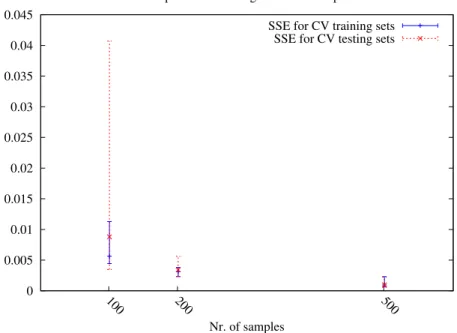
Figure12 LSTM memory block with one cell 37 Figure13 SSEs are reduced when increasing the dataset
size. 39
Figure14 Polyflaps,http://www.cs.bham.ac.uk/∼axs/polyflaps/.
Here we used polyflaps of the shape shown in the bottom-right corner. 41
Figure15 Learning scenario with a polyflap. 42 Figure16 Learning scenario with a box. 42
Figure17 Tracking-State-Detection: From left to right:
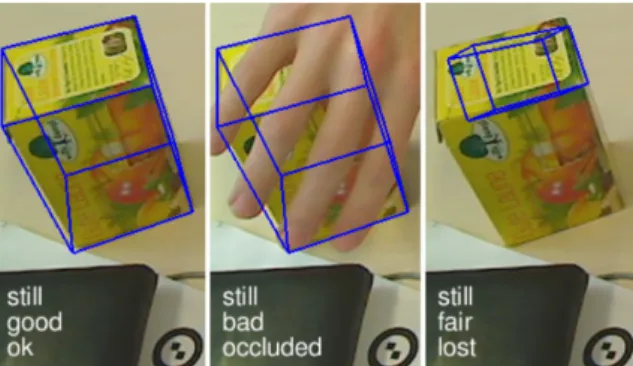
ok, occluded and lost tracking. [41] 43
Figure18 Succesively learning the texture of an
ob-ject (red: matching edges from a textured face, green: matching edges from a non-textured face). [41] 43
Figure19 Features for prediction. 46 Figure20 Learning quality function. 53
Figure21 Region splitting process employing a
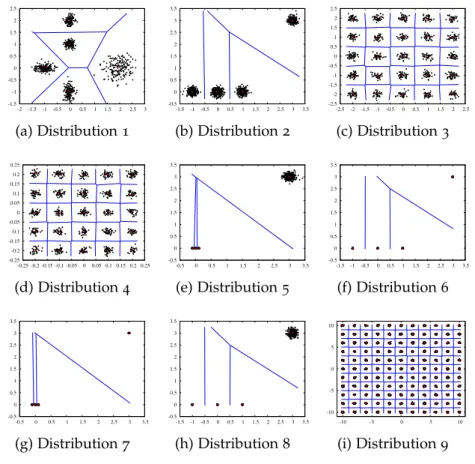
cri-terion based on data set variance. 61 Figure22 Synthetic data sets used for testing vector
quantization. 62
Figure23 Synthetic data sets with outliers. 63 Figure24 Suboptimal quantization for distribution
9. 66
Figure25 MDL history for distribution9. 66 Figure26 The symmetry issue in model vectors 73 Figure27 Partition of VQ states by the CVQ
quan-tizer. 75
Figure28 Transition probabilities of the noisy
au-tomaton. 78
Figure29 Input space quantization of noisy automata. 78 Figure30 Substochastic Moore Machines extracted
from noisy automata 79
Figure31 CVQ Graph and corresponding SSM. 80 Figure32 A complex automaton extracted from
over-lapping Gaussian distributions. 82 Figure33 Pushing actions. 84
Figure34 MDL history for a given sensorimotor
re-gion. 85
Figure35 History of normalized model efficiency
for the input quantizer of a given senso-rimotor region. 86
Figure36 Three runs of the active learning
quanti-zation experiment. 88
Figure37 A run of the online quantization
experi-ment. 89
Figure38 Normalized RMS error in prediction. 91 Figure39 Short-term prediction of affordances. Red
Figure40 Short-term prediction for pushing actions.
Red countour depicts last prediction. 94 Figure41 Prediction of affordances by SSMs trained
for abstract concept learning. Red con-tour depicts last prediction. 97
L I S T O F TA B L E S
Table 1 Summary of learning methods. 23 Table 2 RobustGNG results for clean synthetic data
sets. 64
Table 3 RobustGNG results for noisy synthetic
data sets. 64
Table 4 Comparison of different GNG-based
al-gorithms on synthetic data sets. 65
Table 5 Reconstructed probabilities forσ=0.0. 81 Table 6 Reconstructed probabilities forσ=0.1. 81 Table 7 Average number of SSM states for 3
ex-perimental cases in the simulated scenario for object trajectory prediction. 91 Table 8 Results for short-term prediction in a real
scenario. 93
Table 9 Results for short and long-term
predic-tion for500sequences in a simulated sce-nario. 95
Table 10 Results for long-term prediction in a real
scenario. 95
Table 11 Classification of abstract object motions. 96 Table 12 Long-term prediction of object motion
cat-egories. 97
1
I N T R O D U C T I O N1.1 l e a r n i n g m o d e l s f o r m a n i p u l at i o n. s tat e o f t h e a r t.
Robots need to obtain abilities for manipulating objects, if we want them to carry out complex tasks which are easily accom-plished by humans. They need to be able to solve tasks by identifying physical object properties which are useful in some context. For instance, a robot might want to move a box by slid-ing it in order to grasp it properly and then serve its content in a bowl, as exemplified in Fig. 1. Recognizing these properties im-plies that a robot should be able to predict the consequences of certain actions applied to different objects in the environment. Predicting is a consequence of previous knowledge acquisition. One possible approach is the encoding of knowledge by means of predefined rules, which is tedious work given the variety and complexity of features for objects of any kind that we find in the world. Moreover, it is impossible to do this robustly, flexibly and scalably. Therefore, the approach of learning by interacting with the environment is an evident solution.
We consider here the problem of predicting consequences by applying a restricted set of actions to simple geometrical objects. We have developed novel machine learning algorithms (Robust Growing Neural Gas - RobustGNG and improved Crystalliz-ing Substochastic Sequential Machine Extractor - CrySSMEx), which are able to accurately predict an object pose, given some motor action performed by the robot arm on the object and pre-vious object poses. Prediction is in turn essential for a robot to plan and execute actions in order to achieve some desired goal in the context of solving some task. For example, a robot might predict that if it pushes an object forward and then laterally, the object will then be located in an intended position for it to grasp.
In this dissertation, the prediction models are constructed in such a way that they can be further applied for these planning or control tasks, because they can infer a set of rules or causal re-lationships among different features in the environment across time. Markov Decision Processes (MDPs) are a well established planning framework which suits our models. However, we only test the prediction ability of these machines, and leave the eval-uation of planning for future research.
Figure1: The robot pushes an object in order to grasp it from the
edge of the sideboard. Photo: Humanoids and Intelligence Systems Lab/Karlsruhe Institute for Technology [46]
The work presented here is inspired by the fact that humans and animals in general are able to predict and learn from a dy-namic environment. Theories of cognitive development like the theory of affordances [17] attempt to explain how creatures are
able to acquire sensorimotor skills when they are faced with the different features found in the environment. For instance, sur-faces afford posture, locomotion, collision, manipulation, and in general behavior [17]. Moreover, affordances of objects refer
to the perceived and actual properties of objects which deter-mine how things could possibly be used [44]. It follows from
the above facts that intelligent creatures should then properly predict the consequences of actions on a surface given their own body configuration. After this has been accomplished, they need to be able to plan actions on the basis of newly gathered experience. For our purposes, we consider here a special case of affordance learning in robots, namely that of predicting con-sequences of pushing simple geometrical objects. Pushing is a useful type of interaction to consider, as already exemplified
1.1 l e a r n i n g m o d e l s f o r m a n i p u l at i o n. s tat e o f t h e a r t. 3
in Fig. 1. Moreover, it can be helpful for identifying dynamical properties of objects in an unknown environment.
Exploring the surrounding environment in an efficient way is a key issue for dealing with computational complexity issues. Robots are faced with many features in the environment, which they will have to process and compress in an efficient way. Tak-ing into account the problem we are tacklTak-ing in this dissertation, we propose several new methods which aim to reduce the com-putational complexity with respect to the selection of actions required for learning about pushing actions. For this purpose, we argue that we need robots that extend their knowledge in an incremental, online and active fashion. In robotic contexts, applying these learning approaches is challenging, because one needs to address issues like robustness to noisy environments, overtraining and high dimensionality.
During and/or after these exploratory phases, it is essential that a robot with manipulation skills induces models which could be useful for carrying out subsequent manipulation tasks. Our approach addresses this issue by building models or meth-ods useful for planning, after the exploratory phase.
Online and active learning strategies have been applied and studied recently in robotic problems. Online and active den-sity estimation methods, e.g. based on kernel methods, have been studied in the context of discriminative models for object classification [34, 59]. In robotic manipulation, exploratory and
active learning have been applied for the online acquisition of grasping skills [32, 35]. For instance, in [32] an active
rein-forcement learning approach is applied to enrich object repre-sentations and object-specific grasp affordances. In [35], an
ex-ploratory developmental learning method is used to first con-struct object models and then grasp densities.
Although more focused on aspects more relevant for socially guided learning, the work in [68] looks into exploratory
be-havior for robots with social skills but limited manipulation skills. They consider socially guided exploration for solving simple tasks. In this setting (see Fig. 2), the authors consider self-motivated exploration of a limited set of possible actions, in a similar way as in [47]. The robot learns the names of
three buttons and is motivated by a tutor to turn them all on. Self-motivated exploration can have different motivation
Figure2: Leonardo robot in a learning scenario with three buttons
and a human tutor [68].
sources. In [68], an activity drive, a novelty drive and a mastery
drive are self-motivated exploratory drives. While performing exploratory actions, the robot also performs actions aiming to solve the current task. For these purposes, reinforcement learn-ing strategies are used, specifically task option policies. The main drawback of the work is that the set of states is prede-fined for the task, so that the objective is to learn the policy for the task given a set of states and actions. In contrast, in our work the learning drive of the robot can be defined as a mastery and self-motivated drive, because the robot selects actions with the purpose of reducing the prediction error. Furthermore, our work presents an approach for robot learning where the states and actions are not explicitly given a priori, in a similar way as in [42]. In this simulated scenario (Fig. 3), the robot can grasp a block if the hand and block are colliding. In addition, the agent can observe two floating objects which it cannot interact with, to test the method with distractor objects. The authors designed a system which can discover qualitative states and actions, based on motor, magnitude and direction of change variables. After this discretising step, rules (models of causal re-lationships) are learned by using Dynamic Bayesian Networks (DBNs). The robot learns to move the block, push the block to the floor and pick up the block. The DBNs principles are
1.1 l e a r n i n g m o d e l s f o r m a n i p u l at i o n. s tat e o f t h e a r t. 5
also similar to the probabilistic models we apply in our meth-ods, where dynamic state/action pairs are the building blocks of these prediction models.
Figure3: Simulated robotic scenario for qualitative learning [42]
The problem of predicting object trajectories after a rigid body pushes it has already been addressed in previous work. In [30, 29], the authors applied offline probabilistic models for
density estimation of object poses, specifically Gaussian ker-nel density methods. A completely different approach with no learning phase was adopted in [31], where the physics
prin-ciple of mimimum energy was used. In contrast, our work aims to apply incremental, active and online techniques for learning. We also focus on learning models which are poten-tially useful for planning, as stated above. For that purpose, we apply the CrySSMEx algorithm [25] for extracting rules about
causal relationships of action/outcome pairs. In [58], the
au-thors present a learning system which is conceptually simi-lar to our approach. A discrete set of actions is predefined and a probability model of displacement is updated after the robot performs an action. Then, a task space planner based on Rapidly-exploring Random Trees is used to solve different manipulation tasks.
The problem we consider here is closely related to previous work on affordance learning [62,47,72,51,3,32,35,24], among
others. In [72], the robotic arms perform some random actions
such as pushing or lifting which are mapped to visual features during a learning phase. Then, by implementing a planning framework, these affordance relations can be used for solving different tasks, for instance bringing an object to a target
po-sition. [24] describes a system specialized for pushing and
pulling actions for positioning objects, which can learn and con-trol these behaviours at each time step.
In [47], the robots are more autonomous and enter into
dif-ferent developmental stages on the basis of a learning progress measure, which enables the robot to decide what action to per-form next in the presence of different objects, emulating a curi-ous agent. The authors demonstrate that the agent “discovers” affordances while it starts to perform certain actions repeatedly. This approach is related to active learning, in the sense that an agent needs to choose a learning example so that the informa-tion gain is maximized, thus minimizing the amount of exam-ples needed. From now on, we will simply call these learning strategies active learning.
In [51], the objective was to extract visual features from
ran-dom pushing actions which can be used for obtaining catego-rizations of affordances via unsupervised learning. In the field of cognitive robotics, a related theory has also been developed in recent years, calledobject-action complexes(OACs) [36]. OACs
aim at providing a universal representation enabling efficient planning and execution of actions in different levels of a cogni-tive architecture [36]. OACs combine search capabilities based
on theorem-proving rules and the object and situation oriented concept of affordance, plus the logical framework of the situa-tion calculus for planning [36].
Affordances are also strongly related to the emergence of con-cepts [3]. A new behavior observed in an object or a new way
to adapt the body and apply it to an object to achieve some goal might lead to new linguistic descriptions of these situations. As we mentioned above, we use probabilistic methods to discrimi-nate among different object behaviors given some actions.
The learning processes presented above are elements of the-ories of Developmental or Cognitive Robotics. Different learn-ing stages are necessary for a robot to accomplish a certain goal. Motor skills influence the ability of a robot to express its knowl-edge about an action and, at the same time, language through communication can influence the way motor actions are per-formed. We focus our investigation in the central role that
1.2 c o n t r i b u t i o n s o f t h i s d i s s e r tat i o n 7
plays self-motivated exploration in this developmental learning chain. This is an essential precondition for further skills like verbal communication and the achievement of common goals when robots and humans are interacting. For this purpose, the robots need to acquire models which are useful for planning and concept acquisition that can be incorporated in an interac-tive setting.
Developmental Robotics is a newly established field. “The basic research assumption of this field is that true intelligence in natural and (possibly) artificial systems presupposes three crucial properties: embodiment of the system, situatedness in a physical or social environment, and a prolonged epigenetic de-velopmental process through which increasingly more complex cognitive structures emerge in the system as a result of interac-tions with the physical or social environment” [63].
Develop-mental Robotics, according to [63], emerged partly as a need
for having robots with close to human levels of intelligence. The robotic architectures did not scale up due to the amount of pre-programming and knowledge engineering that are needed for addressing the complexity of robotic tasks. Developmen-tal approaches are inspired by developmenDevelopmen-tal psychology [47].
In [47], two characteristics of child development inspire the
ap-plication of resembling techniques for robots:
• Development is progressive and incremental. “Children undergo a developmental sequence during which a new skill is only acquired when the associated cognitive and morphological structures are ready.” [47].
• Developmental learning presupposes it is autonomous and active. Children decide what tasks are more interesting, even when parents help by scaffolding the infant environ-ment.
1.2 c o n t r i b u t i o n s o f t h i s d i s s e r tat i o n
We set up learning robotic scenarios involving a robotic arm and a geometrical object to address the problem of predicting an object pose, given a motor action performed on an aspect
of the object, and previous object poses. To solve this problem, we apply learning methods which act upon features from vi-sion, simulation and manipulation systems. These features are basically object poses, including finger effector poses, which together define sensorimotor spaces. By performing pushing actions on the object, the robot will be able to construct predic-tion models from these interacpredic-tions by means of learning algo-rithms. In order to discretize the feature spaces, we tackle the problem of density estimation (quantization) of sensorimotor spaces in an interactive environment. Additionally, we tested the classification ability of these prediction models to discrimi-nate among a set of abstract object behaviors.
In this dissertation, we improved and tested new methods for dealing with these learning problems. They are briefly sum-marized in the following list:
• We developed incremental and active quantization meth-ods for density estimation of sensorimotor spaces applied to robot learning scenarios. In this way, following our rea-soning, we aim to present new strategies leading to on-line learning and efficient ways for selecting actions. For these purposes, we designed and applied an improved version of the incremental learning algorithm Growing Neural Gas (RobustGNG).
• We developed and improved the CrySSMEx method to perform an automatic construction of models which ex-hibit the dynamics of robot/object interactions as proba-bilistic finite state machines. These models are useful for planning, but a proof of this is still future work.
• We prove that these probabilistic finite state models are useful for classification of more abstract behavior patterns, i.e., for concept learning.
These three aspects of learning rely on the assumption that we can derive state space models by using information-theoretic mechanisms to reduce the dimensionality of the sensorimotor state space. On the one hand, the RobustGNG algorithm uses novel information-theoretic algorithmic techniques (based on
1.2 c o n t r i b u t i o n s o f t h i s d i s s e r tat i o n 9
Minimum Description Length) to infer a state space without specifying a maximum number of iterations or handcrafted stopping criteria. This is useful for life-long incremental learn-ing, which is a precondition for developmental robotics. On the other hand, the improved CrySSMEx is also an information-theoretic method which applies conditional entropy measures to derive a dynamic probabilistic model of states and transi-tions which can accurately but minimally describe the sensori-motor space. Furthermore, it is useful for deriving models at different (e.g. higher) levels of abstraction, which is useful for concept learning.
With respect to previous strongly related works [30,29], where
offline probabilistic models for density estimation of object poses are used, our work makes progress in the direction of infer-ence of dynamic models based on probabilistic state machines, which is a precondition for planning. Moreover, as already mentioned, our work also focuses on incremental and active approaches for learning, which are preconditions for develop-mental robotics. Last but not least, the accuracy of these mod-els can be relaxed to obtain coarse-grained modmod-els for catego-rization of object behaviours (concept learning methodology), which is also an additional layer upon the learning approaches we mentioned before.
The robot interacts with simple geometrical objects via a push-ing action. After performpush-ing an action, a quantization function for density estimation is applied to a representation of the sen-sorimotor space in an incremental manner. In contrast to [30],
which applied an offline method for density estimation of ob-ject poses, here we additionally apply incremental and active methods. These methods are described in Chapter4. Moreover, the construction of qualitative models which can keep track of the temporal causality for long data sequences is an additional contribution of our work (see Chapter 5).
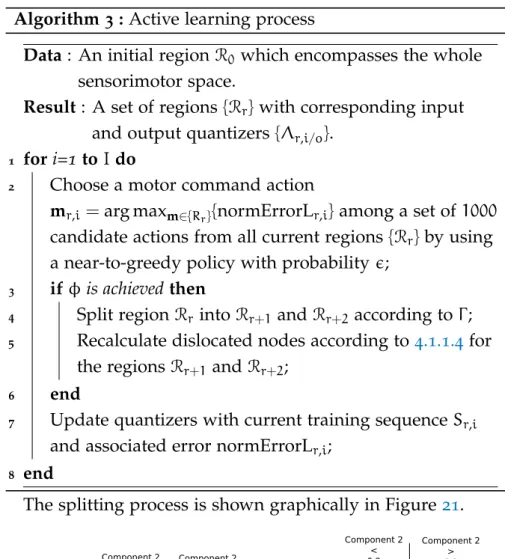
Basically, sequences of finger and object poses (rigid body transformations) are stored as training instances of the senso-rimotor space. The functions are gradually refined, after new training sequences are gathered. The actions selected by the robot are possibly chosen by means of an active procedure
ac-cording to an information-theoretic error measure. Then, the quantized space is split into two subspaces or regions after some iterations. This divide-and-conquer approach accelerates the convergence and induces more simple and tractable mod-els for each region. We present a modification of the Growing Neural Gas algorithm [16, 49, 50, 53] for quantization which is
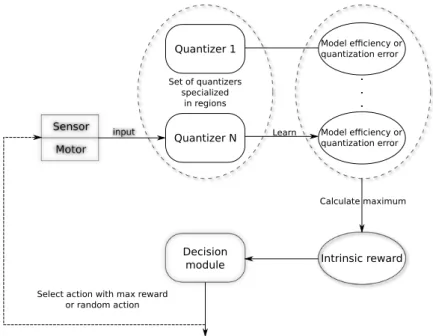
robust for finding the right clusters in the presence of noise. In our algorithm, some modifications are intended to trans-form the algorithm towards a completely online procedure. In Fig. 4 the flow of information when quantizing sensorimotor sequences is presented. The diagram corresponds to both incre-mental and active cases, where the former corresponds to the random selection of actions.
Quantizer 1 Quantizer N Set of quantizers specialized in regions Model efficiency or quantization error Learn Model efficiency or quantization error . . . Intrinsic reward Decision module Calculate maximum
Select action with max reward or random action
Figure4: Quantization schema. Quantization of input spaces via
ac-tive sample selection.
RobustGNG is robust to noisy data. This is particularly im-portant for our problem, specially in the context of real sce-narios, where the information of object pose is derived from an object tracker, which produces a noisy ground truth. There is also uncertainty in the pose measurements from the robotic arm.
When the quantization process finishes, we employ an offline mechanism for constructing probabilistic models of
action/ob-1.2 c o n t r i b u t i o n s o f t h i s d i s s e r tat i o n 11
ject complexes that makes use of the quantization functions. They have the potential to be used for planning, since we obtain a qualitative representation of the sensorimotor space which encodes action/behavior instances. This method is based on the CrySSMEx algorithm [25,53] for extracting substochastic
se-quential machines (SSMs) from dynamical systems. The robot predicts the object behavior in terms of trajectory information contained in sequences of object poses, given an arm pose and a certain action, represented as the target goal of the robot finger. The probabilistic models that we obtain are substochastic finite-state models. Moreover, their graph-based nature encodes the probabilistic transitions that lead to subsequent states, which is particularly useful in planning. In the experiments we present in this dissertation, the state space encompasses geometrical representations of object poses in 3-dimensional space.
The substochastic machines are represented as a special case of Mealy or Moore machines, which also contain probabilistic information. These machines allow us to encode a quantization of the state space, and to encode input functions and output functions, which are quantization functions. In this problem, input functions are a quantization mechanism applied to the representation of the sensorimotor space as mentioned above. They encode a combination of object/finger pose information. On the other hand, output functions may be used in different manners, depending on the discretization degree that we ex-pect in the probabilistic finite-state machine. More precisely, if the objective were to accurately predict the trajectories of jects (in terms of object poses), given some action and some ob-ject pose, we could apply an output function that would act as a probabilistic regression, as long as we represent object poses at subsequent states in this output function.
In our work, we did not use this kind of output function, but rather a quantization mechanism on vectors of object trans-formations, to further reduce the space complexity of output quantizers. This output representation also takes advantage of the information-theoretic learning properties of CrySSMEx and allows for prediction of object trajectories. On the contrary, if we want to group state clusters on the basis of more
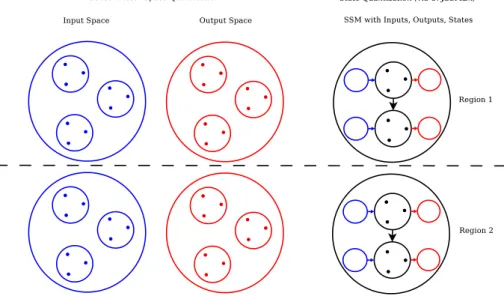
coarse-grained sets (more abstract patterns), we might want to use other quantization functions. In our experiments, we obtained classifications for three different types of object behaviors by means of an alternative output quantization. We only evalu-ated these coarse-grained classifications in simulevalu-ated scenarios to avoid additional complexity introduced by noisy data. A general learning schema is presented in Fig. 5, where different colors are used to identify space types.
Figure5: Learning schema. Quantization of input, output and state
spaces and division of the spaces into regions.
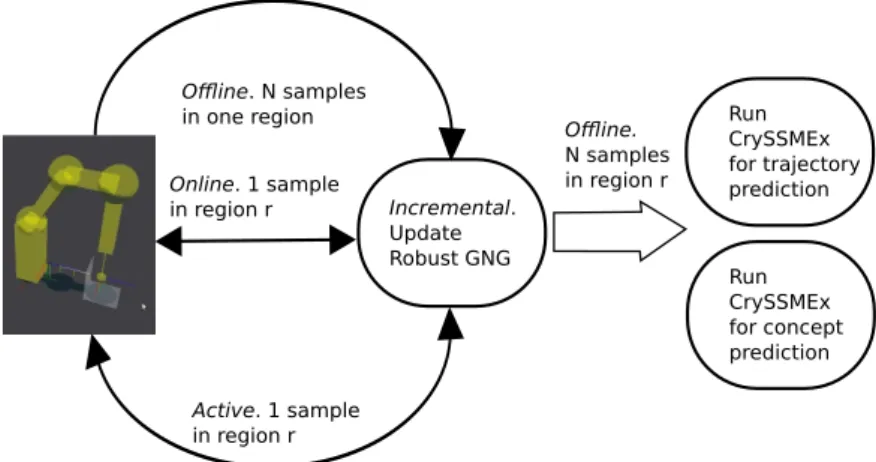
Our learning approaches can also be discriminated in three models: offline, online, incremental and active learning. The information flow depending on which of these models is used is illustrated in Fig. 6.
Our learning scenarios involve a robotic arm, a polyflap (3
-D object, cf. Chapter 3) in the simulated scenario and a box in the real scenario, as illustrated in Fig. 7. We used in our experiments only one object due to limited time and resource constraints such as hardware limitations but also to easily il-lustrate algorithmic issues associated to incremental and active learning, as we explain later in the experimental results. How-ever, experiments with different objects and different shapes is an obvious extension of our research.
1.3 ov e r v i e w 13 Offline. N samples in one region Incremental. Update Robust GNG Online. 1 sample in region r Active. 1 sample in region r Offline. N samples in region r Run CrySSMEx for concept prediction Run CrySSMEx for trajectory prediction
Figure6: Information flow regarding different learning models.
Figure7: Learning scenario where a Katana robot pushes a tea box.
1.3 ov e r v i e w
This dissertation is organized as follows. In Chapter 2, we re-view related work. In Chapter3 we describe the features used in our learning experiments. In Chapter4, we report on a study about the quantization mechanisms implemented and their ap-plication to synthetic data sets. Afterwards, we explain the pro-cess of quantizing sensorimotor spaces in a pushing scenario. In Chapter 5we describe the process of inducing substochastic sequential machines. In Chapter 6 we analyze experimental re-sults for prediction and classification after inducing SSMs. In Chapter 7 we close this dissertation with conclusions and dis-cussion.
2
B A C K G R O U N DIn this chapter we will discuss several topics which are rele-vant for the problem stated in the previous chapter. The so-lutions implemented in this dissertation are inspired or based on the subjects presented below. In the first section (2.1) we explain approaches for learning inspired by neuroscientific re-search, namely developmental robotics and active learning, es-sential for designing autonomous intelligent robots. Section2.2 presents relevant literature about concept learning, i.e., meth-ods to find out abstract patterns which are meaningful for hu-mans from learning features. In Section 2.3 we describe meta-learning aspects to categorize and contextualize the different learning strategies used in this work in a broad sense. Next, in Section2.4we present theoretical aspects of quantization strate-gies, which is one of the key features of our learning algorithms for compressing information. Then, in Section 2.5 we describe approaches for sequence learning which are related to the ex-traction of probabilistic finite state models for dynamic inter-active systems. Finally, in Section 2.6 we present preliminary results of our work, applying different but related strategies for solving the problems we are tackling.
2.1 d e v e l o p m e n ta l r o b o t i c s a n d a c t i v e l e a r n i n g
As we mentioned in the previous chapter, this dissertation fol-lows research directions led by several works in the Develop-mental Robotics field.
In [63], the author proposes five basic principles that describe
the field of developmental robotics:
1. Verification: “An AI system can create and maintain
knowl-edge only to the extent that it can verify that knowlknowl-edge
itself” [63]. Thus, learning does not happen without
veri-fication.
2. Embodiment: since verification does not happen in the
ab-sence of actions, the robot must have a means of affecting the world, i.e., it must have a body.
3. Subjectivity: since a robot autonomously learns and
veri-fies its knowledge, learning is a function of what the robot has experienced through its own sensors.
4. Grounding: successful verification, i.e. grounding, is achieved
through the coupling of actions and their observable out-comes. It consists of act-outcome (or behaviour-observation) pairs.
5. Incremental development: exploration for learning is guided
by an attention mechanism that can decide what parts of the environment are still interesting, i.e., when the levels of verifiability are still not perfect.
In the next paragraphs we briefly introduce some develop-mental robotics scenarios taken from different sources which follow these principles in general terms. In our experiments, the verification and grounding principles are considered dur-ing testdur-ing (estimation, prediction or classification ability) of the learning algorithms, as we will see in Chapters 4 and 5. Incremental development is achieved by applying incremental and active density estimation methods of sensorimotor spaces, and the construction of models for prediction of behavior/ob-servation tuples.
In [68], a robotic agent with social skills but limited
manipu-lation skills uses socially guided exploration for solving simple tasks by applying the following strategies (see Fig. 2):
• Coupled interaction with a human teacher, where the teacher is able to infer the current learning state of the robot through robot demonstrations of the current task and non-verbal social cues like emotions.
• Communication or feedback from the teacher to attain the goal of the current task.
2.1 d e v e l o p m e n ta l r o b o t i c s a n d a c t i v e l e a r n i n g 17
The robot is equipped with a self-motivated exploration sys-tem and a limited set of actions. Self-motivated exploration can have different motivation sources. The following drives for a robot were identified in [68]:
• Activity drive, which reflects the current level of activity.
• Novelty drive, measuring how novel recent events have been.
• Mastery drive, measuring the level of confidence of the current system state.
The selection of an action is not only driven by one of the aforementioned motivation sources but also from task-relevant actions. In that way, the robot and the tutor are expected to work as a team to achieve a common goal. The mechanism for learning how to solve a task is based on reinforcement learn-ing strategies, in particular task option policies [68]. The name
was chosen by the authors to reflect the similarities with the well-knownoptionsframework from the reinforcement learning literature [67].
In contrast, in [47] a more autonomous agent performs
ac-tions on the basis of an intrinsic motivation system inspired by psychological and neuroscientific discoveries, as seen at the beginning of this section. The authors demonstrate experimen-tally that the robot enters into different stages of development during exploration steps where actions are selected according to a measure of learning progress. In that way, the robot carries out novel actions and seems to be curious, because it mostly se-lects actions which maximize the probability of increasing the learning progress calculated from previous and current error estimates in predicting the action. In Fig. 8 a setup of this playground experiment is shown. This approach is inspired by reinforcement learning techniques where a reward for perform-ing an action exists [73, 66]. In this case, however, the reward is
intrinsic (self-motivated). This algorithm is called Intelligent Adaptive Curiosity (IAC). Previous works had implemented agents with artificial curiosity and novelty drives, based
pri-marily on reinforcement learning approaches [57, 69, 28, 13].
Figure8: The playground experiment setup [47].
The work presented in this dissertation is also influenced by developmental strategies for evolving the prediction machin-ery of the robot based on IAC. In particular, [47] presented
an experimentally rigorous analysis about the effects of intro-ducing an intrinsic reward for selecting actions. They did not implement more complex learning methods as in [67] in order
to reduce the complexity of the problem and focus only on analyzing the implications of such a reward in a developmen-tal learning phase. Moreover, given the high dimensionality and complexity of real robotic environments, implementing re-inforcement techniques remains a big challenge.
A nearest-neighbor algorithm was implemented for predic-tion. A sensorimotor context [47] is defined as a vector
con-catenation of the sensory S(t) and motor M(t) inputs at time
t (SM(t)). Sensorimotor regions are defined from the sensori-motor context and the predicted next step sensory input. Thus, an exclusive set of instances hSM(t),S(t+1)i are stored for a certain region. In each region, a corresponding learning expert is specialized. At the beginning of the developmental learning phase, there is only one region and it is recursively divided primarily on the basis of a variance criterion among the corre-sponding instances. During the learning process, the robot oc-casionally focuses on interesting and predictable events, such as biting or pushing objects. These events are correlated to the increase in learning progress at a certain learning step. In [47]
the authors state that IAC could be applied for slowly learning machines like backpropagation neural networks. Our
prelimi-2.1 d e v e l o p m e n ta l r o b o t i c s a n d a c t i v e l e a r n i n g 19
nary experiments [54] implemented an adapted version of IAC
where a recurrent neural network is employed for prediction (see Section2.6).
As pointed out in [47], the strategies for selecting actions
ef-ficiently are closely related to the field of active learning [12]
in machine learning terminology, where the objective is to max-imize the information gain when selecting the next example and thus reduce the amount of instances needed for concept learning.
Developmental phases can also be distinguished from the work in [42]. Their approach for robot learning takes place in
a simulated scenario with individual objects where the states and actions are not defined explicitly (see Fig. 3). A system which can find out qualitative states and actions is designed instead. Firstly, the agent selects random motor values, i.e, the agent “motor babbles” for many iterations, after which it learns to predict and control the variables of the environment, defined as motor, magnitude and direction of change variables. Land-marksof variables which define discrete states help find discrete events. Candidate landmarks are for instance discovered by an information-theoretic criterion which assesses the information gain among events. The relationships among events are used to learn rules (models of causal relationships) encoding actions and states by using dynamic Bayesian networks (DBNs) [42].
Before learning and during qualitative state inference, the agent usually has to decide which actions are relevant, in which case the active learning method [47] described above is employed.
The models learned by the DBNs are then transformed into Markov decision processes (MDPs) to be used for planning by using the options framework, so that robots learn a given task [42].
A developmental approach was also followed in [32] for
ac-quiring object and grasping knowledge. Different types of ob-jects are considered, as seen in Fig. 9. In that work, the robot performs exploratory actions and refines its models gradually, during a developmental learning process with different stages. In the first stage, the robot learns visual models, and in the second it learns object-specific grasp affordances [32]. A third
stage involves the use of the acquired competences to execute a plan for grasping. More concretely, a set of actions aimed for grasping are triggered by specific 3-D feature sets in the first
stage, storing in an episodic memory the outcome (failure or success in grasping) and associated relationships among visual features and proprioceptive information (grasping affordance). At the end of this stage, this set of features represent the object-ness or object shape. Then, in the second stage, a pose estima-tion algorithm, combined with grasping affordances obtained beforehand, is useful for obtaining a grasping memory associ-ated to an object. Finally, planning with grounded objects and grasps is carried out making use of the OAC formalism [48].
Figure9: Experimental setup for grasping through exploration [32].
2.2 c o n c e p t l e a r n i n g
Previous work on affordances learning [55] has presented a
sur-vey on formalizing the concept of affordance and proposed an extended definition:
Definition1 An affordance is an acquired relation between an
ac-quiredeffectand a tuple(entity, behavior)such that when theagent applies the behavior on theentity, theeffectis generated. An affor-dance is then a relation (effect,(entity, behavior)).
In [72], the authors implement the above formalism. The
robot interacts with objects and memorizes the triples obtained to be further used in a planning framework. The work in [3]
shows the relationship among object concepts and verb con-cepts with affordance relations that a robot acquires through interaction with objects. They also use the abovementioned
2.2 c o n c e p t l e a r n i n g 21
formalization and perform two alternative methods for catego-rization. First, they found clusters in a spacehe1,. . .,ei. . .,eni, whereei is the predicted effect of theith behavior on the object. Secondly, a clustering algorithm was applied to the effects of the behaviors, by applying a feature selection method. For in-stance, a system learns the behavior “push left” and discovers that the entities that have led to the effect category “pushed left” and “rolled left” are distinguishable according to some feature element f1 [3].
In [51,52] a similar approach for recognizing affordances was
derived. The experimental setup consists of a tabletop scenario with a robotic arm which interacts with pushing actions on flat-surfaced and curve-flat-surfaced objects (see Fig. 10). Visual object features like shape features or global motion features are ob-tained in order to train an unsupervised clustering algorithm in the space of features. Then, either unsupervised or supervised vector quantization algorithms such as Learning Vector Quanti-zation (LVQ) are used for the classification of affordances such as rolling and non-rolling.
Figure10: Affordance learning scenario [51,52]
It is clear that concept learning or affordance learning has a tight connection with the pattern recognition framework, whether done in a supervised or unsupervised manner. In our work, we explore in Chapter 5 a pattern recognition process involving the dynamics of object behaviors, which was not considered in the work described above. We argue that our approach al-lows the construction of models of causal relationships which are useful for analyzing and understanding complex dynam-ical systems, without the need for predefining specific visual feature sets. Moreover, as we state in Chapter 1, these models
can then be useful for planning (control) by querying them to verify the acquired sensorimotor concepts in an efficient way, since the rules governing the dynamical systems are verifiable in the extracted models.
The object-action complexes (OAC) framework [36] provides a
similar theory which makes use of the concept of affordance which enables planning and execution of actions. In this for-malization, the OAC theory defines affordances more gener-ally as state-transition functions suited to prediction. An agent performing an action to achieve some effect will have to know about the attributes necessary to execute the action. More for-mally,
Definition2 An OAC is a triplet (id,T,M), where id is a unique
identifier, T : S → S is a prediction function where S is a global attribute space and M a statistical measure representing the success in prediction of the OAC over the past.
This framework has been used for the acquisition of grasp and push affordances. In the case of grasping, a state is defined as a stable grasp, a collision, a successful grasp or a non-stable grasp. For pushing, initial and final object poses after a pushing action define the states. In comparison with our work on pushing actions (Chapters 4 and 5), we also consider infor-mation about behaviour dynamics, in contrast to the framework presented above, where the state space is discretized by the pre-diction function defining the system states.
2.3 m e ta l e a r n i n g
2.3.1 Learning methods
In robot learning it is essential to come up with learning models which can be immediately (incrementally) updated after new information arrives. This precondition imposes requirements such as proper generalizations (robustness) and processing effi-ciency.
2.3 m e ta l e a r n i n g 23
Here we follow the distinction made by [18] around different
learning methods, extending it with the concepts of active and passive learning [69] (see Table1).
Learning Method Description
Batch After initializing the model, the training data are completely processed before the model is updated. This is repeated until a certain criterion is met. An iteration is also called an epoch.
Incremental After initializing the model, in each iteration only one training example is processed and then the model is updated.
Offline All the data are given in advance. The stored samples can be accessed repeatedly. Therefore, batch learning is always offline.
Online Each training sample is discarded after it has been processed and the model is updated. Online learning is always incremental but incremen-tal learning can be done online or offline.
Passive A stream of training data is generated by the environment according to some unknown probability distribution. All the above methods can be applied for passive learning.
Active In contrast to passive learning, where the learning method is a pure observer, in active learning the learner has the ability to interact with the environment, in order to generate new samples. More specifically, the learning method can execute actions which generate new training data. Thus, here it is important to come up with measures of efficiency for the selection of actions. Since the learners generate the samples, this is another case of incremental learning (which could be performed online or offline).
Table 1: Summary of learning methods.
In our work, apart from offline approaches to learning, we also focus on incremental and active learning methods.
2.3.2 Lifelong learning
During their entire lifespan, human beings are able to learn and face different learning problems. They have to acquire different learning skills to achieve goals. Learning patterns, communication, logical reasoning and language, among oth-ers, are different aspects of a lifelong learning process [69].
There are opportunities to transfer knowledge between learn-ing tasks. For instance, humans can extract relevant features to generalize a complex target concept well even if the number of potentially relevant features is huge. This ability relies on previously learned knowledge, acquired earlier in the lifetime
of an individual [69]. Thus, concept learning, knowledge
trans-fer and incremental learning are also elements of this lifelong learning context. This formalization of learning has similarities to the developmental learning approach in the sense that dif-ferent learning tasks and transfer of knowledge between tasks arise during and after developmental phases.
2.4 q ua n t i z at i o n
2.4.1 Terminology and Definitions
Robots need to cope with large amounts of information which must be compressed in an efficient way. The process of infer-ring the underlying structure of a data set can be approached in different ways. Different terminology and methods have been also applied in order to obtain qualitative representations of data sets.
One particular problem is the grouping of similar data items from a set of input vectors x in clusters, called clustering. This problem is strongly related to density estimation, which aims to determine the distribution of data within the input space [6,21].
In these tasks, there is no information available about the target values or classes associated to some cluster.
Clustering is a term originating in the pattern recognition lit-erature. It is also called unsupervised classification. The prob-lem in clustering is to group a given collection of unlabeled patterns into meaningful clusters, in contrast to supervised clas-sification, where the given (labeled) patterns are used to learn the descriptions of classes which in turn are used to label a new pattern. In clustering, labels are associated with clusters but these category labels are data driven (obtained solely from the data) [26].
A clustering task usually comprises four main steps: a pat-tern representation step which might include feature extraction or selection, the definition of a pattern proximity measure ap-propriate to the data domain, clustering and data abstraction if needed [26]. Fuzzy clustering techniques assign to an input
2.4 q ua n t i z at i o n 25
to hard clustering where a specific class label is assigned to each pattern, identifying a class [26]. To solve the clustering problem,
different machine learning and pattern recognition algorithms have been employed, including fuzzy clustering, neural net-works, kernel density estimation, nearest-neighbors, principal component analysis and self-organizing maps, among others.
On the other hand, the term quantization originated in the signal processing literature as a process of discretizing signals. In [19] it is regarded as a tool for clustering or cluster analysis
for quantization of empirical probability measures. As a math-ematical topic it can be defined as follows [19]:
Definition3 “Quantization for probability distributions concerns
the best approximation of a d-dimensional probability distribution P
by a discrete probability with a given numbern of supporting points or in other words, the best approximation of ad-dimensional random vector X with distribution P by a random vector Y with at most n
values in its image.”
Finally, the term density estimation is a statistical concept. The problem refers to the modeling of a probability distribu-tion p(x)of a random variablex, given a finite set x1,. . .,xN of observations [6]. A common probability distribution used for
density estimation is the Gaussian distribution. Introducing discrete latent variables enables the modeling of more complex multimodal distributions in the form of mixtures of Gaussians. A discrete latent variable may have discrete binary values rep-resenting the relationship between a data point xn and a latent variablezk associated to the component kof the Gaussian mix-ture. A well-known method for finding maximum likelihood solutions for models with latent variables is the expectation-maximization (EM) algorithm [6]. Whereas in hard clustering
algorithms each data point is associated uniquely with one clus-ter, the EM algorithm makes a soft assignment based on the posterior distribution of latent variables, given the observed variables and distribution parameters [6].
2.4.2 Model Selection
The problems above mentioned concern the ability of a learning machine to find a good explanation for the distribution of a data set. In this work, we use information-theoretic techniques for finding proper models or hypotheses. A good model is one that avoids overfitting, offering a good generalization for, e.g., prediction, pattern classification and parameter estimation. Finding this model is known as the model selection problem.
Overfitting occurs when a model consists of many parame-ters which fit the known data set well, but it does not offer good prediction performance. This absence of good generaliza-tion ability (robustness) is an important issue in inductive and statistical inference [22]. In Bayesian inference [6], the
overfit-ting associated with maximum likelihood, which is a common frequentist estimator, can be avoided by using a Bayesian ap-proach involving probabilities to represent uncertainty in the choice of a model. Thereafter, models are compared directly on the training data. Another common approach is the use of cross-validation, where some proportion of the data set is used for training while using all data to assess performance. Other information-theoretic approaches like the Bayesian information criterion have been applied to correct for the bias of maximum likelihood [6].
In order to compare different explanations (quantizers) for our data sets, we employ the information-theoretic mechanism called the Minimum description length (MDL) principle. This inductive inference method provides a generic solution to the model selection problem, and, more generally, to the overfitting problem. MDL is based on the following insight: any regularity in the data can be used to compress the data, i.e., to describe it using fewer symbols than the number of symbols needed to de-scribe the data literally [22]. This idea leads to a formalization
of a theory of inductive inference with the following properties, among others [22]:
2.4 q ua n t i z at i o n 27
• Occam’s razor. MDL chooses a model that trades off good-ness-of-fit on the observed data with “complexity” or “rich-ness” of the model.
• No overfitting. MDL methods automatically and inher-ently protect against overfitting and can be used to esti-mate both the parameters and structure of a model.
• Predictive interpretation. Data compression is formally equiv-alent to a form of probabilistic prediction. Thus, MDL methods search for a model with good predictive perfor-mance on unseen data.
MDL has been used for model selection, prediction, param-eter selection, parametric and non-parametric density estima-tion, and in general in every type of inductive inference task such as denoising, similarity analysis and clustering, outlier de-tection and transduction [22].
For robust vector quantization, the MDL principle was used in [4]. The problem of vector quantization is defined there as
follows [4]:
Definition4 Given a finite data setS ={x1,. . .,xn}, xi ∈Rd with
d ∈ N, where xi are independently and identically distributed (iid) according to some probability distribution p(x), find a set of refer-ence vectors A = {c1,. . .,cm}, ci ∈ Rd such that a given distortion measure (i.e. expected quantization error) E(p(x),A)is minimized.
Since the only information available is the data set S, the objective is to minimize the expected quantization error
E(S,A) = m X i=1 X x∈Si kx−cik2, (1)
whereSi ={x ∈ Rd|i =arg minj∈{1,...,m}kx−cik}is the Voronoi region of a vectorci (cf. Fig. 11). This minimization is achieved by adequately positioning the vectorsci [4].
The authors approach the problem as a minimization of the description of the training data S. Usually, a description is given in terms of a coding system [22]. In the formalization
Si
Figure11: Voronoi regionSi.
given by [4], the goal is to find a set of reference vectors1 A to
encode S optimally. Some data vectors O are considered out-liers and another set as inout-liers I, thus I = S−O. UsingA, the length of encoding Sis then given by [4]:
• The length of encoding the reference vectorsA, L(A).
• The length of encoding I using A, which is subdivided into two costs:
– The length of encoding the index of A to which the vectors in Ihave been assigned,L(I(A)).
– The length of encoding the residual errors,L((IA))
• The length of encoding the outliers, L(O).
Thus, the cost of encoding SusingAis given by [4]
L(S(A)) =L(A) +L(I(A)) +L((IA)) +L(O). (2)
The goal is then to minimizeL(S(A)), i.e., determineO, m and
ci,1 6 i 6 m such that L(S(A)) is minimal. Assuming that these quantities are specified with a finite precision ηand that reference vectors are represented by K bits, Eq. 2 can be refor-mulated as Eq.3[4]: L(S(A)) =mK+L(I(A)) + m X i=1 X x∈Si L(x−ci) +|O|K. (3)
2.4 q ua n t i z at i o n 29
In general, any clustering algorithm may be used to adapt the reference vectors. In this method [4], a vector quantization
net-work is initialized with a high amount of reference vectors, after which unnecessary reference vectors are removed and outliers are detected, improving the network quality in terms of MDL. An advantage of this method with respect to well-known clus-tering techniques such as K-means and Gaussian mixture mod-els [6] is that the number of reference vectors m is not given
a priori. Indeed, MDL is used here to select among different models of a data distribution containing different components.
2.4.3 Growing Neural Gas for Quantization
The algorithm Growing Neural Gas (GNG) [16] was conceived
for unsupervised learning, where there is no available infor-mation about output classes. GNG is potentially useful for quantization, yet still needs a method for finding the optimal reference vectors. To solve this, combining GNG with MDL has been proposed, as we explain below. The algorithm ini-tially targeted a problem called topology learning: given some probability distribution, the objective is to find a topological structure which closely reflects the topology of the data distri-bution, represented by a set of centers (reference vectors). For this purpose, a competitive Hebbian learning (CHL) method is combined with the vector quantization method Neural Gas [38].
The main advantages of the Neural Gas model according to [40]
are:
1. Faster convergence to low distortion errors.
2. Lower distortion error than that resulting from K-means
clustering, maximum entropy clustering and Kohonen’s self-organizing feature map.
3. Obeying a stochastic gradient descent on an explicit
en-ergy surface.
Assuming there are a number of centers in Rn, CHL succes-sively adds topological connections among them. Given a data
sequence x drawn from some data distribution p(x), the prin-ciple of CHL is [38]: “for each input x connect the two closest
centers (measured by Euclidean distance) with an edge.” The resulting graph is a subgraph of the Delaunay triangulation which has been shown to optimally preserve topology in a gen-eral sense [38].
To make use of all the centers, they have to be placed in regions where p(x) > 0. This can be achieved by any vector quantization algorithm. In [16], the Neural Gas method was
used for that purpose, with the principle: “for each input x
adapt theknearest centers wherebykis decreasing from a large initial to a small final value”.
Since the motion of centers might make edges which have been generated earlier invalid, an edge aging scheme is also considered for the purpose of removing obsolete edges. Com-bining CHL and Neural Gas is a proper method for preserv-ing topology as proven in [39], but the number of centers has
to be decided a priori, which is a common problem in vector quantization algorithms. The GNG algorithm proposes an in-cremental solution to this problem, but a maximum a priori number of nodes or some performance measure is still needed as a stopping criterion.
A GNG network consists of [16]:
• A set A of units (nodes). Each unit c ∈ A has an associ-ated reference vector wc ∈ Rn. The reference vectors can be regarded as positions in the input space of the corre-sponding units.
• A setNof connections (edges) among pairs of units. These are not weighted and their sole purpose is to define topo-logical structure.
The main idea of the method [16] is to successively add new
units to an initially small network by evaluating local statisti-cal measures gathered during previous adaptation steps. In summary, the GNG algorithm executes the steps illustrated in Algorithm21[16].
The adaptation steps towards the input samples (lines 8,9)
2.4 q ua n t i z at i o n 31
Algorithm1: GNG
1 begin
2 Start with two units at random positions;
3 whileA stopping criterion (e.g. net size or some performance measure) is not yet fulfilled
do
4 Generate an input samplexfrom the data distributionp(x); 5 Find the nearest units1and the second nearest units2;
6 Increment the age of all edges emanating froms1;
7 Add the squared distance between the input sample and the nearest unit in the input space to a local error counter variable: errors1=kws1−xk
2;
8 Moves1and its topological neighbors towardsxby fractionsbandn,
respectively, of the total distance:∆ws1=b(x−ws1);
9 ∆wn=n(x−wn)for all direct neighborsnofs1;
10 ifs1ands2are connected by an edgethen Set the age of the edge to zero;
11 ;
12 else ifsuch an edge does not existthen
13 create it;
14 Remove edges with an edge larger thanamax. If this results in points having
no emanating edges, remove them as well;
15 ifthe number of input samples generated so far is an integer multiple of a parameterλ
then
16 Insert a new unit as follows;
17 Determine the unitqwith maximum accumulated error;
18 Insert a unitrhalfway betweenqand its neighborfwith the largest error variablewr= 12(wq+wf);
19 Insert edges connecting the new unitrwith unitsqandf, and remove the original edge betweenqandf;
20 Decrease the error variables ofqandfby multiplying them with a constantα. Initialize the error variable ofrwith the new value of the error variable ofq;
21 Decrease all error variables by multiplying them with a constantd;
input space where p(x) > 0. The insertion of edges (line 10 -12) between the nearest and the second-nearest unit generates
a connection of the “induced” Delaunay triangulation, whereas in line13edges are removed which are no longer part of it. This
is achieved by local edge aging (line 6) and age resetting (line 10) [16]. The accumulation of squared distances (line7) helps to
identify areas with high accumulated errors, which are reduced by adding units in these regions.
The GNG algorithm can potentially be used for quantization, provided some adjustments are applied. GNG was improved in subsequent work [49, 50] to deal with robust quantization of
noisy data sets. In [49], an outlier resistant strategy, an
adap-tive learning rates and cluster repulsion scheme, and a criterion for determining the optimal number of clusters were proposed. The updating rule in GNG (lines 8,9 in Algorithm 21) is
inher-ently fragile in noisy environments and sensitive to the order of input vectors [49].
The outlier-resistant strategy is based upon adding a param-eter used to limit the updating strength caused by some outlier. In Section 4.1.1.1, specifically in Eq. 12, we can see a general form of the learning rule including an outlier-resistant parame-terσk for some nodek.
In [49] adaptive learning rates b and n were introduced.
This strategy solves issues introduced by static learning rates in GNG, which prevent the refinement of the positions of current prototypes towards actual cluster centers. The adaptive learn-ing rates take different values for nodes inserted in different order, and meanwhile make them decrease monotonically with the increment of nodes. These values depend on the predefini-tion of a maximum number of nodes. In our work, we apply a different strategy which depends less on a priori parameters and is explained in Section 4.1.1.1.
In [49] a repulsion scheme was also proposed, by adding
re-pulsive forces to the updating rule such that two nodes do not try to approach one cluster simultaneously. In our work, we avoid the use of repulsive forces by adding a more efficient node insertion mechanism (Section 4.1.1.2).
Finally, in [49], the MDL principle is proposed for
deter-mining the optimal number of clusters. The authors instan-tiated the calculation of MDL as in [4] (explained above in
Section 2.4.2). However, they still use a maximum predefined number of nodes or some predefined performance measure as a stopping criterion. The minimal MDL value found during learning helps to identify the network with the optimal cluster number. In contrast, we use MDL (Sections 4.1.1.3 and 4.1.1.5) to calculate a network stability measure to be used as a stop-ping criterion.
The work presented in [50] is a follow-up to the robust
quan-tization mechanism already explained [49]. Here the authors
employ the same methods to make GNG robust. However, they use MDL and the local error quantities to relocate nodes in more proper locations of the input space. This method re-quires many calculations. Therefore, we came up with more
![Figure 2: Leonardo robot in a learning scenario with three buttons and a human tutor [ 68 ].](https://thumb-us.123doks.com/thumbv2/123dok_us/839689.2606740/18.892.380.616.174.403/figure-leonardo-robot-learning-scenario-buttons-human-tutor.webp)