Constructing Precise Object Relation Diagrams
Ana Milanova
Atanas Rountev
Barbara G. Ryder
Department of Computer Science
Rutgers University
Piscataway, NJ 08854, USA
{
milanova,rountev,ryder
}
@cs.rutgers.edu
Abstract
The Object Relation Diagram (ORD) of a program is a class interdependence diagram which has applications in a wide variety of software engineering problems (e.g., in-tegration testing, inin-tegration coverage analysis, regression testing, impact analysis, program understanding, and re-verse engineering). Because the imprecision of the ORD directly affects the practicality of its usage, it is important to investigate techniques for constructing precise ORDs.
This paper makes three contributions. First, we develop the Extended Object Relation Diagram (ExtORD), a ver-sion of the ORD designed for use in integration cover-age analysis. The ExtORD shows the specific statement that creates an interclass dependence, and can be easily constructed by extending techniques for ORD construction. Second, we develop a general algorithm for ORD construc-tion, parameterized by class analysis. Third, we demon-strate empirically that relatively precise class analyses can significantly improve diagram precision compared to ear-lier work, resulting in average size reduction of 55% for the ORD and 39% for the ExtORD.
1
Introduction
Object-oriented systems are characterized by complex interclass interactions. The goal of integration testing is to reveal faults that cause some interclass interactions to fail. One fundamental problem in integration testing is how to define the test order (i.e., should classA be tested before or after classB is tested). The goal of integration cover-age analysis is to show that sufficiently many interclass in-teractions are covered during testing. Coverage analyzers need to determine which statements trigger interclass de-pendences and which interclass dede-pendences are triggered at a given statement (i.e., exactly which two classes are
in-volved). The goal of regression testing is to show that after a change is made, the program still satisfies its requirements. Regression testing must address the following problems: (i) determining the impact of a change on a given class (i.e., the set of classes affected by the change) and (ii) defining the regression test order (i.e., the order in which affected classes need to be retested).
The Object Relation Diagram (ORD) [13] is a model of interclass dependences which can be used to address these problems. The ORD can be used to define efficient test or-der for integration testing. It can be used in coverage anal-ysis to determine pairs of interacting classes. In addition, the ORD can be used in regression testing to find the set of classes affected by a change and to define efficient regres-sion test order.
The ORD of a programP is a directed graph in which nodes represent program classes and edges represent de-pendences between these classes. There are three kinds of edges. An inheritance edge fromB toA represents that B depends onAbecauseB is a subclass ofA. An aggre-gation edge fromB toArepresents thatB depends onA because instances of classAmay be contained by instances of class B. An association edge fromB to Arepresents associations between objects of classBand objects of class Adue to method calls or field accesses. (Several diagrams are shown in Figure 2 in Section 2.)
One disadvantage of the ORD is that there is at most one edge of each kind between two classes. Therefore, coverage analyzers cannot use the ORD to determine which specific statement triggers the dependence. We define the Extended ORD (ExtORD) to address this problem. The ExtORD al-lows multiple edges of each kind, one for each statement that triggers this kind of dependence; therefore, test cover-age of such statements can be distinguished.
Imprecise ORDs and ExtORDs contain spurious depen-dence edges, representing interclass dependepen-dences that are impossible and do not correspond to any actual program
ex-ecution. In integration testing, spurious edges may lead to dependence cycles in the ORD, which complicates the task of defining a test order. In integration coverage analysis, spurious dependence edges result in time spent on trying to execute code in a way which triggers impossible depen-dences. In regression testing imprecision leads to two prob-lems: (i) when the set of classes determined to be affected by a change is too imprecise, time will be wasted on retest-ing unaffected classes and (ii) cycles in the ORD complicate the definition of a regression test order. In these cases, as well as for other ORD uses such as program understanding and reverse engineering, significant time and effort could be saved if the ORD and the ExtORD are more precise (i.e., contain fewer spurious edges).
Because of the wide range of applications of these de-pendence diagrams, it is important to investigate approaches for construction of precise ORDs and ExtORDs. In order to construct these diagrams, it is necessary to have informa-tion about the classes of all objects that certain variables may refer to at run time. This information can be obtained by using class analysis, which is a popular form of static program analysis for object-oriented languages. The goal of class analysis is to compute for each variabler the set Cs(r)of all classes such that an object of classC∈Cs(r) may be bound torat run time. There are many class analy-ses with different tradeoffs between cost and precision, de-veloped primarily in the context of optimizing compilers for object-oriented programming languages. The precision of the dependence diagrams directly depends on the preci-sion of the underlying class analysis which is used during ORD/ExtORD construction.
In this paper we define a generalized algorithm for ORD construction which is parameterized by class analysis. By varying the underlying class analysis, the algorithm allows the user to build ORDs with differing degrees of precision. For presentation purposes we use Java programs to demon-strate our approach, but the methodology can be used with minor modifications with other object-oriented program-ming languages.
Previous work uses the structure of the program class hi-erarchy to determineCs(r)in order to construct the ORD. In our experiments, we compare this simple form of class analysis with two more precise class analyses based on al-gorithms presented in [20] and [16]. On a set of nine re-alistic Java programs, our results show that these two more precise analyses significantly improve the precision of the ORD and the ExtORD, compared to using the structure of the class hierarchy. We observed average reductions of 55% for the number of edges in the ORD and 39% for the num-ber of edges in the ExtORD.
In integration testing, these reductions may result in sub-stantial savings in time and effort. When using coverage analysis tools, substantially less time will be spent trying
to exercise impossible interclass dependences. In regres-sion testing, the improved preciregres-sion leads to (i) smaller number of classes selected for retesting and (ii) less time spent on determining a retest order. Furthermore, the signif-icantly improved precision is beneficial for other uses of the ORD/ExtORD (e.g., for program understanding and reengi-neering).
Even though most of our data programs are large, the ex-perimental results show that the two precise class analyses from [20, 16] have practical cost. This practicality makes them realistic candidates for use in software engineering tools.
Contributions The contributions of our work are the following:
• We define the Extended Object Relation Diagram (ExtORD) which is suitable for integration coverage analysis. Any method used to construct the ORD from program code can be trivially extended to construct the ExtORD.
• We define a generalized algorithm for ORD con-struction which is parameterized by a class analysis. The parameterization allows the user to control the cost/precision tradeoff by varying the class analysis. • We demonstrate empirically that two practical class
analyses [20, 16] improve substantially the precision of the ORD/ExtORD, compared to using the structure of the class hierarchy. Our results show that employing these analyses in ORD construction tools may result in significant savings in time and effort.
Outline The rest of this paper is organized as follows. Section 2 describes applications of the ORD, summarizes previous work on ORD construction, and argues the impor-tance of ORD precision. Section 3 presents a general al-gorithm for ORD construction and discusses specific class analyses. The experimental results are presented in Sec-tion 4. SecSec-tion 5 discusses related work and SecSec-tion 6 presents conclusions and future work.
2
The Object Relation Diagram
2.1
Applications of Object Relation Diagrams
The ORD can be used in integration testing, integration coverage analysis, regression testing, impact analysis, pro-gram understanding, and reverse engineering. Once con-structed, the ORD can be reused by various clients at no additional cost. In this section we briefly discuss several specific client applications of the ORD.Integration Testing One goal of integration testing is to reveal faults that are triggered by the interactions between classes. Usually, integration testing proceeds in stages. At
each stage there is a target set of classes under test. Classes not included in the target set and used by some of the classes in the target set need to be simulated by stubs. The stubs simulate the class behavior for the given context, which is usually a small subset of the entire class behavior. One im-portant problem in integration testing is how to determine the order in which classes are tested (i.e., should classAbe tested before or after classBis tested).
Bottom-up integration testing strategies [5, 13, 14] aim at minimizing the number of stubs, because stub construction requires significant time and effort. In this case, the test order can be derived by bottom-up traversal of the ORD. Clearly, no stub is required for a class that is tested before the classes that depend on it. Intuitively, the independent classes are tested first, then the classes that depend on them, and so on.
Coverage Analysis The goal of coverage analysis is to evaluate the quality of a given test suite by measuring the coverage of program code and of certain aspects of the be-havior of that code. Integration testing focuses on faults due to complex interclass dependences. Thus, it is important to ensure that the test suite covers interclass interactions. For example, one coverage requirement is that all interclass method calls (i.e., calls from one class to a method in an-other class) should be exercised [5]. Anan-other more strict re-quirement states that every possible interclass dependence should be covered [24]. The Extended ORD (described in Section 2.2) is a version of the ORD that can be used by coverage analyzers to determine the set of statements that trigger interclass dependencies and therefore need to be ex-ercised in order to satisfy coverage requirements.
Regression Testing The goal of regression testing is to ensure that when a change is made to a program, the pro-gram still satisfies its requirements. Because of complex dependences between classes, when a change is made to a class, this change usually affects other classes in the pro-gram. Each of these affected classes needs to be retested. Two fundamental problems in regression testing are (i) how to identify the classes affected by a change and (ii) how to efficiently perform retesting of these affected classes. The ORD can be used in regression testing to identify the set of affected classes. All classes reachable backwards in the ORD from the changed classes are potentially affected by the change. In addition, the ORD can be used to determine a test order which minimizes the necessary stubs. Such test order leads to an efficient retesting strategy, because stub construction requires significant effort. Similarly to deter-mining the test order for bottom-up integration testing, the regression test order can be derived by bottom-up traver-sal of the ORD (i.e., classAis retested before the classes that depend on it; when the classes that depend on Aare retested, stubs are not required forAbecause it has already been retested).
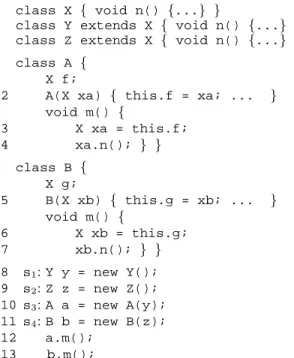
class X { void n() {...} }
class Y extends X { void n() {...} }
class Z extends X { void n() {...} }
class A {
X f;
2 A(X xa) { this.f = xa; ... }
void m() { 3 X xa = this.f; 4 xa.n(); } } class B { X g; 5 B(X xb) { this.g = xb; ... } void m() { 6 X xb = this.g; 7 xb.n(); } } 8 s1:Y y = new Y(); 9 s2:Z z = new Z(); 10 s3:A a = new A(y); 11 s4:B b = new B(z); 12 a.m(); 13 b.m();
Figure 1. Sample set of statements.
2.2
The ORD by Kung et al.
Kung et al. [13] define the Object Relation Diagram us-ing three kinds of dependence edges. For the rest of the paper we use the notation(hB, li, A)to denote an edge la-beledlfromBtoA.
Inheritance There is an edge labeled I from classB to classAif and only ifBis a direct subclass ofA.
Aggregation There is an edge(hB, Agi, A)if and only if statementthis.f = new A(..)appears in a construc-tor defined in classB.1
Association There is an edge(hB, Asi, A)if and only if one of the following is true:
• T m(...,A r,...) {...} is a definition of a method or a constructor in classB. We refer to such an association as a parameter association.
• Field accessr.fappears in a statement contained by a method or a constructor defined in class B and the declared type of reference variablerisA(r6=this). We refer to such an association as a field access asso-ciation.
• Method invocationr.m(...)appears in a statement contained by a method or a constructor in classBand the declared type ofrisA(r6=this). We refer to such an association as a method call association.
1According to [13] aggregation can be (i) static, due to encapsulated
non-pointer fields and (ii) dynamic, due to pointer fields initialized within constructors. Since all fields in Java are references (i.e., pointers to ob-jects), static aggregation is not possible and we simplify the definition ac-cordingly.
X Y Z A B I I BBMB @ @ @ @ @ I As As * H H H H Y P P P P P P i 1 X Y Z A B I I BBMB @ @ @ @ @ I As As X Y Z A B I I BBMB * H H H H Y As As
(a) Static dependences (b) Transitive subclasses (c) Precise run-time dependences Figure 2. Object Relation Diagrams corresponding to different methods of construction.
Figure 2(a) shows the ORD for the program in Figure 1. Clearly, this diagram does not reflect dependences due to dynamic bindings of polymorphic variables. For example, classAdepends on classY because at run time an object of class Y is bound to polymorphic variablexaat line 4. However, this dependence is not shown in the ORD from Figure 2(a).
The class firewall for classC, denoted byCFW(C), is defined as the set of classes reachable from the node corre-sponding to classCin the transpose of theORD[13, 14]. Intuitively, the class firewall contains the classes that may be affected whenCis modified, and thus should be retested (assuming that the ORD for the program is not modi-fied). For example, based on the ORD in Figure 2(a), CFW(X) ={X, Y, Z, A, B}andCFW(Y) ={Y}.
In this paper we define the Extended Object Relation Diagram (ExtORD) which makes the dependence diagram more informative and more suitable for use in code cover-age analysis tools. The ExtORD contains annotated associ-ation and aggregassoci-ation edges. There is an annotated aggrega-tionAg:siif and only ifsi is an object creation statement
which triggers an aggregation. There is an annotated as-sociationAs:si if and only ifsi is a program statement
which triggers a field access association or a method call association. There is a non-annotated associationAswhich denotes parameter association. Thus, the ExtORD may con-tain multiple aggregation and multiple association edges be-tween two nodes, because it makes explicit which program statements trigger the dependences. For example, associ-ation edge (hA, As : 4i, X) indicates that because of the virtual call at line 4 in Figure 1, there is an association be-tween classAand classX. It is easy to see how coverage analyzers can make use of the Extended Object Relation Diagram. Since the ExtORD identifies the interclass de-pendences together with the statements that create them, a high-quality test suite should exercise these statements and should achieve sufficient coverage of the dependencies trig-gered by the statements.
2.3
The ORD by Labiche et al.
Recall from Section 2.2 that the ORD from [13] does not reflect the dependences that arise due to possible dynamic
bindings of polymorphic variables. In order to correct this problem, Labiche et al. [14] propose to augment the ORD from [13] with additional edges representing dynamic re-lationships. If there is an edge labeled Asfrom A toB, there are additional edges with the same label fromAto all subclasses of B (including transitive subclasses). For the example in Figure 1, there are additional association edges from AandB to bothY andZ. Figure 2(b) shows how the diagram in Figure 2(a) is augmented with these addi-tional edges. This approach is equivalent to modifying the three rules for association inference from Section 2.2 to take into account the possible dynamic bindings of polymorphic variables by considering the structure of the class hierarchy (i.e., by considering all transitive subclasses of the targets of ORD association edges).
The ExtORD can be augmented in a similar fashion. If there is an edge labeled As : si from A to B, there are
edges labeled As: si from A to all subclasses of B
(in-cluding transitive subclasses). For the set of statements in Figure 1, there are additional edges (hA, As: 4i, Y)and
(hA, As: 4i, Z). In order to achieve good coverage of inter-class dependences, it may not be enough to exercise a state-ment once. Due to polymorphism, certain statestate-ments (e.g., the method call at line 4 in Figure 1) need to be exercised several times to achieve coverage for all dynamic interclass dependences that may result from such statements.
2.4
The Disadvantages of Imprecise Analysis
Clearly, the ORD computed by Kung et al. [13] omits de-pendences and may result in incomplete testing and retest-ing. On the other hand, the ORD computed by considering the structure of the class hierarchy could be overly conser-vative. This imprecision results from imprecise analysis of the possible dynamic bindings of polymorphic variables. In Figure 1 classAdoes not depend on classZbecause at run time A.A.xaat line 2 and A.m.xaat line 4 can refer-ence only objects of class Y. The same kind of spurious dependence occurs between classBand class Y. The ex-act ORD corresponding to this set of statements is shown in Figure 2(c).Analysis imprecision results in spurious dependences and can impair the usefulness of tools that employ the ORD
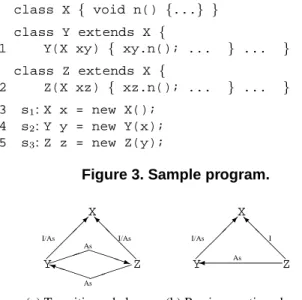
class X { void n() {...} }
class Y extends X {
1 Y(X xy) { xy.n(); ... } ... }
class Z extends X {
2 Z(X xz) { xz.n(); ... } ... }
3 s1:X x = new X();
4 s2:Y y = new Y(x); 5 s3:Z z = new Z(y);
Figure 3. Sample program.
X Y Z @ @ @ I I/As I/As PPPq P P P i As As X Y Z @ @ @ I I/As I As
(a) Transitive subclasses (b) Precise run-time dependences Figure 4. ORDs corresponding to Figure 3.
or the ExtORD. When the ORD is traversed bottom-up to choose integration test order or regression test order, impre-cision can lead to dependence cycles. There are two prob-lems with dependence cycles: (i) complex analysis and ad-ditional work are required to break the cycle [12, 24] and (ii) cycle breaking requires stub construction. Consider the ORDs in Figure 4 which correspond to the set of statements in Figure 3. The diagram in Figure 4(a) is constructed based on the structure of the class hierarchy, and contains a de-pendence cycle betweenY andZ.2 This cycle is caused by a spurious dependence edge fromY toZ which is due to the imprecise analysis of the possible dynamic bindings ofxy—according to the class hierarchy,xymay refer to instances ofX,Y, orZ. Therefore, the test order cannot be determined without cycle breaking. In contrast, the pre-cise diagram in Figure 4(b) clearly shows that the test order should beX, Y, Z.
In coverage analysis, imprecision can lead to incorrect reports of inadequate coverage. For example, if the struc-ture of the class hierarchy is used to compute the ExtORD for the statements in Figure 1, the following three associa-tion edges would correspond to the method call at line 4:
(hA, As: 4i, X) (hA, As: 4i, Y) (hA, As: 4i, Z)
A coverage analyzer will always report that the first and the third edge are not covered. Therefore, the user will attempt to exercise the call with receivers from classes X andZ and will spend valuable time determining that variablexa cannot refer to objects of any other class exceptY.
2In Figure 4(a) there are self-loop association edges atY andZ; for
simplicity, we omit them from the picture. Clearly, self-loop edges can be ignored when the ORD is used for test order definition.
In regression testing, an imprecise ORD can lead to large class firewalls, and thus code not affected by the change may be selected for retesting.
Imprecision in the ORD results in waste of time and ef-fort for activities such as breaking of spurious dependence cycles, trying to execute a statement in a manner that trig-gers nonexistent interclass dependences, and retesting parts of the code that are not affected by a change. Therefore, it is important to investigate approaches for constructing more precise ORDs and ExtORDs.
3
Class Analysis for ORD Construction
Recall that information about the dynamic bindings of polymorphic variables is necessary during ORD construc-tion. In order to determine all classes for which field access p.ftriggers field associations with the enclosing class, one needs to find the possible dynamic bindings of reference variablep(i.e., the classes of all objects thatpmay refer to at run time). Similarly, for method call associations one needs the set of all possible classes of the receiver object; for parameter associations one needs the set of all classes of objects that can be bound to formals.
This information can be obtained by using class anal-ysis, which is a popular form of static program analysis originally developed in the context of optimizing compilers. Class analysis computes a set of classes for each program variabler; this set approximates the classes of all run-time objects that may be bound tor. There is a wide variety of existing class analyses with various degrees of cost and pre-cision [17, 1, 2, 18, 9, 4, 11, 8, 6, 19, 21, 22, 23, 25, 15, 20, 10, 16]. These analyses can be used for ORD and ExtORD construction. More precise underlying class analyses result in fewer spurious dependences and therefore more precise ORDs and ExtORDs. For the set of statements in Figure 3, the set of possible classes of all objects that may be bound to variablexyat line 1 is{X}. The set{X, Y, Z}computed by examining the class hierarchy is a valid approximation because it includes the only possible run-time classX, but it is imprecise because it also includesY andZ.
In Section 3.1 we present a general algorithm for ORD construction, parameterized by a class analysis. Section 3.2 discusses Class Hierarchy Analysis (CHA) which is the sim-plest form of class analysis [7]. Section 3.3 discusses two class analyses that are more precise than CHA.
3.1
ORD Construction
Figure 5 presents an algorithm, parameterized by a class analysis, which computes the ORD starting from an empty ORD.Cs is the output of the given class analysis. Cs(x) denotes the set of classes which approximates the classes
input Stmts: set of statements
Methods: set of methods
Cs:Vars→Powerset(Classes) output ORD
[1] foreach direct subclassXof classCdo
[2] ORD:=ORD ∪ {(hX, Ii, C)}
[3] foreachs:this.f=new C∈Stmtsin a constructor do [4] ORD:=ORD ∪ {(hEnCl(s), Agi, C)}
[5] foreachs∈Stmtscontainingp.fdo
[6] ifp6=thisdo
[7] ORD:=ORD ∪ {(hEnCl(s), Asi, C)|C∈Cs(p)} [8] foreach virtual calls:l=p.m(...)∈Stmtsdo
[9] ifp6=thisdo
[10] ORD:=ORD ∪ {(hEnCl(s), Asi, C)|C∈Cs(p)} [11] foreach methodm∈Methodsdo
[12] foreach explicit formal parameterpofmdo
[13] ORD:=ORD ∪ {(hEnCl(m), Asi, C)|C∈Cs(p)}
Figure 5. ORD construction.
of all objects that may be bound to variablex. EnCl de-notes the enclosing class of a given statement or method. Figure 5 shows the process of constructing different ORD edges. For example, for each statement containing a virtual call through variablep, the algorithm adds association edges from the node representing the class enclosing the statement to each node representing a classC ∈ Cs(p). For brevity we omit discussion of calls to static methods and accesses of static fields; our implementation handles these cases prop-erly. Clearly, the ExtORD can be constructed by extending the algorithm from Figure 5 to add annotated edges.
3.2
Class Hierarchy Analysis
Class Hierarchy Analysis (CHA) is the simplest form of class analysis. To determine the possible bindings of poly-morphic variables, CHA examines the structure of the class hierarchy. For a given variablerof declared typeC, the set of possible classes of objects that may be bound toris re-ported to be the set containingCand all direct and transitive subclasses ofC(excluding abstract classes). For example, CHA computes the following setsCs(x)for the variables in Figure 6:
Cs(X.set.r) ={Y, Z} Cs(p) ={X} Cs(q) ={Y, Z}
3.3
Class Analysis Based on Points-to Analysis
Points-to analysis is a fundamental static analysis which determines the set of objects whose addresses may be stored in reference variables and reference object fields. These points-to sets are typically computed by constructing one or more points-to graphs, which serve as abstractions of the
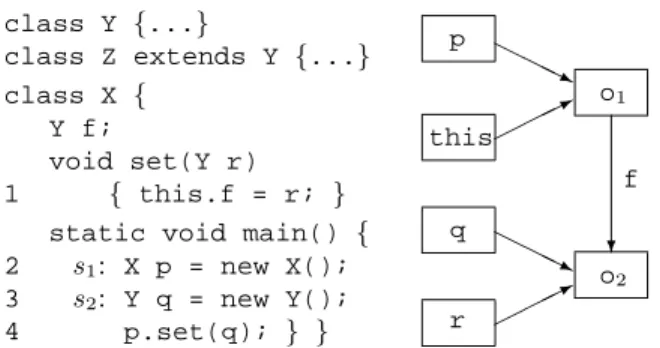
class Y {...} class Z extends Y {...} class X { Y f; void set(Y r) 1 { this.f = r; }
static void main() {
X p = new X(); 2 s1: Y q = new Y(); 3 s2: 4 p.set(q); } } HHHj * HHHj * ? p this q r o1 o2 f
Figure 6. Sample program and its points-to graph.
run-time memory states of the analyzed program. A sample program and its points-to graph are shown in Figure 6. The points-to graphs contain two kinds of edges, both of which are presented in Figure 6. For example, edge(p, o1)shows
that reference variablepmay point to objecto1, where
ob-ject name o1 represents all objects that may be created at
object allocation sites1. Edge(ho1, fi, o2)shows that field
f of objecto1may point to objecto2.
The points-to solution can be used to derive the solu-tion of a corresponding class analysis. The set of possible classes of objects that may be bound torcan be determined by examining the classes of all objects in the points-to set ofr.
In this section we briefly present at a high level two points-to analyses, denoted by AND-PT and OBJ-PT, and their corresponding class analyses, denoted by AND and OBJ. AND-PT [20] is a flow-insensitive and insensitive points-to analysis and OBJ-PT [16] is a context-sensitive version of AND-PT.3 We do not intend to present all details of the design and implementation of these analy-ses; more detailed information is available in [20, 16].
AND-PT is derived from Andersen’s points-to analysis for C [3]. The analysis uses rules that add new edges to points-to graphs. Each rule represents the meaning of a program statement. For example, statementl=rcreates new points-to edges froml to all objects pointed to byr. Similarly, statement l.f = r creates new field edges la-beled f from all objects in the points-to set oflto all ob-jects in the points-to set of r. For virtual call statement l=r0.m(r1, ..., rk), the target method is determined based
on the receiver objects pointed to by r0 and the method
identifierm. The rules are applied repeatedly until no new points-to edges can be added to the points-to graph. The
3A flow-insensitive analysis ignores the flow of control between
pro-gram points. A context-insensitive analysis does not distinguish between different invocations of a method. Flow-sensitive analyses are more precise and costly than flow-insensitive ones. Similarly, context-sensitive analyses are more precise and costly than context-insensitive ones.
resulting points-to graph is examined to determine the solu-tion for the corresponding class analysis AND.
Example Consider the sample program in Figure 6. Due to the object creation statements at line 2 and line 3, points-to edges(p, o1)and(q, o2)are added to the graph.
At line 4,ppoints to objecto1. Based on the class ofo1and
the method identifierX.set, the analysis determines that the method invoked by the virtual call at line 4 isX.set. Thus, implicit parameterthis of methodX.setis set to point to o1, and formal parameterris set to point to all objects in
the points-to set of actual parameterq. In this case, the anal-ysis infers two new points-to edges: (this, o1)and(r, o2).
Finally, when the rule for this.f =r is applied at line 1, fields f of all objects in the points-to set ofthis are set to point to all objects in the points-to set ofr. In this ex-ample, as a result of this rule, the analysis infers points-to edge(ho1, fi, o2). All points-to edges are shown in the
fi-nal points-to graph in Figure 6. The corresponding class analysis AND infers the following sets:
Cs(X.set.r) ={Y} Cs(p) ={X} Cs(q) ={Y} Object sensitivity [16] is an approach for context sen-sitivity of flow-insensitive points-to analysis for object-oriented languages. The key idea is that every instance method and constructor is analyzed separately for each of its receiver objects. OBJ-PT is an object-sensitive version of AND-PT. Because OBJ-PT distinguishes contexts of in-vocations associated with distinct receiver objects, it is able to avoid merging the effects of instance methods and con-structors over all possible receivers.
Example Recall the set of statements from Figure 6. Suppose that the following statements are added at lines 5, 6, 7, and 8 in methodmain:
5 s3: X p2 = new X();
6 s4: Z q2 = new Z();
7 p2.set(q2);
8 Y q3 = p2.f;
When these statements are analyzed using AND-PT, there are spurious points-to edges(ho1, fi, o4),(ho3, fi, o2), and
(q3, o2). This imprecision affects class analysis. For
exam-ple, AND erroneously infers that the set of possible classes for variableq3is{Y, Z}. OBJ-PT avoids merging the
ef-fects of methodX.setfor receiverso1ando3, and only
cre-ates points-to edges(ho1, fi, o2),(ho3, fi, o4), and(q3, o4).
Thus, the corresponding class analysis OBJ infers that the possible set of classes forq3is{Z}.
4
Empirical Results
We performed experiments on nine publicly available Java programs, ranging in size from 177KB to about 1MB
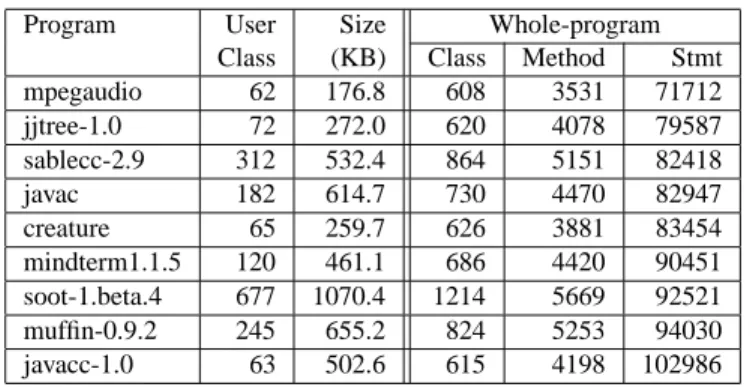
Program User Size Whole-program
Class (KB) Class Method Stmt
mpegaudio 62 176.8 608 3531 71712 jjtree-1.0 72 272.0 620 4078 79587 sablecc-2.9 312 532.4 864 5151 82418 javac 182 614.7 730 4470 82947 creature 65 259.7 626 3881 83454 mindterm1.1.5 120 461.1 686 4420 90451 soot-1.beta.4 677 1070.4 1214 5669 92521 muffin-0.9.2 245 655.2 824 5253 94030 javacc-1.0 63 502.6 615 4198 102986
Table 1. Characteristics of the data programs.
of bytecode. The set includes programs from the SPEC JVM98 suite, other benchmarks used in previous work on analysis for Java, as well as programs from an Internet archive (www.jars.com) of popular publicly available Java applications. All experiments were performed on a 360MHz Sun Ultra-60 machine with 512MB memory.
Table 1 shows some characteristics of the data pro-grams. The first two columns show the number of user (i.e., non-library) classes and their bytecode size. The next three columns show the size of the program, includ-ing library classes, after usinclud-ing CHA to filter out irrele-vant classes and methods. We use the Soot framework (www.sable.mcgill.ca) to process Java bytecode and to build an intermediate representation of the program [26]. The last column in Table 1 shows the number of statements produced by Soot after processing the bytecode.
4.1
Precision
In our experiments we measured the impact of class anal-ysis on ORD construction with respect to two metrics: (i) the number of edges in the ORD and (ii) the average size of the class firewall. We also measured the impact of class analysis on the number of edges in the ExtORD.
Java programs typically contain a large portion of stan-dard library code. We believe that in most cases one can assume the correctness of the library code, and therefore in-teractions between library classes and inin-teractions between library classes and user classes do not need to be tested. In order to assess the impact of the different class analyses on determining the dependencies between user classes, we extract the user-class-related portion of the ORD/ExtORD computed by the algorithm in Figure 5. The nodes of the user-class-related subgraph are all nodes representing user classes, and the edges are all edges connecting user class nodes. For the remainder of this paper the terms ORD and ExtORD will be used to refer to these corresponding user-class-related subgraphs.
Program CHA AND OBJ Reduction AND OBJ mpegaudio 437 232 229 46.9% 47.6% jjtree 604 351 351 41.9% 41.9% sablecc 38643 18023 5531 53.4% 85.7% javac 12292 7672 7654 37.6% 37.7% creature 619 272 232 56.1% 62.5% mindterm 1028 423 420 58.9% 59.1% soot 76223 32581 32479 57.3% 57.4% muffin 11431 2522 2522 77.9% 77.9% javacc 780 554 554 29.0% 29.0% Avg 51.0% 55.4% Table 2. ORD size.
4.1.1 ORD Size
The size of the ORD is an indication of the precision of the diagram; more precise diagrams contain fewer edges. The first three columns of Table 2 show the number of edges computed by CHA, AND, and OBJ. The improvements of AND and OBJ over CHA are shown in the last two columns of the table. On average, AND reduces the number of ORD edges by 51% and OBJ by 55%.
These results show that class analyses based on points-to analyses can significantly reduce the number of spurious dependence edges. The improved precision may lead to less time and effort spent on cycle breaking and stub construc-tion when the ORD is used to define a test order in integra-tion testing or a retest order in regression testing.
4.1.2 Class Firewall Size
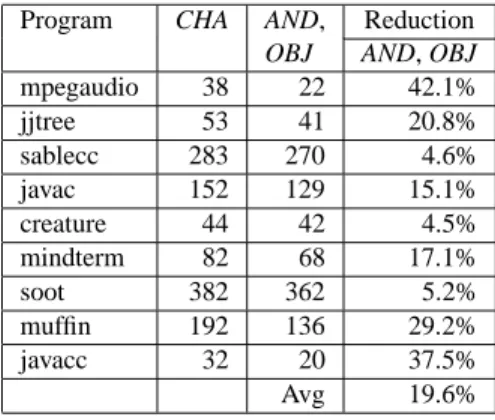
The size of the class firewall indicates how suitable the ORD is for use in regression testing. Class firewalls com-puted from a more precise ORD contain fewer classes. The first two columns in Table 3 show the average class firewall sizes for our benchmarks. For each user class in a program, we calculated the size of its firewall. Then we took the av-erage of these firewall sizes over all the user classes in the program. The last column in the table shows the improve-ments of AND and OBJ over CHA.4On average, the more precise class analyses reduce the average class firewall size by almost 20%.
These results show that class analysis based on points-to analysis produces substantially smaller class firewalls, which may result in less work and less time and effort spent on regression testing. Savings may occur because classes not affected by the change which triggered the regression testing will not be retested.
4The numbers for AND and OBJ are the same.
Program CHA AND, Reduction
OBJ AND, OBJ
mpegaudio 38 22 42.1% jjtree 53 41 20.8% sablecc 283 270 4.6% javac 152 129 15.1% creature 44 42 4.5% mindterm 82 68 17.1% soot 382 362 5.2% muffin 192 136 29.2% javacc 32 20 37.5% Avg 19.6%
Table 3. Class firewall size.
4.1.3 ExtORD Size
In order to estimate the impact of the different analyses on coverage analysis, we computed the size of the ExtORD. This size is an indication of the precision of the diagram; more precise diagrams contain fewer dependence edges (i.e., fewer spurious edges).
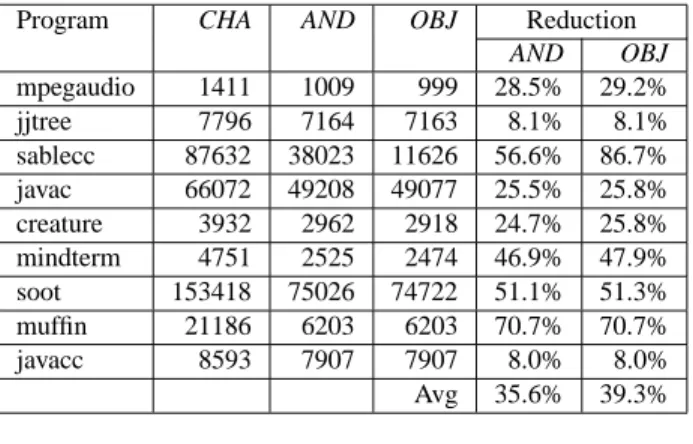
The first three columns in Table 4 show the number of edges computed by CHA, AND, and OBJ respectively. The percentage improvements for AND and OBJ over CHA are shown in the last two columns. On average, AND reduces the number of edges in the ExtORD by 36% and OBJ by 39%.
We draw two conclusions from these results. First, the results computed by CHA are very imprecise and this leads to a significant number of spurious dependence edges. At-tempting to exercise statements in a way that triggers these impossible dependences in order to achieve high coverage will lead to substantial waste of time and effort. Second, this significant reduction shows that AND and OBJ are good candidates for use in tools for coverage analysis.
4.2
Points-to Analysis Cost
The measurements of points-to analysis cost are pre-sented in Table 5. The first two columns show the run-ning time and memory usage of AND-PT. The last two columns show the cost of OBJ-PT. These empirical results show clearly that the two points-to analyses are practical in terms of running time and memory consumption. Thus, these analyses are realistic candidates for use in software engineering tools.
5
Related Work
The firewall approach was proposed by White et al. for regression testing of procedural code [27, 28]. Kung et al. [13] define the Object Relation Diagram (ORD) and adapt the firewall approach for object-oriented languages.
Program CHA AND OBJ Reduction AND OBJ mpegaudio 1411 1009 999 28.5% 29.2% jjtree 7796 7164 7163 8.1% 8.1% sablecc 87632 38023 11626 56.6% 86.7% javac 66072 49208 49077 25.5% 25.8% creature 3932 2962 2918 24.7% 25.8% mindterm 4751 2525 2474 46.9% 47.9% soot 153418 75026 74722 51.1% 51.3% muffin 21186 6203 6203 70.7% 70.7% javacc 8593 7907 7907 8.0% 8.0% Avg 35.6% 39.3% Table 4. ExtORD size.
However, Kung et al.’s work does not consider the effects of dynamic binding of polymorphic variables.
Labiche et al. [14] propose an approach for correcting the problem with dynamic bindings. Their work uses the structure of the class hierarchy to determine possible bind-ings. Our approach uses more precise class analysis and constructs ORDs with significantly fewer spurious depen-dence edges, compared to ORDs constructed by examining the class hierarchy.
Work by Tai and Daniels [24] and Jeron et al. [12] con-centrates on approaches for cycle breaking in the ORD. This work addresses the following question: given the diagram, what cycles should be removed so that the minimum num-ber of stubs will need to be constructed. Our work concen-trates on improving the precision of the ORD, which poten-tially leads to fewer dependence cycles.
There are many existing class analyses [17, 1, 2, 18, 9, 4, 11, 8, 6, 19, 21, 22, 23, 25, 15, 20, 10, 16] that have been used in the context of optimizing compilers and software engineering tools for object-oriented programming languages. Our work is the first one to investigate the use of these analyses for the purposes of ORD/ExtORD construc-tion.
6
Conclusions and Future Work
We have shown how class analysis can be used to con-struct the Object Relation Diagram (ORD) of a program. Our empirical results demonstrate that using precise class analyses can result in substantially more precise ORDs, compared to ORD construction based on the structure of the class hierarchy.
We have defined the Extended Object Relation Diagram (ExtORD), which is a version of the ORD suitable for use in coverage analysis. Any method developed for ORD con-struction can be easily extended to construct the ExtORD. Our experiments show that precise class analyses can sub-stantially improve the precision of the ExtORD.
Program AND-PT OBJ-PT
Time Memory Time Memory [sec] [MB] [sec] [MB] mpegaudio 32.0 53 29.7 52 jjtree 23.7 53 24.4 52 sablecc 136.6 112 73.1 94 javac 973.4 122 956.9 122 creature 176.1 90 126.3 87 mindterm 82.3 91 93.0 88 soot 146.1 130 171.8 131 muffin 236.3 144 214.0 133 javacc 165.2 110 169.5 112
Table 5. Running time and memory usage.
In our future work we plan to use class analysis for ORD construction in the context of tools for integration and gression testing. Our goal is to develop algorithms for re-gression test case selection based on precise ORDs. We also plan to build integration coverage analysis tools based on the ExtORD. Finally, we would like to investigate the use of these dependence diagrams for the purposes of program understanding and reengineering.
7
Acknowledgments
We would like to thank the ICSM reviewers for their helpful comments. This research was supported by NSF grant CCR-9900988.
References
[1] O. Agesen. Constraint-based type inference and para-metric polymorphism. In Static Analysis Symposium, LNCS 864, pages 78–100, 1994.
[2] O. Agesen. The cartesian product algorithm. In Eu-ropean Conference on Object-Oriented Programming, LNCS 952, pages 2–26, 1995.
[3] L. Andersen. Program Analysis and Specialization for the C Programming Language. PhD thesis, DIKU, University of Copenhagen, 1994.
[4] D. Bacon and P. Sweeney. Fast static analysis of C++ virtual function calls. In Conference on Object-Oriented Programming, Systems, Languages, and Ap-plications, pages 324–341, 1996.
[5] R. Binder. Testing Object-Oriented Systems: Models, Patterns, and Tools. Addison-Wesley, 1999.
[6] R. Chatterjee, B. G. Ryder, and W. Landi. Relevant context inference. In Symposium on Principles of Pro-gramming Languages, pages 133–146, 1999.
[7] J. Dean, D. Grove, and C. Chambers. Optimizations of object-oriented programs using static class hierarchy analysis. In European Conference on Object-Oriented Programming, pages 77–101, 1995.
[8] G. DeFouw, D. Grove, and C. Chambers. Fast inter-procedural class analysis. In Symposium on Principles of Programming Languages, pages 222–236, 1998. [9] A. Diwan, J. B. Moss, and K. McKinley.
Sim-ple and effective analysis of statically-typed object-oriented programs. In Conference on Object-Oriented Programming, Systems, Languages, and Applications, pages 292–305, 1996.
[10] D. Grove and C. Chambers. A framework for call graph construction algorithms. ACM Transactions on Programming Languages and Systems, 23(6):685– 746, Nov. 2001.
[11] D. Grove, G. DeFouw, J. Dean, and C. Chambers. Call graph construction in object-oriented languages. In Conference on Object-Oriented Programming, Sys-tems, Languages, and Applications, pages 108–124, 1997.
[12] T. Jeron, J.-M. Jezequel, Y. L. Traon, and P. Morel. Ef-ficient strategies for integration and regression testing of OO systems. In International Symposium on Soft-ware Reliability Engineering, pages 260–269, 1999. [13] D. Kung, J. Gao, P. Hsia, J. Lin, and Y. Toyoshima.
Class firewall, test order and regression testing of object-oriented programs. Journal of Object-Oriented Programming, 8(2):51–65, 1995.
[14] Y. Labiche, P. Thevenod-Fosse, H. Waeselynck, and M.-H. Durand. Testing levels for object-oriented soft-ware. In International Conference on Software Engi-neering, pages 136–145, 2000.
[15] D. Liang, M. Pennings, and M. J. Harrold. Ex-tending and evaluating flow-insensitive and context-insensitive points-to analyses for Java. In Workshop on Program Analysis for Software Tools and Engineer-ing, pages 73–79, 2001.
[16] A. Milanova, A. Rountev, and B. Ryder. Parame-terized object-sensitivity for points-to and side-effect analysis for Java. In International Symposium on Soft-ware Testing and Analysis, 2002.
[17] J. Palsberg and M. Schwartzbach. Object-oriented type inference. In Conference on Object-Oriented Programming, Systems, Languages, and Applications, pages 146–161, 1991.
[18] J. Plevyak and A. Chien. Precise concrete type infer-ence for object-oriented languages. In Conferinfer-ence on Object-Oriented Programming, Systems, Languages, and Applications, pages 324–340, 1994.
[19] C. Razafimahefa. A study of side-effect analyses for Java. Master’s thesis, McGill University, Dec. 1999. [20] A. Rountev, A. Milanova, and B. G. Ryder.
Points-to analysis for Java based on annotated constraints. In Conference on Object-Oriented Programming, Sys-tems, Languages, and Applications, pages 43–55, 2001.
[21] E. Ruf. Effective synchronization removal for Java. In Conference on Programming Language Design and Implementation, pages 208–218, 2000.
[22] M. Streckenbach and G. Snelting. Points-to for Java: A general framework and an emprirical comparison. Technical report, U. Passau, Sept. 2000.
[23] V. Sundaresan, L. Hendren, C. Razafimahefa, R. Vallee-Rai, P. Lam, E. Gagnon, and C. Godin. Prac-tical virtual method call resolution for Java. In Confer-ence on Object-Oriented Programming, Systems, Lan-guages, and Applications, pages 264–280, 2000. [24] K.-C. Tai and J. F. Daniels. Interclass test order for
object-oriented software. Journal of Object-Oriented Programming, 12(4):18–25, 1999.
[25] F. Tip and J. Palsberg. Scalable propagation-based call graph construction algorithms. In Conference on Object-Oriented Programming, Systems, Languages, and Applications, pages 281–293, 2000.
[26] R. Vall´ee-Rai, E. Gagnon, L. Hendren, P. Lam, P. Pominville, and V. Sundaresan. Optimizing Java bytecode using the Soot framework: Is it feasible? In International Conference on Compiler Construction, LNCS 1781, pages 18–34, 2000.
[27] L. White and H. Leung. A firewall concept for both control-flow and data-flow in regression integra-tion testing. In Internaintegra-tional Conference on Software Maintanence, pages 262–271, 1992.
[28] L. White, V. Narayanswamy, T. Friedman, M. Kirschenbaum, P. Piwowarski, and M. Oha. Test manager: A regression testing tool. In Interna-tional Conference on Software Maintanence, pages 338–347, 1993.