By Subrahmanyam Allamaraju, Ph.D.
Copyright © Subrahmanyam Allamaraju 2001 All rights reserved
Published by MightyWords, Inc. 2550 Walsh Avenue
Santa Clara, CA 95051 www.mightywords.com ISBN 0-7173-0642-9
Table of Contents
Summary...1
Introduction...2
Java in Retrospect...6
What is server-side programming? ...9
Server-Side Applications—Programming Models...14
Synchronous Request-Response Model ...16
Basic Requirements ...16
Java RMI...21
Instance Management ...23
Location and Naming ...25
Programming Model...28
Synchronous Stateless Request-Reponse Model ...30
The HTTP ...31
Http Programming Needs ...33
Programming Model...39
Asynchronous Communication Model...40
Message Queuing...42
Publish and Subscribe...44
Programming Model...46
Other Server-Side Requirments ...48
Distributed Transaction Processing ...48
Security...53
J2EE for Server-Side Programming ...56
Distributed Components for Synchronous Programming—EJBs ...60
Session Beans ...68
Entity Beans...69
Naming and Object Location—JNDI...77
Java Servlets and JSP Pages for Synchronous Connectionless Programming...80
Java Servlets ...80
JSP Pages ...84
Java Servlets or JSP Pages?...86
Asynchronous Programming—JMS ...88
Basic Programming Model ...88
Point-to-Point Messaging ...89
Publish and Subscribe Messaging ...91
Point-to-Point or Publish and Subscribe? ...92
Other JMS Features ...93
J2EE Transactions ...95
J2EE Security ...99
Security for Web Applications ...99
Security for EJBs ...102
Conclusion...104
Summary
Building and managing server-side enterprise applications has always been a challenge. Over the last two decades, the role and importance of server-side applications has increased. The twenty-first century economy dictates that e-commerce and other enterprise applications are transparent, networked, adaptable, and service-oriented. These demands have significantly altered the nature of applications. As enterprises migrate from closed and isolated applications to more transparent, networked, and service-oriented applications to enable electronic business transactions, server-side technologies occupy a more prominent place. Despite the disparity of applications that exist in any enterprise, server-side applications are what power twenty-first century enterprises!
The purpose of this article is two-fold. Firstly, this article attempts to highlight the technical needs for server-side applications, and thereby establish a set of programming models. Secondly, based on these programming models, this article introduces the reader to the Java 2, Enterprise Edition (J2EE).
If you are a beginner to server-side programming, or the J2EE, this article will help you gain an overall perspective of what this technology is about. If you are familiar with one or more J2EE technologies, this article will provide the basic principles behind server-side programming, and help you relate these principles to specific J2EE technologies.
Introduction
Building and managing server-side enterprise applications1 has always been a challenge. Over the last two decades, the role and importance of server-side applications has increased. The twenty-first century economy dictates that e-commerce and other enterprise applications are transparent, networked, adaptable, and service oriented. These demands have significantly altered the nature of applications. As enterprises migrate from closed and isolated applications to more transparent, networked, and service-oriented applications to enable electronic business transactions, server-side technologies become more prominent. Despite the disparity of applications that exist in any enterprise, server-side applications are the ones that power twenty-first century enterprises.
The history of server-side applications dates back to the mainframe era, an era during which only mainframes roared across enterprises. They were centralized in nature, with all the computing—from user interfaces, to complex business process execution, to transactions—performed centrally. The subsequent introduction of minis, desktops, and relational databases fueled a variety of client-server style applications. This contributed to a shift in the way applications could be built, leading to various architectural styles, such as two-, three-, and multi-tier architectures. Of all the styles, database-centric client-server architecture was one of the most widely adapted. Other forms of client-server applications include applications developed using remote-procedure calls (RPC), distributed component technologies, such as Common Object Request Broker Architecture (CORBA), and Distributed Component Object Model (DCOM), etc. Just as these technologies and architectures were diverse, so too were the nature of clients for such applications. The most commonly used client types for these applications were desktop based (i.e., those developed using Visual Basic or other similar languages). Other types of clients included other applications (viz., as in enterprise application integration) and even Web servers.
Subsequently, what we see today are Internet-enabled server-side applications. The underlying technologies for building Internet-enabled server-side applications have evolved significantly and are more mature and less complex to deal with, as you will see later in this article. Apart from providing more flexible programming models, today’s server-side technologies are infrastructure intensive. They eliminate some of
1 As per Merriam Webster’s dictionary, the word enterprise means a business organization. Enterprise
the complex infrastructure-related tasks, such as network-level programming, multiple threading and concurrency, distributed transactions, security, and so on.
The way in which server-side applications are built and managed has changed significantly. Unlike applications developed in the ’80s and ’90s, today’s applications are neither centralized (as in mainframes) nor distributed between clients and servers (as in two-tier client-server applications). What we are attempting to build now are loosely coupled distributed applications with the following requirements:
1. Transparent (not locked to departments within enterprises): This represents a shift from both centralized and decentralized client-server applications. The need for transparency arises from a need to access information irrespective of where the data is stored and which application maintains the data.
2. Networked (not isolated): Applications can be linked to execute several complex business processes.
3. Adaptable (rather than those built for each specific need): In an economy where speed matters, it is no longer feasible to build end-to-end applications from scratch for every business requirement. Instead, what is needed is the ability to quickly adapt and enhance existing applications with changing requirements. This implies that enterprise applications cannot be viewed as monolithic units of software, each built for a separate task. Instead, such applications should be viewed (and built) as loosely coupled and flexible components.2 Depending on the need, you should be able to compose such components to implement various business processes.
4. Service Oriented (not user-interface oriented): This requires a marked shift from earlier views, in which enterprise applications were seen as a set of databases and user interfaces. Instead, an application must be seen as a set of services accessed from a variety of channels and user interfaces.
Note: None of these requirements are entirely new. They are simply manifestations of abstraction, encapsulation,3 and loose-coupling at the enterprise level.
2 Here I am using the word component in a loose sense, implying a piece of loosely coupled unit of
software, not necessarily a distributable piece of software.
3 Booch, G. (1994). Object-oriented analysis and design with applications. Addison-Wesley Publishing
What triggered the possibility of building such applications? Until a few years ago, the technologies that enabled Internet and conventional server-side applications were disparate, complex and difficult to manage; they include the following:
• Common Gateway Interface (CGI) and related Web-development technologies.4
• Database-based client-server technologies (for instance, from Oracle and Microsoft).
• Distributed component development technologies, such as CORBA5 and COM/DCOM.
These technologies attempted to address two different categories of problems and left the problem of unifying them to developers. For instance, the CGI and related technologies helped in building dynamic Web pages, while distributed component technologies considered the network and related distribution issues alone. The client-server technologies did not consider either, and instead left us with a large number of applications that aren’t easily adaptable and cannot easily be networked.
This situation has changed significantly over the last couple of years. The Windows Distributed Internet Applications Architecture (DNA), now called Web Solution Platform6, and a part of the recently announced .NET platform7 suite of technologies from Microsoft, and the J2EE8 from Sun Microsystems (in collaboration with other leading technology vendors) attempt to integrate the distributed component technologies and Web technologies together, thus avoiding the burden of integrating them at the application level. In addition, these technologies provide more simplified programming models that hide most of the complexity associated with the underlying technologies. You will find more details later in this article.
In this article, my objective is to discuss the fundamental ideas behind server-side programming and discuss server-side programming using the J2EE technology. Sun
4 Castro, E. (1998). Perl and CGI for the world wide web: Visual QuickStart guide. Addison-Wesley
Publishing Company.
5 Slama, D. et al. (1999). Enterprise CORBA. Prentice Hall Inc.
6 Web Solution Platform at: http://microsoft.com/business/products/webplatform. 7http://microsoft.com/net
Microsystems introduced J2EE in 1999. J2EE is essentially a set of specifications produced by Sun Microsystems with participation from several other leading vendors. Application servers9 complying with J2EE began to appear in 1999 and 2000. Today, J2EE offers a cross-platform (and partly vendor independent) means for developing large-scale server-side applications using the Java programming language.
Following are some of the questions I will address in this article:
1. What is server-side programming? What are the fundamental requirements of server-side technologies?
2. What are the common programming models for server-side programming?
3. What is J2EE? How does J2EE simplify developing distributed component applications for the Internet? How does it relate to the conventional technologies previously mentioned?
4. What are some of the common patterns adapted in J2EE that add flexibility to the infrastructure?
If you are beginning to learn server-side programming and/or J2EE, this article should help you get a quick overview of the underlying principles of server-side programming using J2EE10 and its applicability for electronic commerce.11
This article adopts a discovery approach to discussing the Java server-side technologies and their applicability. In this approach, rather than starting with specific technologies and trying to see their details with examples, we will walk through the business/technical problems first, and then lead to specific Java server-side technologies. You will find pointers to reference books, papers, and Web sites for further reading in footnotes. I encourage you to go through these resources for more details.
9 See: http://www.techmetrix.com for a list of application servers offering J2EE capabilities and their
relative features. Since these products are evolving rapidly, you should also consult the respective vendor Web sites to get more up-to-date product details. Another source of information is
http://www.TheServerSide.com where experienced developers post and debate product reviews. You
may also try http://www.jGuru.com for tips and answers to questions on several Java technologies including J2EE.
10 Allamaraju, S. et al. (2000). Professional java server programming, J2EE edition. Wrox Press Inc. 11 Allamaraju, S. et al. (2001). Professional java e-commerce. Wrox Press Inc.
Java in Retrospect
Today, Java is the one of the most commonly used programming languages for developing enterprise and e-commerce applications. Since its introduction by Sun Microsystems in 1995, the Java programming language has replaced other programming languages, such as C and C++ (and to a lesser extent even Visual Basic). While developers grappled with these programming languages to implement enterprise and e-commerce applications, the Java programming language offered a platform-neutral alternative such that developers could program object-oriented applications in a platform-independent manner. Although programming languages like C and C++ were flexible enough to develop a variety of complex applications (including client-server and other enterprise applications), they lacked a core architecture capable of integrating the programming requirements of the ’90s that were geared towards the Internet.
It is not an overstatement to say that software development needs changed rapidly during late 1990s. This was fueled partly by various business and technical developments related to e-commerce. The most important of these developments includes the need for rapid development, adaptability, and security. The Java programming language attempts to meet these needs at the infrastructure level. Unlike other standard languages, such as C and C++, and proprietary languages, such as Visual Basic, Java provides a more consistent and infrastructure-intensive runtime. The Java platform’s core runtime (the Java Run-time Environment) has built-in security, multiple threading, and memory management (garbage collection). The object-oriented features of this language, coupled with the standard application programming interfaces (APIs) that are included in the platform, help developers achieve rapid development and adaptability. Due to the built-in threading and memory management in Java, it is not uncommon to find Java programs significantly shorter than those developed using other languages, which results in greater software reliability and programmer productivity. Those of you who have attempted to port an application developed in C language to various flavors of UNIX and Windows platforms would be quick to see these advantages.
Apart from Java’s basic object-oriented features, its built-in security and networking facilities and runtime made it a popular language; in fact, Sun Microsystems continues to emphasize these features to this day. Java offers a viable means for developing and deploying a variety of applications—ranging from consumer products and mobile devices, to browser-based applets and multi-tiered
enterprise applications. The fact that the original Java platform could be extended to cater to such diverse application-development needs indicates the strength of its core architecture.
Over the last few years, the Java language has been significantly improved. While the core architecture of Java remained the same, the language has been enhanced in terms of security, usability of APIs, etc. Today, there are three major editions of Java technologies, as follows:
1. Java 2 Standard Edition (J2SE)12: This is the most commonly used form of Java technology. Also referred to as Java Development Kit (JDK), J2SE is a software development kit that includes a set of APIs, tools, and a runtime for developing general-purpose applications.
2. Java 2 Enterprise Edition (J2EE)13: J2EE is the basis for Java-based enterprise applications. J2EE specifies a standard for developing multi-tier distributed component-based applications. J2EE provides an integrated technical framework for developing Internet-enabled enterprise, and e-commerce applications.
3. Java 2 Micro Edition (J2ME)14: J2ME provides a lightweight and optimized Java environment for applications and consumer and mobile devices.
In addition, there are several APIs and related technologies under development via a process known as the Java Community Process.15 Through this process, individuals as well as vendors can participate in enhancing existing APIs and can develop new APIs.
Of these editions, the J2SE is the standard platform for developing Java applications for most of the common platforms, which range from Windows-based personal computers, to Macs, to several variants of UNIX, to even some mainframes.16
12 See: http://java.sun.com/j2se for more details including API documentation, and downloads. 13 See: http://java.sun.com/j2ee for the J2EE specification, links to various J2EE technologies, and
to download the reference implementation.
14 See: http://java.sun.com/j2me for more details.
15 See: http://java.sun.com/aboutJava/communityprocess/index.html. There are over 100 Java
Specification Requests (JSRs) under progress now. These JSRs indicate some of the future directions of Java technologies.
The J2EE consolidates most of the server-side technical infrastructure and development lifecycle requirements into a set of specifications. The purpose of J2EE is to simplify development and management of distributed component-based Web-centric applications.
While J2EE is targeted at large-scale enterprise applications, the J2ME is targeted at consumer electronics and embedded devices. Similar to J2SE and J2EE, the J2ME includes a Java virtual machine and a set of APIs tailored to the needs of applications for consumer electronics and embedded devices.
In this article, my focus is limited to server-side programming with J2EE. As you will see, the J2EE is driving a major section of the Java programming community because the technology addresses most of the infrastructure issues that server-side systems face.
What is server-side programming?
The terms server and server-side programming are very commonly used. But what is a server? Generally speaking, a server is an application hosted on a machine that provides some services to the other applications (clients) requesting the services. As is obvious from the definition, a server typically caters to several clients, often concurrently. The services offered by a server application can be very diverse— ranging from data, and other information, management to the execution of specialized business logic. Although several types of server applications are possible, you can quickly recognize the following two kinds of servers:
1. Commercial Database Servers (or Database Management Systems): Servers that manage data, which come from vendors, such as Oracle, Sybase, and Microsoft. Client applications use standard APIs, such as Open Data Base Connectivity (ODBC) or Java Data Base Connectivity (JDBC), in combination with SQL (Structured Query Language) to access/manipulate the data. In addition to these standard APIs, you may use vendor-specific client access APIs to communicate with the database server. These servers are responsible for consistently managing data such that multiple clients can manipulate the data without loss of consistency.
2. Web Servers: The other easily recognizable types of servers are Web servers. A Web server hosts content, such as HTML files. Clients (Web browsers) access this content by submitting requests using Hyper Text Transfer Protocol (HTTP). In its basic mode, a Web server maps a client request to a file in the file system, and then sends the content of the file to the client making the request. Similar to database servers, Web servers can deal with concurrent requests—often several thousands. Because we are accustomed to working with these types of servers, we often tend to overlook the fact that they are server-side applications, albeit standardized. However, when I use the term server-side programming, I do not mean developing such databases or Web servers. Such applications were commodified years ago. These general-purpose server-side applications provide standard, predefined functionality. In the case of server-side programming, we are more interested in developing special-purpose applications to implement specific business-use cases.
Why is it important or relevant to consider server-side applications? Why is it necessary to build applications that can provide services to several client applications? Following are some common scenarios that illustrate the need for server-side applications:
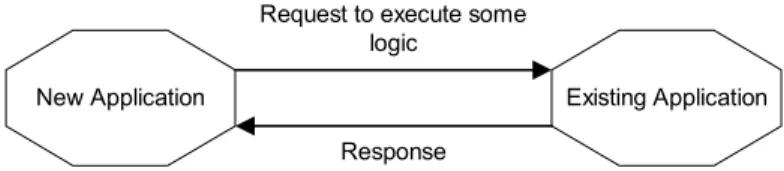
1. Execute some logic available with a different application. This is one of the reasons that prompted development of early distributed technologies, such as the RPC.17 Consider that you are developing an application implementing certain new business-use cases. Suppose that there is some business logic already implemented in a different application. In cases where such functionality is available as separate/isolated class or function libraries, you might consider reusing the same code in the new application. But, what if such logic (and code) depends heavily on some data being managed by the existing application? In such a case, the class/function library cannot be reused as these class/function libraries may fail to execute without the availability of such data. Alternatively, what if such code is dependent on several other parts of the existing application, making it difficult to reuse the code in the new application? One possible solution to deal with this is by executing this logic in the existing application; that is, instead of reusing the code from the existing application, the new application can send a request (with any required data) to the existing application to execute this logic and obtain any results.
New Application Existing Application Request to execute some
logic Response
Figure 1: Execute logic available with a different application.
Figure 1 shows a sample scenario. In this example, we are dealing with two different applications executing as two separate processes, but we can extend this case further and execute these applications on two different machines. In the above example, the new application acts as a client for the existing application (server) that provides the required service, that is, executing some business logic.
2. Access information/data maintained by another application. This is yet another scenario that mandates server-side applications and clients. Database servers and other applications maintain information in a persistent storage fall under this category; however, database servers, such as relational database management systems, typically manage raw data (rows of data in various tables). Such data may or may not be directly usable (in the business sense) by other applications that rely on the data. For instance, consider a database holding various accounts of all customers in a bank. A common requirement in such systems is to consolidate all the accounts of a given customer and present a summarized view of all accounts. Depending on that customer’s account types, the process of generating the summarized view may involve performing some complex calculations including evaluating some business rules.
Now consider several applications within the bank performing other banking tasks some of which require a summarized view of all accounts of a customer. For instance, an application responsible for calculating monthly account charges may require the value of the consolidated account balance. When there are several such applications that require this data, it is appropriate to let one of the applications handle this calculation for all other applications.
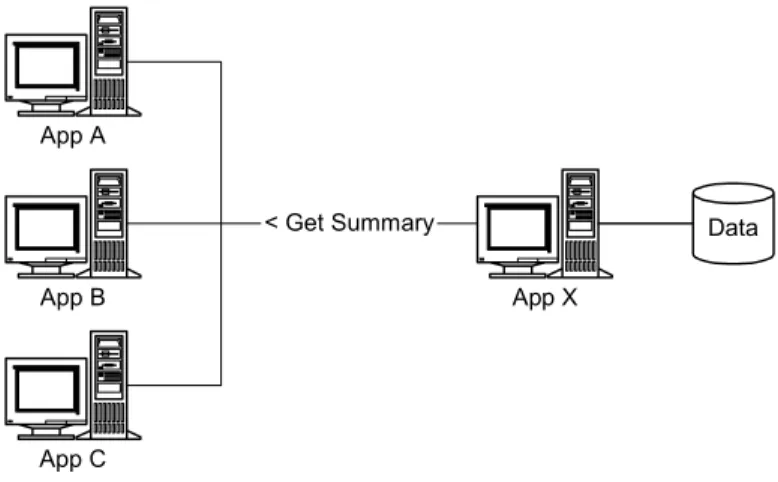
App X Data App C App B App A < Get Summary
Figure 2: Access information from another application.
Figure 2 illustrates such a case. In this figure, App X is capable of making the necessary calculations and arrives at a summarized view of all customer accounts, while App A, App B, and App C request this information from App X. Instead of each individual application attempting to calculate the summarized view, these applications can delegate the responsibility to App X. Similar to the previous
scenario, this illustration also requires of clients and servers. In this case, App X acts as a server (for the account summary information) for App A, App B, and App C.
Standard Web servers also fall under this category. As discussed previously, Web server technologies let you access and search for data/content maintained by Web servers.
3. Integrate applications. In any given enterprise, it is not uncommon to find several applications developed over years that are used for executing different business tasks. You may even find that such stand-alone applications are maintained by different departments of enterprises and developed using different programming languages and technologies. To some extent, such applications were a result of the drive to decentralize businesses from mainframe-based applications. However, as we discussed earlier, one of the requirements encountered by almost all enterprises today is the ability to internetwork such applications so that business workflows can be established across the enterprise.
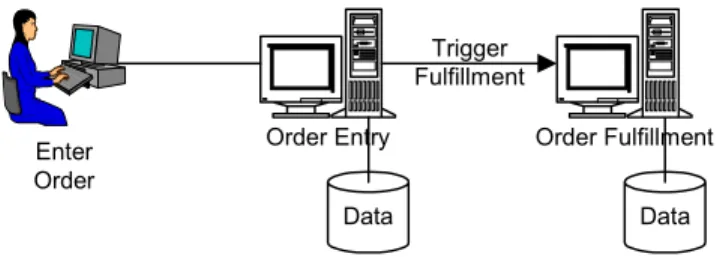
To elaborate further, let us take the case of a traditional retail business collecting orders for products via a call center, surface mail, etc. Let us assume that an order-entry application is used to record all orders (in a database) captured via these channels. Let us also assume that the company has developed an in-house order-fulfillment application, which takes the orders recorded in the database and conducts whatever tasks are need to fulfill each order. These two applications are stovepiped because each of these applications addresses specific business tasks in a decoupled manner without any knowledge of the overall business flow. In this case, the overall business flow is to receive (and enter) orders, and then to fulfill each of the orders. Such stovepiped applications cannot, individually, implement the end-to-end business flow. In order to implement this, you need to integrate the applications such that the order-entry application can automatically trigger the fulfillment application, directly or indirectly. This is the enterprise application integration18 problem, but there are several ways to achieve such integration. One way is to make the order-entry application invoke (or notify) the fulfillment application directly after an order has been captured. The fulfillment application can then start the fulfillment activities thereby streamlining a business flow across these applications.
Order Entry Data Order Fulfillment Trigger Fulfillment Enter Order Data
Figure 3: Integrate applications.
Note: This is a simplified application. In practice, you may find that the fulfillment application was developed using some commercial, off-the-shelf enterprise resource planning (ERP) application (such as from SAP). In such cases, the problem of integration gets more challenging; however, most commercial products offer some technical plumbing to allow for such integration. We’ll discuss more about such pluming in the next section.
These three cases illustrate some of the typical scenarios that require solutions based on server-side applications. Although simplified, and not exhaustive, the purpose of these illustrations is to identify the need for server-side applications.
In the previous examples, we did not discuss specific details of how clients communicate with the server. Neither did we discuss the programming requirements and the underlying technologies. We’ll shortly address these issues.
The server-side technologies (including the Java server-side technologies) can be categorized based on the connectivity model for client-server communication. In the next section, you will find that the connectivity model is what dictates the programming model for different styles of server-side applications. Once we identify the requirements for various programming models, we’ll proceed to map these needs to the various technologies under J2EE.
Server-Side Applications—Programming Models
In this section, we will discuss various programming models for developing server-side applications. But, what do we mean by a programming model? A programming model describes the structure of programs and the associated abstractions. In the case of server-side applications, the programming model describes how to develop client and server applications, how to distribute various infrastructure-related responsibilities, and how the connectivity between clients and servers is established.
In the case of server-side applications, the style of connectivity largely dictates the programming model. The style of connectivity has to do with the following questions: 1. What is the underlying network protocol? Outside of special situations, most
networks and operating platforms use Transport Control Protocol/Internet Protocol (TCP/IP) as the network-level protocol. Unless, the client-server applications use other protocols, such as System Network Architecture Protocol (SNA), TCP/IP is the only protocol that applications have to deal with at the wire level.
2. What is the underlying application protocol? Although the most commonly used network level protocol is TCP/IP, client-server applications may use either a connectionful or connectionless approach for application-level communication. 3. How do clients locate servers? In a client-server world, there may be several
services available across the network. At the network level, the network address specifies a location; however, at the application level, clients will be interested in the services available—not how or where they are located.
4. Do clients and server communicate synchronously or asynchronously? In a synchronous connection, the client connects to the server and waits while the server processes the request. With asynchronous communication, the client does not wait, but instead continues to execute.
5. What is the application-level contract between clients and servers? Do clients see servers as interfaces with methods, or do clients exchange messages with servers? The answer depends on the application-level protocol and the synchronous/asynchronous communication model. You will see the possibilities shortly.
Depending on the application-level protocol, and whether the communication model is synchronous or asynchronous, server-side application programming models can be classified into the following:
1. Synchronous Request-Response Model: This model is meant for method-level communication between clients and servers. In this model, clients invoke methods on server-side objects, and the programming model is similar to regular method invocation on local objects.
2. Synchronous Stateless Request-Response Model: This is the programming model for the Web. In this model, clients send requests using HTTP, and the server responds with responses over HTTP. In the last few years, this programming model has gained tremendous popularity, as it is the model that is driving the externally visible portions of electronic commerce.
3. Asynchronous Communication Model: In this model, clients communicate with servers by sending messages asynchronously. Clients rely on intermediate message brokers (or message buses) for posting messages. This programming model allows highly decoupled communication from clients to servers, and is widely used for integrating enterprise applications.
Now we will discuss each of these approaches and identify the technical infrastructure needs and the application models.
Synchronous Request-Response Model
The fundamental idea behind this model is that it allows client applications to invoke methods/functions executing on remote applications. Technologies, such as CORBA, Java Remote Method Invocation (RMI), and Enterprise JavaBeans (EJB) follow this model.
The following features characterize the synchronous request-response model approach:
1. The contract between clients and servers is interface based. The interface between client and server is the remote interface. It specifies the operations/methods that clients can invoke on servers.
2. The communication between the client and the server is synchronous. This is no different from local method calls. Upon invoking a method, the client thread waits until the server responds. This also implies that the server should be up and running for the client to invoke methods on the server.
3. The communication is connectionful. The application contract can maintain various requests and responses between the client and the server.
These two features narrow the line between invoking a method on a local object and invoking a method on a remote object.
Basic Requirements
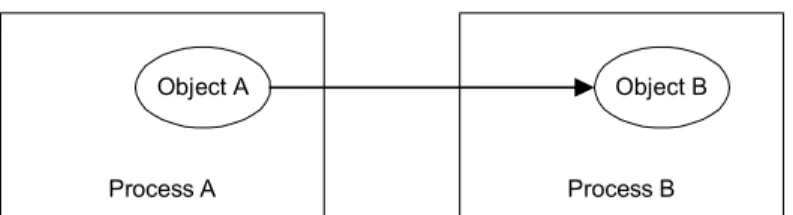
What are the technical requirements for implementing such an approach? Before we can identify the technical requirements, let us study this approach in more detail. The following Figure 4 shows as application (client) invoking a method in a different process. In object-oriented languages, such as Java, methods exist on interfaces or classes. Therefore, in a Java environment, this approach involves a client invoking a method on an object that exists in a different process (possibly on a different machine).
Process A Object A
Process B Object B
Figure 4: Remote method invocation.
Once you start considering the details of implementing the above, you will come across the following infrastructure-level challenges:
1. Object References: In an object-oriented runtime environment, an object can invoke methods on another object as long as the calling object holds a reference to the object being invoked. In Java, an object reference is essentially a handle to an object located in the heap of a process. Because the actual object exists in the heap, an object reference is always local. That is, an object cannot maintain a reference to an object existing in the heap of a different process (unless we are dealing with shared-memory systems, which we are not!). However, the inability of obtaining a reference to a remote object precludes any method invocation in the Figure 4.
In Figure 4, because object B is remote to object A, object A needs to obtain, and maintain, a remote reference to object B. Such a remote reference should be able to maintain a valid reference to an object B existing in process B, and the reference should be valid across the process and network boundaries. But, how to create such a reference? The reference should typically include the following information:
• The network location of the process holding the object.
• Any identity associated with the object in the process.
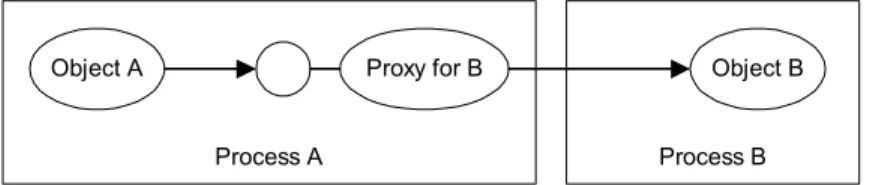
Figure 5 shows a remote reference to B. The remote reference is an object encapsulating the previously listed information. Note that, the client object maintains a reference to the remote reference, while the remote reference object maintains information necessary for connecting to object B. Thus, the role of this remote reference is to be a proxy for object B.
Process A Object A Process B Object B Remote Reference for B
Figure 5: Remote reference.
2. Method Invocation: Once the client obtains a remote reference to a remote object, the next step is to use the remote reference to invoke methods on the remote object. To do this, the remote reference should support all of those methods on the remote object meant for remote invocation. For instance, if object B has five methods that are meant for execution by remote clients, the remote reference should support these methods such that client objects can invoke these methods without having to deal with the remote object directly. One of the ways to exposing these methods is to specify an interface including all the methods. Such interfaces are called remote interfaces. The remote object (object B) implements this interface as it provides the behavior required of the methods specified in the interface. At the same time, the remote reference should also implement this interface, as the clients deal with the remote interface. In this manner, the remote reference acts like a proxy to the remote object. In general, remote references are referred to as proxyobjects or stubs.
Although both the proxy object and the remote object support (implement) the remote interface, there is one difference—the proxy object does not implement the methods, rather it delegates the calls on this object to equivalent calls on the remote object. Figure 6 shows the proxy, and shows the remote interface as a circle attached to an object implementing it.
Process A Object A
Process B Object B Proxy for B
Figure 6: Client-side proxy.
To act as local representative for the remote object in the client process.
To delegate method implementation (over the network) to the corresponding remote object.
Method invocation, however, does not just end by invoking methods on the proxy object. How does this result in a method invocation on the remote object? Should the remote object be network aware and listen for requests over the network? No, it complicates development of the server-side object (i.e., object B).
On the client-side, the proxy object (the remote reference) prevents the calling object (client) from having to deal with the location of the remote object and network semantics. Similarly, on the server-side, we can designate another object to isolate the remote object from the network details. Such an object can receive network-level method requests and translate them into method invocations on the remote object. Figure 7 completes Figure 6 by introducing a skeleton on the server side.
Process A Object A
Process B
Object B Proxy for B Skeletonfor B
Figure 7: Proxy and skeleton isolating the client from the remoteness of the remote object.
The role of this skeleton is similar to that of the proxy on the client side. Both are intermediate objects that prevent the client and the remote object from having to deal with any network-level details. As far as the client is concerned, it is invoking a method on a local object (the proxy). Similarly, as far as the remote object is concerned, it is being invoked by a local object (the skeleton). The proxy and the skeleton handle the true client-server implementation at the network level. 3. Transportation of Data: Let us suppose that we obtain a remote reference to
object B. In terms of local objects, in which an object invokes a method on another object within the same process, the underlying runtime (the Java virtual machine [JVM]) passes the arguments, return types, and exceptions between the calling
object and the object being called. Depending on the argument types, the runtime either copies (call by value), or sends references (call by reference) of arguments to the method being invoked. With primitives, the Java runtime copies the primitives such that these exist in the stack of the method being invoked. In the case of objects as parameters, the runtime copies the references such that the references still point to the same set of objects on the heap. But, what happens in the case of remote objects?
Because references cannot be maintained across processes, all arguments should be copied by value. This applies to both primitives and objects—with one exception, when the argument itself is a remote reference, in which case the remote reference itself can be copied by value.
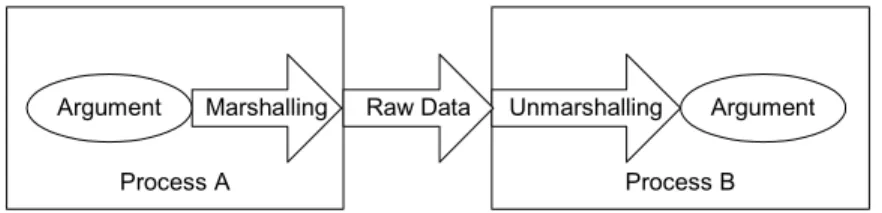
Because arguments (primitives as well as objects) can not copied and sent directly across network to the remote process, the state of each argument should be transformed into a raw format that can be transmitted across the wire. This process is called marshalling, and can be implemented using Java object serialization.
Once the argument data is transferred across the wire to the target process, the data must be converted back into the original format. For instance, if an argument is a java.util.Collection type, the
marshalling process converts the collection into a raw format. On the target process, this raw data must be transformed into an object of the java.util.Collection type, equal by value to the object
that was originally marshalled. This process is called unmarshalling. Object deserialization techniques can be used for unmarshalling. Figure 8 shows these steps.
Process A Argument
Process B Argument Marshalling Raw Data Unmarshalling
Figure 8: Marshalling and unmarshalling.
The previously listed steps apply to return types, as well. Similar to the arguments, return values should be marshalled into raw data on the server side, and the raw data be unmarshalled into the corresponding Java type on the client side.
Although marshaling and unmarshalling applies to exceptions, too, exceptions are more complicated than argument and return values. Apart from copying the exception value to the client side, the same exception should be raised on the client side so that the client application sees the exception as though it was thrown in the same thread.
Let us now summarize the solutions for the previous three technical requirements: 1. Solution requires interface specification for each remote object. Distributed
technologies, such as CORBA and COM/DCOM, rely on interfaces specified using interface definition language (IDL). In the case of CORBA, an IDL interface is a programming language-neutral interface. CORBA vendors provide tools using which such interfaces can be converted into programming language equivalent interfaces/classes. In the case of Java RMI, you can specify remote interfaces by extending the java.rmi.Remote interface.
2. Proxies and skeletons are classes that are capable of performing all network-level tasks between clients and server objects. These tasks include marshalling method requests to the server object, unmarshalling return types, arguments, and exceptions.
Implementing proxy and skeleton classes requires network-level programming. All available distributed technologies today provide tools to automatically generate these classes based on the remote interface specifications. For example, with Java RMI, the RMI compiler generates these classes based on the remote interface specification. Figure 9 summarizes the technical infrastructure for client-server communication.
Process A Object A
Process A
Object B Marshalling Raw Data Unmarshalling
Proxy for B Skeletonfor B
Figure 9: Proxy and skeleton mediating network level method invocation.
Java RMI
Let us now illustrate how to develop client and server objects, and generate proxy and skeleton classes with Java RMI.
Java RMI is the CORBA alternative in a pure Java environment. Java RMI defines a framework for specifying remote interfaces, which is specified in the java.rmi
package. The J2SE also includes the runtime support for remote objects and client-server communication.
You can specify remote interfaces by making your interface extend the
java.rmi.Remote interface (this indicates the Java runtime that it is a remote
interface) as follows:
public interface Process extends java.rmi.Remote {
public void process(String arg) throws java.rmi.RemoteExcetion;
}
This code snippet defines a remote interface with one method. The exception clause is required to denote that this method can throw communication-related exceptions.
The next step is to implement a class that implements the remote interface. This is the server object.
public class ProcessImpl extends UnicastRemoteServer implements Process {
public ProcessImpl() {
super();
}
public void process(String arg) throws java.rmi.RemoteExcetion {
// Implement the method here
}
}
Once you have the remote interface, the next step is to use the rmic compiler on
the implementation class to generate the proxy and skeleton classes. You will find this compiler under the J2SE distribution. This compiler has options to create source files for the proxy and skeleton classes.
Other technologies, such as CORBA or EJB, use similar approaches to specify remote interfaces and generate proxies and skeleton.
Although proxies and skeletons eliminate the need for network-level programming, the following two questions should be considered:
1. How does the skeleton maintain instances of object B? Should the server application create an instance initially, for each request, or should it share one instance for all requests? What are the threading/concurrency implications of any strategy?
2. Location transparency: How do you indicate the location of the server to the proxy object? Can you predetermine this and force the proxy to invoke a specific implementation of the remote interface available at a given network location? If so, the client application would be dependent on the location of the server. But, is it possible to achieve location transparency?
Instance Management
Once the remote interface, and its implementation are available, the next question is how to make instances of the implementation class available in a runtime (process). Creating a new instance of an implementation object is not adequate to make this implementation available via a remote interface. In order for the server implementation object to be available and be able to process requests coming from client applications over the network, the following additional steps are required:
1. The process hosting the instance should be reachable via network. Typically, this boils down to a server socket listening for requests over the network (i.e., the server process should have the necessary infrastructure to do so).
2. The server process should allocate a thread for processing each incoming request. Servers are generally required to be multi-threaded.
3. The server process may host implementations of several remote interfaces. Depending on some of the information contained in the incoming network request, the server process should be capable of identifying the correct implementation object. For instance, the name of the interface could specify the implementation object for the server. In this case, the server should have knowledge of which class implements which remote interface.
4. Once the server identifies the correct interface, it should invoke the associated skeleton class. This class can unmarshall the request parameters and invoke the appropriate method for the implementation class.
In the above list, the task of creating instances depends on whether the client-server communication is required to be stateful or stateless. Address this question when you expect more than one client to invoke methods on a remote object.
The main difference between stateful and stateless communication is whether the remote instance can maintain and rely on instance variable between multiple method calls from a client. For instance, consider that client A is invoking methods on a remote object B. Let’s also assume that the remote interface has several methods. The client may invoke these methods one after the other. While implementing a method, the remote object may store data in its instance variables. For instance, it may store some calculation results in an instance variable. If subsequent methods on this object depend on the value stored in the instance variable, the communication is stateful; that is, the server should make sure that the same instance is being used for all requests from a given client. This also means that, while an instance is serving a client, the server should not use the same instance for other client requests. One important ramification of statefulness is that the server will maintain a separate instance for each client. In systems that have a very large number of clients, statefulness may affect performance.
On the other hand, stateless communication does not require the same instance for a given client (i.e., invoking methods). In this case, the server may be able to use ten objects for these ten clients. As a result, stateless communication is more efficient as it converses memory on the server side.
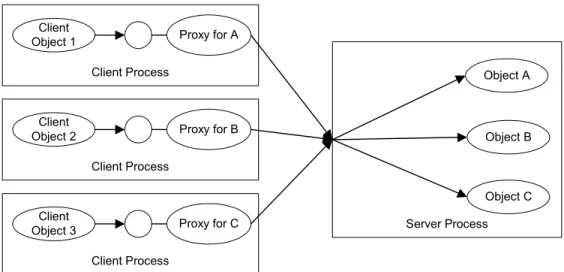
A general practice is to implement remote objects using the stateless approach. Technologies, such as RMI, CORBA, and COM/DCOM provide for stateless remote objects alone. On the other hand, the EJB technology allows for stateful server-side objects, too. We shall discuss more about this later. Figure 10 summarizes the instance management.
Client Process Client Object 1 Server Process Object B Proxy for A Client Process Client
Object 2 Proxy for B
Client Process Client
Object 3 Proxy for C
Object C Object A
Figure 10: Instance management.
Figure 10 shows three client applications communicating with three different remote objects, all being maintained by a single process. Depending on the interface being used, the server process locates an instance and delegates the incoming request to the instance.
Although this figure shows a single server process, in a typical distributed client-server environment, there may be several client-server processes, each maintaining a set of remote objects. When there is one single known server process, it is easy to indicate the network location of the server process to the proxy object; however, when the possibility exists for several such processes, it is difficult to manage the network locations for each proxy. We’ll address this question in the following section.
Location and Naming
As discussed in the previous section, it is important to achieve location transparency in distributed applications with several clients invoking methods on a number of remote objects that are being managed by several server processes across the network. There is one additional question that we did not consider in the previous question. How does the client application create an instance of the proxy object? In the previous discussion we assumed implicitly that the client would create an instance and use it; however, the client should also be aware of the network location of the server process.
Although these two tasks seem independent, both are typically solved using the same approach, with naming and naming services. The basic idea behind naming is
that remote references can be named. Unlike a remote reference (which essentially points to a memory address within the process), a name is portable, and can uniquely determine a remote interface. Therefore, clients can use names to refer to remote objects; however, a name should still correspond to a remote object available at a given network location. How can this association between names and proxies be maintained?
A naming service is one that can manage names and the corresponding remote references (proxies). Let’s consider the following steps in order to understand the role of names and naming services:
1. When the server is started, the server creates a proxy object for each remote object that it is responsible for maintaining, and stores it against a name in another process. Now, this new process has a list of names and the associated proxy objects. The server process can store the network location within the proxy object, or provide sufficient information for the proxy to locate the server.
2. The client supplies the name of a remote object to this new process, and obtains the proxy object corresponding to that name.
3. Because the server originally created this proxy object with the network location embedded, the proxy is network aware. There is no need for the client application to supply this address to the proxy object.
In simple terms, the previous list describes the role of names and naming services. While proxy objects ought to be network aware, the names need not be. During compile time, the client application developer uses a name. At runtime, the client application looks up the naming service to retrieve a proxy object. Figure 11 shows the role of names and naming service.
Server Process Client Process Client Object Proxy Remote Object
Naming Service Publish Names Lookup Proxies
Figure 11: Role of naming service.
In the case of RMI, there is an RMI registry that is equivalent to a naming service. During the server process implementation, the server binds (publishes) the name of the remote object, as shown in the following:
public class MyServer {
public static void main(String args[]) {
try {
ProcessImpl processImpl = new ProcessImpl();
java.rmi.Naming.bind(“myProcess”, processImpl); } catch(Exception e) { // Exception handling } } }
In this code snippet, the MyServer class is the one that hosts an instance of ProcessImpl, which implements the Process remote interface. When you invoke
this class, the main method creates an instance of ProcessImpl, and publishes it in the
RMI registry. Although it appears that the actual ProcessImpl is what is being
published in the registry, it is actually a proxy object that gets published. This task is handled under the wraps by RMI.
Note: In order for the previously listed code to work, the RMI registry should be up and running.19,20
Once the name is published, the client can look up the RMI registry for the proxy object. The following code snippet in a client application illustrates this task:
public class MyClient {
public static void main(String args[]) {
try { Process process = (Process)java.rmi.Naming.lookup(“myProcess”); process.process(“xyz”); } catch(Exception e) { // Exception handling } } }
In this snippet, the client uses the name “myProcess” to locate the proxy from the
RMI registry, and invokes a method process with appropriate arguments. Under the covers, this method call will be marshalled via the proxy object to the server process, unmarshalled by the server-side skeleton, and then handled to the processImpl object
awaiting requests.
Programming Model
What is the programming model for client-server applications based on synchronous requests and responses? The following list explains:
1. Remote interfaces that specify the contract between server-side objects and clients. 2. Proxies and skeletons for handling the network level programming. As discussed
in this section, these are tool generated, and you need not implement these classes explicitly.
20 Also see: Chapter 3 of Professional Java Server Programming, J2EE Edition by Subrahmanyam
3. A server process to maintain server-side remote objects. As you will see later, the J2EE specifies a full-fledged process for maintaining remote objects. Instead of custom developing, you rely on the runtime support provided by commercial J2EE platforms.
4. Naming services for publishing proxy objects. This is an essential piece that allows location transparency.
5. Clients to lookup for proxy objects using names. 6. Clients invoke methods on remote objects.
The purpose of this programming model is to isolate the network-level tasks involved in client-server communication. The previously listed code snippets contain very minimal additional code to indicate that you are dealing with remote objects and not local objects. Once a proxy object is obtained from the naming service, the client uses it as if it were a local object.
The same is true with the server-side object. The object does not know if the caller is local or remote; the only indicator to point to such communication is the task of publishing a name in a naming service.
The goal of this programming model is, therefore, to make the programming task as close as possible to programming local objects. While technologies, such as RMI and CORBA, meet these criteria to a fair extent, the J2EE environment offers a much more simplified approach to developing clients and server objects.
Synchronous Stateless Request-Response Model
In the previous section, we focused on an approach that was based on remote interfaces. In this section, we’ll discuss another approach for client-server communication that is based on HTTP.
HTTP21 is the most widely used protocol across the Internet, connecting browser-based clients and Web servers. The primary purpose of HTTP is to define requests and responses between browsers and Web servers. In this model, a browser sends an HTTP request to a Web server (also called an HTTP server), which generates some response and sends back to the client as a HTTP response.
HTTP is a generic protocol that only specifies certain types of requests, as well as the structure of requests and responses. Unlike the remote interface-based model in which you specify a remote interface, with HTTP, the contract between the client (browser) and the server (Web server) is fixed by the HTTP. Clients and servers can however express parameters and results within HTTP requests and responses.
In the following discussion, the term client means Web browser, and the word server means a Web server. However, note that it is possible to build custom HTTP clients that are not Web browsers and custom HTTP servers that are not full-fledged Web servers.22 In fact, technologies, such as XML-RPC23 and Simple Object Access Protocol (SOAP) are based on non-browser clients interacting with server-side objects via HTTP.
21 The HTTP/1.0 protocol is documented in RFC 1945. A later version of this protocol, HTTP/1.1 is
documented in RFC 2068. These protocols are released as “requests for comments” by the Internet Engineering Task Force (IETF). Although these documents are not called specifications, these documents do not change once released. Any changes to these documents are released as new RFCs. See http://www.ietf.org for a large collection of RFCs that deal with different layers and protocols of Internet technologies. Refer to http://www.ietf.org/rfc/rfc1945.txt for RFC 1945, and to
http://www.ietf.org/rfc/rfc2068.txt for RFC 2068.
22 It is important to remember that a browser is a general purpose HTTP client. Based on user
interaction, the browser makes HTTP requests to specified addresses (in links or in the address bar) to Web servers, receives HTTP responses (downloads), and renders the response (typically HTML with embedded images, documents etc.). However, in the context of client-server applications, it is possible to build more specialized HTTP clients and servers that are meant for implementing specific application logic that does not involve content at all.
23 See: http://www.xml-rpc.org. XML-RPC is based on the idea of using HTTP as the wire-level
protocol for invoking remote objects. SOAP is also based on the same idea. For more historic information on SOAP and XML-RPC refer to “SOAP Part 1” by Simeon Simeonov, XML Journal, Volume 1, Issue 4.
The HTTP
The following demonstrates how the basic HTTP protocol works between Web browsers and Web servers:
• The client composes a HTTP request and sends it to a HTTP server (located at a HTTP address as http://). You can identify a Web server with a HTTP URL.24 An HTTP request includes a request header and a request body. The request header includes a request URI25 and optionally certain parameters (known as query parameters). These parameters are specified as name-value pairs at the end of the request URL. Depending on the type of the request (which will be discussed shortly), the request body might be empty, or it might contain MIME26 messages.
• The HTTP server receives the message and attempts to identify the resource specified in the request. For instance, if your HTTP request points to
http://www.mightywords.com/bestsellers/index.html, the Web server identified by
www.mightywords.com tries to map the resource /bestsellers/index.html to a physical HTML file available under the Web server’s file system. Alternatively, the Web server could map a request, such ashttp://www.mightywords.com/buynow,
to an application that can generate custom HTML.
• If the server is able to identify a resource, it sends the resource as an HTTP response indicating what type of resource is being sent. The server also sends a status message.27
24URL stands for Universal Resource Locators, and is used to locate resources on the Internet. A HTTP
URL uses the HTTP protocol to locate resources, and starts with http://. Other types of URLs include
ftp://, file://, mailto, etc. URLs are documented in RFC 1738, and can be accessed at:
http://www.ietf.org/rfc/rfc1738.txt.
25 URI stands for Universal Resource Identifier, and is the way you can identify resources over the
Internet. Although URIs are usually used for Internet resources, this scheme can be applied to any resource in an application, or in a network. Note that a URL is different from a URI. One of the basic differences is that, a URI does not indicate a protocol. Secondly, a resource identified by a URI may be physical (say, a file) or may be abstract (a name). URLs are documented in RFC 1738, and can be accessed at: http://www.ietf.org/rfc/rfc1808.txt
26MIME stands for Multipurpose Internet Mail Extensions, and is documented in RFC 1521 and RFC
1522. MIME allows complex message bodies (not necessarily human-readable) for Internet messages.
• If the server cannot resolve the request (for instance, if the file was not found), the server sends a status message indicating the possible error. This process is shown in Figure 12.
Web Server (HTTP Server) 1. Map URI to a resource
2. Generate response 3. Send response
HTTP Request
Web Browser
HTTP Response
Figure 12: HTTP request-response process.
As you can see from the description, this is a very simple protocol and is primarily used to send independent atomic requests and receive responses. The Web server treats each request as a new request and executes the logic listed in the Figure 12.
The HTTP/1.0 describes two types of requests—GET and POST, as follows: 1. GET Request: The GET request queries for a resource on the Web server. It may
optionally include query parameters to indicate to the server the criteria used to querying a resource. The idea behind GET is that it is a read-only request.28 That is, the server should not modify any data on the server side while it is invoking a request.
2. POST Request: This is the most commonly used request type for submitting information (for instance, using HTML forms) to Web servers. Unlike GET requests, POST requests help clients send information to Web servers such that the server can implement business logic and generate a response based on the results. The HTTP/1.1 adds six more types of HTTP requests: HEAD, OPTIONS, PUT, TRACE, DELETE, and CONNECT. In general, the most commonly supported and used request types are GET and POST. Other types of requests are rarely implemented by Web servers, and are rarely used. If you are interested in more details, refer to RFC 2068.
HTTP Programming Needs
HTTP does not specify how to implement the logic needed to respond to HTTP request. It is up to the HTTP server to honor the request in any manner deemed satisfactory to generate response. That is, it is up to the implementation of an HTTP server to implement the logic or provide a programming model and framework such that you can plug-in programs to process HTTP requests. Consider the following possible scenarios:
1. Standard HTTP servers: By default, HTTP servers provide documents, such as HTML pages, to incoming requests. This HTTP application is document-centric and is the crucial element for the World Wide Web.
2. Standard HTTP Servers with Additional Programming Capabilities: A Web server may provide programming capabilities such that you can write arbitrary programs to receive HTTP requests and generate HTTP responses. We will focus on this model later in this section.
3. Custom HTTP Servers: In certain cases, you may consider building custom HTTP servers for specific application requirements. For instance, you may consider this route if your application needs to process special-purpose HTTP requests (not necessarily generated by Web browsers).
All three approaches can be used in document-centric (or content-centric) applications; however, the third approach may also be used for data-/service-centric applications in which the response need not be human-readable or browser-renderable content.
Of these scenarios, standard Web servers, such as Apache Web server29, iPlanet Web Server30, or Microsoft’s Internet Information Services (IIS)31, provide the first and second capabilities, albeit in various forms. The following list summarizes these models:
29 See: http://httpd.apache.org for more information. This is most widely used Web server developed as
open-source.
30 See: http://www.iPlanet.com/products for more information. The iPlanet Web server used to be
known as Netscape Enterprise Server.
31 See: http://www.microsoft.com/iis for more information. Note that this product is usually bundled
1. Common Gateway Interface (CGI): This is a very popular model for generating dynamic content. The basic idea behind CGI is to invoke programs registered with a Web server. For instance, you may specify that /bar/buy should invoke a buy.pl (a Perl program). When the server receives a request with this URI, it immediately invokes this Perl program using a Perl interpreter. This program will have access to whatever information is contained in the incoming HTTP request. The information includes query parameters and the POST data. The Perl program can implement any logic (database query, updates, etc.) and output HTML content. The Web server then sends this content as HTTP response.
You can use programming languages, such as Perl, C, Tcl, and even shell scripts to develop CGI applications. Almost all Web servers support CGI. Refer to vendor specific documentation for more details.
CGI was one of the earliest models to address the need for generating dynamic content. Although, this technology gave way to later technologies, such as Java servlets, JSP pages, and active server pages (ASP), there are still several very popular Web sites built using this technology.
2. Web Server Extensions: There are two popular Web server extensions available from iPlanet’s Netscape Server Application Programming Interface (NSAPI)32, and Microsoft’s Internet Server Application Programming Interface (ISAPI).33 Both of these APIs let you develop applications for processing HTTP requests. Although both technologies can be used for developing custom Web applications, in the context of Java, you will find that intermediate layers developed using NSAPI and ISAPI help glue Web servers with commercial J2EE platform implementations. (Note that both ISAPI and NSAPI predate server-side Java technologies.)
Common to both models is the ability to specify some means of application logic while processing an HTTP request, as shown in the Figure 13.
32 See: http://developer.netscape.com/docs/manuals/enterprise/nsapi/index.htm.
33 See: http://msdn.microsoft.com and browse through “Platform SDK Documentation | Web Services |
Web Server (HTTP Server) 1. Map URI to a program
2. Execute the program 3. Send output of the program as
response
HTTP Request
Web Browser
HTTP Response
Figure 13: Custom logic execution during HTTP request-response process.
Upon mapping a URI to a program, the Web server executes the associated program and sends the program’s output—the response—to the client.
Some of the CGI technologies execute the custom programs outside the server process with an external process launched for each HTTP request. However, such an approach may not scale well as it consumes too many server resources. Other CGI technologies, such as mod_perl34, execute the custom programs within the server process.
Given the previous overview of these technologies, let’s identify the requirements for a programming model for HTTP-based applications, as follows:
1. Custom Programming Logic: The first requirement is the ability to plug custom application logic during the HTTP request-response process. Depending on the type and contents of a request, the Web server should be able to identify the corresponding program and invoke it. For example, consider a customer self-registration form in a Web site. When the user submits the form (with a POST request), the Web server can invoke a program that you registered for this purpose. In this program you can open a database connection and store the data in a database.
2. Dynamic Content: The second requirement is the ability to allow creation of dynamic content. Without such a facility, you will be forced to custom generate HTML content (programmatically) using the program that was used to process the data. The easiest method of content generation, in terms of usability, is to rely on templates. A template is a sort of a placeholder for static and dynamic content. While the static content is fixed for all requests, the dynamic content may depend on the nature of the request. For instance, a welcome page in an Internet e-mail site