Forensic Identification and Detection of
Hidden and Obfuscated Malware
Mamoun Atef Alazab
Bachelor degree of Computer Science
Higher Diploma degree of Computer Science
Master degree of Information Technology
This thesis is submitted in total fulfilment of the requirements for the degree of
Doctor of Philosophy
School of Science, Information Technology and Engineering
University of Ballarat PO Box 663
University Drive, Mount Helen Ballarat, Victoria 3353
Australia
Principal Supervisor: Dr Sitalakshmi Venkatraman
Associate Supervisor: Associate Professor Paul Watters
Statement of Authorship
Except where explicit reference is made in the text of the thesis, this thesis contains no material published elsewhere or extracted in whole or in part from a thesis by which I have qualified for or been awarded another degree or diploma. No other person‘s work has been relied upon or used without due acknowledgement in the main text and bibliography of the thesis.
Signed:
Name:
Dated:
Forensic Identification and
Detection of Hidden and Obfuscated
Malware
Mamoun Alazab
Dedication
To my parents, who gave me what I need to get here.
Acknowledgements
During the duration of my PhD study I was blessed with a combination of excellent supervision, institutional assistance, inspirational colleagues, industry encouragement and a supportive family. I have been fortunate to have enjoyed this level of support throughout this endeavour. It is not possible to acknowledge everyone who has made a contribution to this study, but special thanks go to those who have given me generous support and encouragement during my time as a PhD student and during the process of writing this dissertation, who have supported me greatly during my PhD. It has been a difficult time and without them I could not have done it.
First, special thanks to my wonderful parents: my dad and my mum who have provided much support and encouragements over the years.
Very special recognition is due to my principal supervisor, Dr Sitalakshmi Venkatraman. Without her encouragement, mentorship and her continuous support, I doubt I would find myself here. I am indebted to Dr Venkatraman for her feedback, enthusiasm, editing skills, wisdom, insight and expertise in the field of computer security, without which this dissertation would undoubtedly be a lesser contribution to knowledge. I also thank her for her tireless support, motivation and encouragement throughout my studies, for the many hours she devoted in supervising my work, and for setting an exceptional role model in research excellence. I also would like to thank her for her 5 P‘s (Plan, Prepare, Passion, Persistence and Patience) and for reminding me when they were needed.
My biggest thanks must be given to my Associate Professor Paul Watters for his unconditional support, respect and belief in me. I appreciate his vast profound knowledge and skills in many areas. I am greatly indebted for his valuable instructions and suggestions in my research work. I have learnt from him a lot not only about academic studies, but also the professional ethics.
This research has been supported by IBM, Westpac, the Victorian Government and the Australian Federal Police, the shared communications between these sectors has been invaluable and has offered insight where blindness would have ensued. The team at Westpac in particular have been invaluable with their knowledge, insight and feedback, and have provided me with lots of opportunities to improve as a researcher and as a professional. I would like to express my heartfelt gratitude to Simon Brown of Westpac for his valuable ideas, suggestions, constant encouragement and guidance during my research work. Without such inputs, this thesis would not have reached the required practical applicability that has been achieved, which is an important aspect in cybercrime research.
I would also like to thank numerous colleagues, who offered advice and constant encouragement, I would like to acknowledge the helpful support in particular: Kylie Turville, Rosemary Torney, Oarabile Maruatona, and Mofakharul Islam, for their patience, support, guidance and being a great friend throughout the last 3 years of my study and I hope to have the opportunity to continue to interact with all of them in the future. Special thanks to my colleague Robert Layton, who gave me support and assist at important times as research assistance during data collection and data analysis.
I would like to thank my two brothers Ammar Alazab and Moutaz Alazab for being with me in this long journey and joining me in Australia to be as a family. Also, I would like to thank all my siblings; Abed Almajed Alazab, Omar Alazab, my only sister Remah Alazab, who have all given me support throughout my life, have helped to make this possible, and have ultimately made the end result mean much more than just obtaining a degree.
Also, I would like to thank my patient and wonderful partner, Penny Butler, who copyedited my first PhD paper in this dissertation and proofread some of my emails, for her deep understanding, profound encouragements, unlimited support, constant belief, love, help, and patience.
The wonderful staff of the University of Ballarat, those within the Research and Graduate Studies Office, in particular Diane Clingin and Elanor Mahon, and the School of Science, Information Technology and Engineering, in particular Prof. John Yearwood (Dean) with administrative support from Maxine Kingston, Yve Rowe and Rebecca Davis. The support offered by the Internet Commerce Security Laboratory team has been invaluable to me.
Finally, I would also like to take this opportunity to thank the examiners for their time and devotion in regarding my PhD thesis.
List of Publications
The following papers, I author and co-author, which have been previously published or are currently in submission, are reprinted in this dissertation with the full permission of all co-authors of the papers:
JOURNAL PUBLICATIONS
23- Mamoun Alazab, Shamsul Huda, Paul Watters, Sitalakshmi Venkataraman and John Yearwood ―A novel Malware detection using hybrid Wrapper-Filter approach and op-code frequency statistics based on extended x86 IA-32 binary assembly instructions‖, (submitted).
22- Salah Al-Hyari, Moutaz Alazab, Sitalakshmi Venkatraman, Mamoun Alazab, and Ammar Alazab ―Six Sigma Approach to Improve Quality in e-Services – An Empirical Study in Jordan‖ (Accepted) IGI Global, The International Journal of Electronic Government Research (IJEGR), 2011.
21- Salah Al-Hyari, Moutaz Alazab, Sitalakshmi Venkatraman, Mamoun Alazab, and Ammar Alazab ―Performance Evaluation of E-Government Services Using Balance Scorecard An Empirical Study Jordan E-Government‖ (Accepted) Benchmarking: an International Journa, Taylor & Francis, Local Government Studies, 2011.
20- Mamoun Alazab, Mohammad Alkadiri, and Sitalakshmi Venkatraman ―Multivariate Logistic regression model for Malware anomaly detection based on operation code instructions‖, (Submitted) Journal of Computing, 2011.
19- Said Elaiwat, Ammar Alazab, Sitalakshmi Venkatraman and Mamoun Alazab "Applying Genetic Algorithm for Optimizing Broadcasting Process in Ad-hoc Network", The International Journal of Recent Trends in Engineering and Technology, The Association of
Computer Electronics and Electrical Engineers , ISSN: 1797-9617, Vol.4, No.1, 2010, pp. 68 – 72.
18- Mamoun Alazab, Sitalakshmi Venkataraman and Paul Watters ―Effective digital forensic analysis of the NTFS disk image‖, Ubiquitous Computing and Communication Journal, ISSN 1994-4608, Vol. 4, No. 3, 2009, pp. 551- 558.
BOOK CHAPTERS
17- Mamoun Alazab, Paul Watters, Sitalakshmi Venkatraman, and Moutaz Alazab ―Malware Forensics: The Art of Detecting Hidden Maliciousness‖ Book Title: IT Security Governance Innovations: Theory and Research, (Accepted to publish), IGI Global, 2011.
16- Ammar Alazab, Sitalakshmi Venkatraman, Jemal Abawajy, and Mamoun Alazab "An Optimal Transportation Routing Approach using GIS-based Dynamic Traffic Flows", Book Title: Management Technology and Applications Proceedings of the International Conference on. In Rawani, A. & Zhang C. (Eds), ISBN 978-981-08-6884-0, Research Publishing Services, 2010, pp. 168 – 174.
15- Mofakharul Islam, Sitalakshmi Venkatraman and Mamoun Alazab ―Stochastic Model Based Approach for Biometric Identification‖, Book Title: Technological Developments in Networking, Education and Automation. In K. Elleithy, T. Sobh, M. Iskander, V. Kapila, M. A. Karim & A. Mahmood (Eds.) Engineering, ISBN: 978-90-481-9151-2, Springer Netherlands, 2010, pp. 303-308.
14- Mamoun Alazab, Mofakharul Islam, Sitalakshmi Venkatraman ―Towards Automatic Image Segmentation Using Optimised Region Growing Technique‖, Book Title: AI 2009: Advances in Artificial Intelligence. In A. Nicholson & X. Li (Eds.) Lecture Notes in
Computer Science, ISBN: 978-3-642-10438-1, Springer-Verlag Berlin Heidelberg, 2009, Vol.5866, pp. 131-139.
CONFERENCE PUBLICATIONS
13- Mamoun Alazab, Sitalakshmi Venkatraman, Paul Watters, and Moutaz Alazab "Zero-day Malware Detection based on Supervised Learning Algorithms of API call Signatures" Ninth Australasian Data Mining Conference: AusDM 2011, CRPIT series, 1-2 December 2011, Ballarat, Victoria, Australia.
12- Mamoun Alazab, Paul Watters, Sitalakshmi Venkatraman, Ammar Alazab, and Moutaz Alazab ―Cybercrime: Current Trends of Malware Threats‖ International Conference in Global Security Safety and Sustainability / International Conference on e-Democracy, CCIS series from Springer. 24-26 August, 2011, Thessaloniki, Greece.
11- Said Elaiwat, Ammar Alazab, Sitalakshmi Venkatraman and Mamoun Alazab "GOM: New Genetic Optimizing Model for Broadcasting Tree in MANET", Proceedings of The IEEE second International Conference on Computer Technology and Development, IEEE Computer Society, ISBN: 978-1-4244-8844-5, 2010, 2-4 November, Cario, Egypt, pp. 477-481.
10- Mamoun Alazab, Sitalakshmi Venkataraman and Paul Watters "Towards Understanding Malware Behaviour by the Extraction of API Calls", Cybercrime and Trustworthy Computing, Workshop, IEEE Computer Society, 2010, 0, pp. 52-59.
9- Mamoun Alazab, Robert Layton, Sitalakshmi Venkataraman and Paul Watters "Malware Detection Based on Structural and Behavioural Features of API calls", Proceedings The 1st International Cyber Resilience conference, School of Computer and Information Science,
Security Research Centre, Edith Cowan University, ISBN 978-0-7298-0690-9, 2010, 23-24 August, Perth, WA, pp. 1-10.
8- Mohammad Alkhaleefah, Mahmoud Alkhawaldeh, Sitalakshmi Venkatraman, and Mamoun Alazab "Towards understanding and improving e-government strategies in Jordan", International Conference on e-Commerce, e-Business and e-Service, World Academy of Science, Engineering and Technology, ISSN: 2070-3740, Issue 66, 2010, 28-30 June, Paris, France, pp. 1871-1877.
7- Mamoun Alazab, Sitalakshmi Venkataraman and Paul Watters "Digital forensic techniques for static analysis of NTFS images", The Fourth International Conference on Information Technology, ISBN 9957-8583-0-0, 2009, Amman, Jordan.
ABSTRACTS & PRESENTATIONS
6- Mamoun Alazab "Static analysis for Anomaly and Similarity based detection", Annual Research Conference, University of Ballarat, Ballarat, VIC, 2011, 3- 4 November, pp. 87.
5- Mamoun Alazab "Static Analysis of Obfuscated Malware", Annual Research Conference, University of Ballarat, Ballarat, VIC, 2010, 3 November.
4- Mamoun Alazab "Detection of Malware based on Behaviour Identification", University of Ballarat, Three Minute Thesis Competition, July 2010.
3- Mamoun Alazab "Forensic identification of hidden malware in Physical", University of Ballarat, 2nd Cybercrime and Trustworthy Computing Workshop, July 2010.
2- Mamoun Alazab "Investigation techniques for static analysis of NTFS file system images", Annual Research Conference, University of Ballarat, Ballarat, VIC, 2009, 11 November, pp.
1- Mamoun Alazab "Obfuscated Malware Detection", HCSNet Workshop on Statistical Parametric Mapping for Functional Magnetic Resonance Imaging, 2009.
Abstract of the Thesis
Forensic Identification and Detection of Hidden and Obfuscated Malware Mamoun Alazab
Doctor of Philosophy in Information Technology School of Science, Information Technology and Engineering
University of Ballarat, Ballarat, Victoria
Australia
The revolution in online criminal activities and malicious software (malware) has posed a serious challenge in malware forensics. Malicious attacks have become more organized and purposefully directed. With cybercrimes escalating to great heights in quantity as well as in sophistication and stealth, the main challenge is to detect hidden and obfuscated malware. Malware authors use a variety of obfuscation methods and specialized stealth techniques of information hiding to embed malicious code, to infect systems and to thwart any attempt to detect them, specifically with the use of commercially available anti-malware engines. This has led to the situation of zero-day attacks, where malware inflict systems even with existing security measures. The aim of this thesis is to address this situation by proposing a variety of novel digital forensic and data mining techniques to automatically detect hidden and obfuscated malware.
Anti-malware engines use signature matching to detect malware where signatures are generated by human experts by disassembling the file and selecting pieces of unique code. Such signature based detection works effectively with known malware but
packers, polymorphism and metamorphism, are able to fool current detection techniques by modifying the parent code to produce offspring copies resulting in malware that has the same functionality, but with a different structure. These evasion techniques exploit the drawbacks of traditional malware detection methods, which take current malware structure and create a signature for detecting this malware in the future. However, obfuscation techniques aim to reduce vulnerability to any kind of static analysis to the determent of any reverse engineering process. Furthermore, malware can be hidden in file system slack space, inherent in NTFS file system based partitions, resulting in malware detection that even more difficult.
Security researchers and the anti-malware industry are facing a herculean task in extracting the payload, the de-obfuscated malware, and maliciousness hidden by these techniques. For effective and efficient solutions, this thesis moves away from the signature based detection to anomaly based detection. This thesis aims to provide solutions to the problem of detecting hidden and obfuscated malware through the following major contributions to the literature:
One – Propose a method for detecting malicious software that is hidden in NTFS slack space partitions. NTFS file system provides useful information leading towards identifying hidden malware and presentation of digital evidence for the court of law. Chapter 3 of thesis provides knowledge, methodology and discusses the analysis techniques used to successfully detect maliciousness in hidden data and hidden space, by investigating the NTFS file system boot sector.
Two – Extracting features from the obfuscated executables for reverse obfuscation is labor intensive and requires deep understanding of kernel and assembly programming. Develops fully automated system to extract two independent features, namely OP code and API function call features for finding the fingerprint of executable programs and for detection and differentiation of different files that are either malicious or benign.
Three – Propose anomaly based detection that focuses on the extended x86 IA-32 binary assembly instructions' frequency statistics, using i) Maximum Relevance (MR) filter heuristic, ii) Artificial Neural Net Input Gain Measurement Approximation (ANNIGMA), and iii) combination of MR and ANNIGMA (MR-ANNIGMA). Experimental results show that our frequency-statistics based approach achieves high accuracy ~96%.
Four – Propose similarity based detection of unknown malware using API function calls features, using various distance measures of vector models. Experimental analysis claims that our proposed method is an effective method to accurately differentiate malware from benign files and, more importantly, to detect obfuscated malware families.
Five – Investigate the employment of various robust supervised machine learning algorithms on API function call features. Experimental results achieved high true positive rate of ~ 99%, and low false positive rate of less than 2%, which has not been achieved in literature so far. This is much higher than the required commercial acceptance level indicating that our novel technique is a major leap forward in detecting zero-day malware.
consisting of 51,223 recent Malware samples collected over the period 2008-2011, with the remaining executables forming benign samples. Together, these contributions enable an effective and efficient forensic identification and detection of hidden and obfuscated malware.
Table of Contents
Statement of Authorship
... iii
Dedication
... v
Acknowledgements
... vi
List of Publications
... ix
Abstract of the Thesis
... xiv
Table of Contents
... xviii
List of Figures
... xxv
List of Tables
... xxvii
Chapter 1 : Introduction ... 29
1.1 Background ... 29
1.2 Information Security ... 36
1.3 Computer Forensic ... 36
1.4 Definitions ... 39
1.5 Infection Strategies of Malware Authors ... 43
1.5.1 Overwriting Infection ... 44
1.5.2 Companion Infection ... 44
1.5.3 Appending Infection ... 45
1.5.4 Prepending Infection ... 46
1.5.7 Macro Malware ... 47
1.6 Malware on the horizon ... 48
1.7 Research Questions and Hypotheses ... 50
1.8 Research Methodology ... 52
1.9 Contributions ... 53
1.10 Roadmap of the Dissertation ... 56
Chapter 2 : Background of Study and Literature Review ... 58
2.1 Introduction ... 58
2.2 Growth in Malware ... 60
2.3 Conventional Malware Detection ... 66
2.4 Modern Detection ... 70
2.4.1 Heuristics Based Detection ... 70
2.4.2 Behavioral Based Detection ... 72
2.4.3 Semantic Based Detection ... 73
2.4.4 Hidden Markov Model Based Detection ... 74
2.4.5 Similarity Analysis ... 74 2.5 Malware Analysis ... 75 2.6 Code Obfuscation ... 77 2.6.1 Packing ... 80 2.6.2 Polymorphic Malware ... 81 2.6.3 Metamorphic Malware ... 85 2.7 Summary of Literature ... 92
3.1 NTFS File System ... 95
3.2 NTFS Investigation Goal ... 96
3.3 Windows Architecture ... 98
3.3.1 NTFS File System Architecture ... 98
3.3.2 Portable Executable Architecture ... 100
3.4 Digital Crime Investigation Analysis ... 103
3.4.1 Medium Data Analysis ... 106
3.4.2 Volume Analysis ... 107
3.5 Problem Background ... 110
3.5.1 Vulnerabilities of NTFS Disk Structure ... 110
3.5.2 Insufficiency of Malware Detection Tools ... 112
3.5.3 Weaknesses in Digital Forensic Analysis Tools ... 113
3.6 Proposed Forensic Analysis Process ... 114
3.6.1 Stage 1 - Hard Disk Data Acquisition ... 116
3.6.2 Stage 2 - Evidence Searching ... 116
3.6.3 Stage 3 - Analysis of NTFS File System ... 117
3.7 Forensic Investigation Steps ... 117
3.8 Boot Sector Analysis of NTFS ... 119
3.8.1 NTFS Disk Image ... 119
3.8.2 Master File Table ... 121
3.8.3 Boot Sector Analysis and Results ... 121
3.9 Hidden Data Analysis and Results ... 124
4.1 Overview ... 130
4.2 Malware Behaviours ... 131
4.3 Assembly Language and Executable File Format ... 133
4.4 Descriptive Analysis of Data ... 136
4.5 Proposed OP-Code Detection Methodology ... 137
4.5.1 Disassemble Executable for Op-Code Frequency Statistics ... 138
4.5.2 Selection of Most Significant OP-Codes ... 140
4.6 Maximum Relevance Filter Heuristic ... 140
4.7 ANNIGMA wrapper-heuristic ... 142
4.8 OP-Code Selection ... 143
4.9 Hybrid Models ... 147
4.9.1 Search Strategies ... 148
4.9.2 Wrapper Step in MR-ANNIGMA ... 149
4.10 Discussion on Experimental Results ... 150
Chapter 5 : Malware Behaviour by the Extraction of API Calls ... 160
5.1 Overview ... 160
5.2 Windows API Functions ... 162
5.3 API Analysis methods ... 165
5.4 Finding Intrusions ... 166
5.5 Modern Malware Detector Issues ... 167
5.6 Contributions of the Chapter ... 169
5.7 Proposed Approach and Implementation ... 170
5.7.2 Step 2: Extract API Function Calls Features. ... 173 5.7.3 Step 3: Map the API Function calls with MSDN Library. ... 174 5.7.4 Step 4: Extract Binary n-gram features. ... 179 5.7.5 Step 5: Build a Support Vector Machine Model. ... 180 5.8 Verification and Validation ... 182 5.9 Experimental Results ... 183 5.10 Limitations and Future Work ... 184
Chapter 6 : Malware Detection based on Data Mining of API calls ... 186
6.1 Overview ... 186 6.2 Data Mining ... 188 6.3 Related Study ... 189 6.4 Methodology ... 193 6.5 Database ... 195 6.6 Signature Generation based on API calls ... 196 6.7 Experiment Based on Similarity ... 197 6.7.1 Cosine Distance ... 199 6.7.2 Bray-Curtis Distance ... 199 6.7.3 Canberra Distance ... 199 6.7.4 Chebyshev Distance ... 199 6.7.5 Manhattan Distance ... 200 6.7.6 Correlation Distance ... 200 6.7.7 Euclidean Distance ... 200 6.7.8 Hamming Distance ... 200
6.8 Result Based Similarity Distance ... 201 6.9 Feature Selection and Extraction ... 205 6.10 10-Fold Cross Validation ... 207 6.11 Data Mining Algorithms ... 208 6.11.1 The Naive Bayes (NB) Algorithm ... 209 6.11.2 The k−Nearest Neighbor (kNN) Algorithm ... 212 6.11.3 The Sequential Minimal Optimization (SMO) Algorithm ... 215 6.11.4 Artificial Neural Networks (ANN) Algorithm ... 219 6.11.5 Logistic Regression ... 223 6.11.6 J48 ... 226 6.12 Evaluation and Validation Metrics ... 228 6.13 Result ... 230
Chapter 7 : Conclusions ... 233
7.1 Overview ... 233 7.2 Discussion ... 233 7.2.1 State-Of-The-Art ... 234 7.2.2 Proposed Detection Methods ... 235 7.3 Forensic Analysis of the NTFS ... 236 7.4 OP-Code Based Detection ... 238 7.5 API Feature Based Detection ... 240 7.5.1 API Behaviour Analysis ... 241 7.5.2 API Similarity based detection ... 242 7.5.3 Data Mining of API Call Features ... 244
7.6 Future Work and Final Thoughts ... 246
Abbreviations ... 251
List of Figures
Figure 1.1 Companion Infection example ... 45 Figure 2.1 (a) Win32.Bolzano‘s source code (b) Win32.Bolzano‘s signature ... 69 Figure 2.2 Obfuscation Transformation ... 79 Figure 2.3 Different Packer Protections (a) PECompact (b) Themida (c) ASPack ... 83 Figure 2.4 The Polymorphic Code Example of P2P-Worm.Win32.Polip ... 84 Figure 2.5 Original code of Virus.Win95.Regswap ... 86 Figure 2.6 Dead–Code Insertion ... 87 Figure 2.7 Code Transposition based on Unconditional Branches ... 89 Figure 2.8 Code Transposition based on Independent Instructions ... 89 Figure 2.9 Register Reassignment ... 90 Figure 2.10 Instruction substitution. ... 91 Figure 3.1 MFT Layout Structure ... 99 Figure 3.2 The Three Stages of a Digital Crime Investigation ... 104 Figure 3.3 Analysis Areas ... 107 Figure 3.4 Hard Disk Drive Volume and Partition. ... 108 Figure 3.5 Forensic Investigation Steps ... 120 Figure 3.6 Analysis of the Test Boot Sector ... 122 Figure 4.1The Executable File Format ... 135 Figure 4.2 The Most Frequent 13 OP-Codes for Both Malware and Benign ... 137 Figure 4.3 Flow Diagrams for OP-Code Frequency Statistics. ... 139 Figure 4.4 A Single Hidden Layer Multi-Layer Perceptron Neural Network in Wrapper Approach ... 143
Figure 4.5 Venn Diagram for Hybrid Algorithm ... 145 Figure 4.6 Framework for Hybrid of Wrapper and Filter Feature Selection ... 146 Figure 4.7 Score of OP-Codes When Total Attributes=28 ... 153 Figure 4.8 Score of OP-Codes When Total Attributes=27 ... 153 Figure 4.9 Score of OP-Codes When Total Attributes=17 ... 158 Figure 4.10 Score of OP-Codes When Total Attributes=16 ... 158 Figure 4.11 Score of OP-Codes When Total Attributes=15 ... 159 Figure 4.12 Receiver Operating Characteristics Analysis ... 159 Figure 5.1 The WinAPI Interface DLLs and their Relation ... 164 Figure 5.2 Fully-Automated Architecture to Distribute the API Function Calls ... 171 Figure 5.3 Distribution of Obfuscation Packers Used in Malware ... 173 Figure 5.4 API Call Distribution of Malware Samples ... 177 Figure 6.1 API Calls Automation, Similarity, Feature Selection and Malware Detection Methodology ... 195 Figure 6.2 Accuracy of NB with k Cross Validations (k=2 to 10) ... 211 Figure 6.3 Accuracy of kNN with k Cross Validations (k=2 to 10) ... 214 Figure 6.4 Accuracy of SMO with k Cross Validations (k=2 to 10) ... 216 Figure 6.5 Accuracy of ANN with k Cross Validations (k=2 to 10) ... 222 Figure 6.6 Accuracy of Logistic Regression with k Cross Validations (k=2 to 10) ... 225 Figure 6.7 Accuracy of J48 with k Cross Validations (k=2 to 10) ... 227
List of Tables
Table 2.1 Instruction substitution and an equivalent code substitution ... 92 Table 3.1 Portable Execution Structure ... 102 Table 3.2 NTFS Metadata Files Information ... 105 Table 3.3 NTFS Information Details ... 123 Table 3.4 Results of $Boot Analysis ... 126 Table 3.5 Analysis of the Test Boot Sector ... 129 Table 4.1 Heuristics Score for MR, ANNIGMA and MR-ANNIGMA ... 154 Table 4.2 Accuracies at Different Iteration for MR, ANNIGMA and Proposed Hybrid Approach MR- ANNIGMA ... 156 Table 5.1 Main Malicious Behaviour Groups of API Call Features ... 178 Table 5.2 Experimental Results from SVM Classifier Using n-grams ... 184 Table 6.1 Data set ... 196 Table 6.2 Signature Sample of API Database ... 197 Table 6.3 Similarity of Trojan.Downloader.Win32.Dadobra ... 202 Table 6.4 Similarity of Worm.Win32.Delf ... 202 Table 6.5 Similarity between Trojan.Downloader.Win32.Dadobra vs Worm.Win32.Delf ... 203 Table 6.6 Similarity Matrix Benign Files ... 204 Table 6.7 Mean similarity matrix ( ) ... 204 Table 6.8 Performance of Naive Bayes Fold Cross Validation (k=2 to 10) ... 212 Table 6.9 Performance of kNN Fold Cross Validation (k=2 to 10)... 215
Table 6.10 Performance of SMO Normalized Polynomial Kernel Fold Cross Validation (k=2 to 10)... 217 Table 6.11 Performance of SMO Polynomial Kernel Fold Cross Validation (k=2 to 10) ... 217 Table 6.12 S Performance of SMO PUK Kernel Fold Cross Validation (k=2 to 10)... 218 Table 6.13 Performance of SMO RBF Kernel Fold Cross Validation (k=2 to 10) ... 218 Table 6.14 Performance of Artificial Neural Networks Fold Cross Validation (k=2 to 10) ... 222 Table 6.15 Performance of Logistic Regression with k Cross Validations (k=2 to 10) . 226 Table 6.16 Performance of J48 with k Cross Validations (k=2 to 10) ... 227 Table 6.17 Results Nine Classifiers at k = 10 ... 232
Chapter 1 : Introduction
Sherlock Holmes: “It is of the highest importance in the art of detection to be
able to recognize out of a number of facts which are incidental and which vital. Otherwise your energy and attention must be dissipated instead of being
concentrated.”
—Sir Arthur Conan Doyle, “The Adventure of the Reigate Squire,‖
The Strand Magazine (1893)
1.1 Background
The field of computer crime has matured possessing rich history (Casey 2004; Maria 2011). The growth of the Internet has resulted in the increasing computer attacks and intrusions. Among these attacks, Malware (malicious software) is one of the biggest threats facing the digital world (Alperovitch 2011; RSA 2011). With more and more use of computers, portable devices and the Internet in everyday life, identification of new or unknown malware has become the biggest challenge in digital forensics (Vassil 2009). Of late, malware are being designed more for financial gain leading to a huge impact against individuals, organisations and business assets. Recent trends in malware designed for such financial fraud purposes indicate their increasing complexity and they are evolving rapidly as Internet provides more opportunities for automated financial activities. As a result, the financial damages caused by malware to individuals and businesses have dramatically increased in the past few years (RSA 2011).
In many ways, cybercrime is no different than traditional crime (Jahankhani & Al-Nemrat 2008). Both crimes involve in identifying targets, using surveillance and psychological profiling. The major difference is that the perpetrators of cybercrime are increasingly remote to the scene of the crime (Jahankhani & Al-Nemrat 2010). The traditional idea of a 'criminal gang' loses its meaning as members can now reside on different continents without ever having to actually meet.
Data has become more valuable than money. Hence, accessing bank data gives cyber criminals repeated access to the money. Researches into credit card fraud detection have steadily increased over the recent years (Aycock 2006; Ghosh & Turrini 2010; James 2007; Komisarczuk 2010). Intruders, who achieve unauthorized access to financial system for financial gain, cause losses for financial sectors and there is no single technique that can deter them. However, a threat that was once focused on single criminals is now focused on major organised crime crossing international boundaries and jurisdictions. Recent white paper (RSA 2011) to review the current state of cybercrime by the RSA Anti-Fraud Command Center warns that attacks will become more prevalent as more persistent techniques are adopted based on what they witnessed in the year of 2010 and 2011. Moreover, use of botnets, VOIP and mobile SMS in attacks are expected to rise. Globally, 30,000 phishing attacks are reported each month and at least three percent of phishing attempts are successful (RSA 2011). Although phishing alone is not directly responsible for all online banking fraud, Singh‘s statistical work in cyber security indicates that 900 online bank accounts get compromised each month from phishing alone (Singh 2007). Therefore, online banking fraud, in our case, includes all
unauthorized transactions conducted without the legitimate account holder‘s knowledge and (usually) resulting in loss of funds from the account.
Malware detection usually occurs in online systems and the anti-virus software forms the primary tool for the defense against malware. Though the quality of such malware detectors is improving in the techniques being adopted, namely ‗virus signature‘ based detection or heuristic based detection, the malware attackers are always one step ahead of the anti-virus tools (Stolfo et al. 2007). The present malware detection systems usually rely on existing malware signatures with limited heuristics and are unable to detect those malware that can hide themselves during the scanning process in online systems (Alazab, Venkatraman, et al. 2009; Venkatraman 2009). According to a recent report (RSA 2011) new malware goes undetected by the commercially available anti-virus tools, and the literature survey conducted in this study indicates the need for new techniques to identify such hidden malware. Therefore, in order to address this requirement, this research study concentrates, first to developing a robust digital forensic process for NTFS file system, and then to design and apply innovative techniques for fulfilling the main objective of detecting hidden malware, which was still an unsolved challenge for malware detectors. Thus, the research project presented in this document attempts to fill the gap in both literature and practice.
As a first step to address the challenge, Chapter 3 investigates offline NTFS file systems and propose effective digital forensic techniques that could be used to analyse and acquire evidences of hidden malware in NTFS disk images. In the same chapter, the research focuses on achieving the main goal of this research in proposing and evaluating an innovative methodology to effectively detect hidden malware. Since NTFS is
predominantly used in most computer systems, and malware attackers take advantage of its weaknesses to hide malware, this research investigates and identifies the main areas of hidden malware growth. With this in view, the research aims i) to explore the NTFS disk structure and its vulnerabilities (Alazab, Venkataraman, et al. 2009), ii) to investigate weaknesses of existing commonly used digital forensic techniques (Alazab 2009) such as signature-based (Preda et al. 2008), anomaly-based (Patcha & Park 2007), and iii) to propose and evaluate improved methods in static analysis of NTFS for identifying hidden malware by investigating the disk image (physical), and for detecting unknown malware through file content (logical) analysis. Preliminary investigations conducted in this research study to identify hidden malware using function call analysis have been reported (Alazab, Layton, et al. 2010; Alazab, Venkataraman, et al. 2010) and subsequently using file content analysis.
Sophistication in malware through code obfuscation has created another challenge for digital forensic examiners and reverse engineering, namely the detection rate of new and unknown malware is low rate (Passerini et al. 2009; Stang 2010) and identifying benign code as malicious, which is termed as false alarm rate, is high (Patcha & Park 2007). The second challenge is extracting features from the obfuscated executables for reverse obfuscation is labor intensive and requires deep understanding of kernel and assembly programming. This thesis aim to develops fully automated system to extract two independent features, namely OP code and API function call features for finding the fingerprint of executable programs and for detection and differentiation of different files that are either malicious or benign. Obfuscation techniques aim to reduce vulnerability to
Extracting the payload, the de-obfuscated malware, and maliciousness hidden is a challenging task. This thesis aims to provide solutions to the automatic extracting of features out of binaries.
The Third challenge is unknown or obfuscated malware detection. Literature studies on malware detection as illustrated in Chapter 2 have shown that there is no single technique that could detect all types of malware (Chouchane & Lakhotia 2006; Dinaburg
et al. 2008; Lawton 2002; Sharif et al. 2008; TreadwellZhou & Zhou 2009 ). Two
techniques are commonly used for malware detection: signature-based detection and anomaly-based detection. Anti-malware engines use malware signatures to detect known malware. However, these countermeasures cannot detect unknown malware or unknown signatures which uniquely identify a specific malware. Therefore, signature based approaches fail to detect unknown malware. On the other hand, anomaly-based detection uses the knowledge of normal behaviour patterns to decide the maliciousness of a program code. It has the key advantage and ability to detect zero day attacks. However, it is very difficult to accurately specify the system or program‘s behaviour and thus these approaches usually result in a high false positive rate. For the second challenge in this dissertation; signature-free detection methods are proposed in Chapter 4, Chapter 5 and Chapter 6 to cope with polymorphic transformations and metamorphic obfuscations of malware, and use supervised machine learning algorithms for building better anomaly detection:
1) OP-code Features based Malware Detection: detailed in Chapter 4, using the knowledge of normal behaviour patterns of the x86 IA-32 operation codes (op-codes), this research work has proposed a novel algorithm that combines op-code frequency statistics
and hybrid wrapper-filter based feature selection technique for constructing a classifier for malware detection. Also, hybridized op-code statistics with novel wrapper-filter based feature selection technique to optimise the process has resulted in achieving the desired efficiency for large datasets.
2) API Features based Malware Detection: detailed in Chapter 5, using the knowledge of normal behaviour patterns of the Application Programming Interface (API) function calls. While some research has been conducted in arriving at file birthmarks using API call features and the like, there is a scarcity of work that analyses deeply with respect to the use of such features in malcodes. To address this gap, an attempt for the first time has been made to automatically classify the behavior of the API function calls based on the malicious intent present in any packed program. This approach also provides scope for deeper understanding of code obfuscation and to reverse it automatically with least human effort as explained in Chapter 5. Also, Chapter 5 proposes a five-step methodology for developing a fully automated system to arrive at six main categories of suspicious behavior of API call features to optimise the process and to achieve the desired efficiency for large datasets by using support vector machine algorithm with n-gram statistical analysis of API calls by varying n-values from 1 to 5. The main aim is to increase the true positive rate, reduce the false alarm rate, and to improve the overall accuracy.
3) Malware Detection and similarity detection based on Data Mining of API calls, as detailed in Chapter 6, a machine learning framework is proposed and evaluated with large datasets to investigate further on the preliminary observed patterns and to analyse
effectively, based on the frequency of occurrence of each Windows Application Programming Interface (API) calls found in the datasets. Also, different distance measures have been implemented and similarity analysis performed by using eight commonly used distance measures in vector models, namely Cosine, Bray-Curtis, Canberra, Chebyshev, Manhattan, Correlation, Euclidean, and Hamming distance similarity measure for Nearest Neighbor (NN). As well as this, a supervised learning approach has been adopted that uses a dataset to train, validate and test, an array of classifiers. Robust classifiers have been selected, namely Naive Bayes (NB) Algorithm, k−Nearest Neighbor (kNN) Algorithm, Sequential Minimal Optimization (SMO) Algorithm with 4 different kernels (SMO - Normalized PolyKernel, SMO – PolyKernel, SMO – Puk, and SMO- Radial Basis Function (RBF)), Backpropagation Neural Networks Algorithm, Logistic Regression, and J48 decision tree. The chapter also provides details of how data will be collected to conduct the experimental analysis and the data mining algorithms adopted for the study will be evaluated.
In creating new malware, malware authors use obfuscation techniques and behavior modification in order to thwart malware detectors. Obfuscation attempts to hide the true intentions of existing malicious code without changing the behaviours exhibited by the malware. Behaviour modification creates new malware by making changes to the existing malware, although the same behaviour of the malware stills the same. Sophisticated tools are available for malware writers to create new malware very quickly suiting their needs based on these techniques. Reuse and recycle code is a major component in the development of new malware effortlessly.
1.2 Information Security
Free from danger is the simplest definition for security, and information security is the protection of information from any kind of harm. Protection of information from malware authors (who are called under a variety of names such as black hats, hackers, and crackers) is of utmost importance in today‘s information society with high level of cybercrime. Currently the internet offers the biggest buyer and seller of goods and services through electronic medium. Hence, as today‘s society becomes more electronic in terms of smart cards, electronic money, electronic purse, electronic checks, digital cash, stored value cards and online banking, more opportunities for serious threats to e-security have been created. This threat evolution has escalated to a great extent as society has moved towards online as the preferred method for Identity theft, financial transactions and payments (Turville et al. 2010). Today‘s information security is being breached by such threats posed to individuals and organizations as cybercrimes continue to aggressively develop techniques to steal money and financial credentials or personal information for financial gains.
1.3 Computer Forensic
More than quarter century ago, in 1984, the FBI Laboratory and many other law agencies had commenced developing structures to examine computer evidence, in order to address the growing demands of computer crimes (Vacca 2005), and the FBI had established the Computer Analysis and Response Team (CART). In 1991 the term ‗Computer Forensics‘ was coined by the International Association of Computer Investigation Specialists
preserving, identifying, extracting, analysing and documenting computer evidence found at crime scenes so that this evidence may be used in a court of law (Rogers & Seigfried 2004). It also answers questions and attempts to provide full descriptions of a digital crime scene (Reith et al. 2002). In computer systems, the primary goals of digital forensic analysis are fivefold: i) to identify all the unwanted events that took place, ii) to ascertain their effect on the system, iii) to acquire the necessary evidence to confirm malicious activity that may have occurred on computer systems, iv) to prevent future incidents by detecting the malicious techniques used, and v) to recognize the incitement reasons and intendance of the attacker for future predictions. The focus of this research is on goal iii) as this goal has become a major challenge with the recent increase in hidden malware whose malicious activities go unnoticed by current detection tools and techniques.
Computer forensics is a new science that deals with both law and electronic devices (Reed 1990-91). The number of criminal justice agencies and organisations is being constantly increased and they share responsibility for detecting and stopping digital crime. The Regional Computer Forensics Laboratory of the Federal Bureau of Investigation (FBI), in their annual report (RCFL 2008) stated that 1,756 TBs of data was processed in 2008 alone. The year before (RCFL 2007) the RCFL announced that the amount of data examined per criminal case was increasing by 35% annually from 83 Giga bytes in 2003 to 277 Giga bytes in 2007.
Digital electronic evidence can be described as the information and data of investigative value that are stored by an electronic device (Casey 2004; Kruse & Heiser 2001). There is no single universal procedure to conduct the investigation of a digital crime scene (Carrier 2005). Furthermore, there is no standard process, framework or
model for conducting forensic investigation in Windows NT File Systems (NTFS), which is the prime motivation of this research. Many situations have adopted three major phases for investigative process, which are; acquisition, preservation, and analysis (Andrew 2007). However, recent trends of hidden malware warrant new techniques for digital forensics. Hence, this research work aims to investigate and improve the digital forensic techniques that could be used to analyse and acquire evidences of cybercrimes and attacks from the most commonly used file system on computers, namely, Windows NT File System (NTFS).
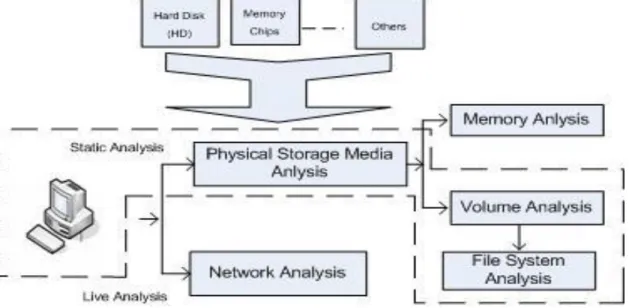
Digital investigation is a process to answer questions about the compromised digital data and this involves using either static or live analysis techniques (Kruse & Heiser 2001). Even though live analysis techniques could help in capturing evidence during forensic investigations to a certain extent, they are far from infallible and lead to false negatives of hidden malware. In live analysis, malware such as rootkits can hide and change itself without being seen. Moreover the attackers target a hidden area on the system structure to hide the malware. Hence, this research focuses on static analysis technique as all the hidden information can be captured and cannot be modified to produce false data as in case of live analysis techniques. An image copy of the NTFS hard disk would capture even hidden data and hence this study entails developing efficient techniques to analyse the data in a confined lab environment for the identification of hidden malware. This research work formed a major initial step towards addressing the open problem of identifying unseen or new malware that could evade detection in the form of hidden or obfuscated malicious code.
Forensic investigation was conducted on NTFS with existing forensic tools by running the disk image in a trusted operating system to search for evidence, as shown in Chapter 3. It was observed that since the NTFS disk image records every event in the system, the data required to be analysed is huge and this has led to imperfect forensic tools that are practical for real-time implementation but not comprehensive and effective as they were unable to detect all malware, in particular hidden malware. Therefore, this preliminary investigation confirms that a comprehensive methodology with an improved technique is warranted for an effective forensic analysis that is capable of detecting hidden malware.
1.4 Definitions
Malware: has numerous synonyms such as; malicious software, malicious code (MC) and malcode. Malware contains code designed to perform illegal activities that cause damage and affect the integrity and functionality of digital electronic devices. McGraw and Morrisett (McGraw & Morrisett 2000) define such malicious code as ―any code added, changed, or removed from a software system in order to intentionally cause harm or subvert the intended function of the system‖. For the purpose of this research, the description given by (Vasudevan & Yerraballi 2006) has been adopted for malware as a generic term that encompasses viruses, worms, Trojans, exploits, backdoors, keystroke loggers, rootkits, spyware, and spam. These terms are coined based on the functionality and behaviour of the malware.
Viruses: The father of computer viruses Dr. Frederick Cohen defined the term computer virus as ‗A virus is a program that is able to infect other programs by
modifying them to include a possibly evolved copy of itself‘ (Cohen 1987). The term computer virus comes from the similarities with biological virus since it infects a healthy subject and destroys it. In order for the virus to function and cause damage, it needs an existing host program. For instance, a virus has been reported and noted to modify the program code to take control of operating system, make copies of themselves to spread to new targets, and usually it attaches itself to commonly used software such as Adobe Acrobat, spread sheets or word processors. The most important part to note here is the new copies of the virus do not have the exact clone of the initial instance, this called ‗metamorphic‘ viruses, sample functionality of the main one but with different byte sequence or the signature for each copy to be completely different (Szor 2005).
Worms: Computer worms have grown to become the fastest spreading and most costly malicious code threats (Holz et al. 2006). A worm replicates itself by executing its own code independently, and spreads to the other computers using network resource connections such as e-mail, TCP/IP, IRC, etc. with the goal of infecting as many computer systems connected to the network as possible. Another name for computer worms given is network viruses. Since computer worms are designed to copy itself from one computer to another, while viruses are designed to spread themselves from one file to another on a single computer, worms are more complex than viruses. The other primary distinction between a virus and a worm is that a worm does not need a host to cause harm unlike a virus.
Trojan horses: A Trojan horse is a seemingly harmless computer program designed to get access to the computer from another location and to perform unauthorized
For example, the program could contain a useful function (such as local weather) to entice users to run the program. Trojan horses replicate in a different way than the replication procedure adopted by viruses and worms. However, a Trojan horse can be part of the payload of a worm and can be spread to many machines as part of a worm infection. It has also been reported that Trojan horses mostly have been sent out as email attachments (Szor 2005). Usually, Trojan horses are associated with accessing and sending unauthorized information from their host via email which could be classified as spyware as well. The embedded malware could also be a time bomb designed to activate at a certain time (Landwehr et al. 1994).
Logic Bomb: created by malicious authors through inserting the malicious code into a system which remains dormant and executes its payload when malicious function conditions are met (such as pre-defined time), and is also named ‗slag code‘. However, a logic bomb can be used by a virus, worm and other malicious code to gain power, and spreads before being noticed. When it gets executed, it could cause Denial of Service (DoS) that leads to slowing down of system or a storage overflow, and would remain dormant until activated.
Rootkit: Rootkit name comes from the combination of two words, ―root‖ and ―kit‖. The highest access level in UNIX environments is ―Root‖, while ―kit‖ refers to tools. Hence, a rootkit is defined as (Manap 2001) a collection of tools that enable attacker to have full control by obtaining the root access level on the compromised system in order to hide its payload from the operating system without being detect. A rootkit can hides its presence by hiding the actual files, processes, network connections, the sniffers, etc. so that there may be a number of processes running on a system that are
not revealed in Task Manager or established connections or netstat display. The rootkit is able to do this by manipulating function calls to the operating system and filtering out information that would normally appear. Once a rootkit is installed, it allows an attacker to mask the ongoing intrusion and maintain privileged access to the hacker by circumventing normal authentication and authorization mechanisms (Lobo, Watters, et al. 2010a, 2010b).
Botnet: is a collection of computers which interact together to compromised computers and to accomplish their illegal goals. The compromised computers are referred to drones or zombies, and the malicious software running on them as 'bots'. Botnets send the majority of spam (McCombie et al. 2009). Bots use vulnerable machines with methods which are used by other malware classes and they use the command and control (C&C) channel.
Spyware: is a software that is sneakily installed on a computer to collect information on system without the user knowledge or consent. However, this software can be classified as a Trojan horse as well. The consequences of spyware infections can be severe, including inundating the victim with pop-up ads, stealing the victim‘s financial information or passwords, or rendering the victim‘s computer useless (Moshchuk et al. 2006).
Backdoor: is a software program which is installed by the attacker on a compromised system to bypass normal security controls on a system and facilitate the further unauthorized access of the attacker on the system.
Exploit: is software, a chunk of data or a sequence of commands that makes use of the vulnerabilities of the victim computer to create an unwanted action on the victim‘s computer. These actions include obtaining the control of the computer system, access control destruction, or DoS. Often exploits are used to install viruses, warms and rootkits.
1.5 Infection Strategies of Malware Authors
As shown in the previous Section (1.4) there are many types of malware, also different instances of malware have a variety of penetration methods, malicious purposes, and effects. A malware instance can be transported through remote exploit, by an e-mail, over a peer-to-peer network, or through removable media. It can also be automatically downloaded and installed by visiting a web site containing exploit code (Moshchuk et al. 2006).
The ability to execute program tasks without interrupting the user is very common in programming. A program will not want to interact with a user when an error occurs for reasons beyond the user's comprehension. Malware authors implement the same technique to prevent a user from suspecting infection. This can be very dangerous, as a virus is allowed to execute fully, without the expressed permission of the user, or indirect feedback from the computer.
Criminals today have sophisticated service providers and high-tech expertise to fully take advantage of their current targets. Furthermore, the exploit servers used can be changed to avoid detection and countermeasures. Malware authors use variety of methods in order to avoid detection, and employ different kinds of deception (Watters &
McCombie 2011). The most common strategies adopted are summarised in the following subsections (Aycock 2006; Skoudis & Zeltser 2003):
1.5.1 Overwriting Infection
An overwriting infection is accomplished by inserting malicious code into an area of the original file of the host computer such as XLS, DOC or PDF. Some type of malware using this strategy completely overwrites a file which destroys the original file, rendering an entire program useless. However, the advanced malware do not try to destroy the file in order to trick the user and evade detection tools. This is done by adding the malicious code in the head or the tail of the host file in order to not affect the functionality of the host file (Crescenzo & Vakil 2006).
1.5.2 Companion Infection
A companion infection is different from overwritten malware as it does not require a host file to insert the malicious code; instead it creates a companion file to the EXE host file (Jacob et al. 2009). To test this infection, a simple experiment performed by injecting the windows XP professional system with a malware and named it similar to the original windows file calc but with the extension COM (calc.COM) and saved it in the same path of the original file of calc.EXE as shown in Figure 1.1. Many users have a tendency to type the name of the file at the ‗run‘ command without typing the extension in order to launch an executable program. Since Microsoft DOS looks for .COM files to be executed before it looks for .EXE files, malware authors need only to save or copy itself as .COM in the same directory as the original .EXE launched. Malware authors are taking this
advantage and they not only save the file with .COM at the same path as the .EXE, but they also conceal their existence by assigning a "hidden" attribute to the companion malicious file (the COM file). This way they try to decrease the likelihood that the system's user could discover the companion file in the directory listing as by default, files with this hidden attribute do not appear in directory listings. Alternatively, the attacker tricks computer user into executing malicious code by creating a malware file with the same name as the benign program, and placing the malicious executable earlier in the path than the benign one (Skoudis & Zeltser 2003).
Figure 1.1 Companion Infection example
1.5.3 Appending Infection
Also called hooking infection an appending infection is a method is predominantly adopted by the rootkits as they implant various hooks such as Import Address Table (IAT) hooks, inline function hooks, System Service Descriptor Table SSDT hooks, etc. appending infection uses operand command instructions (such as jump (JMP) and CALL), by modifying the first few instructions in the file function so that the execution jumps to the address pointed to the malicious function. Usually the malicious code is inserted at the end of the file where it is not affected by the functionality of the file and does not raise any suspicion. An example of such a rootkit is the virus ‗Vienna‘. The
infection technique can be used in all type of portable executables (PE), such as EXE, NE, ELF, etc (Lobo, Watters, Wu, et al. 2010).
1.5.4 Prepending Infection
Prepending infection is similar to appending infection, except that the malware inserts itself at the start of a file. Malware authors have implemented this type of infection on various operating systems (Daoud et al. 2008). Since the malicious code is allocated at the start of the file, the malicious prepending code runs before the original code. An example of the use of this technique is the Hungarian virus Polimer.512.A, which inserts itself within the first 512 bytes of the beginning of the executable and shifts the original program content to follow this block of code.
1.5.5 Cavity or space fill infection
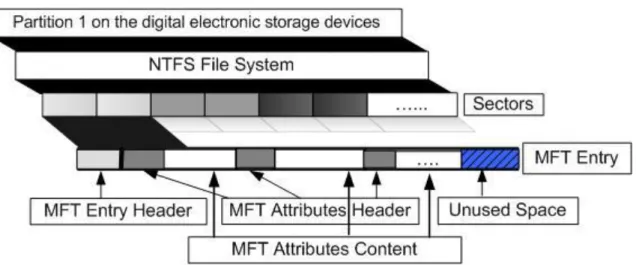
Cavity or space fill infection is an infection that attempts to enclose the malicious code in an empty space while not affecting the actual program and at the same time, not increasing the length of the program. Malware authors infect files without increasing their size or damaging the files. They accomplish this by overwriting unused areas of executable files. These are called cavity viruses. For example, the CIH virus, or chernoby1 virus uses this strategy to infect portable executable files. Also, in the Microsoft NTFS file system, Master File Table (MFT) is the core of NTFS since it contains details of every file and folder on the volume. Each MFT entry has a fixed size which is 1 KB containing two attributes; an attribute header and attribute content. The attribute header is used to identify the size, name and the flag value. The attribute content
can reside in the MFT followed by the attribute header if the size is less than 700 bytes (known as a resident attribute), otherwise it will store the attribute content in an external cluster called cluster run (known as a non-resident attribute). This is because the MFT entry is 1KB in size and hence cannot fit as it occupies more than 700 bytes. The Lehigh virus is an example of this infection (Alazab, Venkataraman, et al. 2009).
1.5.6 Boot Sector Malware
Boot sector malware infection involves infecting the boot sector in order to infect the system every time the machine boots up. The boot sector placed in the beginning of each partition is appropriately called the partition boot sector (PBS) and the Master Boot Record (MBR) is allocated in the first sector of the hard drive which contains the boot code (Lobo, Watters, Wu, et al. 2010). Hence, when the system starts, it locates the first sector on the hard drive, and executes MBR. Boot sector malware infect the Master Boot Sector of the hard drive and infect the system every time it boots up. The Michelangelo virus is an example of a Boot sector malware.
1.5.7 Macro Malware
Embedded in a data file, the term macro means a series of command steps and character strings saved in a single location that is assigned a name (Alsagoff 2011). Malware authors are using macros to infect applications such as word processing and spreadsheet files. Usually, when the name of the macro is found in a document file, the macro is expanded. The macro could perform the series of steps automatically for manipulating
and creating files, changing menu settings, etc (Yao & Liu 2011). A macro virus is often spread as an e-mail virus. A well-known example is the Melissa virus in March, 1999.
1.6 Malware on the horizon
In this research the focus is to conduct static analysis effectively because all the hidden information can be captured and cannot be modified to produce false data, which is apparently the main drawback in live analysis techniques (Alazab 2010). Dynamic analysis techniques analyze the code of a program by actually executing it. They are robust to the obfuscation techniques and those anti-static-analysis techniques (i.e, self-modifying). However, dynamic analysis has many drawbacks. First, it incurs much more overhead than the static analysis. There could be a lengthy code sequence that has to be executed to reach conclusions about the code behaviour. Second, it only covers a part of all possible program execution paths. Therefore, many important behaviours of the analyzed program cannot be discovered. Third, it is hard to simulate the execution conditions under which the analyzed malware exhibits its malicious behaviour. For instance, a bot program needs to receive control and command from a bot master to exhibit its malicious behaviour. Fourth, if the code is executed in a virtual machine, there are techniques that can be utilized by the attackers to determine whether the code is running in virtual environment. As a result, the code can be designed to modify its runtime behaviour.
The research project presented in this document concentrates on detecting hidden malware, which is still an unsolved challenge for malware detectors (Stolfo et al. 2007).
systems and improve the digital forensic techniques that could be used to analyse and acquire evidences of hidden malware in NTFS disk images.
The main goal of this research is to propose a methodology to effectively detect hidden malware. Since NTFS is predominantly used in most computer systems, and malware attackers take advantage of their weaknesses to hide malware, this research focuses on main areas of hidden malware growth in NTFS based systems. With this in view, the research aims i) to explore the NTFS disk structure and its vulnerabilities, ii) to investigate weaknesses of existing commonly used digital forensic techniques such as signature-based, heuristic-based and anomaly-based, and iii) to propose and evaluate improved methods in static analysis of NTFS for identifying hidden malware by investigating the disk image (physical) and by detecting unknown malware through file content (logical) analysis.
Since malware detection techniques work very well in detecting known malware, the malware authors have come up with new and improved techniques for their code to hide and evade detection by using many techniques, such as polymorphic and metamorphic techniques. This has led the AV vendors to start studying the behavioural analysis of the file to check whether the file is benign or malware.
Techniques used for malware detection can be classified into two categories: anomaly-based detection and signature-based detection. Since the major drawback for signature-based detection is the inability to detect new or unknown malicious code and zero day attack, the focus of this research is on anomaly-based detection, a technique that uses the knowledge of what is under consideration to find out what actually is malicious.
In anomaly-based detection, the inverse knowledge comes from the learning phase, Chapter 4 the knowledge was based on operand codes, Chapter 5 and Chapter 6 the knowledge was based on API function calls. So, anomaly-based detection alerts what is anomalous behaviour based on knowledge of the normal files. Malware detectors usually take two inputs. One input is the knowledge of the malicious behaviour, which comes from the learning phase. The other input is the file under inspection or testing that is analysed to decide if the file is malicious or benign.
1.7 Research Questions and Hypotheses
Malware identification and analysis is a technically intense topic, requiring deep knowledge of multiple computer science disciplines. To compound the problem, successful identification and analysis by malware analysts has been confounded by the use of hidden and obfuscated malicious binaries in recent years. Cybercriminals have adopted various obfuscation techniques to disguise the malware binaries, making it difficult to identify. There are available open-source and commercial tools which are being used to make the malicious code highly obfuscated in order to remain hidden in the NTFS file system hard disk drive without being detected by anti-virus tools.
The majority of anti-virus detection systems are signature-based detection, which is the method used by most of anti-virus detection engines as it is highly effective in detecting known malware. Even though hybrid systems applying heuristics have been recently explored, today's anti-malware approaches are neither efficient nor effective in detecting current obfuscated malware attacks. Therefore, this research aims at proposing
and presenting effective and efficient techniques for detecting hidden and obfuscated malware.
With the recent trend in malware to operate as obfuscated malicious code to remain hidden and evade from detection any live analysis technique or anti-virus tools, this research attempts to identify such unknown malware that adopt the following two predominant methods to attack:
– Physical space such as hidden malware in boot record or slack space, and
– Logical space such as code obfuscation of binary contents.
The primary purpose of this research is to answer the following research questions:
Q1: Could malicious code hidden in NTFS file system physical space be detected using an automated process?
Our hypothesis is that signature based detection and existing forensic analysis tools are unable to reveal hidden malware in NTFS physical space and it calls for a new forensic analysis process.
Q2: Could anomaly based detection using static features be applied to effectively detect and classify obfuscated malicious code attacking through binaries or executable files launched in the logical space of computer systems?
Our hypothesis is that existing live analysis malware detection techniques and anti-virus tools that predominantly use signature based methods are unable to detect obfuscated malware hidden in binaries of the computer logical space, and hence calls for
new anomaly based detection techniques that could identify obfuscated malware features by conducting static analysis of the behaviour properties exhibited by such malware.
1.8 Research Methodology
To address the first research question (Q1) listed in section 1.7, this research requires a systematic methodology to search computer hard disk space to search for significant evidence of hidden malware attacks. We adopt the Integrated Digital Forensic Model (IDFM) by Carrier & Spafford (2003) that is widely reported in literature for digital forensics. We propose a new forensic analysis process within the IDFM framework to detect hidden malware in computer physical disk space such as boot record and slack space.
For the second research question (Q2) listed in section 1.7, this research adopts static analysis methodology as it is well suited for byte-level content analysis of malicious patterns that is not possible using live or dynamic analysis conducted in existing anti-malware tools (Karim et al. 2005; Kotler and Maloof, 2006). Since signature based detection and other existing methods are unable to detect and classify the hidden malicious activities, this research proposes novel methods of extracting anomalies in the behaviour patterns of obfuscated malware. We study their s