2016
‐17
Budget
Indigenous Affairs
Dr
Lesley
Russell
Adj
Associate
Professor
Menzies
Centre
for
Health
Policy
Note
This analysis looks at the Indigenous provisions in the 2016‐17 federal Budget. This is done in the light of current and past strategies, policies, programs and funding, and is supported, where this is possible, by data and information drawn from government agencies, reports and published papers. Similar analyses from previous budgets are available on the University of Sydney e‐scholarship website.1 The opinions expressed are solely those of the author who takes responsibility for them and for any inadvertent errors. This work does not represent the official views of the Menzies Centre for Health Policy. 1 http://ses.library.usyd.edu.au/browse?type=author&sort_by=1&order=ASC&rpp=20&etal=‐1&value=Russell%2C+Lesley&offset=20
Contents
Introduction ... 4 Working with Indigenous people ... 6 The National Congress of Australia’s First Nations People ... 6 Constitutional recognition ... 6 Senate Inquiry report on the Indigenous Advancement Strategy tendering processes ... 6 Competitive tendering ... 8 Federal spending on Indigenous health and social security and welfare ... 9 Federal funding to States and Territories ... 11 Funding for Indigenous Health through Department of Health ... 14 Budget provisions ... 16 Education and Training ... 16 Health ... 16 Prime Minister and Cabinet ... 19 Social Services ... 21 Other Budget Provisions with Implications for Indigenous Affairs ... 22 Programs where Indigenous people could benefit but their participation is not specified ... 22 Budget cuts that could impact on Indigenous‐ specific programs ... 24 What is not in the budget ... 24 Help for Indigenous Legal Affairs ... 24 Aged care and dementia ... 24 Increased Funding for Aboriginal Community Controlled Health Organisations (ACCHOs) ... 25 Progress towards Closing the Gap. ... 25 Prime Minister’s Report 2016 ... 26 Productivity Commission Report on the National Indigenous Reform Agreement ... 28 The National Aboriginal and Torres Strait Islander Social Survey ... 29 Overview of Aboriginal and Torres Strait Islander health status 2015. ... 31Introduction
The 2016‐17 Budget presents a sad story about the level of commitment of the Turnbull Government to Indigenous Affairs and to Closing the Gap on Indigenous disadvantage. In his introduction to the 2016 Prime Minister’s Report on Closing the Gap (a report which shows that progress towards this goal has stalled), Prime Minister Malcolm Turnbull said this: “In the days following my appointment as Prime Minister in September, I outlined my key aspiration that our first Australians be afforded the same opportunities and prosperity that everyone else enjoys in this great country. We pride ourselves on having built an egalitarian country where everyone has the same chance to realise their dreams and to fulfil their potential. But it is not until Aboriginal and Torres Strait Islander people have the same opportunities for health, education and employment that we can truly say we are a country of equal opportunity. The expectations must be the same for everyone – from each newborn, to the child about to start school, the student dreaming of his or her future and parents trying to pay the bills and best nurture their families.”2 In contrast to these grand words, addressing Indigenous disadvantage is not listed as a Budget priority, was not mentioned in the Treasurer’s Budget night speech, and was not highlighted in new mainstream programs that might benefit Indigenous people. The Government's relationship with Indigenous people is now widely seen as being at a low point with widespread funding cuts to Indigenous services which are increasingly being removed from Indigenous control.The Budget has new spending of just $60.7 million / 4 years on programs specifically for Indigenous people; perhaps most of the $10.5 million for Fetal Alcohol Spectrum Disorders will also go to help Indigenous mothers and babies. On the other hand, money is shuffled between programs in several versions of robbing Peter to pay Paul and staffing for Indigenous programs will undoubtedly suffer from efficiencies taken within the Australian Public Service. There is nothing in this Budget to reverse the 2014‐15 Budget’s $534 million cuts which have left the Indigenous sector reeling and an
indexation freeze on funding under the Indigenous Advancement Strategy will apply until July 2019. While it is possible that Indigenous people will benefit from new programs to address dental health and provide quicker routes to employment for young people, they will also suffer from attacks on mainstream programs such as the freeze on Medicare rebates. Two years have passed since most Indigenous programs were moved to the Department of Prime Minister and Cabinet (PM&C) and there has been none of the needed reforms in Indigenous policy which were promised and progress in this regard is now in a critical state. There have been significant failings around Closing the Gap on Indigenous disadvantage and addressing the disproportionately high indigenous incarceration rates and discriminatory outcomes in the justice system. Too many Indigenous people have low levels of education, are unable to gain meaningful employment, and live in appalling housing conditions. Progress towards social justice and constitutional recognition is painfully slow. 2 http://closingthegap.dpmc.gov.au/assets/pdfs/closing_the_gap_report_2016.pdf
Recently Jackie Huggins, co‐chair of peak Indigenous body the National Congress of Australia’s First ‐ Peoples, told the UN Permanent Forum on Indigenous Issues that the government‐funded process to consider changes to recognise indigenous people in the Constitution included “no proposal from the government to correct the inequality disorder, nor is there a guarantee that this position will change”. She also said that the flagship policy for overcoming indigenous disadvantage, Closing the Gap, “in reality … advances policies and actions that explicitly remove and deny indigenous control and decision making”.3 These issues will not be resolved by simply applying more funds to them, although it is increasingly difficult to do more with less. What is needed is highlighted succinctly in Dr Huggins’ speech ‐ more Indigenous control and decision‐making. Many Indigenous organisations in urban, rural and remote areas are successfully managing a broad range of programs and services for their communities. We must learn from their experience and expertise, and be as willing to accept their timeframes for outcomes, their need to be unencumbered by red tape, their requirements for capacity building and their failures as we are for mainstream programs and services. There is a lack of evaluation data and research to determine the extent to which community development practices are more effective than other practices in delivering successful Indigenous‐managed programs or comparing community management against programs where communities are not given responsibility for management.4 Without genuine engagement of Indigenous people it will be increasingly difficult to meet the COAG targets and Australia’s commitments under the UN Declaration on the Rights of Indigenous Peoples. There is plenty of authoritative advice on how this must be done5; what is now required is leadership and commitment from all Governments and all stakeholders. 3
https://nacchocommunique.com/2016/05/20/naccho‐healthelection16‐woman‐speaking‐out‐about‐coalition‐indigenous‐policy‐failure‐
and‐reconciliation/
4
https://aifs.gov.au/cfca/sites/default/files/publication‐documents/cfca‐paper32‐indigenous‐programs.pdf
5
Working with Indigenous people
The
National
Congress
of
Australia’s
First
Nations
People
In April the Prime Minister, Malcolm Turnbull, moved to rebuild the Federal Government's relationship with Indigenous communities when he hosted a meeting with the elected leaders of the National Congress of Australia's First Nations People. The national body has been frozen out of policy development and dialogue since the election of the Coalition government. Former Prime Minister Tony Abbott ignored the Congress, which represents almost 9,000 Indigenous organisations and individuals, and his Budgets stripped its funding. On April 22 2016 the co‐chairs of the National Congress, Mr Rod Little and Dr Jackie Huggins, met with the Prime Minister. The meeting discussed the current relationship with the Government, constitutional recognition and the critical state of Aboriginal and Torres Strait Islander Affairs.6 However in May, following the release of the federal Budget, the Minister responsible for Indigenous Affairs, Nigel Scullion, confirmed that the Congress will not be receiving any
Commonwealth funding. He stated that the Congress is not representative and it doesn't deserve federal funding.7
Constitutional
recognition
The Prime Minister and Leader of the Opposition have established a Referendum Council to provide advice on when a referendum on Constitutional recognition should be held and what the question should be. The Council’s final report is due 30 June 2016.8 Much of the drive to get to this point has come from RECOGNISE.9
Funding for this continued work ($14.6 million / 2 years, including $5.0 million to RECOGNISE) is included in the Budget.
Senate
Inquiry
report
on
the
Indigenous
Advancement
Strategy
tendering
processes
The Indigenous Advancement Strategy (IAS), funded at an estimated $4.8 billion / 4 years, streamlined over 150 programs into five funding streams in 2014. It is administered by the Department of the Prime Minister and Cabinet (PM&C). Only 46% of organisations funded under the IAS are Indigenous; they receive 55% of total funding. 6
http://nationalcongress.com.au/co‐chairs‐meet‐with‐the‐pm/
7
http://www.abc.net.au/worldtoday/content/2016/s4459990.htm?site=ballarat
8
https://www.dpmc.gov.au/indigenous‐affairs/constitutional‐recognition
9
The issues around the impact on service quality, efficiency and sustainability of the IAS tendering processes by PM&C was referred to the Senate Finance and Public Administration References Committee on 19 March 2015 for inquiry and report by the 18 June 2015. The report was not completed until March 2016, apparently due to the tardiness of the bureaucracy in responding to requests for information.10 The report acknowledged the potential benefits of streamlining 150 Indigenous programs into five priority areas through the IAS process. However, the reality has been quite different. There has not been the needed policy and administrative changes and there has been little or no consultation or engagement with Indigenous communities and organisations on the fundamental changes to the way Government programs are funded. In addition to implementing a completely new and untested way of doing business, the process was further complicated by machinery of government changes, especially in the Department of Social Services (DSS), and severe budget cuts to the IAS in the 2014‐15 Budget. Consequently the Government was forced to introduce multiple rounds of emergency funding to address gaps in frontline services. It seems that the Government has never really got beyond this ad hoc mode of managing Indigenous services, leaving many in disarray because they are starved of resources and unable to plan and budget for the medium to long‐term. The report also expressed concern about many elements of the program design and the lack of an evidence base to support the ability of the IAS to address earlier policy failings in this area. The five streams do not appear to clearly or adequately cover the field of programs required to meet the objectives of this policy shift. The shift to a competitive tendering model disadvantages Indigenous organisations, especially smaller Indigenous organisations with less experience in applying for competitive funding, compared with larger nongovernment organisations. There are also significant administrative costs, eating up valuable resources. The process also does not appear to recognise the enhanced outcomes of service delivery achieved by Indigenous organisations. Overall the report found a lack of both transparency and a level playing field in the administration of the IAS tendering process PM&C indicated in evidence to the review that in the future funding rounds will be focussed on particular issues, but the analysis and process by which these issues will be selected is currently unclear. For all the upheaval created, the outcome appears to be that organisations funded previously have, by and large, been funded to do the same activities with less money. Of particular concern is that the funding uncertainty across the sector has led to experienced staff being lost. The National Congress was, rightly, scathing in its assessment of the report’s findings, stating that “The report underlined the facts which can only be described as a debacle with government still in denial that there is a problem.”11 The Australian National Audit Office (ANAO) has recently announced their own investigation into the IAS.12 This is due on December 2016. 10 http://www.aph.gov.au/Parliamentary_Business/Committees/Senate/Finance_and_Public_Administration/Commonwealth_Indigenous/R eport 11
http://nationalcongress.com.au/government‐decisions‐are‐still‐self‐serving/
Competitive
tendering
The Abbott/ Turnbull Government has moved to adopt contestability in the way many services are funded. This approach is based on recommendations (often incompletely or inadequately implemented) from the National Commission of Audit13 and the Harper Competition Policy Review14. Often this means privatisation. I have written previously about the consequences for this approach in areas like health, ageing and Indigenous Affairs.15
As the recent Senate report (see above) shows, competitive tendering can disadvantage Indigenous
organisations up against larger and more experienced NGOs, muting the number involved in
delivering services to indigenous people.
National Congress of Australia’s First Peoples co‐chair Kirstie Parker has warned that the lack of
accounting for Indigenous connections in the tendering processes might see “organisations that may
not have anything to do with a particular community or a particular group of people that try to come
in and impose a whole different set of values and a lack of appreciation for community nuance,
histories and cultures.”16
Unless it is specifically mandated, the process of procuring services through competitive tendering limits community engagement and collaboration. Competition principles also restrict the amount of information made available to services and communities. In many cases, especially for Indigenous services in remote communities, there will only be a few providers and / or the service required is specialised and complex, and there are few or no benefits to be derived from competitive tendering. This has been recognised by most reports on competition, but apparently not the Turnbull Government. For the IAS there is a range of other mechanisms that can support better collaboration between service providers and co‐design between government and community organisations with less disruption, including consortia and collaborative ventures and direct negotiation.17 There is a specific issues around the new competitive tendering requirements for Primary Health Networks (PHNs) and how these will work for Indigenous‐specific services. There are specific Indigenous funding allocations (or at least requirements to deliver services) for both mental health and ice (methamphetamine) programs. In March 2016 a set of guidelines governing the relationships between PHNs and ACCHOs was finalised.18 Will these be sufficient to ensure the delivery of culturally save services that are in line with community needs and opinions? 12
https://www.anao.gov.au/work/performance‐audit/indigenous‐advancement‐strategy 13 http://www.ncoa.gov.au/ 14 http://competitionpolicyreview.gov.au/final‐report/ 15 http://www.powertopersuade.org.au/blog/yuvbkwpxpcaliobh9g3plk9aco4o1t/20/3/2016 16
http://www.themandarin.com.au/62013‐competitive‐tendering‐disadvantages‐indigenous‐groups/ 17 https://croakey.org/opportunities‐lost‐lessons‐from‐recent‐federal‐dss‐ias‐tenders/ 18 http://www.health.gov.au/internet/main/publishing.nsf/Content/24B4965FBFBC55DACA257F24007F2120/$File/PHN%20and%20ACCHO %20‐%20Guiding%20Principles.pdf
Federal spending on Indigenous health and social security and welfare
Aboriginal and Torres Strait Islander people currently make up about 3% of the Australian population. The population of Indigenous Australians is growing by 2.0‐2.3% per year, compared to 1.5‐1.8% for the total Australian population.19 Total direct expenditure on services for Indigenous Australians in 2012‐13 (the most recent figures available) was estimated to be $30.3 billion, accounting for 6.1% of total direct general government expenditure. Similar proportions of Indigenous and non‐Indigenous expenditure were devoted to education and training (14.9% and 14.0%), healthy lives (20.7% and 20.6%), economic participation (18.2% and 22.8%) and home environment (9.6% and 10.0%). A greater proportion of Indigenous expenditure (26.4%) than non‐Indigenous expenditure (13.1%) was devoted to safe and supportive communities.20 The Budget Papers show that total spending on Indigenous health will increase by 8.7 % in real terms over the period 2016‐17 to 2019‐20 (see Table 1). However comparison with the comparable data from the 2015‐16 Budget shows that spending over the 4‐year period 2015‐16 to 2018‐19 has been cut, from $3.378 billion to $3.292 billion. It’s not clear where these cuts have been made.
Table 1. Total Federal Spending on Indigenous health and social security and welfare
Estimates Projections 2015‐16 $m 2016‐17 $m 2017‐18 $m 2018‐19 $m 2019‐20 $m Total Health 69,172 71,413 73,425 76,239 79,260 Indigenous health 746 798 856 892 929 Indigenous spend as % of total health spend 1.08 1.12 1.16 1.17 1.17 Total Social Security and Welfare 152,838 158,612 166,518 184,260 191,828 Assistance for Indigenous Australians (nec) 2,153 2,209 2,118 2,046 2,135 Indigenous spend as % of total social security and welfare spend 1.41 1.39 1.27 1.11 1.11 From 2016‐17 Budget Paper No 1.
19 http://www.abs.gov.au/ausstats/[email protected]/Products/C19A0C6E4794A3FACA257CC900143A3D?opendocument 20
http://www.pc.gov.au/research/ongoing/indigenous‐expenditure‐report/indigenous‐expenditure‐report‐2014/indigenous‐expenditure‐
report‐2014.pdf
Funding for social security and welfare assistance (not elsewhere classified) will decrease substantially, by 9.9% in real terms, over the period 2016‐17 to 2019‐20 (see Table 1). This is due to the cessation of a number of measures, including Addressing Welfare Reliance in Remote Communities.
Federal funding to States and Territories
In 2016‐17 the Federal Government will provide $615 million to the States and Territories for Indigenous specific programs funded through 5 separate National Partnerships. This includes $5.7
million to Queensland for the provision of health services in the Torres Strait (see Table 2). The focus of the NPs is almost solely on remote communities and more than 50% of the funds provided goes to the Northern Territory (see Table 7).
Table 2. Funding for Indigenous programs provided through National Partnerships
2015‐16 $m 2016‐17 $m 2017‐18 $m 2018‐19 $m 2019‐20 $m NP on NT Remote Aboriginal Investment 337.9 169.1 166.9 103.4 94.4 NP on Indigenous Health* 10.8 11.5 1.1 1.1 1.1 NP on Torres Strait health protection strategy – mosquito control 1.0 1.0 1.0 1.0 1.0 NP on Torres Strait / PNG cross border health issues 4.6 4.7 4.7 4.8 4.9 NP on Remote Indigenous Housing 388.3 428.5 345.7 ‐ ‐ Total 742.6 614.8 519.4 110.3 101.4 *does not include health component of NP on Remote Aboriginal Investment From 2016‐17 Budget Paper No 3 In the 2015‐16 Budget a new NP with the Northern Territory replaced the NP on Stronger Futures in the Northern Territory. The National Partnership on Northern Territory Remote Aboriginal
Investment will provide $871.1 million / 5 years (see Table 3). These funds are to be spent for: The supplementation of primary care services in remote communities; Services to improve the attendance, engagement and educational achievement of Indigenous students; Services to make Indigenous communities safer, including improvements in child safety and combatting alcohol abuse; Upgrades, new housing, housing‐related infrastructure, and the removal of asbestos from community buildings in remote communities. It is interesting to note that the Housing component also allows for funding for a “sustainable, professional and accredited Aboriginal interpreter service”. As in the 2015‐16 Budget, and in contrast to the earlier NP, little specific guidance is provided as to how these funds are to be spent in any given area.
There is also a one – off payment of $154.8 million in 2015‐16 described as assisting the NT to take responsibility for the ongoing delivery of municipal and essential services in Indigenous
communities. This was announced in last year’s Budget so could be counted twice.
Table 3. National Partnership on Northern Territory Remote Aboriginal Investment
2015‐16 $m 2016‐17 $m 2017‐18 $m 2018‐19 $m 2019‐20 $m Health Component 5.6 5.9 6.2 6.4 6.7 Children and Schooling Component 51.2 46.1 46.6 39.6 39.6 Community Safety Component 70.3 67.4 63.2 53.8 44.5 Municipal and Essential Services Component 154.8 ‐ ‐ ‐ ‐ Public Housing Component 56.0 49.7 50.9 3.6 3.6 Total 337.9 169.1 166.9 103.4 94.4 From 2016‐17 Budget Paper No 3 Funding for the NP on Indigenous health is increasing short‐term – and consequently short‐sighted (see Table 4). This year’s Budget has additional funding for renal services in the NT ($6 million / 2
years) and for trachoma control ($8.5 million / 2 years) but no additional funding for maternal and child health.
Table 4. National Partnership on Indigenous Health
2015‐16 $m 2016‐17 $m 2017‐18 $m 2018‐19 $m 2019‐20 $m Accommodation and infrastructure for renal services for NT 3.0 3.0 ‐ ‐ ‐ Addressing bloodborne viruses and STDs in TSI 0.5 1.1 1.1 1.1 1.1 Improving trachoma control services 4.2 4.3 ‐ ‐ ‐ NT Remote Aboriginal Investment ‐ health 5.6 5.9 6.2 6.4 6.7 Rheumatic fever strategy 3.1 3.1 ‐ ‐ ‐ Total 16.4 17.4 7.3 7.6 7.9 From 2016‐17 Budget Paper No 3
There are several new small NPs that address the need to manage the porous border between Australia and PNG in the Torres Strait. In particular these relate to the looming threats posed by multi drug‐resistant TB, HIV/ AIDS and Zika. This money goes to Queensland (see Table 5).
Table 5. Other National Partnerships that impact Indigenous health 2015‐16 $m 2016‐17 $m 2017‐18 $m 2018‐19 $m 2019‐20 $m NP on Torres Strait health protection strategy – mosquito control 1.0 1.0 1.0 1.0 1.0 NP on Torres Strait / PNG cross border health issues 4.6 4.7 4.7 4.8 4.9 From 2016‐17 Budget Paper No 3 The NP on Remote Indigenous Housing provides funding to provide and improve housing in remote communities and address overcrowding and homelessness (see Table 6). The Budget Papers state that this NP will be replaced with a new NP on Remote Housing from July 2016. This NP will provide incentives (unstated) to States and Territories for progress against agreed outcomes.
Table 6. National Partnership on Remote Indigenous Housing
2015‐16 $m 2016‐17 $m 2017‐18 $m 2018‐19 $m 2019‐20 $m Remote Indigenous Housing 388.3 428.5 345.7 ‐ ‐ From 2016‐17 Budget Paper No 3
Table 7. Distribution of National Partnership funding for Indigenous programs by State and
Territory 2015‐16 $m 2016‐17 $m 2017‐18 $m 2018‐19 $m 2019‐20 $m Northern Territory 410.0 325.6 304.0 103.4 94.4 Queensland 151.3 141.3 6.8 6.9 7.0 New South Wales 48.3 0.3 ‐ ‐ ‐ Victoria ‐ ‐ ‐ ‐ ‐ South Australia 20.1 15.8 12.4 ‐ ‐ Western Australia 113.1 132.0 84.4 ‐ ‐ Tasmania ‐ ‐ ‐ ‐ ‐ ACT ‐ ‐ ‐ ‐ ‐ From 2016‐17 Budget Paper No 3
Funding for Indigenous Health through Department of Health
In July 2014, the Indigenous Australians’ Health Program (IAHP) was established with DoH. This consolidated four previously existing funding streams: primary health care funding; child, maternal and family health programs; the Health Implementation Plan of the former Stronger Futures in the Northern Territory National Partnership Agreement in the Northern Territory (now known as Northern Territory Remote Aboriginal Investment) and programs covered by the Aboriginal and Torres Strait Islander Chronic Disease Fund.21Funding appropriated to the IAHP in 2015‐16 was $2.413 billion / 3 years. Of this funding:
$1.4 billion to fund primary health care services (primarily delivered through ACCHOs and other suitably qualified providers), including the Healthy for Life programme; $205.9 million to the Care Coordination and Supplementary Services (CCSS) and Improving Indigenous Access to Mainstream Primary Care (IIAMPC); $116 million for Tackling Indigenous Smoking; $237 million New Directions and the Australian Nurse‐Family Partnership child and maternal health initiatives; $46 million to capital works; and $12 million for Integrated Early Childhood Services (over two years). This leaves the fate of $396 million undetermined.
The National Aboriginal and Torres Strait Islander Health Plan 2013‐2023 was developed to provide an overarching framework for Commonwealth health activities and identifies areas of focus to guide future investment and effort in relation to improving Indigenous health.22 There is an accompanying Implementation Plan which was developed in 2015.23
Tracking the spending under this DoH structure and against the Plan is also impossible. This is aggravated by the fact that the location of Indigenous health in the Departmental Outcome structure has changed three times in the past 3 years. It current sits as one of 7 programs within Outcome 2.
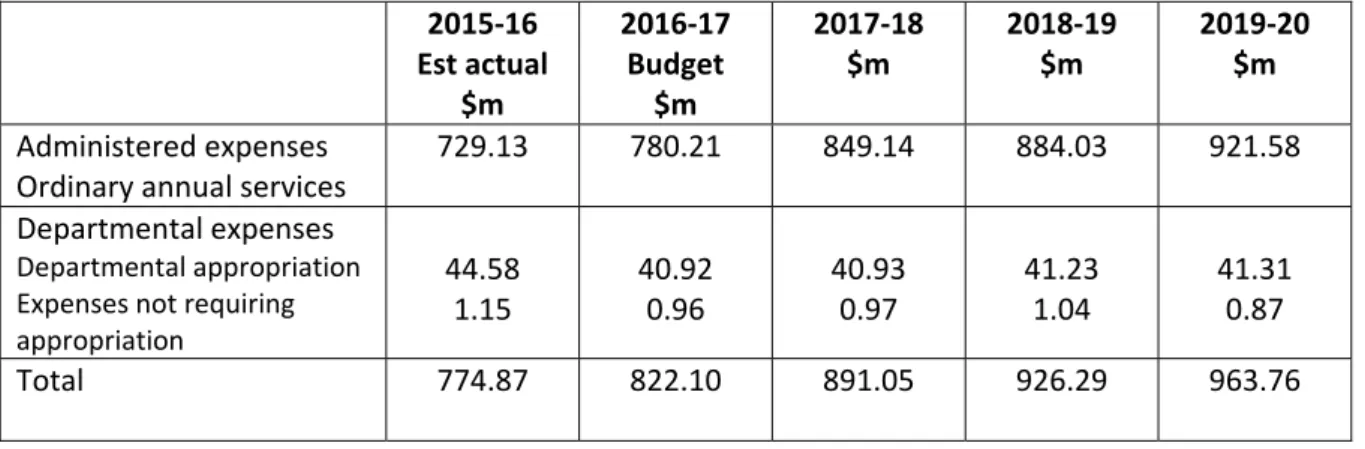
The Budgeted Expense figures from the DoH 2016‐17 PBS show that for the period 2015‐16 to 2017‐ 18 these amount to $2.488 billion (see Table 8). Comparison with figures from the 2015‐16 PBS shows spending of $102.3 million less over the period 2015‐16 to 2018‐19 is forecast in 2016‐17. The PBS also indicates that the Care Coordination and Supplementary Services program and the Improving Indigenous Access to Primary Care programs have been amalgamated into an Integrated Team Care activity. No further information is available.
21 http://www.health.gov.au/internet/main/publishing.nsf/Content/09AEEA5F377AEBB5CA257F1C00159135/$File/Accessible‐IAHP‐ Programme‐Guidelines.pdf 22 http://www.health.gov.au/natsihp 23 http://www.health.gov.au/internet/main/publishing.nsf/Content/indigenous‐implementation‐plan
Table 8. Budgeted expenses for Program 2.2 Aboriginal and Torres Strait Islander Health 2015‐16 Est actual $m 2016‐17 Budget $m 2017‐18 $m 2018‐19 $m 2019‐20 $m Administered expenses Ordinary annual services 729.13 780.21 849.14 884.03 921.58 Departmental expenses Departmental appropriation
Expenses not requiring
appropriation 44.58 1.15 40.92 0.96 40.93 0.97 41.23 1.04 41.31 0.87 Total 774.87 822.10 891.05 926.29 963.76 From 2016‐17 DoH Portfolio Budget Statements
Budget provisions
Education
and
Training
Australian Institute of Aboriginal and Torres Strait Islander Studies
$40 million / 4 years is provided to support the preservation, restoration and management of the AIATSI collection of cultural and heritage material, including digitisation equipment and expertise. 2015‐16 $m 2016‐17 $m 2017‐18 $m 2018‐19 $m 2019‐20 $m AITSIS ‐ 10.0 10.0 10.0 10.1 It is good to see this substantial financial commitment to this important work. Previous funding has been poor; in 2015‐16 $5.0 million was provided, and $3.3 million was provided in 2014‐15 for this work.
Health
Of the $37.4 million provided over the forward estimates for health initiatives, only $10.5 million for Fetal Alcohol Spectrum Disorder in rural and remote communities (it is assumed that most of this effort will be focussed on Indigenous communities) is new money for new initiatives. The remainder continues ongoing programs at current funding levels.
Mosquito Control and Cross Border Liaison in the Torres Strait Protected Zone
Budget Paper No 2 states that $3 million / 3 years from 2017‐18 will be provided to continue funding for mosquito control in the Torres Strait, with a special focus on Horn and Thursday Islands. It is also stated that this funding will enable data sharing with PNG in regard to communicable diseases and other health issues arising from cross border movements in the Torres Strait.
Elsewhere, in Budget Paper No 3, this initiative and its funding are described somewhat differently. This funding ($1 million / year) is part of a NP with Queensland (see Table 5). The funding is provided to assist in mosquito detection and elimination and for the employment of a communication officer.
An agreement signed by Health Minister Ley with the Queensland Government in July 2015 provides $2.923 million for the 3 years 2014‐15 to 2016‐17.24 The additional funding provided this year (and included in the forward estimates) is for 2016‐17 to 2019‐20.
24
http://www.federalfinancialrelations.gov.au/content/npa/health_indigenous/torres‐strait‐health‐
This focus on mosquito control is increasingly important due to the global threat of Zika virus.
National Partnership – Management of Torres Strait – Papua New Guinea Cross‐Border Health
Issues
$19.0 million / 4 years is provided for the continuation of this NP on the Management of Torres Strait – PNG Cross Border Health Issues. This funding has been provided in the forward estimates. It goes to Queensland and is used to support health facilities in the Torres Strait and Queensland to provide needed healthcare services to PNG nationals. In doing so, this protects the health of Australian citizens in the area. DFAT coordinates a Torres Strait Cross‐Border Health Issues Committee which does not appear to have met since October 2015.25 The previous NP agreement with Queensland, for the period 2012‐13 to 2015‐16 was signed in 2013.26
National Partnership on Rheumatic Fever Strategy
An additional $0.4 million is provided in 2016‐17 to extend the Project Agreements with the States and Territories on the Rheumatic Fever Strategy. This brings the funding for 2016‐17 to $3.1 million – the same levels as for 2014‐15 and 2015‐16. Information on the DoH website indicates that all of this additional funding will go to South Australia.27
This provision, although small in the scope of things, highlights all that is wrong with the
Government’s approach to Indigenous health and their failure to make progress in Closing the Gap. Acute rheumatic fever (ARF) and its consequence, rheumatic heart disease, are significant disease burdens for Indigenous children. Ongoing efforts will be needed for at least a generation to ensure the elimination of ARF and the treatment of its consequences.
The cost of this essential data collection and treatment tracking approach is minor; it pays for a National Coordination Unit to develop national education and training resources, support jurisdictions and collect data and for state‐based register and control programs in the Northern Territory, Western Australia, South Australia and Queensland to improve detection, monitoring and management of ARF and RHD. Yet the Government finds itself unable to commit to $12 million over the forward estimates, and so the Rheumatic Fever Strategy is strategic and forward‐planning in name only. Like so many Indigenous programs it must lurch from budget to budget, always worrying if it will get the funding it needs.
National Partnership on Addressing Blood Borne Viruses and Sexually Transmitted Infections
25
http://dfat.gov.au/about‐us/publications/Pages/torres‐strait‐cross‐border‐health‐issues‐committee‐meeting‐summary‐oct‐2015.aspx
26
http://www.federalfinancialrelations.gov.au/content/npa/health_indigenous/torres‐strait‐png‐cross‐border/national_partnership.PDF
27
$4.5 million / 4 years is provided to the Queensland Government via a NP to continue funding for primary care staff and healthcare workers to reduce the risks and prevalence of bloodborne viruses and sexually transmitted infections on Saibai Island and to expand current activities in the Torres Strait. This is not new money but will be provided from within DoH resources. 2015‐16 $m 2016‐17 $m 2017‐18 $m 2018‐19 $m 2019‐20 $m Treasury ‐ 1.1 1.1 1.1 1.1 DoH ‐ ‐1.1 ‐1.1 ‐1.1 ‐1.1 Some years ago the clinic on Saibai Island was redeveloped as other Torres Strait island clinics closed. A 2012 NP agreement provided $3.7 million / 4 years to Queensland for additional staff for the treatment of communicable diseases at the clinic on Saibai Island and the development and implementation of a culturally appropriate sexual health education campaign for people in the Torres Strait. The 2015‐16 Budget provided an additional $0.5 million for this work.
The Saibai Island clinic operates under the Torres Strait Health Protection Strategy.28 The rates of infections from blood borne viruses (including HIV) and of STDs could not be determined. There would be some risk from travel to and from PNG, although apparently the Saibai Clinic no longer treats PNG natives.
Taking More Action to Prevent Fetal Alcohol Spectrum Disorders
$10.5 million / 4 years is provided for efforts to reduce the incidence of Fetal Alcohol Spectrum Disorders (FASD), with a focus on prevention in high‐risk rural and remote communities. Although not stated, this effectively means a focus on Indigenous communities. 2015‐16 $m 2016‐17 $m 2017‐18 $m 2018‐19 $m 2019‐20 $m DoH ‐ 2.6 2.6 2.6 2.6 The goal is to improve diagnosis of FASD and to provide education and training to families and health professionals to reduce the incidence. Activities will include the establishment of a FASD Clinical Network, a FASD diagnostic clinic, a Model of Care for Communities, and expanding the FASD Technical Network. The FASD Action Plan (2013‐14 to 2016‐2017), fully costed at $37 million, was released in August 2013.29 The Government released the National Strategy to Tackle Fetal Alcohol Spectrum Disorder in June 2014 and provided $9.2 million in funding.30 This provided $3.1 million for grants to drug and alcohol services to support alcohol dependent women; up to $1.5 million in targeted grants to 28 http://www.ruralhealthaustralia.gov.au/internet/rha/publishing.nsf/Content/Torres_Strait_Health_Protection_Strategy‐ Saibai_Island_Primary_Healthcare_Clinic 29
http://www.fare.org.au/wp‐content/uploads/research/FARE‐FASD‐Plan.pdf
30
http://www.health.gov.au/internet/ministers/publishing.nsf/Content/health‐mediarel‐yr2014‐nash031.htm
undertake further research to develop best practice guidelines; an additional $4 million to the New Directions: Mother and Babies program; $500,000 for the Diagnostic Tool and $100,000 to the Technical Network.
Clearly overall, given the size of the problem, the effort to tackle FASD is under‐funded, and it
Prime
Minister
and
Cabinet
The only new funding for Indigenous initiatives is the $14.6 million announced in December 2015 for Constitutional recognition activities. There is some modest shuffling and repurposing of funds and a $65 million loan that will relieve the Indigenous Land Corporation of a debt burden incurred as a result of the purchase of Ayers Rock Resort, the terms of which are not public.
Indigenous Business Australia
$23.1 million in 2016‐17 is redirected from Indigenous Business Australia to PM&C to ensure the
continuity of business support and capability development services to Indigenous entrepreneurs in
2016‐17. 2015‐16 $m 2016‐17 $m 2017‐18 $m 2018‐19 $m 2019‐20 $m PM&C ‐ 23.1 ‐ ‐ ‐ Indigenous Business Australia ‐ ‐23.1 ‐ ‐ ‐ According to the Parliamentary Library Budget Brief, this funding will be granted back to IBA, to enable IBA to conduct Indigenous business planning, advice, workshop and training activity that would otherwise be outside IBA’s enabling legislation.31
Indigenous Land Corporation – concessional loan for Ayers Rock Resort
The government is making a concessional loan of up to $65.0 million to the Indigenous Land Corporation (ILC) in order to reduce the ‘crippling’ impact of interest on debt incurred when the ILC purchased the Ayers Rock Resort.. The terms of the loan are commercial‐in‐confidence and the amount is not included in the Budget. 31 http://www.aph.gov.au/About_Parliament/Parliamentary_Departments/Parliamentary_Library/pubs/rp/BudgetReview201617/Indigenou saffairs
The ILC acquired Ayers Rock Resort (ARR) at Yulara near Uluru from property giant GPT for $300 million in October 2010. GPT originally offered the resort to the ILC for $270 million in 2009, but it has been revealed that the sale price was revised upwards by $30 million in 2010. Since the ILC acquired Ayers Rock Resort the property's value has been written down twice, mostly recently in January 2014 when it was valued at $202.5 million. In July 2015, the resort was valued on the ILC's books at $225 million.32
Indigenous Student Success in Higher Education
Funding of $9.7 million / 4 years from PM&C will be directed to DET’s National Institutes Program to
consolidate funding arrangements for the Batchelor Institute of Indigenous Tertiary Education.
2015‐16 $m 2016‐17 $m 2017‐18 $m 2018‐19 $m 2019‐20 $m DET ‐ 1.3 2.7 2.8 2.8 PM&C ‐ ‐1.3 ‐2.7 ‐2.8 ‐2.8
Batchelor Institute is a dual sector tertiary education provider that services the education, training
and research needs of Indigenous people. Batchelor is located in and has a special focus on remote
Northern Territory communities but also attracts higher education students from across Australia.
In addition, three existing education support programs will be consolidated from 1 January 2017 to
create a new program to improve progression and completion rates for Indigenous higher education
students. The new program will replace the Commonwealth Scholarship Program, the Indigenous
Support Program and the Indigenous Tutorial Assistance Scheme — Tertiary Tuition.
The Budget states that funding for this has already been included in the forward estimates. There
does not appear to be any impact on the funding available under these programs. The stated aim is to give universities more flexibility to implement responses that best meet the needs of individual
students by providing scholarships, counselling, and tutorial assistance
This measure progresses some of the recommendations of the 2012 Report of the Review of Higher
Education Access and Outcomes for Aboriginal and Torres Strait Islander People.33
Towards Constitutional Recognition of Aboriginal and Torres Strait Islander People
32
http://www.abc.net.au/news/2015‐07‐07/allegations‐of‐30‐million‐missing‐in‐uluru‐resort‐deal/6599576
33
https://docs.education.gov.au/system/files/doc/other/heaccessandoutcomesforaboriginalandtorresstraitislanderfinalreport.pdf
$14.6 million / 2 years from 2015‐16 is provided to support the national consultation activities to be undertaken by the Referendum Council with respect to the recognition of Indigenous people in the Constitution. This includes $5 million for the campaign work of RECOGNISE.
The Referendum Council34 was established in December 2015 after a campaign by RECOGNISE.35
Social
Services
Third Trial Site for Cashless Debit Card
The Government will expand the trial of the Cashless Debit Card (as proposed by Andrew Forrest in his review of Indigenous Jobs and Training) at a third site. Although this is included in the Budget, no funding is specified as negotiations with commercial service providers are still taking place. It appears likely that the trial site will be Geraldton; approximately 9.5% of Geraldton’s population are Indigenous.36 While these trials are not specifically targeted at Indigenous people (the DSS website states that the Cashless Debit Card Trial is aimed at finding an effective tool for supporting
disadvantaged communities to reduce the consumption and effects of drugs, alcohol and gambling
that impact on the health and wellbeing of communities, families and children), that is where most of the focus on outcomes lies. The Government is currently trialling the cashless debit card in Ceduna, South Australia and Kununurra/Wyndham in Western Australia. Recipients in the trial area who receive a working age payment will receive 80% of their payment through the card and 20% into their regular bank account. Recipients cannot use the card to purchase alcohol or gambling products or to withdraw cash.
In 2014‐15 $101.1 million was provided to extend income management in existing locations for one year and to expand income management in the Ceduna Region from 1 July 2014. The 2015‐16 Budget provided $146.7 million / 3 years to extend these income management arrangements until 30 June 2017. Last year’s Budget also provided $2.7 million to facilitate consultation and
engagement with communities and industry on future income management arrangements involving the Cashless Debit Card. Additional funding (nfp) was provided for 3 years from 2014‐15 to undertake trials in up to three communities. The costs of these trials have not been made public. The DSS website states that the Government has invested over $2.5 million in additional community services to support the current trials, including more drug and alcohol services, a 24/7 mobile outreach, and financial counselling.37 A recent Senate Committee report on the bill to implement these trials noted concerns about their 34
https://www.pm.gov.au/media/2015‐12‐07/referendum‐council
35
http://www.recognise.org.au/why/recognise‐what‐is‐proposed/ 36 http://www.aph.gov.au/About_Parliament/Parliamentary_Departments/Parliamentary_Library/pubs/rp/BudgetReview201617/Indigenou saffairs 37
https://infrastructure.gov.au/department/statements/2016_2017/ministerial‐statement/social‐services.aspx
cost. According to the Parliamentary Library, from 2005–06 to 2014–15 income management has cost the Commonwealth Government around $1 billion. DSS noted at the committee's public hearing that it was unable to discuss the final costs of the trial as negotiations with financial institutions were still in process. DSS confirmed advice provided at the 2015 Budget estimates, that funding for the trial 'might be found in the contingency reserve', but that appropriation details have not yet been decided.38 The Budget also establishes a Compulsory Rent Deduction Scheme, under which occupants of public and some community housing who receive income support payments or Family Tax Benefit will have their rent and related tenancy costs deducted from their payments and automatically transferred to the relevant public and community housing providers. Details of how this scheme might work and who it might be applied to apparently remain to be negotiated with the States and Territories. Domestic and Family Violence – new initiatives.
$100 million / 3 years from 2016‐17 is provided for initiatives to address violence against women and children, following recommendation in the Third Action Plan (2016‐19) of the National Plan to Reduce Violence Against Women and Their Children 2010‐2022. What the Budget Papers do not make explicit is that $32.2 million of this funding is provided by PM&C from the Indigenous Affairs Safety and Wellbeing program. 2015‐16 $m 2016‐17 $m 2017‐18 $m 2018‐19 $m 2019‐20 $m DSS ‐ 33.3 33.3 33.3 ‐ PM&C ‐ ‐ ‐10.0 ‐10.0 ‐12.2 Total ‐ 33.3 23.2 23.2 ‐12.2 This redirected funding appears to be a cost offset rather than an expenditure to specifically help Indigenous women and children. The 2016‐17 DSS Portfolio Budget Statements says this measure ‘will focus on prevention and access to services and support, including targeted assistance for Indigenous and culturally and linguistically diverse women and their children’. However it is always disconcerting to see specific Indigenous funds going to mainstream programs.
This initiative is in addition to the $101.2 million / 4 years provided for the Women’s Safety Package in the 2015‐16 MYEFO.39
Other
Budget
Provisions
with
Implications
for
Indigenous
Affairs
Programs
where
Indigenous
people
could
benefit
but
their
participation
is
not
specified
The new youth employment package Youth Jobs PaTH package ($752 million / 4 years) has the potential to boost Indigenous employment if appropriately targeted. PaTH (Prepare – Trial – Hire) is 38 file:///C:/Users/Lesley/Downloads/report%20(3).pdf 39 http://christianporter.dss.gov.au/media‐releases/womens‐safety‐package‐to‐stop‐the‐violence
designed to move young people off welfare and into employment by requiring mandatory pre‐ employment training, providing internships and rewarding businesses which hire these young people.40 However there is no mention in the Budget Papers of specific measures to ensure these measures benefit Indigenous youth, despite their high rates of unemployment. The Budget makes changes to the Work for the Dole program, requiring job seekers to enter the program after 12 months, rather than the current six. However similar changes have not been made to the Community Development Program (CDP), the jobactive equivalent for regional areas, which has a client base that is around 80% Indigenous.41 The Government has previously been forced to defend the CDP on the basis it is discriminatory, putting more onerous conditions on clients than those on jobactive.42 Unlike jobactive, which is run out of the Department of Employment, the CDP is the responsibility of the Minister for Indigenous Affairs. The new Try, Test and Learn Fund ($96 million / 4 years) under the auspices of the DSS will develop and implement ways of helping people live independently of welfare.43 The approach will target those who have the capacity to work and are at risk of long‐term welfare dependency. However again there is no specific mention of addressing Indigenous needs. Two trials will be funded ($5.1 million / 4 years ) through DSS as part of the Third Action Plan under the National Framework for Protecting Australia’s Children. These trials will build capacity in parents of vulnerable children ($1.2 million) and assist children in out‐of‐home care transition to independent adulthood ($3.9 million). They could assist Indigenous parents and Indigenous children in care, although this is not stated as a goal. The new Child and Adult Public Dental Scheme ($1.7 billion / 4 years) to be delivered under a NP agreement with the States and Territories could make a major difference to the dental health of Indigenous Australians. However this is no detail about how Indigenous children and adults might benefit, especially those outside metropolitan areas. Indigenous Australians have poorer oral health than other Australians; they suffer from more caries, periodontal diseases, and tooth loss. Tooth decay among the Indigenous population more commonly goes untreated, leading to more extractions. This discrepancy is attributed in part to the fact that access to culturally appropriate and timely dental care is often not available to Indigenous people, especially in rural and remote areas.44 The Government’s Response to National Ice Taskforce Final Report45 was released in December 2015, along with a Government announcement of a funding package of $300 million / 4 years. $241.5 million of this will go to PHNs and the media release accompanying the announcement states that “Ensuring that Indigenous‐specific treatment services and culturally appropriate mainstream
40
http://budget.gov.au/2016‐17/content/glossies/jobs‐growth/html/jobs‐growth‐07.htm
41
https://newmatilda.com/2016/05/03/work‐for‐the‐dole‐eased‐but‐not‐in‐black‐communities/
42
http://www.theguardian.com/australia‐news/2016/mar/14/work‐for‐the‐dole‐scheme‐accused‐of‐discriminating‐against‐indigenous‐
australians
43
https://www.dss.gov.au/about‐the‐department/publications‐articles/corporate‐publications/budget‐and‐additional‐estimates‐
statements/budget‐2016/try‐test‐and‐learn‐fund
44 http://www.healthinfonet.ecu.edu.au/other‐health‐conditions/oral/reviews/our‐review
45
https://www.dpmc.gov.au/sites/default/files/publications/national_ice_taskforce_final_report.pdf
treatment services are available for Indigenous Australians will be a key priority”.46 Apparently this will be left to the PHNs.
Budget
cuts
that
could
impact
on
Indigenous
‐
specific
programs
Net savings of $1.4 billion / 3 years are taken in the name of new efficiencies in the operation of the Australian Public Service through an efficiency dividend and what the Budget Papers call public sector transformation. These efficiencies will likely impact the management of Indigenous programs. The 2016‐17 Budget makes further cuts to Health Flexible Funds ($182 million / 3 years). This is on top of cuts of $793 million / 5 years made in the last two Budgets. To date the Indigenous Health Fund has been immune from these cuts. Will this be the case in 2016? In some cases cuts to Indigenous programs may be hidden. For example, the 2015‐16 MYEFO announced the merging of the aged care and health sectors’ workforce funds, to save $595 million / 4 years. The Aged Care Workforce Fund, which was subjected to a 15% cut in the 2015‐16 Budget, includes the Aboriginal and Torres Strait Islander Aged Care Employment Program.47 There are measures in this Budget and a number of so‐called ‘zombie measures’ from the 2014‐15 and 2015‐16 Budget that remain on the books that will increase the costs to patients and/or healthcare providers. These include the freeze on indexation of Medicare reimbursements, the increased PBS co‐payments and safety net thresholds, the removal of bulk billing incentives for pathology and diagnostic imaging and changes to the Medicare safety nets. All of these will adversely impact the ability of Indigenous people to have affordable access to needed healthcare services.
What
is
not
in
the
budget
Help
for
Indigenous
Legal
Affairs
The Budget fails to reverse the cuts to Community Legal Centres and Aboriginal and Torres Strait Islander Legal Services. It is also yet another missed opportunity to better resource Family Violence Prevention Legal Services (FVPLS) who provide legal services and supports to victims and survivors of family violence, with more than 90% of FVPLS clients nationally being Indigenous.
Aged
care
and
dementia
This Budget cuts $1.2 billion from the aged care sector but there is no information about whether this will impact services for Indigenous Australians. The National Aboriginal and Torres Strait Islander
Flexible Aged Care Program (NATSIFACP) is a component of the Residential and Flexible Care Program.48 There are currently 29 services funded under the program, with the majority located in very remote or remote areas.49
46
https://www.health.gov.au/internet/ministers/publishing.nsf/Content/health‐mediarel‐yr2015‐nash054.htm
47
http://www.australianageingagenda.com.au/2015/12/16/indigenous‐dementia‐workforce‐programs‐safe‐as‐sectors‐fund‐to‐merge‐
with‐health/
48
https://www.dss.gov.au/grants/grant‐programmes/ageing‐and‐aged‐care‐programmes/national‐aboriginal‐and‐torres‐strait‐islander‐
flexible‐aged‐care‐programme
49
http://www.healthinfonet.ecu.edu.au/key‐resources/programs‐projects?pid=1605
There is very little recent information available about the care needs of older Indigenous people. There does not appear to be any more recent data on Indigenous people in aged care than the 2012 AIHW report.50 There are data to show that the rates of dementia in Indigenous communities in the rural and remote regions of Western Australia and the Northern Territory is almost five times that in the general Australian population but it is not clear if this also applies to Indigenous people in cities and country towns.51 The increased risk for dementia is likely due to high rates of chronic diseases like diabetes and stroke and cognitive damage due to drugs and alcohol, all factors that may increase the chances of getting dementia in later life. The issues around Indigenous needs for aged care and dementia services are rarely raised and consequently poorly funded.
Increased
Funding
for
Aboriginal
Community
Controlled
Health
Organisations
(ACCHOs)
As part of its pre‐Budget submission this year, NACCHO made a cogent case for the role of ACCHOs in delivering the full range of health and healthcare services to Indigenous Australians.52 Utilising a model of holistic care, ACCHOs deliver comprehensive family‐centred primary health care in a culturally safe manner based on understanding what works and what does not, research and community engagement. NACCHO made a specific request for the expansion of ACCHO services to four of the geographic regions which have been recognised by AIHW as lacking access to culturally safe services, using a ‘hub and spoke’ approach. Detailed costings were provided; the total for six locations across 4 regions was projected at $20.806 million / 3 years.
Progress towards Closing the Gap.
Over the past decade the progress has been incredibly slow, and in some areas the situation has deteriorated. 50http://www.aihw.gov.au/aged‐care/residential‐and‐community‐2011‐12/indigenous‐australians/ 51 https://www.neura.edu.au/sites/neura.edu.au/files/Literature%20Review%20Summary.pdf 52 http://www.treasury.gov.au/~/media/Treasury/Consultations%20and%20Reviews/Consultations/2015/2016%20Pre%20Budget%20submi ssions/Submissions/PDF/NACCHO.ashx
Prime
Minister’s
Report
2016
53As always this is a glossy report, at 60 pages even longer than usual. However the news is as for previous reports: overall progress has been varied and meeting many of the Closing the Gap targets remains a significant challenge. In many cases this report resorts to comparisons with data from the 1990s as a means of making slow progress look better. It is noteworthy that while a whole chapter of the report is given to rationalising why there have not been improvements in Indigenous employment rates there is nothing in the 2016‐17 Budget (described as an economic plan to deliver jobs and growth) to address this. 1. The target to close the gap on life expectancy by 2031 is not on track and is unlikely to be met. Official Indigenous life expectancy estimates are only available every five years so there has been no new data since 2013. While total Indigenous mortality rates have declined over the longer term, particularly from circulatory diseases (such as heart disease and stroke), cancer rates are increasing. Between 2006 and 2013, there was a 10% increase in cancer death rates for Indigenous patients and a 6% decline for non‐Indigenous Australians From 2002 to 2012‐13, there has been a 7 percentage point decline in smoking rates for Aboriginal and Torres Strait Islander people aged 15 years and over (from 51% to 44%). Chronic disease accounts for around three quarters of the gap in mortality rates between Indigenous and non‐Indigenous Australians. 2. The target to halve the gap in child mortality by 2018 is on track to be met. Over the longer‐term, Indigenous child death rates declined by 33% and the gap narrowed (by 34%) between 1998 and 2014. However the decline in Indigenous child mortality between 2008 and 2014 was not statistically significant. The number of low birthweight babies remains high (12% or twice that for no‐Indigenous babies). The proportion of Indigenous mothers who smoked during pregnancy declined only slightly (from 50% to 48%) between 2009 and 2013. Immunisation rates for Indigenous children are high – by the age of five a higher percentage of Aboriginal and Torres Strait Islander children are immunised compared with other Australian children. 95 per cent of all Indigenous four‐year‐olds enrolled in early childhood education by 2025. 3. There is no current data to know if the target for 95% of all Indigenous 4 year olds to be enrolled in early childhood education by 2025 is on track. The baseline data for this new target was to be available in March 2016. This target was renewed by COAG in December 2015 after the original target ‐ to ensure access for all Indigenous four‐year‐olds in remote communities to early childhood education ‐ expired unmet in 2013. In 2013 enrolment of Indigenous children in early childhood education programmes was higher in remote areas (85%) than in major cities (67%) and regional areas (74%). 53 http://closingthegap.dpmc.gov.au/assets/pdfs/closing_the_gap_report_2016.pdf
4. The target to halve the gap for Indigenous children in reading, writing and numeracy achievements by 2018 is described as being within reach. That might be optimistic; progress is uneven. Across the eight areas (reading and numeracy for Years 3, 5, 7 and 9), the proportion of Aboriginal and Torres Strait Islander students achieving national minimum standards is on track in only four of these eight areas. NAPLAN results for Aboriginal and Torres Strait Islander students vary sharply by remoteness area. 5. Greater efforts are needed to close the gap between Indigenous and non‐Indigenous school attendance within five years (by 2018). This target was agreed to by COAG in May 2014. In 2015, the attendance rate for Indigenous students was 83.7%, little changed from the rate in 2014 (83.5%). The Indigenous attendance rate in very remote areas is much lower (67.4%). If consistent attendance is assessed, the situation is much worse. In Semester 1, 2015, only 49.2% of Indigenous students. There is a strong pattern by remoteness area with 55.5% of Indigenous students in metropolitan areas attending school 90% or more of the time compared with 22.8% of Indigenous students in very remote areas. 6. The target to halve the gap in Year 12 attainment by 2020 is on track to be met. The proportion of Indigenous students attaining Year 12 was higher in major cities and regional areas than remote and very remote areas. Over the long‐term there have been improvements in apparent retention rates to Year 12 for Indigenous students, up from 32% in the late 1990s to 45.4% in 2008 and then 60% in 2014. Over a decade 2004 ‐ 2014 there was a 70% increase In the number of Indigenous students in higher education award courses 7. The target to halve the gap in employment by 2018 is not on track. There is no new data to inform this target. Indigenous employment rates are considerably higher now than they were in the early 1990s.